There is overwhelming evidence to support the increasing concerns regarding the health of our planet. Wildlife habitat and biodiversity is reducing, air quality is deteriorating, disease patterns are changing, oceans are warming and acidifying; all of which have significant health effects for mankind.Reference Trompiz1–4 Although widely debated, one could argue that the most pressing threat for humanity is climate change, resulting from the release of “greenhouse gases” by farming, deforestation, and the burning of fossil fuels to support industry and travel. Consequently, global average sea levels are expected to rise up to 82 cm by 2100.Reference Hemming, Iowe, Biginton, Betts and Ryall5 Climate change is already displacing small indigenous communities around the world,6 with many countries with low level populations considering their approach.7 Climate change is harming human health, and needs a broad range of strategies to reduce this harm.Reference Charlesworth, Gray, Pencheon and Stern8,9
There is a growing relationship between environmental harm and planetary health, defined as the “health of human civilisation and the state of the natural systems on which it depends”.Reference Whitmee, Haines and Beyrer10 In causing planetary harm, in this report we examine the hypothesis that widespread travel to conferences is harming human health.
Academics attend conferences to keep abreast of relevant research trends, to network, to be educated, and to present their own research. Traditionally the only way of accomplishing these goals was to travel locally, or as flights became cheaper and more available, internationally. With increased access to international conferences, year on year conference attendance has been growing,11 with the global conference market having an important economic, and environmental, impact. Internationally the economic spend on industry meetings, conference and events is significant. Annually, the UK, Canada, Denmark, and Australia spend a respective $21.24 billion, $19.8 billion,12 $2.75 billion,13 and $17.6 billion14 on these types of events. Conferences generate money for the host city, in terms of hotel accommodations, use of conference facilities and expenditure for local businesses. According to eventbrite, in the UK, on average 258 people attend each conference a year with 10,000 venues, and over 1.3 million business events held every year. Larger conferences attract many more people.15 In 2018, the congress of the European Society of Cardiology had 32,858 participants and the congress of the European Society of Medical Oncology had 27,700 participants.
As conferences have increased, so has the environmental impact. A major concern with the amount of conferences is the effect that the required air travel has on planetary health. One source states that the air travel contributes 5% of the carbon equivalent emissions.Reference Sullivan16 The interesting fact about planes is their environmental impact does not just relate to their carbon emissions. Planes also create contrails, with the soot from a plane allowing water vapor to condense and form cirrus clouds lasting for some hours. These clouds trap ice which in turn trap heat, and in turn warm the climate.Reference Lee, Fahey and Forster17,18 Whereas the carbon dioxide emissions from aviation is predicted to be 84 mW/m2 by 2050, the warming effect from the effects of contrails will be almost twice as high, at 160 mW/m2.Reference LePage19 It is suspected that face-to-face conferences also causes other environmental impacts.
It could be argued that traditional paediatric cardiology conferences with in-person meetings can now be replaced by web based e-learning platforms, forums, and meetings. In the last few years, e-learning has become part of the mainstream in medical education.20 With the COVID-19 pandemic, e-learning has become the new normal, with many primary, secondary and tertiary institutions turning to online platforms such as Zoom, Teams, and a variety of educational software to educate, and interact with their students. The academic conference industry has been slow to follow similar trends prior to the Covid pandemic. Some conferences started to allow online attendance prior to the current COVID-19 pandemic (e.g., the AMEE conference).20 However since the Covid pandemic there has been a dramatic transition to a virtual framework. Several organisations have been producing excellent webinars in paediatric and congenital cardiology including “Heart University”, “Congenital Heart Academy” and the “World University for Pediatric and Congenital Heart Surgery”.
On Wednesday, 6 May, 2020, one of the first webinars in congenital heart disease was hosted by the Heart University, a free online educational platform, hosted by Cincinnati Children’s Hospital, for providers of both congenital and paediatric acquired heart disease.Reference Tretter, Windram and Faulkner21 The webinar series is entitled Contemporary Questions in Congenital Heart Disease Webinar Series. The first webinar in this series was entitled “Tetralogy of Fallot: How can we avoid poor outcomes late after repair?”, and represented the largest gathering at that time of congenital heart disease providers, outside the Quadrennial World Congress of Pediatric Cardiology and Cardiac Surgery, with 1374 participants from 100 countries across 6 different continents.
For the purposes of this study, we calculated what the environmental impact would be if all 1374 attendees at the paediatric cardiology Webinar attended the conference in-person in Cincinnati (typically lasting 2.5 days for the biannual conference). The city of residence for the attendee was used to calculate their travel distances as part of a Life Cycle Analysis calculation. Unlike other papers in this area we were also keen to present the results both as impact factors but also as normative results; showing the impact compared to a person equivalent impact (the impact on the environment a person would have in a usual life year).Reference Zotova, Pétrin-Desrosiers, Gopfert and Van Hove23,Reference Klöwer, Hopkins, Allen and Higham24
Materials and methods
Ethical approval for the Webinar study was obtained from the University of Alberta (JW) from which data was extracted regarding attendee participation and city of origin.
Definitions for all terms are provided in the Appendix 1.
Disability adjusted life year: The disability-adjusted life year is a measure of overall disease burden, expressed as the number of years lost due to ill-health, disability, or early death.
Comparative life cycle assessment: A specific life cycle assessment where two or more products are compared using life cycle assessment methodology.
Life cycle assessment: Life cycle assessment (LCA) is a methodology that strives for the assessment of environmental burdens along an entire (product) value chain.
Life cycle inventory: Life cycle inventory (LCI) involves making an inventory of input and output flows for a product system. Such flows could include inputs of raw materials, and output releases of products to air, land, and water.
A comparative life cycle assessment of a traditional (face-to-face) and a virtual medical conference was undertaken at Trinity College Dublin, Ireland in conjunction with Eastman Dental Hospital, London.
The software OpenLCA v1.10.2 was used for the Life Cycle Assessment, alongside the reference database Ecoinvent v3.7. The Life Cycle Assessment methodology was applied in line with ISO standards and across the 16 environmental impact categories recommended by the Product Environmental Footprint Category 2 Rules Guidance guidelines.22
The functional unit was defined as 1374 delegates attending a 2.5 day congenital heart disease conference. Assumptions and exclusions are described in Table 1.
List of assumptions made in this life cycle analysis

The system boundaries are shown in Figure 1. The entire product system, including geographical location, was compared, in order to account for travel to Cincinnati from worldwide for the traditional conference. A life cycle inventory was created for each type of conference based on these assumptions.
System boundaries.

Data from the life cycle inventory was modelled in OpenLCA v1.10 for the Life Cycle Impact Assessment (LCIA). The Life Cycle Impact Assessment method for each impact category was selected based on the PEF Category Rules Guidance and is described in Table 1.
Disability Adjusted Life Years (DALYs) were also calculated for the following human health impact categories: water consumption, ionising radiation, global warming, ozone formation and depletion, particulate matter formation, human carcinogenic and non-carcinogenic toxicity.
The life cycle inventory is shown in Table 2.
Ecoinvent processes, and unit quantities used in the life cycle assessment

Results
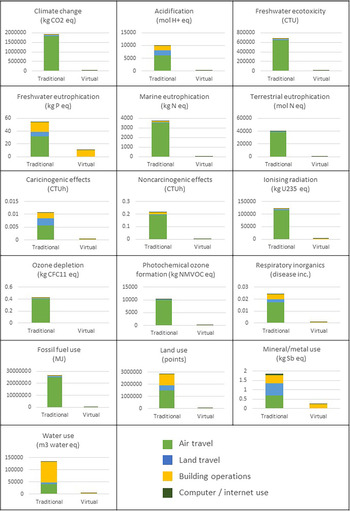
The life cycle impact assessment results are shown in Figure 2. The virtual conference performed better than the traditional conference in all 16 environmental sustainability impact categories.
Life cycle impact assessment results.

Figure 2 also illustrates which parts of the life cycle inventory contributed to the overall impact. For the traditional conference, air transport (long haul passenger flights) was the biggest contributing factor across 15 out of 16 impact categories (ranging from 37%–98%). Water scarity was the only impact category where building operations was the biggest contributor (64%). For the virtual conference, it was the residential energy use that was the biggest contributing factor, responsible for 91% of the climate change impact.
Figure 3 illustrates the normative results for a conference. The climate change impact for a 2.5 day, face-to-face conference for these 1374 people was equivalent to 245 times what an average person would use in 1 year, and the fossil fuel resource use 400 times.
Life cycle assessment normative results.

For a virtual conference the results are much smaller; the climate change impact for the same conference for 1374 people would use less than 3 times what an average person would use in one year.
There are a number of reasons that the impact categories for the face-to-face conference are so high. The majority of the climate change burden of the face-to-face conference was due to the fossil carbon dioxide air emission from air travel. Similarly the resource use, energy carrier’s burden of the conference was mainly due to ground crude oil use for petroleum and gas production, used in air travel. The non-cancer human health burdens of the face-to-face conference were mainly due to the lead and zinc emissions to air from passenger air travel. The terrestrial eutrophication burdens of the face-to-face conference were mainly due to the nitrogen oxides emissions to air from passenger air travel. In contrast the climate change burden of the virtual conference was mainly due to methane and carbon dioxide air emissions from hard coal plants for electricity production for attendees to use residential energy, remaining at home rather than travelling.
The traditional face-to-face conference resulted in a loss of 2.7 DALYs, and the virtual conference just 0.5 DALYs. Water scarcity was the biggest contributing factor to both DALY results (48% and 91% of the total DALYs respectively) followed by fine particulate matter formation (45% and 7% respectively).
Discussion
This is the first paper to use life cycle assessment to model the environmental effects of a cohort of people attending a virtual compared with a face-to-face conference. The life cycle assessment process is a comprehensive and widely accepted method to calculate an environmental impact of this type. It does not just measure carbon, but captures the total life cycle emissions of a process from cradle to grave and can estimate emissions from road travel, air travel, laptop use, and internet use. In this study the Life Cycle Assessment demonstrates the potential significant environmental harm of a traditional conference compared with a virtual conference, with more than a 98% reduction in climate change impact when meetings are held virtually.
The results of our Life Cycle Assessment were based on 1374 delegates, with our calculations showing that each delegate would have contributed almost 1.4 tons of carbon equivalent emissions. This is in similar agreement to that calculated by ZotovaReference Zotova, Pétrin-Desrosiers, Gopfert and Van Hove23 (1.83 tons), but differs from the figure published recently by Klöwer.Reference Klöwer, Hopkins, Allen and Higham24 Both authors consider only carbon emissions, not the overall environmental footprint of conferences including the 16 environmental impact categories recommended by PEF. Of more concern is that both papers fail to mention the “elephant in the room”; that flying is not just about carbon emissions but the other elements of flying which impact significantly on global warming (e.g., the air contrails mentioned above). By just looking at carbon emissions environmental consequences can be understated.
With the current mode of travel conferences are clearly “unsustainable” from an environmental impact viewpoint. In order to be sustainable, it has been suggested that a person should not be responsible for producing more than 3 tons of carbon equivalent emissions per year.25 Zotova argues that a conference can be handled in a responsible and sustainable way, recommending low carbon travel, sustainable catering and carbon offsetting. However, like Klöwer we believe while some of these solutions may be a practical measure towards reducing carbon emissions, bigger changes are needed.Reference Klöwer, Hopkins, Allen and Higham24 Our theoretical data, however, strengthens the argument that webinars may be both a practical and sustainable solution towards providing high quality medical education and a means for contemporary knowledge-sharing in a fashion that results in minimal carbon emission.
Participants attending industry events and conferences would argue that there is significant benefit to traditional, face-to-face attendance. New research trends are identified and explored. Collaborations are started and networking is enhanced. While this is indisputable, such characteristics are not unique to in-person meetings. Indeed, it could be argued that by enhancing the capacity of individuals from many different countries and financial backgrounds to attend such events, virtually, the richness of interaction and the potential for linkages between delegates is enhanced, albeit in non-traditional ways (e.g., through subsequent virtual interactions rather than within the conference setting. Similarly, while virtual lectures perhaps lack the immediacy and interactiveness of one given in a meeting hall there is enhanced opportunity for virtual delegates to message/chat during a video conference in real time, asking questions, discussing the presentation but also to identify similar people in the audience who face similar issues. Indeed, some people may prefer the less socially awkward ability to connect with people initially online. Furthermore, providing instant lists of attendees may facilitate collaboration. Speakers can answer questions after presentations, with no time limits associated with face-to-face conferences. So while the virtual alternative may fall short in some regards to the face-to-face networking, there are also potential benefits to this format.
One of the features apparent to the organisers of the first Heart University webinar was the access it provided to low- and middle-income countries, with over half of attendees hailing from such geographical locations. This fulfilled a priority objective for the Heart University editorial board, to cater to lower resource settings.Reference Tretter, Windram and Faulkner26,Reference Tretter, Ramachandram and Zhelevab27 A conference held virtually is a lot more accessible to delegates from such lower resource settings. A number of countries simply do not have the funding to provide access to their employees to attend international conferences, along with other barriers such as a heavy workload related to a critical shortage of specialists.Reference Musa, Hjortdal and Zheleva28 Virtual conferences provide access to low resource settings around the globe, to both increase content-specific knowledge as well as provide for networking opportunities in these countries.
Limitations
A complete analysis of the entire footprint of an in-person conference requires factoring in food and drink consumption, paper programs, goody bags, prizes and their waste. Each of these (e.g., a goody bag) is outside the scope of this paper and indeed would require a full manuscript. This manuscript analysed one in-person conference and this analysis could be applied to other congenital cardiology conferences including the American Heart Association, American College of Cardiology, American Society of Echocardiography, Society for Cardiovascular Angiography and Intervention to name a few. This data could also be collated for other specialist medical conferences outside paediatric cardiology. Although recent studies have evaluated the benefit of e-learning conferences in facilitating learning, further studies are warranted to evaluate the overall benefits of e-learning webinars compared to in-person conferencing.Reference McMahon, Tretter, Faulkner, Krishna Kumar, Redington and Windram29
Conclusion
The theoretical environmental impact of a virtual paediatric cardiology conference (4 tons CO2 equivalent) is significantly less than the traditional international face-to-face conference (192 tons CO2 equivalent). However, using carbon equivalent emissions to measure environmental harm from flying is an under estimate of the potential damage, when one considers the additional production of contrails. This paper also highlights other significant environmental impacts of the face-to-face conference, including photochemical ozone formation of approximately 250 times the impact of an average person and the eutrophication terrestrial equivalent to 225 times an average person’s impact. There are clear benefits to the traditional conference, such as in-person networking, however the virtual conference may offer appealing and competing advantages. While the virtual conference may never completely replace the traditional in-person conference, the significant theoretical benefits to the environment highlighted in this study warrants consideration for the virtual conference taking a more common place in academia.
Acknowledgements
None.
Financial support
This research received no specific grant from any funding agency, commercial or not-for-profit sectors.
Conflict of interest
None.
Ethical approval
The authors assert that all procedures contributing to this work comply with the ethical standards of the relevant national guidelines and with the Helsinki Declaration of 1975, as revised in 2008, and has been approved by the institutional committees (Ethics Committee University Edmonton, Alberta, Canada).
Supplementary material
To view supplementary material for this article, please visit https://doi.org/10.1017/S1047951121000718