Introduction
Children born preterm or with low birth weight (LBW, <2500 g) are at risk for adverse outcomes including behavioural and cognitive impairments persisting into adolescence and early adulthood.Reference Kormos, Wilkinson, Davey and Cunningham 1 , Reference Moreira, Magalhães and Alves 2 In this sense, LBW children exhibit deficits in cognitive outcomes when compared with their normal birth weight (BW) counterparts. Cognitive development is associated with intrauterine growth measured as weight at birthReference Franz, Pohlandt and Bode 3 and may have a negative influence on school performance at school age.Reference Esteban‐Cornejo, Tejero‐González and Castro‐Piñero 4 , Reference Kirkegaard, Obel, Hedegaard and Henriksen 5
A growing body of research suggests that aerobic capacity and muscular strength are positively associated with school performance across the lifespan in youths.Reference Esteban-Cornejo, Tejero-González and Martinez-Gomez 6 , Reference Torrijos-Niño, Martínez-Vizcaíno and Pardo-Guijarro 7 This relationship has mainly been established for languages and mathematics. A recent studies have also found that LBW was associated with lower aerobic capacity and reduced muscular strength independent of later body size.Reference Ridgway, Ong and Tammelin 8 , Reference van Deutekom, Chinapaw, Vrijkotte and Gemke 9 Given the positive influence of physical fitness on school performance and its relation to BW, it would be useful to clarify whether BW is independently protective of academic attainment, or whether its influence is mediated by children’s physical fitness components. The purposes of this study was two-fold: to analyse the association between BW and academic attainment, and to determine the influence of aerobic capacity and muscular strength on the association between BW and school performance in Chilean children.
Methods
Participants
The study sample consisted of 395 children (mean age 12.1 years; 50.4% boys) enrolled in seven elementary school sites (seventh-grade) from the public school system of the Maule region (Chile). A total of 454 children were invited and 87% agreed to participate in the study (n=395). Children were excluded if they: had special education needs (learning difficulties and/or learning disabilities) or had any type of dysfunction limiting their physical activity (any debilitating illness or problem). Physical education teachers provided this information.
Anthropometric parameters
Participants wearing light clothing were weighed twice using a digital scale with an accuracy of 100 g. Height was measured twice to the nearest 0.1 cm, without shoes, using a wall-mounted stadiometer. The mean of these measurements was used to calculate body mass index (BMI) as weight in kilograms divided by the square of the height in metres (kg/m2). A mean of two readings was taken in the morning.
Neonatal outcomes
BW, length at birth and gestational age were reported by parent. BW was categorized as ⩽2500, 2500–3500 and ⩾3500 g.Reference Kirkegaard, Obel, Hedegaard and Henriksen 5 , Reference Richards, Hardy, Kuh and Wadsworth 10 LBW was defined as BW ⩽2500 g.Reference Johnson and Breslau 11 Maternal recall of BW and gestational age of previous children is sufficiently accurate for clinical and even for epidemiological use.Reference Seidman, Slater, Ever-Hadani and Gale 12
Physical fitness tests
Physical fitness tests were assessed according to the Alpha Battery, valid and reliable in children and adolescents.Reference Ruiz, España and Castro 13 The 20 m shuttle run test was used to measured aerobic capacity. Scores of the last stage number were converted to predict maximal oxygen uptake: VO2max (ml/kg/min)=31.025+3.238×(speed−km/h)–3.248×(age)+0.1536×(speed×age).Reference Leger, Mercier, Gadoury and Lambert 14 Muscular strength was assessed with the standing broad jump test (lower limb explosive strength assessment).Reference Ruiz, Castro-Piñero and España-Romero 15 Participants jumped horizontally to reach maximum distance (in centimetres). This test was performed twice, and the best score was obtained.
School performance
School performance was assessed using the students’ grades in the core subjects (mathematics and language). The grades were collected from the official school records at four moments in the first semester (March, April, May and June 2014). Numeric grade scores in Chile range from 1 (worst) to 7 (best). We calculated the average score for all subjects.
Confounders
Potential confounders identified in previous literature were included in the analyses. Physical activity was assessed by the self-administered Spanish version of the Physical Activity Questionnaire for Adolescents (PAQ-A).Reference Martínez-Gómez, Martínez-de-Haro and Pozo 16 The questionnaire was designed to assess adolescents’ levels of moderate and vigorous physical activity. Nine items scored on a five-point Likert scale were averaged to derive an overall physical activity score ranging from one to five (higher scores indicating higher levels of physical activity). Sedentary behaviour was assessed by self-reported screen time using three questions from the Health Behavior in School-aged Children studyReference Currie 17 about television, video game and computer hours use. Maternal education level was recorded by asking mothers about the highest level of education, dichotomized as university education and below. The socioeconomic status was measured using a scale based on Graffar’s modified method, which considers items such as schooling, job held by the head of the household and characteristics of the house, taking into account three categories (High, Medium and Low socioeconomic status).Reference Álvarez, Muzzo and Ivanovic 18
Data analysis
The continuous variables were expressed as the mean±standard deviation and the categorical data as a frequency distribution. Analysis of covariance (ANCOVA) models were estimated to test differences in mean school performance (mean of the scores in mathematics and language) by BW category, adjusting for potential confounders in Model 1 (age, sex, birth length, BMI, socioeconomic status, maternal education, physical activity and screen time), and aerobic capacity (Model 2) or muscular strength (Model 3). Pairwise post hoc comparisons were made using the Bonferroni test. To examine whether the association between BW and school performance was mediated by physical fitness, linear regression models were fitted using bootstrapped mediation procedures included in the PROCESS SPSS macro.Reference Preacher and Hayes 19 Significance was set at P<0.05.
Results
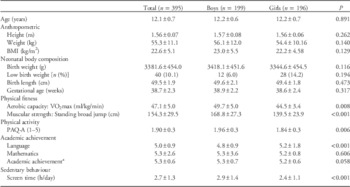
Table 1 presents the descriptive characteristics of the study sample by gender. ANCOVA models showed that school performance was lower in children with LBW (crude data and Model 1); however, after adjusting by aerobic capacity (Model 2) the difference was no longer significant (Table 2).
Characteristics of the study sample, by gender

Values are mean±SD. BMI, body mass index.
a Mean of the scores in Mathematics and Language (scale 1–7).
Mean differences of academic performanceFootnote a according to birth weight categories

Values are mean±SD. Model 1 adjusted for age, sex, birth length, body mass index, socioeconomic status, maternal education, physical activity and screen time; Model 2 and 3 adjusted for the same covariates as Model 1 and aerobic capacity or muscular strength, respectively.
The pairwise comparisons corresponding to mean pairs that showed statistical significance (P<0.05 for post hoc hypothesis two-sided testing with the Bonferroni correction for multiples comparisons).
a Mean of the scores in Mathematics and Language (scale 1–7).
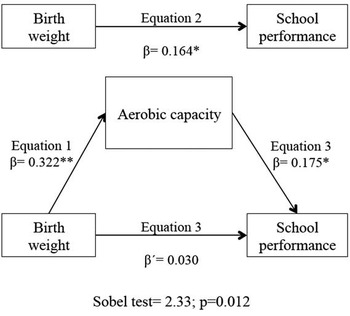
When we tested the mediating role of aerobic capacity in the relationship between BW and academic attainment, BW was positively associated with aerobic capacity in the first regression equation. In the second equation, BW was positively associated with academic attainment. Finally, in the third equation, when BW and aerobic capacity were simultaneously included in the model, aerobic capacity was positively associated with school performance (P⩽0.001), but although BW remained positively associated with academic attainment, the association was no longer significant (P=0.104) (Fig. 1). These results suggest that the effect of BW on school performance was mediated by aerobic capacity. Using the Sobel test for mediation it was estimated that 13.4% (z=2.33; P=0.012) of the total effect of BW on school performance was mediated by aerobic capacity. The relationship between BW and school performance was not mediated by muscular strength, since the above-mentioned criteria for the mediation analysis were not observed (data not shown).
Aerobic capacity mediation model of the relationship between birth weight and school performance in children, adjusting for potential confounders. *P<0.05; **P<0.001.

Discussion
Evidence suggests that children with LBW may be at increased risk of poorer school performance compared with children born with higher BW.Reference Kirkegaard, Obel, Hedegaard and Henriksen 5 A Chilean study in 220,940 school children reported positive associations between both BW and birth length and school performance.Reference Villarroel, Karzulovic and Manzi 20 Our findings are consistent with these studies showing that BW is associated with school performance among children, independent of factors such as current BMI or length at birth. The biological basis for the association between a LBW and school performance could include the increased risk of underlying diseases or birth traumas; restricted growth may lead to impaired brain cognition;Reference Kormos, Wilkinson, Davey and Cunningham 1 , Reference Richards, Hardy, Kuh and Wadsworth 10 and other alternative explanations could be perinatal complications after intrauterine growth retardation (hypoglycaemia, hyperbilirubinemia, infections, poor feeding and brain growth failure in early childhood).Reference Doctor, O’Riordan and Kirchner 21
The novelty of the present study lies in the influence of physical fitness on this relationship. Our results support the notion that school performance may improve with increasing physical fitness in adolescents with LBW. Emerging research has revealed that aerobic capacity is an important factor related to school performance,Reference Esteban-Cornejo, Tejero-González and Martinez-Gomez 6 , Reference Torrijos-Niño, Martínez-Vizcaíno and Pardo-Guijarro 7 , Reference Aguilar, Vergara, Velásquez, Marina and García-Hermoso 22 even prospectively,Reference Sardinha, Marques and Minderico 23 an aspect that would explain the role of aerobic capacity. Children with higher levels of fitness showed greater bilateral hippocampal volumes and superior relational memory task performance,Reference Chaddock, Erickson and Prakash 24 and performed better on cognitive tests including those linked to language skills compared with less fit adolescents.Reference Scudder, Federmeier and Raine 25 Neuroscience findings demonstrate the relevance of differences in brain structure in children with LBW, who have smaller brain volumes and consequently poorer academic performance.Reference Clark, Fang and Espy 26 Therefore, aerobic capacity may relate to the structure and function of the young human brain and could thus counter poor school performance.
The relationship between muscular strength and school performance is less well documented, and previous studies in this area have yielded equivocal results.Reference Torrijos-Niño, Martínez-Vizcaíno and Pardo-Guijarro 7 , Reference Aguilar, Vergara, Velásquez, Marina and García-Hermoso 22 Consistent with the results of the present study, a recent cross-sectional study showed that muscular strength, assessed by standing broad jump, was not associated with BW as performance in this test reflects the dimension of work (distance through which the weight of the body is moved), not power, and is thereby affected by current body weight (this problem cannot be completely solved by controlling for BMI in statistical analyses).Reference van Deutekom, Chinapaw, Vrijkotte and Gemke 9 These aspects could justify the lack of mediation by our strength measure.
We acknowledge several limitations. First, the present study used a cross-sectional design, which does not allow us to draw any conclusions on the causal direction of the associations. Second, using final academic grades to index school performance provided objective information, but hinders comparisons with standardized tests used by other authors. Other pertinent factors such as puberty status, mother’s age at delivery and smoking during pregnancy were not considered.
According to our findings, the present study shows that physical fitness plays a possible critical role in the relationship between BW and school performance in 12–13-year-old children. The current results further emphasize the importance of aerobic capacity during childhood not only for health,Reference Ortega, Ruiz, Castillo and Sjöström 27 but also for neurocognitive and school performance. Therefore, physical fitness might foster or impede cognitive development over time in children with LBW. Our findings have important implications for children’s health and their accomplishments in school. However, these conclusions must be interpreted with caution due to unmeasured variables, the low number of subjects included in the study and the low prevalence of children with LBW (10%).
Acknowledgements
Thanks to the schools, children, and families for their participation and interest in the study.
Financial Support
This research received no specific grant from any funding agency, commercial or not-for-profit sectors. The study protocol was approved by the Autonomous University of Chile Ethics Committee and by the director of each school, and followed the principles of the Declaration of Helsinki.
Conflicts of Interest
None.