Introduction
Rangelands provide herbage for ruminant production systems worldwide and are a source of high-quality edible protein and cash income from non-arable lands (Herrero et al., Reference Herrero, Havlik, Valin, Notenbaert, Rufino, Thornton, Blummel, Weiss, Grace and Obersteiner2013; Adesogan et al., Reference Adesogan, Havelaar, Mckune, Eilittä and Dahl2020). Nevertheless, livestock grazing rangelands today consume a diet dominated by a monotony of grasses (Paterson et al., Reference Paterson, Funston and Cash2001; Robins et al., Reference Robins, Waldron and Jensen2020) with a feeding value that plummets in mid-summer (Ganskopp and Bohnert, Reference Ganskopp and Bohnert2001), disrupting nutrient cycles and necessitating costly supplementation programmes (Putnam and DelCurto, Reference Putnam, Delcurto, Collins, Nelson, Moore and Redfearn2020). In turn, declines in the nutritional quality of grasses cause significant increments in the production of the greenhouse gas (GHG) methane (CH4) by livestock (Lee et al., Reference Lee, Davis, Chagunda and Manning2017). This is significant because, within the beef production cycle, the cow–calf system accounts for about 80% of total CH4 emissions (Beauchemin et al., Reference Beauchemin, Janzen, Little, Mcallister and Mcginn2010; Rotz et al., Reference Rotz, Asem-Hiablie, Place and Thomas2019). All these processes are aggravated by changes in climate, impinging significant reductions in the abundance and nutritional quality of the rangeland forage base (Izaurralde et al., Reference Izaurralde, Thomson, Morgan, Fay, Polley and Hatfield2011; Dumont et al., Reference Dumont, Andueza, Niderkorn, Lüscher, Porqueddu and Picon-Cochard2015).
The aforementioned key challenges to current and future food and agricultural production systems could be at least in part solved by landscape interventions that create multifunctional alternative foodscapes, using strategically selected legume species spatially distributed as resource patches or ‘islands’ across the landscape that supplement, synergize and thus enhance the diet of herbivores grazing in grass-dominated rangelands swards. This approach is in line with the natural provision of diverse food alternatives to generalist herbivores (Westoby, Reference Wilson, Jung, Buxton, Hatfield and Ralph1993), as under natural conditions, diversity of plants is the rule, not the exception, and eating a variety of foods is how animals cope with, and benefit from diverse plant assemblages (Villalba et al., Reference Villalba, Beauchemin, Gregorini and Macadam2019). Cattle evolved in the Mediterranean region grazing a diverse palette of broadleaf and grass species (Grove and Rackham, Reference Grove and Rackham2001), instead of consuming diets dominated by a monotony of grass, a common practice seen in livestock production systems today. Legumes are in general of greater nutritional value than grasses (Phelan et al., Reference Phelan, Moloney, Mcgeough, Humphreys, Bertilsson, O’riordan and O’kiely2015), and many of these species contain functional biochemicals or plant secondary compounds (PSC) like condensed tannins that enhance animal health and decrease greenhouse gas (GHG) emissions to the atmosphere (Min et al., Reference Min, Solaiman, Waldrip, Parker, Todd and Brauer2020). In addition, the services provided by these resource patches may offer farmers/ranchers adaptability to face not only uncertainties in forage productivity and feeding value caused by climate change but also alleviate societal pressures on pastoral livestock production (Fisher, Reference Fisher2020) due to improved soil health and biodiversity. The latter has the potential to increase landscape connectivity and structural complexity in rangelands, enhancing ecosystem services and resilience (Gregorini et al., Reference Gregorini, Villalba, Chilibroste and Provenza2017a ; Leroy et al., Reference Leroy, Hite and Gregorini2020).
To create more functional foodscapes in western US rangelands, critical information is needed on the nutritional synergies existing between the predominant grass-based resource in rangelands, and the legumes in the introduced forage patches, such that they provide the highest likelihood of nutritional complementarities that enhance animal performance while reducing GHG emissions. For instance, such nutritional benefits could be managed and synergised by strategic grazing management, controlling the time and frequency of patch allocation to cattle relative to the use of grasses in the landscape.
Grazing management experiments and corresponding measures of rumen function, nutrient excretion and metabolism in herbivores, pose considerable experimental, technical and economic challenges. Integrating these processes with changes in the foraging landscape (foodscape) is an even greater challenge. As a result, advances in rangeland grazing management for environmental protection while maintaining or increasing secondary production have been low and costly. Simulation models can help us define problems, organise and communicate thoughts, integrate information and theories across multiple scales, make predictions and test understanding and theories (Starfield and Bleloch, Reference Starfield and Bleloch1986). Thus, simulation modelling allows quick and relatively inexpensive evaluations that can accelerate efforts in our field of endeavour.
The objective of this work was to simulate the effect of different grazing management approaches by contrasting frequency (once a: week, fortnight and month) and dietary proportions (0.05, 0.10, 0.15 and 0.20) of either tannin-containing sainfoin (Onobrychis viciifolia) or birdsfoot trefoil (Lotus corniculatus) allocation to beef cattle grazing grass-dominated rangeland swards, in order to explore performance and environmental impact in terms of methane production and urinary N excretion. We predicted that the addition of discrete tannin-containing legume feeding sites or islands of sainfoin or birdsfoot trefoil in a landscape dominated by grass would enhance the efficiency of nutrient use by cattle, with concomitant reductions in environmental impact and that such benefit is dependent on the temporal pattern and levels of ingestion of such legumes.
Materials and methods
The model
The latest version of the model MINDY (Gregorini et al., Reference Gregorini, Beukes, Romera, Levy and Hanigan2013, Reference Gregorini, Villalba, Provenza, Beukes and Forbes2015, Reference Gregorini, Provenza, Villalba, Beukes and Forbes2017b , Reference Gregorini, Provenza, Villalba, Beukes and Forbes2018) was used for the purpose of this modelling study. MINDY is a cluster of seven models: (1) Molly models digestion, metabolism and production of a dairy cow (Baldwin Reference Baldwin1995); (2) diurnal fluctuations in feeding motivation; (3) sward canopy structure and herbage quality; (4) grazing behaviour; (5) dietary preference and forage selection; (6) foraging bioenergetics and (7) drinking and urination behaviour. MINDY also integrates functional relationships between forage ingestion, oral physiology and swallowing and rumen digestion responsible for variations in liquid outflows from the rumen. MINDY can be initialised with unique characteristics, e.g., age, breed, body condition score (BCS), high, body weight, dental arcade, genetic merit for milk production, calving date etc. Likewise, pasture and supplements can be chemically and physically (e.g., sward structure: sward surface height, bulk density, dry matter and chemical entities distributed through the swad canopy and the pasture (i.e., pasture cover), forage species) designed and set by the user. In addition, MINDY simulates spatio-temporal changes in herbage chemical composition (primary nutrient composition as described by Baldwin, Reference Baldwin1995 and Gregorini et al., Reference Gregorini, Beukes, Romera, Levy and Hanigan2013), acknowledging the influence of herbage nutritive and feeding values change throughout the day and grazing strata, as well as the area of the pasture covered.
Virtual experiment
To simulate a beef cow, MINDY was initialised as short pregnant cow (450 kg live weight New Zealand Friesian) of 1.4 m height and a dental arcade of 8 cm, a BCS of 5 (1–10 scale), and with the lowest genetic merit (production and breeding worth) for milk production (average milk of 10 litres/day) in mid-late lactation (200 DIM). MINDY was rotationally grazed on a series of grass (Bromus biebersteinii; meadow brome) pastures, Control, with the addition of a pasture of tannin-containing legumes (Lotus corniculatus-birdsfoot trefoil-Tre, or Onobrychis viciifolia-sainfoin-Sain) been allocated at different time intervals (weekly, fortnightly and monthly) and dietary proportions (0.05, 0.10, 0.15 and 0.20 of total forage allocation) of either Sain or Tre. The residence time of MINDY in the islands of legumes was ∼1, 2 and 3 days, respectively, for the weekly, fortnightly and monthly, allocations).
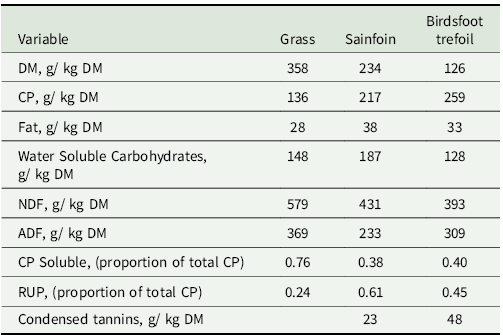
The chemical composition (Table 1, including rumen crude protein (CP) degradabilities and condensed tannin (CT)) of the Control, Sain and Tre were based on the data stored in MINDY’s feed composition table and the works of Sotola (Reference Sotola1941), Grabber et al. (Reference Grabber, Coblentz, Riday, Griggs, Min, Macadam and Cassida2015), Lagrange et al. (Reference Lagrange, Beauchemin, Macadam and Villalba2020), Khalilvandi-behroozyar et al. (Reference Khalilvandi-Behroozyar, Dehghan-Banadaky and Rezayazdi2010) and Stewart et al. (Reference Stewart, Beauchemin, Dai, Macadam, Christensen and Villalba2019). These reports and CT content of legumes simulated in this work, as well as the work of Loregian et al. (Reference Loregian, Pereira, Rigon, Magnani, Marcondes, Baumel, Branco, Del Bianco Benedeti and Paula2023) were used to linearly derive CP degradabilities (i.e., the greater the herbage CT content, the lower proportion of CP that was soluble in the rumen and greater RUP).
Chemical composition input used in MINDY for rangeland grass herbage, sainfoin and birdsfoot trefoil

DM, dry matter; CP, crude protein; NDF, neutral detergent fibre; ADF, acid detergent fibre; RUP, Rumen undegradable protein.
The average pre-grazing herbage mass and height was 2900 kg DM and 30 cm, respectively. Twenty-five simulation scenarios (treatments) were established as a product of a factorial arrangement between frequency and dietary proportions of either Sain or Tre allocation. Each simulation or treatment was run for 70 days, which included 10 days of ‘model adaptation/stabilization’, and the last days of data collection. The outputs requested from MINDY were: Liveweight gain, methane production, milk solids production (MS = Fat+CP), nitrogen (N) intake (NI), N in milk (NM), urinary N (UN) and faecal N (FN), N retained in lean tissue (muscle and gravid uterus, NR), urinary volume, and N discharged onto pasture (NP). By default, in the model, the NI that is not partitioned to NM, UN, FN and NR is estimated to be recycled as urea in the rumen or as amino acid in the visceral tissue. MINDY’s performance under these treatments was compared to a Control scenario (only grass).
Environmental cost (in terms of CH4 production and urinary Nitrogen excretion) incurred by the increments in secondary production (in terms of live weight and milk yield) achieved through legume level of allocation and frequency relative to those observed in the control (just grass) treatment were estimated by dividing the CH4 production or UN (g/d) by the sum of the difference between each ‘treatment’ and control in terms of liveweight (g) and milk yield (g).
Results
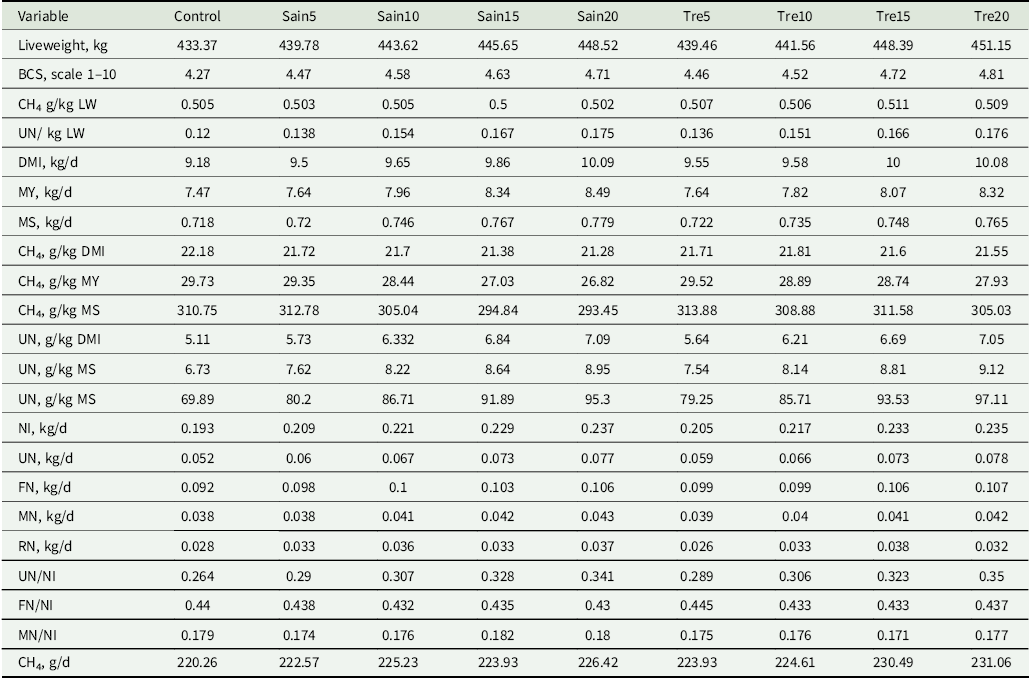
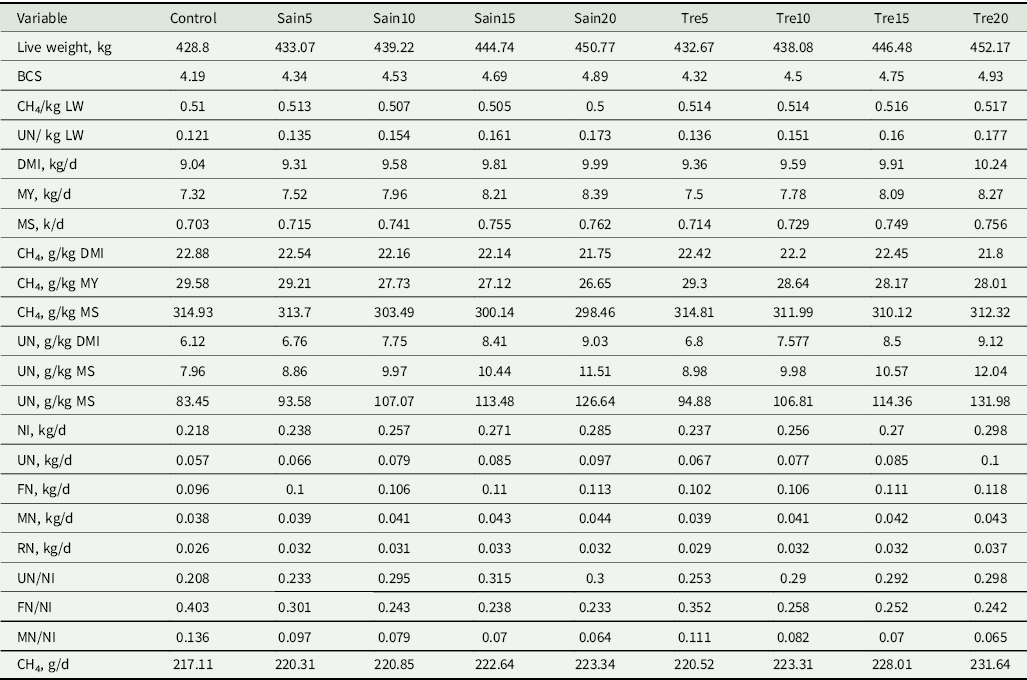
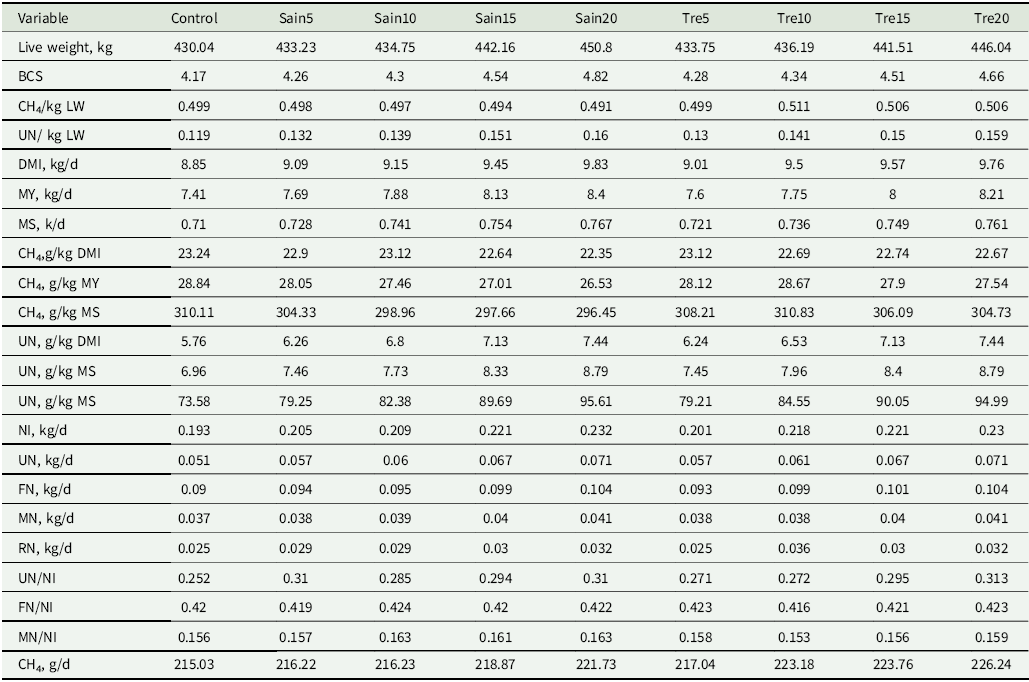
Model outputs are presented in Tables 2–4 and Figures 1 and 2.
Effect (daily average over the simulated period, 70 d) of weekly allocation of four dietary proportions (0.05, 0.10, 0.15 and 0.20) of either sainfoin (San) or birdsfoot trefoil (Tre) allocation to cows grazing grass-dominated rangelands on performance and environmental impact in terms of methane production and urinary N excretion, at the same resource allocation

BCS, body condition score; CH4, methane; UN, urinary nitrogen; DMI, dry matter intake; MY, milk yield; NI, nitrogen intake; FN, faecal nitrogen; RN, retained nitrogen; MN, milk nitrogen. Control, scenario (only grass).
Effect of fortnightly allocation (daily average over the simulated period, 70 d) of four dietary proportions (0.05, 0.10, 0.15 and 0.20) of either sainfoin (San) or birdsfoot trefoil (Tre) allocation to cows grazing grass-dominated rangelands on performance and environmental impact in terms of methane production and urinary N excretion, at the same resource allocation

BCS, body condition score; CH4, methane; UN, urinary nitrogen; DMI, dry matter intake; MY, milk yield; NI, nitrogen intake; FN, faecal nitrogen; RN, retained nitrogen; MN, milk nitrogen. Control, scenario (only grass).
Effect of monthly allocation (daily average over the simulated period, 70 d) of four dietary proportions (0.05, 0.10, 0.15 and 0.20) of either sainfoin (San) or birdsfoot trefoil (Tre) allocation to cows grazing grass-dominated rangelands on performance and environmental impact in terms of methane production and urinary N excretion, at the same resource allocation

BCS, body condition score; CH4, methane; UN, urinary nitrogen; DMI, dry matter intake; UN, urinary nitrogen; MY, milk yield; NI, nitrogen intake; FN, faecal nitrogen; RN, retained nitrogen; MN, milk nitrogen. Control, scenario (only grass).
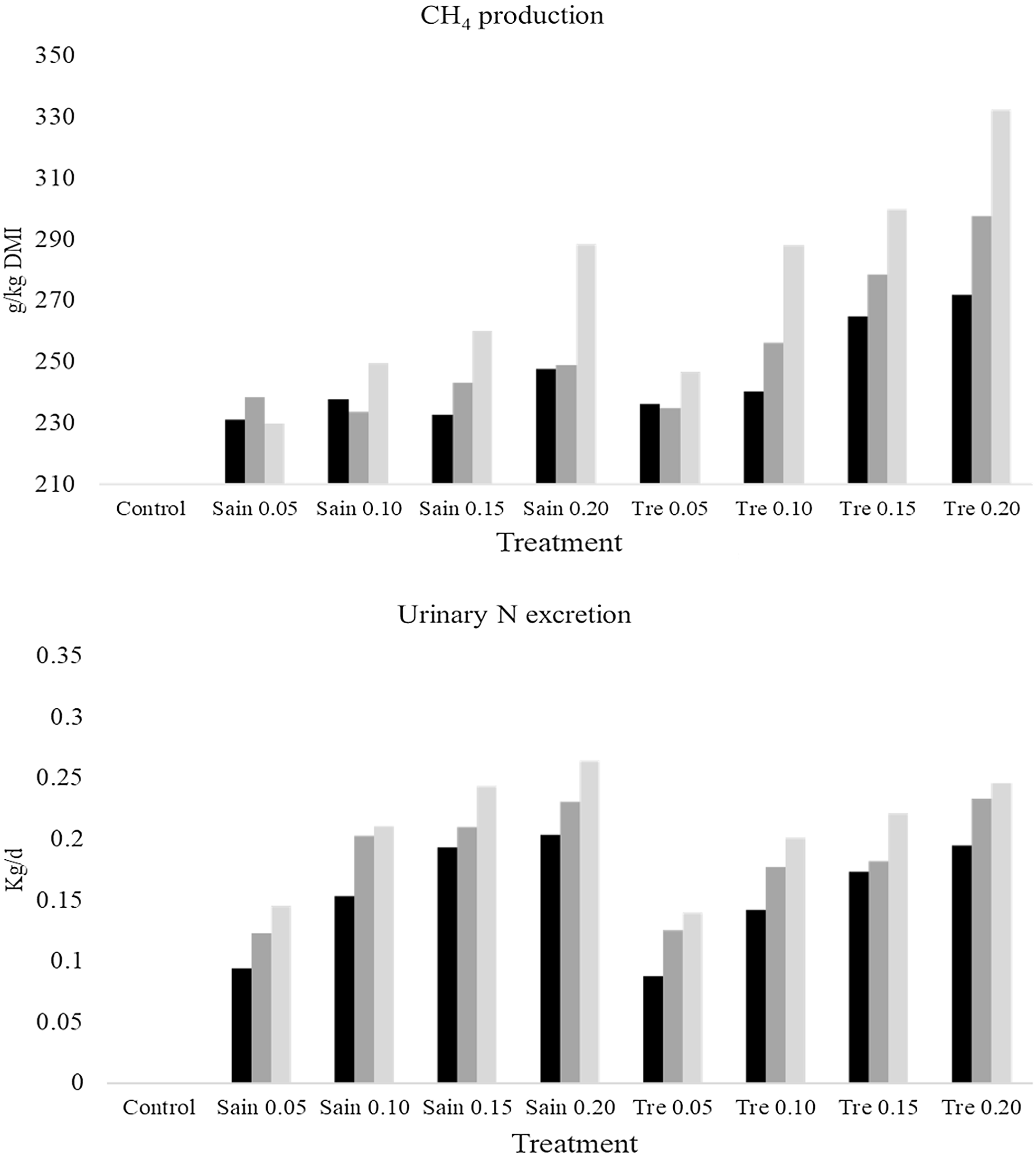
Effect of different grazing managements (daily average over the simulated period, 70 d) by contrasting frequency (weekly: black, fortnightly: dark grey, and monthly: light grey) and dietary proportions (0.05, 0.10, 0.15 and 0.20) of either sainfoin (San) or birdsfoot trefoil (Tre) allocation relative to Control (only grass; horizontal strips) to cows grazing grass-dominated rangelands on environmental impact in terms of methane production, at the same resource allocation.

Effect of different grazing managements (daily average over the simulated period, 70 d) by contrasting frequency (weekly: black, fortnightly: dark grey, and monthly: light grey) and dietary proportions (0.05, 0.10, 0.15 and 0.20) of either sainfoin (San) or birdsfoot trefoil (Tre) allocation relative to Control (only grass; horizontal strips) to cows grazing grass-dominated rangelands on environmental impact in terms of urinary N excretion, at the same resource allocation.

Forage species and dietary proportion of allocation
Compared to the Control treatment, both Sain and Tre, independently of their proportion in the diet and frequency of allocation, significantly increased dry matter intake (DMI), liveweight gain and milk production (Table 2). Compared to Tre, MINDY predicted greater DMI when Sain was part of the diet, except for monthly allocations. In general, CH4 production increased with legume availability (Figure 1a), as well as did N excretion (Figure 2a). Average methane yield (g/kg DMI) tended to be greater when MINDY was faced with the provision of Tre than with the provision of San. As dietary proportion of legumes increased in the diet, DMI, animal performance, CH4 production and urinary N excretion increased as well, with a slightly greater magnitude for the Sain treatment.
Frequency of legume allocation
Compared to Control, increasing the frequency of allocation for both Sain and Tre increased DMI, liveweight gain and milk production (Table 2).
Methane production increased with weekly allocations in both legumes, whereas it declined with monthly allocations of 0.05 and 0.10 dietary proportion of Sain and 0.05 dietary proportion of Tre (Figure 1a). Methane production also declined from weekly to monthly allocations and grazing Sain yielded, in general, less g/d of CH4, than grazing Tre. Methane production was lower than for the Control treatment at monthly allocations of 0.05, 0.10 and 0.15 of Sain and 0.05 Tre in the diet (Figure 1a). Methane yield increased as allocation of legumes moved from weekly to monthly rotations. Increasing the allocation of legumes from 0.05 to 0.15 tended to decrease CH4 yield. Methane yield was also lower than the Control treatment at weekly allocation of legumes when proportions in the diet were at 0.10 and 0.15 (Figure 1b).
At 0.05 and 0.10 of legume allocation, environmental costs in terms of CH4 emission increments per unit of production relative to Control were greater for monthly allocations. In contrast, proportions of legumes in the diet of 0.15–0.20 yielded the lowest costs regardless of the frequency of allocation (Figure 1c).
Urinary N was the greatest for fortnightly allocation, and it increased with increments in the proportion of legumes in the diet (Figure 2a). Urinary excretion in treatments was similar to Control at lower proportions (0.05–0.10) of legumes in the diet at monthly allocations of legumes (Figure 2a). Environmental costs in terms of UN excretion increments per unit of production relative to Control were the lowest at 0.15–0.20 of the legumes in the diet regardless of the frequency of allocation (Figure 2b).
Discussion
Grazing represents an arrangement of decisions leading to ingestive actions nested in spatio-temporal domains (Senft et al., Reference Senft, Coughenour, Bailey, Rittenhouse, Sala and Swift1987; Gregorini et al., Reference Gregorini, Villalba, Chilibroste and Provenza2017a ). These decisions affect short-term ingestive and digestive strategies as how animals acquire nourishment from the landscape (Provenza et al., Reference Provenza, Meuret and Gregorini2015). Grazing management decisions made by farmers set the spatial and temporal context where animals graze, i.e., the animal’s foodscape; and thereby, contextually modulate animal’s ingestive and digestive processes (Meuret and Dumont, Reference Meuret and Dumont2000; Meuret and Provenza, Reference Meuret and Provenza2015). Therefore, under pastoral livestock-production systems, grazing management emerges as a tool to enhance animal performance, profit and reduce environmental impacts by grazing ruminants (Gregorini et al., Reference Gregorini, Villalba, Chilibroste and Provenza2017a ; Savian et al., Reference Savian, Schons, De Souza Filho, Zubieta, Kindlein, Bindelle, Bayer, Bremm and De Faccio Carvalho2012). The objective of this simulation modelling work was to evaluate the effect of frequency of allocation and dietary proportion (i.e., through grazing management) of discrete feeding sites (patches of food in the landscape, i.e., ‘islands’) of legumes containing tannins on grass-dominated rangelands on performance and environmental impact by beef cattle. Our hypothesis was that the temporal pattern and levels of ingestion of legumes, which could be directed through managerial interventions would enhance efficiency of nutrient use and thus help reduce pollution in terms of GHG intensity. Based on MINDY’s outputs, it is argued that at the same forage resource allocation, simple technologies of processes like grazing management could increase secondary production of the system (i.e., animal performance), while reducing some of the negative environmental impacts by livestock in terms of CH4 and urinary N excretion (Figures 1 and 2).
Legumes increase dietary feeding value and cow performance
In our simulations, MINDY ate more, gained more weight and produced more milk as more legume was presented to ‘her’ in the feeding environment. These results are supported by a large body of literature reporting increments in animal performance when replacing grasses with legumes (e.g., Rochon et al., Reference Rochon, Doyle, Greef, Hopkins, Molle, Sitzia, Scholefield and Smith2004; Nicol and Edwards, Reference Nicol and Edwards2011; Lagrange et al., Reference Lagrange, Macadam and Villalba2021), and are explained by the known premise that legumes enhance feeding value of pasture-based diets (Ulyatt et al., Reference Ulyatt, Lancashire and Jones1976; Luscher et al., Reference Lüscher, Mueller-Harvey, Soussana, Rees and Peyraud2014; Gulwa et al., Reference Gulwa, Mgujulwa and Beyene2018). Feeding value is defined in terms of animal productive performance response to a particular forage; and nutritive value, as a particular performance response per unit of DMI of a particular forage. Consequently, dietary incorporation of legumes, per se and incremental proportions of legumes in grasslands increases secondary production of the system as previously reported by Fulkerson et al. (Reference Fulkerson, Neal, Clark, Horadagoda, Nandra and Barchia2007) and suggested by the results of our simulations (Tables 2–4).
Feeding value is a function of both intake and nutritive value of the forage, with nutritive value closely tied to the chemical composition and physical characteristics of the forage (Waghorn and Clark, Reference Waghorn and Clark2004). Legumes are comminuted easier than grasses, which spare energy from costly ingestive processes, facilitate cell content release in the rumen and then fermentation, as well as in certain cases lead to increases in forge digestibility (Wilson, Reference Wilson, Jung, Buxton, Hatfield and Ralph1993). Protein content of legumes is greater than that observed in grasses and legumes also tend to supply greater ME to the host animal (Baker and Dynes, Reference Baker and Dynes1999). Moreover, the presence of tannins in legumes – as the ones tested in this work – can reduce protein fermentation and ammonia production in the rumen, increasing metabolisable protein and essential AA supply to the host’s duodenum (Waghorn, Reference Westoby2008), all of which explains greater animal performance under legume-based livestock forage systems. (Anthony and Harris, Reference Anthony and Harris1976; Pitcher et al., Reference Pitcher, Macadam, Ward, Han, Griggs and Dai2022)
Environmental impact, production intensity and environmental cost
Methane
Legume and frequency allocation of the legume-containing feeding sites affected CH4 production and yield considerably (Figures 1a, b, 3). During the whole grazing period (Simulation 70 d), grazing Tre led to greater CH4 yields than grazing the Sain treatment, which could be explained by the greater fibre intake in Tre as the proportion of this legume increased in the diet. Compared to Tre, Sain has a better CP and soluble carbohydrates balance, which has been reported to enhance rumen function in terms of digesta outflow rate and Y-ATP (Poppi and McLennan, Reference Poppi and Mclennan1995), parameters associated with reductions in methanogenesis (Janssen, Reference Janssen2010). Our modelling also suggests that CH4 yield is more pronouncedly reduced when the proportion of Sain increases in the diet relative to the results observed for Tre.
Effect of different grazing managements with contrasting frequency (weekly: black, fortnightly: dark grey, and monthly: light grey) and dietary proportions (0.05, 0.10, 0.15 and 0.20) of either sainfoin (San) or birdsfoot trefoil (Tre) allocation to cows while grazing the islands (1, 2 and 3 days, respectively for the weekly: black, fortnightly: dark grey, and monthly: light grey, allocations) of legumes in terms of methane production and urinary N excretion.

Independently of legume, reducing the frequency of legume feeding sites allocation, markedly and almost linearly, promoted reductions in CH4 production, despite the increased CH4 yield (g CH4/kg DMI). The latter is explained by a reduction in DMI as frequency of legume allocation declined. Increasing supplementation frequency on grazing animals – especially consuming low-quality forages – has been reported to enhance rumen function and increase DMI (Bargo et al., Reference Bargo, Muller, Kolver and Delahoy2003; Al-Marashdeh et al., Reference Al-Marashdeh, Edwards and Gregorini2020) by enhancing digesta outflow rate and increments in DMI have been linearly related to total CH4 production (Moate et al., Reference Moate, Deighton, Williams, Pryce, Hayes, Jacobs, Eckard, Hannah and Wales2016). See Figure 3, presenting the effect on CH4 while the cow is on the island of legumes.
Our results suggest that supplementing a grass-based (Bromus biebersteinii; meadow brome) swards with either Sain or Tre at different levels of allocation increased animal production (Table 2–4). However, intensity of environmental impact (e.g., g CH4 per kg milk solids or milk yield) in terms of CH4 was a function of the frequency of legume allocation, with the lowest impact at monthly offers and at 0.05 of legume in the diet (Tables 2–4). Monthly allocation to tannin-containing legumes diluted to the greatest extent the short-term increments in CH4 production incurred while grazing the higher quality legume forage (Figure 3).
Our results suggest that at the same level of resource allocation and based on the cow’s production variables, like milk, intensity of environmental impact in terms of CH4 production can be manipulated by managing grazing cows the frequency and level of access to legumes. Figure 1c represents the environmental cost (in terms of CH4 production) incurred by the increments in secondary production (in terms of liveweight and milk yield) achieved through legume level of allocation and frequency relative to those observed in the control (just grass) treatment. From these results emerges that the environmental cost of increasing secondary production from low-quality grass-based rangelands swards supplemented with tannin-containing legumes is reduced as the dietary level of legumes increases in the diet from 0.05 to 0.20. This could be attributed to greater nutrient inputs and ruminal efficiency as the concentration of legumes increased in the diet (Mayberry et al., Reference Mayberry, Hau, Dida, Bria, Praing, Mata and Nulik2021). Secondly, the magnitude of such reduction varies according to the frequency of legume allocation (weekly, fortnightly, monthly), with the lowest dietary levels of legumes in the diet (0.05 and 0.10) showing the greatest cost of CH4 production at a monthly legume allocation. This result could be easily but cautiously explained by the lesser magnitude of total change of CH4 produced. It can also be explained through a disruption in rumen function caused by infrequent supplementation, which could reduce the efficiency of nutrient use relative to more frequent supplementation (Bohnert et al., Reference Bohnert, Schauer, Falck and Delcurto2002). Nevertheless, it has been shown that cattle consuming low-quality forage under low supplementation frequency (every 3, 6 or 7 d) are able to maintain performance, N efficiency use, nutrient utilisation and microbial efficiency comparable to daily supplemented individuals (Kunkle et al., Reference Kunkle, Johns, Poore and Herd2000), without affecting CH4 production (Bohnert et al., Reference Bohnert, Schauer, Falck and Delcurto2002; Canesin et al., Reference Canesin, Berchielli, Messana, Baldi, Pires, Frighetto, Fiorentini and Reis2014). Finally, the greatest levels of legume in the diet (0.15 and 0.20) promoted the lowest environmental costs incurred by increments in production with little differences among frequencies of legume allocation. The greater supply of nutrients with legumes at 0.15 and 0.20 in the diet may have increased efficiency and reduced environmental cost per unit of production regardless of the frequency at which the legume patches were grazed. Therefore, from a practical standpoint, ranchers may allocate grazing on legumes once a month in amounts that represent 0.15 to 0.20 of the diet to achieve improvements in secondary productivity at the lowest levels of CH4 production cost. Due to the nature of this work (modelling simulation), however, caution should be taken at the time of interpreting these premises.
Urinary nitrogen
The increased global concern about the environmental costs of pastoral livestock production is not only related to methanogenesis but also N losses to the environment in the forms of urinary N and nitrous oxide (N2O). The low level of N utilisation of cattle is manifested by the approximately 70 % of ingested N, which is not being used for animal production (Castillo et al., Reference Castillo, Kebreab, Beever and France2000), with approximately 60 % of this surplus being excreted as urinary N. High concentrations of N in the urine patch saturates the soil and the swards’ ability to utilise the N, making it vulnerable to being lost from the system. Such excess results in N being leached from the system into groundwater, with typically 20–30 % lost in this manner and 2 % lost as N2O (Selbie et al., Reference Selbie, Buckthought and Shepherd2015). Nitrous oxide has a global warming potential (GWP) 273 times that of CO2 for a 100-year timescale, meaning nitrous oxide emitted today remains in the atmosphere on average for more than 100 years. Methane emitted today lasts about a decade on average and it has a GWP of 27–30 over 100 years. Moreover, N losses to the environment can also be detrimental to human health as reviewed by Marshall and Gregorini (Reference Marshall and Gregorini2021). Blue baby syndrome is a health problem that has been largely associated with high levels of nitrates in drinking water resulting in methemoglobinemia in infants. There is also evidence of an increased risk of developing colorectal cancer, thyroid disease and neural tube defects from high levels of nitrates consumed in drinking water.
Figures 2a and 3 show a linear increase in urinary N excretion with increments in the levels of dietary legumes for both species (Sain and Tre). Though the average levels of urinary N excretion (70 d simulations) are not of a great concern, the amount of N excreted in urine while MINDY was grazing the Islands of legume it is. Such an increase was slightly greater in Sain than in Tre due to greater values of DMI and\ a related increase in total N consumption, which is linearly associated with urinary N excretion (Castillo et al., Reference Castillo, Kebreab, Beever and France2000).
At each level of dietary legume, frequency of allocation affected the total urinary N excretion (Figures 2a and 3), with the average over 70 d simulation for monthly and fortnightly allocations leading to the lowest and greatest levels of N excretion, respectively. This trend is exactly the opposite when the cows grazing in the legume island tough. The greater DM intake, the greater the N intake and then excreted in urine. However, overall, the whole period of simulation, the lowest urinary N excretion with the least frequent legume allocation could be explained by the lowest DMI and, thereby, the lowest N intake across treatments. Yet, DMI at weekly and fortnightly legume allocations was not different, and consequently, N intake was similar between these two treatments. Nitrogen retention in MINDY was markedly different between weekly and fortnightly legume allocations (Tables 2–3). The greatest UN excretion for the fortnightly legume allocation treatment could be explained by a greater asynchrony of N and energy supply to rumen microorganisms. In fact, a frequent supply of protein and some additional energy typically elicits a more favourable nutrient synchrony profile than infrequent supplement supply (Hersom, Reference Hersom1978). In other words, weekly allocations could have led to less excess of N inputs to the rumen (supported by Figure 3), which is supported by the smallest magnitude of difference between these two allocations when MINDY was offered only 0.05 of her diet in legumes.
MINDY outputs show, in general, more UN excretion for all the legume treatments relative to Control (Figure 2a). These results present a similar pattern to CH4 (Figure 1c) in terms of environmental cost impinged by UN relative to the increments in secondary production (i.e., liveweight; milk yield) attained by the inclusion of legumes in the diet compared to just grazing grass-based (Bromus biebersteinii; meadow brome) swards (Figure 2b). At the greatest level of legumes in the diet, very little differences are observed for the different frequencies of allocation. Therefore, we speculate that from a practical standpoint, and to increase secondary productivity at the lowest N pollution cost, ranchers may allocate the greatest level of legumes (0.15–0.20) in the diet at low frequency (once a month). If they were going to allocate smaller proportion of legumes to the diet, greater frequencies of allocations are recommended. Further empirical validation is required though. Consistent with this, prior research has recommended low levels of N supplementation for weekly supplementation intervals relative to daily supplementation as a management strategy that maintains acceptable levels of DMI, nutrient digestibility and ruminal fermentation while reducing supplementation costs (Cappellozza et al., Reference Cappellozza, Bohnert, Reis, Swanson, Falck and Cooke2021). In summary, it is not only what animals eat, or what it is offered to them, but how grazing is managed in time and on the amounts that different forages are allocated to them. These variables become relevant when the animal is offered a diversity of food items with different chemistries. Grazing lands could be viewed as taxonomically, chemically and spatially diverse foodscapes that provide multiple environmental benefits to soil, plants, herbivores and human beings. The challenging opportunity for managers entails the creation of diverse foodscapes and design sequences of feeding events in time and space that enhance nutritional synergisms and efficiencies which promote animal production with reductions in environmental impact. This has the potential to create resilient grazing systems that enhance animal nutrition, health and welfare and improve the quality of animal products to society (Gregorini et al., Reference Gregorini, Villalba, Chilibroste and Provenza2017a). Under this context, the present exercise explores potential benefits and managerial options emerging from the inclusion of legumes into a monotonous landscape dominated by grass at different dietary levels and frequencies of legume encounter. The different scenarios observed suggest different managerial options, with a 0.15–0.20 inclusion of legumes into the diet during monthly grazing events that potentially reduce environmental costs relative to the production benefits achieved by promoting a diverse diet.
Conclusion
Our model simulations suggest that contrasting frequency of allocation and dietary proportions of either sainfoin or birdsfoot trefoil when beef cattle graze grass-dominated rangelands affect performance and environmental impact in terms of CH4 production and UN excretion, at the same levels of resource allocation. The greater the dietary proportion of legumes, the greater the secondary production of the system and the lower the production intensity. However, at the greatest level of legume allocation, the least frequent allocation (i.e., monthly) provides the least environmental cost/impact per increment of animal production (keg LW and milk yield) and is probably the simplest option for the farmer to manage grazing to ameliorate societal pressures on livestock production, while potentially enhancing ranch’s profitability. Though quite promising, further empirical approaches are required to validate these model outputs.
Acknowledgements
Dr. Konagh Garret for her invaluable contribution in setting and running the modelling scenarios, as well as the dairy farmers of New Zealand through DairyNZ for allowing us to use the MINDY model.
Author contributions
PG and JJV conceived and designed the study. KG (Dr. Konagh Garret) conducted model runs. PG and JJV wrote the article.
Funding statement
This effort was supported by grants from the Utah Agricultural Experiment Station and the United States Department of Agriculture, National Institute of Food and Agriculture, Award Number: 2021-69012-35952. This paper is published with the approval of the Director, Utah Agricultural Experiment Station, and Utah State University, as journal paper number XXXX.
Competing interests
The authors declare there are no conflicts of interest.
Ethical standards
Not applicable.