Introduction
With the widespread application of artificial insemination (AI), semen preservation techniques have developed rapidly (Awda et al., Reference Awda, Mackenzie-Bell and Buhr2009). Preservation of liquid boar semen is a common practice that preserves semen at 15–17oC for 1–5 days (Johnson et al., Reference Johnson, Weitze, Fiser and Maxwell2000). Reactive oxygen species (ROS) accumulates during liquid preservation (Wang et al., Reference Wang, Sun, Wang, Yang, Guo, Wang, Zhang, Yue and Zhou2018). Moreover, ROS also drastically accumulates during the fast cooling process (Amidi et al., Reference Amidi, Pazhohan, Shabani Nashtaei, Khodarahmian and Nekoonam2016). Fast cooling from body temperature to 0–5oC causes irreversible damage and leads to cell death, commonly referred to as cold shock (Zeng and Terada, Reference Zeng and Terada2001).
Boar sperm are highly susceptible to oxidative stress due to the high content of polyunsaturated fatty acids (PUFAs) in plasma membranes (Cerolini et al., Reference Cerolini, Maldjian, Surai and Noble2000). The accumulated ROS causes lipid peroxidation, and impairs sperm membranes and acrosomes as well as DNA (Bennetts and Aitken, Reference Bennetts and Aitken2005), therefore it would impair sperm function, reduce motility (de Lamirande and Gagnon, Reference De Lamirande and Gagnon1992; Baumber et al., Reference Baumber, Ball, Gravance, Medina and Davies-Morel2000; Guthrie and Welch, Reference Guthrie and Welch2006), and eventually lead to infertility (Sikka, Reference Sikka2001; Moustafa et al., Reference Moustafa, Sharma, Thornton, Mascha, Abdel-Hafez, Thomas and Agarwal2004; Gibb and Aitken, Reference Gibb and Aitken2016). Boar seminal plasma has a relatively low antioxidant capacity (Jeong et al., Reference Jeong, Kim, Song, Kang, Ock, Kumar, Balasubramanian and Rho2009), which is further diminished after dilution. Therefore, the addition of antioxidant would help to prevent ROS attack in boar sperm.
Resveratrol (trans-3,5,4′-trihydroxystilbene) is a natural polyphenol produced by plants in response to exogenous stress (Tvrdá et al., Reference Tvrdá, Kovacik, Tusimova, Massanyi and Lukac2015). As an effective antioxidant, resveratrol has the capacity to scavenge free radicals, inhibiting lipid peroxidation, reducing mitochondrial ROS production and regulating expression of antioxidant enzymes (Pervaiz and Holme, Reference Pervaiz and Holme2009). It has been reported that resveratrol could protect human (Collodel et al., Reference Collodel, Federico, Geminiani, Martini, Bonechi, Rossi, Figura and Moretti2011), bovine (Tvrdá et al., Reference Tvrdá, Kovacik, Tusimova, Massanyi and Lukac2015) and mouse (Mojica-Villegas et al., Reference Mojica-Villegas, Izquierdo-Vega, Chamorro-Cevallos and Sanchez-Gutierrez2014) sperm from ROS attack. Resveratrol was found to be effective in improving the quality of post-thaw bull sperm, including motility, mitochondrial activity and DNA integrity (Bucak et al., Reference Bucak, Ataman, Baspinar, Uysal, Taspinar and Bilgili2015; Zhu et al., 2019). Moreover, addition of resveratrol to thawing extender of boar sperm significantly increased the penetration rate and total efficiency of fertilization (number of monospermic oocytes/number of inseminated oocytes) (Gadani et al., Reference Gadani, Bucci, Spinaci, Tamanini and Galeati2017). However, there has been no information about the effects of resveratrol on boar sperm during liquid preservation. We hypothesized that addition of resveratrol would reduce or prevent ROS stress. Therefore, the aim of the present study was to assess whether resveratrol could protect boar sperm during the processes of liquid preservation and fast cooling.
Materials and methods
Experiment design
Experiment 1 was conducted to determine whether resveratrol could improve boar sperm quality during liquid preservation and fast cooling. During liquid preservation at 17oC for 5 days, sperm motility, membrane integrity and acrosome status were measured in the 0, 25, 50, 75, 100 and 125 μM resveratrol treatment groups. On day 5, sperm mitochondrial membrane potentials were measured in the 50 μM resveratrol treatment group. During the fast cooling process, sperm motility, membrane integrity and acrosome status were measured in the 0, 50, 100, 150 and 200 μM resveratrol treatment groups. Sperm mitochondrial membrane potentials were measured in the 150 μM resveratrol treatment group. According to the results of Experiment 1, addition of 50 μM and 150 μM resveratrol had beneficial effects on sperm quality during liquid preservation and fast cooling, respectively. These concentrations were used for the subsequent experiment.
Experiment 2 was designed to detect whether resveratrol could protect boar sperm from oxidative damage during liquid preservation and fast cooling. Intracellular ROS, malonaldehyde (MDA), and total antioxidant capacity (T-AOC) as well as expression of anti-apoptotic protein BCL2 were measured following the addition 50 μM and 150 μM resveratrol, for liquid preservation and fast cooling, respectively.
Chemicals and extenders
All chemicals used in this study were purchased from the Sigma Chemical Co. (St. Louis, MO, USA) unless otherwise stated. Modena was used as a diluted extender that contained 150 mM d-glucose, 26.7 mM trisodium citrate, 11.9 mM sodium hydrogen carbonate, 15.1 mM citric acid, 6.3 mM ethylene diamine tetraacetic acid (EDTA)-2Na, 46.6 mM Tris, 1000 IU/ml penicillin G sodium salt (Solarbio, Beijing, China), and 1 mg/ml streptomycin sesquisulfate (Solarbio, Beijing, China). pH of the Modena extender was adjusted to 7.2.
Animals and semen collection
Semen was collected from 10 boars (Duroc, aged about 20 months). Boar semen was collected using the gloved-hand technique, then filtered and incubated in a water bath at 37oC, and subsequently delivered to the laboratory within 30 min for evaluation. Sperm concentration was determined using a haemocytometer. To exclude individual differences, each sample was made a heterospermic sample, arising from 10 different boar semen.
Semen processing
Liquid preservation
The Modena extender was supplemented with different concentrations of resveratrol and prewarmed at 37oC. Fresh semen was standardized as 1 × 10⁸ sperm/ml using the Modena extender. Semen samples were equilibrated for 2 h at room temperature (day 0) before storage at 17oC. Sperm motility, membrane and acrosome integrity were examined on day 0, day 1, day 3, and day 5. Mitochondrial membrane potentials were evaluated on day 5.
Fast cooling procedure
As described in a previous study (Zeng and Terada, Reference Zeng and Terada2001), fresh semen was centrifuged at 600 g for 5 min. Sperm pellets were suspended and washed twice with Modena extender for 5 min at 600 g. After that, sperm were suspended with Modena extender containing different concentrations of resveratrol. Sperm concentration was 5 × 10⁸ sperm/ml The sperm suspension was incubated in a water bath at 30oC for 15 min, and then in ice water at 5oC for 15 min. After fast cooling, sperm motility, membrane integrity, acrosome status and mitochondrial membrane potentials were evaluated.
Sperm motility
Sperm motility was evaluated by visual estimation under an optical microscope (80i; Nikon) at ×400 magnification, as described by Zhu et al. (Reference Zhu, Ren, Fan, Pan, Lv, Pan, Lei and Zeng2017b). Briefly, a 10-μl drop of sperm suspension was delivered onto a prewarmed (37oC) clean glass slide, and covered with a clean coverslip. Sperm motility was estimated by calculating the percentage of sperm showing progressive movement after viewing five different fields. Three separate aliquots (replicates) were assessed from each semen sample.
Sperm membrane and acrosome integrity
Sperm membrane integrity and acrosome integrity were evaluated in accordance with a previous study (Zhu et al., Reference Zhu, Fan, Lv, Lin, Wu and Zeng2017a), using the SYBR-14/PI stains in a Sperm Viability Kit (Molecular Probes L7011, Leiden, The Netherlands) and fluorescein isothiocyanate–peanut agglutinin (FITC–PNA, Sigma), respectively. Stained sperm samples were evaluated under an epifluorescence microscope (Nikon 80i; Tokyo, Japan) with a set of filters at ×400 magnification. At least 200 sperm were counted per field and more than five separate replicates were assessed from each sample. In total, 100,000 sperm-specific events were analyzed and all samples were evaluated by one observer. As shown in Supporting Information Fig. S1(A), the sperm stained with SYBR-14/PI were classified into three groups: (i) intact membrane, sperm stained with green SYBR-14 but not PI; (ii) damaged membrane, sperm stained with red PI but not SYBR-14; (iii) slightly damaged membrane, sperm stained with both SYBR-14 and PI. In terms of acrosome integrity evaluation, the sperm stained with FITC–PNA were classified into three groups (Fig. S1 B). Group A showed an intact outer acrosomal membrane, which was stained with intensively bright fluorescence of the acrosomal cap. Group B showed a partially damaged acrosome, which was stained with disrupted fluorescence of the acrosomal cap. Group C presented a damaged acrosome, which showed no fluorescence (figure not shown).
Mitochondrial membrane potentials
Changes in sperm mitochondrial membrane potentials were detected using JC-1 (lipophilic cation 5,5′,6,6′-tetrachloro-1,1′,3,3′-tetraethylbenzimidazolcarbocyanine iodide), Mitochondrial Membrane Potential Detection Kit (Beyotime Institute of Biotechnology, China) (Ma et al., Reference Ma, Quan, Chen, Zhang and Zhang2010). Briefly, sperm samples were stained with JC-1 working extender, then incubated at 37oC for 20 min in the dark. Subsequently, samples were washed twice with JC-1 buffer and resuspended in JC-1 buffer. Samples were analyzed using a flow cytometer (FACS Calibur, BD Biosciences). Sperm with high mitochondrial membrane potentials that showed red fluorescence were measured in the FL2 channel (585 nm). Sperm with low mitochondrial membrane potentials that showed green fluorescence were measured in the FL1 channel (530 nm). Data were processed using the FCS Express 5.0 program (De Novo Software) and 20,000 sperm-specific events were evaluated. Different mitochondrial membrane potential statuses were also observed under a fluorescence microscope (Nikon 80i; Tokyo, Japan) using a set of filters at ×400 magnification. As shown in Fig. S1(C), sperm with red fluorescence presented high mitochondrial membrane potentials, and sperm with green fluorescence presented low mitochondrial membrane potentials (Fig. S1 D).
Intracellular ROS, malonaldehyde (MDA) and total antioxidant capacity (T-AOC)
ROS was measured using a Reactive Oxygen Species Assay Kit (Beyotime Institute of Biotechnology, China), as previously described by Zhu et al. (Reference Zhu, Fan, Lv, Zhang, Fan, Zhang and Zeng2015). Briefly, semen samples were suspended in Modena extender containing 10 μM DCFH-DA and suspensions (10 × 106 sperm/ml) were incubated for 20 min at 37oC in the dark. Relative fluorescence levels were qualified using a multidetection microplate reader at 485 nm excitation and 535 nm emission (Synergy HT, Bio Tek, USA).
Sperm MDA level and T-AOC were measured using a Malonaldehyde Assay Kit (Nanjing Jiancheng Bioengineering Institute, China) and Total Antioxidant Capacity Assay Kit (Nanjing Jiancheng Bioengineering Institute, China), respectively. In brief, samples were resuspended in RIPA Lysis Buffer, lysed on ice by ultrasound and centrifuged at 12,000 g for 10 min. Supernatants were collected, transferred to 96-well plates and measured immediately using a microplate reader (Synergy HT, Bio Tek, USA).
Ultrastructure evaluation
Sperm membrane morphology was assessed using a scanning electron microscope, as described previously by Vireque et al. (Reference Vireque, Tata, Silva, Loturco, Azzolini, Ferreira, Dantas, Ferriani and Reis2016). In brief, sperm samples were fixed in 2.5% glutaraldehyde for 24 h at 4oC, then placed on a silicon slice and air dried. After fixation, the samples were washed thoroughly with phosphate-buffered saline (PBS) for three changes of 10 min each. Samples were dehydrated in a series of ethanol dilutions from 30% to 100%, and washed with isoamyl acetate for critical point dry. Subsequently, the samples were mounted onto aluminium stubs and sputter coated with gold. Imaging was performed using a scanning electron microscope (FESEM, S-4800).
BCL2 detection by western blotting
Sperm total protein were separated by 12% SDS-PAGE and transferred to polyvinylidene fluoride (Millipore) membranes. Membranes were blocked with 5% non-fat dried milk powder dissolved in Tris-buffered saline containing 0.1% Tween-20 (TBS-T), then membranes were incubated with a 1:1000 dilution of mouse anti-α-tubulin antibody (sc-8035, Santa Cruz Technologies) or a 1:1000 dilution of rabbit anti-BCL2 antibody (#8523, CST). Then, membranes were incubated with goat anti-mouse IgG or goat anti-rabbit IgG antibody (HRP conjugated; 1:2000, CWBIO). Detection of protein was developed using the Pierce ECL western blotting substrate (Thermo Fisher) and viewed using the ChemiDox XRS system (Bio-Rad).
Statistical analysis
Experiments were replicated at least three times. All data were tested for normality and variance homogeneity prior to statistical analysis. Data were transformed by arc-sin square root transformation when necessary. All values were expressed as mean ± standard error of the mean (SEM) and analyzed by one-way analysis of variance (ANOVA). Multiple comparisons were performed using SPSS version 19.0 for Windows software (SPSS Inc., Chicago, IL, USA). A P-value < 0.05 was considered to be statistically significant.
Results
Resveratrol improves boar sperm quality
Sperm motility
As shown in Table 1, at 1 and 3 days of liquid preservation, a significant increase in sperm motility was observed in sperm treated with 50 μM resveratrol compared with the control (P < 0.05). At day 5, sperm in the 50 μM resveratrol treatment group showed higher motility than those in the control group (P < 0.05). However, addition of 125 μM resveratrol did not further improve motility. Fast cooling led to a decrease in sperm motility (Fig. 1A). Sperm motility in the 150 μM resveratrol group was significantly higher than in the control group (Fig. 1A; P < 0.05).
Effects of resveratrol on sperm quality during liquid preservation (n = 4)

RES: resveratrol. Values represent the mean ± standard error of the mean (SEM). Different superscripts within the same column indicate differences at P < 0.05.
Effects of resveratrol on sperm quality during fast cooling. (A) Sperm motility. (B) Membrane integrity. (C) Acrosome integrity. Bars represent the mean ± standard error of the mean (SEM) (n = 3). a–cDifferent lowercase letters denote significant differences (P < 0.05). FS, freshly ejaculated sperm; 0, cold-shocked sperm treated without resveratrol; 50, 100, 150 and 200, cold-shocked sperm treated with 50 μM, 100 μM, 150 μM or 200 μM resveratrol, respectively.

Sperm membrane integrity
Compared with the control, addition of 50 μM resveratrol had a beneficial effect on membrane integrity during liquid preservation (Table 1, P < 0.05). However, addition of more resveratrol did not further increase the membrane integrity value. Moreover, fast cooling resulted in a decrease in membrane integrity value (Fig. 1B). Supplementation of 50, 100, 150 μM resveratrol to the extender decreased membrane damage of sperm during fast cooling. Notably, membrane integrity in the 150 μM resveratrol treatment was significantly higher than in the 0 μM resveratrol treatment group (Fig. 1B; P < 0.05).
Acrosome integrity
The percentage of sperm with intact acrosome was significantly higher in the 50 μM resveratrol group than in the control group during liquid preservation (Table 1, P < 0.05). However, addition of 100 or 125 μM resveratrol did not yield higher values for acrosome integrity. Similarly, the percentage of sperm with intact acrosome was significantly decreased after fast cooling, whereas acrosome integrity in the 100 μM, 150 μM, and 200 μM resveratrol treatment groups was significantly higher than in the 0 μM resveratrol treatment group. (Fig. 1C; P < 0.05).
Mitochondrial membrane potentials
Addition of 50 μM resveratrol to the extender had a great effect on improvement of high mitochondrial membrane potential (Fig. 2A, C). The percentage of sperm with high mitochondrial membrane potential was 52.48% ± 1.53% in the treatment group supplied with 50 μM resveratrol, which was significantly higher than that in the control group (52.48% vs 28.78%, P < 0.05). Similarly, the percentage of sperm with high mitochondrial membrane potential decreased during fast cooling (Fig. 2B, C). Interestingly, supplementation with 150 μM resveratrol caused a significant increase in the percentage of sperm displaying high mitochondrial membrane potential (Fig. 2C; P < 0.05).
Effects of resveratrol on sperm mitochondrial membrane potentials during liquid preservation (A, C 1) and fast cooling (B, C 2). (A 1, A 2; B 1, B 2, B 3) Dot plots. Sperm with high mitochondrial membrane potentials (FL2 channel) are shown in the upper right quadrant, and the lower right quadrant depicts sperm with low membrane potentials (FL1 channel). (A 3, A 4) Histograms are the same images as (A 1, A 2), respectively. (B 4, B 5, B 6) Histograms are the same images as (B 1, B 2, B 3). (A 1, A 3) liquid-preserved sperm in the control group. (A 2, A 4) liquid-preserved sperm treated with 50 μM resveratrol. (B 1, B 4) freshly ejaculated sperm. (B 2, B 5) cold-shocked sperm treated without resveratrol. (B 3, B 6) cold-shocked sperm treated with 150 μM resveratrol. (C 1) 0, liquid-preserved sperm in the control group; 50, liquid-preserved sperm treated with 50 μM resveratrol. (C 2) FS, freshly ejaculated sperm; 0, cold-shocked sperm treated without resveratrol; 150, cold-shocked sperm treated with 150 μM resveratrol. Bars represent the mean ± standard error of the mean (SEM) (n = 3). a–cDifferent lowercase letters denote significant differences (P < 0.05).

Sperm ultrastructure
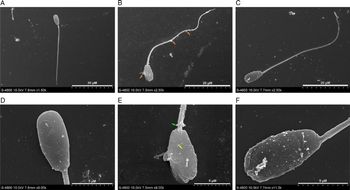
Fast cooling caused dramatic damage. As presented in Fig. 3, cold-shocked sperm in the 0 μM resveratrol treatment group showed severe particle clustering, damaged membranes and tails, and breakage in the connecting piece of the tail. Importantly, sperm in the 150 μM resveratrol group showed less damage to the plasma membrane, with a basically intact connecting piece as well as a normal mid piece of tail (Fig. 3F).
Ultrastructure observation of boar sperm. (A, D) freshly ejaculated sperm. (B, E) cold-shocked sperm treated without resveratrol. (C, F) cold-shocked sperm treated with 150 μM resveratrol. Orange arrows indicate damaged membrane and tail. Yellow arrow indicates severe particle clustering. Green arrow indicates breakage in the connecting piece of tail.

According to the results, supplementation with 50 μM or 150 μM resveratrol to the Modena extender improved sperm quality during liquid preservation and fast cooling, respectively. These concentrations were used for the subsequent experiment.
Resveratrol functions as an antioxidant
Resveratrol decreases the levels of intracellular ROS and MDA, and elevates T-AOC
To detect whether resveratrol could protect boar sperm from oxidative damage, ROS levels, MDA and T-AOC were measured following 5 days of liquid preservation and after fast cooling. As shown in Fig. 4(A, B), ROS and MDA content significantly increased during liquid preservation (P < 0.05). However, addition of 50 μM resveratrol significantly decreased ROS and MDA levels (P < 0.05). Addition of resveratrol greatly increased T-AOC levels, compared with the control (Fig. 4C; P < 0.05). Similarly, during the fast cooling process, sperm treated with 150 μM resveratrol showed not only lower ROS and MDA content, but also higher T-AOC content compared with the control (Fig. 4D–F; P < 0.05).
Effects of exposure boar sperm to resveratrol on reactive oxygen species (ROS), malondialdehyde (MDA) and total antioxidant capacity (T-AOC) during liquid preservation (A–C) and fast cooling (D–F). (A–C) FS, freshly ejaculated sperm; 0, liquid-preserved sperm in the control group; 50, liquid-preserved sperm treated with 50 μM resveratrol. (D–F) FS, freshly ejaculated sperm; 0, cold-shocked sperm treated without resveratrol; 150, cold-shocked sperm treated with 150 μM resveratrol. Bars represent the mean ± standard error of the mean (SEM) (n = 3). a–cDifferent lowercase letters denote significant differences (P < 0.05).

Resveratrol increases BCL2 levels
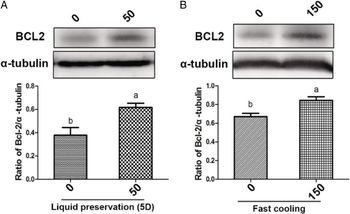
The level of anti-apoptotic protein BCL2 in sperm was measured after 5 days of liquid preservation and after fast cooling. Compared with the control, supplementation of the extender with resveratrol increased BCL2 content during preservation (Fig. 5A; P < 0.05). Meanwhile, during the fast cooling process, addition of resveratrol also preserved high BCL2 content (Fig. 5B; P < 0.05).
Effects of resveratrol on sperm apoptosis. Contents of the anti-apoptotic protein BCL2 were evaluated by western blotting after liquid preservation of 5 days (A) and fast cooling (B). (A) 0, liquid-preserved sperm in the control group; 50, liquid-preserved sperm treated with 50 μM resveratrol. (B) 0, cold-shocked sperm treated without resveratrol; 150, cold-shocked sperm treated with 150 μM resveratrol. Bands for BCL2 were measured at 28 kDa (upper film); α-tubulin was used as the loading control (55 kDa; lower film). The bottom histogram shows the BCL2/α-tubulin ratio (n = 3). a,bDifferent lowercase letters indicate significant differences (P < 0.05).

Discussion
During in vitro preservation, boar sperm suffer oxidative damage and apoptotic-like changes, which reduce sperm fertilizing ability and diminish reproductive performance (Kumaresan et al., Reference Kumaresan, Kadirvel, Bujarbaruah, Bardoloi, Das, Kumar and Naskar2009). In accordance with previous findings in human (Collodel et al., Reference Collodel, Federico, Geminiani, Martini, Bonechi, Rossi, Figura and Moretti2011), bull (Bucak et al., Reference Bucak, Ataman, Baspinar, Uysal, Taspinar and Bilgili2015) and ram (Sarlós et al., Reference Sarlós, Molnar, Kokai, Gabor and Ratky2002) sperm, we found that addition of resveratrol to the extender provided protection to boar sperm during liquid preservation and fast cooling. Resveratrol could decrease ROS level, lipid peroxidation damage and enhance the total antioxidant capacity (T-AOC).
In the present study, supplementation of resveratrol led to a dose-dependent effect on sperm quality but displayed a dichotomy: low doses of resveratrol improved sperm motility, membrane integrity and acrosome integrity, while high dose levels led to these parameters being lower than in the control group. Addition of 50 μM or 150 μM of resveratrol proved to be effective in improving sperm quality during liquid preservation and rapid cooling processes. Similar results have been reported by Tvrdá et al. (Reference Tvrdá, Kovacik, Tusimova, Massanyi and Lukac2015) who induced oxidative damage of bovine sperm with FeAA and found that resveratrol exhibited dose-dependent effects; concentrations ranging between 25–50 μM were notably effective in protecting bovine sperm from oxidative damage. It is worth noting that addition of resveratrol improved the acrosome integrity of boar sperm during the liquid preservation and fast cooling processes. Similar results have been reported by Sarlós et al. (Reference Sarlós, Molnar, Kokai, Gabor and Ratky2002) who demonstrated that resveratrol effectively reduced sperm acrosomal damage during ram semen preservation. Particularly, our results revealed that the fast cooling process led to damage to the connecting piece and tail of boar sperm. The mid piece of the sperm tail normally contains mitochondria that elongate as end-to-end helices to form a mitochondrion sheath covered with a plasma membrane (Lehti and Sironen, Reference Lehti and Sironen2017). Addition of resveratrol protected sperm so that the cells showed an almost intact connecting piece and plasma membrane in the mid piece of the tail.
The sensitivity of boar sperm to oxidative stress is related to the high ratio of unsaturated:saturated fatty acids in phospholipids and the low content of cholesterol in the sperm membrane (White, Reference White1993). Resveratrol, importantly, has the ability to scavenge ROS and inhibit ROS accumulation (Stojanovic et al., Reference Stojanovic, Sprinz and Brede2001; Delmas et al., Reference Delmas, Jannin and Latruffe2005). Many reports have revealed that liquid-stored boar sperm showed morphofunctional changes that resembled the natural process of aging that is correlated with mitochondrial dysfunction and ROS (Chuang et al., Reference Chuang, Lin and Fang2014). Moreover, on detecting ROS levels and MDA content, we found that resveratrol could prevent boar sperm from oxidative stress during liquid preservation, this finding was consistent with previous studies in bovine (Tvrdá et al., Reference Tvrdá, Kovacik, Tusimova, Massanyi and Lukac2015), human (Collodel et al., Reference Collodel, Federico, Geminiani, Martini, Bonechi, Rossi, Figura and Moretti2011), mouse (Mojica-Villegas et al., Reference Mojica-Villegas, Izquierdo-Vega, Chamorro-Cevallos and Sanchez-Gutierrez2014) and ram (Silva et al., Reference Silva, Cajueiro, Silva, Soares and Guerra2012) sperm, suggesting that resveratrol could prevent sperm from oxidative stress.
In our study, liquid-stored sperm in the control group showed higher T-AOC content when compared with fresh semen. Sperm in the 50 μM resveratrol treatment group showed a significant increase in T-AOC content when compared with the control (P < 0.05). However, the mechanism of its antioxidant effect has not been completely studied. Garcez et al. (Reference Garcez, dos Santos Branco, Lara, Pasqualotto and Salvador2010) reported that resveratrol induces a small increase in superoxide dismutase (SOD) activity during cryopreservation of sperm from infertile men. Soleas et al. (Reference Soleas, Diamandis and Goldberg1997) described that the antioxidant effects of resveratrol were mostly due to its ROS scavenging capacity. During rapid cooling to 5oC, sperm membrane phospholipids undergo a lipid phase transition, which would inhibit the lipid from movement and result in severe damage to sperm (Crowe et al., Reference Crowe, Hoekstra, Crowe, Anchordoguy and Drobnis1989; Salmon et al., Reference Salmon, Leclerc and Bailey2016). Excessive ROS would attack the plasma membrane, initiate lipid peroxidation (LPO) and cause further damage to sperm (Wang et al., Reference Wang, Zhang, Ikemoto, Anderson and Loughlin1997). Our results revealed that supplementation with resveratrol during fast cooling not only decreased ROS levels and lipid peroxidation damage, but also improved T-AOC levels of sperm.
Apoptosis occurs as a result of extrinsic or intrinsic signal stimulation (Boise et al., Reference Boise, González-García, Postema, Ding, Lindsten and Turka1993). The BCL2 protein family is a key intracellular regulator in the intrinsic pathway of apoptosis in mammals and regulates the release of the cytochrome complex and other mitochondrial proteins into the cytosol (Wang, Reference Wang2001). Previous reports have found that apoptotic-like changes increase during in vitro preservation of boar (Buhr et al., Reference Buhr, Fiser, Bailey and Curtis2001; Guthrie and Welch, Reference Guthrie and Welch2005), bull (Martin et al., Reference Martin, Sabido, Durand and Levy2004), human (Thomson et al., Reference Thomson, Fleming, Aitken, De Iuliis, Zieschang and Clark2009), equine (Brum et al., Reference Brum, Sabeur and Ball2008) and mouse (Cisternas and Moreno, Reference Cisternas and Moreno2006) sperm. Revel et al. (Reference Revel, Raanani, Younglai, Xu, Han, Savouret and Casper2001) elucidated that resveratrol could diminish benzo(a)pyrene-induced sperm apoptosis in mouse. Li et al. (Reference Li, Zhao, Hao, Wang, Huang, Yan, Du, Pang, Zhang, Liu, Zhu and Zhao2018) proved that resveratrol prevented bovine sperm from apoptosis during the sex sorting procedure. In this study, we measured BCL2 expression during liquid preservation and fast cooling. Results showed that addition of resveratrol to the Modena extender increased the BCL2 content (P < 0.05). However, further studies are needed to determine how resveratrol is involved in preventing boar sperm apoptosis.
Mitochondria are critical organelles and are involved in a several crucial processes such as ATP synthesis, redox regulation, and apoptosis (Ungvari et al., Reference Ungvari, Sonntag, De Cabo, Baur and Csiszar2011). Interestingly, Zini et al. (Reference Zini, Morin, Bertelli, Bertelli and Tillement1999) reported that resveratrol could decrease the activity of complex III, which is a component of the mitochondrial respiratory chain and a generation site of ROS. Ungvari et al. (Reference Ungvari, Labinskyy, Mukhopadhyay, Pinto, Bagi, Ballabh, Zhang, Pacher and Csiszar2009) elucidated that resveratrol could protect mitochondria in coronary arterial endothelial cells. Together with data demonstrating that resveratrol could enhance the mitochondrial activity of boar sperm during liquid preservation and fast cooling, we speculate that resveratrol might protect boar sperm against oxidative stress and inhibit sperm from apoptosis via its protection of sperm mitochondria. However, further study is needed on the specific mechanisms of resveratrol’s protection towards sperm mitochondria.
In conclusion, the present study demonstrated that addition of resveratrol to Modena extender improved sperm motility and structure integrity, and that resveratrol could protect boar sperm against oxidative stress. During liquid storage, the optimal concentration of resveratrol was 50 μM. During the fast cooling process, the optimal concentration of resveratrol was 150 μM. These data could help to facilitate strategy development of boar sperm preservation.
Supplementary material
To view supplementary material for this article, please visit https://doi.org/10.1017/S0967199420000271
Data Availability Statement
All datasets generated for this study are included in the manuscript and the supplementary files.
Acknowledgements
The authors greatly appreciate the College of Animal Science and Technology in Northwest A&F University for technical support to this study.
Author Contributions
LS, XF were responsible for experimental design, sample, data analysis and writing the manuscript. YZ collected the samples and participated in writing the paper. LW, ZZ interpreted the data and checked the draft errors. RL, YL, DW checked the draft errors. WZ were responsible for discussion on experimental design, data analysis and revised the manuscript. All authors read and accepted the final version of the manuscript.
Financial support
This study was supported by the National Key R&D Programme of China (No. 2018YFD0501000) for WZ.
Conflict of Interest
None of the authors have any conflict of interest to declare.
Ethical Standards
All experimental procedures involving boars were approved by the Institutional Animal Care and Use Committee of Northwest A&F University.