


INTRODUCTION AND BACKGROUND
Telling a story is a complex task. It requires the speaker to organize story content into a temporally and causally coherent whole, using suitable linguistic expressions, while simultaneously taking the listener's perspective into account. A crucial aspect of making a story understandable to the listener is to properly introduce new story characters. Adequate introduction of referents in discourse first requires knowledge of the linguistic means for marking the information status of referents in the language (see, e.g. Chafe, Reference Chafe and Li1976; Halliday & Hasan, Reference Halliday and Hasan1976). Second, children need to understand the function of these markers, e.g. that indefinite forms are used for referents that are new to the listener, whereas definite noun phrases and pronouns refers back to already mentioned referents (e.g. Gundel & Johnson, Reference Gundel and Johnson2013). Additionally, children must correctly judge whether or not the referent is currently known to the listener, i.e. they must assess the listener's knowledge state (see, e.g. Ariel, Reference Ariel1990; Arnold, Reference Arnold2008; Gundel, Reference Gundel2010; Gundel, Hedberg & Zacharski, Reference Gundel, Hedberg and Zacharski1993). To do this, they need to have developed sufficient Theory of Mind skills to be able to take the listener's perspective into account (e.g. Tomasello, Reference Tomasello2003).
Different ages at which children are able to introduce referents appropriately have been reported in the literature. Studies of spontaneous interaction have shown that, already at age two to three, children use the full range of referring expressions correctly (Gundel & Johnson, Reference Gundel and Johnson2013) and are sensitive to discourse cues such as prior mention and joint attention in choosing referring expressions (e.g. Hughes & Allen, Reference Hughes and Allen2013; see also Allen, Skarabela & Hughes, Reference Allen, Skarabela, Hughes and Behrens2008, Skarabela, Allen & Scott-Phillips, Reference Skarabela, Allen and Scott-Phillips2013).
Results from studies of elicited narratives are not as clear. Some studies report predominant use of appropriate indefinite expressions already at age two to four (e.g. De Cat, Reference De Cat2013; Emslie & Stevenson, Reference Emslie and Stevenson1981). Other studies indicate that the ability to introduce characters appropriately develops much later, and may not be fully developed until age nine (e.g. Hickmann, Hendriks, Roland & Liang, Reference Hickmann, Hendriks, Roland and Liang1996; Serratrice, Reference Serratrice2007; Warden, Reference Warden1976), or at least not before age seven (e.g. Schneider & Hayward, Reference Schneider and Hayward2010). However, a number of studies point to age four to six as central for the development (Aksu-Koç & Nicolopoulou, Reference Aksu-Koç and Nicolopoulou2015; Schneider & Hayward, Reference Schneider and Hayward2010; cf. Berman & Slobin, Reference Berman and Slobin1994). Studying groups closer in age, which has not often been done, may make it possible to pinpoint when large steps in development take place (cf. Aksu-Koç & Nicolopoulou, Reference Aksu-Koç and Nicolopoulou2015). Using data from elicited oral narratives, the first aim of the current study is therefore to analyze age effects on character introductions in four- to six-year-old children.
One of the factors that may explain differences in the age at which referring expressions are used appropriately in narrative discourse is language structure. Some studies have found differences between languages (e.g. Hickmann et al., Reference Hickmann, Hendriks, Roland and Liang1996 for Chinese, English, French, and German). Investigating children's character introductions in Greek, English, and Turkish, Aksu-Koç & Nicolopoulou (Reference Aksu-Koç and Nicolopoulou2015) point to the influence of the language's referential system for children's performance, suggesting that children speaking languages that use a rich morphological system to mark the information status of referents (e.g. Greek) acquire appropriate use of the different forms earlier. However, results from other studies point to similar ages of acquisition irrespective of language, for, e.g. French (Kail & Hickmann, Reference Kail and Hickmann1992), Spanish (Kail & Sanchez y Lopez, Reference Kail and Sanchez y Lopez1997), Turkish (Küntay, Reference Küntay2002), and Japanese (Nakamura, Reference Nakamura1993). Little is known about when Swedish-speaking children learn to introduce referents appropriately in narrative discourse. The present study is the first to systematically investigate referent introductions for a larger group of Swedish-speaking children.
Another important factor is the stimulus material. De Cat (Reference De Cat2013) used materials in which “[t]he plots were very simple, and consisted essentially in the progressive introduction of new characters joining a group of established characters” (De Cat, Reference De Cat2013, p. 60), which may explain why the French-speaking children in her study already used 83% indefinite NPs in the introductions of story characters at age 2;6–3;3. In contrast, studies finding that children do not introduce referents appropriately until a later age generally used more complex story elicitation materials, such as the frog story (Mayer, Reference Mayer1969), a long wordless picture book with a plot including several complications before the goal is achieved. Plot complexity (including the number of episodes), number of characters, and how easily characters are distinguishable from each other are aspects that also affect the child's ability to appropriately introduce referents (e.g. Aksu-Koç & Nicolopoulou, Reference Aksu-Koç and Nicolopoulou2015; De Cat, Reference De Cat2013; Hickmann et al., Reference Hickmann, Hendriks, Roland and Liang1996; Wigglesworth, Reference Wigglesworth1990).
Relatively few studies have compared children's performance on different elicitation materials. Some studies have compared different elicitation procedures, e.g. with or without a blindfolded experimenter (Kail & Hickmann, Reference Kail and Hickmann1992), used stories with one or more main characters (e.g. Aksu-Koç & Nicolopoulou, Reference Aksu-Koç and Nicolopoulou2015), or compared problem-based with event-based stories (Shapiro & Hudson, Reference Shapiro and Hudson1991). However, elicitation instruments were often similar in layout, length, and/or story complexity. To fully investigate the effect of the stimulus it is necessary to compare children's performance using narrative elicitation instruments that are more dissimilar. To address this issue, the present study compares the performance of Swedish-speaking four- to six-year-olds on two different narrative elicitation instruments, both of which have been developed to suit the targeted age groups.
The study seeks to answer the following two specific questions: Is there a development between age four and six in the use of appropriate referring expressions for introducing story characters? Does the age at which referring expressions are appropriately used for character introductions differ between the two elicitation instruments?
Referent introduction in Swedish
Swedish marks (in)definiteness morphologically. The indefiniteness marker is a free-standing article (en and ett for common and neuter gender, respectively), and the definiteness marker is a suffix (-en/-et). The suffixes are acquired earlier than the articles, i.e. Swedish-speaking children mark definiteness earlier than indefiniteness, but both types of markers emerge in children's spontaneous speech around or even before age two (see Bohnacker, Reference Bohnacker, Josefsson, Platzack and Håkansson2003, Reference Bohnacker, Gülzow and Gagarina2007).Footnote 1 Swedish has four third person singular pronouns, inflected for biological and grammatical gender (hon ‘she’, han ‘he’, den ‘it, common gender’, det ‘it, neuter gender’), but only one plural one (dom ‘they’Footnote 2 ). There is no case marking on nouns or articles (although the personal pronouns have object forms).
When there is no shared knowledge or joint visual attention between speaker and listener, an indefinite article is used together with a noun, as in (1),Footnote 3 to introduce a new referent appropriately (see Teleman, Hellberg & Andersson, Reference Teleman, Hellberg and Andersson1999, pp. 169ff.). To use a definite form, as in (2), is lexically clear, but pragmatically inappropriate, as this form assumes that the referent is uniquely identifiable in the context (cf. Teleman et al., Reference Teleman, Hellberg and Andersson1999, p. 155). Using a pronoun, as in (3), is lexically and pragmatically infelicitous, as this implies that the referent is in the focus of the listener's attention (cf. Gundel et al., Reference Gundel, Hedberg and Zacharski1993).
-
(1) det var en elefant och en giraff som skulle bada (MoSwe6-04, B2)
there was an elephant and a giraffe who should swim
‘There was an elephant and a giraffe who were going to swim’
-
(2) katten tar en fjäril (MoSwe4-02, Cat)
cat-the takes a butterfly
‘The cat catches a butterfly’
-
(3) att han ska ta en fjäril (MoSwe5-04, Cat)
that he shall take a butterfly
‘… that he is going to catch a butterfly.’
METHOD
Participants
Seventy-two monolingual Swedish-speaking preschoolers aged 4;0–6;10, divided into four-, five-, and six-year-olds, participated in the study. The children were recruited with the help of preschool personnel and received stickers and a certificate for their participation. A consent form was signed by the parents, who also filled in a questionnaire about the child's language development as well as parental education and current occupations. All children had typical language development and normal hearing. No child had been treated by a speech and language therapist, or had been diagnosed with any neurological or psychological disorder (e.g. ADHD or autism-spectrum disorder). The children were mainly preliterate. Table 1 gives an overview of the participants.
Participants

Materials
The stimulus materials used were Cat and Dog from the Multilingual Assessment Instrument for Narratives (MAIN; Gagarina et al., Reference Gagarina, Klop, Kunnari, Tantele, Välimaa, Balčiūnienė, Bohnacker and Walters2012, Reference Gagarina, Klop, Kunnari, Tantele, Välimaa, Balčiūnienė, Bohnacker, Walters, Armon-Lotem, de Jong and Meir2015) and A2 and B2 from the Edmonton Narrative Norms Instrument (ENNI; Schneider, Dubé & Hayward, Reference Schneider, Dubé and Hayward2005). The two narrative instruments are henceforth referred to as story types.
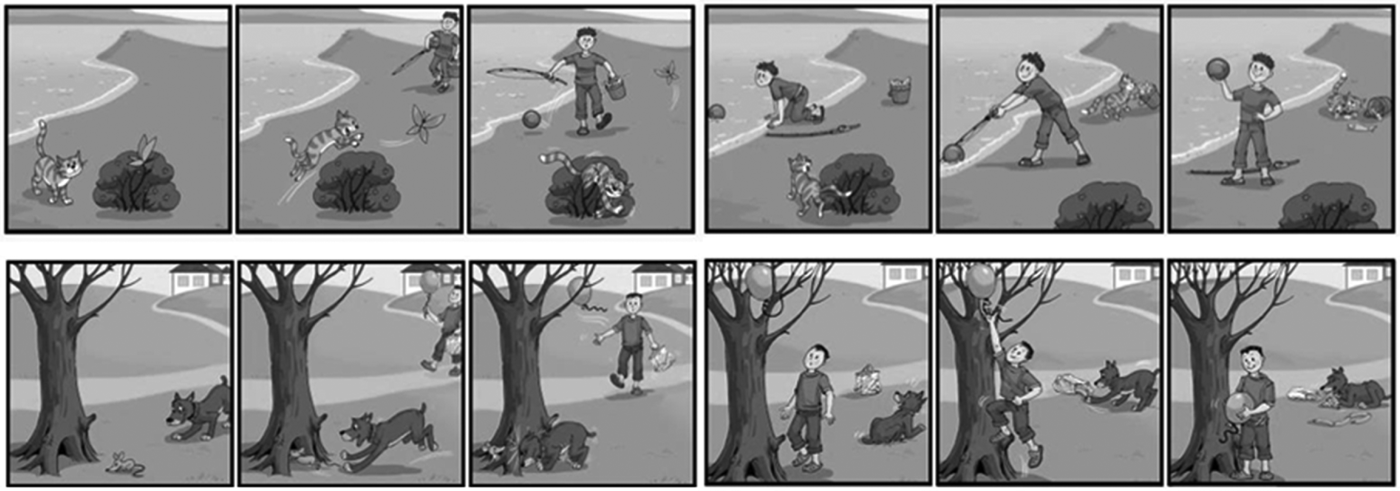
The MAIN Cat and Dog picture sequences, designed for children aged three to nine, consist of six colored pictures and are parallel in terms of episodic structure and number and types of characters. Both stories have three episodes, each including a goal–attempt–outcome sequence (see, e.g. Stein & Glenn, Reference Stein, Glenn and Freedle1979) for one of the characters. Figure 1 shows black-and-white small-scale copies of the picture sequences.
Small-scale black-and-white copies of the picture sequences Cat (above) and Dog (below) from the Multilingual Assessment Instrument for Narratives (Gagarina et al., Reference Gagarina, Klop, Kunnari, Tantele, Välimaa, Balčiūnienė, Bohnacker and Walters2012, Reference Gagarina, Klop, Kunnari, Tantele, Välimaa, Balčiūnienė, Bohnacker, Walters, Armon-Lotem, de Jong and Meir2015).
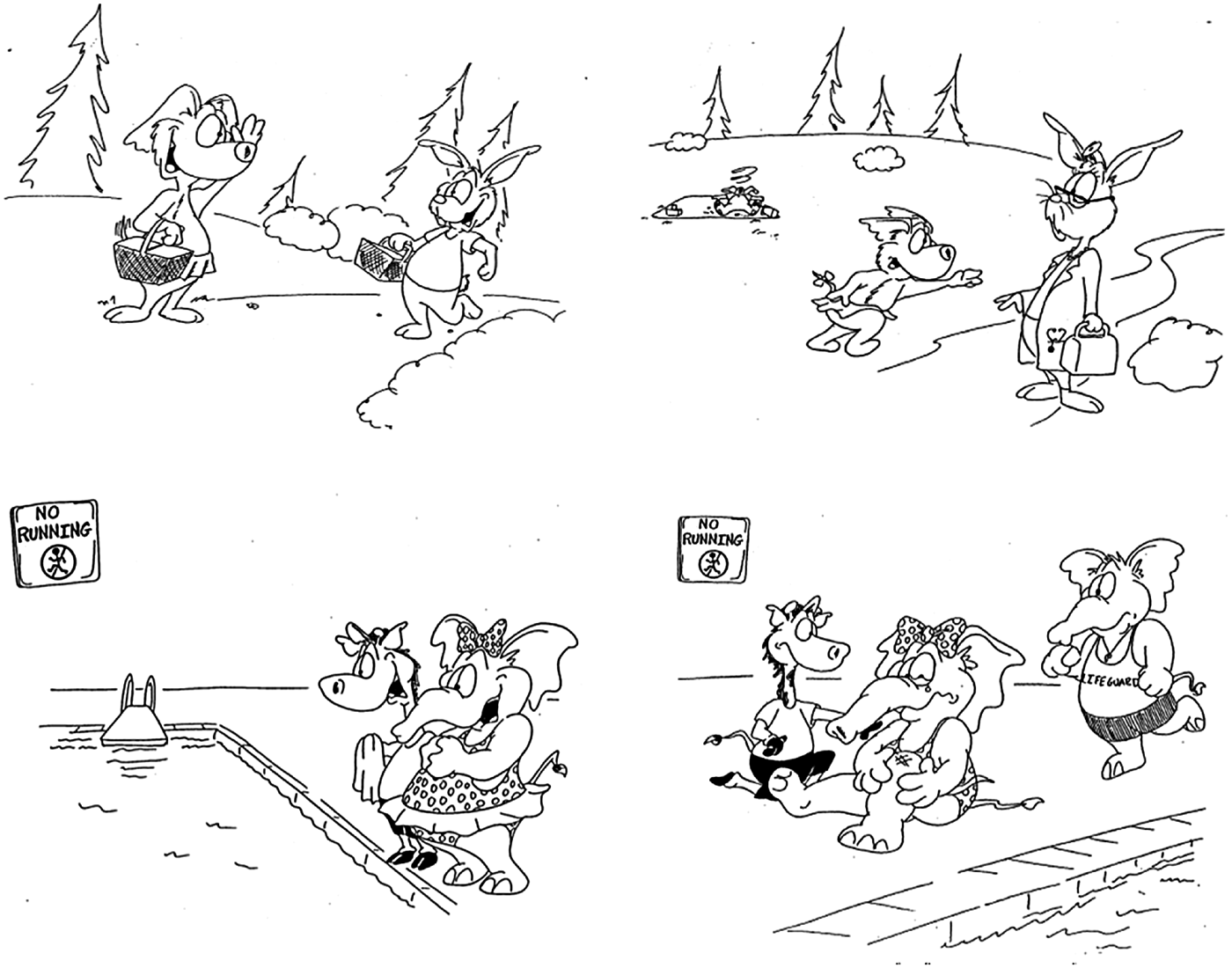
The ENNI A2 and B2 story booklets, created for children aged four to nine, contain eight pages, each with one single black-and-white line drawing. The stories have one episode with a complication/problem for one character and help given by other characters.Footnote 4 A2 and B2 were constructed to be comparable in terms of story content and characters. Figure 2 shows small-scale copies of pictures 1 and 5, the pictures where the characters enter the stories, from A2 and B2.
Small-scale copies of pictures 1 and 5 from B2 (above) and A2 (below) of the Edmonton Narrative Norms Instrument (Schneider et al. Reference Schneider, Dubé and Hayward2005, ©2000, Wooket Graphics).
The main reason for choosing these specific stories for the study was that each story contains three characters and thus requires the same number of introductions. This makes them comparable on one aspect of referential complexity. Table 2 gives an overview of the story characters. Otherwise, MAIN and ENNI differ in several respects, e.g. in the number of pictures and in visual presentation. Table 3 summarizes the similarities and differences between the story types.
Overview of the MAIN and ENNI story characters

Similarities and differences between MAIN and ENNI

Procedure
Each child told two stories, starting with Cat or Dog from the MAIN, followed by A2 or B2 from the ENNI. The story-telling tasks were administered in a quiet room at their preschools as part of a larger set of tasks. The MAIN and ENNI were separated by other tasks taking 15–20 minutes. Six children in each age group told the same combination of stories. As the two tasks were part of a larger test battery it was not possible to counterbalance the order of the tasks.
Standard procedures for administering the MAIN and the ENNI were followed (Gagarina et al., Reference Gagarina, Klop, Kunnari, Tantele, Välimaa, Balčiūnienė, Bohnacker and Walters2012, Reference Gagarina, Klop, Kunnari, Tantele, Välimaa, Balčiūnienė, Bohnacker, Walters, Armon-Lotem, de Jong and Meir2015; Schneider et al., Reference Schneider, Dubé and Hayward2005). Both procedures are similar: the child told the story to an adult listener (the author) who could not see the pictures and acted as if the stories were unknown to her. The children were allowed to look at all pictures before telling their story. Generally, the younger children required more frequent prompting, but all children who needed it received the same minimal prompts (e.g. aa, mm, and then?).
Video- and audio-recordings were made and the narratives were transcribed by the author in the CHAT-format (MacWhinney, Reference MacWhinney2000).
Coding and analysis
All referring expressions used to introduce the story characters in the 144 narratives (N = 403) were coded manually according to type of referring expression (e.g. pronoun, indefinite, or definite NP), age group (four-, five-, or six-year-old), and story type (MAIN, ENNI). Most pronouns were personal pronouns, but there were also a few demonstrative pronouns, e.g. den där ‘that’.
Two logistic regression analyses were carried out. In the first analysis, pronouns, the least appropriate type of referring expression (for introducing referents in narratives), versus lexical NPs was the dependent variable. In the second analysis, the dependent variable was fully appropriate NPs versus all other referring expressions. In addition to indefinite NPs, a few cases of proper nouns and constructions with a possessive and a noun (e.g. introducing the large rabbit as kaninens mamma ‘the rabbit's mother’, where the rabbit had already been introduced) were coded as fully appropriate NPs. Age, story type, and the interaction between them were predictors in both analyses. For the variable age group, one binary predictor compared the six-year-olds to the younger groups, and another one compared the five-year-olds to the four-year-olds (Reversed Helmert coding).
RESULTS
Descriptives
Table 4 shows the distribution of the different types of referring expressions used for character introductions in the MAIN and ENNI narratives divided by age group. No significant differences were found between the two stories within each story type (i.e. Cat vs. Dog for MAIN; A2 vs. B2 for ENNI). Data from the two different stories of each story type were therefore collapsed for all analyses.
Types of referring expressions used to introduce story characters in MAIN and ENNI, divided by age group

note: a. The category Fully appropriate NPs consists of Indefinite NPs, Possessive NPs, and Proper nouns.
Table 4 shows clear differences both between age groups and between story types. The four- and five-year-olds produced relatively low proportions of ungrammatical bare nouns (MAIN: 10% and 4·5%; ENNI: 8·1% and 6·0%). Only one bare noun was produced by the six-year-olds. The six-year-olds used fewer pronouns than the younger groups, but notably more in ENNI than in MAIN (10·6% compared to 1·4%). The four- and five-year-olds used similar proportions of pronouns in MAIN (11·4 % and 10·6%, respectively), but in ENNI, the four-year-olds used a higher proportion of pronouns (35·5%) than did the five-year-olds (19·4%).
Only one pronoun was used by the six-year-olds for character introduction in the MAIN-narratives. This case, shown in (4), differs from the pronouns used by the younger children, as it is an indefinite pronoun (en ‘one’) with a relative clause giving a description of the character, making it a more appropriate introduction.
-
(4) fast en som fiskade, han stoppade katten (MoSwe6-01, 6;6)
but one who fished he stopped cat-the
‘But one who was fishing, he stopped the cat.’
In the use of fully appropriate NPs, the six-year-olds performed much better than the younger groups, but all groups used a markedly lower proportion of fully appropriate NPs in their ENNI-narratives. In MAIN, the six-year-olds used 90·3% fully appropriate NPs, compared with only 71·2% in ENNI. In both narratives, the four-year-olds produced similar proportions of fully appropriate and definite NPs, but these proportions were lower in ENNI (MAIN: 40% vs. 38·6%; ENNI: 25·7% vs. 30·6%), due to the higher proportion of pronouns in ENNI. The five-year-olds fell in between the other groups, with 65·2% and 44·8% fully appropriate NPs for MAIN and ENNI, respectively.
Pronouns vs. lexical noun phrases
Table 5 shows the logistic regression model output for pronouns versus lexical NPs. There was a significant main effect of age: the six-year-olds produced fewer pronouns than the younger children. There was no difference between the two younger groups. Furthermore, a significant main effect of story type was found. The children produced a higher proportion of pronouns in ENNI, than in MAIN. No interaction effects were significant, suggesting that age development was similar for MAIN and ENNI.
Summary of logistic regression model 1: character introductions, pronouns vs. lexical NPs. The right-hand level of each predictor is the reference level.
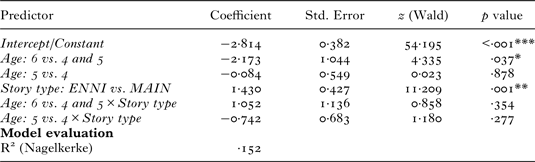
notes: * = p < ·05, ** = p < ·01, *** = p < ·001.
Fully appropriate vs. all other referring expressions
Table 6 shows the model output for the use of fully appropriate NPs for referent introduction versus all other referring expressions. Significant main effects of age and story type were found. The six-year-olds produced a larger proportion of appropriate NPs than the younger children, and the four-year-olds produced fewer expressions of this type than the five-year-olds. The children also produced fewer fully appropriate NPs in ENNI than in MAIN. There were no interaction effects, meaning that the effect of story type was the same across age groups.
Summary of logistic regression model 2: character introductions, fully appropriate NPs vs. all other referring expressions. The right-hand level of each predictor is the reference level.
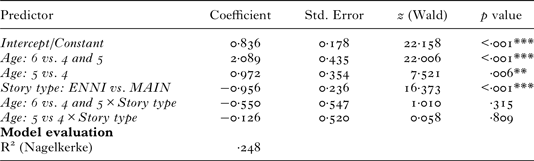
notes: ** = p < ·01, *** = p < ·001.
DISCUSSION AND CONCLUSION
This study investigated character introductions in 144 oral narratives of 72 four- to six-year-old monolingual Swedish-speaking children. The research questions were: (1) Is there a development between age four and six in the use of appropriate referring expressions for introducing story characters? (2) Does the age at which referring expressions are appropriately used for character introductions differ between the two elicitation instruments?
As for the first question, the results showed a clear development from age four to age six in the proportion of appropriate referential expressions for introducing story characters. The six-year-olds produced lower proportions of pronouns, and higher proportions of fully appropriate (mainly indefinite) NPs than the younger children, and the five-year-olds produced a higher proportion of fully appropriate (mainly indefinite) NPs than the four-year-olds.
As for the second question, results for the two elicitation instruments MAIN and ENNI were strikingly different. All age groups produced a higher proportion of fully appropriate NPs and a lower proportion of pronouns when introducing characters in narratives elicited with the MAIN than in those elicited with the ENNI. In fact, the five-year-olds’ ENNI performance was similar to the four-year-olds’ MAIN performance, and the six-year-olds performed only slightly better on ENNI than the five-year-olds did on MAIN. No interaction effects between age and story type were found, suggesting that the age groups were influenced similarly by the MAIN- and ENNI-stories with respect to character introduction.
The results showed that the ability to introduce characters appropriately in a narrative developed extensively during the preschool years. Producing a substantial proportion of appropriate referring expressions already at age four, the Swedish-speaking children in the present study performed better than those of many previous studies of referent introduction in narratives (e.g. Hickmann et al., Reference Hickmann, Hendriks, Roland and Liang1996; Kail & Hickmann, Reference Kail and Hickmann1992; Kail & Sanchez y Lopez, Reference Kail and Sanchez y Lopez1997; Küntay, Reference Küntay2002; Serratrice, Reference Serratrice2007). Differences between languages could play a role in explaining these results. The use of morphology to mark the information status of referents in Swedish combined with the early emergence of these markers in spontaneous speech (cf. Bohnacker, Reference Bohnacker, Josefsson, Platzack and Håkansson2003, Reference Bohnacker, Gülzow and Gagarina2007) may explain why Swedish-speaking children are also able to use these markers appropriately in elicited narratives at an early age (cf. Aksu-Koç & Nicolopoulou, Reference Aksu-Koç and Nicolopoulou2015). In order to test this hypothesis, it would be necessary to carry out a comparative study of children speaking Swedish and children speaking other languages using the same stimulus material (e.g. MAIN and/or ENNI).
However, as some studies of languages with similar referential systems to Swedish (e.g. English; see Hickmann et al., Reference Hickmann, Hendriks, Roland and Liang1996; Schneider & Hayward, Reference Schneider and Hayward2010) found a later age of acquisition, language is clearly not the only aspect affecting children's performance. The elicitation procedure is also important. Generally, children seem to use a higher proportion of appropriate NPs when there is no shared visual attention between the child and the adult listener (e.g. Kail & Hickmann, Reference Kail and Hickmann1992), as was the case in the current study. Still, the preschoolers studied here did not perform as well as the children in, e.g.. De Cat (Reference De Cat2013), although both studies used procedures with no shared visual attention on the stimulus materials between child and experimenter.
Children's ability to introduce referents is also influenced by the type of stimulus material used. The better performance of the children in De Cat (Reference De Cat2013), compared with the current study, can be explained by such differences. De Cat's picture stimulus had ‘low narrative content’, i.e. depicted a simple story. With less story content to tell, narrating becomes less cognitively demanding, thus allowing children to focus more on introducing the characters appropriately. More cognitively demanding material may also make it more difficult for the child to take the listener's perspective into account.
Keeping elicitation procedure and number of story characters constant, the current study compared two elicitation instruments that differ in a number of ways (cf. Table 3), out of which story structure is one. The A2/B2-stories of the ENNI have a simpler story structure than MAIN, but the children performed better in their MAIN-narratives. A more complex story structure does not therefore always make it more difficult for children to properly introduce the story characters.
MAIN and ENNI also differ in the types of characters, as well as when and how these enter the story. The MAIN-characters are more realistic, as they behave in prototypical manners, e.g. a cat eating fish. In contrast, the ENNI-characters are ‘humanized animal agents’, i.e. animals dressed up and acting like humans (e.g. a small rabbit and a dog having a picnic). This could make it more difficult to choose how to refer to them, and may partly explain why the children used pronouns more frequently in the ENNI. Second, in both MAIN and ENNI, two characters are present in the first picture, but the ENNI-characters are more clearly present together, engaged in a joint activity (cf. Figures 1 and 2). This could make it more challenging to introduce them, as the child needs to keep his/her attention focused on two characters simultaneously. The effects of types of characters and characters’ visual/physical proximity on referent introductions would be interesting topics to pursue in further studies.
Drawing style and coloring may also influence the visual recognizability of story characters (but cf. Schneider, Rivard & Debreuil, Reference Schneider, Rivard and Debreuil2011). If it is difficult to identify a character, it is likely also more difficult to refer to it. Quite a few of the children in the current study had difficulties identifying one or more ENNI-characters, as reflected in hedging formulations, e.g. jag tror det är en ‘I think it is a’, and expressions such as nåt konstigt djur ‘some strange animal’, ett annat djur ‘another animal’, or den andra ‘the other one’. Such formulations were absent in MAIN. This indicates that the characters in ENNI are less easy to recognize than those in MAIN, which could influence the proportions of appropriate referring expressions. Taken together, all the above-mentioned aspects may make character introductions in ENNI A2/B2 more challenging than in MAIN Cat/Dog.
It could be argued that the order that the story types were presented in, with MAIN always preceding ENNI, affected child performance, with children getting tired by the time they did the ENNI. However, few children showed signs of exhaustion (e.g. yawning, restless behavior) during the tests. Also, any exhaustion effect would most likely be offset by a training effect, as children tend to perform better when they become more used to the experimenter, the setting, and the tasks. In order to conclusively determine this, an additional study with reversed order of the story types is needed.
In conclusion, the children in the current study used substantial proportions of fully appropriate referring expressions already at age four, and thus performed better at introducing story characters than those in many previous studies. Additionally, we saw an increasing use of appropriate forms from age four to age five, and mastery, or close to it, at age six (at least for MAIN). An important step towards adult-like competence thus appears to be taken around age six. This is in line with findings from earlier studies of narrative ability (e.g. Berman & Slobin, Reference Berman and Slobin1994).
In addition to age effects, the results presented here showed that children's character introductions in narratives are strongly influenced by the stimulus material. All age groups performed better on MAIN than on ENNI. Depending on the stimulus material used, the age at which children use appropriate expressions for introducing referents may thus be different. If the MAIN Cat- and Dog-stories are used, most (Swedish-speaking) children can be expected to consistently introduce characters appropriately by age six, and at age four they will use some appropriate forms. With the ENNI, we cannot expect the same level of performance. One should thus be careful when comparing results across studies and when drawing conclusions about the age at which children are able to use referring expressions appropriately.



