INTRODUCTION
Marine hydrozoans are one of the most common components of the benthic sessile fauna of rocky shores (Gili & Hughes, Reference Gili and Hughes1995; Bouillon et al., Reference Bouillon, Gravili, Pages, Gili and Boero2006). They are considered to be good bioindicators of environmental conditions (Mergner, Reference Mergner and Taylor1977; Gili & Hughes, Reference Gili and Hughes1995): their biogeographical distribution patterns and presence or absence in a given area provide information about general climatic conditions in the surrounding environment (Puce et al., Reference Puce, Bavestrello, Di Camillo and Boero2009).
The present study forms part of a wider sampling programme dealing with the characteristics of hydroid assemblages in the Strait of Gibraltar and nearby areas: the Atlantic Moroccan coast; the Gulf of Cadiz; and the Alboran Sea. The project aims to study the transition between the Atlantic and the Mediterranean and the relationships among the previously cited areas. Among other results, this research detected a strong influence of the inflowing Atlantic waters into the South Alboran Sea, where the assemblages presented a high similarity to those found in nearby Atlantic sites (González-Duarte et al., Reference González-Duarte, Megina, Piraino and Cervera2013).
In the present contribution, we report new records of three hydroid species (Garveia grisea, Eudendrium glomeratum and E. merulum), thus extending their known distributional area to the Atlantic Moroccan coast.
MATERIALS AND METHODS
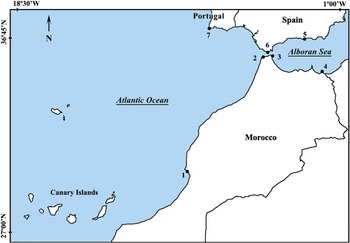
Samples were collected from seven different sites, covering the Alboran Sea, the Strait of Gibraltar, the Gulf of Cadiz and Agadir Bay (Figure 1). The hydroids were collected from shallow waters using SCUBA diving, following the methodology of Boero & Fresi (Reference Boero and Fresi1986). The sampling was undertaken along duplicated vertical transects (A and BFootnote 1) in two different stations for each studied site. Transects were divided into intervals of 5 m from 0 to 30 m depth. Colonies were sampled either with their substrate or fixed in 70–90% ethanol. In the laboratory, the material was sorted and identified to the maximum possible taxonomic level (mostly to species level). Abundance estimates were based on counting the number of hydrocauli.
Site locations: (1) Agadir Bay; (2) Cape Spartel; (3) Ceuta; (4) Chafarinas Islands; (5) Punto Maro (Granada); (6) Tarifa; (7) Sagres.

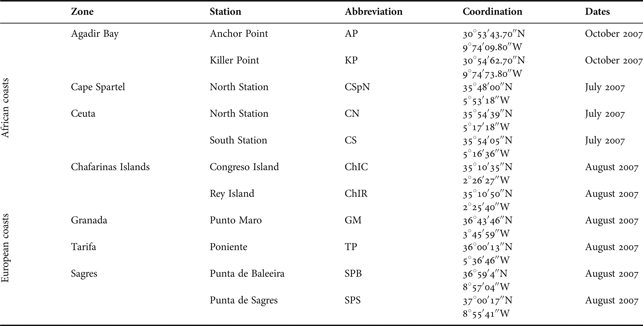
Table 1 sets out the entire data for the different sites where the three hydrozoan species represented in this contribution were found.
Details and data coordination of the sampling sites.

RESULTS
The results of this contribution were derived from the collection, examination and identification of 164,655 hydrocauli, of which 157,491 were Leptomedusae and 7240 were Anthomedusae. In total, we recorded 193 species, representing 66.78% of all hydrozoans from the Iberian Peninsula and Balearic Islands (Medel & López-González, Reference Medel and López-González1996) and 42.23% of all hydrozoans from the Mediterranean Sea (Bouillon et al., Reference Bouillon, Medel, Pagès, Gili, Boero and Gravili2004). 78.76% of all the species herein recorded are thecate hydroids (Leptomedusae) and 21.24% are athecate (Anthomedusae).
SYSTEMATICS
Class HYDROZOA Owen, 1843
Order ANTHOATHECATA Haeckel, 1879
Suborder FILIFERA Kühn, 1913
Family BOUGAINVILLIIDAE Lütken, 1850
Genus Garveia Wright, 1859
Garveia grisea (Motz-Kossowska, 1905)
MATERIAL EXAMINED
AP-A; B 0–10 m: many fertile colonies growing on polychaetes tubes, bryozoans, bivalves, calcareous substrate and epibiotic of other hydroids: Eudendrium cf. racemosum, Halecium petrosum, Sertularella mediterranea and Sertularia marginata. CN-B 15–30 m: 20 to 30 unfertile colonies growing on Eudendrium racemosum and Synthecium evansi. CS-A 15–30 m: five unfertile colonies growing on Plumaria sp. CS-B 20–30 m: four unfertile colonies growing on Peyssonelia sp. CSpN-A 20–30 m: one sterile colony. CSpN-B 10–15 m: five sterile colonies. SPB-A 5–10 m: two sterile colonies growing on Plumularia setacea.
DIAGNOSIS
Colonies monosiphonic, erect and branched. Length varies from very small colonies of less than 1 cm to colonies that are 3 cm high. Some polysiphonic stems occur. Perisarc is double-layered. Branches adnate to the main stem at bases. Small polyps (0.25–0.30 × 0.15–0.18 mm) often contracted in preserved material, are covered by the outer filmy layer of the perisarc as pseudohydrotheca. Hypostome dome shaped. Large female gonophores (0.42–0.58 × 0.32–0.40 mm) growing on stem and with one ovoid egg.
REMARKS
Apart from the shape of the colony, of the polyps, and the gonophores structure, the distinctive characteristics of the species are the adnated branches, the double-layered perisarc and the large macrobasic heteronemes. This allowed us to identify the abundant sterile and less well-developed colonies in our material.
DISTRIBUTION
Garveia grisea was originally described from the Mediterranean Sea (Banyuls-sur-Mer, France), where it was considered to be an endemic species (Boero & Bouillon, Reference Boero and Bouillon1993; Bouillon et al., Reference Bouillon, Medel, Pagès, Gili, Boero and Gravili2004). Medel (Reference Medel1996) reported G. grisea from the North African coast, in Ceuta, and considered the Strait of Gibraltar to be the western limit of the species. The present study showed that this species has a wider distribution, which includes also Sagres, Cape Spartel and Agadir Bay, giving the first records from the African Atlantic waters, including the Moroccan coast. Outside this known distributional area there is an isolated report for the deep bottom of Moira Mounds (Porcupine Seabight, to the south-west of Ireland) (Henry & Roberts, Reference Henry and Roberts2007; Schuchert, Reference Schuchert2007; Wheeler et al., Reference Wheeler, Kozachenko, Henry, Foubert, De Haas, Huvenne, Masson and Olu2011), a very unusual habitat for this species. Indeed, it has never been found in the deep waters of the area studied in this research, the Alboran Sea, Gulf of Cadiz or the Atlantic Moroccan Coast (Ramil & Vervoort, Reference Ramil and Vervoort1992; Vervoort, Reference Vervoort2006), where it is common in coastal habitats.
Family EUDENDRIIDAE Agassiz, 1862
Genus Eudendrium Ehrenberg, 1834
Eudendrium glomeratum Picard, Reference Picard1952
MATERIAL EXAMINED
KP-A; B 10–30 m: nearly 20 small and unfertile colonies growing on algae. TP-B 5–30 m: seven colonies growing on Balanus sp. CN-A; B 5–30 m: nearly 70 fertile colonies. CS 5–30 m: nearly 10 colonies. CSpN-A; B 20–30 m: nearly 38 colonies on calcareous concretions. CS-A 20–30 m: only one unfertile colony. ChIR-A; B 0–30 m: 19 colonies, some fertile with female gonophores. The colonies were found growing on Balanus sp., Cystoseira sp., Lithophyllum sp., Peyssonnelia sp., polychaetes tubes and calcareous concretions. ChIC-A; B 0–30 m: nearly 18 unfertile colonies. SPS-A 5–15 m: nearly 50 colonies growing on calcareous concretions and Plocamium cartilagineum.
DIAGNOSIS
Generally up to 60 mm polysiphonic colonies, irregularly branched. Macrobasic euryteles (24–28 × 10–11 µm) occurring on the hydranth body. These arranged in warts forming a ring around the hydranth body. Male gonophores (2–3 chambers) developed on blastostyle without tentacles. Female gonophores developed on reduced polyps with few tentacles. Spadix simple.
REMARKS
Even if some of our colonies lacked gonophores, the type, measurement and arrangement in warts around the hydranth body of the holotrichous macrobasic euryteles are considered to be distinctive (Picard, Reference Picard1952; Marinopoulos, Reference Marinopoulos and Bellan1992; Marques et al., Reference Marques, Peña-Cantero and Vervoort2000). This latter makes the identification of these sterile colonies reliable. The material from Agadir Bay matches the typical description of Eudendrium glomeratum. However, some colonies from this station present a plane shape due to ramifications growing in the same plane. Some colonies of our material (from Ceuta and the Chafarinas Isands) have macrobasic euryteles scattered across the whole hydranth body. According to Marques et al. (Reference Marques, Peña-Cantero and Vervoort2000), the warts of the macrobasic euryteles can band together, forming an irregular ring around the hydranth body on which they can also be spread.
DISTRIBUTION
For a long time Eudendrium glomeratum has been considered to be an endemic species of the Mediterranean Sea (Picard, Reference Picard1958). However, the species seems to have a wider distribution. In the north-eastern Atlantic it has been recorded in the Boreal Subregion and Lusitanian Province, and in the British Isles (Boero & Cornelius, Reference Boero and Cornelius1987), France (Teissier, 1965; Fey, 1970; Castric et al., 1987; as cited in Schuchert, Reference Schuchert2008) and northern Spain (Altuna, 1994; as cited in Schuchert, Reference Schuchert2008). In the present study, E. glomeratum was found in all the Atlantic stations (Tarifa, Ceuta, Sagres, Cape Spartel and Agadir Bay) as well as in the South Alboran Sea (Chafarinas Islands), the latter being an area under a strong Atlantic influence (González-Duarte et al., Reference González-Duarte, Megina, Piraino and Cervera2013). Cape Spartel and Agadir Bay are the first records for African Atlantic, including Moroccan, waters. It has also been sighted in Australia (Watson, 1985, 1999; as cited in Schuchert, Reference Schuchert2008; Watson, Reference Watson2002), far away from this distribution area. Eudendrium glomeratum, as well as the other species in the genus, presents sessile gonophores, a suppression of the medusa stage and a short-living planula that settles close to the mother colony (Boero et al., Reference Boero, Balduzzi, Bavestrello, Caffa and Cattaneo-Vietti1986; Sommer, Reference Sommer, Bouillon, Boero, Cicogna, Gili and Hughes1992; Gili & Hughes, Reference Gili and Hughes1995). All these characteristics give a reduced dispersion capacity to the species of this genus (Sommer, Reference Sommer, Bouillon, Boero, Cicogna, Gili and Hughes1992). The apparently disrupted distribution could be explained by an artificial introduction in Australian waters, especially because E. glomeratum is considered a fouling species (Morri & Boero, Reference Morri and Boero1986). This species was also recorded from Brazil (Marques, 1993; as cited in Peña Cantero & García Carrascosa, Reference Peña-Cantero and García-Carrascosa2002), but was later demonstrated in this case to be a different species and then re-described as Eudendrium caraiuru (Marques & Oliveira, Reference Marques and Oliveira2003).
BIOLOGY
Eudendrium glomeratum is considered as littoral and shelf species occurring from depths of 2 to 200 m (Marinopoulos, 1981; as cited in Peña Cantero & Garcia Carrascosa, Reference Peña-Cantero and García-Carrascosa2002). It is typical of and very abundant in Mediterranean waters, where it has been characterized as an autumn–winter species (Arillo et al., Reference Arillo, Bavestrello and Boero1989). In the north-eastern Atlantic, however, it has frequently been found in fertile condition during summer (Teissier, 1965; Fey, 1970; Altuna, 1994, as cited in Peña Cantero & García Carrascosa, Reference Peña-Cantero and García-Carrascosa2002; Schuchert, Reference Schuchert2008). Some authors cite that it can also be found during summer in the Mediterranean (Peña Cantero & García Carrascosa, Reference Peña-Cantero and García-Carrascosa2002; Schuchert, Reference Schuchert2008). In the present work, we studied the transition between the Atlantic and the Mediterranean during summer, considering sampling zones with a variety of environmental conditions (González-Duarte et al., Reference González-Duarte, Megina, Piraino and Cervera2013). This allowed the provision of simultaneous data both from assemblages with a typical Mediterranean character and from the near-Atlantic. Benthic Mediterranean communities, particularly suspension feeders, may suffer from summer impoverishment due to the stress imposed by the strong stratification of the water column, high temperature and a depletion of suspended matter above the thermocline (Coma et al., Reference Coma, Ribes, Gili and Zabala2000, Reference Coma, Ribes, Serrano, Jiménez, Salat and Pascual2009). This was in the sampling zones in the North Alboran Sea (González-Duarte et al., Reference González-Duarte, Megina, Piraino and Cervera2013), and in these zones E. glomeratum was not found in the collected samples. However, we found fertile colonies in the Atlantic stations, and also in the South Alboran Sea which has a marked Atlantic influence and a hydroid assemblage similar to those of the Atlantic (González-Duarte et al., Reference González-Duarte, Megina, Piraino and Cervera2013).
Eudendrium merulum Watson, 1985
MATERIAL EXAMINED
KP-A; B 10–15 m: two unfertile colonies growing on bryozoans associated with algae. TP-B 5–10 m: 10 to 15 unfertile colonies. CN-A 20–30 m: nearly 40 unfertile and small colonies growing on Osmalosecosa sp. and Paramuricea sp. CN-B 0–20 m: nearly 12 unfertile colonies growing on Peyssonnelia sp. and Balanus sp. CSpN-B 0–5 m: five sterile colonies found on Pseudolithophyllum sp. ChIR-A 0–5 m: nearly 26 sterile colonies. ChIC-B 10–20 m: nearly seven sterile colonies. GM-B 5–15 m: 30 to 40 fertile colonies with female gonophores; a few unfertile colonies are growing on Eudendrium racemosum.
DIAGNOSIS
Our material consists of branched and monosiphonic colonies of variable length reaching 3.5 cm. Male gonophores usually with only one chamber (20 per blastostyle) growing on completely atrophied polyps, in the basal part of the colonies. Female gonophores (six per blastostyle) have a simple spadix. Two types of nematocysts occur: small (7–9 × 3 µm) and large (15–25 × 8–13 µm) microbasic euryteles. The latter, present in the hydranth and hypostome, have a thick shaft with prominent spines.
REMARKS
Despite some colonies of our material being sterile and weakly developed, their structure, and the type, arrangement and dimensions of the nematocysts, match the characteristics of Eudendrium merulum. The presence of supplementary large microbasic euryteles with a thick shaft spanning more than half of the capsule and with large spines was the determinant character to identify the species.
DISTRIBUTION
Eudendrium merulum was described for the first time by Watson (1985), from Australian waters. More records from Mediterranean waters were later reported by Bavestrello & Piraino (Reference Bavestrello and Piraino1991), Marques et al. (Reference Marques, Peña-Cantero and Vervoort2000) and Peña Cantero & García Carrascosa (Reference Peña-Cantero and García-Carrascosa2002). The latter authors supposed that E. merulum had an Indo-Pacific distribution. Schuchert (Reference Schuchert2008) revised the species, and part of the material he studied came from the Black Sea, the north-eastern Atlantic (Gulf of Biscay and English Channel) and from the Canary Islands. He identified the material as Eudendrium cf. merulum due to the complexity of the result of the molecular analysis he applied. These latter records from the Atlantic would give the species a wider distribution. In the present study, we report E. merulum from Mediterranean and Atlantic coasts: Granada, Ceuta, the Chafarinas Islands, Tarifa, Cape Spartel and Agadir Bay. The two latter Atlantic stations are the first record for Moroccan Atlantic waters.
DISCUSSION
The three hydroid species cited above, reported for the first time on the Atlantic Moroccan coast, are also new records in Atlantic African waters. This widens their known biogeographical distribution area to include the Mauritanian Province.
The Strait of Gibraltar is considered to be a transition zone between the Mediterranean Sea and the Atlantic Ocean (Naranjo et al., Reference Naranjo, Carballo and García-Gómez1998) (Gonzales-Duarte et al., Reference González-Duarte, Megina, Piraino and Cervera2013). Various studies on the current patterns across the Strait of Gibraltar show that the inflowing Atlantic water forms two anticyclonic gyres in the Alboran Sea, which reaches the North African coast in the South Alboran Sea (Candela, Reference Candela1991; Vargas-Yanez et al., Reference Vargas-Yanez, Plaza, Garcia-Lafuente, Sarhan, Vargas and Vélez-Belchi2002). This asymmetrical circulation of the Atlantic waters produces an Atlantic character in the South Alboran Sea (González-Duarte et al., Reference González-Duarte, Megina, Piraino and Cervera2013). The hydroid assemblages in this zone showed a higher similarity to those of the Atlantic. Indeed, when studying these assemblages in the Gulf of Cadiz and the Alboran Sea, González-Duarte et al. (Reference González-Duarte, Megina, Piraino and Cervera2013) found no significant differences and the presence of a more marked transition between the North Alboran Sea, which exhibits typical Mediterranean conditions, and the rest of the studied zones under Atlantic influence.
On the other hand, hydroid fauna in the Strait of Gibraltar (considering the European and African coasts) show a considerable biogeographical similarity with the Mauritanian Province (the Atlantic water of the northern African coast) (Medel & López-González, Reference Medel and López-González1998). Moreover, some authors record new entries of Atlantic hydroid species in the Alboran Sea (Ramil & Vervoort, Reference Ramil and Vervoort1992; Medel & Vervoort, Reference Medel and Vervoort1995; Medel et al., Reference Medel, Garcia and Vervoort1998). Indeed, Boero et al. (Reference Boero, Bouillon, Gravili and Piraino2003) highlight that this sea could be a hot-spot for new entries of Atlantic species into the Mediterranean.
Our results are in agreement with this hypothesis. The three species presented here are considered to be typical and abundant in the Mediterranean Sea (Bouillon et al., Reference Bouillon, Medel, Pagès, Gili, Boero and Gravili2004), and represent examples of a strong relationship between the hydroid fauna in the entrance to the Mediterranean and the South Atlantic Moroccan fauna. Indeed, due to the patterns of water movement, an exchange of species between these two areas would be expected. It is therefore probable that the species coming from the African Atlantic and arriving in the Atlantic section of the Strait of Gibraltar would be directly driven into the Mediterranean Sea, mainly through the southern coast of the Alboran Sea.
AKNOWLEGEMENTS
The present contribution has been financed and supported by the Department of Innovation, Science and Enterprise of the Andalusian Regional Government (project P05-RNM-369) and two Spanish Ministry grants: Ministry of Education and Science (PCI2005-A7-0347) and Ministry of Foreign Affairs and Cooperation (A/5481/06 and A/8688/07). Thanks are due to the Spanish Agency of International Cooperation and Development (AECID) for its help (PhD grant) during the realization of this study.