1. Introduction
When Pierre Curie (Reference Curie1894) introduced the principle that now carries his name, his concern was a quite specific problem in crystallography. The properties of a crystalline substance supervene on the atomic structure of its crystalline lattice. Hence, those properties must respect the symmetries of the lattice. If, in addition, the lattice is subject to external influences such as an electric or magnetic field, the symmetries to be respected reduce to those common to the lattice and external influence. This last remark is the substance of Curie’s observation.
Curie expressed it as one of a number of “propositions” in the general language of cause and effect: “When certain causes produce certain effects, the symmetry elements of the causes must be found in their effects.”Footnote 1 This proposition continues as a basic supposition of crystallography. The generality of its form, however, has led it to appear in other sciences, such as structural geology (see Nakamura and Nagahama Reference Nakamura and Nagahama2000). It has also entered the philosophy of science literature.
If one seeks an ever-elusive principle of substantial content in the metaphysics of causation, one might be tempted to identify this principle. As Brading and Castellani (Reference Brading, Castellani and Zalta2013) point out, it does appear to be a straightforward application of Leibniz’s principle of sufficient reason. A symmetry expresses an indifference in a cause. We should expect that same indifference in the effect, since we lack a sufficient reason for it to be otherwise.
Appealing as this vindication of causal metaphysics may seem, the principle’s status in the literature is fraught. A straightforward macroscopic account of spontaneous symmetry breaking is a prima facie counterexample. An isotropic ferromagnet, on cooling past its Curie (!) point, acquires a magnetization in some random direction. (The example is much disputed; see Ismael 1997, sec. 7; Castellani, Reference Castellani2003; Earman, Reference Earman2004.) Chalmers (Reference Chalmers1970, 134) allows that Curie’s principle may be irrefutable, since we might overturn any counterexample by seeking some as-yet-undiscovered asymmetry. He also reports Freundenthal’s suspicion that the generality of the principle depends on its being “necessarily vague” (133). The supposition that asymmetry can only come from asymmetry is falsified, van Fraassen (Reference van Fraassen1989, 240) asserts, by indeterministic processes. Ismael (Reference Ismael1997, secs. 2, 3, and 6) responds that the principle is a demonstrable truth for both deterministic and indeterministic systems. Belot (Reference Belot2003, 404–5) and, more forcefully, Roberts (Reference Roberts2013) have described counterexamples to Curie’s principle. In short, there is no consensus on the status of Curie’s principle. It is all of an irrefutable, metaphysical necessity with counterexamples; a demonstrable truth; an empirical falsehood; and an overreaching vagueness.
My purpose in this paper is to identify precisely why Curie’s principle engenders such a proliferation of opinions. I will argue that Curie’s principle is a demonstrable truth, but merely as an easy tautology. Its success or failure in science depends entirely on whether it is instantiated in some system. Whether it is instantiated depends, in turn, on how we interpret elusive terms like “cause” and “effect.” There is sufficient pliability in our interpretation of causal language to make the principle a truism, when it does turn out to be true. That is, it is a self-evident truth, but one whose truth is attained cheaply through a pliability in the meaning of causal terminology.
The pliability in our interpretation of causal language arises from the failure of causal metaphysics to deliver unequivocal meanings. Elsewhere (Norton, Reference Norton2003, Reference Norton, Machamer and Wolters2007, Reference Wolters2009), I have argued that the metaphysics of causation supports no independent, empirical principles of universal scope. Rather, successful causal talk in science is merely the opportune attachment of causal labels to terms in the propositions of a science, without in any way restricting their content. These same concerns apply here. Depending on how we construe the notions of cause and effect, we can render Curie’s principle a truth of a selected application in science or not.
Each of the proliferating opinions of Curie’s principle arises by emphasizing one or other aspect of these successes and failures of instantiation. A sense of the pervasive truth of the principle comes from the fact that familiar construals of cause and effect enable successful instantiation. In some cases, other construals are so contrived that we see no alternative. This is a purely fortuitous alignment of our causal prejudices with the case at hand. We mistake that accident as a manifestation of a deep truth of universal scope.
A sense that the principle is banal and its truth cheaply won, I will suggest, derives from an implicit recognition that these construals are not necessities. No higher principle precludes us from using different ones that may lead the principle to fail. Finally, a sense that the principle is a falsehood stems from a recognition of the natural construals of cause and effect that preclude its instantiation.
In section 2, I give a more precise statement of the principle as tautology, a demonstrable truth. In section 3, success or failure of the principle is characterized as success or failure to instantiate the tautology. Sections 4 and 5 provide illustrations of the failure of the principle to be instantiated in a context in which it is generally assumed to succeed (deterministic theories) and illustrations of the success of the principle in contexts in which it is normally supposed to fail (indeterministic theories).
2. Curie’s Principle Formulated as a Lemma
Informally stated, Curie’s principle requires that any symmetry of a cause manifests as a symmetry of the effect. To convert this into a demonstrable proposition, we need to make the notions invoked a little more precise.
Causes and their symmetries. The set of possible causes {C 1, C 2, C 3, …} admits a group GC of symmetry transformations {SC 1, SC 2, SC 3, …} such that any symmetry SCi acting on any cause Ck satisfies Ck = SCi · Ck.
Effects and their symmetries. The set of possible effects {E 1, E 2, E 3, …} admits a group GE of symmetry transformations {SE 1, SE 2, SE 3, …} such that any symmetry SEi acting on any effect Ek satisfies Ek = SEi · Ek.
This characterization is sparse. More would be needed if any of the details of the symmetry transformations are to be displayed.Footnote 2 However, it is not required here since these details will prove irrelevant to what follows.
The causes C and effects E carry these names since they are related by functional determination. For Curie, the cause was a supervenience base of the crystal lattice and imposed fields; the effect was a property fixed by it synchronically. In the philosophy of science literature, the cause is most commonly an initial state, and the effect is the state to which it evolves under some rule of time evolution. The general relation is as follows:
Causes determine effects. There is a functional relation of dependence of effects on causes. That is, there is a function f such that for each cause Ci there is a unique effect Ei = f(Ci).
The dependence function must obey one restriction if it is to figure in a statement of Curie’s principle: it must preserve any symmetry present in the cause when it maps causes to effects. This will be formulated more precisely as CP2 below.
Curie’s principle can now be formulated as a simple lemma, that is, a simple “if … then …” proposition:
Curie’s lemma:3
| IF | (CP1) Symmetry of cause. | Causes Ci admit symmetries GC. |
| (CP2) Determination respects symmetries. | If causes Ci admit symmetries GC and are mapped to effects Ei = f(Ci), then there exists a symmetry group GE that is isomorphic to GC.4 | |
| THEN | (CP3) Symmetry of effect. | The effects Ei = f(Ci) admit symmetries GE isomorphic to GC. |
3. The Meaning of Success and Failure
It is clearly heavy-handed to lay out the principle in the form of the last section, for there is little substance to it. It is a tautology implementing as an easy modus ponens “A; if A then B; therefore B.” That simplicity does make precise the sense that the principle somehow has to be true. For whenever a cause admits a symmetry and the rule of causal determination respects that symmetry in the precise senses of CP1 and CP2, then the symmetry must reappear in the effect as a matter of elementary logic.
Once we have formulated Curie’s principle as a tautology, then its truth is automatic. How can there be any question of it succeeding or failing? That success or failure depends on whether the tautology is instantiated by some system of interest, that is, whether that system of interest provides a model of the tautology in the usual semantic sense in logic. Successes or failures of Curie’s principle then depend entirely on how we map the terms appearing in its statement to the system of interest.
Successes of Curie’s principle arise when we perform the mapping so that CP1 and CP2 are verified. Failures of Curie’s principle arise when we perform the mapping so that they are not verified. These facts powerfully restrict our analytic options. Any success of the principle must be traced back to this mapping verifying CP1 and CP2. Any failure of Curie’s principle must be traced back to this mapping failing to do so.
We now see why the principle is a truism, when the instantiation succeeds. That just means that it is a pliable truth whose successful application to some system comes cheaply. It arises directly from the pliability of our mapping of the terms “cause,” “effect,” and “causal determination” into the terms of the specific case at hand.
There will be many ways to carry out the mapping. When Curie’s principle is applied to cases of deterministic time development, the natural mappings typically yield success. When indeterministic time developments are considered, however, the natural mappings do not. In particular, indeterministic time evolutions give rules of dependence that tend to violate symmetries. Hence, successes of Curie’s principle are normally associated with deterministic time development and failures with indeterministic time development.
The main claim of this paper, however, is that this association is happenstance. There is no higher principle that dictates which mapping is correct. What decides the mapping used is familiarity, comfort, and, ultimately, our whim. The sections that follow will illustrate different mappings that bring an unexpected failure of Curie’s principle for a deterministic system and unexpected successes of Curie’s principle for indeterministic systems.
4. Failure in a Deterministic Theory
Determinism alone cannot be sufficient to ensure Curie’s principle. Some extra condition like CP2 is required. This is shown by a toy example: highly symmetric causes C 1, C 2, … are mapped one to one to effects E 1, E 2, …, each of which has no symmetry whatsoever. Curie’s principle fails, since CP2 is not verified. Below is a more realistic failure and a contrasting success.
4.1. Galileo’s Law of Fall (Failure)
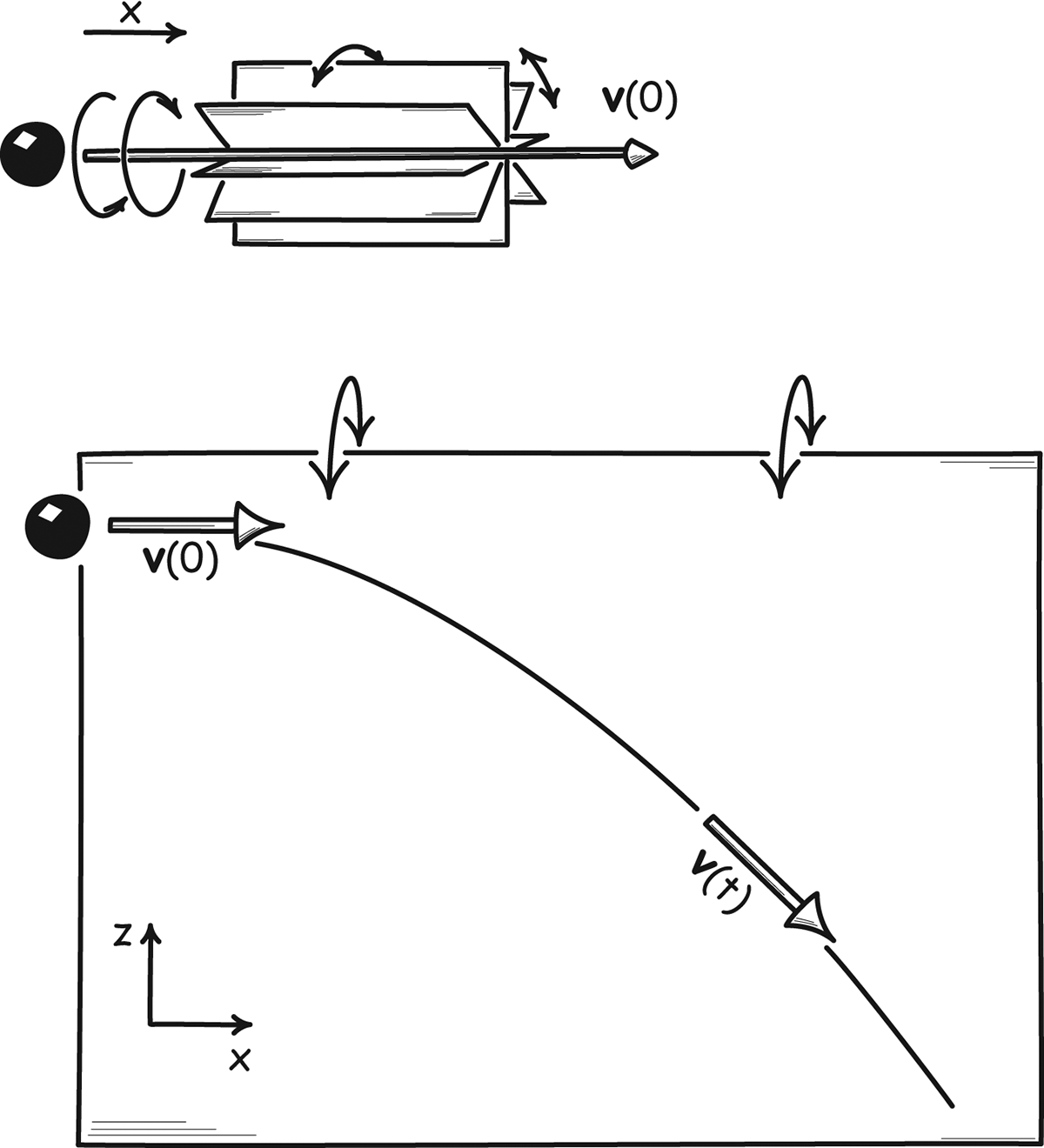
A body with initial horizontal (x direction) velocity v(0) falls vertically (–z direction) with constant acceleration g. It is mapped as follows:
| Cause | The body at the instant t = 0 moving with horizontal velocity v(0). |
| Effect | The parabolic trajectory in the x-z plane; a compounded horizontal and vertical motion. |
| Rule of dependency | Galileo’s law of fall, expressed as d v(t)/dt = −g k, where k is a unit vector in the z direction. |
Curie’s principle fails for Galileo’s law of fall, when the causal notions are mapped as indicated. The symmetries of the cause are all spatial rotations and mirror reflections that preserve v(0). However, as shown in figure 1, the effect does not manifest these symmetries. Spatial rotations about v(0) are not symmetries of the parabolic trajectory of the effect.
Symmetries of Galileo’s law of fall.

The reason for the failure is that condition CP2 of the lemma is not verified. Galileo’s law of fall does not preserve the full symmetries of the initial state. It introduces a vertical motion that violates the rotational and most mirror symmetries of the initial state about the axis of v(0).
4.2. Fall in a Gravitational Field (Success)
There is an easy way to restore Curie’s principle to the law of fall. We say that Galileo’s law of fall, as expressed in section 4.1, does not fully represent all the relevant causal processes. It introduces a preferred direction of space, the z direction, which is distinguished as vertical. We should, the restoration says, give the physical reason for this distinction. We now know that it is the presence of a gravitational field: φ = gz. Galileo’s law of fall should be replaced by the Newtonian field version:

We now map the augmented example as follows:
| Cause | The body at the instant t = 0 moving with horizontal velocity v(0); the gravitational field φ = gz. |
| Effect | The parabolic trajectory in the x-z plane; a compounded horizontal and vertical motion. |
| Rule of dependency | Galileo’s law of fall, expressed as d v(t)/dt = –∇φ = –g k, where k is a unit vector in the z direction. |
With the augmentation of the gravitational field and these new mappings, Curie’s principle succeeds. The symmetries of the cause are now greatly reduced. They are merely the symmetries common to the initial velocity v(0) and the gravitational field φ = gz. That is just the single mirror reflection that preserves the x-z plane in which the initial velocity v(0) is found. This reduced symmetry is respected by Galileo’s law of fall. The same symmetry now manifests in the effect, for the parabolic trajectory of fall is fully contained within this x-z plane.
4.3. Which Is the Real Cause?
One might be tempted to dismiss the failure of Curie’s principle in the first case as arising from an imperfect identification of the causes. Correctly identify the real cause as including the asymmetric field of the second case, and then Curie’s principle succeeds.
The temptation should be resisted. It rests on the presumption that asymmetries have to be included in causes and cannot be included in the rule of dependency.Footnote 5 That presumption conflates a familiarity with a necessity. Asymmetries in rules of dependencies do often later prove to result from other processes still; that discovery may enable the asymmetry to be moved from the rule to the cause, and it may be done in a way that conforms with CP1 and CP2. However, there is no necessity that it must always be so. A deterministic rule of dependency that breaks symmetries is unusual among physical laws, not impossible. A law of fall that includes a preferred direction in space contains no incoherence. Indeed, a more elevated example has been a fixture in the standard model of particle physics for half a century. The weak interaction violates spatial parity conservation. To formulate the physical laws governing the weak interaction, we must introduce a preferred handedness into space, much as formulation of Galileo’s law of fall requires identification of a preferred direction in space.
5. Success in Indeterministic Theories
The most mentioned failures of Curie’s principle involve indeterministic time evolutions. Two examples are presented here. Depending on the mappings used, we can render them as successes or failures of Curie’s principle.
5.1. A Probabilistically Stochastic Theory: Radioactive Decay
Consider the radioactive decay of an atom. To be specific, take the alpha decay of a heavy atom. The decay product, the alpha particle, will be projected isotropically in space, or at least it will be if we follow a Gamow-style model of alpha decay as the quantum tunneling of a particle from a spherically symmetric potential well. It will be governed by the law of radioactive decay, which asserts that the probability of decay in some small time interval dt is λdt, where λ is the decay constant. It follows that the probability density of the alpha particle being projected in angular direction θ, ɸ at time t is given byFootnote 6

This density distributes the probability of projection isotropically, that is, uniformly over the angular directions θ, ɸ. The symmetry is then broken by realization of one direction of projection.
Here are two mappings of the causal notions. One leads to failure of Curie’s principle; one leads to success of Curie’s principle.
| Curie’s principle fails | Curie’s principle succeeds | |
|---|---|---|
| Cause | Radioactive atom at t = 0. | Radioactive atom at t = 0. |
| Effect | Specific radioactive decay event in which an alpha particle is ejected at time t in direction θ, ɸ. | Probability distribution ρ(θ, ɸ, t) that an alpha particle is ejected at time t in direction θ, ɸ. |
| Rule of dependency | Spatially isotropic law of radioactive decay; symmetry-breaking projection. | Spatially isotropic law of radioactive decay. |
The “fails” column has the normal mapping. The cause, the radioactive atom, is spherically symmetric in space. The effect, the emission of an alpha particle in a particular spatial direction, violates this symmetry. Curie’s principle fails to be instantiated. The failure derives from the failure of the mappings to verify CP2. For effect, the particular time and direction of the decay, is not functionally dependent on the cause, the state of the atom at t = 0; and the rule of dependency allows the decaying alpha particle to move in a particular direction, contrary to the symmetry of the atom.
The “succeeds” column indicates another mapping. The effect is not the individual decay event, but the probability distribution to which it conforms. With this mapping, we can quickly verify that Curie’s principle succeeds. The spherical symmetry of the cause, the radioactive atom, is respected by the spatially isotropic law of radioactive decay. The new effect, the probability distribution ρ(θ, ɸ, t), manifests the spherical symmetry of the cause. Replacing the individual decay event by the probability distribution averages away the spatial anisotropy of particular effects, allowing CP2 to be verified.
5.2. A Nonprobabilistic Indeterministic Theory: The Dome
The sort of indeterminism manifested in radioactive decay is limited in the sense that the undetermined futures must conform to a probability distribution. There are many examples of a more extreme failure of determinism. The physics is indeterministic and, crucially, it provides no probability distributions to which the many admissible futures must conform. Yet we shall see that this more severe form of indeterminism is just as hospitable to Curie’s principle.
To make the analysis concrete, consider the simplest example of this sort of indeterminism: the “dome” within ordinary Newtonian physics. A radially symmetric dome has radial coordinate r along the surface of the dome and angular coordinate θ. It sits in a uniform gravitational field and is shaped so that a point at r is depressed vertically below the apex by a distance h = (2/3g)r 3/2, where g is the acceleration due to gravity. At time t = 0, a point mass that can slide frictionlessly over the dome surface is motionless at the apex, r = 0. It is easy to show (Norton Reference Norton2003, sec. 3) that Newton’s laws do not determine the future motion of the mass. It may remain forever at the apex, or, at any time t = T ≥ 0, it may spontaneously move in any direction Θ with the motion:

for Θ some constant angle. Each value of T and Θ yields a distinct motion compatible with the initial condition. The key property of the example is that Newtonian physics provides no probabilities for the different directions in which the spontaneous motion may proceed or for its timing. I have argued in Norton (Reference Wolters2010) that it cannot provide such probabilities for the timing unless we artificially add further physical structure, such as a time constant.
As before, there are mappings under which Curie’s principle fails and mappings under which it succeeds:
| Curie’s principle fails | Curie’s principle succeeds | |
|---|---|---|
| Cause | Mass–dome system at t = 0. | Mass–dome system at t = 0. |
| Effect | A particular spontaneous motion, (rT(t), θΘ(t)), for some specific T and Θ. | The set of all possible motions M = {(rT(t), θΘ(t)): all Θ, T ≥ 0}. |
| Rule of dependency | Newton’s laws of motion. | Newton’s laws of motion. |
For the “fails” case, the cause, the mass–dome system at t = 0, is symmetric under rotations of the dome around the apex. The effect, however, does not manifest this symmetry, since the motion is always in some particular direction Θ.Footnote 7 This arises since Newton’s laws turn out not to respect the rotational symmetry of this particular system (which is an unexpected outcome for those of us whose expectations are set by ordinary textbook treatments of Newtonian systems).
The change in the mapping that enables Curie’s principle to succeed is to alter what is mapped as the effect. A particular spontaneous motion is replaced by the set of all possible motions M, as indicated. This is quite analogous to the shift of the effect from a particular radioactive decay event to the probability distribution to which it conforms. This set M does manifest the rotational symmetry of the cause. That is, if R α is a rotation over the dome by angle α about the apex of the dome, then an individual spontaneous motion is mapped to a new one:

If (r T(t), θΘ(t)) is in the set M, then so is (r T(t), θΘ+α(t)). Hence, it follows that

for all angles α.Footnote 8 Thus, Curie’s principle succeeds. That Newton’s laws do not respect rotational symmetry for individual spontaneous motions is no longer a problem. Newton’s laws do respect this symmetry when applied to the set of all possible spontaneous motions, compatible with the cause.
5.3. Success and Failure for Type versus Token Causation
Once again it is tempting to protect the standard view that Curie’s principle fails for indeterministic systems by favoring one mapping of cause and effect over another. We might argue that mapping the effect to the set of all motions yields success selectively by excising just that part of the effect that would lead to failure.
The temptation should be resisted. There is no unique, correct mapping of cause and effect into the examples. Both described here are admissible. They merely correspond to different senses of cause and effect. The distinction is so familiar that the senses have different names. One is “type causation”: treatment with penicillin cures bacterial infections. The other is “token causation”: treatment of this particular patient on such and such days cured this particular patient’s bacterial infection. The two senses can separate. At the type level, smoking causes lung cancer. But it is harder to maintain that causal relation at the token level when a majority of smokers do not contract lung cancer.
In the last two examples of radioactive decay and Newtonian indeterminism, Curie’s principle succeeds for type causation and fails for token causation. The sense we select will match our purposes and perhaps whims. A smoker’s concern is his or her own specific well-being. Such a smoker may concentrate on a failure of token causation, at least in the sense that this smoker’s smoking will neither assuredly nor even probably lead to the smoker contracting lung cancer. Public health officials will focus on type causation: in general, smoking causes lung cancer in the sense that it raises the average cancer rate in the population. They seek to advance the overall health of the population; hence, for them, the averages matter.
Correspondingly, we might argue that the initial state of the radioactive atom or the dome is not properly the cause of the specific decay or spontaneous motion, but rather only of the tendencies and possibilities encoded in the probability distribution ρ(θ, ɸ, t) or set M. That view favors type causation and the success of Curie’s principle. Both Chalmers (Reference Chalmers1970, 146) and Ismael (Reference Ismael1997, sec. 6) protect Curie’s principle from failure in the case of radioactive decay in just this way.
6. Conclusion
Causal metaphysics is a troubled field. It has no content beyond an elaborate exercise in naming, that is, the attaching of causal labels to preexisting science. While evocative labeling can be conceptually helpful insofar as it aids us in forming apt mental pictures, mere labeling falls short of what causal metaphysics sometimes purports to offer: factual restrictions on all possible sciences in virtue of their causal characters.
Elsewhere (Norton, Reference Norton2003, Reference Norton, Machamer and Wolters2007, Reference Wolters2009), I have argued for the failure of efforts to locate such a factual principle of causality that usefully restricts our science. Curie’s principle is another such failure. Symmetries of a crystal lattice and imposed fields must reappear as symmetries of the crystal’s properties. Symmetries of an initial state, propagated by a symmetry-preserving rule of time evolution, must reappear as symmetries in the propagated state. However, these are not instances of a more general, factual causal principle to which all science must conform. Whether the principle succeeds or fails, I have argued, is a matter of how we choose to attach causal labels to our science. This pliability of choice is what makes Curie’s principle a pliable truth, that is, a truism, or at least it is in cases in which we deem it to succeed.