Introduction
Asthma is a chronic disease that is considered to be a major public health problem in adults, and its prevalence in western societies increased gradually during the twentieth century (Lambrecht and Hammad, Reference Lambrecht and Hammad2015). The relationship between parasitic infections and asthma may be involved in this increase. The role of parasitic infections in the development of asthma is not well understood. Although some studies suggest that parasitic infections protect against the development of asthma, others suggest that parasitic infections actually predispose an individual to asthma (Buijs et al., Reference Buijs, Borsboom and Van Gemund1994; Gonzalez-Quintela et al., Reference Gonzalez-Quintela2006; Silva et al., Reference Silva2017).
Toxocariasis is an important neglected tropical disease caused by the roundworms Toxocara canis and Toxocara cati, which are transmitted when humans ingest eggs in canine or feline faeces, respectively. Larvae penetrate the intestinal wall and then travel through the circulatory system to various organs throughout the body. Toxocara spp. do not multiply within the human host, but exist in host tissues in a state of dormancy. These helminths have a cosmopolitan distribution, and seroprevalence studies indicate that this is one of the most common helminthic infections in humans worldwide (Holland, Reference Holland2017; Ma et al., Reference Ma2018).
The zoonotic ascarid Toxocara has been suggested as a possible etiologic agent of asthma (Rubinsky-Elefant et al., Reference Rubinsky-Elefant2010). Evidence from epidemiological studies (Buijs et al., Reference Buijs, Borsboom and Van Gemund1994; Gonzalez-Quintela et al., Reference Gonzalez-Quintela2006; Silva et al., Reference Silva2017) and experimental models (Pinelli et al., Reference Pinelli2007) suggests that infection with Toxocara spp. helminths contributes to the development of allergic diseases, including asthma, which is prevalent worldwide (Pinelli and Aranzamendi, Reference Pinelli and Aranzamendi2012). A common immunological feature in allergic asthma and toxocariasis is the induction of a Th2 type of immune response characterized by the production of high levels of immunoglobulin E (IgE) and eosinophilia. Although few epidemiological studies have suggested no association between Toxocara spp. infections and asthma (Sharghi et al., Reference Sharghi2001; Gonzalez-Quintela et al., Reference Gonzalez-Quintela2006; Kustimur et al., Reference Kustimur2007; Fernando et al., Reference Fernando2009), no studies so far have reported an inverse association. The hygiene hypothesis proposes that infections with different pathogens, including helminths, confer protection against allergies (Caraballo, Reference Caraballo2018). Toxocara spp. infections, however, do not appear to protect against allergy but on the contrary may contribute to the development of this immunopathology.
The current burden of asthma due to toxocariasis in Iran is largely unknown. Therefore, the current study was conducted to determine whether the zoonotic infection acquired by ingesting Toxocara spp. eggs is associated with human asthma in north-eastern Iran.
Materials and methods
Case patients and controls were selected from clinics in Mashhad in Khorasan Razavi province in north-eastern Iran. Case patients were selected on the basis of physician-diagnosed asthma. The study was conducted between April 2016 and March 2017. The humane investigation committee at Mashhad University of Medical Sciences approved the study protocol. A questionnaire was given to each patient, with questions about their asthma status; asthma severity; risk factors for asthma, such as family history of asthma, exposure to smoking in the home, allergies to pets, race, and annual family income; and risk factors for Toxocara spp. infection, such as ownership of cats and frequency of play in playgrounds.
A 2–3 ml blood sample was collected from each patient by a physician or nurse and placed in a pediatric-size redtop tube containing no anticoagulant. After blood collection, the serum was separated and stored in a freezer at −70°C. Each sample was assigned to either the case group or the control group only after the questionnaire was completed and the blood sample obtained. The commercially available Human Toxocara IgG ELISA Kit (Automation/Cortez Diagnostics Inc., Woodland Hills, California, USA) using a purified excretory antigen from the larval stage of Toxocara spp. (E/S antigen) immunoglobulin G (IgG) was used in both groups. The specificity and sensitivity of the assay were 93.3% and 87.5%, respectively.
ELISA was conducted for Toxocara spp. infection in the Ferdowsi University of Mashhad parasitology laboratory. The laboratory was blind to the asthma status of the source of each specimen and was provided with information only about the study participant's age and sex and the date of blood collection. SPSS statistics version 16 (SPSS Inc., Chicago, IL, USA) was used for statistical analysis, with a P value of <0.05 as significant. An independent-samples t-test was used to compare antibody titre between healthy and asthmatic individuals. Chi-squared tests were conducted to examine whether the potential risk factors, including sex, age, social class, contact with pets and exposure to smoking, were associated with IgG seropositivity to Toxocara spp. and asthma.
Results
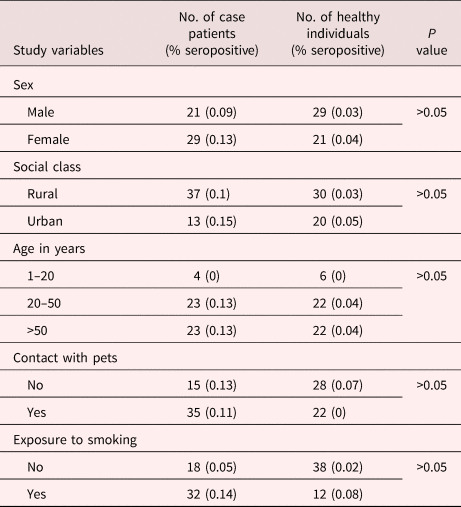
One hundred subjects (50 controls without asthma and 50 case patients with asthma) participated in the study. Distribution of age and sex among the subjects was not significant (P ≥ 0.05). The overall prevalence of Toxocara spp. infection in the study population was 8%, with a prevalence of 6% in patients with bronchial asthma and 2% in the non-asthmatic controls; this difference was not significant (P = 0.47). The demographic characteristics of the cases and controls are shown in table 1. The mean anti-Toxocara spp. antibody titre was not significantly higher in patients with bronchial asthma than in individuals without asthma (P = 0.395, 95% CI = 0.579–1.45). No significant association was found between asthma status and exposure to smoking in the home (P ≥ 0.05). Other commonly identified risk factors for Toxocara spp. infection, such as cat ownership and exposure to pets, were not found to be significantly associated with serologic evidence of toxocariasis (P ≥ 0.05). The presence of anti-Toxocara spp. IgG was associated with higher blood eosinophils, but it was not associated with asthma (P ≥ 0.05).
Associations between potential risk factors and IgG seropositivity to Toxocara spp. and asthma in 100 individuals, aged 5–70 years, in north-eastearn Iran.

Discussion
The purpose of this clinic-based case-control study was to investigate the possible association between Toxocara spp. infection and asthma. The study population comprised individuals aged 5–70 years. Additionally, this study aimed to determine or confirm the risk factors traditionally established for asthma and Toxocara spp. infection. No significant association was found between Toxocara spp. infection and asthma. This finding was in accordance with the results of a study on asthmatic children (5–15 years old) in Arak, Iran (no significant difference between the seroprevalence of anti-Toxocara antibodies and asthma was found) (Mosayebi et al., Reference Mosayebi2016). A potential weakness of the present study is the limited number of samples, which could affect the results and show no significant association between toxocariasis and asthma.
Considering asthma as the outcome and toxocariasis as the exposure, a literature analysis was performed. Studies on Toxocara spp. seropositivity in the USA (Sharghi et al., Reference Sharghi2001), Spain (Gonzalez-Quintela et al., Reference Gonzalez-Quintela2006), Turkey (Kustimur et al., Reference Kustimur2007), Sri Lanka (Fernando et al., Reference Fernando2009), Brazil (Cadore et al., Reference Cadore2016; Silva et al., Reference Silva2017), and Norway (Jõgi et al., Reference Jõgi2018) with clinical asthma showed no difference in Toxocara spp. infection between asthmatic and non-asthmatic individuals. Moreover, an assessment of the relationship between Toxocara spp. seroprevalence and asthma among healthy pregnant women in Vienna did not show significant association (Zacharasiewicz et al., Reference Zacharasiewicz2000). However, studies in the Netherlands (Buijs et al., Reference Buijs, Borsboom and Van Gemund1994), Argentina (Minvielle et al., Reference Minvielle1999) and Cuba (Kanobana et al., Reference Kanobana2013) showed a significant association between Toxocara spp. infection and asthma.
The possible role of Toxocara spp. infection in the development of asthma may be related to immune response. Several studies on toxocariasis using murine models have shown that Toxocara spp. infection leads to airway hyper-reactivity and persistent pulmonary inflammation. The common features in allergic asthma and toxocariasis are inflammation of the airways and induction of T-helper cell type 2 mediated immune responses. The literature analysis of immunologic and molecular mechanisms in an attempt to investigate whether true (statistically significant) differences exist between Toxocara spp. infection and allergic asthma is indispensable. Toxocara spp. infection occurs mainly in children who have close contact with infected household pets or who have been exposed to eggs in the environment. Consequently, adults may have had toxocariasis during their childhood and display cryptic infection; therefore the effect of Toxocara spp. may be less significant in adult-onset asthma because the risk factors may be more heterogeneous (environmental exposure, such as tobacco and occupation) than in childhood asthma.
Perhaps the most important contribution of this study is the documentation of exposure to Toxocara spp. in asthmatic patients. The overall prevalence of Toxocara spp. infection was 8%, with a prevalence of 6% in patients with bronchial asthma and 2% in the non-asthmatic controls, which was not significant (P = 0.47). The mean anti-Toxocara spp. antibody titre was not significantly higher in patients with bronchial asthma than in individuals without asthma (P = 0.395). There was no significant association between Toxocara spp. infection and risk factors such as pet ownership, number of dogs and cats to which the patient was exposed, and exposure to pets (P ≥ 0.05). Further studies are necessary to clarify human, pet and environmental interactions.
Human toxocariasis is a major public health concern in Iran, and the seroprevalence of infection documented in this study and a previous study (20.43%) (Berenji et al., Reference Berenji2016) indicates the need to enforce preventive measures and control against Toxocara spp. infection. Given the fact that Toxocara spp. infection in dogs and cats in this area is reported to be 29% and 28.8%, respectively (Borji et al., Reference Borji2011; Emamapour et al., Reference Emamapour, Borji and Nagibi2015), contact with these animals can be considered a risk factor for toxocariasis. In a previous evaluation of soil samples from Mashhad parks, 7.7% samples were positive for Toxocara spp. eggs (Berenji et al., Reference Berenji2015). In the present study, two patients had a prior history of eating unwashed fruits and vegetables, whereas they had not consumed undercooked cow or sheep liver. To control and manage human toxocariasis, deworming of dogs and cats, and public education about the sources of infection and means of reducing it, such as prevention of soil contamination by dog and cat faeces, should be considered in any endemic area. Further studies are necessary to explore the behaviour of dogs and cats in urban areas, especially defecation habits and mechanisms of exposure of humans in these areas to soil and other materials contaminated with dog and cat faeces.
In the current study, five patients suffered from increased eosinophils. However, there was no significant relationship between the seroprevalence of anti-Toxocara spp. antibody and the increased level of eosinophils (P > 0.05); this can be ascribed to the small sample size in the present study. Hypereosinophilia, however, can be a common finding in the study of Toxocara spp. infection (Fernando et al., Reference Fernando2009).
This study shares many of the epidemiological limitations encountered by other case-control studies. However, some of these limitations were minimized because case patients and controls were selected from the same clinics. Our data provide valuable information concerning the epidemiology of human toxocariasis in this region of Iran, which could be significant for management and prevention plans for this disease. Further studies with larger populations are needed to illuminate the association between Toxocara species and asthma in this area. Additional research on the molecular and immunologic mechanisms that can clarify the observed association are necessary to understand the relation between asthma and Toxocara spp. infection.
Financial support
This study was supported financially by Ferdowsi University of Mashhad, grant number 45502.
Conflict of interest
None.
Ethical standards
The study was approved by the ethical committee of Mashhad University of Medical Sciences.