





Introduction
In June 2021, while conducting an interview to collect local people’s views of the Bunyoro Kitara Kingdom (BKK) in western Uganda, an interviewee in his 30s remarked, ‘the kingdom is supposed to be there. Even if we get another president and he says that the kingdom is supposed to stop, of course, we just stop the president’ (KK int.).Footnote 1 Half a year later, on the death of the paramount chief of the Iteso Cultural Union – another traditional institution in eastern Uganda – President Yoweri Museveni praised the late chief for ‘not meddling in politics’ and further stated that ‘[w]e do not want you to form alternative governments, but rather to support us because there is already a government that was elected by your children. That way, traditional institutions will add value to Uganda’ (Okoth Reference Okoth2022). These contrasting statements capture how boundaries are continuously negotiated between Uganda’s modern government and the traditional institutions across the country.
Following their abolition in 1967 under Milton Obote – a period during which the kingdoms were not constitutionally recognised – and their statutory restoration by Museveni in 1993, Uganda’s traditional institutions have operated under strict limitations. While they achieved formal recognition under the 1995 Constitution, they remain strictly confined to cultural matters.Footnote 2 However, traditional institutions have been proven to be resilient. For instance, the Buganda Kingdom, the most powerful kingdom in central Uganda, manages economic initiatives such as organising female cooperative savings associations (CBS Pewosa 2022). Similarly, the BKK launched development projects and expanded its public presence by building the BKK Plaza in Hoima City to attract business tenants and raise money for both the city and the kingdom.Footnote 3 While aggregate national data from the Afrobarometer indicate that the citizens of Uganda have perceived a general increase in the influence of traditional authorities on local governance over the past 15 years, such macro-level trends often obscure the complex nature of legitimacy in specific local contexts.Footnote 4
The question is how traditional institutions in Uganda remain persistent or even increase their influence on local governance while navigating the structural constraints imposed by the central state. The BKK’s lack of formal resources makes this a particularly compelling case. Unlike the Buganda Kingdom, the BKK holds little financial capital or land rights because it has only partially recovered its confiscated property. In addition, unlike South Africa’s Royal Bafokeng Nation, the BKK holds no legal control over lucrative territory, although 80% of Uganda’s oil wells are in the Bunyoro sub-region.Footnote 5 Despite its formal marginalisation, the BKK continues to shape local governance, especially in the context of the economic transformation driven by oil development. While substantial scholarship has focused on well-resourced kingdoms such as Buganda and the Royal Bafokeng Nation, the persistence of marginalised traditional authorities such as the BKK remains underexplored.
This article examines how the BKK constructs its legitimacy despite constrained formal and material power. In doing so, this study does not view the BKK as a static historical entity. Instead, it conceptualises the contemporary BKK as a modern institution that actively negotiates its authority within its formal title of a ‘constitutionally recognised cultural institution’.Footnote 6 Furthermore, rather than treating the BKK as a monolithic entity, this study highlights its layered structure, showing how the relationship between the central leadership and ordinary citizens is mediated by the network of local chiefs. Based on fieldwork conducted between 2017 and 2021 – including in-depth interviews with the kingdom’s officials, as well as semi-structured interviews and focus group discussions with local Banyoro – this study shows how the BKK cultivates what I call ‘popular resources’.Footnote 7 Popular resources refer to the symbolic, cultural and relational capital cultivated by traditional authorities among communities. These are not merely residual forms of customary legitimacy; they are also actively produced and negotiated through cultural meanings, historical narratives and perceived responsiveness. The strength of the BKK lies in its ability to mobilise popular resources, draw on the collective memories of colonial and post-colonial injustices, and leverage the promise of future economic gain to foster Nyoro solidarity, which serves as a tool to claim a stake in oil extraction benefits.
Building on Kinyera and Doevenspeck (Reference Kinyera and Doevenspeck2019), I demonstrate that the BKK derives its authority not from formal power but from its role as a broker of historical grievances and future hope.Footnote 8 The remainder of this paper is organised as follows. First, I propose a framework that distinguishes between three important resources of traditional authorities: bureaucratic, territorial and popular (Ohira Reference Ohira2023). I then demonstrate that popular resources are crucial assets for the persistence of the BKK. Second, I discuss the brief history of the Bunyoro sub-region to trace the historical experiences of the BKK that inform present-day claims. Third, I examine how the BKK cultivates popular resources and reflect on how it engages local Banyoro in the reconfiguration of political power.
Theoretical framework: resources of traditional authorities
What explanatory framework is most suitable for understanding the persistence of the BKK? Recent scholarship increasingly views traditional institutions in Africa not as static remnants of the past but as dynamic institutions embedded in modern state-making. For example, Khisa and Rwengabo (Reference Khisa and Rwengabo2022) emphasise the evolving relationships between Uganda’s marginalised kingdoms and the central government, arguing that traditional institutions can increasingly function as sites of resistance and negotiation in contemporary state-building. Similarly, Sjögren (Reference Sjögren2021) shows how subnational authorities assert claims regarding the development and recognition of a contested state–citizen relationship. These studies underscore that traditional institutions are not fixed relics but rather actively reshape their roles in response to political and economic pressures. This shift focuses on what traditional authorities do in practice: how they negotiate legitimacy, authority and influence.
The endurance of traditional institutions in modern African states raises important questions about their authority, legitimacy and political adaptation. Building on the scholarship that views traditional authorities as adaptive rather than static, I propose a framework that categorises the resources available to traditional institutions into three types: bureaucratic, territorial and popular.Footnote 9 While each has explanatory value, I argue that the BKK’s persistence is best understood by examining how the constraints on bureaucratic and territorial resources compel the kingdom to strategically cultivate popular resources, a form of community-embedded legitimacy actively produced through history, identity and performance. While the framework draws on continental examples to illustrate broader patterns, the discussion devotes greater attention to Uganda to highlight how these resource types intersect in a specific national context, thereby clarifying how the category of popular resources explains the BKK’s distinct forms of influence despite the constrained material resources.
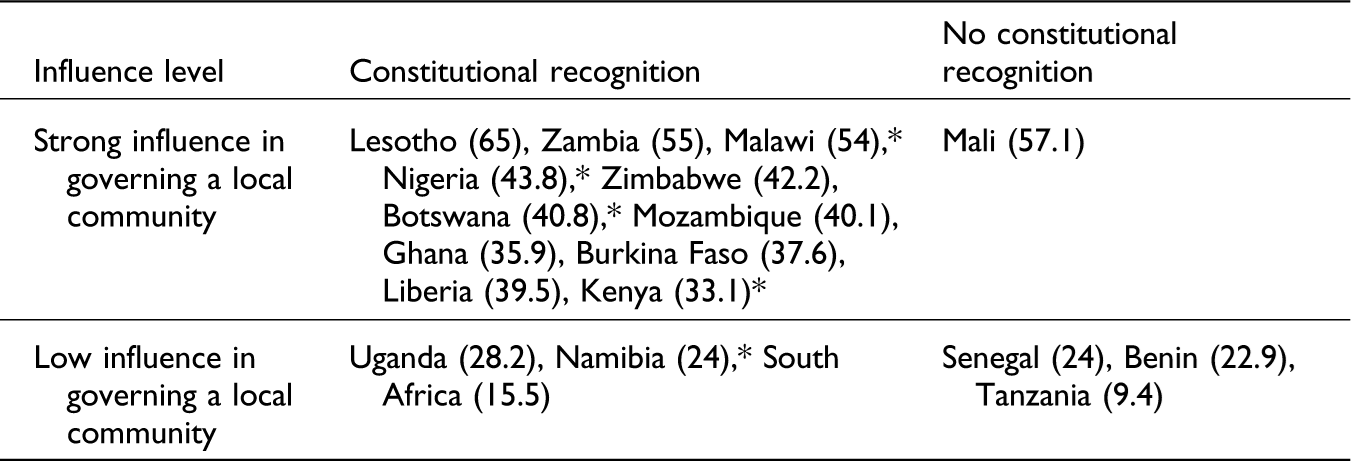
First, bureaucratic resources refer to the extent to which traditional authorities are integrated into formal governance structures. Comaroff and Comaroff (Reference Comaroff, Comaroff, Comaroff and Comaroff2018: 22) define bureaucratic resources as ‘the degree to which [traditional authorities] may interpolate themselves directly into the operation of state’. Table 1 summarises the relationship between constitutional recognition and the perceived influence of traditional authorities. In countries such as Lesotho, Zambia, Malawi and Botswana, traditional authorities are constitutionally recognised and exercise legally endorsed authority. Even where not explicitly recognised, the constitution may guarantee citizens’ rights to access customary law, thereby indirectly legitimising traditional leadership. By contrast, in countries such as Tanzania, Benin and Senegal, where traditional leaders lack constitutional mention, they are perceived as weak or politically irrelevant. Table 1 shows that, while many countries with constitutional recognition report the strong influence of traditional institutions, Uganda stands out. Despite formal recognition, its traditional institutions are perceived to wield little real power, highlighting the limits of bureaucratic resources alone.Footnote 10
Constitutional recognition and influence of traditional authorities

Table 1. Long description
A table comparing constitutional recognition and influence of traditional authorities in various countries. The table has two rows and three columns. The columns are labeled Influence level, Constitutional recognition, and No constitutional recognition. The rows are labeled Strong influence in governing a local community and Low influence in governing a local community. The table lists countries and their corresponding influence levels and constitutional recognition status. For countries with strong influence in governing a local community, constitutional recognition includes Lesotho, Zambia, Malawi, Nigeria, Zimbabwe, Botswana, Mozambique, Ghana, Burkina Faso, Liberia, and Kenya. For countries with no constitutional recognition, Mali is listed. For countries with low influence in governing a local community, constitutional recognition includes Uganda and Namibia, and South Africa. For countries with no constitutional recognition, Senegal, Benin, and Tanzania are listed.
Data sourced from Afrobarometer 2019, 2020, 2021 and each country’s constitution. The numbers between parentheses are taken from the Afrobarometer Round 8 survey. The numbers show the percentage of the respondents in the respective country who answered that their traditional authorities have a great deal of influence in governing their local community. In this table, if more than 30% of the respondents selected ‘a great deal’, traditional authorities in those countries have strong influence in governing their local community. If less than 30% of the respondents selected ‘a great deal’, traditional authorities in those countries have low influence in governing their local community. In the countries marked with asterisks (*), traditional authorities are not recognised in the constitution; however, the constitution recognises customary law and/or the customary court, which is often a domain of traditional authorities. This table originally appeared in Ohira (Reference Ohira2023).
While Chapter 16 of the 1995 Constitution formally recognises traditional authorities, their role is narrowly confined to cultural matters, as they are explicitly prohibited from exercising administrative, legislative or executive power at any level of government (Government of Uganda [GoU] 1995). Museveni’s decision to restore the kingdom was a political compromise embedded in patron–client politics: he needed support from the Buganda Kingdom to consolidate his regime, thereby forcing traditional authorities to navigate their survival strictly within these constitutional limits. This containment reflects Museveni’s clear ‘modernist and developmental visions against “traditional” authority’ (Reid Reference Reid2017: 337):
No no no, I have no problem with these monarchies but they must not interfere with the forward march because we are moving forward. These tribal kingdoms were responsible for the colonization in Africa. The colonization of Africa was a vote of no-confidence in the tribal organisations. … Those who want to have their king can have him but they must not interfere in the forward movement of Africa and not just Uganda. They must know their place (Daily Monitor 10.4. 2010).
Subsequent legislation reinforced these constraints. The 2005 constitutional amendment created regional governments in which kingdoms could exist solely for cultural purposes.Footnote 11 Furthermore, Paragraph 14, Fifth Schedule of the Constitution (amended) authorises the president to take over a regional government under certain conditions. The Buganda Kingdom was furious because the regional tier ‘allows the President to take over the administration of the kingdom if he/she sees that it’s not being run the way he/she wants’ (The Observer 27.3.2014). The 2011 Traditional or Cultural Leaders Act prohibits traditional authorities from participating in partisan politics.Footnote 12 This legal restriction effectively curtails the ability of traditional authorities to officially intervene in politics. As one interviewee put it, ‘the government wants to see these kingdoms weakened’ (KA1 2021 int.). In short, Uganda’s traditional authority possesses minimal bureaucratic resources. Lacking meaningful bureaucratic power, traditional authorities in Uganda, especially the BKK, must rely on other forms of legitimacy to remain politically relevant.
Second, territorial resources refer to control over land or material wealth. Berry (Reference Berry, Comaroff and Comaroff2018: 79) notes that the influence of traditional authorities often depends on ‘their control over territory and material resources – and their ability to influence who gets access to them, on what terms’. Ferme (Reference Ferme, Comaroff and Comaroff2018) offers a vivid example from Sierra Leone, where over 80% of the arable land is under contract with commercial agricultural corporations. Paramount chiefs play a crucial role in these transactions, and their consultations and signatures are required for any land arrangement. As commercial agriculture expands, so does the value of land and, with it, the authority of paramount chiefs. In South Africa, the Royal Bafokeng Nation illustrates another case: by holding the title to land with platinum reserves, it maintains substantial wealth and influence (Cook Reference Cook, Comaroff and Comaroff2018). Within Uganda, the Buganda Kingdom also benefits from territorial resources due to regaining valuable land in and around the capital city upon restoration.Footnote 13
By contrast, the BKK possesses almost no territorial leverage. Although Uganda launched its commercial oil development in 2006 and more than 80% of the oil wells lie in the Bunyoro sub-region, the central government retains exclusive control over the land on which oil wells are located and the associated revenues. Commercial oil production is yet to begin; even once it does, the BKK is entitled to only 1% of the national oil revenues (GoU 2015).Footnote 14 Crucially, as Patey (Reference Patey2015: 36) highlights, this 1% share of royalties represents a severe constraint on the kingdom’s material demand, which initially stood at 12.5%. Furthermore, although this 1% share is projected to eventually yield millions of dollars per annum, such potential revenues remain frozen in the current phase. Smith, Tallontire and Alstine (Reference Smith, Tallontire and Alstine2025) argue that because the region has been trapped in a protracted ‘pre-production phase’ for nearly two decades, actual financial flows remain suspended. In this state of temporal deferral, even legally acknowledged entitlements to oil royalties are held under tight central government control, rendering them unavailable as active territorial leverage for the BKK. Therefore, despite the transformative promise of oil development, these territorial constraints underscore that such resources alone cannot explain the BKK’s current persistence or increasing influence.
Third, popular resources refer to the symbolic, cultural and relational capital that traditional authorities cultivate in their communities. These resources are rooted in the shared identity, historical narrative and the perception that traditional leaders represent and respond to people’s interests. A growing body of research has highlighted the importance of such resources. For example, Wilfahrt and Lesta (Reference Wilfahrt and Lesta2023) emphasise how local legitimacy hinges on performance and social embeddedness rather than formal institutional design. Similarly, Logan (Reference Logan2013) and Baldwin (Reference Baldwin2016) show that traditional leaders often derive legitimacy from responsiveness and integration in everyday community life, not from their legal authority. Herbst (Reference Herbst2000: 180) also notes that ‘[m]uch of chiefs’ power seems to stem from popular legitimacy, a notoriously difficult concept to operationalize’.
Importantly, popular resources are neither fixed nor passively inherited. They are cultivated and contested on the basis of their performance and responsiveness. Logan (Reference Logan2013) suggests that these leaders produce intrinsic benefits by reinforcing social cohesion and cultural continuity. Comaroff and Comaroff (Reference Comaroff, Comaroff, Comaroff and Comaroff2018: 14) argue that traditional authorities increasingly rely on ‘sources utterly un-“traditional”’ to sustain relevance. Others, including Ray et al. (Reference Ray, Quinlan, Sharma and Clarke2011) and Kleist (Reference Kleist2011), emphasise how traditional authorities actively redesign their offices to remain legitimate. For Zimbabwe, Alexander (Reference Alexander, Comaroff and Comaroff2018) notes that durability does not rest on stasis but on adapting to shifting expectations.
Popular resources constitute the most critical assets of the BKK, functioning in a dynamic combination with its circumscribed formal capacities. The kingdom’s bureaucratic and territorial resources are curtailed by national legislation and the structural delays of the oil sector’s pre-production phase. Compelled by these institutional and material constraints, the kingdom has survived by mobilising the collective memory, articulating shared grievances and positioning itself as a cultural and political voice for Banyoro. This strategic deployment of popular legitimacy is not a passive reaction to marginalisation but an active adaptation to stay politically relevant. Understanding how traditional authorities persist in contemporary Africa, particularly those lacking formal power, requires paying closer attention to how popular resources are cultivated and how authority is negotiated.
The BKK, its history and historical injustice
The BKK is one of Africa’s oldest kingdoms. According to oral history, it originated from the Great Kitara Empire in the 7th century, believed to have stretched from modern Sudan in the north to Lake Victoria in the south and from the Congo Basin to western Kenya (Southall Reference Southall1972). Although mythic in scale, this historical imagination plays a crucial role in how the BKK constructed its symbolic capital. The Bito eventually consolidated power in the 14th century, marking the beginning of the BKK. The royal lineage endures to the present day, with the Bito still serving as the ruling clan for the kingdom. While the influence of the BKK declined over time, it experienced a resurgence in the 19th century under two strong rulers: Kyebambe IV Kamurasi and his son Chwa II Kabalega.
Kabalega is particularly revered in contemporary Bunyoro, where his legacy remains central to the local political identity. Through long-distance trade and military organisation, he resisted British colonial forces until he was captured and exiled to the Seychelles in 1899. His defiance remained central to Bunyoro’s historical identity. After his defeat, the colonial administration treated Bunyoro as a conquered and marginalised territory. The Bunyoro Agreement – concluded only in 1933, decades after similar agreements with Buganda, Toro and Ankole – symbolised this secondary status.Footnote 15
Bunyoro has also experienced two profound historical injustices. First, the colonial government imposed the Buganda governance system, which reinforced local resentment. Colonial records vividly illustrate the paternalistic disdain that justified this alien imposition. Deputy Commissioner of the Uganda Protectorate, George Wilson, noted that the intervention was necessary to cope with the ‘benighted ignorance and the low intriguing habits of the Chiefs and people’ (The National Archives [TNA] 1907: CO536/13). The Baganda were thus brought to Bunyoro to instruct the BKK government in 1900. In the early 1900s, Ganda chiefs’ dominance escalated, resulting in the Nyangire Revolt of 1907. ‘Nyangire Abaganda’ literally means ‘I have refused the Baganda’. Nyoro peasants, facing exploitative taxes and forced labour under the Ganda chiefs, petitioned for their removal and attacked their homes, burning huts and slashing crops. Wilson suppressed the revolt and ordered the arrest of 54 Nyoro chiefs and their followers, who were dispatched to Kampala as political prisoners (TNA 1907: CO536/13). While the majority were eventually allowed to return, colonial authorities identified ten sub-chiefs as the primary instigators and ordered their immediate deportation to isolate the unrest (TNA 1907: CO536/13).
Second, the so-called lost counties issue continues to shape Banyoro’s historical consciousness. The lost counties refer to the six counties, representing roughly 15,540 square kilometres of the BKK, transferred to the Buganda Kingdom without the BKK’s consent under the 1900 Buganda Agreement. The origin of the lost counties issue goes back to 1894, when Henry Colvile, the Commissioner, promised the Baganda chiefs to incorporate the six counties into the Buganda Kingdom and divide them equally between Protestant and Catholic chiefs (GoU 1962: 3). The Bunyoro in the lost counties, particularly those in Buyaga and Bugangaizi, whose population was predominantly Banyoro, endured harsh treatment and ‘Anglo-Baganda Colonialism’ (Southall Reference Southall1972: 14).Footnote 16 In the early period of the Baganda occupation of the lost counties, the Baganda chiefs ‘used the most inhuman measures of beating, making [the Banyoro] carry very heavy stones, tying [the Banyoro] to trees like goats, and many other forms of torture so as to enforce their rule’ (Karugire Reference Karugire1980: 210). Despite repeated petitions by the BKK between 1901 and 1954, the lost counties did not return to Bunyoro (GoU 1962: 5).
In addition to the official petitions by the BKK, local inhabitants also organised their own movements. Formed around 1921 by Zakaliya Lugangwa, the Mubende Banyoro Nyinaitwe Committee (MBC) sustained a persistent campaign for over 40 years (TNA 1948–1956: FCO 141/18324; TNA 1930–1952: FCO141/18325).Footnote 17 The MBC sent numerous petitions to the colonial administration, describing their situation under the Buganda Government as ‘hereditary bondage’ and ‘slavery’ (TNA 1948–1956: FCO141/18324; TNA 1930–1952: FCO 141/18325). While both British and Ganda authorities repeatedly rejected these claims, stating that there was ‘no substance in their complaints’ (TNA 1930–1952: FCO141/18325), the Nyoro inhabitants in the lost counties maintained their identity and resistance.
By the dawn of independence in 1961, the colonial government acknowledged that the Banyoro still maintained an overwhelming demographic dominance in the core disputed territories, notably numbering over 33,000 Banyoro against a mere 2,300 Baganda in Buyaga alone (TNA 1961: FCO141/18331). Consequently, the Munster Relationship Commission recommended that the issue should be resolved via a referendum (TNA 1961: FCO141/18331). Though the Buganda Kingdom insisted that ‘the only way that those counties could be transferred to Bunyoro would be if a flood (Mukoka in Luganda) physically carried them into Bunyoro’ (Karugire Reference Karugire1980: 175), a referendum took place on 4 November 1964, and with overwhelming votes in favour, Buyaga and Bugangaizi were formally returned to the BKK on 1 January 1965. Buganda’s resistance to the handover deepened Banyoro’s perception of the long-standing injustice.
Bunyoro also suffered from systematic economic marginalisation. As the Protectorate Government’s policy was that ‘economically backward areas’ such as Bunyoro did not deserve major transportation development (Doyle Reference Doyle2006a: 127), infrastructure was neglected. The colonial government deliberately delayed the introduction of cash crops in Bunyoro. Simultaneously, Bunyoro experienced a population decline that was more severe than anywhere else in colonial Uganda, a demographic crisis rooted in the extreme intensity of colonial conquest, environmental destruction and the spread of endemic disease (Doyle Reference Doyle2000). These layers of political, territorial and economic subjugation – including delayed legal recognition, foreign rule, the lost counties issue and uneven development – form the foundation of BKK’s contemporary claims to legitimacy. These experiences of loss, subjugation and exclusion are not simply remembered as historical facts. They are strategically mobilised in contemporary Bunyoro to justify claims for recognition, resources and regional influence.
These historical narratives continue to resonate deeply. More than a century after the beginning of the colonial administration in Uganda, the current Prime Minister of the BKK, Andrew Byakutaga, made opening remarks at a meeting stating how great King Kabalega was and how Bunyoro had suffered for centuries.Footnote 18 He noted that the routine destruction of the Nyoro culture and forced labour were ‘historical facts’ and that Bunyoro suffered from population reduction during the colonial period because many Banyoro fled to other parts of Uganda to escape from forced labour and famine.Footnote 19 Many interviewees echoed the Prime Minister’s view regardless of the interviewees’ specific backgrounds, suggesting that these historical narratives are deeply embedded in the contemporary Banyoro consciousness (KM1 2019 int.; KA2 2019 int.; NN 2019 int.; IK2 2021 int.; NN 2021 int.; FGD1 2019 int.; FGD2 2021 int.; FGD3 2021 int.; FGD4 2021 int.).Footnote 20 One interviewee estimated Bunyoro’s precolonial population to be three million, which was reduced to 100,000 under colonial rule (FGD3, 2021 int.). Although I could not confirm the validity of this statement,Footnote 21 the interviewee mentioned these numbers to emphasise colonial injustice. Another interviewee mentioned that ‘the population was dying’, and another stated that ‘the colonialist killed a lot of us. … [Because of Kabalega’s resistance,] they were punishing us, and they killed lots of animals, too, lots of cows’ (NN 2019 int.; IK2 2021 int.).
Such memories do not only pertain to the past. They form a core part of the BKK’s popular resources and help to sustain contemporary legitimacy. Across generations, local Banyoro express pride in being Nyoro and in the kingdom’s lineage. As a young interviewee in his 20s put it, ‘[t]o me, the king is almost our God. To the extent we may treasure the king and the kingdom more than the president’ (MJ1 2021 int.).Footnote 22 Their loyalty partly stems from the BKK’s long history and that of King Kabalega. Within the BKK’s administrative structure, officials frequently invoke this memory to assert the kingdom’s historical primacy. As one county chief noted:
The Bunyoro Kitara Kingdom was ruling the whole of Uganda and some parts beyond. … The king was Kabalega. All power rested in Kabalega. So, Kabalega was uniting the whole of Uganda. … Kabaka of Buganda, Toro, Busoga, Nyankole, all their leaders came from Hoima, Bunyoro. This is the origin. The Omukama of Bunyoro is the head of all kings of Uganda (KM1 2019 int.).Footnote 23
This sentiment was echoed by the General Secretary of one of Bunyoro’s biggest clans, who emphasised Kabalega’s transcendent role, stating that ‘Kabalega was almost the whole world’ (AK 2021 int.). Although Kabalega’s resistance to the European invasion provoked colonial punishment, Banyoro saw him as a hero. His defiance has become a source of moral legitimacy. The BKK’s contemporary authority draws strength from this historical memory. As the following section shows, the BKK and local Banyoro actively cultivate their past, not as a static tradition but as a form of political capital. Through collective memory and the promise of future development, they reaffirm the relevance of the kingdom to contemporary Uganda.
Collective memories of historical injustice and the prospect of economic gain
This section explores how historical memories of injustice are not simply preserved but actively invoked to support present-day demands for economic inclusion and development. Such memories of loss and marginalisation are voiced vividly by local Banyoro, who link past injustices to contemporary struggles for dignity and opportunity. As one of the kingdom’s chiefs noted:
We lost something very sacred, some values, and respect for leaders. At the beginning, the Omukama was highly respected. But when politicians came in, and the kingdom was abolished, the kings lost their honour. People began not to respect them, and young ones did not know who the Omukama is, who chiefs are and that is still continuing with young boys and girls. They don’t respect the chiefs (KM1 2019 int.).
For decades, after the restoration of the kingdoms, the Bunyoro sub-region remained politically and economically marginalised. The BKK primarily functioned as a cultural institution with limited visibility or influence. Some Banyoro felt that the kingdom had done ‘nothing’ for the people (MB 2019 int.; MR 2019 int.). A local Munyoro remarked, ‘[s]ince [the kingdom] was restored, we have not benefited at all. We, the local people, have not benefited at all from the kingdom. Anything at all, nothing, other than a few children are getting bursaries’ (IK2 2019 int.). The chiefs also reported a lack of respect, especially compared to their status before 1967. Rebuilding trust and legitimacy – both within the BKK’s formal administrative structure and across its grassroots engagement – has proven difficult in the decades following the abolition.
The turning point occurred in 2006. The government’s decision to develop commercial oil production was a ‘wake-up call’ for the BKK leadership, who perceived this as a critical opportunity to reclaim the kingdom’s political relevance (Byakutaga 2019 int.). With 80% of Uganda’s oil located in the region, Bunyoro shifted from a marginalised periphery to an economic frontier. Newspaper coverage surged. From 1986 to 2006, there were 109 articles on the BKK, mostly on the kingdom’s restoration. However, 87 articles were published in 2006 alone, many concerning oil and land conflicts and Bunyoro’s political voice.Footnote 24 According to Prime Minister Byakutaga, nearly USD 30 billion was invested in Hoima – ‘something that never happened, ever’ (Byakutaga 2019 int.). In his words, oil development brought about ‘economic transformation’ (Byakutaga 2019 int.). New infrastructure – paved roads, airports, refineries, oil pipelines, hotels and new bank branches – gave the kingdom a tangible platform to negotiate its position. BKK officials could now physically host government ministers and corporate executives in the region, leveraging the promise of oil to shift their role from passive cultural custodians to active brokers in the negotiation of land rights, employment opportunities and local content requirements.
The BKK’s response to oil development reflects broader dynamics in African resource politics, where oil discoveries often reconfigure local claims to legitimacy and access. Scholars such as Watts (Reference Watts2004) and Auty (Reference Auty1993) have explored how resource wealth can generate new forms of political bargaining and institutional transformation, sometimes consolidating state power and empowering local actors. In Uganda, the anticipation of oil has catalysed both elite negotiation and grassroots mobilisation (Kinyera & Doevenspeck Reference Kinyera and Doevenspeck2019). Within this framework, the BKK has positioned itself to act as a moral and cultural claimant to the benefits of extraction.
The oil boom gave the BKK a chance to reposition itself not just as a cultural authority but also as a moral claimant to the region’s right to development. The kingdom began advocating for a share of oil revenues and emphasising its role in representing local interests. When the European Union called for the suspension of the pipeline project in 2022, Byakutaga responded by linking past suffering to present entitlement:
It is an opportunity for us. An opportunity for us to develop. We suffered for very many years, actually hundreds of years. I don’t have to go into the history. It is very painful, but also it is very fresh in our memories. So, when people, especially foreigners sitting in foreign capitals, start making resolutions, which affect our well-being, affecting [the] quality of lives of our people, we find that very disturbing and very bothering (NTV Uganda 15.10.2022).Footnote 25
By positioning the BKK as a defender of local development against foreign interference, this statement encapsulates a core strategic narrative that Bunyoro has the right to development as compensation for historical injustice. In this context, the BKK leadership operates as an active broker, strategically mobilising the past not merely to remember, but to legitimise its demands for future economic benefits. This brokerage role is further exemplified by the kingdom’s attempts to monetise its historical grievances through legal and diplomatic channels. The BKK leadership threatened to sue the British government for colonial injustices and the Ugandan government over resource exploitation (BBC News 2.3.2004; The Observer 2013). While these attempts were pursued by the kingdom’s leadership, translating such claims into grassroots solidarity requires local intermediaries.
To communicate the kingdom’s claim to development as a historical redress, the kingdom’s chiefs play a vital role. While Figure 1 presents the formal hierarchy of the BKK, in practice, the effectiveness of the institutions rests heavily on these chiefs, whose day-to-day roles as intermediaries often compensate for the limited operational functionality of the Parliament as a collective body. Also, chiefs help bridge the disconnect between the kingdom’s central leadership and its grassroots constituency. When I conducted the interviews in 2019 and 2021, almost none of the local Banyoro I spoke with had met the king or prime minister in person, except during public ceremonies.Footnote 26 By contrast, chiefs – from the county to the village level – serve as key intermediaries. They represent the king at funerals, weddings and community meetings, delivering messages on cultural preservation, health, environmental issues and, increasingly, the right to benefit from oil (KM1 2019 int.; KA2 2019 int.; KF 2019 int.; FGD1 2019 int.; IK1 2021 int.). In this capacity, they do not merely convey top-down directives; they act as crucial nodes in a network, translating the kingdom’s claims for historical rootedness into tangible expectations for local development.
Structure of the BKK.
Interviews with the BKK prime minister. During the interview period (2019–2021), the Parliament had not yet resumed regular meetings with the chiefs at different levels. This figure originally appeared in Ohira (Reference Ohira2023) and was modified by the author.

However, this system faces several challenges. Since the kingdom’s restoration in 1994, some chiefs were criticised as ‘jacket ministers’ – inactive title-holders lacking commitment (NN 2019 int.).Footnote 27 Because chiefs work voluntarily and receive no salary from the kingdom, their performance depends heavily on their personal dedication and local respect. Recently, the BKK has made deliberate efforts to replace disengaged chiefs with more active figures. Chief Isaac, appointed in October 2018 as a sub-county chief, described his new role as ‘prestigious’ and a source of pride (IK1, 2021 int.). Chief Alex, also appointed in 2018, credited his promotion to hard work: ‘I was very happy, because I am a Munyoro and serving the kingdom’ (KA2 2019 int.). Although unpaid, these hardworking chiefs were widely welcomed by their communities. By revitalising this chief network, the BKK leadership has not only enhanced its capacity to convey royal messages but also effectively secured local-level agents who are motivated to navigate the complex opportunities emerging from the oil economy.Footnote 28
Some chiefs and the local Banyoro explained that one of the king’s recent messages to Banyoro is ‘to multiply’: ‘We want to multiply more. I want us to multiply. The King wants us to multiply, so there are many. … When we are many, we become stronger’ (IK1 2021 int.). This message may seem symbolic, but it reflects deeper anxieties about the demographic presence and political visibility of the Banyoro. For the BKK, increasing the number of Banyoro is not just a cultural aspiration; it is part of a strategy to reinforce collective identity and strengthen the kingdom’s claim to political recognition and economic entitlement.
The latest census estimates that Banyoro make up 5.8% of the total population of Uganda, but only 2.8% identify as ethnically Banyoro (Uganda Bureau of Statistics 2016). These numbers were challenged by the BKK. At the time, Prime Minister Norman Lukumu publicly disputed the census results, arguing that the figures underrepresent the kingdom and risked reducing Banyoro to a ‘minority group’ (Kahungu Reference Kahungu2017).Footnote 29 The BKK parliament even proposed conducting its own census to determine the true number of Banyoro (Kahungu Reference Kahungu2017). These efforts underscore how the BKK links demographic strength to recognition and inclusion, believing that a larger, more visible Nyoro population will strengthen the kingdom’s voice in national affairs.
Many local Banyoro view oil development as an opportunity to improve their livelihood. The region’s unemployment rate is one of the highest in the country (14.5%) and the third highest among Uganda’s 15 sub-regions.Footnote 30 Anticipating oil-sector jobs in construction, logistics and skilled labour, local Banyoro increasingly view their ethnic identity and connection to the kingdom as strategic assets. The BKK petitioned the central government for ‘at least a certain percentage of job opportunities to be given to the sons and daughters of Bunyoro’ (MJ2 2021 int.).
This link among oil, ethnic identity and employment also exists at the local level. The vice-chairman of a local government at the village level explained that he was overwhelmed by requests for job recommendation letters, verifying that the applicants were from Bunyoro:
Right now, the number of letters recommending them is on high speed. … [Letters] to prove that you are from here. I recommend them. … Someone else, for example, from Buganda, not a Munyoro won’t get considered. Once [job interviewers] know that this one is a real Munyoro, part of the kingdom, they consider that one first (MJ2 2021 int.).
Being identified as Munyoro – and being visibly affiliated with the kingdom – has become a practical strategy for securing oil sector jobs. Because of the BKK’s recent innovations – replacing the chiefs to function as a bridge between the kingdom and people, petitioning to the central government to secure jobs for Banyoro, and showing that the kingdom works for the local population – local Banyoro ‘trust the kingdom very much’ (FGD2 2021 int.). It is noteworthy that the same person who stated in 2019 that local Banyoro had ‘not benefited at all from the kingdom’ later described in 2021 that ‘[t]he kingdom is for the local people’ and what the kingdom is doing is to develop Bunyoro (IK2 2019 int.; IK2 2021 int.).Footnote 31 This insistence on Nyoro identity to secure job opportunities closely resonates with the concept of autochthony (Busisa Reference Busisa2022). What is crucial here is that within the BKK’s strategy, this discourse of belonging does not function merely as an abstract exclusionary ideology. Instead, as demonstrated by the shifting perceptions of the local population, it is practically operationalised as part of the popular resources to secure tangible economic benefits while simultaneously rebuilding grassroots trust in the kingdom.
If the kingdom is able to offer access to jobs or tangible benefits from oil development in the near future, the local Banyoro have strong reasons to affiliate with the kingdom by embracing its messages, invoking collective memories of historical injustice and affirming loyalty. Twenty years have passed since Uganda was formally committed to commercial oil production, but oil is yet to flow. However, development is increasingly visible: roads have been paved, Hoima Airport, refineries and pipelines are under construction, and bank branches and new hotels have emerged. For the local Banyoro, who have endured generations of economic and political marginalisation, these changes signal long-awaited opportunities.
Despite lacking bureaucratic or territorial resources, the BKK has reasserted itself as a vehicle for Banyoro’s voice, although not all segments of the community may be equally represented in its messaging. Currently, that voice centres on access to oil-related employment and demands for a fair share of the wealth being generated in their region, home to over 80% of Uganda’s oil wells. By positioning itself as an institutional bridge between local claims and national resources, the BKK demonstrates that, even without formal power, it can play a meaningful role in Uganda’s ongoing economic transformation.
This evolving relationship between the BKK and the local Banyoro reveals a deeper dialectic. As Feierman (Reference Feierman1990: 4) notes, ‘[t]he forms of discourse survive because they are used by peasant intellectuals’. In Bunyoro, the local Banyoro are not passive recipients of the kingdom’s rhetoric. They participate actively in shaping and sustaining it. Feierman (Reference Feierman1990: 18) describes the historical roles of local citizens at moments of leadership, organisation and direction. Bunyoro is currently experiencing unprecedented economic transformation. Both the BKK and local Banyoro are seizing the opportunity to revitalise Nyoro solidarity, drawing on memories of the past to direct it toward a more prosperous Bunyoro. With renewed Nyoro solidarity, the BKK is better positioned to leverage popular resources to negotiate its political space within Uganda. As Bunyoro’s economic significance increased through oil development, the central government, under Museveni or his successor, could no longer ignore Bunyoro’s coherent and historically grounded demand for economic benefits.
Conclusions
In 1947, J. W. Nyakatura, author of Anatomy of an African Kingdom: A History of Bunyoro Kitara, lamented that Nyoro children were no longer taught the history of Kitara (Nyakatura Reference Nyakatura1973).Footnote 32 He recalled that, before colonisation, the young Banyoro learned the past ‘from eminent chiefs and army leaders [who were well known in the country and within reach of almost everyone]’ (Nyakatura Reference Nyakatura1973: ix). By the time kingdoms were abolished in 1967, Southall (Reference Southall1972: 51, 52) noted that ‘the loss of the Omukama (king) was muted’, since the monarchy ‘had long ceased to have any great political significance’. If the king and his chiefs had already lost their importance by the mid-twentieth century, and local Banyoro reacted quietly to the abolition, the question of how ‘Bunyoroness’ – the cultural and political identity tied to the kingdom – has endured and revived in contemporary Bunyoro remains a puzzle.
Inspired by Lonsdale (Reference Lonsdale and Breuilly2013: 319), who asks ‘[w]hen and how patriotic pasts [are] chosen south of Sahara’, this study examined how the BKK cultivates its popular resources in modern Uganda. It also argued that both the past and future matter in the dialectic relationship between the BKK and the local Banyoro. To reconnect with the local Banyoro, the BKK has reconstructed the role of its chiefs, replacing inactive figures with more respected and committed ones. Because chiefs serve as intermediaries between the monarchy and everyday life, their legitimacy reinforces the kingdom. While contemporary chiefs may not play as central a role as their precolonial predecessors, as Lonsdale (Reference Lonsdale and Breuilly2013: 319) points out, ‘in Africa, these memories lie in shallow graves’. Particularly, in Bunyoro, historical grievances over the lost counties issue are often resurrected and reinterpreted to claim legitimacy and shape local and national dynamics both in colonial and contemporary Uganda (Doyle Reference Doyle2006b, Reference Doyle2009; Green Reference Green2008; Peterson Reference Peterson2015). When facing transformative changes such as oil development, these memories are operationalised as capital through the strategic mobilisation of the past to claim that development is a right. Remarkably, the young Banyoro whom I interviewed, many of whom were born after the abolition of the kingdom, expressed a high level of loyalty to the king. They viewed the kingdom as a legitimate voice: ‘Through the kingdom, we raise our voice to the president because the kingdom is valid. … If the kingdom clears out our voice, it will be heard’ (BN 2021 int.). Showing solidarity with the BKK is Banyoro’s local strategy for navigating change and claiming future benefits.
Does the growing Nyoro solidarity challenge the Museveni regime? In June 2021, for the first time in his 35 years, Museveni appointed a prime minister from the Bunyoro sub-region, a move widely welcomed by the Banyoro. In April 2023, the central government announced that the Hoima International Airport would be renamed Kabalega International Airport (Ruhweza Reference Ruhweza2023). The decision came just as Banyoro prepared to mark the centenary of Kabalega’s death, and many publicly thanked the president (Ruhweza Reference Ruhweza2023). In this sense, Museveni acted to appease Banyoro sentiment. A young Munyoro may not be able to ‘stop the president’, but the growing solidarity between the BKK and local citizens has elevated Bunyoro’s importance as a political constituency, and the BKK plays a central role in that shift. In the foreseeable future, the BKK will probably continue to persist and consolidate its political significance.
It has been 40 years since Museveni came to power. His consolidation of state control has long included strategic relationships with traditional authorities. At the same time, the evolving relationship with the BKK reveals how traditional institutions can be co-opted into dominant party systems, serving both as symbols of local legitimacy and channels of strategic accommodation. The BKK’s claims do not overtly threaten the regime but rather invite negotiated inclusion. Whether this fosters bottom-up accountability or entrenches the clientelist dynamics remains unclear. Nevertheless, this suggests that a hybrid political authority is a flexible element in how legitimacy is negotiated and sustained in contemporary African states.
Because of its centrality and historical weight, much of the scholarship on these dynamics has focused on the Buganda Kingdom. Earlier studies on the Buganda Kingdom analyse its reinvention as a ‘cultural kingdom’ (Karlström Reference Karlström1999) and examine the structural limitations in translating symbolic capital into tangible developmental benefits despite territorial resources (Englebert Reference Englebert2002). More recent studies pay close attention to the kingdom’s federalist aspirations and tensions with the regime (Goodfellow & Lindemann Reference Goodfellow and Lindemann2013; Kasfir Reference Kasfir2019; Johannessen Reference Johannessen2006; Sjögren Reference Sjögren2021). However, recent work on the Rwenzuru Kingdom in southwestern Uganda (Khisa & Rwengabo Reference Khisa and Rwengabo2022) suggests that the relationship between the state and traditional authorities in peripheral or marginalised sub-regions is becoming increasingly central to state-building. This study contributes to this shift by highlighting the evolving relationship between the BKK and the central government – one entangled in history, revived through collective memory, and activated through economic transformation. This study also refines the existing models of traditional legitimacy by developing the concept of popular resources. Specifically, it demonstrates how authority can be continually produced through narratives, responsiveness and performative alignment with community aspirations. It thus expands our understanding of traditional authority, not simply as a residual institution, but as a strategic and adaptive actor in contemporary political life.
The BKK’s story is not isolated. Across Africa, traditional institutions such as chieftaincies in Ghana have similarly reasserted themselves – not merely as cultural remnants but as actors in resource governance, development planning and political representation (Berry Reference Berry, Comaroff and Comaroff2018). As state power and the distribution of development benefits are increasingly contested across the continent, traditional institutions are reemerging as meaningful players. Their persistence cannot be explained solely through customs or legality, but also through ongoing work on cultivating popular resources. Understanding these dynamics in places such as Bunyoro may offer broader insights into how authority is reassembled in modern African states.
However, this study has some limitations. While it offers a detailed account of the BKK’s evolving legitimacy, it is based primarily on qualitative data collected from one region during a specific period. It does not fully capture how popular resources may be cultivated – or contested – across generational, gendered or urban–rural variations. Future research should explore these dimensions within Uganda and extend comparative inquiries across other traditional institutions to examine how different configurations of authority, memory and development shape legitimacy across the continent.
Acknowledgements
This paper is based on a presentation by the author at the Harvard University Center for African Studies/Harvard-Yenching Institute Fellows Colloquium on 27 April 2023. The author is grateful for all the comments and questions received at the Colloquium.
Competing interests
The author declares none.


 Open access

