


Introduction
Recognizing the slow pace and low success rate of translating biomedical research findings into clinical practice, leading federal agencies and organizations have attempted to address this problem by enacting new policies and special programs [Reference Zerhouni1–Reference Collins3]. The National Institutes of Health (NIH) National Center for Advancing Translational Sciences (NCATS) was established in 2011 to address the pressing need to accelerate and enhance the process of advancing medical and public health research findings to clinical practice and disseminating interventions that optimize medical care outcomes and improve public health in communities [Reference Vogel, Knebel, Faupel-Badger, Portilla and Simeonov4]. To achieve its mission, NCATS provides leadership and funds a variety of programs to advance translational science (TS) [Reference Vogel, Knebel, Faupel-Badger, Portilla and Simeonov4–Reference Vogel, Hussain and Faupel-Badger7], which refers to translational discoveries that result in generalizable knowledge and operationalizable principles that will speed up and/or make future research more efficient [Reference Collins3,Reference Curry8–Reference Zerhouni11]. Translational research (TR), in contrast, is defined by NCATS as the endeavor to traverse a particular step of the translation process for a particular target of disease or condition. TR shares some similarities with TS in that they both focus on bridging the gap between scientific discoveries and real-world applications in medicine and healthcare [Reference Ioachimescu and Shaker9,Reference Austin12,Reference Austin13]. While TS and TR are distinct in their definitions and priorities, their overlapping efforts and the frequent interchange of these terms often lead to confusion and challenges among researchers and other stakeholders in the field, as highlighted by Christopher Austin, former Director of NCATS, who noted that NCATS “undertook a deliberate process to define ‘translation’ and its congeners ‘translational research’ and ‘translational science’, and emphasized that while it studies the first (translation) as a process, and performs the second (translational research), what distinguishes [NCATS] from any other organization in the USA or internationally is its focus on the third – translational science – as a discipline [Reference Austin14].”
The Clinical and Translational Science Award (CTSA) Program supports a national network of medical institutions that speeds the translation of research discoveries into improved care and public health. As of 2025, more than 60 leading US medical institutions are funded by the CTSA Program. Although CTSA-funded hubs are designed and managed by different institutions, each hub provides core services to researchers and trainees, including shared research infrastructure, collaboration tools, training and educational opportunities, administrative support (e.g., streamlining Institutional Review Board approvals or data safety monitoring boards), and research funding programs [15]. One of the major activities of all CTSA hubs is administering Pilot Programs that provide seed funding and support to researchers to develop preliminary data, test new methodologies, and foster collaborations, ultimately aiming for subsequent larger, externally funded projects [16]. These Pilot Programs play a crucial role in advancing TS by encouraging innovative research, promoting team science, and addressing barriers to translating research into practice [Reference Morozumi, Patel and Kerr17,Reference Schneider, Bagaporo and Croker18]. To address the need for locating expert reviewers not in conflict with applications submitted for pilot study awards, a group of CTSA hubs formed a consortium, the CTSA External Reviewer Exchange Consortium (CEREC), in the fall of 2016, and a second instance, CEREC II, was created in 2020 [Reference Schneider, Bagaporo and Croker18]. CEREC and CEREC II have played and continue to play a crucial role in recruiting reviewers for each consortium member. In addition, Pilot Program administrators (directors or managers) share their experience and challenges in implementing and managing the CTSA Pilot Programs via formal regular meetings and email communications.
Beginning with the 2021 CTSA Funding Opportunity Announcement (FOA) [19,20], NCATS has required: “Pilot projects must be focused on translational science, i.e., focused on understanding a scientific or operational principle underlying a step of the translational process with the goal of developing generalizable principles to accelerate translational research. Projects are intended to: (1) explore possible innovative new leads or new directions for established investigators; (2) stimulate investigators from other areas to lend their expertise in research in [Clinical Translational Science]; and (3) provide initial support to establish proof of concept.” This was a shift from prior CTSA funding opportunities which focused on TR rather than TS. As CTSA hubs transitioned to awards under the new TS requirement, Pilot Program administrators now have the task of distinguishing between TS and TR in their review and funding decisions for Pilot grants. In recurring CEREC and CEREC II meetings, hubs discussed how they would operationalize and implement TS in their hub’s call for pilot proposals. In an attempt to operationalize identifying TS projects, twelve CTSA hubs (a subset of CEREC and CEREC II members) harnessed their collective knowledge and experience to develop and publish a list of criteria useful for distinguishing TS vs TR grant applications [Reference Schneider, Woodworth and Ericson21]. However, this was only one step among many for hubs to implement the TS requirement.
A recent case study of the CTSA hub at Albert Einstein College of Medicine in New York [Reference Kim, Marantz, Suadicani, Milman and Keller22] provided a detailed look at how one hub navigated their introduction of TS to their investigator community. Their experience identified widespread confusion about the TS/TR distinction within the investigator community as well as a dearth of funding opportunities for future support of the research initiated through TS pilots. They concluded their case study with a list of proposed approaches for cultivating stronger TS proposals. The present study extended this work by seeking out commonalities across multiple CTSA hubs in their experiences implementing the TS requirement.
To explore experiences with and challenges to implementation of the NCATS TS requirement, we conducted two surveys among CTSA Pilot Program directors and managers operating under the new TS requirement. The purpose of this study was to explore the impact of the transition by identifying challenges that hubs are experiencing with the implementation of the TS requirement and approaches they are using to overcome those challenges.
Methods
Survey procedure
The Research Electronic Data Capture (REDCap®) [Reference Harris, Taylor and Minor23,Reference Harris, Taylor, Thielke, Payne, Gonzalez and Conde24] was used for data collection. A REDCap survey was emailed twice to 27 hubs operating their Pilot Programs under the new TS requirement. One hub had preemptively begun following the TS requirement and requested to participate in the survey; the remaining 26 were those that were being funded under the UM1 with the TS requirement. The first survey was sent in fall of 2024, and the second survey was sent approximately 6 months later in spring of 2025. The intent was to ascertain how rapidly hubs were adapting to the new requirement. Slight modifications were made to the 2025 survey using insights from the 2024 survey. Pilot Program administrators were asked to complete the survey.
Measures
Using forced-choice items, the following basic information was collected on surveys administered both in 2024 and 2025, using the same wording both times. Response options for each item are shown in Table 1.
Basic characteristics of the Pilot Programs at hubs implementing CTSA translational science (TS) requirement who completed both surveys (N = 13). All items were forced-choice

Table 1. Long description
The table presents survey responses from 2024 regarding the implementation of a new mandate. It includes data on the number of calls released under the new mandate, completion of review cycles, requirements for letters of intent, reviewer scoring of applications, approaches to educating the investigator community, and sources of information for determining if proposed studies were TS. The table has 13 rows and 2 columns. The columns are labeled ‘# of calls released under new mandate’, ‘Completed at least one review cycle with TS mandate’, ‘Required letter of intent or pre-application’, ‘Reviewers were asked to score full applications as to whether TS criterion was met’, ‘Approaches to educating the investigator community’, and ‘Source of information for determining if proposed study was TS’. Each row lists the response options and the corresponding number and percentage of responses. Notable trends include a high percentage of respondents releasing 3 calls under the new mandate, completing at least one review cycle, requiring letters of intent, and emphasizing TS in calls for proposals and application forms.
-
• The number of calls for pilot study proposals that were released under the TS mandate.
-
• Whether a review cycle had been completed under the TS mandate.
-
• What steps were taken to educate the investigator community about the transition.
-
• Whether the hub required a letter of intent (LOI) or Pre-Application.
-
• Whether reviewers were asked to score full applications as to whether TS criteria were met.
-
• Source of information for determining whether a proposed project was TS.
In addition, for the 2025 survey, the following closed-ended questions were added:
-
• Has the number of full applications submitted decreased compared to your program prior to the TS mandate? (Yes/No/we don’t know yet).
-
• How well did the applicants incorporate TS into their proposals? (not well at all, fairly well, pretty well, extremely well).
Open-ended questions were included in the surveys to capture qualitatively how the transition to the TS requirement had impacted the hub. On both the 2024 and 2025 surveys, respondents were asked the following open-ended question: What challenges has your hub experienced related to implementing the TS mandate?
In addition, the 2025 survey included the following items:
-
• Please describe the impact on your Pilot Program of transitioning to funding TS projects.
-
• What, if anything, is working well for your hub in making the transition to funding TS Pilot projects?
Data analysis and reporting
Survey data were downloaded from the REDCap database. Frequencies for closed-ended questions were analyzed separately for each survey wave using Microsoft Excel. No specific significance test was conducted as this was an exploratory study of hubs’ experiences implementing the TS requirement.
Answers to the open-ended items were qualitatively coded by two authors with extensive experience coding qualitative data (AW and MS). Each coder read through all the answers to each question and proposed a series of themes. Themes were compared and a final set of themes was arrived at by consensus, after which each coder independently assigned themes to each of the qualitative survey responses. Again, coding was compared and discrepancies resolved through discussion to arrive at consensus. Verbatim quotes illustrating the themes were identified to highlight the experiences and challenges encountered during the implementation of the TS requirement.
Results
The CTSA hubs that participated in both surveys are listed in the Supplementary Materials. Nineteen unique hubs responded to the survey (70% response rate), with 13 responding to both surveys (48%). These 13 hubs who responded at both time points are the focus of this paper, and baseline (2024) characteristics for these 13 hubs are presented in Table 1.
Hub approaches to implementing the TS Pilot Program
As shown in Table 1, only one responding hub had not yet issued a new request for Pilot grant applications (RFA) under the TS requirement at the time of the first survey. Two-thirds of the hubs required a LOI and similar proportions of hubs asked the reviewers to score each full application as to whether TS criteria were met. CTSA hubs used information from applicants, reviewers, and/or executive leadership to determine whether each submitted full application met TS requirements. All but one of the hubs reported emphasizing TS in the call for proposals and the application form, and all but two reported meeting with prospective applicants to discuss TS. More than half provided optional education sessions about TS, and a third required such educational sessions.
Respondents who indicated that they had used “other” steps to educate the applicant community provided examples of their efforts to educate the investigator community, which included:
Example 1: We introduced a mandatory initial consultation prior to the submission of Letters of Intent (LOIs). After this consultation, a link to the LOI submission form is provided.
Example 2: In addition to usual informational calls during the application phase, we also held campus-wide Townhalls on addressing Translational Science - the events were advertised through the OVCR/ Dean’s Office.
Challenges in implementing the TS Pilot Program
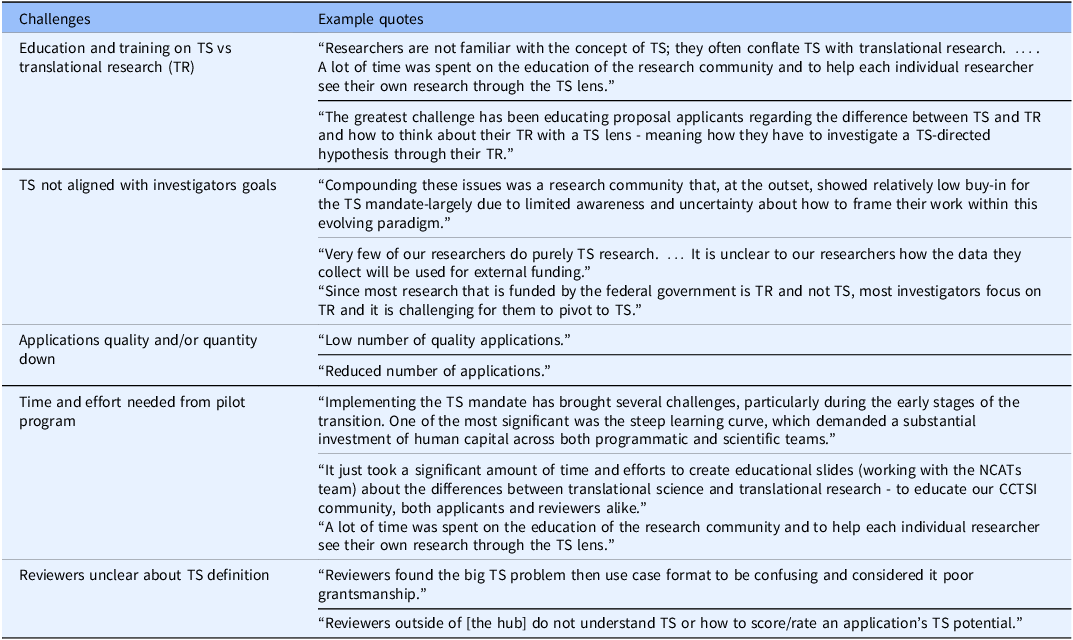
Qualitative analysis of responses to the open-ended questions concerning challenges the hubs have faced with implementing the TS requirement resulted in the identification of 5 distinct challenges that were mentioned by at least two hubs. These challenges are presented in Table 2 along with illustrative quotes drawn from the completed surveys.
Results of the qualitative analysis of challenges to implementing the translational science (TS) requirement that were reported by hubs

Table 2. Long description
A table detailing challenges in implementing translational science (TS) requirements, with five distinct challenges identified. The table has two columns: Challenges and Example quotes. The Challenges column lists five rows: Education and training on TS vs translational research, TS not aligned with investigators goals, Applications quality and/or quantity down, Time and effort needed from pilot program, and Reviewers unclear about TS definition. The Example quotes column provides illustrative quotes for each challenge. Each row provides specific insights into the challenges faced by hubs in implementing TS requirements.
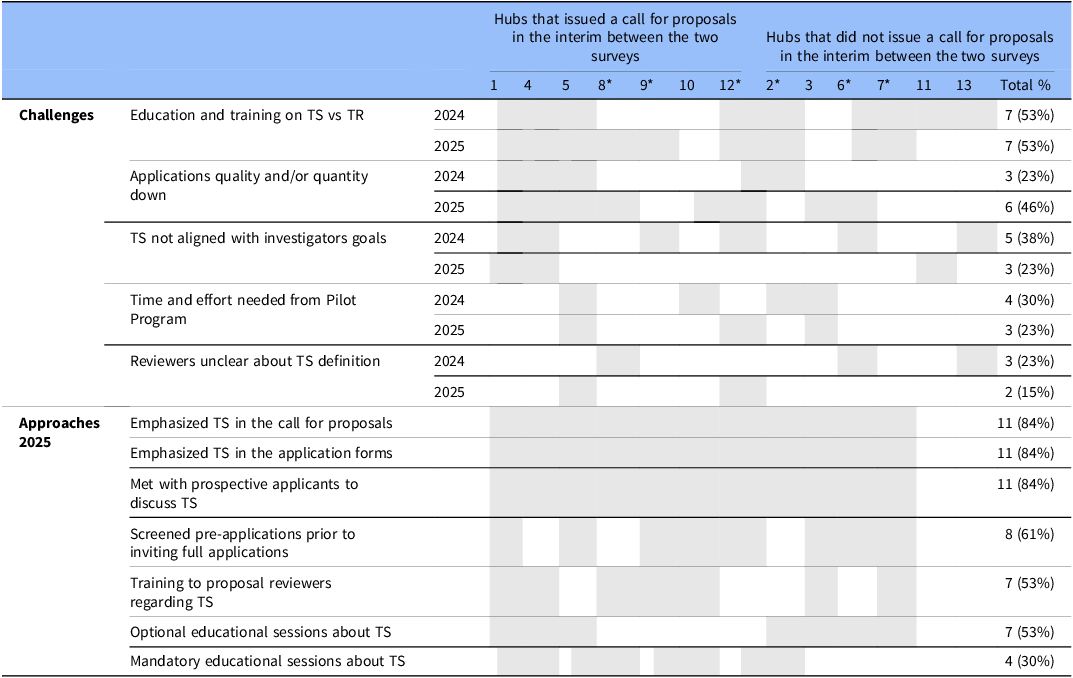
Table 3 presents the results of the qualitative analysis of the challenges to implement the TS requirement that were reported in 2024 and 2025 as well as the results of the checklist items assessing approaches to facilitating the transition, which was completed on the 2025 survey.
Challenges to implementing the translational science (TS) requirement and approaches to facilitating the transition from translational research (TR). Shading indicates a challenge and/or approach was reported by a hub, identified by number to maintain anonymity

Table 3. Long description
A table with 13 columns and 11 rows. The columns are divided into two main groups: hubs that issued a call for proposals and hubs that did not. Each group lists specific hubs by number. The rows are divided into two main categories: Challenges and Approaches 2025. Under Challenges, the rows list specific issues such as education and training on TS vs TR, applications quality and/or quantity down, TS not aligned with investigators goals, time and effort needed from Pilot Program, and reviewers unclear about TS definition. Each challenge is further divided into years 2024 and 2025, with the number of hubs reporting the challenge and the percentage in parentheses. Under Approaches 2025, the rows list specific approaches such as emphasizing TS in the call for proposals, emphasizing TS in the application forms, meeting with prospective applicants to discuss TS, screening pre-applications prior to inviting full applications, training to proposal reviewers regarding TS, optional educational sessions about TS, and mandatory educational sessions about TS. Each approach lists the number of hubs implementing the approach and the percentage in parentheses.
*Hub is a member of CEREC or CEREC II.
In 2024, the most frequent challenge reported was the need to provide education and training about the difference between TS and TR, with 7 out of the 13 hubs mentioning this challenge. More than a third (38%) of respondents to the 2024 survey mentioned a misalignment of TS with investigators’ goals, primarily referring to likely sources of subsequent funding being awarded more typically to TR than to TS. A third of respondents in 2024 mentioned that the transition to the TS requirement demanded considerable time and effort from the Pilot Program staff, and about a quarter of the respondents in 2024 mentioned that application quality and/or quantity had decreased, while a quarter also mentioned that reviewers were unclear about the definition of TS.
Interestingly, the qualitative data regarding perceived challenges to implementing the TS requirement collected in the second round of surveys suggested that there had been little improvement in hubs’ experiences since 2024. The proportion of hubs reporting the need to provide education and training on TS remained unchanged (53%), and the number of hubs reporting a decline in the quantity and/or quality of applications doubled from 3 to 6. The number of hubs that mentioned the other three challenges remained similar across both survey waves.
As shown in Table 3, about half of the hubs in the study completed a call for pilot study proposals in the interim between the 2024 and 2025 surveys. Although not evaluated statistically owing to the small sample size, there was a trend in the data indicating that hubs that implemented a call for proposals in the interim between the two surveys reported more challenges on the 2025 survey (mean challenges = 2.1 across 7 hubs) as compared to hubs that did not implement a call for proposals in the interim (mean challenges = 1 across 6 hubs). Even among those hubs that had not implemented a new call for proposals in the interim between the 2024 and 2025 surveys, hubs adopted a variety of approaches to ease the transition. Because the survey timing was orthogonal to the timing of hubs’ calls for proposals, some of these new approaches were adopted in anticipation of a pending call rather than in reaction to a completed call. All but two hubs (84%) emphasized TS in the call for proposals and the application forms and met with prospective applicants to discuss TS. About two-thirds of hubs reported screening applications for the TS requirement prior to inviting a full application. Close to half of the hubs provided optional educational sessions to potential applicants, close to half provided training to proposal reviewers, and a third of the hubs mandated educational sessions for applicants.
The qualitative data were consistent with responses to forced-choice items in that only 43.8% of the 2025 respondents reported that applicants incorporated TS into their proposals “Pretty Well” or “Extremely Well.” Moreover, almost one third of 2025 survey participants responded “yes” to the close-ended question asking whether they noticed a reduction in the number and/or quality of full Pilot application submissions.
Impact of the transition and approaches used
Owing to the variety of idiosyncratic responses to the open-ended questions about the impact of the shift to funding TS projects and what is working well, formal qualitative analyses of these data were not carried out. A number of comments about impact echoed the information already obtained through the question about challenges (e.g., fewer applications, time and effort required by Pilot staff, need for increased education to the research community). A few hubs indicated that the new focus afforded them the opportunity to implement substantial changes to their Pilot Program; one hub stated that “Transitioning allowed us to redesign our pilot program in a truly substantive way” while another stated that “Overall, the shift to TS funding has not only reshaped the scientific scope of our pilot program but also challenged us to evolve our approach to engagement, outreach, and evaluation-ultimately strengthening the program’s alignment with NCATS’ TS goals.”
In response to the open-ended question about what was working well, several hubs described the specific educational efforts that were being made, including “Ideation Sessions where we educate prospective applicants on the difference between TS and TR and host a space for them to present and receive early feedback on their project ideas has worked really well;” “Providing written and verbal instructions and opportunities for one-on-one discussions with applicants;” and “A LOT of outreach and personal consultations to help tailor applications to the mechanism.” Other hubs indicated that they were still experimenting with new approaches: “What we listed above is working, but there is plenty of room for improvement;” and “We need to see how the 2nd round goes before we can answer this question.”
Discussion
This multi-hub survey study examined how CTSA hubs have implemented the NCATS TS requirement for Pilot Programs. Across 13 hubs surveyed both in 2024 and in 2025, nearly all issued at least one RFA, and two-thirds required a LOI during the review process which they used to screen applications. Most hubs revised application materials, educated investigators and reviewers to clarify TS expectations, and adopted formal screening or scoring procedures. Although applicants increasingly incorporated TS elements, half of hubs in 2025 still reported challenges, including TS not aligning with investigators’ goals, and the substantial time and effort required to educate applicants in preparing TS-compliant proposals.
The requirement that Pilot projects address TS reflects NCATS’ strategic intent to build generalizable solutions that accelerate research efficiency and impact across diseases, populations, and settings, rather than advancing knowledge for a single condition [Reference Austin14,Reference Schneider, Woodworth and Ericson21]. Similar initiatives to emphasize TS principles have been implemented internationally, including efforts by European and Asian research councils to fund projects focused on overcoming translational bottlenecks [Reference Curry8,Reference Schneider, Woodworth and Ericson21,Reference Kim, Levine, Nehl and Walsh25]. Within the USA, this policy shift responds to long-standing concerns about inefficiencies in the translational pipeline, with studies estimating that discoveries can take 17–23 years to reach clinical practice [Reference Gupta, Boland and Aron26,Reference Morris, Wooding and Grant27], and a significantly high proportion of promising research findings never advance to benefitting patients or public health [Reference Butler28–Reference Thomas, Desai and Takahashi30]. It is worth noting, however, that the approach to evaluating the impact of the CTSA Pilot Study Programs has historically been on determining whether investigators successfully secured subsequent grant funding building on their pilot award [Reference Daudelin, Peterson and Welch31], typically in the form of an investigator-initiated award from NIH. The most common of these investigator-initiated funding opportunities, known as an R01, is usually awarded for work that addresses a gap in knowledge that will result in impact relative to a specific identified health metric (e.g., cancer, diabetes, heart disease, mental health, etc.) and not to solutions that are generalizable across diseases. There is, therefore, a potential disconnect between the criteria currently being applied by CTSA hubs to select pilot studies for funding and the criteria being applied by NIH to award R01 grants; a disconnect that is reflected in our data within the challenge identified as TS not being aligned with investigators’ goals.
Because of this potential disconnect between the criteria informing funding decisions for CTSA pilot studies and those informing funding decisions for R01 grants, it will be interesting to track how successful TS projects will be in leading to subsequent extramural funding as compared to the TR projects funded by hubs in prior years. It may emerge that there are different indicators of success that more effectively demonstrate impact for TS studies, such as the number of subsequent publications that cite methods developed by a given TS project, the number of study participants who are screened using a new procedure developed with CTSA Pilot funding, or the adoption of a new clinical guideline informed by the results of a CTSA Pilot project. Some of these nontraditional indicators are included in the Translational Science Benefits Model (TSBM) [Reference Luke, Sarli and Suiter32], which has recently been adopted by many CTSA hubs as a framework for evaluating research impact. Over time, utilization of the TSBM may generate the kinds of data needed to detect these non-traditional indicators of impact [Reference Swanson, Stadnick and Bouchard33–Reference Zhang, Gurkan, Qua, Swiatkowski, Hemphill and Pelfrey35].
Among the 13 hubs who responded to these surveys, implementing the TS requirement required them to educate applicants. At most hubs, applicants were asked to self-identify the TS rationale for their proposals (63% of hubs), although final determinations were often informed by standing committees or CTSA executive leadership teams. Reviewers from about two-thirds of surveyed hubs were tasked to score whether the TS requirement was met. These steps are consistent with prior findings that local leadership must arbitrate distinctions between TR and TS, given their conceptual overlap and the novelty of TS as a discipline [Reference Faupel-Badger, Vogel, Austin and Rutter5,Reference Faupel-Badger, Vogel and Hussain6]. It also underscores the need for shared heuristics, such as the NCATS TS principles, to reduce variability and enhance transparency in funding decisions [Reference Vogel, Haynes and Hussain36].
Our survey revealed that these CTSA hubs employed a variety of approaches to educating investigators about the NCATS TS requirement. Nearly all revised RFAs and application materials to clarify TS requirements, and most offered opportunities for direct engagement, such as informational calls, office hours, or workshops to educate their investigator community about the transition to funding TS projects. Some of the hubs in our study also required mandatory consultations or instituted town halls to orient applicants, while others piloted ideation forums to encourage early incorporation of TS principles. Between 2024 and 2025, the proportion of hubs responding to the survey that reported the need to educate investigators about the difference between TS and TR remained steady at about two-thirds of hubs. These local challenges mirror national initiatives to formalize and disseminate TS education [Reference Faupel-Badger, Vogel and Hussain6,Reference Vogel, Hussain and Faupel-Badger7]. NCATS has developed online case study-based courses that convey TS principles in accessible ways, showing significant improvements in learners’ knowledge, attitudes, and interest in translational careers across diverse backgrounds and career stages [Reference Vogel, Hussain and Faupel-Badger7,Reference Vogel, Hussain and Faupel-Badger37]. Whether these educational efforts have been effective remains unclear, since hubs in this study reported that fewer than half of the proposals that were submitted incorporated the TS perspective well.
There is some research suggesting that with appropriate education researchers with limited prior exposure to TS can achieve substantial gains in understanding of the TS approach, particularly in creativity, innovation, team science, and boundary-crossing collaborations [Reference Vogel, Hussain and Faupel-Badger37]. A 2023 scoping review of education and training programs further identified cross-disciplinary team science and partnerships as areas of relative strength, while principles of efficiency, risk-taking, and producing generalizable solutions remain underrepresented [Reference Vogel, Haynes and Hussain36]. Based on our experience and feedback from CTSA hubs, sharing TS operational principles [Reference Schneider, Woodworth and Ericson21] and NCATS resources [Reference Faupel-Badger, Vogel, Austin and Rutter5,Reference Austin13] and providing examples of TS pilot projects were considered very helpful to investigators. Together, these findings suggest that hub-level educational programs are a critical complement to NCATS-led national courses, serving as both entry points for new investigators and reinforcement mechanisms to help established researchers develop their pilot grant applications that align with the TS requirement.
Despite extensive educational initiatives and new resources, many of the hubs in our study continued to report major challenges in implementing the TS requirement. By 2025, half cited persistent difficulties in educating investigators and reviewers to distinguish TS from TR grant applications, reflecting the recent emergence of TS as a distinct discipline and the longstanding conflation of the two in training and practice [Reference Schneider, Woodworth and Ericson21]. Shifting scientists’ ingrained mindsets is particularly difficult given that most scientists are trained to value disease-focused discovery rather than system-level innovations that yield generalizable principles [Reference Austin14,Reference Casadevall and Fang38]. Pilot administrators also noted the heavy time and effort required for educating the investigator communities, echoing broader critiques of the burdens imposed by rigor and reproducibility requirements [Reference Austin14,Reference Casadevall and Fang38]. Potential practical steps could ease these barriers, including national-level case study-based training to standardize knowledge [Reference Faupel-Badger, Vogel and Hussain6,Reference Vogel, Hussain and Faupel-Badger37], broader dissemination of validated TS checklists [Reference Schneider, Woodworth and Ericson21], and incorporation of TS competencies into graduate and faculty development programs [Reference Vogel, Haynes and Hussain36].
Many of the approaches reported by the hubs queried in the present study were consistent with those suggested by Kim. [Reference Kim, Marantz, Suadicani, Milman and Keller22] in their case study of one CTSA’s experience with transitioning to the focus on TS within their Pilot Program. Specific suggestions for delivering education and training on TS included: adding new content on the CTSA website; explaining TS to campus leadership; requiring TS consultations prior to application submission; sponsoring scientific presentations of past TS projects; and hosting a TS symposium. Beyond educating the scientific community about the differences between TS and TR, Kim et al. also suggested that Pilot Programs might be proactive about identifying researchers engaged in relevant research to encourage them to apply for the CTSA Pilot funds. Relatedly, they proposed that Pilot Programs might prioritize certain research roadblocks that warrant attention based on unique institutional strengths. In acknowledgment of the issue concerning relevance of TS to investigators’ prospects for follow-on funding, Kim et al. proposed that CTSA hubs might highlight funding opportunities outside of NCATS, such as the Advanced Research projects Agency for Health (ARPA-H). The final recommendation from this case study ties in well with our study: “The collective sharing of experiences and innovative approaches to overcoming TS challenges that arise at our hubs is critical if the field is to expand and gain wider recognition and acceptance by the scientific and broader communities.”22, p4
Strengths and limitations
This study had several important strengths. It was the first to capture multi-hub perspectives on implementing the NCATS TS requirement across two consecutive years, offering both cross-sectional and temporal insights. The combination of structured survey questions and open-ended responses allowed integration of quantitative trends with rich qualitative narratives. Nonetheless, certain limitations should be considered. The findings were based on self-reported survey data from CTSA hub administrators, which might be subject to recall bias or differences in interpretation of NCATS requirements. Although 13 hubs participated, the sample did not represent all CTSA hubs, limiting generalizability across the national consortium. In addition, the open-ended responses, while informative, might not fully capture the breadth of hub experiences.
Conclusion and implications
In conclusion, CTSA hubs have made meaningful progress in implementing the NCATS TS requirement for Pilot Grant Programs, including revising application processes, educating investigators and reviewers, and adopting new screening procedures. Nonetheless, substantial challenges remained, particularly in clarifying the distinction between TS and TR, shifting researcher mindsets, and dedicating the time and resources required for education and training. Continued efforts to refine educational approaches, improve communication of TS principles, and streamline review processes will be critical. Strengthening these practices across hubs will enhance Pilot Programs and accelerate the national advancement of TS.
Supplementary material
The supplementary material for this article can be found at https://doi.org/10.1017/cts.2026.10839.
Author contributions
Margaret Schneider: Conceptualization, Data curation, Formal analysis, Methodology, Project administration, Supervision, Writing – original draft; Amanda Woodworth: Formal analysis, Writing – review & editing; Renee McCoy: Conceptualization, Writing – review & editing; Pam Dillon: Writing – review & editing; Julie A. Johnson: Writing – review & editing; Henry Xiang: Writing – original draft.
Funding statement
This work was supported by the following National Institutes of Health, National Center for Advancing Translational Sciences, Clinical Translational Science Awards: UM1 TR004548; UM1 TR004927; UL1 TR001436; UM1 TR004360.
The content is solely the responsibility of the authors and does not necessarily represent the official views of the National Institutes of Health.
Competing interests
The authors have no conflicts of interest to declare.



 Open access

