Introduction
Recent sociological analysis of the expansion of the biofuels industry internationally has noted the paradox between the purported global environmental benefits of reducing greenhouse gas (GHG) emissions by replacing fossil fuels with biofuels, and the potential for distinctly negative environmental impacts experienced at local sites of biofuels productionReference Mol1. In the advanced industrialized countries, these negative local environmental impacts from biofuels production may include increased mono-cropping, soil erosion, air and water pollution and reduced availability of water for other uses, especially in more arid regions. In developing country contexts, the negative local environmental externalities may also include deforestation and loss of biodiversity, in addition to air and water pollution.
Biophysical scientists have contributed recent literature that contests the global environmental benefits of biofuels to climate change mitigation by attempting to incorporate a life-cycle analysis of biofuels and calculating the indirect environmental impacts of land-use change in the tropics to evaluate the overall environmental profile of biofuelsReference Searchinger, Heimlich, Houghton, Dong, Elobeid, Fabiosa, Tokgoz, Hayes and Yu2–Reference Searchinger, Hamburg, Melillo, Chaneiides, Havlik, Kammen, Likens, Lubowski, Obersteiner, Oppenheimer, Robertson, Schlesinger and Tilman4. However, this research is actively contested by others who claim that improvements in the life-cycle energy efficiency and GHG emissions of corn ethanol has brought corn–ethanol systems closer to the climate change benefits gained from advanced cellulosic biofuels systemsReference Liska, Yang, Bremer, Klopfenstein, Walters, Erickson and Cassman5.
Broadening the scope of biofuels impacts to include the environmental effects of land-use change in other countries has been significant in scaling back the claims of overall environmental benefits derived from the shift to biofuels, and has even led to policy changes at the European Union (EU) level. In the EU, the Gallagher Review6 on the indirect land-use effects of biofuels production in the tropics led to cutbacks in mandated percentages of transportation fuels coming from biofuels to include a broader definition of renewable sources, including green electricity. In the USA, however, concerns about offsite environmental impacts have not led to any domestic policy changes; the Energy Independence and Security Act of 2007 (EISA) increased the mandate for biofuels production and use through 2022, with increasing percentages coming from cellulosic and biodiesel sources, while grain-based biofuels will decline over time7. However, an important exception to the mandate is that the US EPA can waive these requirements if supplies of these fuels are not adequate or if economic or environmental circumstances dictate. Moreover, the requirements that GHG emissions from biofuels production decline over time are also quite variable, with higher percentage GHG emissions reductions demanded from second or advanced biofuels, while allowing conventional biofuels facilities to be grandfathered at earlier standardsReference Searchinger, Howarth and Bringezu8.
There is clearly a disjuncture between concerns expressed about the global environmental impacts of indirect land-use change in developing countries stimulated by biofuels development and the lack of attention or policy formulation to address local environmental impacts at the place of biofuels production in advanced industrialized countries, particularly in the USA. Currently several non-state, non-governmental and private organizations are working on developing systems of sustainability certification and labeling for biofuels production in many developing countries and for importing fuels from developing countries but have not yet applied similar certification systems to production in advanced industrialized countries9.
To date, there has been little research that investigates the local-level environmental benefits and burdens of biofuels production experienced by communities hosting biofuels production plants. This paper attempts to address this gap in the research by examining the local impacts experienced by case-study communities in Kansas and Iowa that host biofuel production facilities. We find that local residents do not express many concerns about environmental impacts and that the state has played a modest role in governing the negative local environmental impacts. We argue that this lack of concern is related to the histories of these rural communities, which have long depended on resource extractive and polluting industries and currently are desperate for any form of economic growth. We find that criticisms of negative environmental impacts are muted in relation to the dominant discourse of economic benefits and to other local industries that have comparable externalities. We suggest that there may be a need for a stronger role by the state in governing biofuels production and impacts.
In the next section, we will review environmental sociological literature to determine which framework best explains the emergence and impacts of the biofuels industry on local rural communities. Then we will present three case studies of rural communities in Kansas and Iowa hosting biofuels plants, in order to examine environmental impacts as well as attitudes toward the environment at the local level, drawing on community surveys, interviews and other secondary data. In the final section, we then discuss whether the case of biofuels suggests a new role for the state in environmental governance that is not being met by current approaches.
Literature Review
While environmental sociologists have been aligned in their critiques of the discipline of sociology for overlooking the biophysical environment as an important arena for sociological inquiryReference Catton and Dunlap10–Reference Dunlap and Catton12, debates among environmental sociologists have been longstanding. The debates in US-based environmental sociology in the 1980s and early 1990s have been largely defined by two perspectives: (1) those who focus on the impacts of population and consumption on the environment, taking a human ecology approachReference York, Rosa and Dietz13 and (2) those who use a political economy approach to conceptualize environmental degradation brought by modernization and industrializationReference Schnaiberg, Pellow, Weinberg, Mol and Buttel14, Reference Schnaiberg15.
Building on the influential work of Schnaiberg, scholars working from a political economy perspective have characterized society's relationship to the natural environment as being on a ‘treadmill of production’, in which natural resources are extracted (or withdrawn) from and pollution or negative environmental externalities are added to the natural environment through the process of industrial production. Treadmill of production theories have come under criticism from other scholars who argue that ‘additions and withdrawals’ from the natural environment have been predominantly framed in a nation state context, which has been superseded by globalization and supra-national institutions in the contemporary periodReference Mol and Spaargaren16. More recently, however, political economy approaches to the environment that draw from treadmill perspectives have been broadened beyond the nation state by examining the outsourcing of the negative aspects of industrial production to developing countriesReference Schnaiberg, Pellow, Weinberg, Mol and Buttel14 and by the inclusion of world systems perspectivesReference Bunker17.
In the 1990s, a new perspective emerged in environmental sociology, termed ecological modernization (EM), whose proponents claimed that modernization and industrialization could be achieved in ways that are not destructive to the environment. EM theory emerged in a northern European context, and rose to become a dominant theoretical framework in the environmental social sciences at the end of the 20th century. EM theorists see the treadmill of production framework as being too deterministic, and discounting possibilities for more environmentally friendly development in the contemporary worldReference Mol and Spaargaren16. Rather than highlighting environmental degradation caused by industrialization and modernization, EM theory has been concerned more with environmental governance and with explaining environmental reformsReference Mol and Spaargaren18, Reference Buttel19. Through increased or even hyper-industrialization, an EM process is possible, and examples such as corporate greening, recycling and energy conservation programs are used to suggest that possibilities exist for a more sustainable development.
However, others have criticized EM theory for ignoring the important role of human consumption in creating environmental externalities in the over-emphasis on greening in the production sphereReference Carolan20. EM has also come under attack from environmental sociologists employing human ecology frameworks who believe that the assumptions of EM have not been adequately verified empiricallyReference York and Rosa21. Treadmill of production theorists argue that, counter to EM theory, private firms and the state always give preference to economic considerations over ecological concerns, unless they are pressured by civil society to do otherwiseReference Schnaiberg, Pellow, Weinberg, Mol and Buttel14. Others suggest that EM theories seem to be more applicable to a northern European context, where more state environmental reforms have occurredReference Buttel19, than to the US context, although recent work has applied EM to other non-Western contextsReference Sonnenfeld and Mol22.
Debates between these two opposing camps have been ongoing, although recent attempts have been made to move beyond this theoretical stalemate. One suggested way out of the impasse between treadmill of production and EM perspectives has been the sociology of networks and flows. In seeking common ground between these theories, Mol and SpaargarenReference Mol and Spaargaren16 first lay out some important similarities between EM and treadmill of production perspectives, namely that both are focused on materialist rather than social constructivist concerns which have taken hold in many environmental social sciences; both focus on the organization of production–consumption relationships between society and the natural environment. They suggest that a sociology of environmental flows can bridge the two perspectives. In place of nation states or societies as primary actors, in the sociology of networks and flows, the flows of information, resources and energy are the key units for analysis in the globalized world. Power is related to being included in, or having access to, flows of resources, rather than the ownership of resources. Because many environmental problems, such as climate change, are beyond the scale and capacity of nation states to regulate, they require other governing mechanisms which might include supra-national actors, non-state actors, and/or partnerships of state and civil society actors. A key concern expressed by sociologists of networks and flows, however, is how to ‘govern environmental flows’Reference Spaargaren, Mol and Buttel23.
Currently, there are some nascent efforts at supra-national regulation and governance in the biofuels domain. For example, in the international arena, some labeling and certification schemes are being initiated for sustainable biofuels, but are challenged by difficulties in monitoring a diverse set of indicators of social and environmental sustainability. Organizations comprised of partnerships of NGOs, private and state actors, such as the Roundtable on Sustainable Biofuels, are working on third-party certification systems for biofuels sustainability standards, encompassing environmental, social and economic principles and criteria at the international level9.
However, other scholars question the reliance on partnership forms of environmental governance, wondering if such arrangements have the authority or legitimacy to protect social and environmental goods in the face of strong private sector actorsReference Glasbergen, Biermann and Mol24. Some scholars suggest there may be a need to bring the ‘environmental state back in’ to ensure that sustainability standards are enforceable and accountableReference Mol, Glasbergen, Biermann and Mol25. The case of biofuels is particularly interesting because the state (both the USA and the EU, as well as individual European states, and states and local governments within the USA) has played a prominent role in promoting the development and expansion of biofuels production, especially through government mandates and incentives. However, the state's role in regulating or governing the potentially (negative) economic, social or environmental impacts of biofuels production on local communities has been much more limited in scope. Case studies of biofuels development in the Midwestern states of Kansas and Iowa will be used to illustrate some of the challenges both at the practical and theoretical levels of ‘governing’ biofuels production.
Case-study Communities
In addition to providing energy independence, the expansion of biofuels development was promoted as a means for revitalizing declining rural communities in Europe and in the USA26, 27. Since the 1980s Farm Crisis, continued low prices for agricultural commodities across the Great Plains and the Midwestern US have exacerbated ongoing farm loss, farm consolidation and economic decline. This has contributed toward dramatic population losses in large regions of the Corn Belt and Great Plains regions in the MidwestReference Johnson, Rathge, Brown and Kandel28, Reference Rathge and Highman29. Counter to these trends, some rural communities within the states of Kansas and Iowa have achieved economic growth and population increases through attracting the construction of meat packing plants and cattle feedlots, many of which now compete with biofuels production for feedstock and water suppliesReference Broadway and Stuhl30–Reference Bloom32.
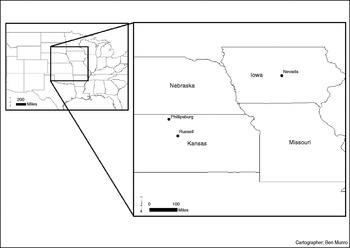
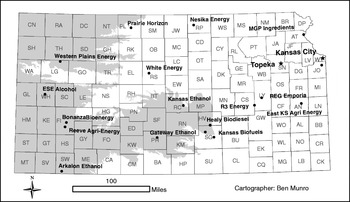
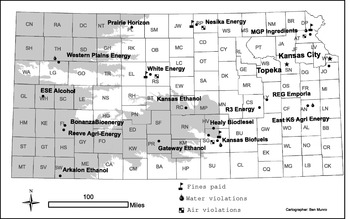
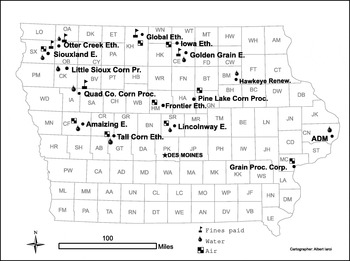
The vast majority of ethanol biorefineries are spatially concentrated in the Cornbelt of the upper Midwest. The center of the industry is concentrated in the state of Iowa, which contains the largest number of ethanol plants (Fig. 1). In 2009, there were 42 ethanol plants in operation in Iowa, including four plants under construction33. The state of Kansas represents the western edge of the geographic center of the industry and is also experiencing a rapid expansion in its ethanol production capacity (Fig. 1). In 2009, Kansas had 11 existing ethanol plants in operation, two plants which are idled for reasons of bankruptcy, three under construction and another three which are permitted or have permits pending but not yet under construction34. Several of the existing and planned plants are in western Kansas, where water availability depends on extraction from underground aquifers (Fig. 2). The economy of western Kansas continues to be very dependent on agriculture, and therefore on water resources. This heightens the tension underlying the allocation of limited water supplies between food and fuel crops, water for ethanol processing and water for human consumption and development within affected rural communities.
Location of case-study communities in Kansas and Iowa.

Location of the high plains aquifer and Kansas ethanol plants.

Iowa was an early leader and widespread adopter of biofuels production and processing, and is also representative of several other Corn Belt states, such as Illinois and Indiana, in terms of water availability and cropping patterns, and therefore provides a good comparison for biofuels production in Kansas.
Selection of case-study communities
Case-study communities were selected from non-metropolitan counties based on a combination of criteria. Three rural communities with ethanol plants in Kansas and Iowa were selected in order to gain variation in terms of date of plant establishment, plant size, type of feedstock used, location, water availability/constraints and ownership structure (locally versus non-locally owned). Research has begun in another three case-study communities, although data for these communities are not included here. These criteria for selection are described in Table 1 for the first three communities.
Criteria for case selection.

Russell and Phillipsburg, Kansas, both county seats, are small rural communities in central west Kansas that have been declining in population since the 1950s; the current population living in these communities is older than either the Kansas or the US average for rural and metropolitan areas. Crude oil transformed the city of Russell into a fast-growing community in the 1930s, and small-scale oil extraction continues today. Phillipsburg grew as a result of the Rock Island railroad going through the town and the establishment of an oil refinery, which operated from the 1950s through the 1980s.
Agriculture in Russell and Phillipsburg is dominated by non-irrigated grain crops, especially sorghum and wheat, and by livestock. The average farm size in both Phillips and Russell counties is larger than the state average, but the value of crops grown in these counties is lower than the state average. Russell has a lower median household income ($35,549) and higher poverty rate (13.7%) than does Phillips county ($41,735 and 10.9%, respectively). Although the poverty rate in Russell is higher than other non-metro counties in Kansas, it is lower than the average for US non-metro counties35. In the years leading up to the establishment of the ethanol plant, Russell experienced several crises: in 2000, an explosion destroyed the city's power plant and the town's largest private employer, a recreational vehicle manufacturing company, halted production. Job losses there were compounded by the closing in May 2001 of the wheat gluten factory that employed about 35 people. The prospect of an ethanol plant was greeted with enthusiasm in Russell and, as an incentive, city officials decided to build an advanced replacement power plant next to the 189 million liters (50 mgy) biorefinery. In Phillipsburg, Kansas, farmers in a local co-operative decided to pool their resources to invest in an ethanol plant. Prairie Horizon Agri-Energy LLC ethanol plant was financed by 305 investors, a Board of Directors (13 on the Board, who are all investors) and employs 31 people. The plant began operating in 2006, and produces 141 million liters (40 mgy) of ethanol, and wet and dry distillers grain for animal feed.
Lincolnway Energy, LLC (LWE) is located in the city of Nevada, the county seat of Story county, in central Iowa. Nevada has a population of approximately 6658 and Story county, also the location of Iowa State University, has a population of 78,000. Median annual household income in 2007 was $49,104, higher than the two communities in Kansas, although the percentage of the population below poverty in Story county was 14.4%35. LWE was founded as a locally owned ethanol plant. Initially, the farmer-owned Heart of Iowa Co-operative (HOIC) proposed building an ethanol plant that would be owned and controlled by HOIC as a means to strengthen the economic viability of their members by providing a market for their corn. However, the co-operative soon realized that they could not raise sufficient capital to build a 189 million liter (50 mgy) plant, which they considered the minimum size to be competitive. Subsequently, the decision was made to change the ownership structure to a limited liability company but to ensure local control by restricting investment opportunities to Iowans and to prohibit any single shareholder from owning more than 2%. Half of the original investors were farmers.
Near Nevada, there are also several food manufacturing businesses as well as other industrial employers. As the local government center of Story county, Nevada provides employment in its county administrative offices. Nevada is just 19 km from two large government employers, Iowa State University and the Iowa Department of Transportation, both located in Ames.
Sampling and Data Collection Methods
The research design for this study employed a mixed methods approach using both quantitative and qualitative methods. The quantitative component of the research design employed survey research for the purpose of measuring the perceived impacts of the local ethanol plant among residents in each case-study community. A random sample of households from each case-study community was selected. Each sample was limited to households located within the city boundaries of the community in which the ethanol plant was located. The sample from Russell, Kansas included 454 households, the sample from Phillipsburg, Kansas included 500 households and the sample from Nevada, Iowa included 600 households. The survey was targeted toward the head of household and self-administered by the respondent.
Each community survey was conducted by mail using a modification of Dillman's Tailored Design methodReference Dillman36. Prior to sending out the surveys, sampled households in each case study community were notified that a community survey was being conducted. A postcard providing notification of the survey was sent to each sampled residence. Further, public notification of the survey was provided in the local newspaper. An initial survey packet was then mailed to each sampled household which included a cover letter, survey questionnaire and business reply envelope. A postcard reminding non-respondents to complete and return the survey was sent 2 weeks after the initial mailing. Finally, a second survey packet was mailed to non-respondents 1 month after the initial mailing. The community survey was conducted in Russell, Kansas during April/May 2008, and in Phillipsburg, Kansas and Nevada, Iowa during October/November 2008.
The Russell, Kansas survey yielded 173 completed questionnaires. Excluding the 54 surveys returned due to undeliverable addresses and the 20 households that requested to be removed from the list of participants, the Russell survey produced a response rate of 45.5%. The Phillipsburg, Kansas survey produced 226 completed questionnaires. In total, 33 surveys were returned due to undeliverable addresses and 7 households requested to be removed from the list of participants. Excluding these households, a response rate of 40.4% was attained. The Nevada, Iowa survey yielded 262 completed surveys. Excluding the 26 surveys returned due to undeliverable addresses, a response rate of 45.65% was attained.
When we compared the demographic characteristics of the samples to that of the characteristics of the community in the 2000 US Census of Population and Housing, we found that there were some difference between the samples and the populations as characterized in 2000Reference Selfa, Kulcsar, Bain, Goe and Middendorf37. We found that our samples in each community had higher percentages of residents with college degrees and higher percentage of households in the middle to upper income categories, as compared to the US Census of Population. This may suggest that residents with a greater interest in the issues addressed in the survey responded. Therefore, our findings can only be generalizable to those residents who do have a greater interest and not necessarily to all residents in the communities.
Qualitative methods
The qualitative component of the research design involved the use of semi-structured interviews with stakeholders who held a vested interest in some aspect of the ethanol plant in each case-study community. Individual interviews were conducted with a range of stakeholders in each community, including local government officials, school district administrators, municipal utility plant managers, environmental organization staff, economic development directors, ethanol plant owners, farmers and community members. Focus group interviews were held with farmers, ethanol plant workers and community business leaders. The purpose of these interviews was to collect in-depth qualitative data on the perceived economic and environmental impacts of the ethanol plant from the perspective of these community stakeholders. The focus groups (N=6) and individual interviews (N=50) were semi-structured and followed an interview guide. All interviews were tape recorded and transcribed verbatim, and interview data were sorted thematically. In the next section, we present an overview of the findings derived from the survey, analysis of environmental violations and individual interviews in the three case-study communities.
Findings
Results from survey
The survey asked several questions related to overall impacts of the plant on the local economy, the local environment and on the local quality of life. It also included several questions that attempted to measure community residents' attitudes about the environment more generally.
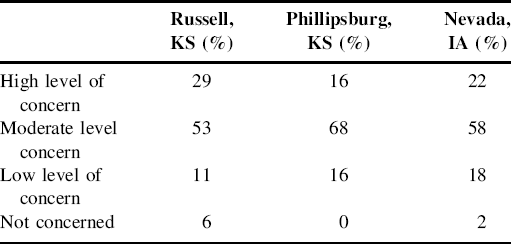
Of the three communities, Russell, Kansas had the highest percentage (29%) of residents who expressed a ‘high level of concern’ about environmental issues in the community (see Table 2). Interestingly, Russell, Kansas also had the highest percentage of residents (6%) who were not concerned about environmental issues. In all three communities, between 80 and 84% of survey respondents have moderate to high levels of concern about the environment. Kansas had recently experienced a multiple year drought, which had led to water restrictions for residents in Russell a year before the survey was conducted, and concerns about water availability were reiterated in interviews and in a survey question about specific environmental impacts.
What is your level of concern about environmental issues in your community?
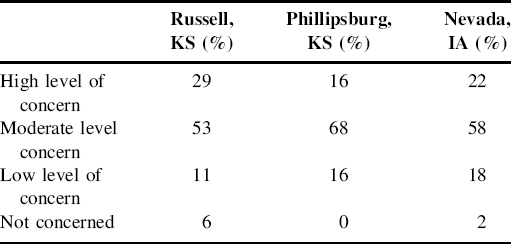
N for Russell=170, for Phillipsburg=183 and for Nevada=260.
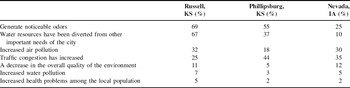
In terms of specific impacts of the ethanol plants on the local environment and on overall quality of life, the highest percentage of residents in all communities complained about the odors generated by the plant, although there was substantial variation among the three communities (Table 3).
How would you rate the impact of the ethanol plant on the local quality of life?

N for Russell=171, for Phillipsburg=186 and for Nevada=261.
In the Kansas communities, a high percentage of residents (67% in Russell and 37% in Phillipsburg, respectively), expressed concerns about the plant diverting water resources away from other uses. This was not a concern for many residents in Nevada, Iowa, where water resources are more plentiful. A large percentage of residents in all three communities noted the impacts of increasing traffic congestion, and about one-third of residents in Russell, Kansas and Nevada, Iowa, were concerned about an increase in air pollution. In contrast, fewer residents expressed concerns about water pollution on the survey, which was also validated by interviews in which several community stakeholders stated that they thought ethanol production had a good environmental profile. Interestingly, although residents cited several areas of concern related to environmental impacts (odors, air pollution, water availability, etc.), a relatively small percentage of them agreed that the plant had led to a decrease in the overall quality of the environment, or that the plant had led to increased health problems among the local population. Apparently residents do not connect environmental concerns experienced individually (for example, water scarcity or odors) to an overall decline in the quality of the local environment. Interview data provide further explanation for this paradox.
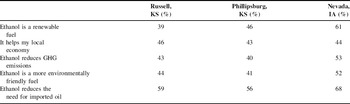
Because these communities host ethanol production sites, it was also important to examine their environmental knowledge and attitudes related to ethanol production and use. We asked several questions to measure residents' environmental attitudes and knowledge and their attitudes about ethanol, specifically E-85 (Table 4). Several questions were designed to understand if residents are using ethanol for environmental, economic or energy independence reasons. The highest percentage of residents in all three communities stated that ‘ethanol reduces the need for foreign oil’ (i.e., energy independence) as a very important reason for using E-85. After energy independence, residents in Nevada, Iowa consistently rated environmental reasons for using ethanol higher than residents in either community in Kansas. That is, more than half of Nevada residents responded that it is very important to use E-85 because it is renewable, it reduces GHG emissions, and it is a more environmentally friendly fuel.
Percentage of respondents who said the following reasons are very important for using E-85.

N for Russell=99, for Phillipsburg=179 and for Nevada=248.
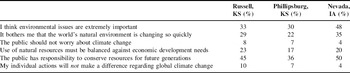
We asked several other questions that measured more general environmental attitudes, especially attitudes related to climate change and to balancing the conservation and/or use of natural resources for current and future generations (Table 5). Residents from Nevada, Iowa demonstrated higher levels of strong agreement with pro-environmental statements compared to the residents from either Kansas community. We believe that because of the proximity of a major university, Iowa State University, to Nevada, there may be a greater interest in, and more information available about, environmental issues. Residents from Phillipsburg, Kansas consistently had the smallest percentage of residents who strongly agreed with pro-environmental statements, including statements related to believing that environmental issues are extremely important, and believing that the public has a responsibility to conserve resources for future generations. Even when compared to Russell and Nevada, the economy of Phillipsburg has long been dominated by resource-intensive, extractive industries, which may influence residents' attitudes about the environment.
Percentage of respondents who strongly agree with the following statements.

N for Russell=171, for Phillipsburg=184 and for Nevada=256.
Analysis of environmental violations
We examined the history of environmental violations at all of the ethanol plants in Iowa and Kansas in order to explore what role the state has played in governing or regulating these plants. Several of the plants in both states have been cited for environmental violations, including air and water pollution. (see Figs. 3 and 4 for distribution of violations in both states). Some of the citations resulted in fines, while others did not. Several of the plants had multiple violations. For the 13 plants in Kansas (including those currently idled), citations were given by state agencies for water violations seven times and for air-quality violations four times38. In Iowa, of the 26 operating ethanol plants, 21 of them had at least one violation and several of the 26 plants had as many as seven citations of violations39. In only a handful of these violations were fines levied against the companies. In Iowa, of the 32 total violations, fines were given in only five cases, ranging between $10,000 and $20,000; in Kansas, there were five fines levied for 15 violations38, 39.
Kansas ethanol plants and environmental violations.

Iowa ethanol plants and environmental violations.

Air-quality violations were related to excessive particulates and pollution coming from the plants in violation of the Clean Air Act. Common violations were for initiating construction of a pollution-emitting facility without proper permits and not installing proper air pollution control equipment, and for failing to accurately report increases of emissions. Facilities were also cited for excessive releases of volatile organic compounds (VOCs), carbon monoxide and of particulate matter (PM10). While these citations were brought against the companies by state agencies, in one case eventually the EPA became involved40. Water-quality violations included: discharging effluent in excess of permitted amount, failing to report a wastewater spill to the state agency, release of hazardous substances, lack of an adequate pollution prevention plan, producing over the permitted amount of ethanol and exceeding the maximum contaminant level for coliform bacteria. Other violations included proceeding without a site survey and placing an anhydrous ammonia tank within 60 feet of a public drinking well.
Both locally and non-locally owned plants were cited for violations with similar frequency, belying the idea that locally owned plants would be more environmentally conscious toward their local surroundings. However, whether the local plant had been cited for air- or water-quality violations did not appear to influence residents' perceptions about the plant's environmental impacts in the case-study communities. This may indicate that community residents were not well informed about the violations. The EPA reached a settlement with the plant in Russell in 2005 in response to alleged Clean Air Act violations under the New Source Review (NSR) provisions, which require a new source of emissions (i.e., the ethanol plant) to install proper pollution controls to prevent air-quality problems during plant construction. The settlement was reached for annual reductions of emissions such as VOC, nitrous oxide, PM10, carbon monoxide and other hazardous air pollutants40. A fine of $30,000 was levied against the company. Nonetheless, the violation and fine were never mentioned in any of the interviews with residents in Russell when asked about environmental issues related to the plant. Content analysis of the local newspapers in Russell and Phillipsburg, Kansas, found that the reporting on the ethanol plants' impacts in the community was nearly always positive, and any negative coverage of environmental issues related to the ethanol industry came from associated press sources, not local reportersReference Iaroi, Middendorf and Selfa41. Similarly, the plant in Nevada was also fined in 2006 and 2007 for air- and water-quality violations, neither of which was identified by interviewees.
Analysis of interview data
Individual and focus group interviews were conducted with a range of stakeholders in each community, including local government officials, school district administrators, municipal utility plant managers, environmental organization staff, economic development officials, ethanol plant owners, farmers, ethanol plant workers and community business leaders. The interview data indicate that residents and business leaders voiced many of the same environmental issues of concern that appeared on the survey, including serious concerns about the availability of, and competition for, water resources in central and western Kansas. In response to a question about identifying environmental issues related to the ethanol plant, a local city government official stated:
I would say water … there is always a concern especially in Western Kansas where we have a lot of drought that we are using a resource that might not come back to us without the rains … so I would say that water usage and consumption is always a big concern.
Other issues identified in interviews were concerns about odors from the plant and highway congestion. However, many of the interviewees expressed no concerns about environmental impacts, and/or stated that the ethanol plant was no different than other local industries in terms of its impacts. It is important to recall that these communities have long been the location of other extractive and polluting industries, such as oil refineries, feedlots, meatpacking plants and other heavy manufacturing. Relative to many of the other industries, ethanol seems benign in its impacts. Moreover, many interviews revealed that any potentially negative environmental concern is balanced against a positive perception of the creation of jobs and new markets for farm products. In some ways, residents in these communities, which have been declining in population and employment for the past several decades, appear resigned to industries that may have environmental externalities. In interviews, many residents downplayed any concerns about the environmental impacts by comparison to the presumed economic benefits. As one city employee stated:
Here in Phillips County we have had the refinery, we have had Tamko (asphalt roof tile manufacturing facility), you know now that we have the ethanol I don't see that as a major problem because you still have the asphalt smell … and even my family home is about seven miles from here—five miles as the crow flies—and on a windy day even there we could smell the asphalt from the refinery and occasionally when the wind is straight you can smell the ethanol but … I don't see this being a major issue, I think it's a good thing for the farmers for their crops, there is some other outlet; having grown up on a farm it was always the market we were worried about so … it helps. … when we were talking about the environment … we talked about allergies, I had … there are people here in the community with their allergies have gotten worse since the ethanol … I can't say that because I had trouble once before.
Local government officials and business leaders, in particular, were sanguine about the plant's positive economic impacts, which offset any environmental concerns that may have been raised. They also believed that the regulatory agencies and environmental organizations would have addressed environmental concerns if they had arisen. As a local entrepreneur stated:
I don't see anything that's real serious. I think when we met the first time, I mentioned that something is coming out of the plant that creates a little difference in the air and the territory around. There is some residue of some sort, I'm not sure what it is, but apparently, it's nothing that's harmful or the environmental people would have been out here screaming and hollering. It's just something that comes with the territory.
Clearly a business booster, one Chamber of Commerce official noted:
Environmental issues, no. Not that I can see, but I'm more in town. I don't get out there and see things. I mean, there are environmental issues on just about everything you can have now. But for it to be built up, we haven't had any. You know, like I said, the smell and that is minor for what it does for the area.
One of the board members of one of the ethanol plants stated:
I don't really see too many environmental issues with the ethanol plant right now. Everything is within EPA requirements, and there isn't anything that I can see that's detrimental to the environment.
A community member also stated she could not imagine there are environmental problems because ethanol production is a clean process and does not produce pollution.
Well, we, when you talk about environmental [issues], we don't have a lot of issues with pollution or any of those things, so we got a few complains about the smell or … but overall, environmentally I don't think I have an issue with it. It's a clean process. There is … a little odor comes out and some days when clouds are heavy and so forth you smell it, but other than that I don't have any issues.
Another interviewee noted that in comparison with the former wheat gluten plant which was discharging effluent, the ethanol plant's environmental profile was positive. She praised the local ethanol plant for its water usage and thought it compared quite favorably to plants in other towns. She stated:
Of course I remember the ‘good old days’ of wastewater [coming from the wheat gluten plant] … so I always worry about that right now … and I feel fortunate that that seems to be under control with the new plant that we have out there. Air … I am probably as air quality conscious as anybody—plus the allergies and that type of thing—I go to other towns and see worst things … I feel very fortunate to live in Russell and have the plant that we do. I do not notice the air quality issue. Water—this type of industry just uses water and it's a balance that we have to have …. So, it's a fine balance throughout but our plant seems to do a very good job at that part.
In Iowa, most of the interviews with city officials, community members and business owners did not reveal many environmental concerns either. The environmental concerns in Iowa were focused more on the water-quality impacts of increased row crops for ethanol production, on erodible land coming out of Conservation Reserve Program for corn production, on discharges from ethanol plants and on air-quality impacts. Interviews with representatives of environmental organizations in Iowa revealed some interesting paradoxes. For the representatives of the environmental organizations interviewed, the water- and air-quality concerns expressed were all muted by reference to the much greater concerns about coal-fired power plants in the state. Because ethanol plants are seen as bringing much needed jobs to rural areas of the state, little criticism of the environmental impacts of ethanol plants is voiced by environmental organizations. One environmental organization spokesperson expressed it as such:
We generally share the same perspective on biofuels [with other environmental organizations], but I think most of us, maybe with the exception of the Sierra Club, really don't see the benefit in lobbying against biofuels policies given the political backlash that would occur.
Ironically, although some ethanol plants, including the plant in our case-study community in Nevada, Iowa, were coal fired, even this was not subject to criticism by environmental groups because of the perceptions that, because jobs had been created, any criticism would bring a backlash to the environmental organization. In addition, local business people and investors claimed that one of the primary reasons that the local ethanol plant in Nevada was economically viable was because it used coal, which is less expensive and is subject to much less price volatility than natural gas.
A representative for an Iowa environmental organization expressed their stance against coal rather than biofuels as ‘picking their battles’ in the state:
I think as an organization we have decided to make a very hard stand on coal and so as an organization we have said ok, we say there is no acceptable use of coal and new coal fired power plants we are going to oppose them we are going to try to shut down existing ones and we sort of felt like that was a position that would be more stringent than we might otherwise take on a lot of issues.
This environmental organization spokesperson expressed political pragmatism about their position on the biofuel industry, realizing that biofuels development in the state may also open up opportunities for other, more environmentally sustainable alternative, energy production in the future:
I think, a real politically valuable role that growing biofuels industry could have for a range of other environmental issues and so it is kind of a balancing act. At what point are we willing to sacrifice certain costs imposed by the biofuels industry which many of which have been born in Iowa and elsewhere around the world to benefit from the political opportunities that it can generate, and those would be essentially, being able to pit some very powerful interests against each other in ways that sort of shake up power lines and help create new allies for things like wind or solar energy.
A representative for another environmental organization in Iowa expressed his concerns about the ethanol industry in the state, and what he believed to be a lack of enforcement of environmental regulations because of perceived economic benefits:
I think typically the water that is discharged from those plants are not, a variety of the discharges do not meet EPA standards and I think most of the ethanol plants in Iowa are not meeting EPA requirements, I am quite sure of that. … EPA doesn't want to shut them down, because of the negative impacts that go beyond environment, but if they have regulations, you can't just let it slide either …. Yeah plants are a point source, … and what we are talking about within the plant is an engineering issue. It is how can they use water differently, how they can treat it for discharge. … If you have got enough fresh water that is really clean, whatever you discharge you can mix in freshwater to bigger barrels and then release it so that it meets concentration standards.
It is clear from interviews that for many stakeholders, environmental issues are sidelined by other, more locally prominent issues. In particular, these local issues are: (1) stating that compared to many industries, ethanol is relatively benign; (2) community residents assuming that environmental organizations and/or agencies would step in and confront or regulate if there were a problem; (3) downplaying environmental negatives by comparison to purported economic benefits of the ethanol industry; and (4) environmental organizations focusing on curtailing coal-fired plant construction rather than opposing ethanol production.
While many business leaders and local government officials assumed that the ethanol plants caused no environmental problems or that the state agencies and environmental organizations were policing the plants, environmental organizations were concerned that many violations were going unnoticed. Representatives of environmental organizations complained that the regulatory agencies were not adequately enforcing environmental laws related to ethanol because of perception of job creation.
Conclusions
These case studies illustrate a contrast between the perceptions of biofuels bringing global climate benefits, and some of the negative impacts on local environments. While residents in these communities expressed concerns about water competition, water pollution, air pollution and odors from the ethanol plants, they did not voice concerns about overall environmental impacts on the local surroundings or on community health. Examining these issues at the site of biofuels production reveals some important factors not commonly considered. First, these rural communities have historically been hosts for resource extractive and polluting industries, and ethanol production does not differ much from these historical industries. It is ‘just something that comes with the territory’ as one of the entrepreneurs we interviewed stated. Because of the economic decline and depopulation that these rural communities have faced over the past few decades, many residents are persuaded that the economic growth these plants bring overwhelms any negative impacts. Even those who do have legitimate concerns about the environmental profile of the biofuels industries, namely environmental organizations, believe it is too politically dangerous to raise concerns about biofuels within the states of Kansas and Iowa, where the industry has represented a lifeline for many rural communities. While environmental organizations might act as a partner or as a watchdog for regulatory agencies in such issues of environmental governance, in these states they do not appear to be actively engaging with regulatory agencies on the biofuels issue.
While the state is playing a modest role in governing the ethanol plants through its regulatory agencies, it appears from our research that it more often works with the private sector than challenges it. In most cases, the companies are given a citation for their non-compliance with environmental regulations rather than receiving a fine for non-compliance. When they are given fines, these are quite minimal compared to overall revenues. It is interesting to note that many of the violations seem intentional, not accidental. For example, not applying for a construction permit or not installing proper pollution control devices on the ethanol plants are not simple oversights, but rather seem intentional. Moreover, many of these plants are receiving subsidies, incentives and tax breaks from local and state governments to build the plants and yet are flagrantly ignoring proper permitting and requirements for installing adequate emissions and wastewater controls, which are designed to protect the public interestReference Demmel42. Given these incentives and subsidies, the state (local and state governments) would have leverage to demand that proper procedures are being followed, but they are not. Perhaps state regulators are not levying large fines because the ethanol industry is already so economically fragile, or because the ethanol industry is so politically powerful as to be unchallengeable at the local level.
The sociology of network and flows literature points us to a consideration of the importance of environmental governance. Mol's recent work examining different forms of governance partnerships and environmental authorities related to biofuels production reveals an appreciation for the need for new modes of governance in a globalizing world, but also reveals concerns that public–private partnerships can also legitimize non-intervention on the part of the stateReference Mol, Glasbergen, Biermann and Mol25. He is also skeptical about the ability of supra-national and non-state actors to effectively ensure the sustainability of biofuels production. He suggests that both private interests, such as corporate sustainability certification systems, and non-state actors, such as environmental organizations, may have more market or moral means (i.e., pressure from environmental organizations), respectively, than regulatory authority to address environmental concernsReference Mol43. However, it is clear from the case studies presented here that leverage that an environmental organization may claim can be subject to political and economic exigencies, especially at the local level. This research suggests the need for a renewed role for the state in governance of biofuels, especially at the local level, where private economic interests often supersede public interest.
Acknowledgements
This research was funded by the US Department of Energy Office of Science, Office of Biological and Environmental Research, ELSI (Ethical, Legal and Societal Implications) Program. Thanks for research assistance and cartography provided by Albert Iaroi and Ben Munro. I would like to acknowledge my collaborators on the project: Laszlo Kulcsar, Richard Goe, Carmen Bain and Gerad Middendorf. I especially appreciate comments and feedback from Carmen Bain, and from two anonymous reviewers.