Introduction
All through the industrialization process of western countries in the nineteenth and twentieth centuries, modern poultry production has turned to a true landless, input and capital intensive production system, exclusively based on highly productive and specialized hybrid strains. Sustained by the rapid genetic progress allowed by the short life-cycle of the poultry as well as by the economies of scale (increasing returns), a highly concentrated economic sector has emerged, where the global production hardly relies on a few major genetic types (Lariviere and Leroy, Reference Lariviere and Leroy2008). Nowadays, a rapid demand-driven expansion of the livestock sector in developing countries is taking place (Delgado et al., Reference Delgado, Rosegrant, Steinfeld, Ehui and Courbois1999). In this so-called Livestock Revolution, the intensive peri-urban poultry sector did more than its fair share in the satisfaction of the rising demand for animal products in developing urban centres. However, this industrialization process of egg and chicken production constitutes a serious threat to the genetic diversity of poultry around the world. This trend could be particularly damaging to backyard small-scale poultry rearing that emerged these last few years as a powerful tool in poverty alleviation, in which the need for wide genetic resources cannot be overvalued, as a result of the wide array of environmental conditions to be considered. In developed countries also, a major evolution of consumption habits is converting the animal production sector to more qualitative concerns, for which valorization of local breeds should be of prime interest.
In Belgium, where 95 percent of local poultry breeds are greatly endangered (Larivière and Leroy, Reference Lariviere and Leroy2005), a local breed named Ardennaise is considered as promising in the context of quality terroir production (Moula et al., Reference Moula, Antoine-Moussiaux, Farnir and Leroy2009a, Reference Moula, Antoine-Moussiaux, Farnir, De Foy and Leroy2009b), the flavour of its flesh being largely renowned. By its remarkable robustness and its resistance to humid climates, this breed has also been proposed for amelioration projects of village chicken production in Sub-Saharan Africa (Youssao et al., Reference Youssao, Toleba, Dahouda, Adehan, Ahounou, Mama Ali, Gbangboche, Lariviere and Leroy2009). The Ardennaise breed is actually composed of 12 recognized varieties, of which the white one is sometimes considered as a different breed, named the Famennoise (Moula et al., Reference Moula, Antoine-Moussiaux, Farnir and Leroy2009a, Reference Moula, Antoine-Moussiaux, Farnir, De Foy and Leroy2009b, Reference Moula, Antoine-Moussiaux, Farnir and Leroy2009c; Moula et al., Reference Moula, Jacquet, Verelst, Antoine-Moussiaux, Farnir and Leroy2012). As the selection process that gave birth to those varieties has been realized on the basis of non-productive phenotypic traits (plumage and eye colour and morpho-biometric characteristics), the question of the relevance of their differentiation regarding production objectives must be considered. In this context, the present study aims at evaluation of egg and meat production abilities of the two major Ardennaise varieties, namely, the silver black feathered and the golden black feathered Ardennaise.
Material and methods
This study was implemented from January 2008 till December 2009 and involved three phases. The first phase consisted in the morpho-biometric characterization of Ardennaise individuals from both silver and golden varieties available at the Animal Production Department of the Faculty of Veterinary Medicine of the University of Liege (Belgium). In the second phase, the meat production performances were recorded through the follow-up of live weight for a growth period of 22 weeks and the assessment of meat quality at slaughter. Quantitative and qualitative egg production performances were then studied during a third phase for a 52-weeks laying period.
Morpho-biometry
Adult birds (over 10 months of age) of the silver black and the golden black varieties from breeding flocks were used for the morpho-biometric characterization. The different body measurements were recorded in accordance with the FAO recommendations (FAO, 1981), by means of a digital balance (precision 1 g), an electronic sliding caliper (precision 0.01 mm) and a tape measure.
The collected data were thus the sex and age of the bird, the comb's length and height, wattles height, the length and diameter of the tarsus and the beak.
Growth and carcass and meat quality
A total of 304 eggs, among which 130 of the silver black Ardennaise and 174 of the golden black Ardennaise, were incubated. All the eggs were less than 10 days old and originated from the flock of the Veterinary Faculty. The number of chicks obtained was 90 for the silver black and 124 for the golden black variety. All the chicks were vaccinated against Marek's disease at day 1.
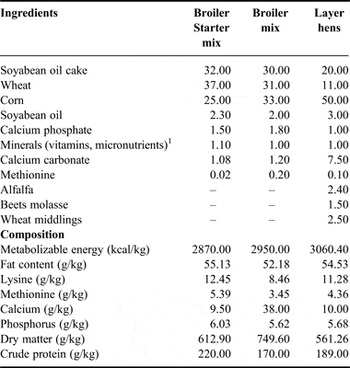
All the chicks were floor-bred on a sawdust litter in the same ventilated building, both varieties being separated by netting. The chicks were first put under a heating lamp and the room temperature was regulated manually according to the chicks' behaviour. Continuous light program was adopted for the whole experiment period. The chicks were fed ad libitum with a starter mix until the age of 14 days (energy: 2 870 kcal/kg, density: 0.732 kg/l) and a traditional poultry mix (energy: 2 950 kcal/kg, density: 0.723 kg/l) from day 14 to slaughter. Between days 14 and 21, both feed types were mixed to provide an adaptation period. Both mixes contained wheat, corn, soyabean, soyabean oil, methionine, lysine, vitamins and BHT ethoxyquine anti-oxidant. Their compositions are listed in Table 1.
Feed mix composition for starting, growth and laying.

1Vitamin A 13 500 UI/kg, vitamin D3 3.000 UI/kg, vitamin E 25 mg/kg and copper sulphate 15 mg/kg.
Each bird was identified individually, first by a numbered plastic ring at the leg then by metallic ones after week 5. Sexing was achieved visually at week 9 by comb inspection. The birds were weighed individually once a week from week 1 till week 16 with an electronic balance (accuracy 0.01 g). The birds were weighed once again, at week 22, before slaughter. An overall feed conversion index was calculated for each variety from the total feed intake and the total gain.
Mortality was recorded during the growing period.
Four birds of each sex were randomly chosen among each variety (n = 16) and were slaughtered at week 22, which is the regular slaughter age for slow-growing local breeds such as the Ardennaise. The birds were deprived of feed for 15 h before last live weight record and slaughter. They were bled, plucked under warm water, weighed again and eviscerated. The legs were sectioned at the tibiotarsus–metatarsus joint and the head was cut at the skull–atlas joint. The warm carcass was then weighed. The dressing out percentage was then calculated as the ratio between warm carcass weight and live weight at slaughter.
The carcass was then cut and the wings, legs and drumsticks were sampled and weighed after being skinned. The left pectoral muscles (Pectoralis major and Pectoralis profondus) were sampled about 8 h post-slaughter, weighed and packed in plastic bags for conservation at 4 °C for 24 h. Water loss was calculated as the difference between muscles' weight at sampling and after 24 h of draining on absorbent paper.
pH was measured with a Portamess 751 pH-meter (Knick GmbH&Co, Berlin, Germany) combined with a Mettler-Toledo electrode (LoT406-DXKS7/25; Mettler-Toledo International Inc., Urdorf, Switzerland). Meat colour of the left pectoral muscles was determined on three different parts of each sample after exposition to air, with a spectrocolourimeter Hunterlab Lab-Scan II (Hunter Associates Laboratory, Reston, USA). Colour was expressed in CIE units: L* a* b* with L* being a value indicating the darkness (lightness), high values of a* indicating an intense red colour of meat (redness) and high values of b* indicating an intense yellow colour of the meat (yellowness).
Egg production and quality
Egg laying rate was assessed in 40 silver black and 30 golden black. The hens were first housed under natural light conditions. At week 24, the hens began to produce small eggs and were transferred at week 28 in a building under artificial lighting where a 16 h light/8 h dark programme was applied. The hens were fed with a mix for layers, containing 10 g/kg calcium (see Table 1 for composition). Laying was followed-up for 52 weeks. The eggs were collected every day and conserved at 6 °C except abnormal eggs (cracked and broken) which were eliminated. Quality analysis was implemented the day after egg collection and conducted at different hens' ages: 30, 45, 60 and 80 weeks. Total weight was measured (electronic balance, accuracy 0.01 g) and average egg weight was obtained by dividing total eggs weight by eggs number. Then, their length and width were measured by means of an electronic sliding caliper (precision 0.01 mm), so that an egg shape index could be calculated as the ratio between length and width multiplied by 100 (Monira, Salahuddin and Miah, Reference Monira, Salahuddin and Miah2003; Parmar et al., Reference Parmar, Thakur, Tomar and Pilla2006). The yolks were carefully separated from the albumen. The shells including the membranes and yolks were weighed separately (accuracy of 0.01 g). Albumen weight was determined by subtracting yolk and shell weights from the total egg weight. The shell thickness was measured at three different random points in the equatorial shell zone using an electronic micrometer (precision 0.01 mm) and average calculated. Tyler and Geake (Reference Tyler and Geake1964) indeed reported the eggshell thickness to be slightly thinner but more stable in the equatorial shell zone compared with the other shell zones. Yolk and albumen pH was then measured with a pH-meter (ORION, model 290A, 1990 Orion Research Inc. Boston, MA 02129, USA).
Statistical analyses
The analysis of data was conducted by using the SAS package (procedure GLM, SAS, 2001) and least square means (LSM) and standard errors were calculated, allowing ranking of variety and sexes according to Duncan's procedure.
The following models were used.
 $$Y_{ijk}=\mu+A_i +B_j+(AB )_{ij} + e_{ijk}$$
where Y ijk are the mature body weight and measurements and meat quality traits in 22-week-old chicks, μ is the overall mean, A i is the fixed effect of the ith variety (golden black and silver black variety), B j is the fixed effect of the jth gender (male, female) and e ijk is the random residual effect.
 $$\eqalign{Y_{ijkl} & = \mu + A_i + B_j + C_{k } + ({AB} )_{ij} + ({AC} )_{ik} \cr & \quad + ({BC} )_{\,jk} + ({ABC} )_{ijk} + e_{ijkl}}$$
where Y ijkl is the body weight, μ is the overall mean; A i is the fixed effect of the ith variety (golden black and silver black variety), B j is the fixed effect of the jth gender (male, female), C k is the fixed effect of the kth age (1 to 22 weeks), and e ijkl is the random residual effect.
 $$Y_{ijk} = \mu + A_i + B_j + ({AB} )_{ij} + e_{ijk}$$
where Y ijk is the egg quality traits, μ is the overall mean, A i is the fixed effect of the ith variety (golden black and silver black variety), B j is the fixed effect of the age (30, 45, 60 and 80 weeks) and e ijk is the random residual effect.
The Gompertz equation was used to model the growth of the chickens (Porter et al., Reference Porter, Kebreab, Kuhi, Lopez, Strathe and France2010). This equation has the form: Y = αe −βe −γt
where Y is the weight of the chicken in grams, α is the asymptotic weight, ß is constant, γ is growth speed factor (maturation factor), and t is the age in days.
The growth curve parameters of the Gompertz equation were estimated (proc NLIN, SAS, 2001). The age at inflexion when the growth rate is maximum was calculated using the following formula (Porter et al., Reference Porter, Kebreab, Kuhi, Lopez, Strathe and France2010): t i = (1/ γ ) × ln│ ß │
To compare the egg-laying rate, hatching rate and mortality rate between the silver black and the golden black varieties, the Chi squared test was used.
Results
Morpho-biometric characteristics
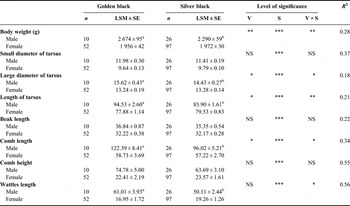
The least squares means of the live weight and body measurements of mature animals are given in table 2 along with the significance of the fixed effects of sex and variety.
Body weight (g) and measurements (mm) of adult Ardennaise chicken according to variety (V) and sex (S), least squares means and standard error and significance level of the effects of variety, sex and their interaction (V × S).

***P < 0.001; **P < 0.01; *P < 0.05; NS: P > 0.05. LSM ± SE: Least squares means ± SE; a, b: different superscripts indicate significant differences (P < 0.05).
The sex effect is highly significant (P < 0.001) on all studied traits. The effects of variety and interaction variety × sex were significant (P < 0.05) on body weight, large diameter and length of the tarsus and on the comb length. The males of the golden black variety were significantly (P < 0.05) heavier (2 674 g) than the males of the silver golden black variety (2 290 g) but the live weight was not significantly different between the hens of the two varieties.
Golden black males had body measurements (length of the tarsal, the length and height of the comb and the length of the wattles) greater (P < 0.05) than the silvery black variety. In females, there was no significant difference in comb height and wattles length between the two varieties (Table 2).
Growth
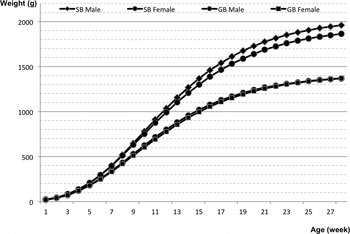
Figure 1 shows the live weight growth of the birds from 1 day old (36 g for all sex and varieties) up to 22 weeks of age. Mean weight at 22 weeks of age was 1 550 and 1 513 g in golden and silver varieties, respectively. The body weight was significantly (P < 0.01) influenced by the fixed effects of the variety, the sex, the age and the interaction between sex and age (Table 3).
Gompertz growth curve parameters of Ardennaise broilers by varieties (SB, Silver black; GB, Golden black) and sex.

Body weight of Ardennaise broilers by variety (V), sex (S) and age (A). LSM ± SE and significance level of the effects of variety, sex and age and their interactions.

(), number of specimens; V, varieties; S, sex; A, age. ***P < 0.001; **P < 0.01; *P < 0.05; NS, P > 0.05.
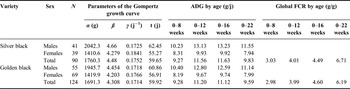
The parameters of the Gompertz curve, the average daily gain (ADG) and the feed conversion ratio (FCR) of the two Ardennaise varieties and sexes are shown in Table 4. Asymptotic weights were 2 042 and 1 946 g in males and 1 411 and 1 420 g in females for the silver black and the golden black, respectively. The age of inflexion was near 60 days for the silver and golden varieties.
Gompertz growth curve parameters, average daily gain (ADG) and feed conversion ratio (FCR) of Ardennaise broilers by variety and sex.

α is the asymptotic weight; ß is constant; γ is the growth rate parameter (maturing factor); t is age in days.
The overall FCR was similar for the two varieties during the first 16 weeks and slightly higher in silver black thereafter. The birds of the silver black and golden black variety had cumulative FCR of 3.03 and 2.98 at 8 weeks of age, 4.01 and 3.99 at 12 weeks of age, 4.49 and 4.60 at 16 weeks of age and 6.71 and 6.19 at the end of the rearing.
Reproductive traits
The hatching rate is not significantly different between the silvery black variety (69.2 percent) and the golden black variety (71.3 percent).
The mortality at 22 weeks of age, was similar (χ 2 = 0.094, P = 0.7) for the two varieties and reached 6.92 and 6.32 percent for the silver black and the golden black, respectively.
Carcass characteristics and meat quality
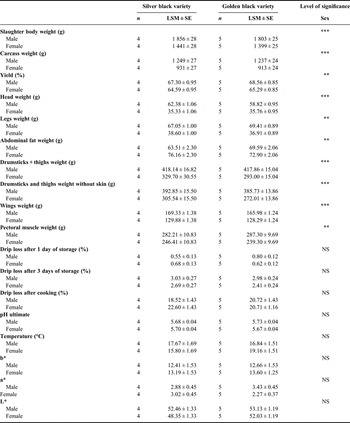
Carcass characteristics and meat quality of the broilers at 22 weeks of age were compared for sex, variety and two factors interaction in Table 5.
Carcass and meat quality traits of Ardennaise broilers by variety and sex. LSM ± SE and significance level of the effects of sex.

***P < 0.001; **P < 0.01; *P < 0.05; NS: P > 0.05. LSM ± SE: Least squares means ± SE; a, b: different superscripts indicate significant differences (P < 0.05).
Note: The variety × sex interaction had no significant effect on any trait.
The variety and the interaction of variety × sex had no significant effect on these various traits. The male showed significantly higher weights for the body, head, legs, wings, drumsticks and thighs (P < 0.01).
None of the various traits of meat quality were affected by any of the three factors studied.
Egg production
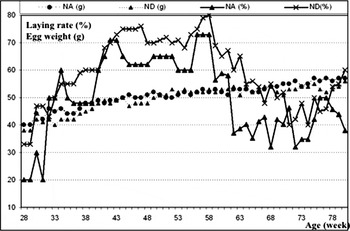
From the age of 28 weeks up to 80 weeks, the laying rate varied between 20 and 78 percent for the silver black and between 33 and 80 percent for the golden black (Figure 2). Over the whole laying period, the laying rate was not different between the two varieties (χ 2 = 0.57, P = 0.32) neither at 30, 45, 60 and 80 weeks. The golden black produced on average 199 eggs per year and the silver black 183 eggs per year. The changes in egg weight during laying period are shown in Figure 2. The mean of the egg weight during the production period was 54.4 and 49.6 g for the silver black and the golden black, respectively.
Evolution of laying rate (%) and egg weight (g) during the 80 weeks laying period of the Ardennaise breed by variety (NA: Silver black; ND: Golden black).

Egg quality
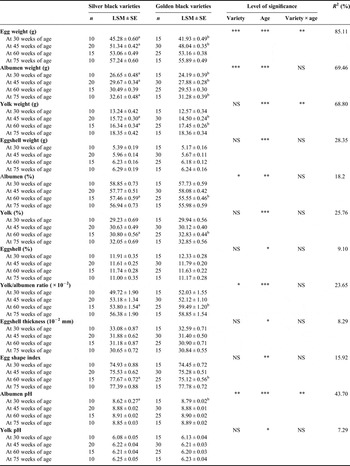
Table 6 shows the mean values of the various traits of egg quality per variety and indicates the significance of the effects of variety, age and interaction variety × age. Only the variety has an effect (P < 0.05) on the egg and the albumen weights, the albumen percentage, the yolk/albumen ratio and the albumen pH. Age influenced (P < 0.05) all traits related to egg quality. The weight of egg, albumen, yolk and shell and the yolk percentage increased with age. The interaction between variety and age was significant (P < 0.05) for the egg and yolk weights and the albumen pH.
Egg quality of Ardennaise hens by variety and age. LSM ± SE and significance level of the effects of variety, age and interaction.

***P < 0.001; **P < 0.01; *P < 0.05; NS: P > 0.05. LSM ± SE: Least square means ± SE; a, b: different superscripts indicate significant differences (P < 0.05).
The two Ardennaises varieties had significant differences in the egg weight at 30 and 45 weeks of age, albumen weight at 30, 45 and 80 weeks, yolk weight at 45 and 60 weeks, albumen percentage at 60 weeks, ratio yolk/albumen at 60 weeks, egg shape at 60 weeks and the albumen pH at 30 weeks.
Discussion
Morpho-biometric characterization
The first visible difference between silver black and golden black is the colour of the plumage. The colour of the hackle is easily observable, white (silver) in the silver variety and red (gold) in the golden black variety.
The golden black cocks are significantly bigger than the silver black cocks, but the golden black hens tended to be smaller (1 956 versus 1 972 g), increasing the sexual dimorphism in the golden black. Nevertheless, our results for mature body weight (2 674 g and 1 956 g and 2 290 g and 1 972 g, for male and female of the golden and silver varieties, respectively) are well above those reported at the beginning of the last century by Carpiaux (Reference Carpiaux and Duculot1921) and Voitellier (Reference Voitellier1925) which barely exceeded 2 and 1.5 kg for male and female, respectively. However, these weights are close to those reported by N'Dri (Reference N'Dri2006) for the Gauloise breed (2.5 kg for rooster and 1.5–2.0 kg for hen).
Growth
The silver black and golden black Ardennaise performed similar weights at hatching (35.84 versus 36.53 g for males and 35.56 versus 35.42 g for females) and at 22 weeks (1 814 versus 1 752 g for males and 1 258 versus 1 266 g for females).
At 12 weeks of age, the average weight was 1 139 and 1 111 g in males and 870 and 848 g in females, for the golden black and silver black, respectively, lower than the weight at 12 weeks of the white Ardennaise variety, 2 000 and 1 500 g in males and females, respectively (Moula et al., Reference Moula, Antoine-Moussiaux, Farnir and Leroy2009a).
The ADG is also always higher in males, which explains the higher final weight in cocks compared with females.
The FCR was similar for the two varieties during the first 16 weeks and slightly lower in the golden black over the last 6 weeks.
Carcass characteristics and meat quality
Comparison between the two varieties of the Ardennaise breed of carcass characteristics and meat quality traits of animals slaughtered at 22 weeks of age revealed no significant difference. The results only showed that the weights of different body parts are higher in roosters compared with hens. Similar results were recorded by Youssao et al. (Reference Youssao, Toleba, Dahouda, Adehan, Ahounou, Mama Ali, Gbangboche, Lariviere and Leroy2009) in the Coqard chicken, which is a crossbred between traditional Ardennaises cock and hen from a French commercial slow growing strain. However, dressing percentage was better in the Ardennaise than in the French industrial red label, 67 and 65.5 percent, respectively.
After cooking, the average loss in the Ardennaise is about 20 percent which is considerably lower than the recommendations of Sauveur (Reference Sauveur1997) for the Label Rouge chicken (25 percent). However, the slaughter age of the latter is 12 weeks, while it is 22 weeks for the Ardennaise. The choice of this slaughter age (22 weeks) by the connoisseurs of Ardennaise, can be explained by the improved flavours and taste with age but at the expense of the tenderness (Touraille et al., Reference Touraille, Ricard, Kopp, Valin and Leclerq1981).
The ultimate pH of the muscles stabilizes to a value between 5.7 and 5.9 in poultry (Sante, Fernandez and Monin, Reference Sante, Fernandez and Monin2001). The values measured in the pectoral muscles of the two varieties of Ardennaises, around 5.7, are very close to this range and with the values found in different genetic groups by Debut et al. (Reference Debut, Berri, Baeza, Arnould, Guemene, Sante-Lhoutellier, Boutten, Jego, Chapuis, Beaumont and Lebihan-Duval2005) and Quentin et al. (Reference Quentin, Bouvarel, Berri, Le Bihan-Duval, Baeza, Jego and Picard2003) where ultimate pH ranged from 5.59 to 6.01.
The colour, which represents the first criterion for assessing meat by the consumer and the absence of difference between the varieties of Ardennaise is interesting from the point of view of the uniformity of the commercial product. L* values recorded in the present study (48.35–53.13) are lower than those recorded by Quentin et al. (Reference Quentin, Bouvarel, Berri, Le Bihan-Duval, Baeza, Jego and Picard2003) ranging from 54.5 in fast growing strains to 53.5 in slow growing strains including the French red label. The values of a* of Ardennaises, 2.3–3.4, are higher than those recorded in many studies, ranging from −0.8 to 0.28 (Quentin et al., Reference Quentin, Bouvarel, Berri, Le Bihan-Duval, Baeza, Jego and Picard2003; Debut et al., Reference Debut, Berri, Baeza, Arnould, Guemene, Sante-Lhoutellier, Boutten, Jego, Chapuis, Beaumont and Lebihan-Duval2005). These high values of a* indicate that the meat of Ardennaise is redder, in fact these values are closer to those recorded in turkeys (a* of about 5) in the study of Molette et al. (Reference Molette, Serieye, Remignon and Babile2005). The average value of b* (approximately 13) in the Ardennaise is much higher than those recorded (6.89–11.8) by Debut et al. (Reference Debut, Berri, Baeza, Arnould, Guemene, Sante-Lhoutellier, Boutten, Jego, Chapuis, Beaumont and Lebihan-Duval2005) and Quentin et al. (Reference Quentin, Bouvarel, Berri, Le Bihan-Duval, Baeza, Jego and Picard2003), therefore, a yellow colour is more pronounced in the Ardennaise.
The laying rate and egg quality
The hens of both varieties begin to lay at the age of 24 weeks, an age identical to that recorded by Hocking et al. (Reference Hocking, Bain, Channing, Fleming and Wilson2003) on a group of traditional breeds (Barnvelder, White Sussex). However, this age remains well above that of industrial strains such as ISA-Brown (22 weeks of age) (Benabdeljelil et al., Reference Benabdeljelil, Lahbabi and Bordas2003). However, they are precocious compared with Indian breeds (Danki, Kalasthi and Ghagus) whose age at first egg varies from 25 to 32 weeks on average (Vij et al., Reference Vij, Tantia, Mishra, Bharani Kumar and Vijh2006) and the Egyptian Fayoumi breed whose first egg is generally laid at the age of 28 weeks (Zaman, Sorensen and Howlider, Reference Zaman, Sorensen and Howlider2004).
Even if there is no difference in the laying rate of the two varieties of Ardennaise, golden black hens lay more eggs than silver black hens (199 eggs vs 183 eggs). However, the weight of the latter is slightly higher (50.74 versus 49.53 g). Similar differences were recorded in different varieties of the Gauloise (N'Dri, Reference N'Dri2006).
The influence of age on the composition of the egg is already reported by numerous studies (Marion et al., Reference Marion, Nordskog, Tolman and Forsythe1964; Akbar et al., Reference Akbar, Gavora, Friars and Gower1983; Fletcher et al., Reference Fletcher, Britton, Pesti and Rahn1983; Nys, Reference Nys1986; Rossi and Pompei, Reference Rossi and Pompei1995; Hartmann et al., Reference Hartmann, Johansson, Strandberg and Wilhemson2000; Dolgokorova, Reference Dolgokorova2006).
The comparison of the two varieties of eggs had revealed some differences for certain traits at given age (Table 6).
The freshness of the egg is represented in this study by the pH. Except at the age of 30 weeks where albumen pH was significantly higher in black golden Ardennaise (8.79 versus 8.62), the pH of the white and the yellow were similar at the other ages. These values are comparable with those recorded by Moula et al. (Reference Moula, Antoine-Moussiaux, Farnir and Leroy2009a, Reference Moula, Antoine-Moussiaux, Farnir and Leroy2009c).
The soundness of the shell is the second most important economic quality of the eggs (Wells, Reference Wells and CARTER1968). The fragility of the shell is the cause of about 6–8 percent of the losses in the egg industry (Washburn, Reference Washburn1982). In this study, the two Ardennaise varieties presented similar thicknesses at all ages (ranging from 30.65 to 33.08 × 10⁻² mm), values close to those recorded by Moula et al. (Reference Moula, Antoine-Moussiaux, Farnir and Leroy2009c) in Ardennaise.
The third important criterion of the egg quality is the yellow-to-white ratio. High proportions of yellow are sought because it has a significant effect on the dry matter of the eggs (Harms and Hussein, Reference Harms and Hussein1993; Hartmann et al., Reference Hartmann, Johansson, Strandberg and Ryhmer2003) which is an essential criterion in the industry (Flock, Preisinger and Schmutz, Reference Flock, Preisinger and Schmutz2001). In this study, the Ardennaises golden black yellow/white ratio exceeds that of the silvery black Ardennaise (52.03–59.49 versus 49.72–56.38).
Conclusion
Most of the growth and laying traits as well as most of the quality characteristics of meat and egg did not differ significantly among the golden and silver varieties. These results might indicate that these varieties could be managed as one same population in order to face the problem of small population size.
It could be very interesting to complete this study by molecular markers analysis to evaluate the degree of genetic similarity between the two varieties. A wider study extended to the other ten varieties of Ardennaise would be welcome to fully assess the variability of the breed. This project should need the collaboration between public authorities, academic institutions and local race fans associations.
Acknowledgements
We are deeply grateful to Professor Antoine Clinquart (Department of Food Science, Faculty of Veterinary Medicine, ULg) and Professor Baudouin Nicks (Department of Animal Production, Faculty of Veterinary Medicine, ULg) who have generously put their laboratory equipment at our disposal. Special thanks to Pascal Nicolas, Aurélia Zizo, Guy Degand, Jacqueline Thimister and Abdellah Salhi for their support and collaboration.