To have friends coming from afar: is this not a delight (有朋自远方来, 不亦乐乎)?Footnote 1
(Confucius, Analects Book I, Chapter I.2)‘The timpani beats just hit on my heart’, recounted Madam Wang Zhen-Mei (1948–), a Chinese American pianist, of her unforgettable experience of attending the Philadelphia Orchestra's concert in Beijing on 16 September 1973.Footnote 2 One year after President Richard Nixon's historical visit in 1972, the Philadelphia Orchestra toured the People's Republic of China (PRC) as the first American orchestra to visit this country. Their concerts in Beijing and Shanghai left a legacy among an entire generation of Chinese audiences and musicians.
Three months before the tour, the conductor of the Philadelphia Orchestra, Eugene Ormandy, proudly announced in a speech, ‘with the cordial invitation to visit China, the Philadelphia Orchestra feels the large responsibility of acting as the bellwether for United States culture’.Footnote 3 American orchestra tours in the name of diplomacy were popular and conventional cultural events, especially during the Cold War period. As Danielle Fosler-Lussier suggests, although Western art music was only arguably the most representative American cultural form, given its European origin, the effectiveness of live classical music performances in conveying prestige was widely acknowledged during the period.Footnote 4 Nevertheless, taking place in the midst of the Sino-US rapprochement, which laid the foundation for the post-Cold War world order, the significance of the Philadelphia Orchestra's China Tour in 1973 cannot be simply summarized as propaganda.Footnote 5 If, as Fosler-Lussier suggests, Western art music functioned as a ‘mediation of prestige’ and ‘development aid’ in America's Cold War diplomacy, then how do we account for many accommodations and even compromises that the American musicians and politicians made to conform with the requests of their Chinese hosts in this tour?Footnote 6 Given the political context of 1973 (the third year of the Cold War détente and the eighth year of the Chinese Cultural Revolution), how did Western art music become justified and interpreted in the midst of complex domestic and international politics? And more fundamentally, how did music become a form of mediation and a means of communication between the two nation-states that were neither ideologically congruent nor culturally recognizable to each other? How did musical diplomacy promote a sense of coevalness between two societies that had been secluded from each other for more than two decades?
Extending the ‘acoustic turn’ in international relations and building on rising interest in diplomacy in musicology in recent years, I suggest that instead of treating music and diplomacy as two separate yet closely related enterprises, as it is typically done in musicological scholarship, we may situate ‘diplomacy’ itself in non-Western contexts in order to construct other perspectives for understanding the connections between music and political negotiation.Footnote 7 Although scholars such as Cécile Prévost-Thomas and Frédéric Ramel have explored different dimensions of musical diplomacies in international relations, their understanding of the concept of ‘diplomacy’ itself is Eurocentric as they overlook the fact that even the very basic conception of diplomacy per se could vary from culture to culture.Footnote 8 As the historian Ronald C. Keith suggests, the practice of diplomacy is often recognized as a tradition that originated with ‘chancelleries of Europe’, yet the European language of diplomacy was not the only operative means of communication in twentieth-century international politics.Footnote 9 And in order to fully unpack a music event in the midst of Sino-US rapprochement, which was commonly perceived as a conversation across civilizations, it is necessary to contextualize the meaning and practice of diplomacy in relation to music in the Chinese perspective.
An investigation of this music diplomacy also compels historians to reconsider diplomatic history and international politics as a process, not as events that constituted ‘moment[s] in time’.Footnote 10 Nowadays it is popular to describe the 1972 Nixon's China visit as ‘ice-breaking’, indicating the significance of this event as unprecedented and even unanticipated.Footnote 11 And most political scientists interpreted the Sino-US rapprochement as an imminent, pragmatic, and strategic move made by American and Chinese politicians in response to the deterioration of Sino-Soviet relations. However, as indicated by narratives of Sino-US cultural exchanges in the early 1970s, the rapprochement was made possible through a multiplicity of bilateral connections that could be traced back to the Second World War, even earlier than the establishment of the PRC. And music, given how it is embedded in memory, further illuminates the sense of coevalness between the two communities. To historicize the complexity of this music diplomacy, I follow Johannes Fabian's discussion on coevalness and set it in dialogue with assemblage theory – historical co-existence was an indispensable pre-condition in forging the assemblage of diplomacy.Footnote 12
This article uses the case of the Philadelphia Orchestra's PRC tour to offer an alternative retheorization of twentieth-century music diplomacy. To do this, I bring together my personal interviews of participants of this tour with a wide range of published and unpublished first-hand accounts surrounding the tour. I argue that this tour and its aftermath must be understood at the various levels at which it took place. I show that the performance of Western art music in this diplomatic context, which initially emerged as a controversial project at the state level, was justified and negotiated not only between states but also among musicians and politicians. At the level of reception, the live concert experiences made a significant impact on Chinese audiences by revitalizing pre-Cultural Revolution sonic memories. Second, I argue that the significance of the 1973 Orchestra tour lies in the ritualization of Western art music as diplomatic etiquette, based on further contextualization of this event in the historical trajectory of Sino-US relations as well as within the entrenched Chinese ideology of liyue (礼乐) – literally translated as ‘ritual and music’. I suggest that the process of ritualization that manifested individual musical preferences into communal obligation created an assemblage – an enduring but flexible set of relations inside of which different parties including the states, musicians, politicians, and institutions co-depended on one another and continuously justified values and aesthetics of Western art music in the following decades.Footnote 13 And through this assemblage, coevalness between Chinese and American systems gradually emerged as both a historical fact and a temporal reality.
This article proceeds in three parts. I first contextualize the understandings of Western art music in Sino-US diplomacy in the early 1970s to discuss how competing parties justified the Philadelphia Orchestra's China tour and Western art music repertoire, despite the heightened political atmosphere. Second, focusing on individual audience members’ experiences of the tour concerts, I discuss how real-time listening revitalized pre-Cultural Revolution memories of Western art music and simultaneously created new memories. This suggests that Western art music forged connections as part of a discursive process that rested on lingering resonances between spontaneous listening effects and long-term remembrance. Last, through a re-contextualization of diplomacy in the ideology of liyue in Chinese Classical philosophy, I re-evaluate the significance of the 1973 Philadelphia Orchestra tour in twentieth-century Sino-US relations.
Western art music and Sino-US diplomacy in the 1970s
With the outbreak of the Sino-Soviet Border Conflict in 1969, followed by the ‘ping-pong diplomacy’ that resulted in Nixon's visit to communist China in 1972, the world witnessed a shift in power structure: the communist bloc no longer appeared to be monolithic, and the ‘iron curtain’ between the two ideological camps became more penetrable.Footnote 14 While the official normalization of Sino-US relations did not take place until 1979, Nixon's visit in 1972 opened up a few possibilities for cultural exchange. Henry Kissinger, the US Secretary of State and the most crucial staff member collaborating with the Chinese communist leaders, initiated a series of events in the name of Sino-US rapprochement. Reflecting this shift, the New York Times heralded a new phase of Sino-US relations in early 1973: ‘Increased cultural and technical exchanges will take place later this year, including visits by American Congressmen, and the Philadelphia Orchestra to China and by Chinese gymnasts and nuclear physicists to the United States.’Footnote 15 The logistics of these exchanges were mostly managed by the newly established liaison offices in Beijing and Washington DC.Footnote 16 Two weeks before the Philadelphia Orchestra's departure, a Washington Post article titled ‘Philadelphia in Peking: Using “River” as a Bridge’ suggested openly that the orchestra tour would reinforce diplomatic ties.Footnote 17 The ‘River’ here referred to the Yellow River Piano Concerto (黄河钢琴协奏曲 huanghe gangqin xiezouqu) that would be performed collaboratively by the Philadelphia Orchestra and the Chinese pianist Yin Chengzong (1941–).Footnote 18
In China, the early 1970s was by no means a time of cultural liberation. In 1973, the seventh year of the Cultural Revolution, Western art music was still largely banned for the general public although some musicians such as pianists and cellists had been re-assembled by the government to accompany for ‘model operas’ (样板戏 yangbanxi) – music productions that propagated communist ideologies. The decade-long sociopolitical movement formally known as the Great Proletarian Cultural Revolution (1966–76) was marked by an exceptional level of governmental censorship on arts in general. Western art music was strictly censored, and a great number of Chinese practitioners of this music were persecuted from the mid- to late 1960s. As Paul Clark, Laikwan Pang, and Tsan-Huang Tsai note, more than any other genre, model operas ‘[occupied] a pivotal position’ in the Chinese general public, and recent music scholarship on this decade reflects the period's focus on propagandist music.Footnote 19
Despite the importance of model operas to the Cultural Revolution, scholars such as Barbara Mittler and Chinese musicians such as Zhu Xiao-Mei emphasized that the practice of Western art music had been continued throughout this momentous time. However, most cases they discussed were those conducted in private by musicians as it was common knowledge that the government officially condemned the genre.Footnote 20 The rehearsals and the official performances of Western art music that were enacted for the purpose of establishing diplomatic ties with Western-bloc countries in the early 1970s are therefore noteworthy exceptions. They also meant that Western art music were resumed in China before the end of the Cultural Revolution.
More precisely, rehearsals of Western symphonies were resumed after the restoration of foreign affairs under Prime Minister Zhou Enlai in 1971.Footnote 21 In order to host visiting foreign leaders, Premier Zhou requested the conductor Mr Li Delun (1917–2001) rehearse a few Western classical pieces with the China Central Philharmonic Orchestra (中央乐团 zhongyang yuetuan).Footnote 22 According to the Biography of Li Delun, by the end of 1972, the Central Philharmonic Orchestra had rehearsed around ten symphonic pieces, including Beethoven's Symphony No. 5 and Symphony No. 6.Footnote 23 From 1972 to 1973, foreign leaders such as Henry Kissinger, French president Georges Pompidou, and US president Richard Nixon were all treated to performances of Western art music by the Central Philharmonic Orchestra.
In addition to restoring Western art music rehearsals in the Central Philharmonic Orchestra, communist leaders also sent invitations to foreign classical musicians. Since Premier Zhou took control of the Ministry of Foreign Affairs in 1971, a few American musicians were invited to China as personal guests to perform in private settings. In 1972, based on a past connection formed during the Second World War between Chinese Communist Party (CCP) leaders and Bishop Logan Roots, an American Episcopal missionary, Premier Zhou invited Richard and Frances Hadden (the son-in-law and daughter of Roots), an American piano duo, for a seven-week concert tour in China.Footnote 24 During their tour, the couple played for private audiences both Western classical repertoire of composers such as Bach and their own arrangements of Chinese folk music.Footnote 25
Compared to these musical exchanges, the Philadelphia Orchestra tour placed much more pressure on the organizers who were taking charge of planning and coordination. Nicholas Platt (1936–), the American diplomat working for the Liaison Office in Beijing, was asked to take over the management of this tour in August 1973 by the White House.Footnote 26 In his memoir, he recounted, ‘Though flattered, I was deeply apprehensive about the assignment.’Footnote 27 In an interview with Ambassador Platt in 2018, the author asked him what his deepest fear was. He said, ‘Madam Mao knows about music! And she had so much power at that time, everybody was afraid of her. I was afraid that if we play something that sounds offensive, that would ruin the whole thing!’Footnote 28 As noted by various Chinese music scholars including Mittler and Frederick Lau, Madam Mao vigorously promoted model operas as her brainchild while condemning Western and most foreign music as ‘bourgeois music’.Footnote 29 This most likely caused organizers from the American side to remain cautious.
Archival materials suggest that even with widely imposed censorship and criticism of Western art music, Chinese communist leaders’ (including Madam Mao's) understanding of Western art music was rather vague. As recalled by Li Delun, Premier Zhou asked him to explain the meanings and titles of Beethoven's symphonies accordingly because Zhou himself had very limited knowledge of this music.Footnote 30 Madam Mao also asked Li to get her some tapes of Brahms symphonies and a Tchaikovsky ballet because she had never heard of them and wanted to get a taste of these Western classical composers.Footnote 31 In other words, while the communist leaders had banned Western art music for the general public, citing its allegedly corruptive effects on society, they were generally unfamiliar with this genre. Paradoxically, because of this unfamiliarity, the meaning of Western art music and the implication of its performance became negotiable and somewhat manipulatable.
Madam Mao's preparations for Kissinger's visit to China in 1972 demonstrate that the meaning of Western art music was interpreted flexibly among the top Chinese communist leadership. In preparation of this secret visit, she asked Li for advice on repertoire that the Central Philharmonic Orchestra would play for the American negotiator. The particular conversation between Madam Mao and Li is remembered in detail in the Biography of Li Delun:
Jiang Qing [Madam Mao] asked Li: ‘Which one of Beethoven's symphonies, do you think, would be appropriate for us to play for foreigners?’ Li said, ‘We could play Beethoven's Symphony No. 5.’ Yu Huiyong [the Minister of Culture] who was also present, said, ‘No, No. 5 praises fatalism.’ Jiang Qing asked, ‘what else?’ Li suggested that they could play Beethoven's ‘Eroica’ Symphony. Yu immediately said, ‘No, the ‘Eroica’ Symphony praises Napoleon, we cannot play that either.’ Li could do nothing but kept silent. In the end, Yu suggested that, No. 6, the ‘Pastoral’ Symphony, was appropriate, as this piece praised the natural world [implying that this does not go against any communist doctrines]. Li thought: Well, according to your [Yu's] logic, No. 6 should not be appropriate either – ‘pastoral’ could also imply praise to landlords. But of course, he only dared to keep such argument in his mind. After Kissinger came, the Central Philharmonic Orchestra held a private concert for him and played Beethoven's Symphony No. 6.Footnote 32
This conversation reveals not only that Madam Mao's knowledge of Beethoven's music was lacking, but also that she relied on musicians including Yu Huiyong (1925–77) and Li Delun to be her source of information.Footnote 33 It also shows how Yu's interpretations of Beethoven's symphonies framed Beethoven's Symphony No. 6 as a safe choice.
The arbitrary interpretation of ‘pastoral’ as ‘praise of nature’ accidentally made Beethoven's Symphony No.6 a favourable choice of the communist leaders. In fact, they even requested the Philadelphia Orchestra to perform it in 1973. Before the orchestra's departure in September 1973, it was not in the repertoire list; however, as Platt recounted, Chinese personnel added this piece as a last-minute request.Footnote 34 According to Xu Fangfang (1948–), a Chinese pianist who was then writing programme notes for the Philadelphia Orchestra's concert, the request to play the ‘Pastoral’ Symphony had come specifically from Madam Mao herself.Footnote 35 This suggests that Madam Mao was possibly convinced by Yu Huiyong's earlier explanation and believed that this piece was, if not propagating, at least not against communist ideology.
The vagueness and arbitrariness of musical interpretation allowed negotiation among the American delegates as well. When Eugene Ormandy initially refused to conduct the ‘Pastoral’ Symphony, Platt explained to him, ‘The Chinese loved programme music, and the Pastoral themes represented peasant life in the countryside. Theirs was a peasant revolution, and they identified the storm in the fourth movement with the struggle they had been through. The peaceful, triumphant movement represented China under Communist rule.’Footnote 36 More than four decades after the tour, Ambassador Platt laughed and confessed in the interview, ‘That peasant revolution explanation … I made it up! I made it up to convince Ormandy to play this piece.’Footnote 37 Platt's juxtaposition of pastoral themes and the Chinese proletarian revolution may have sounded amusing and even absurd to some; however, it successfully persuaded Ormandy to make compromise. Apparently, prioritizing national interest and fulfilling his duty as a diplomat, Platt took advantage of Ormandy's unfamiliarity with China and the Chinese political atmosphere. It was also the lack of a clear explanation from the Chinese side on this programming choice that enabled him to fabricate such interpretation. If Yu Huiyong and Li Delun were making sense of the ‘Pastoral’ Symphony to Madam Mao in light of the Chinese politics, Platt was doing the exact opposite – painstakingly making sense of the Chinese politics to rationalize the ‘Pastoral’ Symphony to Ormandy.
Historian Jessica C. E. Gienow-Hecht suggests that after the Second World War, states frequently initiated orchestra tours as a form of diplomacy with countries that they needed to improve relations with.Footnote 38 And orchestras, through these performances, boosted their own prestige on the international stage.Footnote 39 This perspective sheds light on musical diplomacy at the macro level: in this model, orchestras, as institutions, and states establish mutually beneficial relations through state-sponsored tours. However, it fails to show the process of negotiation at the micro level, where a sense of co-dependency was cultivated between politicians and musicians, rather than states or ideologies. As my discussion of the negotiation for the 1973 Philadelphia Orchestra's China Tour shows, politicians who represented the states and individual musicians who worked for either governments or institutions acted as co-dependent parts and ultimately forged an assemblage that effectively mediated power between the states and their respective general publics.Footnote 40 According to this analytic, music diplomacy could not have been a predetermined totality but rather a set of ongoing decisions, many of them arbitrary, that only appear to have been part of a whole in retrospect.
Sounds and memories in dire times
While the negotiations between the White House and Zhongnanhai generated both hope and tension, musicians and audiences were mostly curious and excited. For many Chinese audiences and musicians, the Philadelphia Orchestra tour revitalized their memories of a type of musical sound that they used to be familiar with. In 2018, the author interviewed a Chinese American couple, Dr Yu Kwang (1944–), a cellist, and Madam Wang Zhen-Mei, a pianist.Footnote 41 Both of them were students of the Central Conservatory of Music in the 1960s. Their experience of having college education interrupted by the Cultural Revolution was shared by thousands of Chinese youths during the 1960s. Both Madam Wang and Dr Yu attended the Philadelphia Orchestra concert at the Beijing Cultural Palace of Nationalities in 1973. It was clear from the interview that their memories of this encounter focused more on the sound and their own excitement than the actual repertoire played during the concert.
‘It felt like as if you are meeting Xi Jinping!’ replied Dr Yu with a cheerful tone, when the author asked him how he felt when he saw Ormandy in live performance.Footnote 42 He continued, ‘In fact, before the Cultural Revolution, back in 1962, I used to see a poster featuring maestro Ormandy and had a chance to listen to a gramophone record of him conducting the Orchestra released by the Pathé Records.’Footnote 43 When the author then asked him what his impression on the concert was, he said, ‘Clean (干净 ganjing)! The sound was clean!’Footnote 44 The author asked Dr Yu to clarify if by ‘clean’ he meant ‘politically discharged’, as the music that he performed during that period – mostly model operas – was considered propagandist in nature. Dr Yu replied, ‘No, I meant, the sound was artistically polished.’ Relating this concert to his own experience during the Cultural Revolution, he further explained:
The Cultural Revolution interrupted my musical training as a cello student. I went to [work on] a farm in the late 1960s. All Western classical music was banned, no Beethoven nor Mozart, for four or five years. When I came back to play for model opera troupes in the early 1970s, the sound produced by our ensemble was broken (残的). Compared to our broken sound, the sound produced by the Philadelphia Orchestra was pure and clean.Footnote 45
While Dr Yu sat for the entire concert, his wife Madam Wang only had a chance to hear the first piece. She recounted:
On that day, there were definitely more audience in the concert hall than the number of tickets being issued, because so many people wanted to see the concert live. I ran back from the farm [that I was working on] just for this concert. The usher ultimately found that I did not have a ticket and chased me out after the first piece. It has been too long since I last heard this type of music live. I cannot remember which piece they played. I remembered nothing but the timpani, the timpani beats just hit on my heart (打在我心上)!Footnote 46
For members of the audience, it was the sound qualities and the bodily felt listening experience that were remembered, whereas the impressions of the specific repertoire faded as time went on.
It is now a common view that the aural encounter with music during the Chinese Cultural Revolution was an embodied listening experience. As Nancy Yunhwa Rao suggests, the popularization of model operas during the Cultural Revolution rested on the embodiment of musical experience; the ‘lyrical revolutionary enthusiasm’ became internalized and ‘deeply felt’ through repetitions in sound and physical gestures.Footnote 47 Barbara Mittler makes similar observations from her interviews with interlocutors who had first-hand experience of musical activities during the Cultural Revolution.Footnote 48 It is interesting to note that one of Mittler's interviewees described Chinese revolutionary songs as ‘engraved in the hearts (刻在心里)’, similar to Madam Wang's phrase ‘hit on my heart’.Footnote 49 The difference between the two interlocutors lies in the repertoire as well as in the workings of memory: what the former described as ‘engravement’ was the process through which memories were created through repetitive bodily practice (e.g., singing, listening, and dancing) of the same repertoire, while what Madam Wang termed ‘hit’ was a sudden revitalization of a pre-existing but intentionally silenced piece of memory. Differences aside, both embodied interactions point to the highly politicized and therefore constrained space for aural interaction during the Cultural Revolution.
Under such circumstance of a strictly controlled sound culture, the most heartfelt connection that the Philadelphia Orchestra's China tour established was not necessarily a transnational one between the American and Chinese people, but the re-connection between Chinese listeners and their own memories of Western art music. For Dr Yu, the live concert reminded him of his earlier encounter with Ormandy through a poster and a gramophone record. For Madam Wang, the very short episode of timpani beats reminded her of European symphonic music, the genre that she used to practise and hear daily. The particular experiences of Yu and Wang suggest that in the case of the Philadelphia Orchestra's 1973 concerts, musical diplomacy was entwined with the audience's memories of the performed music. Given that the censorship of Western art music among Chinese public was still in place by 1973, the resonance generated among the audience by the sound of live orchestra performances would have been caused not only by the performers’ musicianship but also by a lack of sound and practice that the audience had been familiar with in their own past. The profoundness of such connection was inseparable from the individual listener's own memories.
The reception of the Philadelphia Orchestra's performance among Chinese audiences allows us to ask to what extent memories constitute an indispensable part of musical diplomacy's discursive path, especially in diplomatic settings that seek to bridge previously connected cultures. Live performance of Western art music in the twentieth century, as Edward Said recalls on his experience of attending classical piano recitals in New York City, can be understood as a ‘replay of European memory’.Footnote 50 He also points out that, although in recitals music is mostly performed in public spaces, ‘its fullest effects are felt in a private sphere of memory and association which is the listener's own’.Footnote 51 Speaking of the Chinese audiences’ experience of live concerts in 1973, their memories – individual or collective, previously existing or newly created – went far beyond a European association. Instead, such memories highlighted the coeval past between Chinese audience and American musicians – the circulation of musical sounds and products already occurred long before this tour. And simultaneously, the individual remembrance of certain repertoire, sounds, or even sound effect helped catalyse a transnational music network in terms of long-distance connections and filiations for the future, in ways that are not reducible to the formal state-to-state relations that have been commonly emphasized in studies of musical diplomacy. Indeed, one day in 1994, Madam Wang accidentally met Gerald Carlyss, the orchestra's timpanist who was part of the tour in 1973, in Philadelphia, and pleasantly shared her memory of the sound that ‘hit on her heart’ twenty-one years before.Footnote 52 Individual memories of musical experiences, in other words, move almost freely from the private to the public, and high-stake diplomacy between nation-states continued to operate in seemingly unrelated and private spheres. And yet, the individual–public experience cannot be divorced historically from musical diplomacy.
Music, friendship, and Li (礼: Etiquette/Ritual) in Sino-US relations
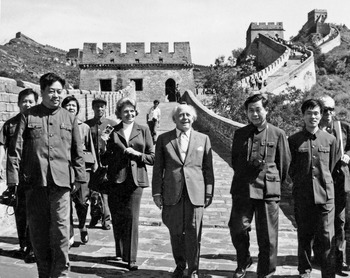
‘To friendship with China’, remarked Ormandy in a toast to thank his Chinese hosts.Footnote 53 Despite the proud and even slightly reluctant attitude that Ormandy exhibited towards Chinese musicians at the beginning of the tour, he gradually became gregarious and eventually fostered camaraderie with Chinese musicians.Footnote 54 It appears that Li Delun, too, was pleased with the American musicians in China. During a day trip to the Great Wall (Figure 1), the two conductors chatted about the contemporary musicians they were familiar with, and Li was excited to find out that the Russian conductor Gennady Rozhdestvensky was a mutual connection.Footnote 55 Li also invited Ormandy to a rehearsal of the Central Philharmonic Orchestra so that the American conductor could conduct the second movement of Beethoven's Symphony No.5. American journalists in China were keen to capitalize on this moment of baton-passing. Both Harold Schoenberg (a music critic and New York Times correspondent) and Sandy Grady (a Philadelphia Bulletin correspondent) highlighted this episode in their articles.Footnote 56 At the end of this rehearsal, Li graciously commented, ‘Starting this afternoon, a strong link between American and Chinese musicians has been made. And this day marks only the beginning of this friendship’.Footnote 57
Li Delun (left) and Eugene Ormandy (middle) on the Great Wall. Personal Collection of Madam Li Yan (Li Delun's second daughter).

When juxtaposing the Chinese and American media coverage of this tour, ‘friendship’ emerges as a cliché. In modern language, the word ‘friendship’ and its Chinese translation, ‘you-yi (友谊)’, generally refer to the amicable relationship established between individuals through mutual trust. In the realm of international politics, friendship also refers to the state of being non-hostile, allied, and at peace between nations. However, in the midst of the Sino-US rapprochement, what exactly did it mean for musicians such as Ormandy and Li to establish friendship? Was ‘friendship’ an overstatement or understatement to describe the connection forged between musicians from countries belonging to the either side of the Iron Curtain within the span of thirteen days? Did the American corps and the hosting Chinese community have the same understanding of ‘friendship’? Most importantly, how did the so-called ‘friendship’ established through musical exchange become meaningful to the Sino-US rapprochement?
‘They all say “you-yi,” “you-yi,” but it was actually curiosity’, is how Ambassador Platt reflected on the newly formed connections during the tour.Footnote 58 For American musicians, audiences, and other working staff, this tour was perceived and embraced as an unprecedented opportunity to interact with a society that had become almost unknown to them since the dawn of the global Cold War. As Kissinger wrote in his own memoir On China, by the late 1960s, the United States and China had regarded each other as ‘implacable enemies’ for more than twenty years.Footnote 59 Even the top leaders including Nixon and Mao found it difficult to start a conversation, not to mention the interactions on a non-governmental or popular level. In this context, a sense of curiosity about China – specifically, a desire to find out similarities and differences – seems to have driven the engagements of Americans in China, who included not only musicians but also journalists and sponsors. For example, Daniel Webster, a journalist from Philadelphia, asked Chinese musicians whether there was a career for music critics in communist China.Footnote 60 The wife of one of the Philadelphia Orchestra's main sponsors, who also joined the tour, kept chatting with Li Delun about her own household chores, on finding out that Li could speak English.Footnote 61 Apparently, curiosity inspired a remarkable level of enthusiasm among the Americans in communicating with their Chinese hosts.
By many accounts, the interactions enabled by this musical diplomacy proved to be unforgettable for the American participants. As Sue E. Dunn concluded in a report presented to the Committee of US-China Relations in 1976:
Many of these musicians remember well the ‘hate-Red-China, fear-the-yellow-peril’ propaganda of the 50s and 60s. Some were apprehensive about it. But China rapidly became something much different. Here was an ancient land with proud traditions, a real place with real people, families, familiar concerns. In spite of language barriers, the Philadelphians returned with the feeling that this had been a moving human experience.Footnote 62
Dunn's observations reflect a complex sense of coevalness from the American side. On the one hand, these musicians sensed a different China (‘an ancient land’), an example of what Fabian labels as ‘their time’.Footnote 63 That Chinese society they experienced seemed to go far beyond their own understanding of the past. On the other hand, the live interactions with their Chinese musician colleagues effectively led them to rise above preconceptions. These American grasped a shared reality through their ‘moving’ interactions with their Chinese colleagues.Footnote 64
One may critique Dunn's report as a naïve and idealistic take on musical diplomacy and argue that friendliness could only be a social performance in state-sponsored events, not a genuine willingness to communicate. However, as Gienow-Hecht pointed out, orchestras that went on tours had the agency to represent not only the states but also themselves as ‘players in the world arena’.Footnote 65 Similarly, in the process of state-arranged interactions, individual musicians, staff members, and even affiliated families demonstrated a sense of agency and made human connections by initiating conversations about their respective interests. From the perspective of individuals who were directly involved, music and exchanges around it created what Tia DeNora addressed as ‘dispositions and opportunities’ for transnational interactions.Footnote 66 Conversations initially held at the level of interstate diplomacy gradually made it possible for individuals to parlay pre-existing curiosities into further voluntary exchanges of extra-musical ideas and practices. This transformation can be understood – simply but affectively – as fellowship, or friendship.
The CCP, on its part, consistently recognized the Philadelphia Orchestra members as friends and the entire project of musical diplomacy as a demonstration of friendship. During the trip, terms such as ‘friendship’, ‘friendly’, and ‘friendliness’ appeared frequently in Chinese newspaper headlines that covered this tour.Footnote 67 As the political scientist Anne-Marie Brady reminded, ‘friendship’ is a highly politicized identification in the CCP's ideology, especially during Mao's era.Footnote 68 In Mao's perspective, ‘friends’ were defined against ‘enemies’ and generally referred to non-hostile, allied, or potentially allied foreign leaders and communities.Footnote 69 And to the CCP, ‘friends’ more specifically referred to influential foreigners who took the initiative to help or support the party in history – especially during the Second World War and the Chinese Civil War.Footnote 70 At a superficial glance, the CCP's use of ‘friendship’ may seem arbitrary, but seen through the preceding formulations, musicians of the Philadelphia Orchestra were appropriately qualified as ‘friends’: first, their arrivals in China signified the reduction of hostility between the two nations; second, as highlighted by the People's Daily (人民日报 Renmin Ribao), Eugene Ormandy (among other conductors) and the orchestra held a wartime relief concert in 1940 for the China Aid Council.Footnote 71 Indeed, ‘we are old friends. You helped us during the 40s’ is how Madam Mao first greeted Ormandy during the concert intermission in Beijing.Footnote 72
Moreover, it should be noted that friendship was a concept that went beyond amiable interpersonal interactions from the standpoint of the CCP. Kissinger, one of the key players in the Sino-US rapprochement, noticed the nuanced difference in the understanding of ‘friendship’ and its role in diplomacy between the two states:
Chinese diplomats consider continuity of relationships an important task and perhaps more important than formal documents. By comparison, American diplomacy tends to segment issues into self-contained units to be dealt with on their own merits. In this task, American diplomats also prize good personal relations. The difference is that Chinese leaders relate the ‘friendship’ less to personal qualities and more to long-term cultural, national, or historic ties; Americans stress the individual qualities of their counterparts.Footnote 73
Kissinger's judgement was astute. For American musicians such as Ormandy, their declaration of ‘friendship’ was based on ‘a fascinating excursion into international, intercultural, and interpersonal growth’ that they experienced within the duration of thirteen days.Footnote 74 But for the CCP, their juxtaposition of symphonic music and ‘friendship’ signified a long-term lineage of Sino-US exchanges that could be traced back to WWII and would include this specific tour as a trademark.
When we focus on the style of Chinese diplomacy in the early 1970s, hospitality – demonstrated through showing a maximum level of cordiality and generosity – emerges as the defining attribute. As Beverly Hooper noted, the consolidation of diplomatic relations between China and several Western countries from 1972 to 1973 were built on close personal connections between Premier Zhou and individual diplomats.Footnote 75 Foreigners who visited or resisted China in this context were commonly left with impressions of hospitality.Footnote 76 As Kissinger observed from his interactions with CCP leaders, ‘what we encountered was a diplomatic style closer to traditional Chinese diplomacy … Chinese statesmen historically have excelled at using hospitality, ceremony, and carefully cultivated personal relationships as tools of statecraft’.Footnote 77
It is particularly important to note that this diplomatic orientation justified Western art music in the midst of political negotiations. While planning for foreign officials’ visits, Chinese statesmen and personnel prepared a specifically calibrated programme of Western art music that sought to speak to the cultural backgrounds of individual politicians. Although Premier Zhou had very limited background knowledge of Beethoven's symphonies, it was him who first suggested performing Beethoven when hosting Walter Scheel (a former Foreign Minister of West Germany) and Henry Kissinger, citing the fact that both Scheel and Kissinger were of German origin.Footnote 78 Similarly, in preparation for Nixon's visit, the Central Philharmonic Orchestra rehearsed America the Beautiful, a choice that was no less controversial than Beethoven's symphonies in China at that time.Footnote 79 According to the Chinese documentary writer Chen Dunde, Zhou specifically commented during the rehearsal, ‘This piece [America the Beautiful] was played in Nixon's presidential inauguration ceremony. You guys [musicians from the Central Philharmonic Orchestra] please play it well!’Footnote 80 As these examples suggest, Premier Zhou and the Chinese Ministry of Foreign Affairs chose music repertoire not necessarily based on an in-depth understanding on the repertoire itself but on the cultural and political associations of individual visitors.
Zhou's disposition can be understood as a gesture of hospitality – or, a demonstration of the Chinese concept of li 礼 (etiquette) in diplomatic context. Functioning as an essential pillar of the entire discourse of Confucianism, li became a guideline, a quality, and a standard of conduct in political settings. The act of calibrating music programme corresponding to the cultural and political identities of individual guests was comparable to how music figured in ancient Chinese diplomacy. In Chinese antiquity, music functioned as a ritual that directly embodied propriety in both individual acts and communal behaviours.Footnote 81 In political proceedings such as diplomatic negotiations, music had to be performed and the choice of music had to accord precisely with the political status of individual personnel. The ancient Chinese diplomat Shusun Bao (?–538 bc), for example, demonstrated his ‘ritual knowledge’ during a diplomatic mission by only bowing to the music that was appropriate for his political rank as a minister; he refused to enjoy musical entertainment that was considered to be incongruent with his political status.Footnote 82 That is to say, in ancient Chinese context, music was appropriate only if it conformed with the listener's political identity, and musicianship – here I specifically refer to the capacity to differentiate and decode music's political association – was considered as an indispensable virtue. Perhaps unsurprisingly, the imprint of this ancient philosophy on Zhou points towards the ways in which classical Chinese philosophy, especially Confucianism, played an essential part in Zhou's personality and working style, a dynamic documented by a number of historians including Keith, Gao Wenqian, Peter Rand, and Laurance R. Sullivan.Footnote 83 Despite the fact that the CCP took an anti-Confucianist stance and initiated anti-Confucius campaigns during the Cultural Revolution due to an alleged connection of this classical philosophy to feudalism, Confucianism was not only relevant to top CCP leaders’ working style but also permeated through different levels of Chinese society.Footnote 84
Of course, it would be a gross exaggeration to claim that Zhou's measured dealings with music and the orchestral performances that were enacted under his auspices were somehow a direct reconstruction of a ritual from Chinese antiquity.Footnote 85 However, a consideration of the traditional Chinese ideology of liyue (ritual and music), together with its application in diplomacy, helps to justify the prominent role played by Western art music in Chinese diplomacy during the 1970s. Within the broad concept of liyue, music-making is first an individual self-cultivation that contributes to the communal interest of social stability.Footnote 86 For individual diplomats in Chinese antiquity, although they themselves were not necessarily music performers, the capacity to appreciate, differentiate, and even criticize music proved to be an indicator of their moral standard and political achievement.Footnote 87 As rulers of the hosting state, based on historical accounts such as the Zuo Tradition (左传), the arrangement of music performance for visiting diplomats was a ritual, and an appropriate choice of the repertoire – the repertoire that the visiting diplomat could understand and precisely accord with his political identity – signalled not only the li (etiquette) of the ruler but also the li (ritual propriety) of the entire state.Footnote 88 Similarly, Zhou's decision of resuming practices of Western art music in 1972, followed by an entire series of Sino-Western musical exchanges, went beyond a recognition of prestige associated with Western musical heritage; instead, by demonstrating an understanding of the visiting statesmen's background through music, communist leaders such as Zhou hoped to reconstruct the Chinese national image of decorum, of etiquette, and of propriety.
With this understanding of liyue, it is possible to reconceptualize the relationship between music and diplomacy in the Chinese context. During Chinese antiquity when the ideology of liyue first emerged, not only was music essential in diplomacy as an etiquette but also diplomats had to present themselves as decent humans – as someone who is well versed in li – by demonstrating their comprehensive musical knowledge.Footnote 89 That is to say, in the context of Chinese antiquity, the conception of diplomacy itself was inclusive of music both as an act and as a core value. The continued influence of this conception explains why the phrase ‘music diplomacy’ in the Western and modern sense of the word does not always make perfect sense to a Chinese audience, for whom diplomacy itself should be musical.
Despite the evolution of li as a concept and how it functioned as a counterpart to yue throughout Chinese history, examples of musical diplomacy can be easily found in historical narratives of numerous dynasties ranging from Chinese antiquity to the late Qing period. These took the form of exchange of musicians, musicians doubling as diplomats, or music-making as a solemn ceremony when leaders of different states meet.Footnote 90 Even in the very first encounter between imperial China and the West, musical instruments from Europe became essential presents that helped establish diplomatic relations.Footnote 91 In 1601, the Italian Jesuit Matteo Ricci dedicated a clavichord to the Chinese Emperor Wanli in a ceremonial setting.Footnote 92 Such an act not only granted Ricci the permission to settle in China as a dignitary but also paved the way for his music teaching at the Chinese court.Footnote 93 In this very first known Sino-Western musical exchange in early modern history, the clavichord itself was seen as a precious li (present), and the act of dedication demonstrated the quality of li (etiquette) of Ricci and the institution he represented.
Given the remarkable tradition of music being included as an integral part of diplomacy in Chinese history, the Sino-Western musical diplomacy in 1973 was not an innovation. The significance of the 1973 Philadelphia Orchestra Tour went beyond a re-introduction of Western art music to the Chinese audiences or a demonstration of friendship between the American and Chinese people. Instead, it was a redefinition of Western art music and related practices (e.g., the symphonic arrangement of American folk songs) as a ritualized etiquette in Sino-US diplomacy.Footnote 94
Conclusion
As if to contradict the stubborn cliché that music helps bring peace because it is a universal language, the immediate aftermath of the tour was rather embarrassing. In October 1973, Madam Mao terminated a previously allowed score exchange of the Chinese piece Moonlight Reflections on the Second Spring (二泉映月Erquan Yingyue) between Ormandy and Li Delun, having become irritated by Harold Schoenberg's criticism of the Yellow River Piano Concerto as a ‘bastardization’ of Chinese music in the New York Times.Footnote 95 In the following year, domestic political turmoil in both countries amplified interstate dissension on multiple levels. On the Chinese side, partisan politics resulted in another series of severe criticisms against Western art music.Footnote 96 In the United States, the Watergate scandal, which resulted in Nixon's resignation, generated backlash against the newly established Sino-US relations and even negative public opinion of Ormandy, given that he was a friend of Nixon.Footnote 97 Ironically, music seemed to become a hopelessly ill-suited tool for China-US relations in late 1973 and 1974: not only was music incapable of helping resolve interstate conflicts but it also helped provoke more disagreements.
Following the end of Cultural Revolution in 1976 and a series of political reforms in both nations, the normalization of Sino-US relations ultimately took place in 1979 between President Jimmy Carter and the Vice Premier Deng Xiaoping. Two months after Deng's visit to Washington in January 1979, Seiji Ozawa and the Boston Symphony Orchestra toured in China to commemorate the progress in diplomatic relations.Footnote 98 In this tour, the Boston Symphony performed Erquan Yingyue, completing the project that initially started with the score exchange between Li Delun and Ormandy six years before.Footnote 99 Fast-forwarding to 2019, despite US-China tensions caused by the trade war, the Philadelphia Orchestra hosted the Shanghai Philharmonic at the beginning of the year and embarked on its twelfth China tour in May, as part of the commemoration of the forty-year anniversary of the normalization of Sino-US relations.Footnote 100 Taking this long-term view, I suggest a new historiography of musical diplomacy concerning China and the United States. From the China relief concert co-conducted by Ormandy in 1940, to the Philadelphia Orchestra's recent partnership with several Chinese music institutions in the 2010s, Western art music performance in a diplomatic context can be viewed as an institutionalized act of what is known as lishang wanglai (礼尚往来) in Chinese philosophical discourse: etiquette places key importance on reciprocity – that is, the act of extending and receiving.Footnote 101
As we re-evaluate the significance of Western art music performed in China in 1973, we can say that it functioned as a broad, if vague, sign-vehicle that could be easily recognized and yet differently decoded by various parts in the assemblage that constituted the tour – diplomats, bureaucrats, musicians, audiences – and within the frames that compelled hearing tradition, diplomacy, friendship, and solidarity from different perspectives. This view highlights not only the canon-building process or the ideologies of repertoire that are often invoked in studies of musical diplomacy but also the various social scales that were set into motion: the musical performances provided a ground for transnational and intercultural interactions, fostered personal connections, and revitalized and created sonic memories.
This is not to deny that music played in the name of diplomacy was political. It was political, by all means. It was a state-initiated project entwined with ideological debates and interstate conflicts, taking place at a dire time marked by authoritative regime. It was precisely because of the political embeddedness of music in Chinese understandings of diplomacy that the event was justified and paved a way for the genre of Western art music. Based on the discussion of an entrenched ideology of liyue, I suggest that the political nature of Western art music in diplomatic context was actually a strength instead of a limitation, because music, as a kind of li, was able to dovetail artistry with politics, personal memories with communal experiences, past coevalness with present co-existence, and individual commitments with state interests.
The ritualistic aspect of music diplomacy has also transformed itself into a trendy cultural phenomenon that is inseparable from current diplomatic relations. Of course, over the past four decades, senior orchestra members retired, a younger generation of audiences replaced the elder ones, and public relations agencies replaced individual bilingual and multi-tasking diplomats. However, the assemblage connecting individuals, nation-states, and institutions that forged in 1973 is still operating. Repertoires, sounds, and aesthetics that used to be at the core of negotiation during the period of Sino-US rapprochement remain vigorous subjects in today's strategic partnership. In the midst of the dynamic twenty-first century Sino-US relations, exchanged sounds in transnational settings – instrumental or vocal, consonant or dissonant, cacophonous or harmonious – are yet to be decoded.
Selected Chinese names and terms