Introduction
In terms of the value of Croatian agricultural production, livestock production represents approximately 40% (Grgić et al., Reference GRGIĆ, HADELAN, PRIŠENK and ZRAKIĆ2015), of which poultry production is 17% (Bobetić, Reference BOBETIĆ2013). Poultry production in Croatia has been characterised by a high level of industrialisation, involving the breeding of light- and heavy-breed laying hen hybrids, production of hens for laying consumer eggs, one-day chickens and fattening broilers, turkeys, ducklings and geese (Senčić and Butko, Reference SENČIĆ and BUTKO2006; Kralik et al., Reference KRALIK, HAS-SCHÖN, KRALIK and ŠPERANDA2008). Poultry production takes place at specialised poultry farms or their subcontractors. For the purpose of meat and egg production, large poultry production systems use poultry with genetic potential that assures high production levels, while family farms keep poultry of lower genetic potential (Kralik et al., Reference KRALIK, KRALIK, KRALIK and JANJEČIĆ2012; Crnčan et al., Reference CRNČAN, KRISTIĆ and RANOGAJEC2013). Recently, there has been a strong emphasis placed on animal welfare, which has required reorganisation of existing production capacities in order to meet requirements for poultry production and to fulfil environmental and organic standards. These changes can cause oscillations, as well as reductions, in poultry and egg production (Van Horne and Bondt, Reference VAN HORNE and BONDT2003; Beierlein et al., Reference BEIERLEIN, SCHNEEBERGER and OSBURN2008; Crnčan et al., Reference CRNČAN, RANOGAJEC, DEŽE and KRISTIĆ2011). The following review examines poultry production in Croatia between 2009 and 2016 compared to EU regulations and consumption patterns.
Population and production of poultry in Croatia and the EU
There have been many changes in poultry production in most European Union countries recently, associated with the reforms and legislation related to animal welfare, ecology, and biological safety in food production and distribution (Van Horne, Reference VAN HORNE2007; Elson, Reference ELSON2008). Such changes have caused production stagnation or even its reduction, which have been linked to the year of accession of a country to the European Union and implementation of its legislation relating to animal welfare. Table 1 provides an overview of the number of birds by type produced in the Republic of Croatia from 2009 to 2016. In 2009, total poultry output was 10,787,196 birds, of various poultry was produced, and in 2016, that number had reduced by 8.63%, down to 9,856 million birds. The number of hens during the analysed period was reduced by 42.5%, the number of turkeys in 2016 was 12.31% lower than in 2009, geese decreased by 66.23%, ducks by 51.06%, and the number of other types of poultry decreased by up to 90.92%.
Population and type of poultry in Croatia in the period 2009-2016.

Source: Croatian Bureau of Statistics, 2017.
In the overall structure of poultry production, the largest proportion is represented by hens, although it is notable that this proportion has declined. This can be associated with the implementation of animal welfare standards, as defined by the Council Directive 1999/74/EC of 19 July 1999, which specified minimum standards for the protection of laying hens. These regulations were incorporated into Croatian legislation (Official Gazette, 77/10, 99/10 and 51/11). Along with the decrease in total poultry production in the Republic of Croatia, imports of poultry increased by about 40% in 2014, amounting to 17,912 tons. In comparison, the import of poultry meat in 2009 was 12,753 tons. In 2015, imports were greater at 24,150 tons of poultry meat, and this trend has continued over subsequent years, as presented in Figure 1.
Import of poultry meat in Croatia from 2009-2018.
Source: prepared by the authors according to available data, 2017.

The export of poultry meat is much smaller when compared to imports, but there has been an increasing trend, with 11,122 tons of poultry meat in 2014, 36% more than in 2009 when only 8,178 tons of poultry meat was exported. In 2015, there was a reduction in registered exports, at only 6,360 tons of poultry meat. Most poultry production in the EU countries covers their own needs at a level of 106%, and exports refer to an average of 1.1 million tons of poultry meat annually. During the time period studied, EU countries increased poultry meat production by 8.8%, as well as export by 10%, but decreased imports (3.7%) and increased consumption by 1.5 kg per capita. At the same time, self-sufficiency of poultry meat was stagnant or increased (Kralik et al., Reference KRALIK, TOLUŠIĆ and BOŠNJAKOVIĆ2017). The analysis of poultry meat imports and exports in the Republic of Croatia, as shown in Figure 1 and 2, showed that there was a trend of increasing imports, yet there was also a tendency for increased export. Taking this into account, it remains that the export of poultry meat was lower than imports.
Poultry meat and eggs are foodstuffs of high nutritional value for humans. (Horning, Reference HORNING1995). Hence, the relatively low price of poultry products and consumer opportunities, make expected demand likely to increase. The price of Croatian poultry products is high because of the high input costs, resulting in the lack of domestic products for retail and the increase in meat and egg imports. In order to maintain existing production levels, and to increase and achieve the competitiveness of poultry production, it is necessary to reconstruct local production systems and marketing. As presented in the Table 2, annual consumption of poultry meat in all EU countries is estimated at 22 kg per capita, which is 2.4 times more than the annual consumption of poultry meat in the Republic of Croatia (9 kg per capita).
Export of poultry meat in Croatia from 2009-2018.
Source: prepared by the authors according to available data, 2017.

Average annual consumption of poultry meat and eggs in EU countries.

Source: elaborated by the authors according to available data, 2017.
The same applies to the consumption of table eggs, which is 20.67% less than the average consumption of eggs in other European Union countries. In the past, eggs were considered an exceptional and cheap source of essential nutrients. This view has changed since eggs have been considered as a source of cholesterol. However, eggs have regained popularity, due to the fact that they are relatively cheap and nutritionally valuable. The funds for investment in the poultry sector in the Republic of Croatia are, unfortunately, not sufficiently used to improve poultry production, even though they represent a significant opportunity for improving poultry businesses.
Production of eggs
In the Republic of Croatia, poultry production is organised mostly in large production units owned by a small number of producers, whose facilities were built at a time when the standards for building and animal welfare were significantly lower than at present (Kralik et al., Reference KRALIK, JANJEČIĆ, KRALIK and ŠKRTIĆ2013; Crnčan et al., Reference CRNČAN, HADELAN, KRALIK and KRISTIĆ2017). Intensive egg production covers 70% of market needs and about 30% of eggs are produced within extensive production systems, which are organised in smaller production units or even in individual households (Tolušić, Reference TOLUŠIĆ2011). Hens from light hybrid lines are used in intensive breeding for egg production, and heavy hybrid lines are mostly used for meat production (Senčić and Butko, Reference SENČIĆ and BUTKO2006; Rodić et al., Reference RODIĆ, PERIĆ and ĐUKIĆ-STOJČIĆ2009). In intensive breeding systems, light hybrid poultry are usually kept in cages, while heavy hybrid lines are kept on deep litter. On family farms, poultry is mainly kept under free-range systems (Kralik et al., Reference KRALIK, HAS-SCHÖN, KRALIK and ŠPERANDA2008).
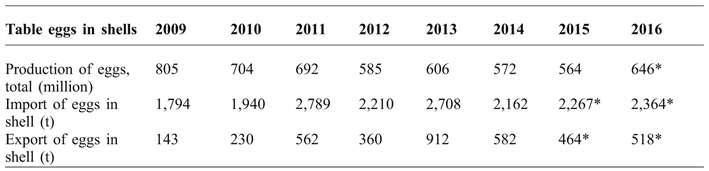
The annual production of eggs in the Republic of Croatia amounts to 661 million. Total production of table eggs in shells is presented in Table 3. Compared to figures for 2009, production in 2014 showed a decrease of almost 29%. It should be noted that the decrease in egg production occurred after the implementation of EU Council Directive 1999/74/EC in 2013.
Production, import and export of table eggs in Croatia in the period 2009-2016.

Source: elaborated by the authors according to available data (2017), * estimated by the authors according to available data.
Proportional to the reduced poultry population in Croatia, the import of eggs in 2014 increased by almost 17%, compared to 2009 when the import of eggs was 1,794 tons per year. The export of eggs is increasing, but this is negligible compared to the amount of eggs imported into the Republic of Croatia. In 2014, import of eggs was 3.7 times higher than the export of eggs in the same year. Until 2012, breeding hens in the Republic of Croatia was mostly conducted in cages. Hens are kept in these facilities for 12-14 months, until their productivity falls below 60%. After that, the flock used for production is replaced by a new one.
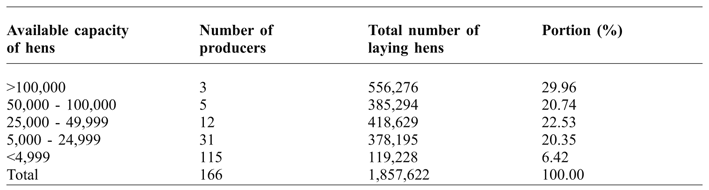
One year after the accession of the Republic of Croatia to the EU, table egg producers had to adopt the requirements defined in the Council Directive 1999/74/EC of 19 July 1999, which defines minimum standards for laying hens. According to this Directive, egg production can take place in free-range, semi-intensive or deep litter systems or in stacked cages (i.e. in aviaries or in cages). According to the data available in the register of laying hens for October 2017 (Table 4), there was a total of 166 table egg producers registered in the Republic of Croatia (Ministry of Agriculture, 2017). In July 2014, one year after joining the European Union, there were fewer producers of table egg, i.e. only 79 producers accounted for 250,000 to 259,200 laying hens in total (Crnčan, Reference CRNČAN2016), and the number of producers had increased by almost 110% in 2017.
Structure of egg producers according to their production capacity

Source: elaborated by the authors according to the data available in the Register of laying hens (Ministry of Agriculture, October 2017).
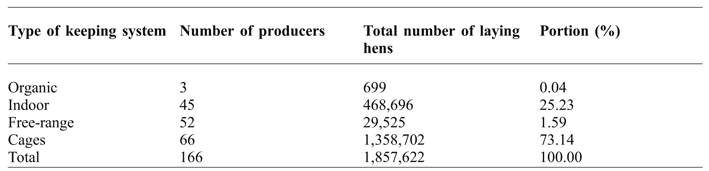
For table egg producers, most use extensive keeping systems with less than 4,999 hens on their farms and the number of producers with available capacity of over 100,000 hens is very small. There are only three large producers in the Republic of Croatia and they account for 556,276 laying hens in total. With reference to the system of keeping laying hens, cages are currently the most well represented, both according to the number of producers that use this system and the total number of laying hens involved (Table 5). This is followed by the indoor keeping system, accounting for 25.23% of hens and involving 468,696 hens in total.
Structure of producers according to the system for keeping laying hens.

Source: elaborated by the authors according to the data available in the Register of laying hens (Ministry of Agriculture, October 2017).
Production of eggs to organic standards is the least represented, at 0.04% and with only three producers in the entire Republic of Croatia who use such system. This is because organic production requires larger areas for the birds and the ability to produce their own feed materials. According to legislation, organic production requires 230 laying hens for each one hectare of external area. The organic food market is increasing in most EU countries, and also in Croatia. Whilst organic farming worldwide is growing, in the Republic of Croatia, despite all resources and preconditions, this type of production is still underdeveloped (Crnčan, Reference CRNČAN2016; Crnčan et al., Reference CRNČAN, HADELAN, KRALIK and KRISTIĆ2017). Concerns about care and welfare of poultry are not the same throughout Europe, with legislation strictly adhered to in some countries, whilst other countries are more lax. There are big differences in subsidy programs for poultry production (Appleby, Reference APPLEBY2003). Even prior to the introduction of the Council Directive (1999/74/EC), the Netherlands encouraged producers to replace conventional battery cages with alternative systems. Their government stimulated programs for development and promoted organic production, so out of approximately 30 million hens, more than 50% are now kept in aviaries, followed by free-range and organic production. There are only a few farms that keep laying hens in enriched cages and these can be used for a short period, because the state legislation in the Netherlands is stricter than the EU. In Switzerland, over 80% of laying hens are kept in aviaries combined with government supported roofed outdoor areas, i.e. ‘winter gardens’. The production of eggs in Switzerland has undergone a strong campaign aimed at improving the quality of eggs and poultry welfare. In Sweden, more than 60% of egg production is in aviaries or on deep litter, and approximately 30% of laying hens are kept in enriched cages (Matković et al., Reference MATKOVIĆ, VUČEMILO and MATKOVIĆ2007). Hence, at present, unlike in the Republic of Croatia, certain EU countries have well-developed production of eggs using free-range, enriched indoor or organic systems. Moreover, consumers are encouraged to choose products that take animal welfare and food safety into consideration, and certain market labels are applied to egg packaging that clearly point out the production system in which they are produced. Therefore, the most marketable labels are given to organic eggs, while eggs produced in enriched cages do not have any specific labelling (Crnčan et al., Reference CRNČAN, KRISTIĆ and ZMAIĆ2014).
Indigenous Croatian poultry breeds
In the Republic of Croatia, there are two types of indigenous poultry: the Zagorje turkey and the Hrvatica hen. The Zagorje turkey has four strains: bronze, grey, bright and black, based on the colour of feathers. In all strains of Zagorje turkeys, females are considerably smaller than male turkeys and do not have shiny feathers. The female's head, snood and wattle are much smaller than in male turkeys. The Zagorje turkey is strong and resistant to diseases, which is the result of extensive rearing. After 24 weeks of growing, the male turkey reaches a weight of 6 to 7 kg, while a female turkey reaches a weight of 3 to 4 kg (Barać et al., Reference BARAĆ, ČAČIĆ, DRAŽIĆ, IVANKOVIĆ, JANJEČIĆ, JEREMIĆ, MARKOVIĆ, MIOČ and POLJAK2012).
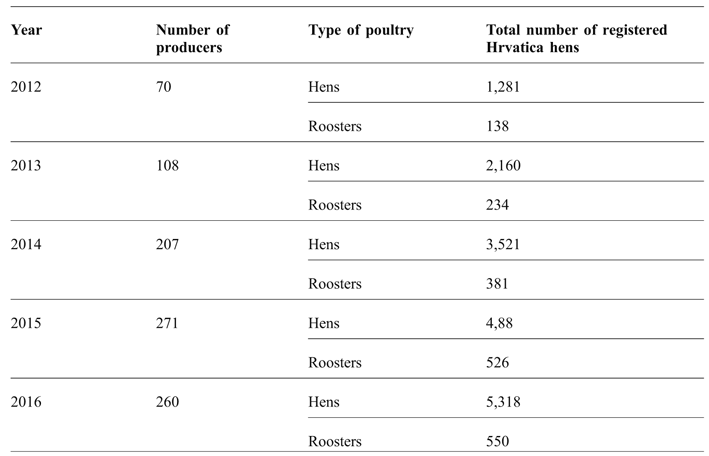
There are four strains of indigenous Hrvatica hen. They differ in feather colours, which can be red, black, partridge-gold and black-gold. All strains have white ear lobes. White legs are characteristic of red and partridge-gold strains, while black and black-gold strains have grey legs. The adult body weight of an adult hen is 1.6-1.8 kg and a rooster 2.2-2.6 kg (Janječić, Reference JANJEČIĆ2011). The Hrvatica hen is a breed that is well adjusted to outdoor rearing systems throughout the year. In favourable conditions, they lay about 200 to 220 eggs with light brown shells (Janječić, Reference JANJEČIĆ2011; Kralik et al., Reference KRALIK, JANJEČIĆ, KRALIK and ŠKRTIĆ2013). Between 2012 and 2016, the number of producers of Hrvatica hens increased in the Republic of Croatia, which was in proportion to the number of registered animals (Table 6).
Number of producers and number of registered Hrvatica hens in the period 2013-2016.

Source: Croatian Agricultural Agency, 2016
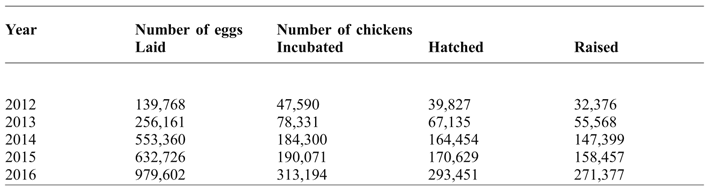
The number of registered Hrvatica hens increased from 1,281 hens and 138 roosters in 2012 to 5,318 hens and 550 roosters in 2016, which confirmed a growing interest of producers in this breed. In proportion to the increased number hens, in 2016, egg production from Hrvatica hens was seven times higher than in 2012 (Tables 6 and 7).
Total number of eggs and number of Hrvatica chickens in Croatia.

Source: Croatian Agricultural Agency, 2016.
Compared to the number of hatched chickens, those raised for meat in 2012 was lower by 18.71%. In 2016, mortality rate was reduced, so the portion of raised chickens was only 7.53% less than the number of hatched chickens of the Hrvatica hen. Breeding with the Hrvatica hen and production of eggs on small family farms offers the potential for self-sustainability and development of indigenous poultry production. In the future, breeding of such birds will have an important role in poultry production, because the Hrvatica hen is resistant and endurable, and is therefore suitable for both organic and free-range systems. Expanding production on small agricultural farms, whose development is encouraged by the European Union, can be ensured through breeding indigenous poultry and production of their meat and eggs according to organic principles.
Conclusions
In the Republic of Croatia poultry meat and eggs are considered foodstuffs of high nutritional value. However, it is expected that the total number of poultry in the Republic of Croatia will continue to decrease, especially in the face of increasing legislative control from the EU. Consumption of table eggs and poultry meat in the Republic of Croatia is lower than in other European Union member states. Out of the total number of table egg producers, the majority use extensive keeping system, involving less than 4,999 birds of poultry on their farms. The number of poultry producers who have more than 100,000 birds of poultry is very small; with only three such producers with a total production capacity of 556,276 laying hens. Production and market globalisation has resulted in a number of challenges for the local sector. The success of future poultry production will depend on producer's adherence with the requirements of the EU and implementation of legislation relating to animal welfare and environmental protection at all stages of production. It is necessary to make changes in the entire sector, which need investing in new production capacities or reconstructing existing ones. This aside, it is essential to create branded products with the emphasis on freshness and nutrition. The premise for achieving competitiveness in the domestic and EU market requires the combined effort of poultry farmers and the active inclusion of experts in production. In addition, promotion of indigenous breeds suitable for outdoor and organic production could provide a niche market sector within Croatia. In this way, it is possible to increase profitability by better marketing, and on the distinctiveness of final products.