In the United States, hospitals are perceived as stable sources of support and assistance, especially during disasters, when the usual lines of communication are disrupted. Community members assume the hospital is one of a handful of facilities equipped with the supplies, personnel, and protocols necessary to provide health and auxiliary care during an emergency.Reference Albanese, Birnbaum and Cannon1-Reference Paturas, Smith and Smith4
Previous studies have confirmed the central role of hospitals in the context of large-scale disasters, using the attacks on the World Trade Center and Hurricane Katrina as real-life examples.Reference Barbera, Yeatts and Macintyre5 In New Orleans, Louisiana, inadequate planning, specifically regarding evacuation protocols and the delivery of supplies, resulted in serious consequences and unnecessary fatalities.Reference Gray and Hebert6 These high-profile events drew well-deserved attention to disaster preparedness in the health care setting and stimulated discussion on how to improve hospital preparedness before the next disaster. In spite of a movement to update emergency management protocols, research indicates that hospitals are still not prepared to handle a surge in demand driven by a large-scale disaster.Reference Niska and Shimizu7-Reference Rebmann, Wilson and LaPointe9
Multiple organizations and researchers, including the Joint Commission on Accreditation of Healthcare Organizations and the Department of Homeland Security, have identified essential components of hospital emergency management plans.Reference Niska and Shimizu7, Reference Hodge and Brown10-Reference Rebmann12 These planning elements are designed to ensure that hospitals have the capability and capacity to remain open during and after the disaster. In addition, it has been suggested that hospitals have a responsibility to provide nonmedical support to community members during a disaster.Reference Albanese, Birnbaum and Cannon1 Examples of such nonmedical support include food, water, family reunification, and news. To date, the full scope of nonmedical resources and services that hospitals may be expected to provide during a disaster has not been delineated nor has research assessed the public's expectations regarding which of these resources and services they anticipate needing.
The purposes of this study were to identify the extent to which the general public expects hospitals to provide nonmedical resources and services during 3 hypothetical catastrophic events (influenza pandemic, earthquake, and terrorist bombing), the extent to which individuals anticipate they will need or want nonmedical resources and services from hospitals during disasters, and to delineate factors that influence these anticipated needs. Because these issues have been largely unexplored, it is unlikely that hospitals are currently in a position to meet these expectations in the event of a disaster. We hypothesized that the public's anticipated needs and expectations would vary depending on the nature of the disaster, and that they would be influenced by demographic characteristics, including age, race, socioeconomic status, and pattern of health care utilization.
Methods
A 35-item paper survey was offered to all adults either presenting for emergency care or accompanying a patient to the emergency department (ED) of 3 hospitals in St Louis, Missouri from March to December 2011. Two of the hospitals were academic urban hospitals; 1 exclusively served pediatrics patients (annual ED census of 44 000), and the other was an adult facility (annual ED census of 36 000). The third hospital was located in a suburban area and served all ages (annual ED census of 55 000). All ED visitors or patients were approached during recruiting hours (recruiting hours consisted of day and night shifts on all days of the week) by research assistants. Exclusion criteria included persons younger than age 18 years, those presenting with an Emergency Severity Index (ESI) of 1 (ie, having a very high medical acuity), and those who were incapable of reading or speaking English, had an altered mental status, or were suicidal/homicidal. Only 1 person per group (patient or accompanying family member or friend) could take the survey. All surveys were anonymous.
Survey Questionnaire
Research related to anticipated public expectations and needs of hospital services during a disaster was used as the basis for this questionnaire.Reference Albanese, Birnbaum and Cannon1-Reference Paturas, Smith and Smith4 Participants were asked to identify which resources and services that they anticipate they would need from a hospital during 3 disaster scenarios: influenza pandemic, earthquake, or terrorist bombing. The 3 scenarios are presented in the Appendix. These scenarios were chosen to represent a variety of disaster types (biologic, natural, and man-made), as based on the highest risks on the researchers’ hospital hazard vulnerability analysis to create the most realistic scenarios for the participants.
Questions related to the person's experiences during past disasters (such as loss of home or property, injury), whether the individual had a personal or family disaster plan related to reunification of family during a disaster, and the anticipated need for ongoing electricity for the medical support of self or a family member during a disaster (such as a home ventilator) were included in the questionnaire. Last, demographic questions assessed the participant's age, race, gender, relationship to the patient, zip code (used as a proxy for income based on median income for zip code), and the number of ED visits, primary care visits, and hospitalizations the patient experienced in the past 12 months. A group of 10 US disaster preparedness researchers provided feedback on content validity. The content validity index (CVI) was computed for each item.Reference Lynn13 No items had a CVI below 0.80, so none was deleted. Items were revised based on feedback from the CVI panel. The final survey contained 27 questions plus demographic items. The questionnaire then underwent a pilot study using a 10-person panel of representative subjects. The final survey was considered exempt by the Saint Louis University Institutional Review Board.
Data Analysis
The Statistical Package for the Social Sciences (SPSS®) 19.0 was used for all analyses. Data from the paper surveys were entered into the database. Five percent of surveys were secondarily checked for data entry accuracy by one of us (R.L.C.). Surveys with extensive incomplete data (70% or more) were excluded from analyses. Descriptive statistics were computed for each question and used to describe resources and services participants anticipate they would need from a hospital during a disaster. Utilization scores were calculated for each of the 3 scenarios (pandemic, earthquake, and bombing) by assigning 1 point for each resource or service an individual reported anticipating would be needed (ie, they “strongly agreed” or “agreed somewhat” that they would need an item or service from a hospital during a disaster). Each scenario had a varying number of possible resources or services; therefore, the utilization scores for the 3 scenarios varied. Except for a single item in the earthquake and pandemic scenarios (ie, treatment for difficulty breathing during a pandemic, and treatment of serious injuries during an earthquake), all utilization score items consisted of inappropriate or suboptimal usage of ED resources or services. The highest possible utilization scores for each scenario were pandemic, 7 points; earthquake, 8 points; and bombing, 4 points. Linear regression was used to describe factors associated with higher resource utilization scores for the scenarios. Nonsignificant variables, such as income, hospital location, and hospital type (adult vs pediatric) were not included in the final models; only the final models are reported. Chi-square tests were used to compare agreement rates (agree vs not agree) for each hospital resource or service when comparing response by race (white vs non-white).
Results
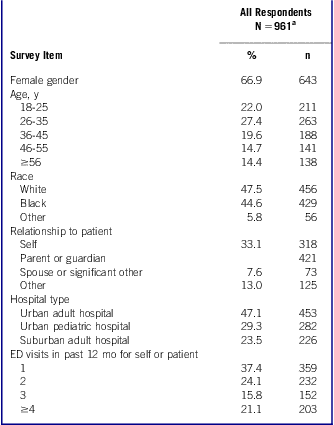
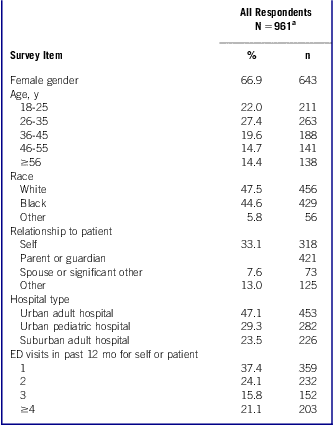
In all, 961 individuals participated in the survey, although denominators for individual questions may vary due to missing or incomplete data. Most participants were female (66.9%, n = 643), and white (47.5%, n = 456) or black (44.6%, n = 429). Participants represented all age groups. A full list of participant demographics is provided in Table 1.
Demographics of Respondents
Abbreviation: ED, emergency department.
aDenominators varied due to missing or incomplete data.
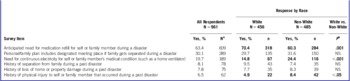
Many participants (63.4%, n = 609) anticipated needing medication refills for themselves or family members during a disaster; whites were more likely than non-whites (χ2 = 10.3, P = .001) to indicate that medication refills will be needed (Table 2). A small percentage of respondents (20%, n = 189) reported that they had a family member or were themselves dependent on electricity to support a medical condition; non-whites were more likely than whites (χ2 = 13.3, P < .001) to report a medically-related dependency on electricity (Table 2). Approximately one-third (30.1%, n = 289) reported having a designated meeting place for separated family members. Few reported experiencing a personal or family injury (6.5%, n = 62), separation from family (8.1%, n = 78), or loss of property (7.8%, n = 75) during a previous disaster. Non-whites were more likely than whites (χ2 = 4.7, P < .05) to report a history of personal or family injury during a past disaster (Table 2). No differences were found between race and having a family-designated meeting place, history of family separation during a past disaster, or loss of property during a previous event (Table 2).
Respondents’ Experiences During Past Disasters, Extent of Personal Plan, and Anticipated Needs During Future Event by Race

Abbreviation: NS, nonsignificant.
aDenominators varied due to missing or incomplete data.
bDetermined by the χ2 test.
Anticipated Hospital Resources and Services Needed During Influenza Pandemic
Participants were asked to identify which resources and services they would expect to need from a hospital during an influenza pandemic; the survey listed 8 possibilities: (1) food; (2) news and information about the pandemic; (3) treatment for self or child experiencing cough, fever, and congestion, but without difficulty breathing; (4) treatment for self or child experiencing cough, fever, congestion, and difficulty breathing; (5) support or counseling if a friend or family member died and the death did not occur in the hospital; (6) personal protective equipment to help prevent exposure from illness (ie, mask and gloves); (7) medication refill(s); and (8) event-related vaccine (such as pandemic influenza vaccine).
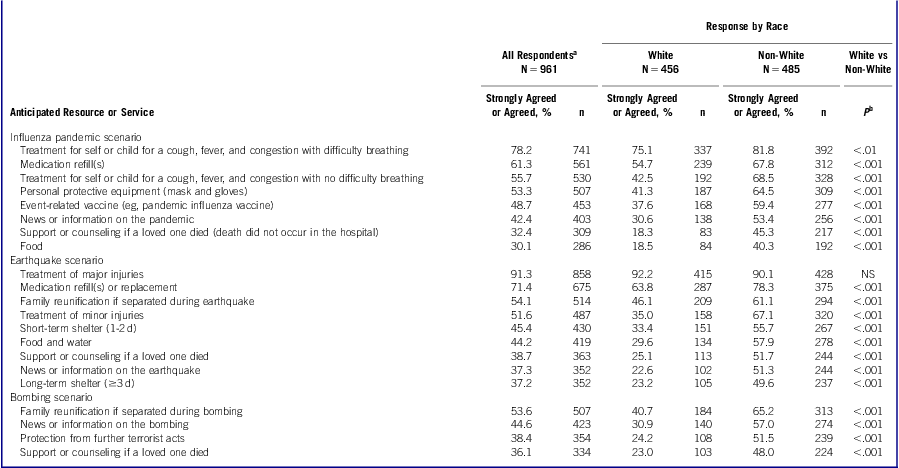
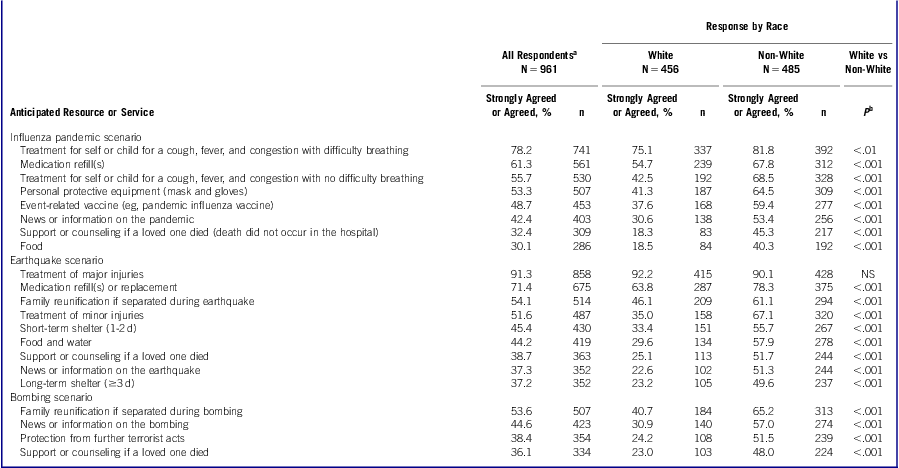
The most commonly reported anticipated needs during a pandemic included treatment for a serious illness (cough, fever, congestion, and difficulty breathing; 78.2%, n = 741), medication refills (61.3%, n = 561), and treatment for minor illness (cough, fever, and congestion without difficulty breathing; 55.7%, n = 530) (Table 3). The least commonly reported anticipated needs included counseling (32.4%, n = 309) and food (30.1%, n = 286) (Table 3).
Anticipated Utilization of Hospital Nonmedical Resources or Services During Disasters By Race
Abbreviation: NS, nonsignificant.
aDenominators varied due to missing or incomplete data.
bDetermined by the χ2 test.
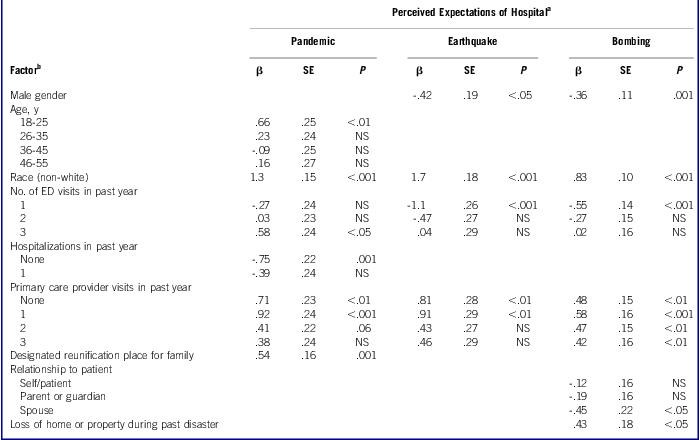
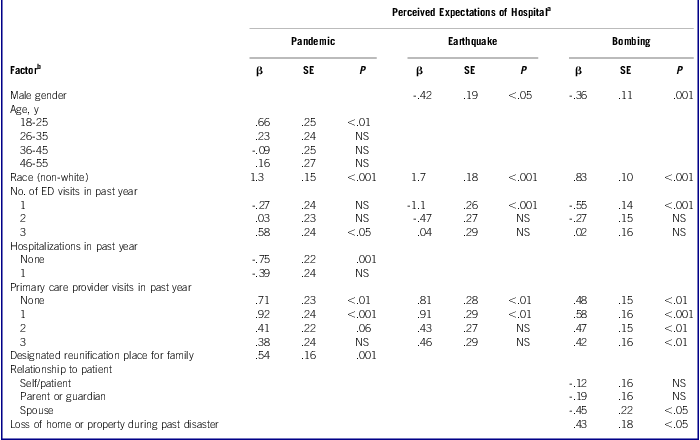
A pandemic utilization score was calculated by assigning 1 point for each resource or service that individuals reported that they would want to receive from a hospital during a disaster except for the item about treatment for severe illness. Difficulty breathing is life-threatening; therefore, it was not included in the pandemic utilization score, which aimed to measure suboptimal use of hospital resources or services during the event. The highest possible score was 7 (ie, 1 point for each of the 7 items). Participants’ scores ranged from 0 to 7 points, with an average of 3.2 points. Determinants of pandemic utilization were age, race, number of ED visits during the past 12 months, number of hospitalizations during the past 12 months, number of visits to a primary care provider in the past 12 months, and having a personal or family disaster plan that includes a designated meeting place for the family in case of separation during an event (see Table 4).
Determinants of Anticipated Utilization of Hospital Nonmedical Resources or Services During Disaster Scenarios
Abbreviation: NS, nonsignificant.
aRanges of utilization scores: pandemic, 0-7; earthquake, 0-8; and bombing, 0-4. Blank cell indicates variable was not included in model because it was nonsignificant.
bAge referent, ≥56 years; ER visits referent, ≥4 per year; hospitalizations referent, ≥2 in past year; primary care provider visits referent, ≥4 visits per year; relationship referent, other.
Anticipated Hospital Resources and Services Needed After an Earthquake
Participants were asked to identify which resources and services they would expect to need from a hospital following an earthquake; the survey listed 9 possibilities: (1) food and water; (2) news and information about the earthquake; (3) short-term shelter (lasing 1-2 days); (4) long-term shelter (3 or more days); (5) support or counseling if a friend or family member died and the death did not occur in the hospital; (6) reunification with family if they become separated during the earthquake; (7) medication refill(s); (8) treatment for minor injuries; and (9) treatment for serious injuries. The most commonly reported anticipated needs following an earthquake included treatment for a serious illness (91.3%, n = 858), medication refills (71.4%, n = 675), and family reunification (54.1%, n = 514) (Table 3). The least commonly reported anticipated needs included long-term shelter (37.2%, n = 352) and news regarding the earthquake (37.3%, n = 352) (Table 3).
An earthquake utilization score was calculated by assigning 1 point for each resource or service that individuals reported that they would want from a hospital following an earthquake except for seeking treatment for a severe injury. Utilization of ED services for serious injuries during an earthquake is appropriate; therefore, it was not included in the score, which aimed to measure suboptimal use of hospital resources or services during an earthquake. The highest possible score was 8 (ie, 1 point for each of the 8 items). Participants’ scores ranged from 0 to 8 points, with an average of 3.8 points. Determinants of earthquake utilization were gender, race, number of ER visits during the past 12 months, and number of visits to a primary care provider during the past 12 months (see Table 4).
Anticipated Hospital Resources and Services Needed After a Bombing
Participants were asked to identify which resources and services they would want to obtain from a hospital after a bombing; the survey listed 4 possibilities: (1) news and information about the bombing; (2) reunification with family if they become separated during the bombing; (3) support or counseling if a friend or family member died and the death did not occur in the hospital; and (4) protection from further terrorist acts. A bombing utilization score was calculated by assigning 1 point for each resource or service that individuals reported that they would obtain from a hospital following a bombing. The highest possible score was 4 (ie, 1 point for each of the 4 items). Participants’ scores ranged from 0 to 4 points, with an average of 1.7 points.
The most commonly reported anticipated need following a bombing included family reunification (53.6%, n = 507) (Table 3). The least commonly reported anticipated need included counseling (36.1%, n = 334) (Table 3). Determinants of bombing utilization were gender, race, relationship to the patient, number of ER visits during the past 12 months, number of visits to a primary care provider in the past 12 months, and having experienced a loss of home or property during a past disaster (Table 4).
Discussion
Our findings showed that the public has high expectations of using hospitals for nonmedical resources during biological, natural, and man-made disasters. At least one-third of the participants reported that they planned to use the hospital for every resource listed in the survey, including a large number of people planning to seek hospital care for minor medical issues, in spite of the scenarios explicitly identifying alternative locations for services and needs that were not immediately life-threatening. This latter finding indicated a strong need either to educate the general public about appropriate sources to obtain nonurgent medical care during disasters (such as directing them to community-based alternate care sites) or to establish plans to meet these needs somewhere on hospital grounds.
These plans would need to be coordinated locally and regionally and communicated clearly to the public to avoid overcrowding or chaos at hospitals, which could delay providing treatment to the critically ill or injured. Community emergency managers must consider the needs and expectations of their population. If community members cannot be swayed from seeking resources at local hospitals, emergency managers need to allocate resources aimed at redirecting the public to more appropriate sites or develop plans for providing these services through the hospital.
The most frequently reported anticipated need for nonurgent resources or services included family reunification, access to personal protective equipment (gloves, masks), and medication refills. An important aspect of community resiliency, family reunification has been shown to be an emotionally charged issue during past disasters.Reference Blake and Stevenson14-Reference Chung and Shannon16 Development of systems to reunite families during disasters should be a high priority for community disaster planners that is coordinated between hospitals and community agencies. In Israel, family reunification centers have been set up in hospitals, but the system is only for reuniting family members who are receiving medical care; the coordination site is located away from the ED to avoid interfering with medical care provision.Reference Admi, Eilon and Hyams17
Other nonurgent or nonmedical services would be best administered or provided off hospital grounds. Our findings demonstrated that large segments of the general public anticipate getting these services from hospitals. However, that would not be the best use of hospital or community resources, particularly in biological disasters such as pandemics, which are potentially hazardous to the public. Public education needs to be increased regarding better sources for these types of services, such as alternate care sites (ACS), medical clinics, and community-based pharmacies.
Providing off-site medical care (ie, nonhospital-based) is critically important during influenza pandemics. During pandemics, public congregation is discouraged, especially if it means that ill and well individuals would be in the same area to obtain services such as medication refills. Planning documents for alternate care sites and points of dispensing have been published regarding safe provision of medication and vaccine during pandemics to minimize the risk of exposure and spread of disease during pandemics.Reference Rebmann and Coll18, Reference Rebmann, Russell and Alexander19 Medication refills and pandemic vaccine administration should be provided only to hospital patients who have legitimate need for urgent hospital care; all others should be directed to community-based alternate care sites and points of dispensing. Younger individuals, those with a recent history of higher medical service usage (more ED visits, primary care provider visits, and hospitalizations), and those who identified themselves as non-white were more likely to report anticipated need for nonmedical services or resources from hospitals. Public education regarding the risks of congregating at hospitals during pandemics and better sources to obtain nonmedical services should be targeted to these groups.
Similar to the pandemic scenario, differences in the public's anticipated expectations of hospital services during an earthquake or bombing were found to vary by demographics. Women were more likely than men and non-whites were more likely than whites to report anticipated need for nonurgent or nonmedical services from hospitals during an earthquake or bombing, while those with a recent history of lower medical service usage (fewer ED visits or primary care provider visits) were less likely to report anticipated need. Those who reported having lost their home or property during a past disaster were also more likely to report anticipated need for nonurgent or nonmedical services from hospitals following a terrorist bombing. Previous research has indicated that women perceive higher threats and a lower sense of personal resources during experimental violent disaster experiences compared to men. This finding may have contributed to our findings, in which women also anticipated increased needs for services during disasters.Reference Ben-Zur and Zeidner20
The increased anticipated utilization of resources reported among non-white (mainly black) participants in this study appeared to be due to some unidentified factor. The racial differences noted did not correspond with income in this study. Additional research in this area would be needed to examine these issues more closely to better identify the factors influencing these anticipated needs.
Strengths and Limitations
This study has some notable strengths. To our knowledge, it is the first to measure the general public's anticipated needs and expectations related to obtaining nonurgent and/or nonmedical services from hospitals during disasters. The large sample size and data collection in pediatric, adult, urban, and suburban hospital settings also allow for robust statistical analysis and the ability to assess the impact the various hospital types may have on expected hospital utilization. These study findings have major implications for hospital disaster planners and administrators and community disaster planners.
However, some study limitations must also be noted. The generalizability of this survey is limited by its geographic distribution. Respondents in other cities and states, or those outside the United States, might have responded differently to the survey. The potential impact of race and past experiences with disasters, in particular, may vary significantly by region. Replication of this study in additional geographic sites would be very useful in helping to identify factors influencing individuals’ anticipated needs from hospitals during disasters. Although socioeconomic status was not found to be a significant factor for expected hospital utilization in this survey, this finding may have been due to the manner in which income was measured (using zip code data vs actual direct assessment of annual income). Future studies should aim to assess income more directly to evaluate what impact it may have on the individual's expected hospital utilization during disasters.
In addition, other factors may have contributed to the differences noted that were not identified in the survey, suggesting that further work in this area is necessary. This survey was distributed only to those already seeking care at a hospital, possibly introducing a bias toward hospital utilization. Moreover, public expectations may be quite different from actual behavior in an event. Measurement of community usage of the hospital for these resources during an actual event would provide more specific and additional information for disaster planners.
Conclusions
Hospitals and communities must be prepared to address the resource needs of a community during all types of disasters. Findings from this study indicate that the public has strong intentions of going to the hospital during disasters to obtain nonurgent and/or nonmedical services and resources—even when alternative options for obtaining these services are offered. Inappropriate hospital usage during disasters overwhelms hospital resources rapidly. Community planners need to determine the best ways to distribute these resources and inform the public of disaster plans so that they are prepared to seek resources at more appropriate locations.
Acknowledgments
Zachary Swick, MS and Kate Blanquart assisted in survey distribution and collection.