Introduction
Epidemiological studies of eating disorders (EDs) in youth have primarily focused on adolescence. In one national study with adolescents, the lifetime prevalence of EDs was found to be about 2.7%, with these disorders being more than twice as prevalent among females than males (Merikangas et al., Reference Merikangas, He, Burstein, Swanson, Avenevoli, Cui and Swendsen2010). Although the lifetime prevalence of EDs in adolescents is relatively low (Merikangas et al., Reference Merikangas, He, Burstein, Swanson, Avenevoli, Cui and Swendsen2010; Swanson, Crow, Le Grange, Swendsen, & Merikangas, Reference Swanson, Crow, Le Grange, Swendsen and Merikangas2011), they are associated with significant psychiatric comorbidity and elevated mortality rates (Franko et al., Reference Franko, Keshaviah, Eddy, Krishna, Davis, Keel and Herzog2013; Smink, Van Hoeken, & Hoek, Reference Smink, Van Hoeken and Hoek2012; Swanson et al., Reference Swanson, Crow, Le Grange, Swendsen and Merikangas2011). Moreover, EDs that emerge in adolescence often persist into adulthood (Herpertz-Dahlmann, Reference Herpertz-Dahlmann2015).
Although the typical age of onset for EDs is in adolescence (Volpe et al., Reference Volpe, Tortorella, Manchia, Monteleone, Albert and Monteleone2016), EDs have also been found to occur in preadolescent children (Equit et al., Reference Equit, Pälmke, Becker, Moritz, Becker and Von Gontard2013; Pearson, Combs, & Smith, Reference Pearson, Combs and Smith2010; Reference Pearson, Combs, Zapolski and Smith2012). This is important because there is accumulating evidence to suggest that EDs in this age group may be increasing (Herpertz-Dahlmann, Reference Herpertz-Dahlmann2015; Rosen et al., Reference Rosen, Blythe, Braverman, Breuner, Levine, Murray and Seigel2010; Smink et al., Reference Smink, Van Hoeken and Hoek2012). For example, hospitalizations for EDs in the U.S. increased by 119% from 1999 to 2006 for children ages 12 and younger (Zhao & Encinosa, Reference Zhao and Encinosa2009). Furthermore, as with adolescent-onset EDs, EDs present in childhood often follow a chronic course into adulthood (Herpertz-Dahlmann, Reference Herpertz-Dahlmann2015; Kotler, Cohen, Davies, Pine, & Timothy Walsh, Reference Kotler, Cohen, Davies, Pine and Timothy Walsh2001). However, considerably less is known about the prevalence, correlates, and treatment of EDs in this age group. Indeed, population-based studies of eating pathology in childhood have been largely limited to reports that combine data for children and adolescents (Decaluwé & Braet, Reference Decaluwé and Braet2003; Lucas, Beard, O'Fallon, & Kurland, Reference Lucas, Beard, O'Fallon and Kurland1991), as well as findings of prevalence for problematic eating behaviors rather than clinical diagnoses (Equit et al., Reference Equit, Pälmke, Becker, Moritz, Becker and Von Gontard2013; Lamerz et al., Reference Lamerz, Kuepper-Nybelen, Bruning, Wehle, Trost-Brinkhues, Brenner and Herpertz-Dahlmann2005; Micali, Rask, Olsen, & Skovgaard, Reference Micali, Rask, Olsen and Skovgaard2016). Studies of early onset EDs have reported incidence rates ranging from 1.1 per 100 000 to 2.6 per 100 000 (Smink et al., Reference Smink, Van Hoeken and Hoek2012). However, these estimates are limited in their generalizability because the samples on which they are based were recruited through a specific source (i.e. pediatricians).
A recent preliminary report based on the Adolescent Brain Cognitive Development (ABCD) Study, a large, population-based sample of 9–10-year-old U.S. children, yielded an estimated prevalence rate of 1.4% across all EDs (Rozzell, Moon, Klimek, Brown, & Blashill, Reference Rozzell, Moon, Klimek, Brown and Blashill2019). Although important for providing the first national prevalence estimates of EDs in this age group, it was based on only the first half of the ABCD sample, which when considered with the relatively low base rate of EDs in this age group, yielded preliminary values that must be confirmed with the more stable estimates that the full sample would provide. The low base rate coupled with the sample size also precluded any determinations of sociodemographic and clinical correlates of EDs in preadolescents, as well as psychiatric treatment utilization among those with EDs in the general population.
Even more recently, a report based on the full ABCD dataset found that EDs were associated with several psychiatric comorbid conditions in preadolescents (Convertino & Blashill, Reference Convertino and Blashill2021). Specifically, this report evaluated EDs as a predictor for other psychiatric illnesses. Conversely, which psychiatric disorders uniquely predict EDs in this age group remains unclear. Further clarifying the phenomenology of EDs is the appropriate next step to better understand the nature and scope of this problem in preadolescent children. Additionally, it is important to examine patterns in treatment utilization in preadolescents with EDs, in light of recent findings (albeit in an older sample) suggesting that a substantial proportion of youth with eating problems go without treatment (Sanzari & Liu, Reference Sanzari and Liu2019). The aims of the current study are: (i) to estimate the lifetime prevalence of preadolescent EDs at the national level; (ii) to assess sociodemographic and psychiatric correlates of these disorders; (iii) to evaluate the temporal association between past psychiatric disorders and recent onset of EDs; (iv) to generate estimates of the prevalence of lifetime psychiatric treatment utilization among preadolescents with EDs; and (v) to evaluate lifetime EDs as a predictor of preadolescent psychiatric treatment utilization.
Method
Sample and procedure
The current study describes cross-sectional analyses conducted with data from the ABCD Study (dataset release 2.0.1). The ABCD cohort consisted of 11 875 children ages 9–10 years (weighted M Age = 9.50, s.d. = 0.01), recruited from 21 catchment sites across the United States. Eating disorder data were available for 11 721 children, who constituted the study sample. Participants were recruited to reflect the sociodemographic composition of the U.S. population based on age, gender, race and ethnicity, socioeconomic status (SES), and urbanicity, as put forth by the U.S. Census Bureau's American Community Survey (Garavan et al., Reference Garavan, Bartsch, Conway, Decastro, Goldstein, Heeringa and Zahs2018). Complete details regarding sample recruitment and demographics, study design, and weighting procedures have been described elsewhere (Brislin et al., Reference Brislin, Martz, Joshi, Duval, Gard, Clark and Sripada2020; Convertino & Blashill, Reference Convertino and Blashill2021; Janiri et al., Reference Janiri, Doucet, Pompili, Sani, Luna, Brent and Frangou2020; Rozzell et al., Reference Rozzell, Moon, Klimek, Brown and Blashill2019).
Measures
Sociodemographics. Data on child sex, race, ethnicity, parent education, parent marital status, and family economic insecurity were obtained through parent self-report, and sexual orientation was obtained through child self-report. To retain sufficient power for analysis, categories for the race were collapsed into ‘White,’ ‘Black,’ ‘Multiracial,’ and ‘Other race;’ parent education was collapsed into four categories ranging from ‘less than high school’ to ‘college graduate;’ and parent marital status was collapsed into ‘not married’ and ‘married.’ The non-married category consisted of: widowed, divorced, separated, never married, and cohabitating. Race categories reported were: White, Black, American Indian, Alaska Native, Native Hawaiian, Guamanian, Samoan, other Pacific Islander, Asian Indian, Chinese, Filipino, Japanese, Korean, Vietnamese, other Asian and other races. Individuals were categorized as multiracial if they endorsed two or more races. Economic insecurity was calculated by summing the answers to seven questions about the ability to pay for the following necessary services: food, phone bill, rent or mortgage, eviction, utilities bill, doctors' and dentists' visits. Higher scores indicated greater economic insecurity. This index reflects relative deprivation, a more sensitive indicator of the impact of economic circumstances than is annual income (Diemer, Mistry, Wadsworth, López, & Reimers, Reference Diemer, Mistry, Wadsworth, López and Reimers2013). To assess sexual orientation, children were asked if they were gay or bisexual. Potential responses were ‘Yes,’ ‘Maybe,’ ‘No,’ and ‘I do not understand this question.’ Participants that responded ‘Yes’ or ‘Maybe’ were combined to create a ‘Gay, bisexual, or questioning’ group, those who responded ‘no’ formed the heterosexual group, and participants who did not understand the question formed the third group.
DSM-5 psychiatric disorders and psychiatric treatment utilization. Parent and child reports of a lifetime and current (i.e. past 2 weeks) mental disorders were determined using the computerized, self-administered form of the Kiddie Schedule for Affective Disorders and Schizophrenia – Present and Lifetime Version for DSM-5 (K-SADS-PL). Prior research has found an acceptable parent-child agreement for certain EDs in the K-SADS (de la Peña et al., Reference de la Peña, Rosetti, Rodríguez-Delgado, Villavicencio, Palacio, Montiel, Mayer and Ulloa2018). Furthermore, research on the reliability of the K-SADS for other psychiatric diagnoses suggests there is a 76–94% diagnostic agreement (Townsend et al., Reference Townsend, Kobak, Kearney, Milham, Andreotti, Escalera and Kaufman2020). The disorders included psychosis, major depressive disorder (MDD), separation anxiety, social anxiety, specific phobia, generalized anxiety disorder (GAD), obsessive-compulsive disorder (OCD), post-traumatic stress disorder (PTSD), attention-deficit/hyperactive disorder (ADHD), conduct disorder (CD), oppositional defiant disorder (ODD), and EDs. Three subtypes of EDs were included: anorexia nervosa, bulimia nervosa, and binge-eating disorder. All EDs were combined into a single variable in the current study to allow for sufficiently powered analyses. In line with standard clinical practice, a child was coded as having met lifetime criteria for a psychiatric disorder if a positive diagnosis resulted from either parent or child report data (Copeland, Shanahan, Costello, & Angold, Reference Copeland, Shanahan, Costello and Angold2009). The weighted mean number of lifetime psychiatric disorders (excluding EDs) was 1.05, s.e. = 0.02. Parents responded to the question, ‘Has your child ever received mental health or substance abuse services?’ They also indicated which types of mental health treatment their child received (outpatient, partial hospital, inpatient, outpatient substance abuse, partial hospital for substance abuse, inpatient for substance abuse, psychotherapy, medication management, other; not mutually exclusive).
Statistical analyses
Analyses were conducted in Statistical Package for the Social Sciences (SPSS version 23.0.0.0) and data were weighted using propensity weights to generate population-based estimates. Current and lifetime prevalence of EDs, as well as lifetime prevalence of EDs for each sociodemographic factor and psychiatric diagnosis, were estimated with cross-tabulations. In addition, cross-tabulations were used to estimate the lifetime prevalence of psychiatric treatment utilization among children with lifetime EDs.
Associations of sociodemographic factors with lifetime EDs were analyzed first with a series of bivariate logistic regressions with EDs as the criterion variable, followed by multivariate regression analysis with all sociodemographic factors included as predictors. Similarly, a series of bivariate logistic regression analyses were conducted with psychiatric diagnoses as predictor variables and lifetime EDs as the criterion variable, followed by a multivariate logistic regression model with child sex, sexual orientation, parent marital status, and economic insecurity as covariates. These covariates were chosen based on previous literature providing evidence for their associations with EDs (Becker et al., Reference Becker, Middlemass, Taylor, Johnson, Gomez, Becker and Gomez2017; Calzo, Blashill, Brown, & Argenal, Reference Calzo, Blashill, Brown and Argenal2017; Hazzard, Loth, Hooper, & Becker, Reference Hazzard, Loth, Hooper and Becker2020; Merikangas et al., Reference Merikangas, He, Burstein, Swanson, Avenevoli, Cui and Swendsen2010; Nagata, Ganson, & Austin, Reference Nagata, Ganson and Austin2020; Power, Power, & Canadas, Reference Power, Power and Canadas2008; Suisman, Burt, McGue, Iacono, & Klump, Reference Suisman, Burt, McGue, Iacono and Klump2011) and with other disorders evaluated in relation to EDs, particularly depression (Bettis & Liu, Reference Bettis and Liu2019; Hankin & Abramson, Reference Hankin and Abramson2001; Kovacs & Lopez-Duran, Reference Kovacs and Lopez-Duran2010; Shanahan, Copeland, Costello, & Angold, Reference Shanahan, Copeland, Costello and Angold2011). An evaluation was also conducted with the lifetime number of psychiatric diagnoses (excluding EDs) as the predictor variable and lifetime EDs as the criterion analyses in univariate and multivariate analyses. Child sex, sexual orientation, parent marital status, and family economic insecurity again served as covariates in the multivariate model.
To evaluate psychiatric disorders as temporally preceding predictors of the first-lifetime onset of EDs, a series of univariate regression analyses was first conducted with past psychiatric disorders (excluding EDs) as the predictor variable and recent first onset of EDs (in the past 2 weeks) as the outcome variable. The recent first onset of any eating disorder was coded based on current v. lifetime K-SADS diagnoses. Participants who endorsed a current (past 2 weeks) anorexia nervosa, bulimia nervosa, or binge-eating disorder diagnosis, but no eating disorder prior to the last 2 weeks, were coded as having a recent first onset of an eating disorder. Then, a multivariate logistic model was generated with all psychiatric disorders included in the analysis. Child sex, a static sociodemographic characteristic, was entered as a covariate so as to maintain clean temporal separation between all predictors and the outcome variable. Additionally, a univariate regression was conducted with a number of past psychiatric disorders (excluding EDs) as a predictor of the recent first onset of EDs, followed by multivariate analysis, again including child sex as a static covariate.
Finally, a bivariate logistic regression analysis was conducted with lifetime EDs as a predictor variable and utilization of any mental health services as the criterion variable, followed by multivariate logistic regression analysis with the utilization of any mental health services as the criterion variable and lifetime EDs as the predictor of interest and with all other psychiatric diagnoses and child sex, sexual orientation, parent marital status, and family economic insecurity as the covariates. Coefficients were exponentiated to create odds ratios (ORs) with 95% confidence intervals (CIs). Statistical significance was set as p < 0.05 using a two-tailed test. Multiple comparisons in univariable analyses were corrected using the Benjamini–Hochberg procedure.
Results
Prevalence and sociodemographic correlates
Lifetime prevalence for EDs was 0.95% (s.e. = 0.10, unweighted N = 105) and 2-week prevalence was 0.77% (s.e. = 0.09, unweighted N = 86). When separated by the eating disorder subtype, the binge-eating disorder was the most common disorder, with a lifetime prevalence of 0.80% (s.e. = 0.10, unweighted N = 88) and a 2-week prevalence of 0.66% (s.e. = 0.09, unweighted N = 74). Lifetime prevalence of anorexia nervosa was 0.10% (s.e. = 0.03, unweighted N = 11) and 2-week prevalence was 0.05% (s.e. = 0.02, unweighted N = 6). Lifetime prevalence of bulimia nervosa was 0.06% (s.e. = 0.02, unweighted N = 7) and 2-week prevalence was 0.05% (s.e. = 0.02, unweighted N = 6).
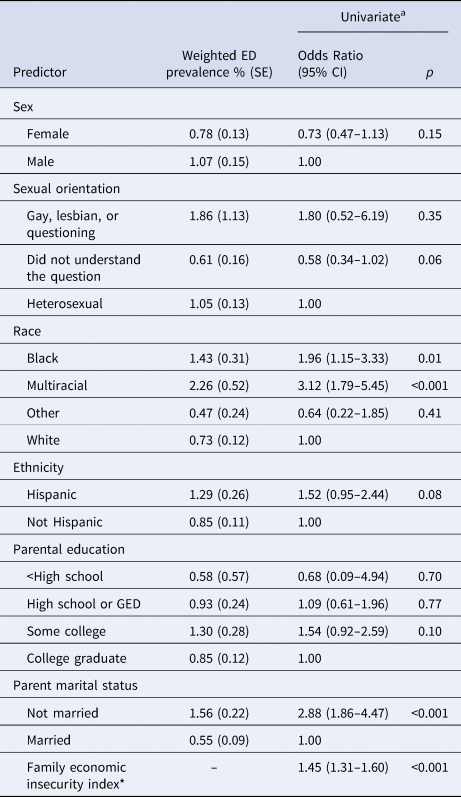
Results of the univariate and multivariate analyses of sociodemographic predictors of EDs are presented in Table 1. In univariate analyses, no differences in lifetime EDs were observed for child sex, sexual orientation, ethnicity, or parent education. However, differences emerged for a race, with multiracial (OR 3.12, 95% CI 1.79–5.45, p < 0.001) and Black (OR 1.96, 95% CI 1.15–3.33, p = 0.01) children having higher odds of having an eating disorder compared to White children. Further, children whose parents were not married (OR 2.88, 95% CI 1.86–4.47, p < 0.001) and from families with higher economic insecurity (OR 1.45, 95% CI 1.31–1.60, p < 0.001) had higher odds of developing an eating disorder.
Associations between sociodemographic characteristics and lifetime eating disorder diagnosis (unweighted n = 11 721)

Note: Weighted prevalence of lifetime eating disorder is presented for each predictor. CI = confidence interval; GED = General education development
*Weighted prevalence of EDs was not reported for the poverty index as it is not a categorical variable.
a All results remained significant after applying Benjamini–Hochberg corrections.
Psychiatric diagnostic correlates
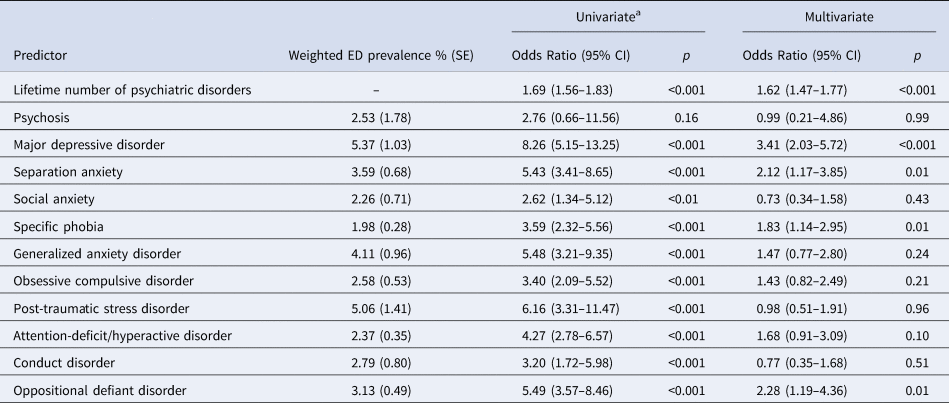
The lifetime prevalence of EDs for each of the other psychiatric disorders is presented in Table 2, with prevalence rates of EDs ranging from 1.98% (s.e. = 0.28) for a specific phobia to 5.37% (s.e. = 1.03) for MDD. Table 2 also presents associations between psychiatric disorders and lifetime EDs in both bivariate and multivariate models, adjusting for child sex and sexual orientation, parent marital status and family economic insecurity.
Associations between psychiatric disorders and lifetime eating disorder diagnosis (unweighted n = 11 721)

Note: Weighted prevalence of EDs is presented for each predictor.
Separate multivariate analyses are demarcated by a horizontal line. Each multivariate model covaried child sex, sexual orientation, parent marital status, and economic insecurity. CI = confidence interval.
a All results remained significant after applying Benjamini–Hochberg corrections.
Lifetime number of psychiatric disorders was associated with greater lifetime odds of having an eating disorder at the bivariate (OR 1.69, 95% CI 1.56–1.83, p < 0.001) and multivariate level (OR 1.62, 95% CI 1.47–1.77, p < 0.001). In the case of individual lifetime disorders, when examined at the bivariate level, all disorders were significantly predictive of lifetime EDs, with the exception of psychosis. For the disorders with significant associations with EDs, the strength of these associations ranged from OR 2.62 (95% CI 1.34–5.12, p < 0.01) for social anxiety to OR 8.26 (95% CI 5.15–13.25, p < 0.001) for MDD. In the multivariate model, ORs were generally reduced. In the corresponding multivariate analysis, four-lifetime disorders remained significant predictors: MDD, separation anxiety, specific phobia, and ODD. For these disorders, ORs ranged from 3.41 (95% CI 2.03–5.72, p < 0.001) for MDD to OR 1.83 (95% CI 1.14–2.95, p = 0.01) for specific phobia.
Temporal predictors of eating disorder onset
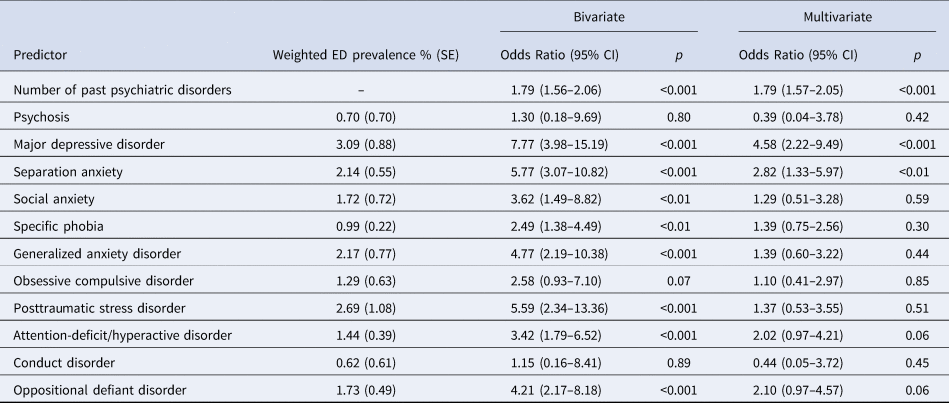
Table 3 presents the prevalence of recent (i.e. past 2 weeks) first onset of EDs for each past psychiatric disorder, as well as bivariate and multivariate analyses for these past psychiatric disorders predicting recent eating disorder onset. Prevalence of recent first onset of EDs ranged from 0.62% (s.e. = 0.61) for CD to 3.09% (s.e. = 0.88) for MDD. At the bivariate level, having an increasing number of past disorders was associated with greater odds of recent onset of an eating disorder (OR 1.79, 95% CI 1.56–2.06, p < 0.001). This finding held after accounting for child sex, a static sociodemographic characteristic (OR 1.79, 95% CI 1.56–2.06, p < 0.001). In terms of individual past disorders predicting the recent onset of EDs, all disorders were observed to have significant associations at the bivariate level, with the exception of psychosis, OCD, and CD. For past disorders predictive of recent eating disorder onset, the size of their associations ranged from OR 2.49 (95% CI 1.38–4.49, p < 0.01) for a specific phobia to OR 7.77 (95% CI 3.98–15.19, p < 0.001) for MDD. In the multivariate model that included child sex as a static sociodemographic covariate, only separation anxiety (OR 2.82, 95% CI 1.33–5.97, p < 0.01) and MDD (OR 4.58, 95% CI 2.22–9.49, p < 0.001) remained significantly predictive of recent onset of EDs.
Past diagnostic predictors of recent first onset of EDs (unweighted n = 11 673)

Note: Weighted prevalence of recent onset of EDs is presented for each past disorder. CI = confidence interval.
Separate multivariate analyses are demarcated by a horizontal line. Each multivariate model covaried child sex, a static demographic characteristic, to maintain clean temporal separation between predictors and recent first onset of EDs.
Treatment utilization
Of the children who had a lifetime eating disorder diagnosis, only 47.40% (s.e. = 5.51) received some type of psychiatric treatment. Although lifetime EDs significantly predicted psychiatric treatment utilization at the bivariate level (OR 4.63, 95% CI 2.99–7.16, p < 0.001), this association was no longer significant (OR 1.40, 95% CI 0.71–2.75, p = 0.33) after accounting for child sex and sexual orientation, parent marital status, economic insecurity, and all other lifetime psychiatric diagnoses.
Discussion
The current study found the lifetime and 2-week prevalence of EDs to be 0.95% and 0.77%, respectively. This fits within a pattern of the increasing prevalence of EDs across development, with higher rates previously documented in adolescents (2.7%; Merikangas et al., Reference Merikangas, He, Burstein, Swanson, Avenevoli, Cui and Swendsen2010) and adults (9%; Smink et al., Reference Smink, Van Hoeken and Hoek2012). Interestingly, the rates of anorexia nervosa in this preadolescent sample were higher than bulimia nervosa, whereas the opposite is true in older populations (Smink et al., Reference Smink, Van Hoeken and Hoek2012). Given the literature characterizing bulimia nervosa, but not anorexia nervosa, as a culturally bound syndrome (Keel & Klump, Reference Keel and Klump2003), this finding perhaps suggests that preadolescents have yet to be fully exposed to compensatory behaviors, which has important implications for clinical intervention at this age.
Among sociodemographic factors associated with EDs, a lack of resources as measured by family economic insecurity was particularly notable. This finding is consistent with prior literature reporting an association between low SES and EDs (Hazzard et al., Reference Hazzard, Loth, Hooper and Becker2020; Power et al., Reference Power, Power and Canadas2008; Rogers, Resnick, Mitchell, & Blum, Reference Rogers, Resnick, Mitchell and Blum1997; Story, French, Resnick, & Blum, Reference Story, French, Resnick and Blum1995). That is, the current study extends to preadolescents prior findings that adolescents living in a low SES environment had higher rates of eating pathology (Power et al., Reference Power, Power and Canadas2008; Rogers et al., Reference Rogers, Resnick, Mitchell and Blum1997; Story et al., Reference Story, French, Resnick and Blum1995). One potential explanation for this relationship between eating pathology and economic insecurity is the similar cyclical patterns of dietary restriction and overconsumption that are characteristic of food insecurity (e.g. due to food stamp timing) and EDs, particularly binge-eating disorder (Becker et al., Reference Becker, Middlemass, Taylor, Johnson, Gomez, Becker and Gomez2017; Lydecker & Grilo, Reference Lydecker and Grilo2019), the most common eating disorder in our sample. Furthermore, that EDs were associated with economic insecurity and non-married parent status is concerning insofar as it suggests that the families with children at risk for EDs may have the least resources for addressing this risk.
Being Black and multiracial were significantly associated with higher odds of having an eating disorder. These results suggest that the prevalence of EDs varies by race and that underrepresented groups of preadolescents may be significantly more likely to have EDs than non-Hispanic White youth. Even though prior research suggests that high rates of disordered eating exist among racial/ethnic minority youth (Rodgers, Berry, & Franko, Reference Rodgers, Berry and Franko2018), the misconception that EDs only affect White girls and women prevails in the general public (Loudin, Reference Loudin2020). This association between eating pathology and race provides support for the stated need for research investigating the mechanisms and strategies for reducing such racial disparities (NIH, 2021).
Finally, the notable absence of significant sex differences in our analyses warrants discussion. Although previous studies (e.g. Merikangas et al., Reference Merikangas, He, Burstein, Swanson, Avenevoli, Cui and Swendsen2010) have reported EDs in an epidemiological sample of adolescents to be more prevalent among females, other literature suggests that this sex difference does not emerge until puberty (Klump et al., Reference Klump, Culbert, Slane, Burt, Sisk and Nigg2012). Our findings mirror those of Rozzell et al. (Reference Rozzell, Moon, Klimek, Brown and Blashill2019) and suggest sex differences in EDs may not emerge until adolescence. Taken together, these findings highlight the importance of assessing for EDs in both preadolescent boys and girls.
The current study also builds on prior work with ABCD data (Convertino & Blashill, Reference Convertino and Blashill2021) by simultaneously evaluating psychiatric disorders in relation to EDs as the outcome variable, in contrast to examining EDs as a predictor of other psychiatric illnesses. Whereas this prior research found EDs to be associated with every other psychiatric disorder under consideration, the current study found evidence of specificity when it comes to evaluating the unique contribution of these other psychiatric disorders to the odds of receiving an eating disorder diagnosis. Indeed, most individual psychiatric disorders were not predictive of EDs at the multivariate level either cross-sectionally or temporally.
Although lifetime number of psychiatric disorders was consistently associated with receiving an eating disorder diagnosis, suggesting that general comorbidity beyond any single disorder may be important for understanding EDs in preadolescents, the few psychiatric disorders that were significantly predictive of this outcome in both cross-sectional and temporal analyses warrant specific attention as particularly robust predictors. In line with prior research with adolescent samples (Johnson, Cohen, Kotler, Kasen, & Brook, Reference Johnson, Cohen, Kotler, Kasen and Brook2002; Swanson et al., Reference Swanson, Crow, Le Grange, Swendsen and Merikangas2011), MDD emerged as the most robust diagnostic predictor, both cross-sectionally and temporally. Separation anxiety was the only other disorder to be significantly predictive of EDs in both cross-sectional and temporal analyses. Although the directionality of anxiety disorders and MDD in relation to eating disorder development is debated, some previous literature does support the notion that separation anxiety and MDD diagnoses are associated with later eating disorder development (McClelland, Robinson, Potterton, Mountford, & Schmidt, Reference McClelland, Robinson, Potterton, Mountford and Schmidt2020; Troisi, Massaroni, & Cuzzolaro, Reference Troisi, Massaroni and Cuzzolaro2005). Clarifying the nature of this association is an important direction for future research. For example, whether MDD is directly related to EDs, or rather, shared underlying vulnerabilities (e.g. emotion regulation difficulties; Harrison, Sullivan, Tchanturia, & Treasure, Reference Harrison, Sullivan, Tchanturia and Treasure2009; Joormann & Gotlib, Reference Joormann and Gotlib2010; Naumann, Tuschen-Caffier, Voderholzer, Caffier, & Svaldi, Reference Naumann, Tuschen-Caffier, Voderholzer, Caffier and Svaldi2015) account for the association between these outcomes in preadolescents remains to be determined. Collectively, our findings suggest that the presence of MDD and separation anxiety may augment the risk for the onset of EDs in preadolescence.
The current findings relating to treatment utilization are of particular clinical concern. First, just over half of preadolescents with an eating disorder (52.6%) did not receive any mental health treatment. This is concerning given evidence that the rates of EDs are on the rise in childhood and adolescence (Herpertz-Dahlmann, Reference Herpertz-Dahlmann2015; Rosen et al., Reference Rosen, Blythe, Braverman, Breuner, Levine, Murray and Seigel2010; Smink et al., Reference Smink, Van Hoeken and Hoek2012) and are associated with life-threatening medical conditions and significant psychiatric comorbidities (Herpertz-Dahlmann, Reference Herpertz-Dahlmann2015). Second, having an eating disorder was not associated with treatment utilization. This suggests that for children with EDs who are receiving treatment, comorbid psychopathology may be driving treatment utilization, and thus EDs may be a comparably unrecognized clinical concern in this age group among parents and in primary care settings. This is consistent with prior work with adolescents revealing that the majority of those with an eating disorder who seek treatment do so for comorbid psychopathology (Swanson et al., Reference Swanson, Crow, Le Grange, Swendsen and Merikangas2011), resulting in a substantial treatment gap for adolescents with disordered eating (Sanzari & Liu, Reference Sanzari and Liu2019). Collectively, and in light of the aforementioned increase over time in childhood EDs, these findings highlight the need for greater attention and resources devoted to addressing preadolescent EDs. In particular, our findings regarding sociodemographic correlates of EDs underscore the need for greater investment of effort to reach families with the least means for receiving care. Furthermore, given that our analyses suggest that approximately one in 20 preadolescents with MDD also have EDs, as well as the robust association observed between these two disorders, screening for EDs in children with depression may be warranted.
Although the present study contributes to our understanding of preadolescent EDs, it is not without limitations. In particular, although the current study allowed for the unique opportunity to evaluate diagnostic predictors temporally preceding eating disorder onset in preadolescent children, it was reliant on a retrospective report of psychiatric diagnoses from parents and children. This may potentially increase the prevalence rates of these disorders compared to reports from one source alone, although the prevalence rates from the current study are generally comparable to other ABCD studies using only parent reports (Convertino & Blashill, Reference Convertino and Blashill2021; Rozzell et al., Reference Rozzell, Moon, Klimek, Brown and Blashill2019). Further, there is epidemiologic data suggesting differences between prospectively and retrospectively assessed psychiatric disorders (Moffitt et al., Reference Moffitt, Caspi, Taylor, Kokaua, Milne, Polanczyk and Poulton2010). Although this concern is somewhat mitigated with the shorter recall period required for preadolescents, it would be important for future studies in this area to employ a prospective, longitudinal design. Also, the low prevalence rates of individual eating disorder subtypes precluded multivariate regression analyses by eating disorder subtype. Additionally, data were not available for lifetime occurrence of Other Specified Feeding/Eating disorder BED or AN or Avoidant Restrictive Food Intake Disorder (ARFID). The lack of data on ARFID is particularly relevant in a preadolescent sample, given that ARFID is associated with younger age among youth (Nicely, Lane-Loney, Masciulli, Hollenbeak, & Ornstein, Reference Nicely, Lane-Loney, Masciulli, Hollenbeak and Ornstein2014). Finally, the lack of data on diagnostic symptom onset and offset is a limitation of note, as some symptoms may overlap in timing and obscure diagnoses. Future studies could utilize a clinical sample with reasonably higher expected prevalence rates of EDs in order to conduct more fine-grained analyses of specific eating diagnoses.
Overall, the present study highlights key sociodemographic and diagnostic factors associated with EDs in preadolescents that should be targeted in prevention and intervention strategies. Rates of eating disorder among preadolescents are on the rise (Herpertz-Dahlmann, Reference Herpertz-Dahlmann2015; Smink et al., Reference Smink, Van Hoeken and Hoek2012), and our results suggest that children who come from families with less resources (i.e. low economic insecurity and unmarried primary caretaker) are especially at risk. Identifying ways to engage families of children with EDs with fewer resources for receiving treatment, as well as increasing screening for EDs in preadolescents with depression may be critical for reducing the high rate of unmet treatment needs of those with EDs in this age group.
Financial support
Preparation of this manuscript is supported in part by a National Science Foundation Graduate Research Fellowship [Grant No. 1645421] to CMS, and by the National Institute of Mental Health of the National Institutes of Health under Award Numbers RF1MH120830, R01MH101138, R01MH115905, and R01MH124899 to RTL. The content is solely the responsibility of the authors and does not necessarily represent the official views of the funding agencies or ABCD consortium investigators.
Conflict of interest
None.