Bribing in the health sector
The minute after she had given birth to her first child at one of the public hospitals in the city of Bangalore in India, Nesam Velankanni wanted the midwife to put the crying baby on her chest. However, before even getting a glimpse of her newborn baby, a nurse whisked the infant away and an attendant asked for a bribe. Nasam Velankanni was told that the customary price if she wanted to hold her child directly after giving birth was US$12 for a boy and US$7 if it was a girl. The attendant told her that she wanted the money immediately because the doctors were leaving for the day and wanted their share before going home. For Nasam Velankanni and her family, US$12 was a substantial amount of money since her husband was working for less than US$1 a day. Eventually, the poor woman’s mother-in-law solved the problem by promising to pawn a set of gold earrings and thus Nasam Velankanni got to hold her newborn baby. Even if the Government of India has established fierce measures to combat such forms of petty corruption and extortion in the health sector, the custom remains partly because many poor people are afraid that their babies will receive bad treatment from angry health-care workers if they do not pay (Dugger, Reference Dugger2005).
This story, told in The New York Times on 30 August 2005, is but one of innumerable descriptions of corruption and similar forms of dysfunctional government practices that exist in many countries in the health-care sector. Survey data about perceptions of corruption from 23 developing countries shows that corruption in the health-care sector is ranked as number one among nine sectors in three countries,Footnote 1 as number two in three other countriesFootnote 2 and within the top four most corrupt sectors in another four countries.Footnote 3 In many of these countries, over 80% of the population has experienced corrupt practices in the health sector. Another survey study from former communist countries in Eastern Europe has shown that in most of these countries, well over 50% of the population thinks that corruption among doctors is widespread (Lewis, Reference Lewis2006). In Hungary, the practice is to leave an envelope at the doctor’s desk with a sum that for an ordinary Hungarian family is quite substantial (Kornai, Reference Kornai2000). Another example is the very high level of absenteeism among health personnel in many national health-care systems in developing countries. For various reasons (low pay, bad control, low sense of public duties, greed), health-care workers in developing countries simply do not show up at work. Instead, they decide to earn extra money by working ‘on the side’ (Widmalm, Reference Widmalm2008; Lewis and Lloyd-Sherlock, Reference Lewis and Lloyd-Sherlock2009).
Corruption kills?
In 2006, the leading international anti-corruption organization, Transparency International, published a special report about the devastating effects that corruption has on people’s access to health care and on health in general. The report documents the existence of corruption and similar practices in many different areas of the health-care sector such as the administration of hospitals, ‘under the table’ payments to doctors in many Eastern European countries, the existence of counterfeit drugs in Nicaragua and over-billing to insurance companies in the United States. The report indicates that while the type of corruption illustrated by the ‘Bangalore case’ above is unusual in the OECD countries, other forms of corrupt practices in the health-care sector plague many developed countries. A survey of deaths caused by malaria in rural Tanzania reported that nearly 80% of the children who died had been to modern health facilities. The reason that they were not cured was to a large extent due to corrupt practices in the form of drug pilfering, provider absenteeism, stolen equipment and very low levels of diagnostic efforts (World Bank, 2010: 2).
Recently, The New York Review of Books, one of the world’s most influential literary magazines, published a lengthy article (and a following ‘exchange’) titled ‘Drug Companies and Doctors: A Story of Corruption’ in which the author Marcia Angell (2009) claims that medical doctors in the United States are evaluating the effects of new drugs manufactured by companies in which they also have an economic interest. One interesting part of this ‘exchange’ is that the author of the article does not equate corruption with criminal behavior. Instead, she argues that corruption should be understood as “undermining the impartiality that is essential both to medical research and clinical practices”. As Marcia Angell (Reference Angell2009) argues, “judges do not hear cases in which they have a financial interest. Reporters do not write stories about companies in which they have a financial interest. By the same token, doctors should not have a financial interest in treatments they are evaluating”.
Studying the relationship between the quality of government (QoG) and good health
Since the late 1990s, issues about the quality of countries’ public institutions have been put forward by a large number of development and international aid organizations, as well as by many scholars, as the most important explanation for variation in economic performance and social well-being (for an overview of the argument, see Acemoglu and Robinson, Reference Acemoglu and Robinson2008). Theoretically, this reflects the ‘institutional turn’ in economics, political science and sociology connected to scholars such as James March and Johan Olsen (Reference March and Olsen1989), Douglass North (Reference North1990) and Elinor Ostrom (Reference Ostrom1990), all arguing that the ultimate causes of a society’s well-being are related to how their institutions (understood broadly as ‘the rules of the game’) are structured. The implication of this research is that factors such as a society’s access to technology and skills as well as various forms of capital are seen only as proximate causes behind their level of development while the quality of the institutions is seen as the ‘ultimate cause’ behind how a country can make use of the former type of assets (Acemoglu and Robinson, Reference Acemoglu and Robinson2008). Although there are several ways in which government institutions can be said to have low quality (see Rothstein and Teorell, Reference Rothstein and Teorell2008), corruption is clearly one of them and, as we have indicated, has a significant negative impact on population health. For instance, Gupta et al. (Reference Gupta, Davoodi and Tiongson2000) have shown that corruption indicators are negatively associated with, for instance, child and maternal mortality. The purpose of this study is to try to give a preliminary overview of the relation between variables that measure what have been defined as quality of government and a number of standard measures of population health in the light of how much and what type of (private or public) money is spent on health care in different countries (Bloom and Canning, Reference Bloom and Canning2000). In addition to academic interests, studies like this will have an analysis like this one may be important to policymakers in both the health-care and development sector. Simply put, if you want to improve population health (measured as infant mortality and expected lifetime at birth), what works? More precisely, is it better to simply increase spending on health care (and if so, should this be public or private money), or is it better to improve the overall quality of the country’s government institutions? Following Rothstein and Teorell (Reference Rothstein and Teorell2008), we define QoG as when the exercise of public power is based on impartiality as the basic norm. As such a basic norm, impartiality in the exercise of public power is equivalent to ‘political equality’ for access to political power in a democracy. Their definition of impartiality in the exercise of public power is the following: “When implementing laws and policies, government officials shall not take anything into consideration about the citizen/case that is not beforehand stipulated in the policy or the law” (Rothstein and Teorell, Reference Rothstein and Teorell2008: 170), such as money in the form of bribes, personal relationships, ethnicity, religion or gender. This idea is related to the notion of ‘the rule of law’, but it is wider since it also includes professional corpses in the public sector that are supposed to follow professional standards and not precise legal rules when they implement public policies. There is as yet no country-based precise measurement of QoG as we define it here; instead, we will use a number of available measures that all come reasonably close to our definition. The relation to efficiency and effectiveness is twofold. First, impartial (i.e., meritocratic) recruitment to the civil service and of professionals working in the public sector will improve efficiency and effectiveness. Second, QoG as impartiality will lower transaction costs in the economy in a very substantial way since citizens and companies will be able to predict the outcomes of their interactions with government authorities (North, Reference North1990).
As for our dependent variables, it should be added that indicators of population health, such as the ones we use here, can be interpreted as telling us more about a society than just how healthy its population is. As argued by Hall and Lamont (2009), there are good arguments for taking population health as a measure of how successful different societies are. Based on the idea of ‘capabilities’ launched by Amartya Sen, and criticizing various strands of “post-enlightenment thought for leading to a balkanization within (and between) the social science disciplines”, they argue that all else being equal, health enhances an individual’s capabilities “to pursue there the goals important to their lives, whether through individual or collective action” and that this is what, according to them, defines a successful society (Hall and Lamont, Reference Hall and Lamont2009: 2).
The empirical case studies and illustrations noted above are important for increasing our knowledge about the great variety of corrupt practices that can take place in the health-care sector. They are also very valuable for laying bare the ‘micro-level’ logic in these practices and give insights into how the agents’ behavior can be understood. However, like all case studies, they can be questioned because of the difficulty in generalizing from the data. One reason for why many health economists have refrained from studying the impact of QoG on the performance of the health sector in their countries has been the lack of intra-country comparable data. However, by using available measures of indicators on the QoG institutions in a large number of countries, a small group of scholars have started to analyze this problem at a more generalizable level. The general finding, which we will refer to below, is that the ‘QoG factor’ is statistically positively related to standard measures of population health such as infant mortality and life expectancy from birth. Moreover, in some studies it has been shown to be more important than the level of public spending on health care. Before summarizing this literature, it is necessary to make a few arguments why the health-care sector may be especially prone to problems of corruption and similar forms of dysfunctional government practices.
Ways of causality
There are several reasons why population health should be related to QoG. The indirect links are that since a country’s QoG is positively related to economic performance, high QoG should result in more economic growth, which should imply better food, better housing, access to safe water and sanitation, less strenuous working conditions, fewer people living under destitute conditions and so forth (Bloom and Canning, Reference Bloom and Canning2000). However, the link between a country’s economic prosperity and population health is by no means clear-cut. The ‘wealthier is healthier’ proposition has difficulties handling the fact that there is great variation in, for example, infant mortality and life expectancy between the equally poor and (although to a lesser extent) equally rich countries (Evans, Reference Evans2009).
The magnitude of how an institutional factor like QoG indirectly has an effect on population health can be illustrated by the following example. According to a conservative estimation by the World Health Organization, 1.3 billion people lack access to sufficient quantities of safe water and nearly 3 billion people are without adequate sanitation. Consequently, 80% of all illnesses in the developing world are the result of waterborne diseases. A conservative estimation is that about 12,000 people die every day from water- and sanitation-related illnesses (Stockholm International Water Institute, 2006; Anbarci et al., Reference Anbarci, Escaleras and Register2009). This problem is no longer seen, by an increasing number of experts in the area, as an engineering problem that can be solved by more investment in technical equipment. The main problem in providing people with safe water is not a lack of technical solutions (dams, sewages, water cleaning stations, etc.) or natural supply of clean water. Instead, the problem lies mostly in dysfunctional administrative institutions. More precisely, the problem is seen as caused by a lack of adequate institutions for maintenance, pricing and distribution of rights to land and water (Bruns and Meinzen-Dick, Reference Bruns and Meinzen-Dick2000; Transparency International, 2008; Sjöstedt, Reference Sjöstedt2008). Cross-comparable empirical assessments of how different institutional frameworks perform comparatively in providing safe water are, however, in short supply and more research is widely asked for (Bruns and Meinzen-Dick, Reference Bruns and Meinzen-Dick2000; Bayliss, Reference Bayliss2003).
Other such indirect causal chains are that QoG is positively related to social capital (a combination of extended social networks and generalized trust), which in turn has been shown to have a positive impact on health (Schultz et al., Reference Schultz, O’Brien and Tadesse2008; Lindstrom and Mohseni, Reference Lindstrom and Mohseni2009). Hall and Taylor argue that not being able to cope with various life challenges often leads to emotional as well as physiological health problems. Lacking networks and relations based on mutual trust is one important factor why people lack capabilities to handle various challenges (Hall and Taylor, Reference Hall and Taylor2009). Using an experimental approach, Rothstein and Eek (Reference Rothstein and Eek2009) have shown that experiencing corruption in public authorities does diminish people’s trust not only in these authorities, but also in ‘people in general’. Thus, one can argue for a causal chain that goes from corruption to low trust/low social capital to health problems (Hall and Taylor, Reference Hall and Taylor2009). Moreover, based on the data from the World Value Survey and WHO, Helliwell and Huang (Reference Helliwell and Huang2008) have shown that living under corrupt, unreliable and untrustworthy government institutions is a very important explanation for low subjective well-being (also known as unhappiness), especially in poorer countries, controlling for a number of other variables such as divorce rate, income per capita and religiosity. Since low life satisfaction is causally related to health problems, there could also be a causal chain running from corruption to unhappiness and to low population health.
High levels of QoG should also make people more willing to pay taxes since they would have more confidence in how well their tax money will be used by various government agencies (Scholz and Lubell, Reference Scholz and Lubell1998). Since there is a positive correlation between public spending on health care and the standard measures of population health, high QoG should result in more public spending on health care and thus better population health.
Furthermore, as shown by research in social epidemiology, there is a strong causal link between social and economic inequality on the one hand and low levels of population health on the other. For example, Wilkinson and Picket show that this relation between equality and well-being exists both when they compare the Western OECD countries, and when they compare the 50 states in the United States, and what is striking about their findings is that mental illness, physical health problems and shorter life expectancy are hitting not only the poor people in unequal societies. Instead, they show, for example, that “across whole populations, mental illness is five times higher in the most unequal compared to the least unequal societies” (Wilkinson and Pickett, Reference Wilkinson and Pickett2009: 181). The same goes for problems like obesity, life expectancy and various forms of physical illnesses. As they point out, the Nordic countries together with Japan are the ones that are doing best in their sample. This shows that low levels of inequality (and the following higher level of population health) can be reached without an encompassing high-spending welfare state (Japan). However, as they also point out, most of the countries that have high levels of population health are countries with encompassing welfare states (the Nordic countries). Thus, there may be another indirect causal link between QoG and population health, because in countries with low QoG, people will not entrust the government with enough money (taxes), and without economic resources, there will be a shortage of social policies that ameliorate high levels of inequality, which, according to this type of research, is a major causal factor behind low population health (Marmot, Reference Marmot2004; Siegrist and Marmot, Reference Siegrist and Marmot2006; Wilkinson and Pickett, Reference Wilkinson and Pickett2009).
As indicated by the empirical illustrations mentioned above, one could also hypothesize a number of more direct causal mechanisms between QoG and population health. The health-care sector produces a type of service in which what economists call ‘problems of asymmetric information’ are common. The source of the funding for medical treatment, be it the patient herself, a government agency or a private insurance agency, cannot have anything close to ‘perfect information’ if the treatment that the doctor(s) suggests is motivated by medical reasons or by an interest for personal enrichment. Moreover, when there is a ‘third party’ that pays something that is common in most developed countries, the patient and doctor can collaborate to use treatments that cost more than what is medically motivated. The health-care sector is special since the provider of the service usually determines what the ‘customers’ should buy (Savedoff and Hussmann, Reference Savedoff and Hussmann2006). The consequence of these information problems is that the health-care service is a classic case for ‘market failures’, implying that governments usually have to be involved in order to avoid massive inefficiency (Barr, Reference Barr2004). This implies that the production of an efficient health-care sector often involves a complex mix of public, semi-private and private providers as well as regulatory agencies. Taken together, the problems of the economic magnitude of the health-care sector in many countries, the complex mix of actors and the information problems may make this sector especially prone to corruption (legal or illegal) as well as other forms of low QoG.
QoG and health: the State of the Art
Surprisingly, there are only a handful of studies in the health and governance literature that have systematically analyzed the relation between population health, health care and QoG.
Employing data from 91 countries, Rajkumar and Swaroop analyze the impact of public health spending on child mortality by modeling the interaction between public spending and QoG variables such as ‘quality of bureaucracy’ and ‘control of corruption’. Controlling for a number of other variables, such as income inequality and ethno-linguistic division, they conclude that QoG is central in determining the effectiveness of public spending on health care. The empirical analysis reveals that a one percentage point increase in the share of public health spending of GDP lowers the child mortality rate by 0.32% in countries with high QoG, by 0.20% in countries with average QoG and has no effect in countries with low QoG (Rajkumar and Swaroop, Reference Rajkumar and Swaroop2008).
One of the few meta-analyses of the relation between QoG and health has been carried out by Maureen Lewis for the Center for Global Development. The main finding is that ‘good governance’ is a critical factor in making national health-care systems work and that public spending on health care is inefficient in countries with low QoG. Unless governments shift their attention to institutional factors that affect performance in the health sector, it is doubtful that mortality rates will decline (Lewis and Lloyd-Sherlock, Reference Lewis and Lloyd-Sherlock2009). Wagstaff and Claeson (Reference Wagstaff and Claeson2004) have shown that an increase in the levels of public health funding in countries that have received a medium or low CPIA (Country Policy and Institutional Assessment that measures the quality of policies and institutions) score from the World Bank would not by itself necessarily lead to a reduction in child mortality. However, they show that in countries with high levels of QoG, an increase in government health budgets would reduce mortality rates for children and mothers based on the assumption that the additional funding is distributed to programs and institutions according to the same ratio as current allocations. A similar result is reached by a study with data from 118 developing countries (Baldacci et al., Reference Baldacci, Clements, Gupta and Cui2008). Regarding the specific question of HIV, an analysis of 149 countries shows that the prevalence of HIV is significantly related to low QoG (Menon-Johansson, Reference Menon-Johansson2005). Lastly, in a recent study, Klomp and de Haan have undertaken the most advanced study so far in this area in terms of data and methods. The authors criticize the above-mentioned type of studies for taking only a few control variables into account and consider that their conclusions about the positive effect of QoG on population health therefore are in doubt. They furthermore argue that the relationship between governance and the (quality of) health-care sector is arguably a key variable in explaining differences in health outcome across countries. In addition to a wealth of data from 101 countries for measuring QoG, Klomp and de Haan use 16 indicators for measuring health. In addition to the standard indicators mentioned above, they add, for instance, the prevalence of a number of diseases such as HIV, polio and tuberculosis. Moreover, they measure the standard of the health-care sector by using 10 indicators such as the number of health-care personnel per 1000 inhabitants and immunization rates for four different illnesses (hepatitis, diphtheria, measles and tuberculosis).
Klomp and de Haan’s main finding is that governance influences health through its indirect positive effects on the standard of the health-care sector and on income. They estimate that a 1% increase in governance leads to an increase of 0.55% in the quality of the health sector and 3.54% in the health of individuals. Moreover, the study shows that it is through the indirect positive effects on income that governance can contribute most to an improvement in health. However, the authors also argue that the significance of these indirect effects varies between country groups. For countries with a relatively healthy population, QoG will have a positive indirect effect through the quality of the health-care sector, but not via income. On the other hand, for countries with a poor population health, the case will be the opposite; QoG will have a positive indirect effect through income, but not through the quality of the health-care sector (Klomp and de Haan, Reference Klomp and de Haan2008). Similarly, Lazarova and Mosca (Reference Lazarova and Mosca2008) argue when they make the case that absolute income is what matters the most in terms of improving health indicators in countries below a certain threshold (5000 PPP international dollars per capita), whereas in countries above this threshold it is QoG that is the most important determinant of health.
One conclusion from this study is that the influence of QoG on the standard of the health-care sector may be explained by the fact that it is only in countries with a relatively high level of general QoG that people are willing to pay taxes at the level needed to have a high standard in the health-care sector. However, the causality may also run in the opposite direction. In countries where people perceive that the quality of the health-care sector is low (because they experience various forms of corruption by the health-care staff), they will not be willing to pay taxes at the level needed to increase the general QoG (Rothstein and Eek, Reference Rothstein and Eek2009). Another conclusion is that the small amount of research in this area and the variation in the results point to the need for more research.
Charting basic relationships
In this section, we will provide some basic statistics for the relation between QoG and population health using the data from the open source data set of the Quality of Government Institute (Teorell et al., Reference Teorell, Holmberg and Rothstein2008). Aided by some of the meta-analyses cited above, three QoG variables and five indicators of population health will be analyzed. Since money always matters, not least in this policy sector, some spending variables will also be included. Hence, four measures of health spending were incorporated as well. A pivotal question is to what extent QoG matters besides, or on top of, spending on health care. A related but largely overlooked question in the literature is whether public or private health spending is best at creating good health. And if one type of health spending is better than the other, does the same still hold in combination with good government?
The three QoG variables that we use are the World Bank’s rule of law indicator, the World Bank’s government effectiveness measure and Transparency International’s Corruption Perception Index. In theory, they measure different things, but in practice, as argued above, all three of them are reasonably good measures of QoG. It should be added that, empirically, they are highly inter-related with correlation coefficients of around 0.93.
Four of the five health variables are also highly internally correlated across the sample of some 180 countries. The internal correlations vary between 0.85 and 0.97. The four variables are life expectancy at birth, mortality rate for children under five, maternal mortality rate and healthy life expectancy – all are taken from the WHO. The fifth health variable is less correlated with the other four (around 0.10). It is a subjective health measure taken from the World Value Survey and is only available for around 45 countries in the data bank of the Quality of Government Institute. The money variables measure the total health spending (% of GDP), government spending on health (% of GDP), private spending on health (% of GDP) and private share of total health spending (%). All spending measures have been put together by the WHO.
It should be observed that all the spending variables are relative in the sense that they measure money spent as a percentage of GDP (or, in one case, total health spending as a percentage of GDP). This means that they are sort of priority or policy variables indicating the kinds of health spending policies that different countries have opted for. What they do not measure is how much money different countries spend on health in an absolute sense.
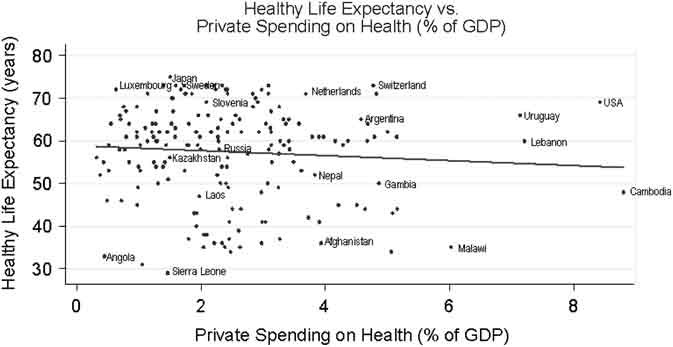
In the Appendix Figures (A1–A5), which is fully published on the QoG Institute’s web page, 35 bivariate scatter plots with regression lines are presented for all of our five health variables and they have been run against the three QoG variables and the four health spending measures.Footnote 4 Browsing through all these very informative scatter plots gives an excellent overview of the bivariate relationships around the world between, on the one hand, health spending and good government and, on the other, good health. Five of these instructive plots can be found at the end of this article.
Added to this, we have also included 24 additional scatter plots that demonstrate the connections between two health indicators (healthy life expectancy and mortality rate for children under five) and three measures of health spending and three QoG variables in OECD countries as well as in non-OECD countries (see the QoG Institute’s web page).Footnote 5 This addition was made to study the relationship among more developed and rich countries in comparison with less developed and poor countries. In the health literature, the degree of economic development is often included as an intervening or interacting variable ultimately affecting levels of population health. The hypothesis is that a better economy leads to better health for the population. The OECD vs non-OECD classification of countries is used as a proxy for the level of economic development and richness.
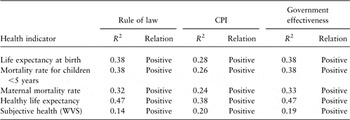
The results are summarized in a set of tables in the Appendix (Tables A1–A5). All QoG variables reveal strong and positive bivariate relationships with all five health indicators. Here, a positive relation indicates that more of a QoG variable is positively associated with higher levels of life expectancy, lower levels of mortality rates for children and mothers, higher levels of healthy life expectancies and higher levels of subjective health feelings. The positive relationship with QoG is most pronounced for healthy life expectancy and least noticeable for subjective health.
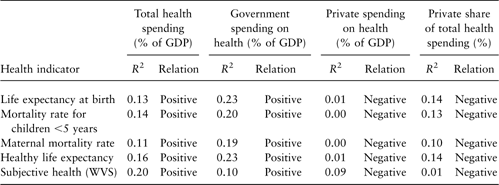
In contrast to the strong relationships between the QoG variables and the health indicators, the relationship between the health spending measures and population health is weaker most of the time and occasionally non-existent. The connection to health levels is positive, but semi-weak for total health spending and only semi-strong for government health spending (see Table A2). However, for private health spending as well as for private share of total health spending, the relation to good population health is close to zero or slightly negative. A negative relation in this context means that more private health spending (as a percentage of GDP) is coupled with lower life expectancy, higher mortality rates among children and mothers, lower healthy life expectancies and lower subjective health assessments.
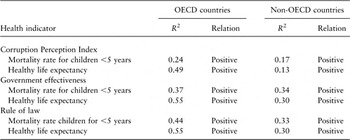
Controlling for being an (rich) OECD or a (not so rich or even poor) non-OECD country does not change any of the relationships. The QoG variables are all positively related to good health among OECD as well as among non-OECD countries. However, if anything, the relationships are somewhat stronger among OECD countries. Notwithstanding this, it is worth emphasizing that the connection between QoG and good health is rather strong and positive among the less economically developed non-OECD countries as well. The conclusion is that QoG matters for good population health among the poor as well as rich countries.
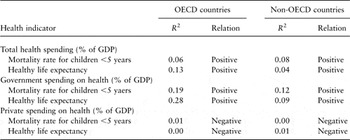
Even the relationships between health spending and levels of population health stay the same after taking OECD membership into consideration. All correlations are weak if at all existing. However, the relationship between total health spending and good health as well as the relationship between government health spending and good health is positive among OECD and non-OECD countries. For private health spending, there is no relation, or a negative one, with health indicators like the mortality rate of children under five and healthy life expectancy. Thus, how money is spent matters for good health, but only to a limited extent. And preferably, it should be spent publicly, not privately.
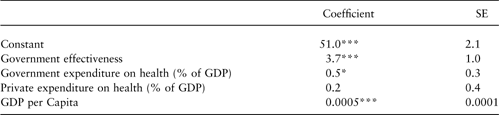
Testing the results for overlapping or confounding effects in multivariate analyses further strengthens these conclusions. For example, and as in Table A5, regressing a health indicator (healthy life expectancy) on a QoG variable (government effectiveness) and two health spending variables (government as well as private expenditures on health and controlling for GDP per capita) underscores the previous finding that QoG as well as public health spending – independent of each other – is significantly and positively connected to high levels of population health. The results remain basically unchanged when we introduce interaction terms between the QoG variable and the health spending variables in the regression model in Table A5. The independent effect of government effectiveness in combination remains strong, but on top of this there is also an effect of government effectiveness on health. The impact of government effectiveness is most evident among countries with less public health spending. Thus, to a degree, good QoG can compensate for lower levels of public money spent on health care. Private expenditure on health, however, is not significantly associated with good health.Footnote 6 This result stays unaltered when we include an interaction variable combining government effectiveness and private expenditure on health in our regression analysis. The QoG variable and government expenditure on health retain their independent effects while private expenditure on health has no effect either on its own or in combination with government effectiveness. Thus, private health spending does not compensate for poor QoG. If there is any connection, it tends to be negative, not positive.Footnote 7
Consequently, the policy recommendation coming out of this study to improve health levels around the world, in rich as well as poor countries, is to improve the QoG – corruption kills – and to finance health care with public, not private, money. We readily admit that there is no ‘quick fix’ for improving QoG and that the international anti-corruption and ‘good governance’ reform movement so far can count very few real successes. As argued elsewhere, this may be caused by a misspecification of ‘the nature of the problem’ that seems to have been geared too much towards changing the incentives by increasing law-enforcement resources and setting up specific anti-corruption units. However, low levels of QoG, such as systemic corruption, may instead be a problem of changing deeply entrenched mutual expectations in a society about how, in general, ‘other agents will play’, which may require more fundamental social changes than just changes in the incentives (Rothstein, Reference Rothstein2010). As the prominent democratization researcher Larry Diamond puts it:
“Endemic corruption is not some flaw that can be corrected with a technical fix or a political push. It is the way that the system works, and it is deeply embedded in the norms and expectations of political and social life. Reducing it to less destructive levels – and keeping it there – requires revolutionary change in institutions” (Diamond, Reference Diamond2007: 19).
Conclusions: why quality of government impacts population health
Our main findings are three. First, QoG has a negative impact on population health, both in rich as well as poor countries. Second, when it comes to money, it is only public spending that has a significant effect on population health. The analyses of interaction effects show that, to some degree, increasing QoG can compensate for lack of economic resources for increasing population health. The conclusions hold when we check for various interaction effects between QoG and public spending.
As indicated above, there are many reasons why variations in the level of QoG should have an impact on population health. Some are what have been called direct factors, such as absenteeism of health personnel because they want to earn more money by illegal means. Demands of extra ‘under the table’ fees may deter some of those that are in most need of health care to visit health clinics. Corruption in the procurement of contracts and the supply of pharmaceutical may be other such direct factors. However, as shown in the cases of safe water and policies that ameliorate the worst forms of inequality, there may also be strong indirect effects between QoG and population health. The finding that it is public and not private spending that has a positive effect on population health demands further investigations. One possible way to understand this surprising effect may be the following. According to new research by Anirudh Krishna (Reference Krishna2006), what drives people into poverty in many developing countries (and also the uninsured part of the population in the United States) is that they themselves, or someone in their family, are hit by an illness that requires extensive medical treatment. Lacking health insurance, the medical bills they have to pay become a financial burden of such magnitude that they are driven into severe poverty, often because they have to sell land, cattle or other assets that they have used to accumulate income. The effect of the lack of publicly funded health insurance results in severe poverty for many, which, in turn may be the cause for why they are hit by the inequality–bad health effect that the social epidemiologists have analyzed, or that they simply lack resources for even basic forms of preventive health care (Krishna, Reference Krishna2007).
Appendix
Healthy life expectancy vs rule of law; R 2 = 0.47. Source: World Health Organization (2003); World Bank Governance Indicators (2002).

Healthy life expectancy vs corruption; R 2 = 0.38. Source: World Health Organization (2003); Transparency International (2002).

Healthy life expectancy vs government effectiveness; R 2 = 0.47. Source: World Health Organization (2003); World Bank Governance Indicators (2002).

Healthy life expectancy vs government spending on health (% of GDP); R 2 = 0.23. Source: World Health Organization (2003).

Healthy life expectancy vs private spending on health (% of GDP); R 2 = 0.01. Source: World Health Organization (2003).

The relationship between three quality of government variables and five indicators of health

WVS=World Value Survey.
A positive relation indicates that more of the quality of government (QoG) variable is positively associated with higher levels of life expectancy, lower levels of mortality rates for children and mothers, higher levels of healthy life expectancies and higher levels of feeling subjectively healthy. A negative relation indicates the opposite on all accounts. CPI stands for Corruption Perception Index. The data come from the QoG Institute Data Bank. All variables are specified in the Appendix Figures.
The relationship between four measures of health spending and five indicators of health
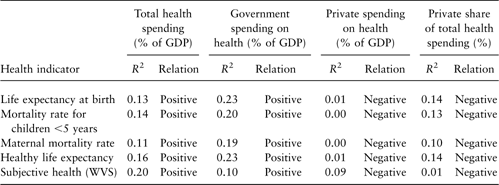
WVS=World Value Survey.
See Table A1.
A negative relation means that more private spending on health as a percentage of GDP or as a percentage of total health spending is associated with lower life expectancy, higher mortality rates among children and mothers, lower levels of healthy life expectancy and lower levels of subjective health assessments.
The relationship between three quality of government variables and two indicators of health levels among OECD and non-OECD countries

See Table A1.
A positive relation indicates that more of the quality of government variable is positively related to higher levels of healthy life expectancies and to lower levels of child mortality.
The relationship between three measures of spending on health and two indicators of health levels among OECD and non-OECD countries

See Table A2.
A positive relation indicates that more of the health spending variable is associated with higher levels of health. A negative relation means that more health spending is related to lower levels of health.
Regressing healthy life expectancy on government effectiveness and government and private expenditures on health including GDP per capita as a control variable
Adjusted R 2 = 0.53.
p>/t/=0.01***;=0.05**;=0.10*.
The dependent variable (healthy life expectancy) is measured in years. The expenditure variables are measured as percentage of GDP. The World Bank’s government effectiveness variable is standardized and varies in most cases between −2.5 (low effectiveness) and +2.5 (high effectiveness). The variable GDP per capita in US dollars is taken from Gleditsch (Reference Gleditsch2002). The total number of countries is 188.