




No CrossRef data available.
Article contents
- Extract
- Acknowledgements
- I. Introduction
- II. Background Context
- Mode of Procedure in Contested Election Cases
- A Short Historical Overview of Contested Elections
- Noteworthy Cases
- III. Analyzing Contested Election Cases
- Committee Rolls
- Roll-Call Voting
- Examining the Polsby Thesis
- The Impact of Partisanship
- IV. Examining the Late-Nineteenth Century Rise in Contested Elections
- Reconstruction and Contested Elections
- Post-Reconstruction and Contested Elections
- The Data: A Closer Look
- The End of Contested Elections as a Partisan Tool
- V. Conclusion and Future Extensions
Partisanship and Contested Election Cases in the House of Representatives, 1789–2002
Published online by Cambridge University Press: 01 March 2005
Article contents
- Extract
- Acknowledgements
- I. Introduction
- II. Background Context
- Mode of Procedure in Contested Election Cases
- A Short Historical Overview of Contested Elections
- Noteworthy Cases
- III. Analyzing Contested Election Cases
- Committee Rolls
- Roll-Call Voting
- Examining the Polsby Thesis
- The Impact of Partisanship
- IV. Examining the Late-Nineteenth Century Rise in Contested Elections
- Reconstruction and Contested Elections
- Post-Reconstruction and Contested Elections
- The Data: A Closer Look
- The End of Contested Elections as a Partisan Tool
- V. Conclusion and Future Extensions
Extract
Article I, Section 5, Clause 1 of the United States Constitution states: “Each House shall be the Judge of the Elections, Returns, and Qualifications of its own Members. . . .” With this simple statement, each chamber of Congress is granted complete authority over how its membership will be comprised. Thus, when a given election is contested, that is, when there is a dispute over who is the rightful occupant of a given seat after the ballots have been collected and tallied, each chamber acts as the sole arbiter without external constraint. This constitutional guarantee was an artifact of English and colonial rule, as fear of executive authority led the House of Commons and nearly every colonial legislature to adopt similar protections.
Information
- Type
- Research Article
- Information
- Copyright
- 2004 Cambridge University Press
Acknowledgements
Earlier versions of this paper were presented at the History of Congress conference, December 5–6, 2003, San Diego, CA, and the 2003 annual meeting of the American Political Science Association, Philadelphia, PA. Thanks to Scott Adler, Richard Bensel, David Brady, Jamie Carson, Gary Cox, Ira Katznelson, Mathew McCubbins, Nathan Monroe, Timothy Nokken, Charles Stewart, Richard Valelly, and other conference attendees for their many helpful comments. Thanks also to Jamie Carson and Tim Nokken for sharing their data and to Karren Orren and Steve Skowronek for their support and encouragement throughout the review process.
I. Introduction
Article I, Section 5, Clause 1 of the United States Constitution states: “Each House shall be the Judge of the Elections, Returns, and Qualifications of its own Members. . . .” With this simple statement, each chamber of Congress is granted complete authority over how its membership will be comprised.1
Various attempts have been made over time to appeal (and modify) this congressional right, without success. On the last occasion, in the 1972 U.S. Supreme Court case of Roudebush v. Hartke, involving a Senate election contest, the Court ruled that each chamber of Congress, per the guidelines of the Constitution, retains the unconditional and final judgment in contested election cases.
The term “contested election” is not to be confused with the term “contested race,” which denotes that more than one major candidate is seeking a congressional seat.
John T. Dempsey, “Control by Congress over the Seating and Disciplining of Members” (Ph.D. diss., University of Michigan, 1956), 12–20, 25–28.
In this article, I investigate the procedures and outcomes in contested election cases in one chamber of Congress, the House of Representatives, across time. The subject of contested elections has not received a great deal of scholarly treatment in recent years. While older studies by Henry L. Dawes, C. H. Rammelkamp, De Alva Alexander, and Vincent M. Barnett, Jr. provide excellent historical overviews and valuable contextual accounts, contemporary political scientists have virtually ignored the subject.4
Henry L. Dawes, “The Mode of Procedure in Cases of Contested Elections,” Journal of Social Science 2 (1870): 56–68; C. H. Rammelkamp, “Contested Congressional Elections,” Political Science Quarterly 20 (1905): 421–42; De Alva Alexander, History and Procedure of the House of Representatives (Boston: Houghton Mifflin, 1916), 313–30; Vincent M. Barnett, Jr., “Contested Elections in Recent Years,” Political Science Quarterly 54 (1939): 187–215.
Dempsey, “Control by Congress over the Seating and Disciplining of Members,” is an unpublished dissertation that provides excellent historical background and a rich source of data on contested elections. George B. Galloway, History of the United States House of Representatives (New York: Crowell, 1968) and Kenneth A. Martis, The Historical Atlas of Political Parties in the United States Congress, 1789–1989 (New York: Macmillan, 1989) provide very useful overviews of contested elections, but their accounts are largely derivative. Terry L. Seip, The South Returns to Congress: Men, Economic Measures, and Intersectional Relationships, 1868–1879 (Baton Rouge: Louisiana State University Press, 1983), 106–8; Richard Franklin Bensel, Sectionalism and American Political Development, 1880–1980 (Madison: University of Wisconsin Press, 1984), 84–88; Richard Franklin Bensel, “The American Ballot Box: Law, Identity, and the Polling Place in the Mid-Nineteenth Century,” Studies in American Political Development 17 (2003): 1–27; Richard Valelly, “National Parties and Racial Disenfranchisement,” in Classifying By Race, ed. Paul Peterson (Princeton: Princeton University Press, 1995); and Richard Franklin Bensel, The American Ballot Box in the Mid-Nineteenth Century (Cambridge: Cambridge University Press, 2004) offer fresh connections between contested elections and larger institutional/electoral forces, but their coverage is limited. Matthew N. Green, “Disputing the Vote: Explaining the Decline of Contested Elections to the U.S. House of Representatives” (Working Paper, Yale University, 2003) offers a lengthier examination of contested election cases, focusing on the determinants of their decline over time. Finally, Nelson W. Polsby, “The Institutionalization of the House of Representatives,” American Political Science Review 62 (1968): 144–68 examines contested election cases as one element in a larger House-institutionalization thesis and stands as the most influential published analysis to date.
In addition to generating a complete accounting of all contested election cases in the House from the 1st through 107th Congresses (1789–2002), I also begin to examine the distribution of cases across time as well as the determinants of decision making. In doing so, I investigate the chief claim regarding contested elections that appears in the historical literature: that partisanship has been a (and sometimes the) guiding force in determining outcomes in contested election cases. The evidence mustered to support this claim is often sketchy. Some evidence, considered quite compelling by many scholars, is actually rather anecdotal in nature. For example, the following two quotations, the first from Henry L. Dawes, the Chairman of the Committee on Elections at the time, and the second from Thomas B. Reed, the Speaker of the House at the time, are often cited when making the claim for partisanship:
All traces of a judicial character in these proceedings are fast fading away, and the precedents are losing all sanction. Each case is coming to be a mere partisan struggle. At the dictate of party majorities the committee must fight, not follow, the law and the evidence; and he will best meet the expectations of his appointment who can put on the record the best reasons for the course thus pursued. This tendency is so manifest to those in a situation to observe, that it has ceased to be questioned, and is now but little resisted. There is no tyranny like that of majorities, and efforts in the past to resist them, and to hold the judgments of the Committee of Elections up above the dirty pool of party politics, have encountered such bitter and unsparing denunciations, and such rebuke for treason to party fealty, that they are not likely often to be repeated.6
Dawes, “The Mode of Procedure in Cases of Contested Elections,” 64. These comments were first presented in a paper read at the general meeting of the Social Science Association, held in New York City, on Oct. 26, 1869.
The decision of election cases invariably increases the majority of the party which organizes the House, and which herefore appoints the majority of the Committee on Elections.7
Thomas B. Reed, “Contested Elections,” North American Review 151 (1890): 112–20. To strengthen his point about the role of partisanship, Reed stated: “Probably there is not a single instance on record where the minority was increased by the decision of contested cases” 114. This was not true. In fact, prior to Reed's statement, sitting majority party members had been unseated by minority party claimants on ten separate occasions: once each in 1794, 1821, 1822, 1872, 1873, 1874, 1875, 1881, 1883, and 1885.
Other evidence is based on results from the contested-election cases themselves; studies in this vein take the next step and generate some simple statistics to support their assertions. What are the general findings with regard to partisanship? Results are mixed. Some argue that partisanship has always been the overriding factor in deciding contested election cases.8
See Alexander, History and Procedure of the House of Representatives; Dempsey, “Control by Congress over the Seating and Disciplining of Members.”
See Rammelkamp, “Contested Congressional Elections”; Barnett, “Contested Elections in Recent Years.”
Thus, much work needs to be done to make the contested election process in the House, and the factors that influence it, transparent. Through the remainder of this article, I will endeavor to do just that. In the end, I believe significant strides will be made, both in developing a fuller understanding of contested elections and in establishing the role that partisanship has played in determining case outcomes. In addition, I will develop a more subtle argument – specifically that contested elections were the vehicle by which the Republican Party sought to preserve a party organization in the South during the late- nineteenth century. That is, amid evenly divided national electorates from the mid-1870s through the early-to-mid-1890s and a growing Democratic-led disfranchisement of African Americans in the South, Republicans turned to contested elections as an institutional equalizer, a tool to maintain a sufficient number of southern seats to retain majority control of the House. Thus, for a period of two decades, contested elections played a crucial role in southern politics and House politics specifically, as well as national party politics more broadly.
II. Background Context
Before proceeding to an analysis of contested elections, I first provide some background context. In the following three subsections, I describe the historical mode of procedure in contested election cases, present an overview of contested election cases across time, and recount several interesting and noteworthy cases.
Mode of Procedure in Contested Election Cases
Shortly after the First Congress convened in 1789, the House appointed a standing committee – the Committee on Elections – to devise a procedure for investigating contested election cases. The Committee on Elections recommended that it play a strictly clerical role, wherein it would collect all available evidence and report it back to the chamber, so that the membership might decide on its merits.10
Rammelkamp, “Contested Congressional Elections.”
Matthew St. Clair Clarke and David A. Hall, Cases of Contested Elections in Congress, From the Year 1789 to 1834, Inclusive (Washington, DC: Gales and Seaton, 1834).
Dawes, “The Mode of Procedure in Cases of Contested Elections.”
This informal mode of procedure would create difficulties, as requirements for gathering evidence and recording depositions tended to shift based on the whims (and partisanship) of individual committee members. After failed attempts in 1791, 1796, and 1797, a law was passed in 1798, during the Fifth Congress, which instituted a more formal mode of procedure: establishing the manner of serving summons on witnesses, the process of serving notification on the opposing party, the manner in which witnesses would be examined and testimony taken, and so on.13
U.S. Statutes at Large, vol. 1, chap. 8, 537–39. Enacted on Jan. 23, 1798.
U.S. Statutes at Large, vol. 2, chap. 28, 39. Enacted on Apr. 22, 1800.
Clarke and Hall, Cases of Contested Elections in Congress, 14–16.
For a more detailed account of the various formal modes of procedure proposed and discussed in the House prior to 1851, see Dempsey, “Control by Congress over the Seating and Disciplining of Members,” 45–55.
Dawes, “The Mode of Procedure in Cases of Contested Elections,” 61. In addition, committee decisions were typically made with little regard to precedent. This was because committee members were often not aware of prior precedents, as the first digest of contested election cases (Clarke and Hall's) was not published until 1834. See Rammelkamp, “Contested Congressional Elections.”
Dempsey, “Control by Congress over the Seating and Disciplining of Members,” 53.
Finally, in 1851, a uniform mode of procedure for contested elections was enacted into law.19
U.S. Statutes at Large, vol. 9, chap. 11, 568–70. Enacted on Feb. 19, 1851.
Rammelkamp, “Contested Congressional Elections.”
For the most part, the mode of procedure specified in the Act of 1851 would be the guiding statute for settling contested election cases for more than a century.21
Two minor changes would be made in subsequent years. First, in 1873, the length of time specified for taking testimony was extended from sixty days to ninety days. See U.S. Statutes at Large, vol. 17, chap. 24, 408–9. Second, in 1887, the House Clerk would be required to print and submit evidence pertaining to contested election cases to the Committee on Elections before the commencement of a given Congress. See U.S. Statutes at Large, vol. 24, chap. 318, 445. For a more detailed discussion, see Rammelkamp, “Contested Congressional Elections.” The full set of procedures can be found in 2 U.S. Code, chap. 7, sect. 201–26.
The FCEA was enacted on Dec. 5, 1969, and codified as 2 U.S. Code, chap. 12, sect. 381–96. For a detailed description of the procedures underlying FCEA, see Thomas M. Durbin and L. Paige Whitaker, “Procedure for House-Contested Election Cases,” Congressional Research Service, Library of Congress, 1995, no. 95–61 A.
Angie Welborn, “House Contested Election Cases: 1933 to 2000,” Congressional Research Service, Library of Congress, 2000, no. 98–194 A.
Lastly, the committee responsible for managing contested election cases has changed over time. In 1895, the Committee on Elections was split into three committees – Elections #1, Elections #2, and Elections #3 – at the beginning of the 54th Congress. This was done, in large part, to accommodate a greater workload, created by an increasing number of contested election cases in the late-nineteenth century. These three Election Committees remained in place until 1947, when, as part of the Legislative Reorganization Act of 1946, they were combined with several other committees into one standing committee – the Committee on House Administration.24
These other committees included Accounts, Enrolled Bills, the Library, Memorials, Disposition of Executive Papers, and Printing.
The Committee on House Administration underwent a brief name change during the 104th and 105th Congresses, when it became known as the Committee on House Oversight. However, contested election cases still fell within its jurisdictional boundaries, and the committee reverted back to House Administration in the 106th Congress.
A Short Historical Overview of Contested Elections
There have been 601 contested election cases in the House between the 1st and 107th Congresses (1789–2002), or an average of just over 5.6 per Congress.26
Sources used to code contested election cases include Chester H. Rowell, A Historical and Legal Digest of All the Contested Election Cases in the House of Representatives from the First to the Fifty-Sixth Congress, 1789–1901. House Document 510, 56th Cong., 2nd Sess. (Washington, DC: Government Printing Office, 1901), which covers the 1st through 56th Congresses; Merrill Moores, A Historical and Legal Digest of All the Contested Election Cases in the House of Representatives from the Fifty-Seventh to and Including the Sixty-Fourth Congress, 1901–1917. House Document 2052, 64th Cong., 2nd Sess. (Washington, DC: Government Printing Office, 1917), which covers the 57th through 64th Congresses; Dempsey, “Control by Congress over the Seating and Disciplining of Members,” which covers the 1st through 82nd Congresses; Lewis Deschler, Deschler's Precedents of the United States House of Representatives, vol. 2 (Washington, DC: Government Printing Office, 1977), which covers the 65th through 92nd Congresses; and Welborn, “House Contested Election Cases,” which covers the 73rd though 106th Congresses. Some coding discrepancies exist between the various works. For example, in identifying contested election cases, Dempsey differs from Rowell on five occasions, Moores on one occasion, and Deschler on ten occasions. To determine which coding scheme to use, I examined the debates in Congress, using the Annals of Congress, the Register of Debates, the Congressional Globe, and the Congressional Record, as guiding materials.
The dotted line in Figure 1 illustrates the number of House seats that are contested. For the most part, there is a one-to-one mapping between contested election cases and House seats, that is, a contested election case usually deals with a single House seat. However, for several reasons, this is not always so. First, some cases deal with multiple seats. The clearest example is the case in the 28th Congress (1843–1845) when twenty-one seats were part of a single contest. The basis of the case was the General-Ticket system that New Hampshire, Georgia, Mississippi, and Missouri continued to employ to elect their House members, despite the provision in the Apportionment Act of 1842 mandating single-member district elections. Because of the nature of the contest, the Committee on Elections dealt with all twenty-one seats in one case. Second, multiple cases occasionally deal with the same seat. This can occur when the Committee on Elections determines that an election contest first involves a prima facie case (when, for example, two individuals possess what appear to be valid election certificates), before a case can be evaluated on its merits. This can also occur if there are multiple elections for a single seat in the same Congress (because of death, retirement, or some other vacancy), opening the door for multiple contests. Third, some cases deal not with districts (or states), but with U.S. Territories, which are entitled to representation in the House, though territorial delegates may not vote. Thus, contested election cases involving territorial seats do not constitute “true” House seats. In all, of the 601 contested election cases, forty-three deal with disputes over territorial representation.
Based on the Figure 1 data, Figure 2 illustrates the percentage of House seats contested in each Congress. Because the number of seats per Congress has varied over time, the impact of election contests is better assessed on a percentage basis, rather than using raw per-Congress seat totals. As the figure illustrates, the percentage of contested House seats has fluctuated considerably over time. While the number of contested seats has exceeded 10 percent on one occasion – 10.3 percent in the 28th Congress (1843–1845) – and 6 percent on three other occasions – 6.6 percent in the 40th Congress (1867–1869), 8.6 percent in the 42nd Congress (1871–1873), and 6.1 percent in the 47th Congress (1881–1883) – the average across the 107 Congresses is just under 1.9 percent. This is due, in large part, to a significant decline in election contests in recent decades. Since the 67th Congress (1921–1923), the percentage of contested House seats has exceeded 2 percent on only one occasion – 3.9 percent in the 73rd Congress (1933–1935) – and the per-Congress average over the time-span is 0.7 percent.

Number of contested cases and contested seats, 1789–2002.

Percentage of seats contested, 1789–2002.
State Distribution of Contested Election Cases

Grounds in Contested Election Cases

Table 1 breaks down the distribution of contested election cases across the various states.27
For simplicity, I have included cases that involved territories in the relevant state categories. Some territories do not map directly into states, such as Guam, the Dakota Territory, the Northwest Territory, and the Southwest Territory; thus, these cases do not appear in any columns.
As to the basis of election contests, cases have been brought on many different grounds. Often, individual contests contain multiple charges; here, I have attempted to identify the primary ground in each case.28
This can sometimes be difficult to determine, based on a reading of the case reports. As Dempsey states: “No two writers would agree on any classification system applied.” Dempsey, “Control by Congress over the Seating and Disciplining of Members,” 56. To underscore this notion, my own coding for several cases differs from Dempsey's.
Noteworthy Cases
There have been several noteworthy contested election cases in the House across history. I will detail three here: the New Jersey case in the 26th Congress, Smith v. Jackson (West Virginia) in the 51st Congress, and Kunz v. Granata (Illinois) in the 72nd Congress. Each case provides some individual evidence for partisanship as a determinant in the House outcome. Moreover, in the New Jersey and Kunz cases, the outcome in the election contest determined majority control of the House. A more systematic examination of the role of partisanship in election contests appears in the following section.
The issues surrounding the first case, involving the seating of five members from the state of New Jersey, erupted at the beginning of the 26th Congress (1839–1841), as the House attempted to organize. Ten men – five Whigs and five Democrats – appeared before the House to claim the five seats. In fact, these five disputed seats would be pivotal, as the Democrats, who held a small numerical advantage over the Whigs, could not muster enough support to elect a speaker. This was due to two factors: (1) a small group of Anti-Masons who opposed the Democratic candidate, and (2) a small group of conservative Democrats from Virginia and North Carolina, who held more Whiggish preferences on economic policy and used the situation involving the New Jersey delegation as leverage in the organization of the House.
The cause of the New Jersey dispute revolved around rejected ballots in two towns: Millville and South Amboy. Based on claims of widespread illegal voting, and under pressure from the Whig Governor, the respective county clerks rejected the town returns. As the state's representatives were elected via General Ticket, these returns were crucial for the entire New Jersey delegation.29
The specific claim was that hundreds of ballots were cast by “aliens,” that is, foreign-born individuals who had never been naturalized. See Rowell, A Historical and Legal Digest, 112.
Rowell, A Historical and Legal Digest, 109–10; Major L. Wilson, The Presidency of Martin Van Buren (Lawrence: University Press of Kansas, 1984), 139.
Unable to organize, the House tried to rule on the New Jersey claims, but, after heated debates and discussions, failed.31
The House Clerk, Hugh Garland, refused to read the names of the five Whig members in his call of the roll, which effectively forced the House to decide on the conflicting claims to the New Jersey seats. By not acknowledging the five Whigs, however, Garland swung the control of the House organization to the Democrats. Many held that this was a partisan decision, as Garland had been elected Clerk in the previous House by netting the Democratic vote. Moreover, once the 26th Congress was organized, Garland was once again elected House Clerk, thanks to the votes of a majority of Democrats. See Alexander, “History and Procedure of the House of Representatives,” 14–18; Jeffery A. Jenkins and Charles Stewart III, “More than Just a Mouthpiece: The House Clerk as Party Operative, 1789–1870,” paper presented at the 2004 annual meeting of the American Political Science Association, Chicago, IL, September 2–5, 2004.
Was there an agreement between the Whig Hunter and the Democrats regarding the partisan composition of the Committee on Elections (and the standing committees generally), prior to the speakership vote? No “smoking gun” has been uncovered, but an examination of standing committee rosters suggests that a majority of committees were controlled by Democrats. See Charles Stewart III, David T. Canon, and Garrison Nelson, Committees in the U.S. Congress, 1789–1946, Volume 1: House Standing Committees (Washington, DC: CQ Press, 2002).
Martis, The Historical Atlas of Political Parties in the United States Congress, 95.
Writing in 1901, Chester Rowell reflected on the New Jersey case:
The importance of this case is not derived from any particular novelty or importance in its issues, but simply from the fact that the political control of the House turned on its determination, and that on this account it received a more elaborate discussion, both in committee and in the House, than has ever been given to any other case. It is interesting also to note that this is the first case in which charge, now so common, that the majority of the committee were controlled in their determinations by partisan considerations, was solemnly and directly made by a minority of the committee in a report to the House.34
Rowell, A Historical and Legal Digest, 109.
The second case involved a contested election, but simply as a pretext. In the 51st Congress (1889–1891), the House was considering the case of Smith v. Jackson (West Virginia, Fourth District), when the Speaker, Republican Thomas Reed, used the opportunity to institute a rules change that would restrict the rights of the minority party.
During the 1880s, the minority party frequently used the “disappearing quorum” to stifle the ability of the majority party to pursue its agenda. That is, House rules dictated that a bare majority of the membership – a quorum – was necessary before House business could be conducted. At this time, the two parties' congressional delegations were often very close in number. Thus, minority party leaders realized that the majority party typically had a very slim margin of error. If, for example, several majority party members were out of town or otherwise indisposed, the majority could not by itself produce a quorum. Thus, on those occasions, minority party leaders began instituting the “disappearing quorum,” when minority party members would not respond to their names during the call of the roll.35
Alexander, History and Procedure of the House of Representatives, 162–64.
The minority party (Democrats) once used the disappearing quorum successfully to derail a contested election case, Lee v. Richardson (South Carolina, First District), in the 47th Congress (1881–1883).
Reed used the Smith v. Jackson contested election case to break the disappearing quorum. His timing was strategic. That is, the Republican Party was often divided on economic issues, primarily currency issues but also tariff issues, during this period; yet, contested election cases typically produced partisan consensus.37
H. Wayne Morgan, From Hayes to McKinley: National Party Politics, 1877–1896 (Syracuse, NY: Syracuse University Press, 1969); R. Hal Williams, Years of Decision: American Politics in the 1890s (New York: Wiley, 1978); Eric Schickler, Disjointed Pluralism: Institutional Innovation and the Development of the U.S. Congress (Princeton, NJ: Princeton University Press, 2001), 35–36.
Schickler, Disjointed Pluralism, 39.
Regarding the resolution of the Smith v. Jackson case, the House unseated the Democrat Jackson in favor of the Republican Smith.
For an extensive discussion of the Reed Rules, see Alexander, History and Procedure of the House of Representatives, 164–79, 205–12; Schickler, Disjointed Pluralism.
The third and final case was Kunz v. Granata (Illinois, Eighth District) in the 72nd Congress (1931–1933). This case was held in a very tightly divided House, as the general election had returned 217 Republicans, 217 Democrats, and one member of the Farmer-Labor Party.41
In fact, the initial distribution was 218 Republican, 216 Democrats, and one Farmer-Labor. However, Republican Harry M. Wurzback (Texas, 14th District) had died before the 72nd Congress convened. He was replaced in a special election, held less than three weeks later, by Democrat Richard M. Kleberg.
The Democrats soon discovered that organizing the House and maintaining working majorities were two very different things. The Democratic leadership could count on the support of Paul Kvale, the Farmer-Labor member from Minnesota, on most issues, as well as a few midwestern Republicans on some issues; however, they constantly needed to assemble all of their partisans to have a chance. Even the smallest number of Democratic absences on a given day could ground their agenda to a halt. Thus, the Democrats hoped to add to their partisan ranks during the Congress.
The first (and only real) opportunity came with the consideration of the Kunz v. Granata case. Republican Peter C. Granata was elected from the Eighth District in Illinois, over the incumbent Democrat, Stanley H. Kunz, by a total of 1,171 votes. Kunz charged fraud and gross irregularity in counting the ballots, and a general recount was ordered. The recount, overseen by a Democratic board of election commissioners, reported back a majority of 1,288 votes for Kunz. Their basis was that a number of “straight ticket” Democratic ballots had been thrown out because of inconsistent markings. The Democrats on the Elections Committee, consisting of a majority, supported the recount results, while the Republi- cans on committee opposed them. The Republicans claimed that a number of the supposed “straight ticket” Democratic ballots, which were now being counted for Kunz, had actually been marked in the congressional column for Granata. In addition, they claimed that the recount generated a host of new ballots, which had never been seen or counted before.42
Deschler, Deschler's Precedents, 463–64. This latter charge was in keeping with the general reputation of corrupt politics in the Eighth District of Illinois, a gangster-controlled section of Chicago.
Outcomes in Contested Election Cases
A host of angry debate followed, with a flurry of votes. Each time the Republicans lost. Finally, Kunz was elected (and Granata unseated) on a voice vote, without opposition, as the Republicans withdrew and accepted their defeat. The Democrats thus had achieved some additional wiggle room in the House – in fact, they now possessed a bare majority of the chamber – but not without producing a public spectacle. As Vincent Barnett, Jr. states, “The decision was perhaps as nearly partisan as any that can be found during this period [1918–1937]. . . . [I]n all probability the case of Kunz v. Granata is an example of the misuse of power by both the Committee on Elections and the House itself in order to attain partisan ends.”43
Barnett, “Contested Elections in Recent Years,” 203–4.
III. Analyzing Contested Election Cases
In this section, I move beyond descriptive and individual-case analyses and begin to examine contested election cases more systematically across time. I focus on trying to identify patterns in House and committee outcomes, with a particular emphasis (later in the section) on assessing the role of partisanship.
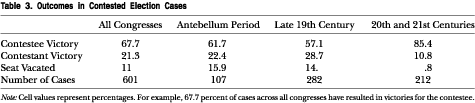
How have contested election cases in the House typically been resolved? For the most part, the ruling has been in favor of the contestee. Of the 601 contested election cases, the contestee has emerged victorious in 407 cases (or 67.7 percent), the contestant has won 128 cases (or 21.3 percent), and the election has been voided, and the seat vacated, in 66 cases (11 percent). Thus, in just over two of every three cases, the contestee has retained his or her seat.
Historically, these percentages have fluctuated. Table 3 illustrates this. During the Antebellum period (1st–36th Congresses), contestees won nearly 62 percent of contested election cases. From the Civil War through the turn-of-the-century (37th–55th Congresses), contestees fared less well, winning just over 57 percent of contested election cases. Since the start of the twentieth century (56th–107th Congresses), however, contestees have fared exceedingly well, winning over 85 percent of contested elections cases. While contestants at one time stood a reasonable chance of winning an election contest, this is no longer true in the modern period. Case in point: Since the 67th Congress (1921–1923), only five of 128 cases (or 3.9 percent) have been decided in favor of the contestant.44
The last successful election contest was in the 99th Congress (1985–87), in the McCloskey v. McIntyre (Indiana, Eighth District) case, when Republican Richard D. McIntyre, who held the election certificate, was replaced by Democrat Frank X. McCloskey. A ballot recount showed McCloskey as the victor, a decision upheld by the House.
To investigate the degree to which partisanship has influenced contested election cases, the first question to examine is: To what extent have decisions favored the majority party?45
Party affiliation data for contestees and contestants was obtained from Martis, The Historical Atlas of Political Parties in the United States Congress, and Michael J. Dubin, United States Congressional Elections, 1788–1997 (Jefferson, NC: McFarland & Company, Inc., 1997).
Cases involving territorial delegates are dropped, due to difficulties in determining the partisanship of the claimants. In addition, qualification cases (in which no there was no contestant in the case) and cases in which both the contestee and contestant are members of the majority party are dropped.
Yet, this simple result may be misleading. If majority party claimants contest at a higher rate, because they believe they will be awarded a seat simply by virtue of their majority party affiliation, then there will be a selection effect present. That is, many potential frivolous cases will be brought by majority party claimants – leading to dismissals – while only serious cases will be brought by minority party claimants. And, in fact, majority party claimants do contest at a significantly higher rate, bringing 72 percent of all cases. Thus, to get a better sense of the degree to which partisanship influences contested election outcomes, we must dig deeper.
One avenue to pursue would be to evaluate only those cases that involved a split within the committee. In a sense, split-committee cases will serve as a control on case quality. For example, if a high number of frivolous cases are in fact brought by majority party claimants, they should be “weeded out” at the committee level. That is, a unanimous committee report should follow from frivolous (and other weak) cases, leading to negative decisions on the House floor. Thus, my assumption is that only serious cases will yield committee splits. The question then becomes: Do we see a significant difference in majority-party versus minority-party outcomes when committee splits occur? The answer is yes: The majority party in fact wins nearly 70 percent of split-committee cases.
Another avenue to pursue would be to examine only those cases in which a contestant successfully unseated a constestee. The question here would be: Do we observe impartiality when a seat “flips,” or changes hands? The logic for partisan behavior is straightforward – it is one thing for a majority to allow a minority member to retain his or her seat, while it is quite another for the majority to unseat one of its own in favor of a member of the minority. If we in fact observe a similar ratio of majority-minority and minority-majority “flips,” then this would constitute evidence of non-partisan behavior in decision-making. Again, restricting cases to those in which a member of the majority party is directly involved, as either the contestee or contestant, I find that seat flips significantly favor the majority party. In 85.8 percent of the cases in which a contestee has been unseated, the contestant who gains the seats has been a member of the majority party. Only fifteen times in a total of 106 cases has a sitting majority party member been unseated in favor of a minority party contestant.
The flipped-seat results combined with the split-committee findings, I argue, lends credence to a story of partisanship in contested election cases. Once the frivolous cases brought by majority party claimants are stripped away, and attention is focused on cases that would seem ripe for partisan activity, the outcomes disproportionately favor the majority party.
Committee Rolls
Another issue to investigate is the degree to which the House outcome has differed from the committee's recommendation in contested election cases, or in other words, the frequency with which the committee has been “rolled.” This question is related to the issue of partisanship, in that committees will be dominated by members of the majority party. Theory developed by Gary W. Cox and Mathew D. McCubbins posits that majority party contingents on committee should act as “agents” for the interests of the underlying majority in the House.47
Gary W. Cox, “Agenda Setting in the U.S. House: A Majority-Party Monopoly,” Legislative Studies Quarterly 26 (2001): 185–210; Gary W. Cox and Mathew D. McCubbins, “Agenda Power in the U.S. House of Representatives, 1877–1986,” Party, Process, and Political Change in Congress: New Perspectives on the History of Congress, ed. David W. Brady and Mathew D. McCubbins (Stanford, CA: Stanford University Press, 2002).
In the 601 contested election cases across time, fifty committee rolls have occurred. Excluding the forty-three cases involving territorial delegates and two cases involving seceded states in the 38th Congress where partisan identification of the claimants is difficult to determine, the relevant committee (Elections or House Administration) has been rolled on thirty-nine occasions, or 7 percent of the time.48
If the sample is restricted to the fifty-five Congresses examined by Cox and McCubbins – the 44th through 99th Congresses – then the roll rate drops to 4.5 percent.
Interestingly, a unanimous committee recommendation has been rolled on four occasions. In only one of those cases was the committee recommendation inconsistent with the interests of the majority party.
Roll-Call Voting
Another way to gain leverage on the question of partisanship in contested election cases is to examine roll-call votes. That is, the distribution of individual vote choices in election contests that are decided by roll call can help reveal whether partisanship was a major factor in the case outcomes. Moreover, we can compare party-based models of roll-call voting to ideological models to assess the relative importance of party and ideology.
Before turning to an examination of roll-call votes, I first consider the distribution of cases that elicited roll calls. Table 5 provides a breakdown, both generally and across the three time periods from Table 3. Overall, less than one-third of all contested election cases have been decided by roll call, with the remaining cases dealt with by voice vote or by the House taking no action (and thereby accepting the outcome from the initial election). The cross-period distribution reveals an interesting pattern: The percent of cases determined by roll call was reasonably high prior to the twentieth century, but dropped off considerably thereafter. In fact, in the most recent period, it would not be a stretch to characterize an election contest decided by roll call as something of a “rare event.” These results suggest that the disposition of contested election cases has become more programmatic in recent years.50
In my view, it would be a mistake to argue that the reduction in roll-call votes is also an indication that the contested election process has become less partisan over time. The Kunz v. Granata case, for example, was highly partisan but was eventually resolved by voice vote. The move to more programmatic disposition of contested election cases could simply be a function of the changing costs and benefits attributed to election contests by partisan decision makers in the twentieth century. While these issues will be discussed to some degree in Section IV, they deserve additional investigation in the future.
Contests Leading to Committee Rolls

Of those election cases determined by roll call, to what extent has partisanship been a factor in the outcome? An initial answer would be to determine how many roll calls constitute “party votes,” that is, votes in which at least 50 percent of one major party opposed at least 50 percent of the other major party. Table 6 provides a summary total, as well as a cross- period breakdown. In fact, a distinct majority of roll calls are party votes: exactly 87 percent. In addition, just over one out of every seven roll calls is a perfectly-aligned party vote, in which all voting members of one party oppose all voting members of the other party. Results for the late-nineteenth century are even more extreme – nearly 95 percent of roll calls are party votes, and over one out of every five roll calls is a perfectly-aligned party vote. These latter results are consistent with the general view in the literature that the late-nineteenth century was a particularly partisan era.
Further evidence of partisanship can be obtained through an examination of individual vote choices on roll calls. Here, a party-based model of roll-call voting can be tested against a simple “naïve” model to determine how much better the former fits the underlying vote-choice data. Moreover, a party-based model can be compared to a competing ideologically-based model to determine whether ideological cleavages provide a better explanation than partisan cleavages. In terms of methodology, the party model is a basic logistic regression, where an individual roll-call vote is regressed on a member's party affiliation. In effect, a vote is deemed “correctly classified” if a member votes with the majority of his party. The ideological model follows the same approach, except that instead of party affiliation two ideological “scores” developed by Keith T. Poole and Howard Rosenthal are included as independent variables.51
For a fuller discussion of these ideological scores, dubbed NOMINATE scores, see Keith T. Poole and Howard Rosenthal, Congress: A Political-Economic History of Roll Call Voting (New York: Oxford University Press, 1997). In effect, these scores represent placements on “dimensions” that are recovered from a multidimensional unfolding technique applied to the matrix of roll-call votes in a given Congress. Over time, the first NOMINATE dimension generally taps economic cleavages across parties, while the second NOMINATE dimension typically taps cleavages within parties, such as sectional or geographic differences.
This naïve model characterization is a typical benchmark used in the congressional voting literature. See Herbert F. Weisberg, “Evaluating Theories of Congressional Roll-Call Voting,” American Journal of Political Science 22 (1978): 554–77; Poole and Rosenthal, Congress, 29–30.
Percentage of Election Contests Decided by Roll–Call Vote, by Era

Percentage of Election Contest Roll Calls Classified as “Party Votes”, by Era

Percentage of Individual–Level Roll–Call Votes Correctly Classified, by Era
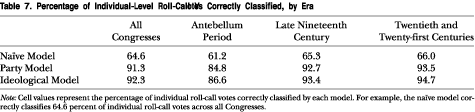
Table 7 documents the performance of each model generally and across periods. The naïve model correctly classifies just under 65 percent of all individual-level roll-call votes across all Congresses, with slight variations period by period. The party model easily outperforms the naïve model generally, correctly classifying 91.3 percent all individual-level vote choices, as well as in each period. The party model does display some classification variance, with a high of 93.5 percent in the most recent era and a low of 84.8 percent in the Antebellum period. Finally, the ideological model yields the best classification success of the three models, outperforming the party model generally as well as in each period. The improvement, however, is slight, averaging around one additional percentage of classification success.
Goodness of Fit Comparison between Party and Ideological Models, by Era
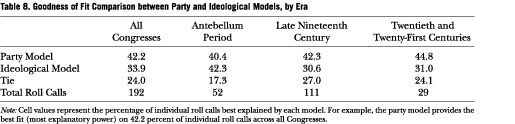
The party model thus provides an excellent fit to the underlying individual-level vote choices; however, it is marginally surpassed by the ideological model. This does not necessarily suggest that ideological determinants are always more important than party determinants in explaining individual-level vote choices in contested election cases. The findings in Table 7 are individual-level results aggregated across all roll calls, either generally or within a particular era. Another option would be to compare how the party and ideological models compare at the individual-level on each roll call. This provides a way to determine if the ideological model outperforms the party model systematically, or if the party model emerges as superior in a head-to-head competition on some subset of roll calls.
Table 8 illustrates how the party and ideological models perform on a roll-call by roll-call basis. In fact, the party model outperforms the ideological model generally, providing superior explanatory power on over 42 percent of roll calls. The ideological model outperforms the party model on nearly 34 percent of roll calls, while the two models perform similarly on 24 percent of roll calls. These relative percentages are comparable in a period-by-period analysis, except that the ideological model outperforms the party model during the Antebellum period. Overall, then, the party model stacks up quite well in a head-to-head comparison against the ideological model. Specifically, the party model performs either as well or better than the ideological model roughly two-thirds of the time. These results therefore suggest that partisanship is the major determinant on a significant number of contested election roll calls across American history.
Examining the Polsby Thesis
The roll-call voting data in the previous subsection can also be used to examine speculations by Nelson Polsby regarding contested election cases.53
Polsby, “The Institutionalization of the U.S. House of Representatives.”
Ibid., 163.
Polsby's investigation, however, stops short of providing more systematic evidence for a move to universalism in the twentieth century. But he does lay out how the transition to a universalistic norm could be identified, specifically by:
measuring the extent to which party lines are breached . . . in voting on the floor in contests cases. I have made no such study, but on the accumulated weight of contemporary reports such as I have been quoting, I predict that a time series would show strict party voting in the nineteenth century, switching to unanimity or near-unanimity, in most cases, from the early years of the twentieth century onward.55
Ibid.
Results in Tables 6 and 7 can be used to test Polsby's prediction. In fact, it is not borne out. First, since the beginning of the twentieth century, the number of election-contest votes that can be characterized as “party votes” is quite high – approximately 80 percent – with roughly one in six characterized as perfectly-aligned party votes. These results represent only a slight drop off from the late-nineteenth century. If universalism had indeed emerged as the new norm in the twentieth century, party lines should have (largely) broken down on election-contest votes in favor of unanimous (or near-unanimous) coalitions, and we thus should observe no (or few) votes that would be characterized as party votes.
Second, a model of universalism can be evaluated more directly by examining the results in Table 7. Specifically, the naïve model is a model of universalism – wherein all members are predicted to vote with the winning side on each roll call. Thus, particularism and universalism can be evaluated side by side, based on the relative performances of the party and naïve models. And, in fact, the party model has far outperformed the naïve model on election-contest votes since the start of the twentieth century. While universalism, through the naïve model, accounts for 66 percent of individual vote choices, particularism, through the party model, correctly classifies more than 93 percent. Moreover, the performance of the party model has not waned since the late-nineteenth century; in fact, classification success has increased. Thus, while certain aspects of the contested election process – like the sheer number of cases, the relative success rates of contestants, and the proportion of cases dealt with by roll call – have declined since the late-nineteenth century, the degree to which partisanship enters into floor votes in election cases remains strong.
The Impact of Partisanship
While various forms of evidence can be marshaled to argue that partisanship has been a (or the) significant determinant in contested election cases, perhaps the more fundamental issue is measuring the degree to which the majority party has benefited from controlling the contested election process in the House. Stated another way, determining the impact of partisanship is key. The most straightforward way to do this is to ask: How would the distribution of majority-party seats have been different in a given Congress, had the contested-election procedure not been available? That is, if House membership were determined exclusively by an individual's possession of the certificate of election, how would this have changed the majority-party seat allocation?
This question can be examined by comparing the actual House membership to how the House membership would have appeared had (a) no successful contests occurred and (b) no seats been vacated. The difference between these two scenarios (the actual and the counterfactual) is illustrated in Figure 3. For any given Congress, two pieces of data are provided. The left y-axis, which corresponds to the solid line, measures the change in majority-party seats; a positive (negative) number represents the addition to (subtraction from) the majority-party ranks from the contested election procedure. The right y-axis, which corresponds to the dotted line, measures the percentage change in the size of the majority party, given the increase (decrease) in seats. As the figure shows, the impact of the contested-election procedure on the majority party was relatively small prior to Reconstruction, and sometimes negative. In the 3rd (1793–1795), 18th (1823–1825), 24th (1835–1837), 26th (1839–1841), and 32nd (1851–1853) Congresses, the majority-party seat allocation was reduced, by as many as two seats, because of election contests. Moreover, when the majority party did benefit from election contests, the impact was small, with the seat addition maxing out at two. In fact, for the first thirty-eight Congresses (1789–1865), the total net gain for the majority party from contested elections was five seats.

Net impact of contested election procedure.
The significance of contested elections would only be felt after the Civil War. The first two Reconstruction-era Congresses, the 39th (1865–1867) and 40th (1867–1869), witnessed small majority-party gains of two and three seats, respectively. The 41st Congress (1869–1871), however, produced a “sea change,” as contested election cases generated ten additional seats for the majority party. There were eight successful contests, all of which involved a Republican unseating a Democrat, along with two Democratic seats declared vacant that were later won by Republicans in special elections. The addition of these ten seats increased the size of the Republican Party by 6.2 percent.
For the next three decades, contested election cases would become part of the partisan landscape; however, their effects would ebb and flow. The 42nd (1871–1873) and 43rd (1873–1875) Congresses were a complete departure from the 41st, as the Republicans, the majority party, would lose two seats in each because of election contests. The Democrats would then assume control of the House for the next six years, the 44th through 46th Congresses (1875–1881) and use contested election cases for their own benefit.
The majority-party “bump” from contested election cases would fluctuate for the next twenty years, as Republicans and Democrats alternated control of the House. However, the especially large gains occurred under Republican rule – five additional seats in the 47th Congress (1881–1883),56
These additional five seats constituted the difference between a Republican plurality and majority – without the five seats, the Republicans would have only controlled 146 of the 293 House seats, one seat short of a majority.
All of these gains came at the expense of the Democratic Party. Moreover, one additional Democrat was unseated in favor of a Labor Party contestant in the 51st Congress, and two additional Democrats were unseated in favor of Populist Party contestants in the 54th Congress.
Thus, the data from Figure 3 convey three distinct periods: weak majority-party gains through the Civil War; strong majority-party gains from Reconstruction through the turn of the century; and weak majority-party gains thereafter. More specifically, the majority party benefited little from the contested election process in the first and third periods, but benefited considerably in the second period.
IV. Examining the Late-Nineteenth Century Rise in Contested Elections
As the prior section illustrated, the partisan impact of contested election cases has actually been quite small during most of congressional history. At most, the majority-party gain from election contests was two seats per Congress during the Antebellum period and the twentieth century. The outlier, however, was the late-nineteenth century, during and after Reconstruction, when contested elections often produced sizeable benefits for the majority party. What was different about this period?
First, the late-nineteenth century was an extremely partisan time, resulting in large part from an evenly divided national electorate. Between 1870 and 1900, the House changed partisan hands six different times, and a small redistribution of seats in various elections would have increased that figure even more. Thus, there was every incentive for the parties to search for strategic advantages, both institutional and electoral, to increase their likelihood of gaining (and maintaining) control of the House, as well as the national government more generally. Examples of strategic maneuvers included the manipulation of congressional districts,58
Erik J. Engstrom, “Stacking the States, Stacking the House: The Partisan Consequences of Congressional Redistricting in the Nineteenth Century,” paper presented at the 2003 annual meeting of the Midwest Political Science Association, Chicago, IL, April 3–6, 2003. According to Engstrom, at least one state pursued a redistricting in every year between 1872 and 1896.
Charles Stewart III and Barry R. Weingast, “Stacking the Senate, Changing the Nation: Republican Rotten Boroughs, Statehood Politics, and American Political Development,” Studies in American Political Development 6 (1992): 223–71. According to Stewart and Weingast, this was a strategy concocted by the Republicans to “stack” the Senate and control the presidency. It also had a marginal benefit for Republicans' efforts to control the House.
Scott C. James and Brian L. Lawson, “The Political Economy of Voting Rights Enforcement in America's Gilded Age: Electoral College Competition, Partisan Commitment, and the Federal Election Law,” American Political Science Review 93 (1999): 115–31.
But, perhaps even more importantly, the use of contested elections was crucial to the continued Republican success in the House. That is, by the 1870s and 1880s, the Republican dominance in the North, which was consolidated during the Civil War, had ended. The Democratic Party began making serious inroads outside of the former-Confederate states, winning a majority of seats in the border states, pulling even with the Republicans in the Great Lakes states, and even capturing a sizeable number of seats in the northeast.61
Charles Stewart III, “Lessons from the Post-Civil War Era,” in The Politics of Divided Government, ed. Gary W. Cox and Samuel Kernell (Boulder, CO: Westview Press, 1991).
Vincent P. De Santis, Republicans Face the Southern Question: The New Departure Years, 1877–1897 (Baltimore, MD: The Johns Hopkins Press, 1959), 12; Vallelly, “National Parties and Racial Disenfranchisement.”
The problem, however, was how to make inroads in the South. Many of the strategic tools that Republicans used effectively throughout the late-nineteenth century, like redistricting, admittance of western states, and deployment of federal election officials were not effective in maintaining a Republican presence in the South. And, with the federal troops no longer stationed in the South, per the implicit agreement underlying the Compromise of 1877, no enforcement mechanisms were in place to ensure fair elections. The contested election procedure, therefore, became the chief means by which the Republicans would fight Democratic-sanctioned fraud, intimidation, and violence in the South, and promulgate hopes that a southern wing of the Republican Party could be resuscitated.63
In addition, the Republican pursuit of election contests in the South would be used as electoral fodder in the North, as coverage of southern fraud and corruption would put northern Democratic candidates on the defensive. See Bensel, Sectionalism and American Political Development, 87.
Reconstruction and Contested Elections
But, first, a step back. Initially, during Reconstruction, a southern Republican Party was very much a reality. With African-American enfranchisement, an “occupying” army of Union troops, and no general amnesty for Southern troops, the South was staunchly Republican. Of the forty-one former-Confederate House seats in the 40th Congress (1867–1869), thirty-six were controlled by the Republicans. In the 41st Congress (1869–1871), a southern Democratic Party began to revive, and the electoral process (mainly through violence toward and intimidation of African- American voters) was threatened.64
Allen W. Trelease, White Terror: The Ku Klux Klan Conspiracy and Southern Reconstruction (New York: Harper & Row, 1971); Michael Perman, The Road to Redemption: Southern Politics, 1869–1879 (Chapel Hill: University of North Carolina Press, 1984).
The Enforcement Acts were a series of five laws passed between May 1870 and June 1872 that were intended to protect and insure the voting rights of African Americans in the South. William Gillette, Retreat from Reconstruction, 1869–1879 (Baton Rouge: Louisiana State University Press, 1979), 25–27; Eric Foner, Reconstruction: America's Unfinished Revolution, 1863–1877 (New York: Harper & Row, 1988), 454–59, 528–31.
For the next several Congresses, the contested election procedure was used sporadically. In the 42nd (1871–1873) and 43rd (1873–1875) Congresses, the Republicans did not use election contests as a partisan tool, relying instead on army supervision of southern elections as part of the various Enforcement Act provisions. And while the Democrats were making inroads in the Deep South as well as the border states, the Republicans still maintained a majority presence. By the 44th Congress (1875–1877), all of that changed, due to two factors. First, on the heels of a Midwestern depression, the Democrats regained majority control of the House. Second, the Union army was fully withdrawn from the South. As a result, the intimidation of African-American voters went unchecked, and the southern Republican Party was dealt a near-fatal blow.66
For a discussion of military withdrawal, corruption, and southern elections in the late 1870s, see Richard Franklin Bensel, Yankee Leviathan: The Origins of Central State Authority in America, 1859–1877 (Cambridge: Cambridge University Press, 1990), 366–415.
Post-Reconstruction and Contested Elections
Thus, by the 46th Congress (1879–1881), the southern component of the Republican Party was virtually eliminated – only three Republican seats remained: one each in Florida, Tennessee, and Virginia. In addition, the liberal element within the Republican Party, led by President Rutherford Hayes, began pursuing a “new departure” in the South, courting white southern Democrats with Whiggish persuasions, while denying patronage to the carpetbaggers, scalawags, and African Americans who made up the southern Republican rank and file.67
C. Vann Woodward, Origins of the New South, 1877–1913 (Baton Rouge: Louisiana State University Press, 1951), 27–29; Stanley P. Hirshson, Farewell to the Bloody Shirt: Northern Republicans & the Southern Negro, 1877–1893 (Bloomington: Indiana University Press, 1962), 25–26; C. Vann Woodward, Reunion and Reaction: The Compromise of 1877 and the End of Reconstruction (Boston: Little, Brown and Company, 1966), 22–50; Ari Hoogenboom, The Presidency of Rutherford B. Hayes (Lawrence: University Press of Kansas, 1988), 51–78.
Vincent P. De Santis, “President Hayes's Southern Policy, The Journal of Southern History 21 (1955): 476–94; De Santis, Republicans Face the Southern Question, 99–103; Mark Wahlgren Summers, Rum, Romanism, & Rebellion: The Making of a President, 1884 (Chapel Hill: University of North Carolina Press, 2000), 30–39, 45–46.
Yet, some hope remained. The Republicans recaptured the House in the 47th Congress (1881–1883), and, with Hayes now out of the picture, they labored to keep their southern pulse alive. Contested elections would be the vehicle, as six southern Democrats – one each in Alabama, Florida, Mississippi, and Missouri, and two in South Carolina – would be unseated in favor of Republicans.69
One Iowa Republican would be unseated in favor of a Democrat, producing a net gain of five seats for the Republicans.
Accompanying this Republican spurt was an effort by Republican President Chester Arthur to reach out to Independents in the South, principally members of the Readjuster Party in Virginia, for additional support. Vincent P. De Santis, “President Arthur and the Independent Movements in the South in 1882,” The Journal of Southern History 19 (1953): 346–63; De Santis, Republicans Face the Southern Question, 133–81; Hirshson, Farewell to the Bloody Shirt, 105–22; Jane Dailey, Before Jim Crow: The Politics of Race in Postemancipation Virginia (Chapel Hill: University of North Carolina Press, 2000), 55–59.
The Republicans regained the House in the 51st Congress (1889–1891), and with the backing of President Benjamin Harrison and a small group of members of Congress sympathetic to the old Radical party roots, they resumed their southern mission.71
De Santis, Republicans Face the Southern Question, 195–97; Hirshson, Farewell to the Bloody Shirt, 200–214. Richard E. Welch, Jr., “The Federal Elections Bill of 1890: Postscripts and Prelude,” Journal of American History 52 (1965): 511–26; Homer E. Socolofsky and Allan B. Spetter, The Presidency of Benjamin Harrison (Lawrence: University Press of Kansas, 1987), 60–65.
The Force Bill of 1890 would pass in the House, but be bogged down in the Senate by a Democratic filibuster. The original Force Acts of the early 1870s would be repealed in 1893 during Grover Cleveland's administration. See Michael Perman, Struggle for Mastery: Disfranchisement in the South, 1888–1908 (Chapel Hill: University of North Carolina Press, 2001), 38–47; Robert M. Golden, “A Free Ballot and a Fair Count”: The Department of Justice and the Enforcement of Voting Rights in the South, 1877–1893 (New York: Fordham University Press, 2001), 145–70.
In addition, one Democrat from Arkansas was unseated in favor of a member of the Labor Party.
In addition, two Democrats from the Deep South, one each from Alabama and North Carolina, were unseated in favor of Populists.
At that point, however, the Republicans' use of election contests as a means of securing a southern base began to slow. Three Democrats from the Deep South in each of the next two Congresses, the 55th (1897–1899) and 56th (1899–1901), were unseated in favor of Republicans. However, while the Republicans would control the House for the next five Congresses, no additional election contests would replace Democrats with Republicans in the former-Confederate South. Meanwhile, the Republicans' electoral suc- cess in southern congressional elections left little doubt that the party's southern base was essentially dead. Save for occasional Republican successes in eastern Tennessee, southwestern Virginia, and western North Carolina, the South became a one-party Democratic state. In fact, aside from the aforementioned areas and one district in Texas, the Republican Party would not capture another southern district until the late 1950s.75
This was the 14th District, represented by Republican Harry M. Wurzbach from the 67th (1921–1923) through 71st (1929–1931) Congresses.
The South and Contested Election Cases, 1867–1911

The Data: A Closer Look
The southern emphasis on contested election cases in the late-nineteenth and early-twentieth centuries is underscored in Table 9. Between the 40th and 61st Congresses (1867–1911), generally considered the most partisan period in American history, there were 270 contested election cases in the House,76
This excludes U.S. Territories.
These states include Alabama, Arkansas, Florida, Georgia, Louisiana, Mississippi, North Carolina, South Carolina, Tennessee, Texas, and Virginia.
These states include Delaware, Kentucky, Maryland, Missouri, and West Virginia. While these states were not “reconstructed,” as were the former Confederate states, each had strong Democratic histories and southern sympathies. Kentucky and Missouri, for example, elected rump governments during the Civil War, which were recognized by the Confederacy and given representation in the Confederate Congress.
Table 10 lays out the distribution of seats that resulted in a partisan flip, following from successful election contests and vacated seats. Overall, of the seventy seat flips that favored the majority party between the 40th and 61st Congresses (1867–1911), thirty-four (or 48.6 percent) occurred in the former Confederate South. And, again, if “South” is expanded to include all former slave states, then forty-six seat flips (or 65.7 percent) were southern in nature.
Also illustrated in Table 10 is the evolving use of the contested election process by the Republican Party. As discussed previously, prior to the adoption of the Enforcement Acts between 1870 and 1872, the Republicans used election contests to prevent Democratic fraud and intimidation. Once the Enforcement Acts were in place, the Republicans reduced their monitoring of Democratic impropriety and seemingly applied the contested election procedure in an equitable manner. In the 42nd (1871–1873) and 43rd (1873–1875) Congresses, for example, the Republicans awarded five seats to Democrats in the former Confederate South, while only awarding two seats to their own partisans.
Seat Changes Due to the Contested Election Procedure, 1867–1911

After the Compromise of 1877 and the emasculation of the Enforcement Acts, however, the Republicans behaved much more parochially. Over the next five Congresses in which they were the majority, the Republicans seated twenty of their own partisans in the former Confederate South, while seating no Democrats. Overall, the Republicans now used the contested election process almost exclusively as a means of maintaining a southern presence. Of the twenty-nine Republican seats added via contested election cases in the 47th (1881–1883), 51st (1889–1891), 54th (1895–1897), 55th (1897–1899), and 56th (1899–1901) Congresses, only three were located outside of the former slave states.
When the Democrats held the majority reins in the House, their strategy was different. In large part, they did not apply the contested election procedure much in the South, relying instead on fraud, violence, and intimidation to influence the electoral process.79
For examples of these various corrupt practices, see J. Morgan Kousser, The Shaping of Southern Politics: Suffrage Restrictions and the Establishment of the One-Party South (New Haven, CT: Yale University Press, 1974); Peter Argersinger, “New Perspectives on Election Fraud in the Gilded Age,” Political Science Quarterly 100 (1985–1986): 669–87; Perman, Struggle for Mastery; Mark Wahlgren Summers, “Party Games: The Art of Stealing Elections in the Late-Nineteenth-Century United States,” The Journal of American History 88 (2001): 424–35; Mark Wahlgren Summers, Party Games: Getting, Keeping, and Using Power in Gilded Age Politics (Chapel Hill: University of North Carolina Press, 2004).
Finally, Table 11 documents the Republican presence in the former Confederate South between the 40th and 61st Congresses (1867–1911), and notes the number of Republican seats generated specifically through election contests. Between the 40th and 43rd Congresses (1867–1875), the Republicans maintained a majority presence in the former Confederate South, which was accomplished almost wholly through the standard electoral process: only seven of the 150 Republican seats (or 4.7 percent) resulted from contested elections.
Election Contests and Republican Seats in the Former Confederate South, 1867–1911

After the Democrats returned to power nationally, and the remaining troops were pulled out of the South, the Republicans' share of seats dropped off substantially. For the most part, without the help of the contested election procedure, the Republicans learned quickly that they could only count on single digits in the former Confederacy. Thus, on the next five occasions when the Republicans controlled the House, in the 47th (1881–1883), 51st (1889–1891), 54th (1895–1897), 55th (1897–1899), and 56th (1899–1901) Congresses, contested elections became a major tool to boost the party's seat totals. Of the fifty-eight seats that the Republicans controlled during these five Congresses, twenty (or 34.5 percent) came directly via election contests.
The End of Contested Elections as a Partisan Tool
After the 56th Congress (1899–1901), the use of contested elections as a partisan tool ended abruptly. The Republicans would maintain their majority status in the next five Congresses, yet not a single Republican seat was added in the South via election contests. What accounts for this change?
Three complementary explanations can be provided. First, while the contested election process produced additional Republican seats in the South and was supported by prominent party leaders like President Harrison, many Republicans were not enthusiastic about its continued use as a partisan device. One very vocal opponent was Thomas B. Reed, Republican Speaker of the House in the 51st (1889–1891), 54th (1895–1897), and 55th (1897–1899) Congresses. Reed believed that the contested election process was a tremendous waste of resources for the committee members, who had to read thousands of pages of testimony, as well as the House, which had to spend an often significant amount of time considering arguments and rendering decisions.80
William A. Robinson, Thomas B. Reed: Parliamentarian (New York: Dodd, Mead & Company, 1930), 76, 85.
Reed, “Contested Elections,” 114–15. Henry Cabot Lodge (R-MA) echoed Reed's concerns, suggesting that contested election cases consumed thirty to sixty days in each session of Congress. New York Herald, November 30, 1889.
Reed also had first-hand experience with election contests, having had his own seat contested in the 47th Congress (1881–1883). The contestant in the case, Democrat Samuel J. Anderson, leveled a number of charges, chief among them that a number of his would-be voters were intimidated by Reed's supporters and did not participate in the election. Filing a short brief with the Committee on Elections, Reed stated: “If I could scare them as easily as the contestant seems to think and by means as inadequate as he has proved, I have certainly been recreant in a plain duty. I ought to have scared more of them” (quoted in Robinson, Thomas B. Reed, 75). Both the committee and the House found the evidence presented by Anderson exceedingly flimsy and ruled in favor of Reed.
Successful Republican Contestants, 47th, 51st, 54th–56th Congresses

Second, the strategy of using election contests to maintain a Republican presence in the former Confederate South was largely a failure. Most of the Republicans who successfully unseated Democrats via the contested election procedure were unable to build a base of support and maintain control of their districts. This is illustrated in Table 12. Of the fifteen successful Republican contestants in the Republican-controlled 47th, 51st, 54th, 55th, and 56th Congresses who ran for reelection to the subsequent Congress, only six were reelected. And, of those six, only two were elected outright. The other four gained their seats via another successful election contest. In fact, one candidate, William F. Aldrich (Alabama, 4th District), won three successive election contests, in the 54th, 55th, and 56th Congresses.83
Aldrich's vote totals in those three races were 41.37, 40.1, and 45.12 percent, respectively. In each case, Aldrich charged corruption in the election, specifically fraudulent returns. He ran for reelection to the 57th Congress but received only 2.57 percent of the vote and did not contest the election.
Mean Cohesion Scores for Republicans in the Former Confederate South

Moreover, the loyalty of these Republican contestants left much to be desired. Specifically, Republican contestants in the former Confederate South were significantly less loyal than their Republican brethren who were elected outright. Cohesion scores for Republicans in the former Confederate South on party votes appear in Table 13. For each of the five Congresses in question, southern Republicans elected outright were significantly more supportive of the party than those seated via election contests. Thus, in addition to being unable to maintain control of contested seats across congresses, Republicans received very little “bang for the buck” from those members who represented contested House seats. As a result, it was in many ways a “lose-lose” strategy: It was a time-consuming process to “flip” a seat, and the resulting benefit turned out to be minimal.
Third, and finally, the changing electoral landscape in the late-1890s made the use of election contests as a partisan tool no longer necessary.84
For a similar argument, see Valelly, “National Parties and Racial Disenfranchisement.”
This all changed, however, with the elections of 1894–1896, which produced a national, electoral realignment. Battling over industrial, agrarian, and monetary issues, the Republicans and Democrats emerged from the 1894–1896 elections with a new distribution of solid, lasting constituencies. As David W. Brady states, these elections “converted competitive two-party states in the industrial East and Midwest into solid Republican regions and made the Border states . . . [which] were solidly Democratic before 1894 . . . into a competitive two-party region.”85
David W. Brady, Critical Elections and Congressional Policy Making (Stanford, CA: Stanford University Press, 1988), 61. See also, Valelly, “National Parties and Racial Disenfranchisement.”
Enjoying the positive effects of the electoral realignment, the Republicans would begin to reassess their partisan strategies. In effect, they no longer needed representation in the South to win control of the House, and thus could heed Speaker Reed's advice by dropping their (largely unsuccessful) contested-election strategy and focusing on their policy agenda. This did not happen all at once, however, as it was not immediately clear whether the initial Republican electoral victories in the mid-to-late 1890s reflected a temporary swing or a more general, lasting movement. As a result, the Republicans maintained a conservative approach and continued adding southern seats through election contests – four in the 54th (1895–1897) Congress, and three each in the 55th (1897–1899) and 56th (1899–1901) Congresses. After President William McKinley's reelection in 1900, however, Republican Party leaders were confident in their newfound electoral windfall, and the partisan use of election contests (and the Republican presence in the South) went by the board.86
This leads, of course, to the following question: why did contested elections not reemerge in the 1910s and 1920s, when the Democrats began to contend once again for national preeminence? Several complementary reasons exist. First, the information costs of contesting elections increased, as illiteracy rates declined and media coverage (including radio) expanded. In effect, the populace was simply better informed, which required party leaders to better explicate and justify their reasons for pushing election contests (and thereby attempting to overrule the decisions of the electorate). Second, related to the first point, the South was no longer a battleground, as Jim Crow effectively eliminated African American electoral participation. During the late-nineteenth century, attempts at African American disfranchisement (through intimidation and violence) had kept the electoral costs of election contests low, as “fairness” and “Democratic intransigence” as campaign issues played well with Republican voters in the North. See Bensel, Sectionalism and American Political Development, 87. By the early twentieth century, these “morality” issues were no longer in play, and election contests outside of the South (and the “undemocratic” nature in which they were often portrayed) became quite costly to both parties. Third, balloting became secret (via the Australian ballot) and voting technology improved, making it more difficult for outright fraud to enter into congressional elections.
V. Conclusion and Future Extensions
This has been an initial examination of contested election cases in the House of Representatives, a generally-understudied topic in Congressional history. In addition to providing a general overview of the phenomenon, by describing the historical mode of procedure in contested election cases, presenting an overview of the 601 contested election cases across time, and recounting several noteworthy cases, I examine the determinants of case outcomes, focusing specifically on the role of party. Using a variety of data, including case dispositions, committee recommendations, and roll-call votes on the floor, I find that partisanship has been a significant factor in contested election outcomes generally across time, and during the late-nineteenth century in particular.
Moreover, I offer a broader thesis: that contested elections were vital to the Republican Party's efforts to maintain a Southern presence after Reconstruction, at a time when the Democrats had resurfaced as a viable national party, Republican control of the House (and national politics generally) was tenuous, and African American disfranchisement in the South was rampant. From the mid-1870s through the mid-1890s, contested elections were used as a partisan tool to combat the Democratic-sanctioned fraud, corruption, and violence that had become commonplace in southern electoral politics. Thus, for a time, contested election cases and partisan “seat flips” were a normal part of the political process. Eventually, the critical elections of the mid-1890s and the subsequent electoral realignment returned the Republican Party to national dominance; as a result, the Republicans no longer sought a southern organization and discontinued the use of contested elections as a partisan tool. Since then, contested elections have been brought only sporadically, and few have been successful.
While I believe that I have made significant strides in this analysis, a number of questions remain, providing opportunities for various extensions in the future. First, a more systematic analysis of contested election cases needs to be pursued, using multivariate methods. A number of avenues are ripe for examination: why some general election outcomes are contested, and why some are not; why some cases are successful (net of partisanship), and why some are not; and, finally, why some Congresses (especially in the late-nineteenth century) generate large numbers of cases, while others do not.
Second, a similar examination of the Senate would provide a useful comparison. Much like the House, very little is known about contested election cases in the Senate. Yet, we do know that a number of such cases have arisen across the Senate's history – around 130 or so.87
Anne M. Butler and Wendy Wolff, United States Senate Election, Expulsion, and Censure Cases, 1793–1990. Senate Document 103–33 (Washington, DC: Government Printing Office, 1995).
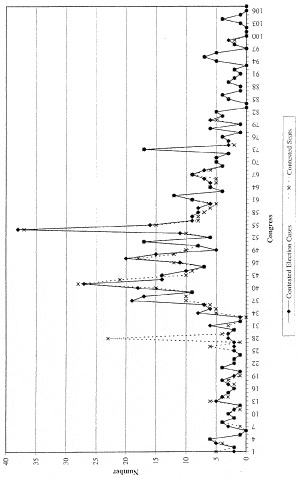
Number of contested cases and contested seats, 1789–2002.
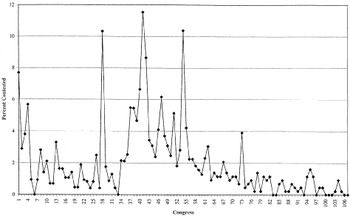
Percentage of seats contested, 1789–2002.
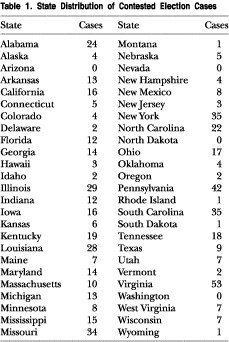
State Distribution of Contested Election Cases
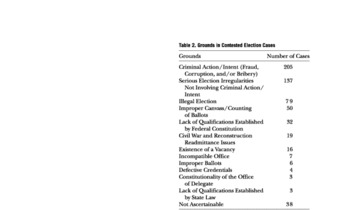
Grounds in Contested Election Cases
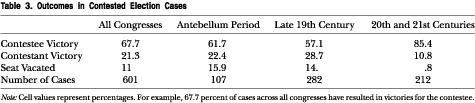
Outcomes in Contested Election Cases
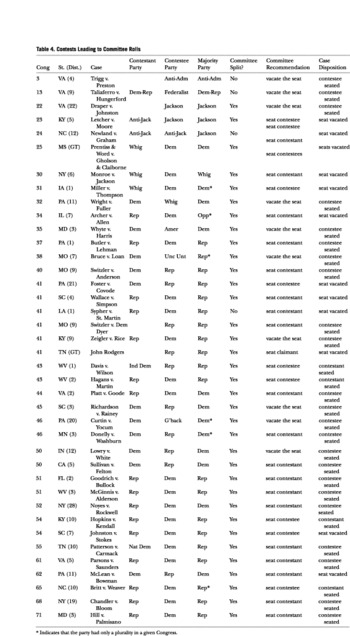
Contests Leading to Committee Rolls

Percentage of Election Contests Decided by Roll–Call Vote, by Era

Percentage of Election Contest Roll Calls Classified as “Party Votes”, by Era
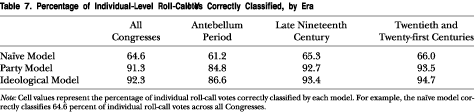
Percentage of Individual–Level Roll–Call Votes Correctly Classified, by Era
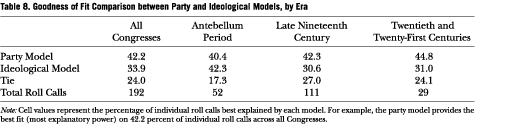
Goodness of Fit Comparison between Party and Ideological Models, by Era
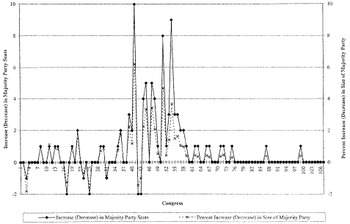
Net impact of contested election procedure.
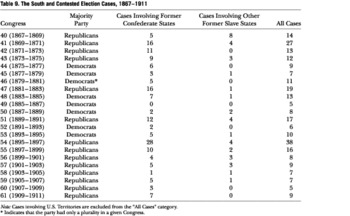
The South and Contested Election Cases, 1867–1911
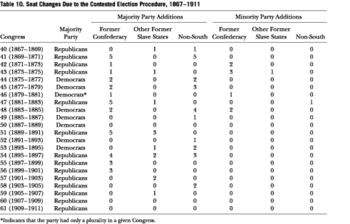
Seat Changes Due to the Contested Election Procedure, 1867–1911
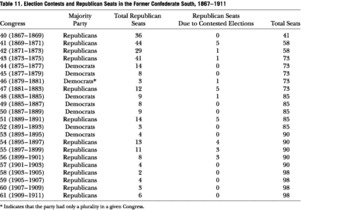
Election Contests and Republican Seats in the Former Confederate South, 1867–1911
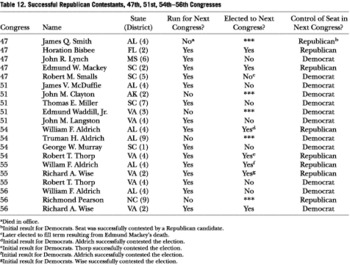
Successful Republican Contestants, 47th, 51st, 54th–56th Congresses
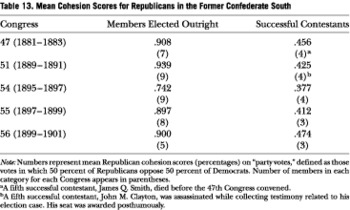
Mean Cohesion Scores for Republicans in the Former Confederate South
 You have
Access
- 21
- Cited by