

A stigma is a personal characteristic or behaviour — or a reputed characteristic or behaviour — that can lead an individual to be categorised and stereotyped by others in a particular context and in a disagreeable manner. The stigma is usually related to a person's character, a group he or she belongs to, or a physical attribute (Goffman, Reference Goffman1963). A stigmatised identity can be visible (such as racial background) or invisible (such as certain types of chronic diseases). Disclosing an invisible stigmatised identity can have both negative and positive consequences for the individual.
Research suggests that disclosing a stigmatised identity in the workplace may result in discrimination, prejudice, and the devaluation of the individual with the stigmatised identity (Badgett, Reference Badgett1996; Gouvier, Steiner, Jackson, Schlater, & Rain, Reference Gouvier, Steiner, Jackson, Schlater and Rain1991; Herek, Reference Herek2009; Miller & Major, Reference Miller, Major, Heatherton, Kleck, Hebl and Hull2000). This in turn may have adverse consequences for the stigmatised person's identity formation, wellbeing, health, cognition, and behaviour (Dovidio, Major, & Crocker, Reference Dovidio, Major, Crocker, Heatherton, Kleck, Hebl and Hull2000; Miller & Major, Reference Miller, Major, Heatherton, Kleck, Hebl and Hull2000; Pascoe & Smart Richman, Reference Pascoe and Smart Richman2009). The adverse consequences associated with the stigmatising of certain identities in the workplace may be especially severe for individuals with degenerative eye conditions. In the United States (US), the rate of unemployment among individuals with vision impairment is above 60% (Erickson, Lee, & Von Schrader, Reference Erickson, Lee and von Schrader2010). As these rates are even higher than those of many other disability and minority groups (Bell & Mino, Reference Bell and Mino2013), the issue of the disclosure of visual impairments in the workplace is critical.
It has also been shown, however, that disclosing a stigmatised identity can be beneficial for the individual. When a person stops trying to hide his or her identity, he or she may, for example, have higher self-esteem, more energy, and lower stress levels (Corrigan & Matthews, Reference Corrigan and Matthews2003; Clair, Beatty, & MacLean, Reference Clair, Beatty and MacLean2005; Derlega, Metts, Petronio, & Margulis, Reference Derlega, Metts, Petronio and Margulis1993; Jourard, 1971). However, the existing studies on the benefits of disclosure have not focused specifically on the benefits in the workplace. Therefore, it is difficult to draw conclusions about which disclosure pathways are associated with positive outcomes in this specific context. Moreover, most studies on the topic of disclosure focus on the antecedents that lead individuals to disclose their stigmatised identity (Clair et al., Reference Clair, Beatty and MacLean2005; Greene, Derlega, & Mathews, Reference Greene, Derlega, Mathews, Vangelisti and Perlman2006; Ragins, Reference Ragins2008). Studies investigating the antecedents of disclosure look at how contextual (e.g., characteristics of the organisation) and individual (e.g., personality traits) level factors influence the choice to reveal or conceal an invisible stigmatised identity. The few studies on the consequences of disclosure for positive wellbeing have focused mainly on the effects of the confidant's reaction (i.e., a positive response is beneficial for reducing stress, while a neutral or negative response is not), and on esteem-related emotions (Clair et al., Reference Clair, Beatty and MacLean2005; Corrigan & Matthews, Reference Corrigan and Matthews2003; Derlega et al., Reference Derlega, Metts, Petronio and Margulis1993; Jourard, 1971). Thus, little is known about the conditions under which disclosure in the workplace is beneficial for wellbeing, especially for the unique group of individuals with degenerative eye conditions (Hayeems, Geller, Finkelstein, & Faden, Reference Hayeems, Geller, Finkelstein and Faden2005).
An additional reason to focus on the group with degenerative eye conditions is that, because sight loss is a gradual process, it can be difficult for people who are losing their sight to decide when the right time is to disclose that they have this feared and often misunderstood condition (Dickerson, Smith, & Moore, Reference Dickerson, Smith, Moore, Moore, Graves and Patterson1997). Concealing the condition may reduce the likelihood that an individual will face discrimination and prejudice. However, waiting too long before disclosing instead of making the disclosure can result in physical and mental strain, as keeping up appearances with worsening eyesight can be dangerous (Hayeems et al., Reference Hayeems, Geller, Finkelstein and Faden2005; Spiegel, de Bel, & Steverink, Reference Spiegel, De Bel and Steverink2016). It is important to establish when the disclosure of a degenerative eye condition in the workplace is beneficial for the wellbeing of the individual.
Theoretical Framework
While fairly little is known about the benefits of disclosure in the workplace for individuals with degenerative eye conditions, a few pathways can be deduced from previous literature on the benefits of disclosing a concealable stigmatised identity. The literature points to two main pathways linking the disclosure of a stigmatised identity and wellbeing.
The first pathway, the alleviation of inhibition, suggests that disclosure can reduce or diminish the stress associated with concealment. Once the stigmatised identity is revealed, the individual has the ability to express inhibited emotions and traits, which can in turn influence his or her overall sense of wellbeing (Chaudoir & Fisher, Reference Chaudoir and Fisher2010). This pathway has also been referred to as emotional processing (Beals, Peplau, & Gable, Reference Beals, Peplau and Gable2009). Since a physical disability can be difficult to conceal not just emotionally, but also physically, this pathway may be prominent among individuals with degenerative eye conditions (Beals et al., Reference Beals, Peplau and Gable2009; Chaudoir & Fisher, Reference Chaudoir and Fisher2010).
The second main pathway is through social support. It has been suggested that the degree of instrumental and emotional support received from the individual's confidants in relation to the act of disclosure, is an important determinant of wellbeing (Beals et al., Reference Beals, Peplau and Gable2009; Chaudoir & Fisher, Reference Chaudoir and Fisher2010). It also seems very likely that for individuals with a degenerative eye condition, receiving instrumental and emotional social support after they disclose their condition in the workplace contributes to their wellbeing. Thus, social support in the workplace context may operate as a second pathway to benefits from disclosure.
So far the individual's emotional processes and the reactions of the individual's social contacts are presented as important pathways linking disclosure and wellbeing. However, because of the particular characteristics of people with visual impairments and the challenges they face, an additional, physical, pathway linking disclosure to wellbeing may emerge. Because concealing a degenerative eye condition in the workplace will limit the ability of these individuals to gain access to physical accommodations (i.e., assistive technology or mobility aids), they may find it increasingly difficult to meet their work responsibilities. The failure to perform well at work may in turn take a toll on their overall wellbeing. Therefore an additional pathway based on the Social Production Function (SPF) theory is introduced. The SPF theory (Lindenberg, Reference Lindenberg, Ganzeboom and Lindenberg1996; Ormel, Lindenberg, Steverink, & Verbrugge, Reference Ormel, Lindenberg, Steverink and Verbrugge1999) suggests that there are basic universal (physical and social) needs, the fulfillment of which contributes to the overall wellbeing of the individual. When these basic needs are not met, the individual is at risk of experiencing stress and deficits in effective functioning and wellbeing, which may in turn negatively influence the individual's wellbeing (cf. Ryan & Deci, Reference Ryan and Deci2000).
There are three basic social needs: affection, behavioural confirmation, and status (Lindenberg, Reference Lindenberg, Ganzeboom and Lindenberg1996; Steverink & Lindenberg, Reference Steverink and Lindenberg2006). Affection refers to the need of an individual to love and to give and receive affection, both through physical proximity (e.g., a hug) and through emotional closeness (e.g., having the feeling of being listened to). Behavioural confirmation refers to an individual's need to receive validation for his or her behaviour from people whose opinions are valued. Finally, status refers to the need of an individual to be respected, independent, and seen as a person with unique skills and accomplishments. In seeking to fulfill these social needs, an individual makes use of resources (e.g., friends, family, job positioning) and sets goals that are aligned with meeting these needs (e.g., making a friend or getting a high status job). The SPF theory posits that the fulfillment of the three social needs is essential for a basic level of wellbeing.
On the one hand, keeping a stigmatised identity secret may be seen as a strategy or a ‘resource’ that can help the individual fulfill social needs. A person's professional network may be expected to fulfill his or her behavioural confirmation and status needs. These two needs are met when coworkers, employers, subordinates, and/or clients validate the performance of the individual. Empirical studies (Badgett, Reference Badgett1996; Herek, Reference Herek2009; Dovidio et al., Reference Dovidio, Major, Crocker, Heatherton, Kleck, Hebl and Hull2000) and theories on stigma (e.g., Goffman, Reference Goffman1963; Link & Phelan, Reference Link and Phelan2001; Link & Phelan, Reference Link and Phelan2013) indicate that in professional settings individuals with stigmatised identities tend to be undervalued based on prejudices and preconceptions related to the stigmatised identity. Because revealing his or her identity can have negative implications for the fulfillment of his or her needs, an individual may choose to conceal the stigmatised identity.
On the other hand, keeping a stigmatised identity a secret may interfere with the individual's ability to fulfill his or her physical needs. For instance, over time commuting may become a challenge for an individual with a degenerative eye condition, and may be expected to become increasingly difficult if he or she avoids using a white cane or a guide dog in order to conceal his or her identity. After the individual has disclosed his or her disability identity, he or she will be better able to manage his or her physical restrictions by making use of assistive devices, and will thus find it easier to fulfill his or her physical needs.
The use of assistive devices can help people with disabilities meet both their work productivity and physical needs (e.g., Yeager, Kaye, Reed, & Doe, Reference Yeager, Kaye, Reed and Doe2006). When an individual avoids using assistive devices, he or she runs the risk of performing worse than able-bodied peers, which may hinder the fulfillment of status and behavioural confirmation needs. While social support (the second pathway) can be seen as related to the fulfillment of the need for affection, the use of assistive devices in the workplace can act as a means of fulfilling the additional social needs of behavioural confirmation and status. Whether these two needs are met depends on whether the individual's workplace contacts positively evaluate his or her behaviour. Thus, the individual's needs go beyond the needs that can be met through emotional and instrumental support.
From this theoretical framework it can be concluded that the benefits the individual derives from disclosure will depend greatly on the extent to which his or her needs are fulfilled, and the interplay between the fulfillment of these various needs (i.e., fulfilling one need may come at the cost of fulfilling another). Thus, the physical pathway, through the use of assistive devices, may be beneficial for both the physical and social aspects of wellbeing through the fulfillment of both physical and social needs.
In the current study, a mixed methods approach is used to investigate when the disclosure of a degenerative eye condition relates positively to wellbeing. First, using survey data the direct association between disclosure and wellbeing will be tested to examine whether the three pathways — that is, the alleviation of inhibition, workplace social support, and the use of assistive devices — are mediators of this association. Second, using qualitative life stories interview data, the participant's experiences of disclosure in the workplace and the link with wellbeing through the three pathways will be explored.
Method
Survey Data
Data Description
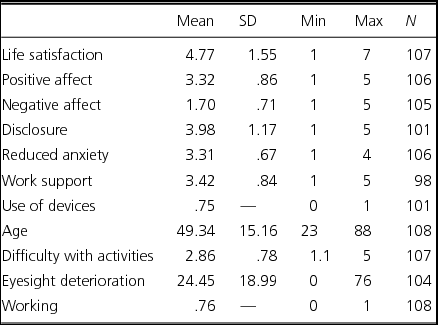
An online survey was administered among individuals with degenerative eye conditions who were over age 18 and were living in the US. The participants were approached through a nonprofit organisation for medical research on vision loss based in the US. The survey was also advertised through the National Federation for the Blind (NFB), through various social network groups (support groups for individuals with low vision on Facebook), and through email lists for individuals with low vision. Given the various methods of outreach, the exact response rate is unknown. The survey was completed by 143 individuals, of whom 108 indicated that they were either currently employed or retired.
Measures
Wellbeing was measured using three concepts that are often mentioned in the literature in conjunction with each other as measures of subjective wellbeing (Pavot & Diener, Reference Pavot and Diener1993): life satisfaction, positive affect, and negative affect. Life satisfaction was measured using the Satisfaction With Life Scale (SWLS; Diener, Emmons, Larsen, & Griffin, Reference Diener, Emmons, Larsen and Griffin1985). This five-item scale consists of items such as: ‘In most ways my life is close to my ideal.’ The answer categories range from 1 (strongly disagree) to 7 (strongly agree). This is a highly reliable scale (alpha = .92). Positive and negative affect were measured using the short (five items per concept) PANAS scales (Thompson, Reference Thompson2007). Participants were asked to indicate the degree to which they had experienced certain feelings in the last two weeks on a scale ranging from 1 (very slightly to not at all) to 5 (extremely). Among the items that represent positive affect are ‘alert’ and ‘determined’ (alpha = .84); while among the items that represent negative affect are ‘afraid’ and ‘nervous’ (alpha = .84).
Disclosure in the workplace was measured with the following item: ‘To what degree are you open about your condition at your current workplace (or if not working — your last workplace) from 1 (conceal it entirely) to 5 (completely open about it)?’ It is important to acknowledge disclosure as a fluid rather than as a dichotomous concept, as individuals can choose to partially disclose their identity by, for example, concealing the severity of their disease, or disclosing their condition to certain work contacts only.
Anxiety was measured using a seven-item scale (Generalized Anxiety Disorder [GAD-7]; Spitzer, Kroenke, Williams, & Löwe, Reference Spitzer, Kroenke, Williams and Löwe2006), in which participants were asked: ‘Over the last 2 weeks, how often have you been bothered by the following problems?’. An example of an item is ‘feeling nervous, anxious or on edge’. The answer categories ranged from 0 (not at all) to 3 (nearly every day). The scale has been reversed to measure reduced anxiety (alpha = .90).
For social support of work related contacts, the coworker support and supervisor support scale (Schwartz, Pieper, & Karasek, Reference Schwartz, Pieper and Karasek1988) were used. Examples of items are ‘How often do you get help and support from your coworkers?’ and ‘How often do you get help and support from your immediate supervisor/s?’. The possible responses for both work-related social support items ranged from 0 (all the time) to 5 (never). As in the previous case, the scale has been reversed to measure high work social support (alpha = .78).
Use of assistive devices was measured by looking at three sub-factors. To measure the factors using assistive technology at work and using a cane at work, the respondents were asked whether they used assistive technology at work (yes/no) or used a cane at work (yes/no). The third factor, using a guide dog was measured by asking the respondents whether they made use of a guide dog (yes/no). A dichotomous variable was constructed indicating whether individuals made use of either one of these three assistive tools, with zero indicating that they did not use any, and one indicating that they used at least one. Analyses were first conducted with the three concepts separately, and similar results were found. However, given that the three measures represent the same concept — the use of a device that is visible to others — these three measures have been combined.
Additional Measures: Controls
Additional factors that might play a role in the wellbeing of individuals with degenerative eye conditions were controlled for: age (in years), how long ago the participants started experiencing difficulties due to their vision (measured in years), using the 10-item difficulty with activities subscale from the Visual Functioning Questionnaire (VFQ-25; Coleman, Reference Coleman2002); the degree of difficulty the participants were experiencing with daily activities was measured (alpha = .83) and finally whether the participants were currently employed or retired (employed = 1, retired = 0) was controlled for. Descriptive statistics about the various concepts can be found in Table 1.
Descriptive Statistics

Analysis
Using Stata 13, pathway analyses were conducted with the SEM command to estimate the association between disclosure and life satisfaction, positive affect and negative affect, and the mediation effects of reduced anxiety and workplace social support. Missing values can cause skewed results. To deal with missing data, maximum likelihood for missing values (MLMV; Bodner, Reference Bodner2008) was used. The pathway model test in this software is, however, unable to perform MLMV for logistic outcomes. Because of the restrictions on the use of dichotomous mediators using the structural equation modelling (SEM modelling) in Stata, we tested the pathways related to device use using ordinary least squares (OLS) regression models. To deal with the missing data in this portion of the analysis chained multiple imputation techniques were applied (White, Royston, & Wood, Reference White, Royston and Wood2011).
Survey Data Results
Bivariate Analysis
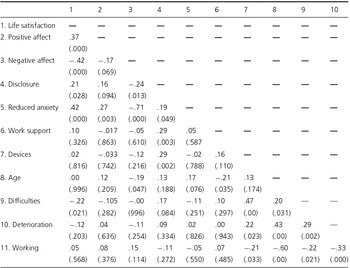
The correlation table (see Table 2) shows that negative affect and positive affect are correlated with life satisfaction. As these measures are used to measure the concept of subjective wellbeing, this is an expected outcome. The only relationship of concern in this context is the correlation between the scales that measure (reduced) anxiety and negative affect is higher than .6. The two aforementioned scales have been developed to measure these two unique concepts, and hence will be used in their original form. The drawbacks of analysing highly correlated concepts together are acknowledged and taken into account for the interpretation of the results. Given that a simple correlation test is not an appropriate means of assessing the relationship between a dichotomous and continuous variable, a chi-square test is performed to test whether there are concerns with modeling the use of devices together with the three dependent variables. The results were not significant.
Correlation Table

Note: p values in parentheses.
Direct Associations and Mediation Analyses Results
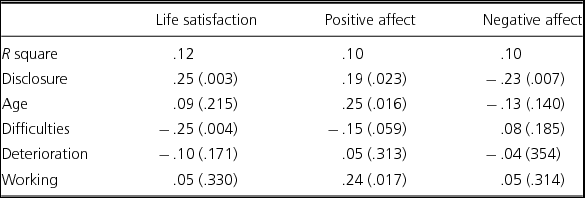
The first step in this analysis was to test whether disclosure is associated with the three wellbeing outcomes. As can be seen in Table 3, the results are in the expected direction: disclosure is positively associated with life satisfaction (β = .25, p = .003) and positive affect (β = .19, p = .023), and negatively associated with negative affect (β = −.23, p = .007).
Direct Association Between Disclosure and the Three Wellbeing Outcomes

Note: N = 108, one-tailed results in line with theoretical expectations. Standardised coefficients are presented with p values in parentheses.
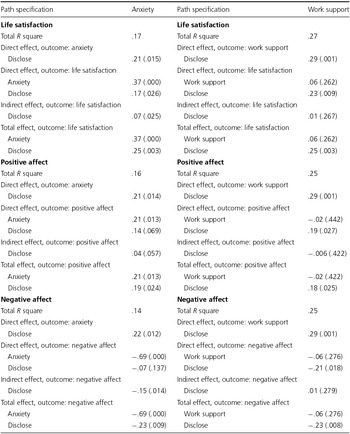
The next step was to test whether the three factors — that is, reduced anxiety, workplace social support, and the use of devices — mediated the association between disclosure and wellbeing. A significant indirect association between disclosure and life satisfaction (β = .07, p = .025), and between disclosure and negative affect (β = −.15, p = .014), through reduced anxiety are found (see Table 4). These results support the notion that reduced anxiety may act as a mediator of the relationship between disclosure and wellbeing. The pathway model of reduced anxiety and life satisfaction had an R square of .17, while the pathway model of reduced anxiety and negative affect had an R square of .14.
Mediation Effect of Reduced Anxiety and Work Support on the Three Wellbeing Outcomes

Note: N = 108, one-tailed results in line with theoretical expectations. Standardised coefficients are presented with p values in parentheses. For the purpose of convenience, control variables are excluded from the tables but the full tables are available on request.
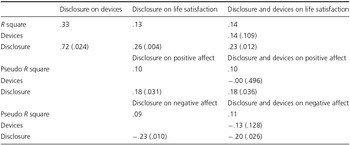
While disclosure was positively associated with both workplace support (see Table 4; β = .29, p = .001) and the use of devices (see Table 5; β = .72, p = .024), no support is found for an association between these two factors and the three subjective wellbeing outcomes, and, by implication, no support for a mediation pathway.
Mediation Effect of Use of Devices on the Three Wellbeing Outcomes

Note: N = 108, one-tailed results in line with theoretical expectations. Standardised coefficients are presented with p values in parentheses. For the purpose of convenience, control variables are excluded from the tables but the full tables are available on request. Pseudo R square is reported for the dichotomous outcome: devices.
Interview Data
Sample
The participants were approached through the same organisation used for the survey portion of the study. The individuals who fit the study criteria were sent a participation letter. The criteria for participation were that the individual was over the age of 40, had been experiencing a degenerative eye condition for at least 10 years, and had been employed at the onset or during the progression of the disease.
The number of participants (n = 36) was reached through information saturation (Hennink, Hutter, & Bailey, 2010).
Of the final group of participants, 28 had a form of retinitis pigmentosa and eight had Stargardt's disease. While all of the participants had held white-collar positions at some point in their life, three of the 36 had not completed college. When asked about their current employment status, 24 of the respondents indicated that they were participating in the labour market, one reported being between jobs, four said they were unemployed, and seven said they were retired. The youngest participant was age 42 at the time of the interview, and the oldest participant was age 82. The average age of the participants was 59. Further information about the participants is available from the authors on request.
The survey (survey content and consent form) and the interview study have received approval from the ethical committee of the sociology department of the University of Groningen. Consent was obtained from all of the participants, as they agreed to the consent statement on the first page of the online survey.
Data Collection
Because the aim of the study was to work inductively to gain insights into a relatively unexamined subgroup, a grounded theory approach was taken (Hennink et al., 2010; Strauss & Corbin, 1990). This approach enabled us to work inductively.
Life stories of participants were collected, with an emphasis on the role their vision loss played in their work trajectory. While the participants were encouraged to recount their story freely, a set of themes (e.g., work life choices, identity, and demographic characteristics) was used as a guideline. (The full list of themes used in the interviews is available from the authors on request.) If the participants were having difficulties reporting their life story, the themes were consulted to help them complete the task.
The majority of the interviews (24) were done face-to-face, and the rest were done by phone (12). On average, each interview lasted 50 minutes.
Data Analysis
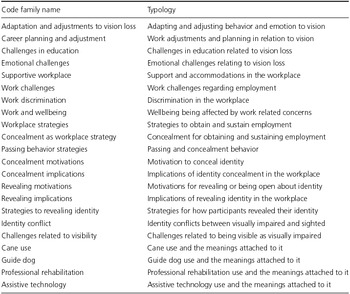
The interviews were transcribed fully and coded inductively by the first author and an additional coder in ATLAS.ti. The coding was done independently, and after each additional four interviews were coded, the two coders reported on the main emerging codes. A ‘joint family code’ (see Table 6) was then created and used in further analyses (Hennink et al., 2010).
Main Code Families Used in the Analysis (Alongside Demographic Information)

To answer the research questions, the ‘bigger picture approach’ was used (Hennink et al., 2010). In this method, first the primary family codes related to the investigated theme are identified. The experiences reported in these family codes are then linked to the individual narratives, in order to identify commonalities and variation among participants. The identified patterns within the family codes, alongside the variation therein, are then presented. In the current study the main family codes were related to the benefits of disclosure and the respondents’ work-related challenges and achievements. The three factors: the alleviation of inhibition, workplace support and the use of assistive devices, were then reconciled with the bigger picture (i.e., with the individual narratives).
Qualitative Data Results
Disclosure and Wellbeing
Except for one, all of the participants in this study had disclosed their identity in the workplace. However, not all of the participants did so at the same time: 15 said they disclosed their identity before or when they were hired, 15 said they disclosed their identity mid-career, and five said they disclosed their identity shortly before leaving the labour market. The majority of the participants reported that they had positive experiences with disclosure, and had a higher overall level of wellbeing thereafter. Eleven of the participants said they experienced both positive wellbeing outcomes related to disclosure (e.g., physical and mental relief) and adverse outcomes related to disclosure (e.g., discrimination in the workplace).
It is important to note that for many of the participants, both disclosure and the benefits of disclosure emerged through a gradual process. That is, not all of the participants disclosed their full condition to all of their coworkers at once, and thus did not experience immediate positive outcomes from disclosing their identity. These benefits seemed to emerge gradually over time for many participants. This gradual process can be explained to a great extent by the pathways suggested in the following section.
Pathways Linking Disclosure in the Workplace to Wellbeing
Alleviation of Inhibition
The experience of the alleviation of inhibition was a dominant theme among the participants who self-disclosed, or who were ‘forced’ to disclose their condition because it was worsening, and was thus becoming difficult to conceal. Sixteen of the participants who disclosed their condition after a period of concealment reported that they experienced an alleviation of inhibition following the disclosure, while another three of these participants reported that they experienced a partial alleviation of inhibition following the disclosure. The more control the participants had over how visible their condition was to others — that is, the more ‘invisible’ their identity was — the more likely they were to try to keep it a secret. The desire to conceal their condition generally stemmed from a fear of unfavorable reactions from employers and coworkers. The participants described their efforts to conceal their condition as having been emotionally and physically taxing:
I hid it my entire life, and it was incredibly stressful; at work [it was] incredibly stressful. Put more and more strain on my family my relationships and my social ties until I really couldn't hide it anymore.
Two of the participants reported that they used medication to deal with the anxiety related to being discovered:
I have an eye problem; I have to deal with my eye problem. But they did put me on some medication that would help with anxiety and depression. Not heavy dosages, but little dosages.
Interestingly, though, most of the participants who had disclosed their condition reported experiencing reduced anxiety and stress:
When you're able to just say ok so my vision is impaired and this is what I need from you or can you help me in this way, it's like all of that angst is just lifted from you. People generally I would say more than 90% of the time are amazingly agreeable and helpful and nice and interested.
Thus, it seems that concealment was accompanied by a certain degree of stress and anxiety. Generally, the more severe an individual's condition became, the more difficult it was for him or her to keep up appearances, and the more anxiety he or she felt in relation to the act of concealment. In the majority of cases, the disclosure of the identity was associated with relief from anxiety and enhanced wellbeing. However, three of the participants also experienced adverse responses in their work environment (e.g., discrimination, being undervalued). In those cases, while the stress related to concealment was lowered, their overall stress levels did not decline, and their wellbeing outcomes were thus less positive. This ongoing perception of stress was probably related to difficulties they were experiencing in maintaining and sustaining employment.
Social Support in the Work Context
All but one of the of the participants of this study had disclosed their identity in the workplace at a certain point in their work trajectory. However, not all of them reported that they received support from coworkers and employers. The individuals who revealed their condition and received support in the workplace from the coworkers with whom they had a close relationship seem to have experienced higher levels of wellbeing. The positive responses took the form of offers of emotional or practical support, as is illustrated in the following case:
He [partner in firm] wasn't surprised; he knew that there were some issues but he didn't know the extent of it. He actually tried to learn more about the disease and was helpful and helped me quite a bit, and we remain friends today.
However, in the cases in which the participant's coworkers and employers responded in a less than accommodating fashion, the wellbeing of the participant suffered. Even if some individuals in the workplace responded in a more supportive manner, if there were negative responses as well, the overall impact of disclosure on the participant's wellbeing was negative:
Some understood but some [did] not. Like the collections manager had a fit . . . Often people are just dumb about (it), they're ignorant; I should say they're ignorant.
It is important to note that for some of the participants the perception of support in the workplace was a motivator for revealing their condition. Individuals who worked in a supportive environment felt more comfortable disclosing their identity at work. For the majority of the participants, being open about their condition resulted in a higher level of wellbeing. However, whether the participants described the disclosure as a positive experience depended on the responses of the confidant(s) to the act of disclosure.
Using Assistive Devices
There are various devices that can assist people with low vision in their day-to-day functioning, both within and outside of the workplace. However, individuals who are trying to conceal their identity may avoid using certain types of devices, as doing so may expose their disability. But by avoiding assistive devices, individuals with low vision may find it difficult to maintain their performance at work. Trying to keep up with their peers without accommodations affected the wellbeing of some of the participants in a negative way:
‘So the company and the people around me would not know that mistakes were made because they were covered up (laughter). I covered it up. But I knew what was going on and I thought that it was quite dangerous for my clients and so that's you know. . . I didn't want to keep practicing law that way.’
Disclosing the condition allowed participants to seek help and accommodations in the workplace:
I contacted the people in the state office that was helping me for the visually impaired; they outfitted me an office with a computer program called zoom text to help me read a little bit larger . . . Basically they helped me out immensely.
The participants reported that they felt relief, and experienced greater wellbeing, as their efficiency improved after these accommodations were made:
Sometimes the more progressed or the less vision you have to play with the easier things get. Ok? . . . As long as you have that piece of macular (peripheral vision) you are always trying to use it and it's difficult. But once it's gone you are free of that battle to see in that way. For me I had to become a better computer user. A better user of technology. It was a major turning point for me.
Some participants indicated that they disclosed their impairment from the beginning of their employment, because without visible accommodations they would have had difficulties functioning:
Yes, it was always out (identity) because I couldn't function otherwise. I could socially function without people knowing, sometimes if I have the right contact but I cannot function at work without someone knowing. Cause almost any task that I need to do I need an accommodation.
Overall, the use of accommodations reduced the level of effort participants needed to exert to perform on par with their work peers. Using assistive devices improved the participants’ wellbeing and quality of life. Whether they had access to assistive technologies depended to a large extent on whether the participants had disclosed their condition in the workplace.
It is important to note that some individuals disclosed their identity because they were already using devices prior to entering the labour market or a particular work setting. However, for the majority of participants, vision decline was a process that occurred while they were already participating in the labour market, and those individuals were more likely to have taken the aforementioned pathway.
Discussion
Findings Summary
In this study a mixed methods design was used to study which factors play a role in the relationship between the disclosure of a degenerative eye condition in the workplace and wellbeing. Based on the literature on this topic, three pathways through which disclosure and wellbeing are linked were identified: the alleviation of inhibition, social support in the workplace, and the use of assistive devices. To test whether these factors mediate the association between disclosure in the workplace and wellbeing, survey data were used as a first step. Next, interview data were used to explore what role the aforementioned factors played in the narratives of the participants.
Both the survey and the interview data suggest that the alleviation of inhibition is a meaningful aspect of the relationship between disclosure in the workplace and wellbeing. Additionally, both the survey and the interview data show that disclosure in the workplace is related to workplace support and to the use of devices. However, weaker support is found for the assumption that workplace support and devices act as a pathway linking disclosure in the workplace and wellbeing. The analysis of the survey data indicates that there is no direct association between these two mediating factors and subjective wellbeing. Using the interview data, it has been demonstrated that these factors are important in the relationship between disclosure and wellbeing, but are less important than the alleviation of inhibition. In the following discussion, the contributions of the findings to the literature will be addressed from two different perspectives: theory and methodology.
Theory
In line with the Chaudoir and Fisher (Reference Chaudoir and Fisher2010) and Beals et al. (Reference Beals, Peplau and Gable2009), the alleviation of inhibition is found to act as an important factor in the relationship between disclosure in the workplace and wellbeing. Device use and workplace support emerged as pathways linking disclosure in the workplace and wellbeing in the interview data only. It is possible that the use of devices and workplace support act as pathways linking disclosure and alternative workplace outcomes, such as workplace productivity. For example, previous literature on disabilities has pointed out that the use of accommodations in the workplace by individuals with disabilities helps in ‘leveling out the playing field’ between disabled and able-bodied workers (Yeager et al., Reference Yeager, Kaye, Reed and Doe2006). Thus, it is possible that these two factors act as a resource for alternative work-related outcomes, rather than as direct contributors to wellbeing. Future research may investigate device use and workplace support as contributors to the realisation of alternative workplace outcomes.
Methodology
The mixed methods design used in this study has proven beneficial for tackling the research problem at hand. The quantitative portion of this study allowed us to systematically establish whether the three mediating factors were evident when looking at a larger pool of individuals. The qualitative in-depth interviews confirmed the importance of the pathways linking disclosure and wellbeing that had been identified in the previous literature; and the use of the SPF theoretical framework allowed us to establish variations within the pathways. For instance, the findings suggest that disentangling an exact causal relationship between disclosure the use of devices and workplace support and wellbeing is challenging. The survey data indicate that these factors are not likely candidates to act as pathways between disclosure and wellbeing. The additional qualitative analysis provide insights into the long-term processes participants go through, which shed more light on possible reasons for no pathways being identified in the survey data analysis. The qualitative data analysis shows that participant's reports are challenging to interpret in one direction. A pathway such as the use of assistive devices can act as a cause for the disclosure but may also induce wellbeing one disclosure has taken place.
The lack of statistical support for the pathway through workplace social support may also be related to the measurements used in this study. A general scale that does not differentiate between physical and psychological support related to vision loss, and that does not account for both positive and negative support from colleagues and supervisors, was implemented. Previous research on the relationship between social support and wellbeing indicates that both positive and negative social support can have an influence on the wellbeing of individuals with low vision (Reinhardt, Reference Reinhardt2001). This suggests that positive social support in the workplace might not directly contribute to wellbeing among individuals who are open about their condition, but rather that the absence of negative social pressure may play a role in preventing reduced wellbeing. Future studies may want to account for the number of confidants in the workplace, and the ratio between those who respond positively and those who respond negatively to the disclosure.
This study should be viewed as an initial exploratory investigation of this topic among this group. While the qualitative interviews provided an adequate overview of the careers individuals engaged in the survey data were more limited with this respect. Future quantitative studies would benefit from achieving more nuanced information about the career background of individuals such as duration of current employment and number of previous jobs.
Conclusions
The findings suggest that disclosure in the workplace relates positively to wellbeing. Legislation, such as the Americans with Disabilities Act, has been shown to have little positive influence on labour market participation rates of individuals with disabilities (e.g., DeLeire, Reference DeLeire2000). One potential explanation for this outcome is that legislation and policy often do not include measures to educate employers about the abilities of individuals with disabilities. For instance, the law might require an employer to provide appropriate support for employees with vision loss. But unless an employer believes that the employee is able to do the job, the employer might choose to do the bare minimum required by law. Policies aimed at increasing workplace diversity awareness, may be beneficial in tackling psychological inhibitions that may result from keeping up appearances in the workplace, and may prolong the careers of these individuals.
Acknowledgements
We would like to thank the participants in the study for their time and help. We declare there is no conflict of interest. The research received no specific grant from any specific agency, commercial, or non-for-profit sectors.