Introduction
Subordinate perceptions of relationship quality with their supervisor are an important factor in shaping the subordinate’s meaning, satisfaction, commitment, and performance at work (e.g., Gerstner & Day, Reference Gerstner and Day1997; Dutton & Ragins, Reference Dutton and Ragins2007). Relationship quality within supervisor–subordinate relationships is a crucial building block of the organizing process (Grant & Hofmann, Reference Grant and Hofmann2011) such that the supervisor–subordinate relationship is considered ‘the most central dyadic unit in the organization’ (Farmer & Aguinis, Reference Farmer and Aguinis2005, p. 1) and often becomes the ‘lens through which the entire work experience is viewed’ (Gerstner & Day, Reference Gerstner and Day1997, p. 840). In an effort to develop a more complete empirical understanding of supervisor–subordinate relationships in the wake of offensive supervisor behavior, we examine how subordinates forgive supervisors and foster high-quality supervisor–subordinate exchange relationships (e.g., leader–member exchange).
Imperfect interactions are ‘part and parcel of organizational life’ (Ren & Gray, Reference Ren and Gray2009, p. 105) and may evoke negative cognitions and emotions toward the relational other (Aquino, Grover, Goldman, & Folger, Reference Aquino, Grover, Goldman and Folger2003). These offenses, if not forgiven, can be harmful to the subordinate, the supervisor, the relationship, and the organization. According to burgeoning forgiveness research (see Fehr, Gelfand, & Nag, Reference Fehr, Gelfand and Nag2010; Palanski, Reference Palanski2012), antecedents of forgiveness include perspective taking, self-esteem (Fehr, Gelfand, & Nag, Reference Fehr, Gelfand and Nag2010), empathetic disposition (McCullough, Worthington, & Rachal, Reference McCullough, Worthington and Rachal1997; McCullough, Rachal, Sandage, Worthington, Brown, & Hight, Reference McCullough, Rachal, Sandage, Worthington, Brown and Hight1998), dispositional forgiveness (Brown, Reference Brown2004), perceived intent, and level of contrition (McCullough et al., Reference McCullough, Rachal, Sandage, Worthington, Brown and Hight1998). Forgiveness within organizations is important because it is typically associated with improved decision-making (Cannon-Bowers, Salas, & Converse, Reference Cameron1993), productivity, cooperation, optimism, and trust (see Bright, Fry, & Cooperrider, Reference Bright, Fry and Cooperrider2006; Strelan & Covic, Reference Stets and Burke2006). Likewise, forgiveness within organizations is different than in other domains (e.g., personal relationships) because workplace relationships are often shaped by status differences, power differentials, and task structures. These characteristics may require individuals to work with supervisors by assignment rather than by choice, thus creating potential incongruities in how relationships are enacted. As such, individuals within organizations may approach forgiveness at work differently than forgiveness within personal relationships.
Scholars have defined forgiveness in many ways. For some, forgiveness refers to the degree to which individuals within a relationship are able to remove negative thoughts and feelings toward a transgressor (Aquino et al., Reference Aquino, Grover, Goldman and Folger2003; McCullough, Fincham, & Tsang, Reference McCullough, Fincham and Tsang2003; Bright & Exline, Reference Bright and Exline2012). Others have suggested that, in addition to removing the negative, restoring positive thoughts and feelings may be required (Worthington & Wade, Reference Worthington and Wade1999; Yamhure-Thompson & Shahen, Reference Yamhure Thompson and Shahen2003). Intrapersonal forgiveness pertains to an individual’s affect and cognition, but does not address interpersonal behavior (Bright, Stansbury, Alzola, & Stavros, Reference Bright, Stansbury, Alzola and Stavros2011). Going beyond intrapersonal forgiveness, interpersonal forgiveness occurs when individuals explicitly communicate their forgiveness to the relational other (McCullough & Worthington, Reference McCullough and Worthington1994; Worthington, Reference Worthington2001; Aquino et al., Reference Aquino, Grover, Goldman and Folger2003; Worthington & Scherer, Reference Worthington and Scherer2004; Bright et al., Reference Bright, Stansbury, Alzola and Stavros2011). Bright and Exline (Reference Bright and Exline2012) explain that forgiveness is ‘a family of actions intended to break or prevent destructive cycles of human interaction.’ Moreover, the forgiver ‘ensures that the offender ceases to engage in harmful behavior, recognizes that the cessation has occurred, and forgoes retributive actions.’ This occurs whether forgiveness remains intrapersonal or becomes interpersonal. Forgiveness, therefore, stops the cycle of anger and hostility, but does not necessitate reconciliatory behaviors. In fact, many researchers suggest that reconciliation is a different construct altogether (Freedman, Reference Freedman1998; Exline, Worthington, Hill, & McCullough, Reference Exline, Worthington, Hill and McCullough2003; Bright & Exline, Reference Bright and Exline2012). In accordance with Bright and Exline (Reference Bright and Exline2012), most scholars seem to agree that the forgiveness process commences with the release of the anger, hostility, or antipathy evoked by the offense and, at a minimum, requires refraining from negative actions (McCullough & Worthington, Reference McCullough and Worthington1994; Aquino et al., Reference Aquino, Grover, Goldman and Folger2003; Worthington & Scherer, Reference Worthington and Scherer2004).
Enright (Reference Enright2001) describes forgiveness as a four-phase process. In the uncovering phase, the prospective forgiver assesses the extent of damage incurred as a result of the transgression and begins to get a sense as to the nature of the offense and its likely consequences. This is the phase where the prospective forgiver unpacks the layers of emotional pain inflicted on him or her. In the decision phase, the prospective forgiver, through his or her own choice, begins to decide whether they are going to forgive. Driving this decision, as noted by Enright (Reference Enright2001) is the extent to which the individual is ‘pushed by the pain’ and/or ‘pulled by the hope’ of the circumstances. In the work phase, the prospective forgiver engages in an effort to forgive. He or she strives to gain more cognitive clarity and closure regarding the transgression and may rethink the initial response to the offense. Finally, in the deepening stage, the prospective forgiver begins to experience decreased levels of negative emotion toward the transgressor and may gain a renewed sense of optimism. In the deepening stage, the potential forgiver may find meaning in working through their negativity and view the path forward as one of potential growth and enhanced understanding. In alignment with Enright (Reference Enright2001), several forgiveness scholars describe forgiveness as a multifaceted emotional and cognitive process (Bright & Exline, Reference Bright and Exline2012) instead of a one-time event while noting that forgiveness might even take decades for some individuals to achieve (see McCullough, Pargament, & Thoresen, Reference McCullough, Pargament and Thoresen2001). He further notes that process models need to consider individual differences and contextual variations if they are to capture the various pathways individuals might take to forgiveness (Enright, Reference Enright2001).
With this manuscript, we empirically examine two potential motives associated with the forgiveness process. In earlier work, Bright, Fry, and Cooperrider (Reference Bright, Fry and Cooperrider2006, Reference Bright, Fry and Cooperrider2008) made the initial advances toward a better understanding of forgiveness motive by qualitatively examining pragmatic forgiveness and transcendent forgiveness, respectively. These scholars classified responses to interpersonal transgressions based, in part, on whether or not empathy was present in the forgiveness, or, whether the forgiveness was comprised of self-interested motives. We endeavor to build on Bright, Fry, and Cooperrider (Reference Bright, Fry and Cooperrider2006, Reference Bright, Fry and Cooperrider2008) foundational qualitative work by quantitatively examining two distinct motives by which individuals forgive in organizational contexts. With an increasing number of exceptions (e.g., Aquino et al., Reference Aquino, Grover, Goldman and Folger2003; Cameron, Reference Cannon-Bowers, Salas and Converse2007; Palanski, Reference Palanski2012), most research on forgiveness has occurred in the context of personal relationships within the spiritual, psychological, or social psychological domains (e.g., McCullough, Worthington, & Rachal, Reference McCullough, Worthington and Rachal1997; Worthington, Reference Worthington1998; Worthington & Scherer, Reference Worthington and Scherer2004; Fehr, Gelfand, & Nag, Reference Fehr, Gelfand and Nag2010). We focus specifically on forgiveness within the context of supervisor–subordinate relationships.
We assert that as organizational scholars examine key organizationally relevant constructs, context is an important consideration (see Bamberger, Reference Bamberger2008; also see Galvin, Reference Galvin2014) and that quantitatively examining forgiveness motive within organizational contexts will provide a valuable contribution to the extant literature. With the exception of Bright, Fry, and Cooperrider’s (Reference Bright, Fry and Cooperrider2006, Reference Bright, Fry and Cooperrider2008) qualitative work on forgiveness motive, much of the forgiveness motive tends to classify forgiveness as being associated with compassion and concern for others. For example, forgiveness motive has been attributed to ‘a matter of willed change of heart – the successful result of an active endeavor to replace bad thoughts with good, bitterness and anger with compassion and affection’ (North, Reference North1987, p. 506; also see Enright, Reference Enright2001); an altruistic gift (Enright, Freedman, & Rique, Reference Enright, Freedman and Rique1998; Worthington, Reference Worthington1998); or an act of compassion or love (Enright & the Human Development Study Group, Reference Enright1991). Forgiveness can also be considered a human virtue (see Bright, Cameron, & Caza, Reference Bright, Cameron and Caza2006) wherein forgivers demonstrate genuine interest in others and concern for their well-being (Cameron, Reference Cameron2005). Some scholars describe forgiveness as often occurring in association with compassion while suggesting forgiveness can foster the return of positive thoughts and feelings (see Worthington, Reference Worthington1998; McCullough, Pargament, & Thoresen, Reference McCullough, Pargament and Thoresen2001; Bright, Cameron, & Caza, Reference Bright, Cameron and Caza2006; Cameron, Reference Cannon-Bowers, Salas and Converse2007). Framing forgiveness as being associated with compassion, may suggest that the forgiveness process is disrupted when an individual lacks a compassionate orientation (see McCullough & Hoyt, Reference McCullough and Hoyt2002); an attitude of affection (see Holmgren, Reference Holmgren1993; Tangney, Wagner, Hill-Barlow, Marschall, & Gramzow, Reference Tangney, Wagner, Hill-Barlow, Marschall and Gramzow1996); a changed motivation state from the negative to the positive (McCullough, Worthington, & Rachal, Reference McCullough, Worthington and Rachal1997); a display of beneficence and generosity; or a benevolent response (Enright, Gassin, & Wu, Reference Enright, Gassin and Wu1992).
Scholars have also examined whether individuals might be motivated to forgive for moral, relational, and religious motives. Conversely, they may simply perceive a lack of alternatives so they forgive in order to avoid retaliation and other forms of punishment (Cox, Bennett, Tripp, & Aquino, Reference Cox, Bennett, Tripp and Aquino2012). Although self-interest might be implicitly associated with some of these other forgiveness motives, to our knowledge, self-interest has not been explicitly assessed as part of a quantitative analysis. In fact, a preference for other-interested forgiveness is reflected in existing forgiveness motive scales. For example, the Transgression-Related Interpersonal Motivations scale (TRIM-18; McCullough et al., Reference McCullough, Rachal, Sandage, Worthington, Brown and Hight1998) assesses avoidance motivations, revenge motivations, and benevolence motivations (e.g., other-interest). It does not, however, measure self-interested motivations. Similarly, emotional forgiveness (see Worthington & Scherer, Reference Worthington and Scherer2004; Hook & Worthington, Reference Hook and Worthington2008) is often assessed by either the presence of compassion and concern (e.g., caring, feeling sympathy, loving) or the absence of hostility (e.g., no longer feeling upset, bitter, mad, or resentful), but not the presence of self-interest. We aim to take Bright, Fry, and Cooperrider’s (Reference Bright, Fry and Cooperrider2006, Reference Bright, Fry and Cooperrider2008) seminal research one step further by examining self-interested and other-interested forgiveness motives quantitatively. Our purpose is to quantitatively demonstrate that, in addition to being driven by other-interest (e.g., empathy and compassion), individuals can also be motivated to forgive by self-interest as they develop high-quality leader–member exchange relationships such that the forgiveness process is altered, not necessarily disrupted, in the presence of concern for self. We do not present one forgiveness motive as being superior to the other. Rather, we present two viable pathways to leader–member exchange – both of which hold potential value to prospective forgivers.
In addition to examining where these two forgiveness motives converge, we look at where they diverge. We endeavor to predict differential associations with two key relational variables: task-focused interpersonal citizenship behavior and person-focused interpersonal citizenship behavior. We demonstrate that self-oriented forgiveness motive has a stronger association with task-focused interpersonal citizenship behavior and other-oriented forgiveness motive has a stronger association with person-focused interpersonal citizenship behavior. This is important because it provides clarity regarding differences between self-oriented forgiveness motive and other-oriented forgiveness motive. Although these two forgiveness motives are distinct, we do not suggest that one forgiveness motive is superior to the other. In fact, it appears that both forgiveness motives add value in terms of fostering positive relational outcomes. Both provide a path forward and both contribute to an increased understanding of the forgiveness process.
Finally, we suggest that proactive personality and empathic concern are two dispositional factors that influence the relationship between forgiveness motive and leader–member exchange. We demonstrate that proactive personality facilitates high-quality relationships for self-oriented forgivers. This is important because organizations and individuals increasingly utilize proactive behaviors as a coping strategy in organizational contexts (cf. Crant, Reference Crant2000; Frese & Fay, Reference Frese and Fay2001; Grant & Ashford, Reference Grant and Ashford2008). We also suggest that empathic concern serves as an enabler of high-quality relationships for other-oriented forgivers. Examining proactive personality and empathic concern in tandem is a useful endeavor because we see that one’s disposition interacts with the relational context in a way that augments positive relational outcomes. In short, proactive personality makes it more likely for self-oriented forgivers to experience leader–member exchange and empathic concern makes it more likely for other-oriented forgivers to experience leader–member exchange. Perhaps more importantly, we suggest that only proactive personality moderates the relationship between self-oriented forgiveness motive and leader–member exchange and only empathic concern moderates the relationship between other-oriented forgiveness motive and leader–member exchange.
Leader–Member Exchange
Leader–member exchange has its foundation in social exchange theory (Blau, Reference Blau1964; Graen & Scandura, Reference Graen and Scandura1987). This theory pertains to ‘voluntary actions of individuals that are motivated by the returns they are expected to bring’ to the focal individual (Blau, Reference Blau1964, p. 91). With social exchange theory, individuals exchange resources because of the potential to gain valuable benefits and avoid the negative ramifications in failing to reciprocate (Thibaut & Kelley, Reference Thibaut and Kelley1959). Leader–member exchange refers to exchanges that occur directly between the supervisor and subordinate (Graen & Uhl-Bien, Reference Graen and Uhl-Bien1995). These exchanges are more likely to occur when both individuals place high value on the benefits provided by the relational other, and believe that the benefits exchanged are most readily obtained within this relationship (Graen, Novak, & Sommerkamp, Reference Graen, Novak and Sommerkamp1982). With leader–member exchange, individuals can approach reciprocation such that ‘parties in the relationship seek to minimize the difference between the benefits they provide and the benefits they receive from others’ (see cf. Clark & Mills, Reference Clark and Mills1979; Ballinger & Rockmann, Reference Ballinger and Rockmann2010, p. 373). Individuals expect to benefit from the contributions they provide others (Uhl-Bien & Maslyn, Reference Uhl-Bien and Maslyn2003), often through the receipt of information, rewards, status, compliance, compliments, or encouragement (Cropanzano & Mitchell, Reference Cropanzano and Mitchell2005).
Although there is an abundance of literature addressing the supervisor and his or her role in the leader–member exchange (Bauer & Green, Reference Bauer and Green1996; Sparrowe & Liden, Reference Sparrowe and Liden1997), there has been a dearth of work on how subordinate responses to supervisor transgressions influence relationship quality, especially from the subordinate’s perspective. As subordinate’s are increasingly claiming more empowerment and autonomy with work relationships (see Wrzesniewski & Dutton, Reference Wrzesniewski and Dutton2001), an understanding the supervisor–subordinate relationship through the eyes of the subordinate following a supervisor transgression is paramount, especially since failed relational expectations will likely diminish the amount of effort, resources, and support the subordinate provides the supervisor (see Nahrgang, Morgeson, & Ilies, Reference Nahrgang, Morgeson and Ilies2009, p. 257). As leader–member exchange develops (Graen & Scandura, Reference Graen and Scandura1987), the subordinate will often adhere to ‘if … then’ contingency behaviors providing valuable resources and support if the supervisor provides valuable benefits in return (Baldwin, Reference Baldwin1997; Baldwin & Baccus, Reference Baldwin and Baccus2003), resulting in idiosyncratic exchange relationships among supervisor–subordinate relationships. those who are perceived as meeting the other’s ‘needs, abilities, and wishes’ (Schein, Reference Schmitt and Klimoski1968) are often considered a member of the focal individual’s in-group (e.g., Graen & Schiemann, Reference Graen and Schiemann1978). This in-group distinction helps explain the positive relationship between leader–member exchange and commitment, trust, pro-social behavior, job satisfaction, and performance (Gerstner & Day, Reference Gerstner and Day1997; Ilies, Nahrgang, & Morgeson, Reference Ilies, Nahrgang and Morgeson2007; Dulebohn, Bommer, Liden, Brouer, & Ferris, Reference Dulebohn, Bommer, Liden, Brouer and Ferris2012).
Self-Oriented Forgiveness Motive
We define self-oriented forgiveness motive as the removal of negative thoughts and feelings on the basis of self-interest and rational calculation. Self-oriented forgiveness motive might be the impetus for forgiveness when prospective forgivers do not want their well-being and productivity disrupted by lingering feelings of anger and hostility (see Bright, Fry, & Cooperrider, Reference Bright, Fry and Cooperrider2006, Reference Bright, Fry and Cooperrider2008). As individuals endeavor to promote their self-interest, they are driven by a transactional and calculating mindset aimed at tabling the conflict and dispelling their animosity in order to benefit themselves (see Blau, Reference Blau1964; Bazerman, Reference Bazerman1993). For subordinates, self-oriented forgiveness motive might help preserve a potential promotion, positive evaluation, or even continued employment. Self-oriented forgiveness motive is distinct from impression management because self-oriented forgiveness motive is a drive toward legitimate forgiveness wherein anger and hostility are removed and strained relationships are mended (see Bright, Fry, & Cooperrider, Reference Bright, Fry and Cooperrider2006). This can be especially valuable for those who may not feel compassion for the relational other or are experiencing compassion fatigue, but who wish to obtain some of the benefits of forgiveness (Maltby, Day, & Barber, Reference Maltby, Day and Barber2004; Strelan & Covic, Reference Stets and Burke2006). Self-oriented forgiveness motive can help both the subordinate and supervisor move on from the offense while restoring civility, and preventing fractured relationships from atrophying (see Bright, Fry, & Cooperrider, Reference Bright, Fry and Cooperrider2006, Reference Bright, Fry and Cooperrider2008).
We suggest that self-oriented forgivers will generate high-quality exchange relationships and develop high returns within this relationship as a result of their efforts to work through negative thoughts and feelings (see Thibaut & Kelley, Reference Thibaut and Kelley1959). Similarly, as individuals engage in forgiveness motivated by self-orientation, they engage in forbearance (see Cropanzano & Mitchell, Reference Cropanzano and Mitchell2005). Forgiveness is often a much desired resource in the eyes of transgressors (see Exline et al., Reference Exline, Worthington, Hill and McCullough2003; Wade and Worthington, Reference Wade and Worthington2005). Consequently, we suggest that self-oriented forgiveness motive will foster high-quality relationships and generate valuable resources within that relationship, even if compassion is not one of those resources (see Graen & Uhl-Bien, Reference Graen and Uhl-Bien1995). Self-oriented forgiveness motive also activates the norm of reciprocity predicated on the ‘if … then’ scenario such that the provision of forgiveness generates a benefit to be received from the transgressor and can signal that positive exchanges will continue within this relationship in spite of a temporary set-back (see Blau, Reference Blau1964). Thus, we propose the following:
Hypothesis 1: Self-oriented forgiveness motive is positively related to leader–member exchange.
Other-Oriented Forgiveness Motive
We define other-oriented forgiveness motive as the removal of negative thoughts and feelings on the basis of concern for others and benevolence wherein the individual feels empathy and compassion for the transgressor (see Enright, Gassin, & Wu, Reference Enright, Gassin and Wu1992; Worthington, Reference Worthington1998; Exline et al., Reference Exline, Worthington, Hill and McCullough2003; Bright, Fry, & Cooperrider, Reference Bright, Fry and Cooperrider2006, Reference Bright, Fry and Cooperrider2008). Other-oriented forgiveness motive likely leads to an increased willingness to be accommodating (McCullough, Worthington, & Rachal, Reference McCullough, Worthington and Rachal1997; Rusbult, Hannon, Stocker, & Finkel, Reference Rusbult, Hannon, Stocker and Finkel2005), pro-social, and consider the perspective of others (see Berkowitz, Reference Berkowitz1972; Korsgaard & Meglino, Reference Korsgaard and Meglino2008). Other-oriented forgiveness motive can be characterized as a purely altruistic gift where forgivers eschew self-serving calculations (Enright, Freedman, & Rique, Reference Enright, Freedman and Rique1998; Worthington, Reference Worthington1998). Other-oriented forgivers reframe negative situations where anger gives way to empathy and compassion (Freedman, Enright, & Knutson, Reference Freedman, Enright and Knutson2005; Bright, Fry, & Cooperrider, Reference Bright, Fry and Cooperrider2006, Reference Bright, Fry and Cooperrider2008). Individuals who have an other-oriented forgiveness motive elevate the level of discourse from civility to compassionate healing (Enright & The Human Development Study Group, Reference Enright1991; McCullough, Worthington, & Rachal, Reference McCullough, Worthington and Rachal1997) wherein they mend fractured relationships through compassion (see Bright, Fry, & Cooperrider, Reference Bright, Fry and Cooperrider2006, Reference Bright, Fry and Cooperrider2008) and endeavor to do more than just move on – they seek a transformative outcome where empathy expels their anger (Exline et al., Reference Exline, Worthington, Hill and McCullough2003; Wade & Worthington, Reference Wade and Worthington2005).
Accordingly, we posit that other-oriented forgivers will forge high-quality exchange relationships in which they receive and obtain valuable resources as a result of their efforts to express kindness amid offensive behavior. We further suggest that such efforts are driven by genuine concern for the relational other (Bright, Fry, & Cooperrider, Reference Bright, Fry and Cooperrider2006, Reference Bright, Fry and Cooperrider2008). The relational other will likely view compassion as a much desired resource that elevates their perceptions of high relationship quality, further reinforcing positive reciprocity (see Blau, Reference Blau1964; Graen & Uhl-Bien, Reference Graen and Uhl-Bien1995; Baldwin & Baccus, Reference Baldwin and Baccus2003). Other-oriented forgiveness motive is the means by which the focal individual removes negative thoughts and feelings and can signal that positive exchanges will continue within this relationship. Having removed such feelings and offered empathy, the subordinate is better positioned to experience positive exchanges within the supervisor–subordinate relationship. Thus, we propose the following:
Hypothesis 2: Other-oriented forgiveness motive is positively related to leader–member exchange.
Interpersonal Citizenship Behavior
Interpersonal citizenship behavior refers to an individual’s completion of tasks that are not formally assigned and that benefit a relational other (see Organ, Reference Organ1988; Settoon & Mossholder, Reference Schein2002). Interpersonal citizenship behaviors can be task-focused (helping with work-related assignments and self-efficacy) or person-focused (helping with personal struggles and well-being of others) (see Bolino, Reference Bolino1999; Settoon & Mossholder, Reference Schein2002). We posit that self-oriented forgiveness motive will have a stronger association with task-focused interpersonal citizenship behavior than other-oriented forgiveness motive will have with task-focused interpersonal citizenship behavior. This is due to self-oriented forgiveness motive being more transactional, dispassionate, and formal, and the forgiver focused on neutralizing the negative effects of the transgression. Conversely, we suggest that other-oriented forgiveness motive will have a stronger association with person-focused interpersonal citizenship than self-oriented forgiveness motive will have with person-focused interpersonal citizenship behavior. This is due to other-oriented forgiveness motive reflecting compassionate and empathetic concern for the relational other. This occurs even in informal, nontask-related settings, with the forgiver focusing on nurturing empathy-infused relationships and utilizing forgiveness as a means to foster rich interpersonal interactions. Thus, we hypothesize the following:
Hypothesis 3: The relationship between self-oriented forgiveness motive and task-focused interpersonal citizenship behavior is stronger than the relationship between other-oriented forgiveness motive and task-focused interpersonal citizenship behavior.
Hypothesis 4: The relationship between other-oriented forgiveness motive and person-focused interpersonal citizenship behavior is stronger than the relationship between self-oriented forgiveness motive and person-focused interpersonal citizenship behavior.
Proactive Personality
Proactive personality is when individuals are predisposed to control their environment (Bateman & Crant, Reference Bateman. and Crant1993). Bandura (Reference Bandura1986, p. 22) suggests that those with a proactive personality tend to ‘create environments and set them in motion as well as rebut them’ (Frese & Fay, Reference Frese and Fay2001). Frese and Zapf (Reference Frese and Zapf1994) note that those with a proactive personality tend to be inherently active in forging autonomy and responding to strong inclinations to act rather than being acted upon. Such individuals refuse to remain ‘passive recipients of environmental presses’ (Buss, Reference Buss1987, p. 1220) and seek opportunities to shape the social relationships and tasks associated with a job (Wrzesniewski & Dutton, Reference Wrzesniewski and Dutton2001) while anticipating relational demands (cf. Grant & Hofmann, Reference Grant and Hofmann2011). Subordinates with a proactive personality tend to be change-oriented and future-focused (Bateman & Crant, Reference Bateman. and Crant1993; Parker, Bindl, & Strauss, Reference Parker, Bindl and Strauss2010). These individuals often scan the environment until they find ways to enact the change they seek. This practice tends to be calculative and can help them perceive opportunities to increase their self-interest and to carve out their own desired path (cf. Leavitt, Reference Leavitt1988). We posit that proactive personality will strengthen the relationship between self-oriented forgiveness motive and leader–member exchange. Those with a proactive personality will be intrinsically capable of enacting calculating maneuvers aimed at resetting the relational context in the wake of a transgression, seizing opportunities to perpetuate change within relationships, and augment their self-interest in the wake of an offense (see Parker, Bindl, & Strauss, Reference Parker, Bindl and Strauss2010). As a result, proactive individuals will not only be better positioned to successfully enact change, but also be more aware of ways to prevent future violations of relational norms in the future.
Thus, proactive individuals will use reciprocity as a tool to not only remove their negative thoughts and feelings but also scan the environment, interpret relational cues, and decrease the likelihood of future adverse behaviors within the relationship (see Fuller & Marler, Reference Fuller and Marler2009). We posit that proactive personality strengthens the relationship between self-oriented forgiveness motive and leader–member exchange. Proactive personality connotes the ability to engage in adaptive and reciprocal behaviors to preserve self-interest and makes it more likely that self-interested forgivers will forge high levels of leader–member exchange (see Grant & Ashford, Reference Grant and Ashford2008; Parker, Bindl, & Strauss, Reference Parker, Bindl and Strauss2010). Thus, we propose the following:
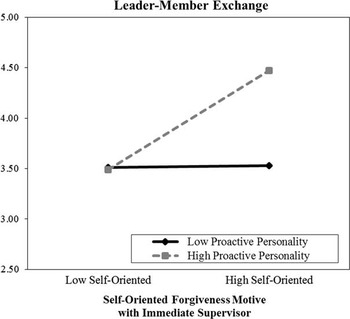
Hypothesis 5: The positive relationship between self-oriented forgiveness motive and leader–member exchange is moderated by proactive personality such that the positive relationship is stronger when proactive personality is high.
Empathic Concern
Empathic concern refers to an individual’s ‘tendency to experience feelings of sympathy and compassion for others in need’ (Davis, Reference Davis1994, p. 57). Thus, empathic concern is a disposition wherein individuals are inclined to experience compassion and concern for others across contexts and relationships (Batson, Reference Batson1987). This occurs even if at the expense of one’s self-interest (cf. Korsgaard & Meglino, Reference Korsgaard and Meglino2008). Empathic concern can increase joy, psychological well-being, affective commitment, and longevity (Batson, Reference Batson1987). Those with empathic concern approach conflict by seeking collaboration rather than retaliation (see Parker, Reference Parker1993; Hagedoorn, van Yperen, van de Vliert, & Buunk, Reference Hagedoorn, Van Yperen, Van de Vliert and Buunk1999). This creates favorable circumstances under which other-oriented forgiveness motive will lead to leader–member exchange (cf. Blau, Reference Blau1964; Grant, Reference Grant2007). Individuals with empathic concern strive for rich interpersonal relationships where caring is paramount (see Grant, Reference Grant2007). Under conditions of high empathic concern and high other-oriented forgiveness motive, the relational context and disposition are compatible. Those with an empathic concern often desire to make a difference in the workplace and have a positive impact on the lives of those with whom they associate (McNeely & Meglino, Reference McNeely and Meglino1994; Thompson & Bunderson, Reference Thompson and Bunderson2003). Those who are predisposed to seek opportunities to be caring and compassionate will find such opportunities in the context of other-oriented forgiveness motive (Bright, Fry, & Cooperrider, Reference Bright, Fry and Cooperrider2006).
We posit that empathic concern will fortify the relationship between other-oriented forgiveness motive and leader–member exchange. In the context of a transgression, empathic individuals will have the opportunity to extend kindness to those who may have a special need of such kindness. Empathic concern (see Davis, Reference Davis1994; Korsgaard & Meglino, Reference Korsgaard and Meglino2008) will heighten the other-interested forgiver’s capacity to forgive and forge a reciprocal connection with the individual they are forgiving. We propose that empathic concern strengthens the relationship between other-oriented forgiveness motive and leader–member exchange. In the context of other-oriented forgiveness motive, empathic individuals will help develop high-quality relationships as they provide understanding and genuine concern. Empathic individuals tend to be less calculating, more other-interested, pro-socially motivated, and better positioned to foster positive relationships using a contextual forgiveness motive that does the same (see Grant & Dutton, Reference Grant and Dutton2012; Rynes, Bartunek, Dutton, & Margolis, Reference Rynes, Bartunek, Dutton. and Margolis2012). Dispositional qualities can help foster meaningful and effective supervisor–subordinate relationships, especially in the context of a transgression (Korsgaard & Meglino, Reference Korsgaard and Meglino2008; Fehr, Gelfand, & Nag, Reference Fehr, Gelfand and Nag2010). Thus, we propose the following:
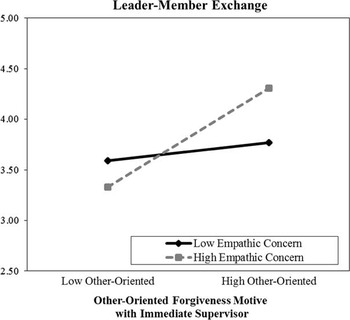
Hypothesis 6: The positive relationship between other-oriented forgiveness motive and leader–member exchange is moderated by empathic concern such that the positive relationship is stronger when empathic concern is high.
Overview of Studies
We conducted two studies to test our hypotheses. For study 1, we conducted a temporally lagged (4 weeks) assessment of undergraduate working professionals in examining the direct effects of forgiveness motive on leader–member exchange (Hypotheses 1 and 2). We also proposed that the two forgiveness motives related differentially to task-focused interpersonal citizenship behavior and person-focused interpersonal citizenship behavior, hypothesizing a stronger relationship between self-oriented forgiveness motive and task-focused interpersonal citizenship behavior (Hypothesis 3) and between other-oriented forgiveness motive and person-focused interpersonal citizenship behavior (Hypothesis 4).
For study 2, we conducted a cross-sectional assessment of graduate working professionals in confirming the direct effects of forgiveness motive on leader–member exchange (Hypotheses 1 and 2). We also proposed that two moderators (proactive personality and empathic concern) influenced the strength of these relationships. We further hypothesize interaction effects between self-oriented forgiveness motive and proactive personality on leader–member exchange (Hypothesis 5) and between other-oriented forgiveness motive and empathic concern on leader–member exchange (Hypothesis 6).
Study 1 Method and Results
Sample
We administered an online survey to 302 part-time working professionals enrolled in an undergraduate business program at a large US university in the Southeast United States. Of those, 29 individuals did not respond to the second survey. All participants had been offended by their supervisor and had a basis to forgive. Our final sample was comprised of 273 participants. Participation was voluntary and in exchange for extra credit. Participants were assured that their responses were anonymous. The sample participants (n=273) were 55% male and 73% Caucasian with an average age of 21 years (SD=1.84). The average work experience was 30 months (SD=21); organizational tenure was 12 months (SD=12); and relationship tenure was 11 months (SD=13).
Measures
Scale development
We adhered to Hinkin’s (Reference Hinkin1998) guidance for scale development in developing two new scales for this study. Inspired by Bright, Fry, and Cooperrider (Reference Bright, Fry and Cooperrider2006, Reference Bright, Fry and Cooperrider2008) work on pragmatic forgiveness and transcendent forgiveness, we examined their verbiage to develop items that reflected one’s motive for forgiving, whether self-oriented or other-oriented. With this foundation, we first ensured that ‘the sample of items drawn from potential items adequately represents the construct under examination’ (Ghiselli, Campbell, & Zedeck, Reference Ghiselli, Campbell and Zedeck1981; Hinkin, Reference Hinkin1998, p. 105). Second, we sought feedback from multiple sources to assess the face validity of the items. Finally, we pretested and received feedback on all items while being parsimonious in selecting the appropriate number of items employed (Hinkin, Reference Hinkin1998). Undergraduate students (~20 students) were asked to identify items that were difficult to comprehend or that were not reflective of the definition of the constructs. Management scholars served as subject matter experts and were asked to provide feedback on the clarity of the items as well as assess the compatibility between the items and the definition in an effort to ensure that our theoretical descriptions precisely matched our operationalization of the constructs (cf. Anderson & Gerbing, Reference Anderson and Gerbing1991). We followed the general steps outlined by Hinkin (Reference Hinkin1998) concerning questionnaire administration, item reduction, and factor analysis. We then assessed the reliability and validity of the new measures using an independent sample (i.e., Hinkin, Reference Hinkin1998) of 421 undergraduate students at a university in the Southeast. Exploratory factor analysis (Bagozzi & Edwards, Reference Bagozzi and Edwards1998) revealed that, as proposed, self-oriented forgiveness motive and other-oriented forgiveness motive comprise two separate factors, with the self-oriented forgiveness motive items loading together and the other-oriented forgiveness motive items loading together. For the exploratory factor analysis, all factor loadings were above 0.70 and loaded to the appropriate factor while the α reliabilities were 0.86 and 0.92, respectively. Consequently, the pilot study confirmed the validity and reliability of the two measures so we commenced data collection for the two main studies. We report the confirmatory factor analysis factor loadings and α reliabilities for the new scales we developed for study 1: self-oriented forgiveness motive and other-oriented forgiveness motive (in parentheses following each item below).
Self-oriented forgiveness motive
We measured self-oriented forgiveness motive by developing our own scale. The response scale ranged from 1=‘strongly disagree,’ to 5=‘strongly agree.’ Individuals were asked to indicate the extent to which they agreed/disagreed with the following statements. On the occasions when I choose forgive (which was defined for the participants as the removal of their negative thoughts and feelings following a transgression) this person, my decision to forgive him/her is mostly because ‘Holding onto anger would have a negative effect on me’ (0.71); ‘It would be more costly for me to not forgive’ (0.69); ‘I want to receive future benefits from this person’ (0.61); ‘It is in my self-interest to forgive’ (0.79); ‘I do not want my own productivity to suffer’ (0.76). We obtained an α reliability of 0.84.
Other-oriented forgiveness motive
We measured other-oriented forgiveness motive by developing our own scale. The response scale ranged from 1=‘strongly disagree,’ to 5=‘strongly agree.’ Individuals were asked to indicate the extent to which they agreed/disagreed with the following statements. On the occasions when I choose forgive this person, my decision to forgive him/her is mostly because: ‘I am concerned for his/her well-being’ (0.77); ‘I feel empathy for him/her’ (0.74); ‘It is the kind thing to do’ (0.70); ‘I want to help him/her feel better’ (0.72); ‘I want to show compassion for him/her’ (0.80). We obtained an α reliability of 0.86.
Leader–member exchange
We measured leader–member exchange by adapting Graen, Novak, and Sommerkamp (Reference Graen, Novak and Sommerkamp1982) 7-item scale to reflect the immediate supervisor. The items are as follows: ‘How often do you know where you stand with your immediate supervisor? (rarely to very often);’ ‘How well does your immediate supervisor understand your job problems and needs? (not at all to fully);’ How well does your immediate supervisor recognize your potential? (not at all to fully);’ ‘Regardless of how much formal authority he/she has built into his/her position, what are the chances that your immediate supervisor would use his/her power to help you solve problems in your work? (none to very high);’ ‘Regardless of the amount of formal authority your immediate supervisor has, what are the chances that he/she would “bail you out,” at his/her expense? (none to very high);’ ‘I have enough confidence in my immediate supervisor that I would defend and justify his/her decisions if he/she were not present to do so? (strongly disagree to strongly agree);’ and ‘How would you characterize your working relationship with your immediate supervisor? (extremely ineffective to extremely effective).’ We obtained an α reliability of 0.88.
Task-focused interpersonal citizenship behavior
We measured task-focused interpersonal citizenship behavior using Settoon and Mossholder’s (Reference Schein2002) 8-item scale. Illustrative items are as follows: ‘I take on extra responsibilities in order to help this supervisor when things get demanding at work;’ ‘I help this supervisor with difficult assignments, even when assistance is not directly requested;’ and ‘I go out of my way to help this supervisor with work-related problems.’ The response scale ranged from 1=‘strongly disagree,’ to 5=‘strongly agree’. We obtained an α reliability of 0.88.
Person-focused interpersonal citizenship behavior
We measured person-focused interpersonal citizenship behavior using Settoon and Mossholder’s (Reference Schein2002) 7-item scale. Illustrative items are as follows: ‘I listen to this supervisor when he/she has to get something off his/her chest;’ ‘I make an extra effort to understand the problems faced by this supervisor;’ and ‘I try to cheer up this supervisor when he/she is having a bad day.’ The response scale ranged from 1=‘strongly disagree,’ to 5=‘strongly agree’. We obtained an α reliability of 0.87.
Controls
We assessed age, racio-ethnicity, gender, relationship tenure, organizational tenure, work experience, relational self-construal, positive affectivity, transgression severity, and time since the most recent transgression as potential control variables. In accordance with Becker (Reference Becker2005), our final analyses only included control variables that were significant when included in the model. Inclusion of nonsignificant control variables (e.g., impotent control variables) in the model can unnecessarily reduce power and otherwise confound the results (Becker, Reference Becker2005); whereas, appropriate use of control variables can help rule out alternative explanations (Schmitt & Klimoski, Reference Settoon and Mossholder1991). The significant controls were positive affectivity and transgression severity.
Confirmatory factor analysis
To ensure that the measures in this sample represented unidimensional constructs, we conducted a confirmatory factor analysis (Hu & Bentler, Reference Hu and Bentler1999; Jackson, Gillaspy, & Purc-Stephenson, Reference Jackson, Gillaspy and Purc-Stephenson2009). We compared the hypothesized 5-factor model (i.e., self-oriented forgiveness motive, other-oriented forgiveness motive, task-focused interpersonal citizenship behavior, person-focused interpersonal citizenship behavior, and leader–member exchange) to (1) a 3-factor combined model (i.e., wherein self-oriented forgiveness motive and task-focused interpersonal citizenship behavior combine into one factor and other-oriented forgiveness motive and person-focused interpersonal citizenship behavior combine into one factor); and (2) a 1-factor omnibus model. The 5-factor model demonstrated a good overall model fit and was a significantly better fitting model than the other models (χ2=717.24 [df=454]; comparative fit index (CFI)=0.93; root mean square error of approximation (RMSEA)=0.05, and standardized root mean square residual (SRMR)=0.05). We concluded that the measures represented unidimensional constructs. Table 1 presents descriptive statistics, reliabilities, and correlations.
Study 1 descriptive statistics, reliability coefficients, and correlations

Note. n=273. Reliability coefficients (α) are on the diagonal.
*, **Significant at p≤.05, p≤.01, respectively.
Analytical method and results
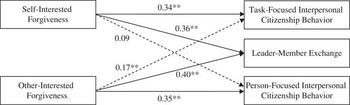
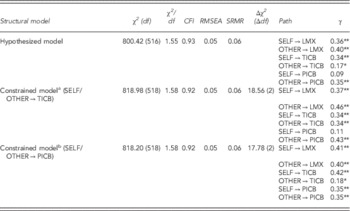
We analyzed the data using structural equation modeling (maximum likelihood estimation). Structural equation modeling takes into account measurement error and is thus a strong method by which to measure latent constructs, especially in models that do not test moderation (Kline, Reference Kline2005). We first specified the measurement model and then the structural model. The model fit indices for the hypothesized model indicated good overall fit (χ2=800.42 [df=516]; CFI=0.93; RMSEA=0.05, [Hypothesis 0: RMSEA<0.05, p=.91]; SRMR=0.06). For Hypotheses 1 and 2, the outcomes were as follows: self-oriented forgiveness motive was positively related to leader–member exchange (0.36; p<.01) and other-oriented forgiveness motive was positively related to leader–member exchange (0.40; p<.01). Thus, we found support for Hypotheses 1 and 2. For Hypothesis 3, we proposed that the relationship between self-oriented forgiveness motive and task-focused interpersonal citizenship behavior was positive and stronger than the relationship between other-oriented forgiveness motive and task-focused interpersonal citizenship behavior. The relationship was positive (Hypothesis 3; β=0.34; p<.01) and constraining the paths from self-oriented forgiveness motive and other-oriented forgiveness motive to task-focused interpersonal citizenship behavior to be equal (χ2=818.98 [df=518]) yielded a worse fitting model than the hypothesized model (χ2=800.42 [df=516]) according to the χ2 difference test Δχ2 (Δdf)=18.56 (2) (Kline, Reference Kline2005). For Hypothesis 4, we proposed that the relationship between other-oriented forgiveness motive and person-focused interpersonal citizenship behavior was positive and stronger than the relationship between self-oriented forgiveness motive and person-focused interpersonal citizenship behavior. The relationship was positive (Hypothesis 4; β=0.35; p<.01) and constraining the paths from self-oriented forgiveness motive and other-oriented forgiveness motive to person-focused interpersonal citizenship behavior to be equal (χ2=818.20 [df=518]) yielded a worse fitting model than the hypothesized model (χ2=800.42 [df=516]), according to the χ2 difference test Δχ2 (Δdf)=17.78 (2) (Kline, Reference Kline2005). Thus, we also found support for Hypotheses 3 and 4 (see Table 2 and Figure 1).
Study 1 hypothesized model

Study 1 hypothesized model and constrained models

Note. n=273. Control variables: positive affectivity→self-oriented forgiveness motive (0.21, p<.01), other-oriented forgiveness motive (0.15, p<.05), person-focused interpersonal citizenship behavior (0.18, p<.01); transgression severity→leader–member exchange (−0.14, p<.05)
a The path from self-oriented forgiveness motive and other-oriented forgiveness motive to task-focused interpersonal citizenship behavior was constrained to be equal.
b The path from self-oriented forgiveness motive and other-oriented forgiveness motive to person-focused interpersonal citizenship behavior was constrained to be equal.
SELF=self-oriented forgiveness motive; OTHER=other-oriented forgiveness motive; TICB=task-focused interpersonal citizenship behavior; PICB=person-focused interpersonal citizenship behavior; LMX=leader–member exchange.
*, **Significant at p≤.05, p≤.01, respectively.
Study 2 Method and Results
Sample
We administered an online survey to 190 full-time working professionals enrolled in an executive education business program at a large US university in the Southeast United States. Of those, 18 individuals did not respond. Of those, four individuals had not been offended by their supervisor and had no basis for forgiveness. Thus, our final sample was comprised of 168 participants. Participation was voluntary and in exchange for extra credit. Participants were assured that their responses were anonymous. The sample participants (n=168) were 57% male and 68% Caucasian with an average age of 31 years (SD=7.1). The average work experience was 86 months (SD=69); organizational tenure was 34 months (SD=33); and relationship tenure was 21 months (SD=18).
Measures
Self-oriented forgiveness motive
We measured self-oriented forgiveness motive by using the same items developed for study 1. We report the confirmatory factor analysis factor loadings (in parentheses following each item below): ‘Holding onto anger would have a negative effect on me’ (0.87); ‘It would be more costly for me to not forgive’ (0.76); ‘I want to receive future benefits from this person’ (0.78); ‘It is in my self-interest to forgive’ (0.72); ‘I do not want my own productivity to suffer’ (0.74). We obtained an α reliability of 0.88.
Other-oriented forgiveness motive
We measured other-oriented forgiveness motive by using the same items developed for study 1. We report the confirmatory factor analysis factor loadings (in parentheses following each item below): ‘I am concerned for his/her well-being’ (0.85); ‘I feel empathy for him/her’ (0.75); ‘It is the kind thing to do’ (0.74); ‘I want to help him/her feel better’ (0.78); ‘I want to show compassion for him/her’ (0.85). We obtained an α reliability of 0.89.
Leader–member exchange
We measured leader–member exchange by using the same items used in study 1. We obtained an α reliability of 0.90.
Proactive personality
We measured proactive personality using Bateman and Crant’s (Reference Bateman. and Crant1993) 17-item scale. Illustrative items are as follows: ‘Wherever I have been, I have been a powerful force for constructive change;’ ‘If I see something I don’t like, I fix it;’ ‘If I believe in an idea, no obstacle will prevent me from making it happen;’ and ‘When I have a problem, I tackle it head on.’ The response scale ranged from 1=‘strongly disagree,’ to 5=‘strongly agree’. We obtained an α reliability of 0.90.
Empathic concern
We measured empathic concern by using Davis’ (Reference Davis1983) 7-item empathic concern scale. The response scale ranged from 1=‘strongly disagree,’ to 5=‘strongly agree’. The items are as follows: ‘I would describe myself as a pretty soft-hearted person;’ ‘When I see someone being treated unfairly, I sometimes don’t feel very much pity for them’ (reverse-coded); ‘When I see someone being taken advantage of, I feel kind of protective towards them;’ ‘Other people’s misfortunes do not usually disturb me a great deal;’ ‘I am often quite touched by things that I see happen;’ ‘I often have tender, concerned feelings for people less fortunate than me;’ and ‘Sometimes I don’t feel very sorry for other people when they are having problems’ (reverse-coded). We obtained an α reliability of 0.91.
Controls
We assessed the same control variables assessed in study 1. There were no significant controls. Following Becker (Reference Becker2005), no control variables were included in the final analysis.
Confirmatory factor analysis
To ensure that the measures represented unidimensional constructs, we conducted a confirmatory factor analysis (Hu & Bentler, Reference Hu and Bentler1999; Jackson, Gillaspy, & Purc-Stephenson, Reference Jackson, Gillaspy and Purc-Stephenson2009). We compared the hypothesized 5-factor model (i.e., self-oriented forgiveness motive, other-oriented forgiveness motive, proactive personality, empathic concern, and leader–member exchange) to (1) a 3-factor combined model (i.e., wherein self-oriented forgiveness motive and proactive personality combine into one factor and other-oriented forgiveness motive and empathic concern combine into one factor); (2) a 2-factor model (i.e., wherein self-oriented forgiveness motive, proactive personality, other-oriented forgiveness motive, and empathic concern combine into one factor); and (3) a 1-factor omnibus model. The 5-factor model demonstrated a good overall model fit and was a significantly better fitting model than the other models (χ2=951.51 [df=754]; CFI=0.94; RMSEA=0.04, and SRMR=0.07). We, therefore, concluded that the measures represented unidimensional constructs. Table 3 presents descriptive statistics, reliabilities, and correlations.
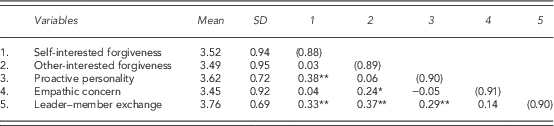
Study 2 descriptive statistics, reliability coefficients, and correlations

Note. n=168. Reliability coefficients (α) are on the diagonal.
*Significant at p≤.05.
**Significant at p≤.01.
Analytical method and results
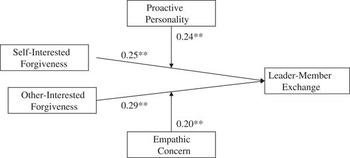
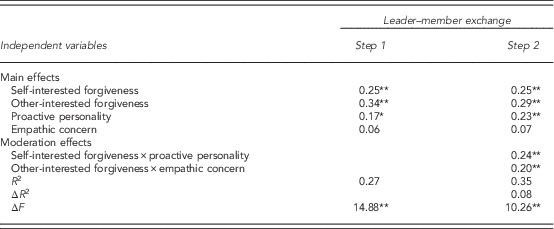
To test our hypotheses, we employed moderated multiple regression analysis (Hypothesis 1, Hypothesis 2, Hypothesis 5, Hypothesis 6). For Hypotheses 1 and 2, the outcomes were as follows: self-oriented forgiveness motive was positively related to leader–member exchange (Hypothesis 1; β=0.25; p<.01) and other-oriented forgiveness motive was positively related to leader–member exchange (Hypothesis 2; β=0.29; p<.01). Thus, we found support for Hypotheses 1 and 2. For Hypotheses 5 and 6, we proposed that proactive personality moderated the relationship between self-oriented forgiveness motive and leader–member exchange (Hypothesis 5; β=0.24; p<.01) and that empathic concern moderated the relationship between other-oriented forgiveness motive and leader–member exchange (Hypothesis 6; β=0.20; p<.01). Consistent with Aiken and West (Reference Aiken and West1991), we mean centered our main effect variables before computing an interaction term and graphed our interaction lines 1 SD above and below the means. We also conducted the simple slope test (Cohen, Cohen, West, & Aiken, Reference Cohen, Cohen, West and Aiken2003; Dawson & Richter, Reference Dawson and Richter2006) to confirm these findings (Hypothesis 5: t=3.53, p<.01; Hypothesis 6: t=4.10, p<.01). Thus, we also found support for Hypotheses 5 and 6 (see Table 4 and Figures 2–4).
Study 2 hypothesized model

Study 2 interaction plot of self-oriented forgiveness motive and proactive personality (to leader–member exchange)

Study 2 interaction plot of other-oriented forgiveness motive and empathic concern (to leader–member exchange)

Study 2 moderated regression analyses for leader–member exchange

Note. n=168.
*, **Significant at p<.05, p<.01, respectively.
Discussion
Drawing on social exchange theory, this manuscript examined the effects of two forgiveness motives on leader–member exchange. Much of the previous research focuses on other-oriented forgiveness motive. In the cases where self-oriented forgiveness motive is also considered, there is no quantitative data associated with this research. We have demonstrated that high-quality leader–member relationships can be enhanced by self-interested and other-oriented forgiveness motive. We also looked at where these forgiveness motives diverge – predicting differential associations with task-focused interpersonal citizenship behavior and person-focused interpersonal citizenship behavior. We demonstrated that self-oriented forgiveness motive was more closely associated with task-focused interpersonal citizenship behavior and other-oriented forgiveness motive was more closely associated with person-focused interpersonal citizenship behavior. Finally, we asserted that the relationship between forgiveness motive (whether self-interested or other-interested) and leader–member exchange can be strengthened by one’s disposition. Proactive personality strengthened the influence of self-oriented forgiveness motive on leader–member exchange and, conversely, empathic concern strengthened the influence of other-oriented forgiveness motive on leader–member exchange.
Finding quantitative evidence in support of our claims augments contemporary understanding pertaining to two conceptually and empirically distinct types of forgiveness. We see that both self-oriented forgiveness motive and other-oriented forgiveness motive are positively related to leader–member exchange, but differentially related to interpersonal citizenship behavior. Both forgiveness motives facilitate the removal of negative thoughts and feelings following transgressions, but for different reasons. Previous research demonstrated that forgiveness can increase well-being, conflict management, and productivity, etc. (McCullough et al., Reference McCullough, Rachal, Sandage, Worthington, Brown and Hight1998; Aquino et al., Reference Aquino, Grover, Goldman and Folger2003). This manuscript adds to extant knowledge of forgiveness outcomes and introduces self-oriented and other-oriented as two distinct forgiveness motives.
With these two distinct forgiveness motives, we also gain a better understanding of the four-phase forgiveness process: uncovering, decision, work, and deepening (Enright, Reference Enright2001). As prospective forgivers contemplate forgiveness, their orientation likely alters how they approach the various stages and what guides their thoughts and feelings at these stages. For example, in the uncovering stage, self-oriented individuals are looking to cut their losses and preserve self-interest while other-oriented individuals are looking to insert compassion into the relational equation. The uncovering stage is also a stage in which one’s forgiveness motive is ascertained and more fully developed based on compassion fatigue, for example, and disposition. As such, the decision stage would not only entail making a choice about whether to forgive, but for refining the motive that will drive the forgiveness (self-oriented or other-oriented), perhaps with self-oriented forgiveness motive driving those ‘pushed by the pain’ of the transgression and other-oriented forgiveness motive driving those ‘pulled by the hope’ of the forgiveness. Our quantitative measures help us further unpack what is going on in the mind of the prospective forgiver as he or she contemplates a form of forgiveness. In fact, the deepening stage of the forgiveness process might look highly divergent depending on the prospective forgiver’s motives, with other-oriented forgivers likely developing a sense of optimism and hope, coupled with meaning and purpose and self-oriented forgivers likely being highly calculating in seeking to table the conflict and maintain desired relational boundaries. Irrespective of forgiveness motive, what seems to remain constant is that forgiveness is a multifaceted ongoing process comprised of varying levels of emotion and cognition employed to reduce hostility and lower rumination (see Bright & Exline, Reference Bright and Exline2012). Using Bright, Fry, and Cooperrider (Reference Bright, Fry and Cooperrider2006, Reference Bright, Fry and Cooperrider2008) focus on self-interest and other-interest, we examine their qualitative analysis to develop quantitative items and test their relationship with a key relational variable: leader–member exchange. In so doing, we ground our work in strong theoretical logic and qualitative evidence while pivoting to the quantitative domain within the specific context of supervisor–subordinate relationships wherein we discover the ability of both forgiveness motives to augment the exchange quality within supervisor–subordinate relationships.
We also demonstrated how proactive personality serves as an enabling mechanism in strengthening the relationship between a positive response to an offense and a meaningful predictor of leader–member exchange. We have also suggested that empathic concern serves as a facilitator of high-quality relationships for those who forgive with compassion. Thus, this manuscript also builds on the current literature by examining how a compassionate disposition interacts with a relational context wherein one is striving to overcome anger and hostility in a manner that benefits the other individual. We have suggested that by examining proactive personality and empathic concern in tandem helps us understand that one’s disposition interacts with the relational context in a way that augments positive relational outcomes. Our analyses also revealed that (1) only proactive personality moderates the relationship between self-oriented forgiveness motive and leader–member exchange; and (2) only empathic concern moderates the relationship between other-oriented forgiveness motive and leader–member exchange. Thus, we learn that proactive personality is uniquely useful in shaping positive outcomes and empathic concern is uniquely valuable in enriching relationships based on compassion.
Practical implications
With these studies, we learn that subordinates can experience high-quality work relationships through two distinct and unrelated forgiveness motives such that self-oriented forgiveness motive and other-oriented forgiveness both provide value in forging leader–member exchange relationships. As such, organizations should consider ways to foster self-oriented forgiveness motive outcomes and other-oriented forgiveness motive outcomes. Identifying and quantitatively examining these two forgiveness motives as predictors of positive outcomes equips managers with additional resources to offer their employees in terms of conflict resolution techniques. Some individuals within organizations may approach forgiveness very cautiously, believing that forgiveness only comes via empathy and compassion which may present limited forgiveness opportunities for certain individuals. In fact, some individuals may believe that they are incapable of forgiving someone in the absence of empathy and compassion. They may even give up on the possibility of forgiveness altogether.
This manuscript offers two viable pathways to forgiveness, based on a self-interested motive or other-interested motive and helps managers identify potential contingencies wherein leader–member exchange will be more likely within certain relationships. These findings can help shape supervisor–subordinate assignments and can also influence methods by which organizations assess fit and facilitate supervisor–subordinate interactions.
Identifying different pathways to leader–member exchange is an important contribution to the existing literature. These contributions are especially relevant due to the strong in-group/out-group distinction that occurs as supervisor–subordinate relationships develop. Those who are perceived as meeting the other’s ‘needs, abilities, and wishes’ (Schein, Reference Schmitt and Klimoski1968) are often considered a member of the focal individual’s in-group (e.g., Graen & Schiemann, Reference Graen and Schiemann1978). This in-group distinction helps explain the positive relationship between leader–member exchange and commitment, pro-social behaviors, job satisfaction, and performance (e.g., Gerstner & Day, Reference Gerstner and Day1997). In the past, scholars have often asserted that in-group membership is strongly influenced by supervisor–subordinate similarity and initial subordinate performance (e.g., Graen & Uhl-Bien, Reference Graen and Uhl-Bien1995). This empirical examination provides additional insights regarding predictors of leader–member exchange, and suggests that subordinates may have additional tools than what we previously imagined. As such, in-group membership becomes less reliant upon typecasting due to perceived similarity and becomes based more on positive behavioral responses in the context of an offense (see Stets & Burke, Reference Strelan and Covic2003). In short, forgiveness, whether self or other-interested, can be a viable means by which to mend relationships.
Limitations and future research
Self-report measures can potentially be confounded by social desirability, negative affectivity, and acquiescence (Spector, Reference Spector2006). Additionally, although it is difficult to know for sure whether participant’s responses were shaped by social desirability, two of the constructs of interest that are perhaps the most vulnerable to socially desirable responses are the two forgiveness motives. Although two potential candidates for social desirability bias, self-oriented forgiveness motive and other-oriented forgiveness motive were not significantly related to each other. That is, it does not appear that participants were indiscriminately suggesting they forgive both in a self-interested and other-interested way. Rather, different individuals forgave for different reasons. For the most part, participants selected one of the two forgiveness motives, both of which were positively related to leader–member exchange, but not related to each other. This empirical evidence is meaningful and offers promise in terms of impact.
Furthermore, incorporating other-report measures into a survey does not remove social desirability. It merely transfers the potential source of social desirability from the focal individual to the individual providing the assessment (Spector, Reference Spector2006). Likewise, Conway and Lance (Reference Conway and Lance2010) note that self-report variables are not always upwardly biased nor are they necessarily inferior to other-report variables. In fact, using other-report measures may prove to be less reliable when the phenomenon in question is held internally, as is the case with self-oriented forgiveness motive and other-oriented forgiveness motive (Podsakoff, MacKenzie, Lee, & Podsakoff, Reference Podsakoff, MacKenzie, Lee and Podsakoff2003). As such, attempting to assess the implicit attitudes of another individual via other-report may actually introduce more error into the model than we would otherwise have (Podsakoff et al., Reference Podsakoff, MacKenzie, Lee and Podsakoff2003).
Consistent with Conway and Lance (Reference Conway and Lance2010), we have endeavored to provide logic as to the value of using self-report measures. This is especially important, given the aim of this study to understand the subordinate’s perspective, while also providing evidence of construct validity. That said, we only assessed the subordinate’s perspective of leader–member exchange. Understanding the supervisor’s perspective pertaining to leader–member exchange would also be informative and would help extend the literature. Although our aim with these studies was to assess the subordinate’s perspective, we recommend that future studies assess the supervisor’s perspective of leader–member exchange. Such an assessment could augment these findings and facilitate a dyad-level analysis of the supervisor–subordinate relationship while enabling an assessment of behavioral (interpersonal), rather than just internal (intrapersonal), forgiveness.
Another limitation to these studies is our use of a cross-sectional data sample in study 2. We recommend that future studies incorporate a temporally lagged design across studies in order to solidify claims inferred causality. Podsakoff and Organ note that a temporally lagged design allows for the separation of measurement such that the design is able to ‘mitigate the problem of transient mood state and common stimulus cues, and perhaps reduce the effect of respondents’ strain toward consistency’ (Reference Podsakoff and Organ1986, p. 540). However, we did not see substantial differences in the effects from study 1 (temporally lagged) to study 2 (cross-sectional). Although we used a temporally lagged study, we did not conduct a longitudinal study because we did not collect all variables in both time periods. This would have allowed us to assess a change in outcomes over time. For example, Baker and Bulkley (Reference Baker and Bulkley2014) note that, although self-interest is a short-term motivator, helping based on self-interested motives tends to have effects that are weaker in strength and shorter in duration than helping based on positive emotion. Also, Grant and Patil (Reference Grant and Patil2012) argue that high levels of self-interest can inhibit helping behaviors over time and can be very difficult to change, once a self-interested norm emerges. In fact, they posit that a fluid transition from a self-interested motive to an other-interested motive is less likely than a fluid transition from an other-interested motive to self-interested motive. Nevertheless, other-interested behavior is not without risks. Grant (Reference Grant2013) reports that other-interested individuals tend to be both the best performers (because they are energized and creating strategic networks) and the worst performers (because they are neglecting other tasks and indiscriminately helping others). A longitudinal design might be especially conducive to understanding the effects of self-interest and other-interest during the forgiveness process. with a longitudinal design we would likely gain insight into (1) the effects of time on forgiveness; (2) whether self-oriented forgiveness motive impoverishes a relationship over time; (3) whether other-oriented forgiveness motive is more sustainable because of its levels of compassion; and (4) whether self-oriented forgiveness motive is more sustainable because of its facility in practically tabling conflict.
A final potential limitation is that this study does not assess mutual interest or more incidental forms of exchange. We believe a study of mutual interest would likely yield very interesting findings wherein the individual is motivated to forgive to preserve the interests of both parties. Lawler (Reference Lawler2001) proposed that richer interpersonal relationships can exist to the point that individuals do not calculate reciprocal behaviors in an effort to minimize differences between the benefits they receive versus the benefits they provide – they spend less time monitoring the receipt of benefits and are more likely to be concerned for the other individual as well as the self (Meeker, Reference Meeker1971; Clark & Mills, Reference Clark and Mills1979; Lawler, Reference Lawler2001). Under such circumstances, one’s ‘motivation for the giving of benefits is different’ such that ‘members of a communal relationship assume that each is concerned about the welfare of the other’ (Clark & Mills, Reference Clark and Mills1979, p. 13) – with both members demonstrating mutual responsiveness (Pruitt, Reference Pruitt1972).
Conclusion
Drawing on social exchange theory, this manuscript demonstrated that high-quality leader–member relationships can be enhanced by two distinct and unrelated forgiveness motives. self-interested and calculating whereas other-interested and compassionate (see Enright, Gassin, & Wu, Reference Enright, Gassin and Wu1992; Bright, Fry, & Cooperrider, Reference Bright, Fry and Cooperrider2008). Although much of the extant research links forgiveness outcomes with other-interest, our studies suggest self-interest might also play an important role in the forgiveness process. Forgiveness based on self-interest (self-oriented forgiveness) is related to leader-member exchange, differentially associated with task-focused citizenship behavior, and its relationship with leader-member is strengthened by proactive personality. The relationship between other-oriented forgiveness motive and leader-member exchange is strengthened by empathic concern. In examining other-interested and self-oriented forgiveness motive motives, this manuscript provides two avenues to high-quality relationships at work.