Introduction
The study of intergenerational social mobility has gained significant momentum since the publication of papers by Campbell and Lee (Reference Campbell and Lee2008, Reference Campbell and Lee2011) and Mare (Reference Mare2011). A series of ensuing studies have successfully demonstrated the multigenerational processes of social mobility and reproduction in different eras and locations (e.g., Chan and Boliver Reference Chan and Boliver2013; Dribe and Helgertz Reference Dribe and Helgertz2016; Jæger Reference Jæger2012; Knigge Reference Knigge2016; Lindahl et al. Reference Lindahl, Palme, Massih and Annagren2015; Mare Reference Mare2014; Pfeffer Reference Pfeffer2014; Sharkey and Elwert Reference Sharkey and Elwert2011; Song and Mare Reference Song and Mare2015; Song et al. Reference Song, Campbell and Lee2015).
In this study, we extend such multigenerational mobility studies into the context of premodern Korea. The premodern Korean case provides a unique opportunity to investigate the processes of multigenerational social mobility over a longer-term time horizon thanks to the availability of official family lineage books known as jokbo. Jokbo is multigenerational records of elite families in premodern Korea, which have been published continually for hundreds of years and are still being produced to this day (Song Reference Song1980; Wagner Reference Wagner1972).
Several characteristics of jokbo are worth noting to understand how today’s researchers can construct prospective genealogical microdata from these data sources (Song and Campbell Reference Song and Campbell2017; Song and Mare Reference Song and Mare2015). First, with the exception of a few early generations before original compilers, a jokbo provides a prospective record of major life events in an elite family including birth, marriage, office acquisition, and death. Jokbo does not omit parents without children or offspring without government offices. Second, jokbo has detailed information about government office rankings for all lineage members, including both male and female descendants. Thus, jokbo tracks a large, diverse population of elite families beyond just the patrilineage. Thanks to this wide coverage, we can observe the social ranks of a full range of elite class members, their parents, kin, and distant ancestors. Lastly, the original compilers of jokbo and the timing of the publication are known. This is useful for contemporary researchers because we can utilize the information to identify a subset of jokbo data that were recorded prospectively.
In 2007, a collaboration of researchers, including one of the coauthors here, embarked on a data collection project to convert the universe of handwritten jokbo documents into machine-readable data. We constructed genealogical microdata from the two oldest extant jokbo data: the Andong Gwon-ssi clan Seonghwabo (referred to henceforth as Seonghwabo) and the Munhwa Ryu-ssi clan Gajeongbo (Gajeongbo henceforth). Seonghwabo was published in 1476 and Gajeongbo was published in 1565. We utilize the fact that only postcompiler generation jokbo data were recorded “prospectively” in the sense that family events such as birth, death, marriage, or office acquisition are continually updated by parents while precompiler generation jokbo data were based on memories of compiler generations (Song and Campbell Reference Song and Campbell2017; Song and Mare Reference Song and Mare2015). After trimming out precompiler generations and ending generations for interfamily comparability, we obtain a historical elite family data set over five generations, covering the transition from the Goryeo dynasty (918–1392) to the Joseon dynasty (1392–1910). The total number of elite members in the resulting data set is 42,525, which consists of 6,667 from Seonghwabo and 35,858 from Gajeongbo.Footnote 1
Premodern Korea has an “ambiguous stratification system” (Miyajama 2012), in which the status of the yangban (part of the traditional ruling class) was not legally inheritable and their de facto social status was determined by the reputation of the family’s lineage (Henderson Reference Henderson2000). For example, the Great Code of Administration of Joseon (Gyeongguk-Daejeon) did not guarantee the status of yangban. Members of elite lineages must pass a state examination, the gwageo, to be government officials and the reputation of elite lineages hinged crucially upon the existence of eminent government officials from their family members. Therefore, parents and grandparents have a strong reason to distribute mobility-related family resources for collective goals of family survival, rather than for goals of individual children’s well-being. Given the fact that the allocation of scarce family resources has significant impact on the ensuing social status of offspring and in these societies, we view that the social status of elite family members in premodern Korea was a product of the intrafamily resource allocation process, through which parents and grandparents exert significant heterogeneous influence on the distribution of limited resources to offspring.Footnote 2 In other words, parents and grandparents of elite lineages in premodern Korea faced a trade-off between the maximum rank of the offspring’s offices (the quality of the offspring’s office) and the maximum number of the officeholding offspring (the quantity of the offspring’s office).Footnote 3 This view is very different from the view in the economics literature where parents are modeled to face a trade-off between their own consumption and the quality of children (Becker and Tomes Reference Becker and Tomes1976; Dahan and Gaviria Reference Dahan and Gaviria2003; Mulligan Reference Mulligan1997).
In premodern Korea’s ambiguous stratification system, parents and grandparents of elite lineages made a family-resource allocation decision to maximize their elite lineage’s social influence and long-term continuity and at the same time to minimize the probability of downward sliding of their elite lineage. Producing eminent high-ranking government officials was the most effective method for these goals (Deuchler Reference Deuchler1992; Duncan Reference Duncan2000; Han Reference Han2013; Kawashima Reference Kawashima1977; Miyajima Reference Miyajima2003, Reference Miyajima2012; Wagner Reference Wagner1974b).
Previous two-generation models of social mobility implicitly or explicitly assumed egalitarian parents who distributed family resources equally across children. For example, when Warren and Hauser (Reference Warren and Hauser1997) regressed grandchildren’s occupational statuses onto parents’ and grandparents’ characteristics, they implicitly assumed that parents and grandparents distribute their characteristics equally across all grandchildren. However, if parents had strong reasons to invest more in some children than others, the regression coefficients would be confounded by unequal distribution of mobility-related family resources. Similarly, models in family economics assume that parents “exhibit equal concern for all of their children” (Behrman et al. Reference Behrman, Pollak and Taubman1982: 54). Although some models allow the possibility of nonegalitarian parents and sibling inequality, this aspect is considered only in the context of the trade-off between consumption by children and consumption by parents (e.g., Balbo et al. Reference Balbo, Billari and Mills2013; Becker and Lewis Reference Becker and Lewis1973; Becker and Tomes Reference Becker and Tomes1976; Becker et al. Reference Becker, Murphy and Tamura1990; Begall and Mills Reference Begall and Mills2011; Betzig Reference Betzig1986; Dahan and Gaviria Reference Dahan and Gaviria2003; Jones et al. Reference Jones, Schoonbroodt and Tertilt2011; Miller Reference Miller2011; Mulligan Reference Mulligan1997; Skirbekk Reference Skirbekk2008; Solon Reference Solon2014).
We depart from these previous studies here. In our three-generation model, there are two levels of the intrafamily resource allocation, the grandchildren’s sibling level (the G1 problem) and the parent’s sibling level (the G2 problem). The G1 problem is the intrafamily resource allocation problem between parents and their children and the G2 problem is the intrafamily resource allocation between grandparents and parents. To analyze social status inheritance among three generations, we need to control for both the G1 and G2 problems in our empirical analysis.
First, we control for the G1 problem in the estimation of the parent effect by treating the social status of children as aggregate outcomes at the parent level. Thus, the outcome variable of our analysis is the quality of successful children, measured at various ranks, rather than individual children’s social status. The number of successful children at various ranks measures the transmission of parents’ social status to their offspring at the aggregate level. The aggregate measure allows us to avoid the confounding effect of the intrafamily resource allocation among children’s siblings when we estimate the parent effect and the grandparent effect.
Second, we control for the G2 problem in the estimation of the grandparent effect by analyzing a subset of data consisting only of parents with no siblings. When grandparents have only one child to pass on their mobility-related resources, the intrafamily resource allocation problem would not occur at the parent level and hence the estimation of the grandparent effect on grandchildren’s social status would not be confounded.
For empirical analysis, we use an overdispersed Poisson mixed-effects model (also called an overdispersed Poisson multilevel/hierarchical model) using the number of children as an offset. We compare the main results of our analysis with those of conventional approaches of individual children-level analysis. We also investigate multigenerational factors that affect fertility using a mixed-effects logistic regression model.
The findings support our two central theoretical conjectures, that parents and grandparents cared more about having at least one offspring attain to the highest possible level position rather than having many children attain to some position, and that parents and grandparents concentrated scarce family resources into a subset of their offspring rather than distributing them equally to achieve this goal. We find positive associations between parents’ and grandparents’ social ranks and the number of successful grandchildren in elite lineages in premodern Korea. In contrast, results from the individual-level analysis using individual children’s social status as outcome variables failed to show effects of multigenerational factors on individual children’s social status. Only ego-related factors are found to be significant in the individual-level analysis. Finally, we find that parents’ social status is one of the key predictors of successful progeny from the mixed-effects logistic analysis on fertility.
Background
Jokbo
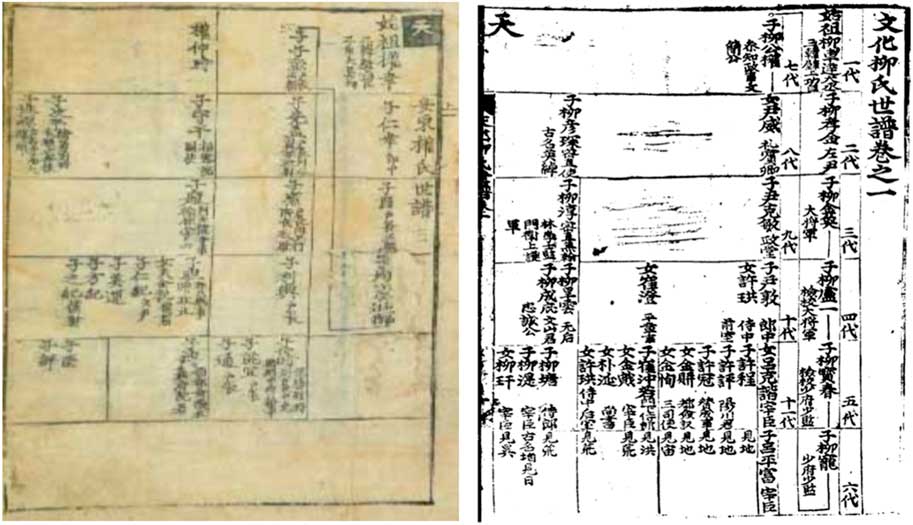
Jokbo refers to the ancestry records of elite families in premodern Korea, which have been published for hundreds of years up through today. Jokbo records a progenitor and his descendants along both male descendant lines and son-in-law descendant lines (Lee and Park Reference Lee and Park2008; Wagner Reference Wagner1989). Figure 1 shows examples of the two family records used in this article. The image on the left comes from the Andong Gwon-ssi clan Seonghwabo and the image on the right from the Munhwa Ryu-ssi clan Gajeongbo. Seonghwabo is the oldest extant jokbo and Gajeongbo is the second oldest. These two jokbos span both the Goryeo dynasty (918–1392) and the former period of Joseon dynasty (1392–1910), with social and demographic information of 59,605 elite family members. Seonghwabo lists 10,243 members and Gajeongbo lists 49,362.
Seonghwabo (left) and Gajeongbo (right).

Genealogies in Korea differ from their Chinese counterparts in a critical way (Choi Reference Choi1979; Deuchler Reference Deuchler1992; Lee and Park Reference Lee and Park2008; Song Reference Song1980). Korean genealogies contain information on daughters, their husbands, and their children. Chinese genealogies included records on agnatic kin, but information on daughters, their husbands, and their descendants are highly limited (Harrell Reference Harrell1987; Liu Reference Liu1978; Palmer Reference Palmer1972; Telford Reference Telford1990; Zhao Reference Zhao2001). Chinese genealogies were written for the internal purpose of consolidating kin and maintaining unity. While Korean genealogies shared this purpose, jokbo had the additional goal of making a vaunt of the prestige of a family lineage (Miyajima Reference Miyajima2012). Thus, unlike Chinese genealogies, Korean genealogies contain detailed information of daughters, their husbands, and their descendants to show the prestige of their lineages.
The inclusion of daughter lines (daughters, their husbands, and their descendants) makes Korean family genealogies a more representative of the elite class than lineage records from their Chinese counterparts because the growth of daughter lines represents expanding marriage networks of elite lineages. Marriage networks has been a crucial characteristic of Korean genealogy compared to Chinese genealogy and marriage has been a core strategy to retain the prestige of elite families (Lee and Lee Reference Lee and Lee2017).Footnote 4 For this reason, the percentage of family members who had different surnames than Gwon is 94.5 percent in Seonghwabo. Likewise, the percentage of family members who had different surnames than Ryu is 96.9 percent in Gajeongbo.
Another key feature of jokbo is that the data are generally attributable to verifiable compilers and publication dates. For example, Seonghwabo was published in 1476 and Gajeongbo was published in 1565. The known publication dates are valuable because family genealogies usually have significant omissions or recall biases in precompiler generations. At the time of the first publication, original compilers had to trace back their ancestors based on limited information. However, after the publication, jokbo is recorded “prospectively” in the sense that family events such as birth, death, marriage, or office acquisition are continually updated by generations of elite family members.Footnote 5 Persons without children or without government offices are not omitted. Thanks to these fortuitous aspects of the data source, the information in jokbo after the known publication dates can be considered as a rare source of prospective genealogical microdata over many generations (Song and Campbell Reference Song and Campbell2017; Song and Mare Reference Song and Mare2015). Postcompiler generation data for Seonghwabo covers Generation 16 to Generation 19 and postcompiler generation data for Gajeongbo covers from Generation 17 to Generation 20. Another fortunate feature for researchers is that the jokbo details specific information for individuals regarding government office rankings, as well as the rankings of their parents, kin and distant ancestors.
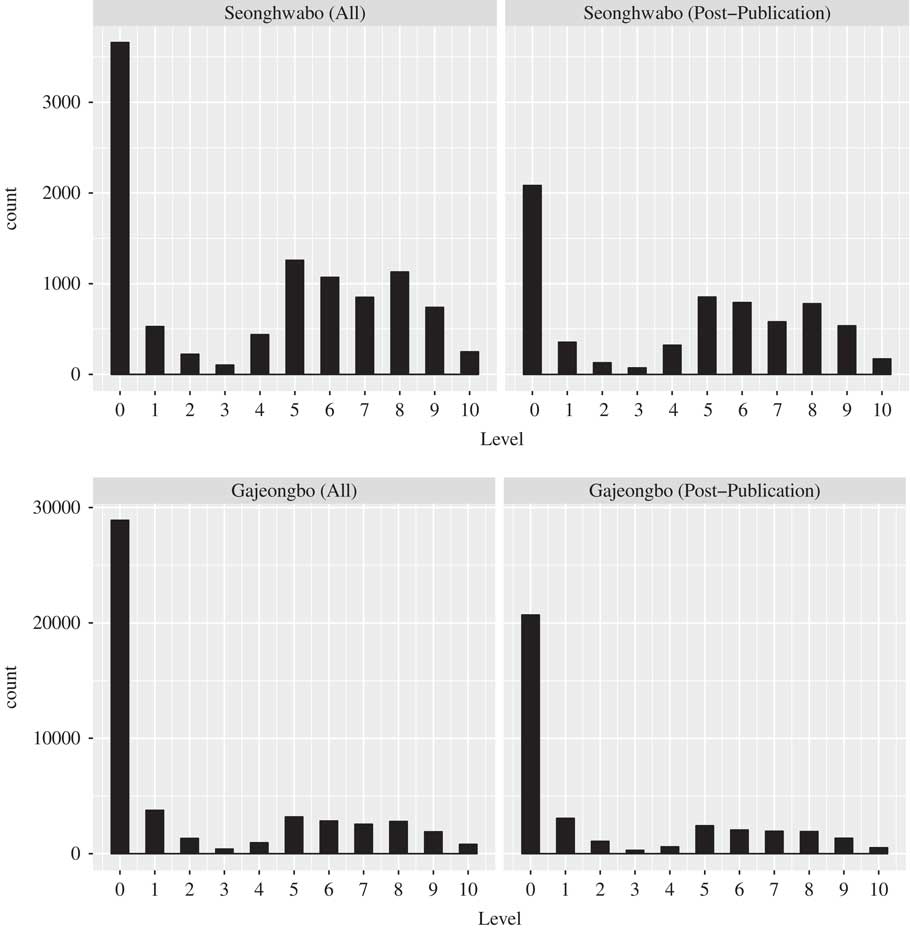
We converted handwritten jokbo documents into machine-readable data and collected the entire record of public offices and progeny over five generations of two elite lineages in premodern Korea. Figure 2 shows the distribution of government office rankings for both an entire family (left column) and the postcompiler generation subset (right column). In both Seonghwabo and Gajeongbo, the largest difference between the full data set and the postcompiler generation subset can be found in the number of family members with no government office. While the shape of the distribution appears similar between both data sets, the inclusion of prepublication data could lead to erroneous findings due to recall biases and other types of nonrandom omissions.
Marginal distributions of 11-scale government office rankings in Seonghwabo (top) and Gajeongbo (bottom).
Note: The left column contains the entire data set. The right column contains the postpublication subset.

Social Status in Premodern Korea
In premodern Korea’s ambiguous stratification system (Miyajima Reference Miyajima2003), the status of the yangban was determined by the reputation of the family’s lineage (Henderson Reference Henderson2000). The most important factor affecting the reputation of a yangban family was whether their lineage had eminent high-ranking government officials (Miyajima Reference Miyajima2003). The importance of eminent high-ranking government officials can be explained partially by the political system in premodern Korea. Premodern Korea had long maintained a monarchy with the centralized administration. Under such a system, bureaucracy was an indispensable tool for the exercise of political power (Frederickson Reference Frederickson2002). As in premodern China, the social status of bureaucrats was determined by office rank. High-ranking offices were the first court rank to the higher third court rank (called tangsangkwan), mid-ranking offices were from the lower third court rank to the sixth court rank (called chamsangkwan), and low-ranking offices were the seventh court rank through the ninth court rank (called chamhakwan). The entry into tangsangkwan or chamsangkwan was considered as the most important way for elite lineages to improve their social influence and maximize longevity. In contrast, elite lineages that failed to produce tangsangkwan- or chamsangkwan-level officials declined in social influence and wealth.
There were many ways to enter the centralized administration. The most common was to pass a state examination, the gwageo (Lee Reference Lee1994). A state examination system was first implemented in 958 (the ninth year of King Gwangjong’s reign in the Goryeo dynasty) and maintained through 1894 (the 31st year of King Gojong’s reign in the Joseon dynasty). The second way was to receive a protected government appointment, or eumseo. The third way was to be recommended through cheongeo, an entry point for community members who were known to be uniquely competent and reputable scholars or officials (Jeong Reference Jeong1995). Eumseo and cheongeo were available only to a small number of elite families whose ancestors held high government positions or made important contributions to the country (Park Reference Park1990). Therefore, passing a state examination with distinction was the only practical way to maintain the political power of an elite family lineage.
Government offices were an important means to augment a family’s wealth, too. The Goryeo and early Joseon governments operated a stipend land system and rank land system, respectively, which apportioned land to bureaucrats according to their grade rank (Lee Reference Lee2004). As a result, individuals and families paid significant attention to obtain a government office because it guaranteed private economic benefits (Henderson Reference Henderson2000).
The number of government offices was fixed, while the number of yangban continued to grow over time. According to both academic research and the Great Code of Administration of Joseon (Gyeongguk-Daejeon), there were roughly 2,300 government positions in the Goryeo dynasty and 5,000 to 6,000 government positions in the Joseon dynasty (Noh et al. Reference Noh1485; Park Reference Park1990). Although there is no conclusive historical record to estimate the size of the elite class, most scholars agree that yangban consisted of about 5 to 10 percent (roughly half a million to 1 million) of the total population during Joseon dynasty (Miyajima Reference Miyajima2008). In contrast to the large size of the yangban, the average number of state exam passers during Joseon dynasty was only about 29 per year (Miyajima Reference Miyajima2008).Footnote 6
Because of the lack of reliable representative data, prior studies have produced conflicting views on the level of social mobility in premodern Korea. One group of scholars argue that social mobility was fairly low and family backgrounds were the overriding factor in obtaining government office. For example, Lee (Reference Lee2004) argued that only 30 percent of elite families produced more than one officeholder throughout the Joseon dynasty. Additionally, some scholars argue that powerful elite families were not changed even in the transition from the Goryeo dynasty to the Joseon dynasty (Deuchler Reference Deuchler1992; Duncan Reference Duncan2000).Footnote 7 In contrast, another group of scholars argue that social mobility was quite high in premodern Korea, especially in Joseon society. The main factor that contributed to the high social mobility was the state examination for entrance into government offices (Han Reference Han2013; Wagner Reference Wagner1974a). For example, Han (Reference Han2013) showed that about 24 percent officials in the early Joseon dynasty acquired government offices for the first time in their family history and this rate increased up to 53 percent in later periods of the Joseon dynasty.Footnote 8
Theory: High-Ranking Official Production as a Lineage Survival Strategy
In this section, we present our theoretical framework of social status as the product of family inputs. We start our discussion with a review of the common assumption in the social mobility literature that parents and grandparents distribute mobility-related family resources equally across their offspring. Our analysis demonstrates that this assumption is not only unrealistic in many contexts but also highly misleading when used as a baseline for empirical study.
Synthetic Example
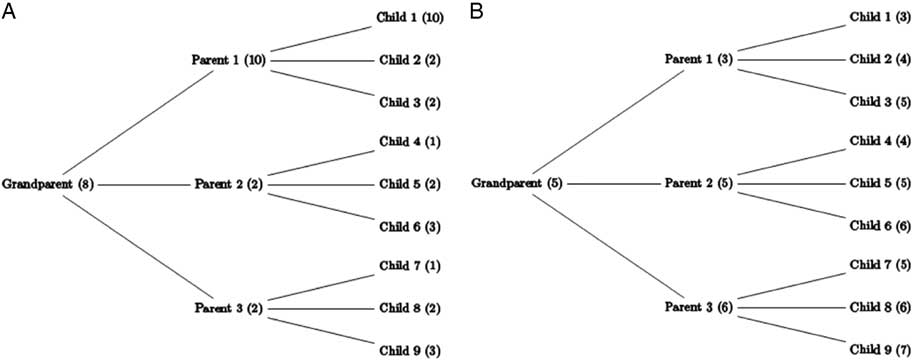
For ease of initial illustration, we present a synthetic case of two families. Figure 3 shows two hypothetical families across three generations. We code social positions by the 11-scale government office rankings, matching the coding of our data, with 0 indicating no office and 10 indicating the highest government office. Realized office rankings reflect the trade-off between quantity and quality of offspring’s offices and a regress-to-the-mean pattern in intergenerational mobility.
Synthetic mobility data: Numbers in parentheses indicate public office rankings.

We assume that Family A follows an unequal resource allocation strategy, while Family B follows an egalitarian resource allocation strategy. It is clear that the unequal distribution of mobility-related family resources produced strong sibling interference in intergenerational social mobility. For example, the downward mobility of Parent 2 and Parent 3 in Family A is caused by the concentration of resources into Parent 1 and the downward mobility of Parent 1’s Child 2 and Child 3 is caused by the concentration of resources into Child 1. However, the egalitarian strategy in Family B does not produce similar sibling interference in intergenerational social mobility.Footnote 9
We show what would happen when one applies a simple regression model to predict a child’s individual social status as an additive function of his/her parent’s and grandparent’s social status, ignoring sibling interferences.Footnote 10 For simplicity, we only consider the parent effect in this example. Let k be the total number of children in family i, x i be parent’s social status, and z ij be the intrafamily allocation to child j. A simple reduced form model explaining the effect of the parents’ status on a child’s social status can be written as follows:
 $$\matrix{ {y_{{i1}} {\equals}\beta _{0} {\plus}{\rm }\beta _{1} x_{i} {\plus}{\rm }\beta _{2} z_{{i1}} {\plus}\,\ldots\,{\plus}{\rm }{\epsilon}_{{i1}} } \cr \vdots \cr {y_{{ik}} {\equals}\beta _{0} {\plus}{\rm }\beta _{1} x_{i} {\plus}{\rm }\beta _{2} z_{{ik}} {\plus}\,\ldots\,{\plus}{\rm }{\epsilon}_{{ik}} } \cr } $$
where equations are correlated by error terms.Footnote 11
Because z
ij
is unobserved and missing, an accurate identification of the parent effect (β
1) hinges crucially upon (1) the correlation between x
i
and z
ij
and (2) the distribution of z
ij
across children 1 through k. If all parents are egalitarian and the intrafamily resource allocation is constant across children, z
ij
would be uncorrelated with x
i
and the omission would not bias the estimation of β
1.Footnote
12
However, if the intrafamily allocation varies across children and it is correlated with parent’s characteristics, the reported estimate of β
1 is inefficient due to hidden correlation among error terms and biased by
 $\beta _{2} {{Cov(x_{i} , z_{{ij}} )} \over {Var(x_{i} )}}$
. Let’s ignore inefficiency and focus on the bias. Still, it is not straightforward to gauge the direction and size of the bias. In general, highly placed parents tend to have more children and the covariance of allocated resources and parents’ social status (Cov(x
i
,z
ij
)) increases with the number of children. We should therefore expect the size of bias to increase as parents’ social status increases. This is why intrafamily resource allocation is such a critical issue in the analysis of social mobility in the upper class, which is opposite to the conventional assumption in the literature. For example, Dahan and Gaviria (Reference Dahan and Gaviria2003) assume that “rich parents educate all their children…sibling inequality of education and earnings will be greater in the middle of the income distribution” (ibid.: 282). In contrast, we argue that the consideration of intrafamily resource allocation is more important in the study of intergenerational social mobility in elite families.Footnote
13
A similar story can be told for the grandparent effect.
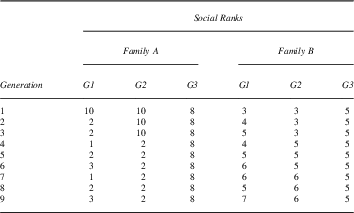
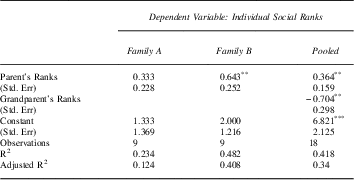
Figure 3 is reconstructed into a long form for the regression analysis, the result of which is shown in table 1. Conventional regression analysis in social mobility studies uses individual children as the unit of analysis and parents’ and grandparents’ social positions as key explanatory variables. In this approach, the regression model assumes that individual children’s social status is conditionally independent from one another, while controlling for parents’ and grandparents’ social status.
Individual social positions in the synthetic mobility

Notes: 1 is the lowest rank and 10 is the highest rank. 0 indicates no rank.
Table 2 reports the regression results following the conventional independent intrafamily resource allocation assumption. As anticipated, the positive association between parents’ social ranks and individual children’s social ranks (0.643*) was found only in Family B where no sibling interference occurred in intergenerational status inheritance. In contrast, the omission of the heterogeneous intrafamily resource allocation and hidden correlation among error terms make it difficult to interpret the regression results.
Regression results of the synthetic mobility

Note:The dependent variable is social ranks in which 1 is the lowest and 10 is the highest.
*p<0.1. **p<0.05. ***p<0.01.
A counterintuitive finding from table 2 should be noted when one pools the two-family data to review the grandparent effect. The association between grandparents’ social ranks and individual grandchildren’s social ranks is shown to be negative and statistically significant. It is obvious that the negative association is driven by the observations from Family A where a highly successful grandparent has one highly successful grandchild and eight “mediocre” grandchildren. However, this finding is a statistical artifact caused by a mismatch between a family-based status-inheritance process for Family A and an individual-based regression model in the empirical analysis. If we consider social status as the product of a family’s goal of producing high-ranking officeholders, the grandparent effect in Family A must be considered to be positive and larger than that of Family B.
The Intrafamily Resource Allocation Problem
Prior studies of intergenerational social mobility do not take into consideration the intrafamily resource allocation problem either theoretically or empirically. For example, Warren and Hauser (Reference Warren and Hauser1997) analyze three-generation families in the Wisconsin Longitudinal Study by regressing grandchildren’s occupational statuses to parents’ and grandparents’ characteristics. In doing so, they implicitly assume an independence between the distribution of mobility-related family resources and parents’ and grandparents’ characteristics (Cov(x i ,z ij ) = 0). As we have argued, there are many substantive reasons to question this independence. The number of children and grandchildren may vary depending on parents’ and grandparents’ characteristics, which indirectly affects the distribution of allocated resources. Also, parents’ and grandparents’ characteristics such as income, wealth, genetic factors, and historical conditions can directly affect the distribution of allocated resources. Studies have shown that families in desperate conditions may concentrate their resources more into a subset of children (Dasgupta Reference Dasgupta1993; Mirrlees Reference Mirrlees1976).
Economic models of social mobility generally assume inequality-averse parents (Behrman et al. Reference Behrman, Pollak and Taubman1982; Gaviria Reference Gaviria2002). For example, Gaviria (Reference Gaviria2002) writes that “[p]arents are assumed to be averse to inequality in that, all else equal, they prefer a more egalitarian distribution of income among their children. Parents are also assumed not to care about earning differentials among their children as long as they can be compensated with financial transfers. This precludes any parental concern about non-pecuniary effects of both earnings (they may enhance self-respect) and financial transfers (they may cause guilt or jealousy)” (ibid.: 333). While some prior models did allow the possibility of nonegalitarian parents and sibling inequality, the authors only considered this possibility in the context of the consumption trade-off between parents and children (Becker and Tomes Reference Becker and Tomes1976; Dahan and Gaviria Reference Dahan and Gaviria2003; Mulligan Reference Mulligan1997).
Of course, there do exist certain cases in which the assumption of a homogeneous intrafamily resource allocation is harmless. One example is when social status is primarily determined by nonrivalrous (or nonsubtractable by the consumption of others) factors, such as genetics, intelligence, or family reputation. Another case is a society consisting predominantly of single child families. Contemporary China during the single-child policy and Asian countries experiencing ultra-low fertility rates would be good examples. Aside from these cases, however, a baseline assumption of homogeneous intrafamily resource allocation could be misleading when family plays an important role in social status inheritance.
We depart from prior studies by conceptualizing the social status of elite family members in premodern Korea as products of a heterogeneous intrafamily resource allocation process in which parents and grandparents aim to achieve the lineage’s goal of producing high-ranking government officials. Then, why did the quality of an offspring’s government office matter so much in premodern Korea? We present two reasons. First, the most effective way to maximize an elite lineage’s social influence and long-term continuity was to produce eminent high-ranking government officials (Deuchler Reference Deuchler1992; Duncan Reference Duncan2000; Han Reference Han2013; Miyajima Reference Miyajima2003, Reference Miyajima2012). Prestigious government offices have amplifying effects that could be passed on through multiple generations and across remote kin groups. In the lineage of elite families, ancestors with prestigious government offices directly influenced their descendants’ social position. For example, Gwon Bu (1262–1346) in the 13th generation of Andong Gwon Ssi family obtained the government office of 10 (jong il poom) and produced five sons and three sons-in-law with the government office of 10 (jong il poom). Because of his success and his children’s success, his family became known as Ilga-Gu-Bonggun (an entire family raised by meritorious deeds to the status of gun, or “feudal vassals”). After his children’s success, Andong Gwon Ssi entered the inner circle of elite power families in premodern Korea. In contrast, low-ranking government offices did not produce similar effects beyond current generations or close kin groups.
Second, prestigious government offices produced important externalities to the principal’s family, in stark contrast to lower-ranking government offices. While the previously mentioned amplifying effects are largely intangible to family members of the contemporary generation, externalities from prestigious government offices are tangible to them. For example, by producing family members with prestigious government offices, a family’s influence in local politics would increase. Another benefit was the protection-based appointment of family members. Officials holding a rank of five or higher were eligible to name one descendant as an official without having to pass the state examination (Park Reference Park1990). The descendants of Ryu Seung (1248–98) in the 10th generation of Munhwa Ryu ssi are a good example. Rye Seung obtained the government office of 9 (jong i poom) and had three sons and two sons-in-law. Out of his five children, the second son took an office as a protected appointment thanks to his father and his grandfather Ryu Gyeung, the most powerful man at that time. In addition, Ryu Bobal, grandson of Ryu Seung and great-grandson of Ryu Gyeung, became an official without taking a state examination thanks to his father as well as prestigious ancestors.
Despite the importance of high-ranking government positions for family reputation, their numbers were very small and the availability was extremely limited. For example, in the Joseon court, office positions were categorized into 9 poom (each poom were subcategorized into jeong and jong). The highest office position was 1 poom, which consisted of only 11 positions, 7 for civil (literati) officials and 4 for military officials. In general, it was very competitive to reach office positions higher than the third, known as jeong 3 poom. In The Great Code of Administration of Joseon Dynasty (Gyeongguk Taejeon, published in 1485), there were about 28 office positions higher than 3 poom. Because of the limited number, competition to the highest offices among elite families was very tight. For this reason, it was not surprising for yangban parents who wish to maximize the lineage’s goal of producing high-ranking officials to concentrate family resources into a few children with high abilities to pass the state exam. Once they passed the exam, family resources were devoted to their marriage with powerful elite families and their promotion to prestigious offices.
Our focus on intrafamily resource allocation is linked to lineage-based approaches in contemporary social mobility studies. Many social mobility studies have shown that lineage has played a dominant role in processes of reproduction and social stratification around the world, particularly in East Asia (Campbell and Lee Reference Campbell and Lee2003, Reference Campbell and Lee2008, Reference Campbell and Lee2011; Cohen Reference Cohen1990; Eastman Reference Eastman1988; Freedman Reference Freedman1966; Keiko Reference Keiko2011; Miyajima Reference Miyajima2012; Song Reference Song2016; Song et al. Reference Song, Campbell and Lee2015). From the Chinese multigenerational data, for example, Song and colleagues (2015) showed that “[p]atrilineages founded by high-status males eventually accounted for a disproportionately large share of the male population…. [H]igh-status origin descent lines achieved overrepresentation in succeeding generations of males by minimizing their extinction probabilities” (ibid.: 575).
Also, our emphasis on heterogeneous intrafamily resource allocation is connected with the recent review of multigenerational social mobility presented by Torche and Corvalan (Reference Torche and Corvalan2016). These authors criticized Clark’s (Reference Clark2014) study using surname-level income averages as an instrument for individual income. They correctly pointed out that it is not possible to infer individual social mobility from grouped data such as surname-level income averages, the point of which has been emphasized in social science research for quite some time (Achen and Shively Reference Achen and Shively1995; Durkheim Reference Durkheim1966; Goodman Reference Goodman1953; King Reference King1997; Robinson Reference Robinson1950). In this article we emphasize the opposite. Inferring about group-level phenomena (e.g., intergenerational social status inheritance in premodern Korea) using disaggregated data (e.g., individual social status) is error prone due to unobserved factors related to intrafamily resource allocation.
Empirical Strategies
To test our theory, we employ a regression-based empirical approach using a three-generation family as the unit of analysis. As mentioned previously, it is essential to account for the effects of unobserved intrafamily resource allocation to correctly estimate the effects of multigenerational factors on intergenerational social mobility. In our three-generation model, the intrafamily resource allocation exists both at a child’s sibling level (G1) and at the parents’ sibling level (G2).
We use the number of successful children as outcome variables. The number of successful children measures the transmission of parents’ social status to their offspring at the aggregate level. The aggregate measure allows us to avoid the confounding effect of the intrafamily resource allocation among children’s siblings when we estimate the parent effect and the grandparent effect.
We approach the definition of “successful children” in three ways to make our analysis robust relative to measurement errors and the multiple comparison problem. First, we define success as a government office position at or above rank 8 (R≥8). Second, we consider low to middle positions as successful. In 11 scales, these are individuals at or above rank 2 (R≥2). Third, we consider mid-high positions as successful, positions at or above 5 (R≥5).
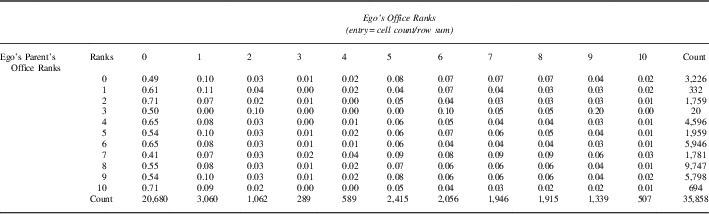
We illustrate the difference between the conventional analysis using individual-level data and our proposed approach using aggregate children data by constructing two mobility tables corresponding to respective data sets from Gajeongbo. Table 3 shows the association between ego’s office ranks (row) and their parent’s office ranks (column) for the entire entries. Each cell is a proportion of entries given their parents’ ranks. We divide the count of each cell by a row sum. Roughly speaking, each row in table 3 can be read as a conditional distribution of an ego’s rank given their parent’s rank at 0 to 10. For example, 0.49 in (0, 0) indicates that out of 3,226 Gajeongbo entries with parents having no office, on average 49 percent of them ended up having no office. The amount 0.61 in (1, 0) indicates that out of 332 Gajeongbo entries with parents having office at level 1, on average 61 percent of them had no office at all. The highlighted column in table 3 indicates the counterintuitive pattern that the probability of obtaining no office slightly increases as a parent’s rank increases. This pattern is inconsistent with common knowledge and existing studies of premodern societies. Focusing on the most successful ego of rank 10 displays a similarly confusing story: The conditional probability of ego’s office at the highest rank (10) does not improve as a parent’s rank increases.
Ego’s and their parent’s office ranks in Gajeongbo

Notes: The integer numbers in the column and row indicates social ranks where 1 is the lowest rank, 10 is the highest rank, and 0 indicates no rank. The number indicates proportions. For example, 0.49 in (0, 0) indicates that out of 3,226 people with parents having no office, 49 percent of them ended up having no office. The increasing number in the highlighted cells shows that individual-level data could be misleading in understanding intergenerational social mobility between multichildren families.
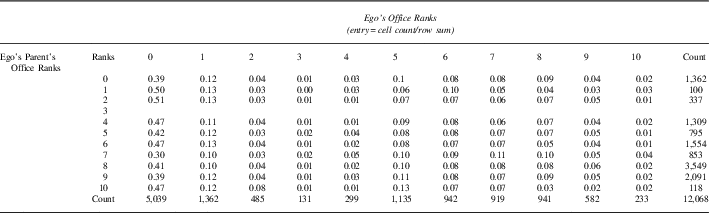
Table 4 and table 5 compare intergenerational social mobility measured at the individual family member level (table 4) and at the aggregate children level (table 5). The total number of entries is 12,068 as we exclude family members without children for comparison.Footnote 14 The individual-level mobility table shows a counterintuitive pattern, which is very similar with the one we observe from table 3. Having a successful parent does not affect the chance of obtaining any office. In fact, having the most successful parent seems to harm the chance of obtaining an office: The conditional probability of having no office increases from 0.39 to 0.47 as parent’s social ranks move from 0 to 10. Again, this does not make sense in any interpretation of premodern Korea.
Ego’s and their parent’s office ranks in Gajeongbo excluding ego without children

Notes: The integer numbers in the column and row indicates social ranks where 1 is the lowest rank, 10 is the highest rank, and 0 indicates no rank. The number indicates proportions.
Ego’s office ranks and the number of their successful children in Gajeongbo

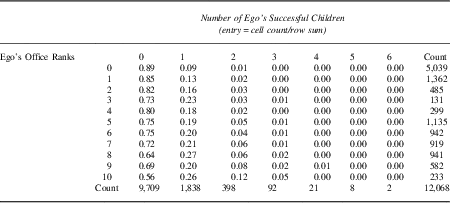
Notes: The integer numbers in the column and row indicates social ranks where 1 is the lowest rank, 10 is the highest rank, and 0 indicates no rank. The number indicates proportions. For example, 0.89 in (0, 0) indicates that out of 5,039 parents with no office, 89 percent of them had no successful children.
However, if we measure the intergenerational social mobility using aggregate children-level data, shown in table 5, we can find a more intuitive pattern. In table 4, we define successful children as the number of ego’s children who obtained a government office position at or above rank 8 (R≥8). The highlighted cells clearly show that having successful parents helps family members acquire a government office while having parents with no government office significantly increases the possibility of having no office. Also, the probability of having one successful child (the third column) increases as ego’s social status increases. The probability of having more than one successful child is extremely low when ego’s office ranks are lower than five. All the patterns in table 5 are highly consistent with our prior knowledge of intergenerational social mobility in premodern societies while the patterns found in table 3 and table 4 are nonsensical.
The absence of a strong association between parents’ rankings and children’s rankings in table 3 is likely to be caused by many factors including complex interplays of parents’ social status, reproduction, multigenerational influences, or the intrafamily resource allocation problem. For example, parents with high social status tend to have many children and many siblings. As a result, they encounter a more severe intrafamily resource allocation challenge than parents with low social status both at the parent (G1) level and at the grandparent (G2) level. Successful parents with many children often had a few unsuccessful children, which cancels out the positive parent effect by successful children. Table 3 and table 4 fail to show the true underlying intergenerational social mobility by ignoring this factor. In contrast, when we aggregate children’s social status at the parents’ level in table 5, the hidden association between the parents’ social status and the children’s social status becomes apparent in the mobility tables.
Next, we need to address the intrafamily resource allocation problem among parent’s siblings to correctly estimate the grandparent effect. Grandparents with multiple children also encounter the same type of mobility-related family resource allocation problem as parents with multiple children do. Here things get more complicated because an unequal distribution of family resources by grandparents can affect grandchildren’s social status in a number of ways. First, grandparents directly affect grandchildren’s social status by concentrating family resources in a subset of grandchildren. Second, there is an indirect path going through (un)successful uncles or aunts who help (obstruct) their cousins’ chances of acquiring high-ranking public positions. Last, grandparents’ decisions on the allocation of resources among parents may affect social status of their grandchildren by differentiating parents’ social status. These multiple pathways are the main reason why it is so difficult to estimate the net grandparent effect from observational data of family genealogies.
We address the problem of estimating the grandparent effect by using a subset of data consisting of grandparents with single child. While the loss of information is sizable and the subpopulation of parents with no siblings is somewhat different from parents with siblings, the bias coming from the multiple pathways can be minimized by narrowing our analysis on the subpopulation. Factors related to the multiple pathways do not confound the estimation of the grandparent effect when grandparents have only one child because these grandparents did not need to divide their mobility related resources and there are no uncle and aunt who influence grandchildren’s social status. We use the Poisson mixed-effects model because the dependent variable is count data and its conditional distribution is likely to be overdisposed. As shown by Gelman and Hill (Reference Gelman and Hill2007) and Gelman et al. (Reference Gelman, Fagan and Kiss2007), the Poisson mixed-effects model provides an effective framework to model an overdispersed, multilevel count data-generating process by adding random disturbances at different levels. In our case, we include random disturbances at the parent level (G2) and the grandparent level (G3). The resulting model can be written as follows:
 $$\eqalignno{ & p\left( {y_{{ijt}} {\rm \,\mid\,}\mu _{{ijt}} } \right){\equals}{{{\rm exp}({\minus}\mu _{{ijt}} )\mu _{{ijt}} ^{{y_{{ijt}} }} } \over {y_{{ijt}} \,!\,}} \cr & \mu _{{ijt}} {\equals}{\rm exp}({\mib{x}} '_{{{\mib{ijt}} }} {\mib{\beta }} {\plus}\alpha _{j} {\plus}\delta _{t} {\plus}\gamma _{i} {\plus}\log \left( {z_{{ij}} } \right)) \cr & \alpha _{j} \,\sim\,N\left( {0,{\rm }\sigma _{\alpha }^{2} } \right),{\rm }\gamma _{i} \,\sim\,N\left( {0,{\rm }\sigma _{\gamma }^{2} } \right) $$
where μ ijt is the mean, x ijt is a k by 1 vector of covariates, i indicates a parent, j indicates a grandparent, and t indicates a generation. Included covariates are parents’ ranks, parents’ connection to the lineage in terms of a surname (1 indicating different surnames from the lineage’s surname due to marriages and 0 indicating the same surname with the lineage’s surname), parents’ birth order (1 indicating the firstborn and 0 otherwise), grandparents’ ranks, and grandparents’ birth order (1 indicating the firstborn and 0 otherwise).Footnote 15
Note that z ij indicates the number of children for parent i, and that this serves as an offset. If we move it to the left-hand side, the covariates are regressed on the rate of successful children. In the last equation, α j represents random disturbances at the grandparent level (G3) and γ i stands for random disturbances at the parent level (G2). Last, δ t is the generation-specific effects, which we control for using generation indicator variables. All the statistical computation is done using lme4 (Bates et al. Reference Bates, Mächler, Bolker and Walker2015) and the bobyqa algorithm (Powell Reference Powell2009).
Results
In this section, we present the results of our statistical analysis. Before we discuss our main results, we present results from the individual children-level analysis using office ranks as the dependent variable. Although children’s office ranks are ordinal data, we treat them as count data and use the Poisson mixed-effects model for easy comparison with our main results. We then discuss the results of the Poisson mixed-effects analysis using the number of successful children as the dependent variable.
Individual Children-Level Analysis
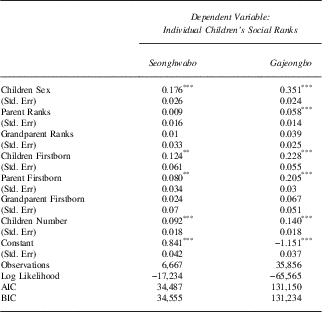
Table 6 summarizes the results of individual-level analysis. As discussed, estimates of the individual-level analysis without proper control for unobserved intrafamily resource allocation suffer from the omitted variable bias. To correctly interpret these results, we have to consider how the unobserved intrafamily resource allocation is correlated with these covariates. For example, if we assume that parents would concentrate resources more into sons than daughters, then the covariance of a child’s sex and the allocated resources could be considered to be negative. The estimate of children’s sex is then likely to be overestimated, as the bias term (
 $\beta _{2} {{Cov(x_{i} , z_{{ij}} )} \over {Var(x_{i} )}})$
would be negative: β
2>0 and Cov(x
i
,z
ij
)<0.
Poisson mixed-effects analysis on individual children’s social ranks

Notes: Random effects are added at ego, parent, and grandparent levels, respectively. The dependent variable is individual children’s social ranks where 1 is the lowest rank, 10 is the highest rank, and 0 indicates no rank. Continuous variables are centered for the analysis.
*p<0.1. **p<0.05. ***p<0.01.
Following the same logic, if we assume that parents concentrate resources into a firstborn child more than nonfirstborn children, then the estimate of “Firstborn Child” is likely to be underestimated as the bias term would be positive: β 2>0 and Cov(x i ,z ij )>0. Here we are only considering the intrafamily resource allocation problem at the parent level. Accounting for the intrafamily resource allocation problem at the grandparent level becomes more complicated. Thus, it is obvious that researchers cannot make a reasonable inference about effects of multigenerational factors using this methodology when social status of children is an aggregate product of family inputs.
Parent-Level Analysis Using the Number of Successful Children
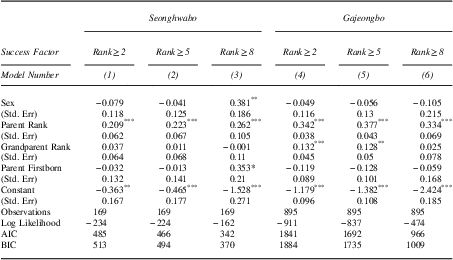
Table 7 shows the results of the Poisson mixed-effects analysis for parents without siblings. Note that the random effect for sharing the same grandparent is dropped because grandparents have only one child in this data set.
Poisson mixed-effects analysis of the number of successful children of parents without siblings

Notes: Random effects are added at the parent level and at the grandparent level. The dependent variable is the number of successful children. Generation fixed-effects are not reported to save space. Continuous variables are centered for the analysis.
*p<0.1. **p<0.05. ***p<0.01.
The first item to note is the positive parent effect across different definitions of “successful” children. This presents strong empirical evidence of the rigidity of social stratification in premodern Korea. The size of the parent effect is quite large. For example, the coefficient of 0.334 in column (6) implies that parents with the highest government office have, on average, 1.49 more highly successful children (R≥8) than parents with no government office.Footnote 16
Next, we examine the grandparent effect. In table 6, we compare grandparents who had only one child, so the G2 intrafamily resource allocation problem does not factor in here. The coefficients of “Grandparent Rank” in Seonghwabo are statistically insignificant, which may be caused by the small sample size of grandparents with a single child in Seonghwabo (N=169). In contrast, the coefficients of “Grandparent Rank” are statistically significant and positive in two cases of Gajeongbo, columns (4) and (5). That is, grandparents with higher government offices tend to have more successful grandchildren (defined as either R≥2 or R≥5) than grandparents with lower government offices. The size of the effect is not small. Holding other things constant, grandparents with the highest government office have 0.46 or 0.44 more successful grandchildren (defined as either R≥2 or R≥5) than grandparents with no government office. Of course, here we cannot separate the grandparent effect from the only-child effect at the parent level. This is the price we have to pay to reduce a bias in the regression estimates.
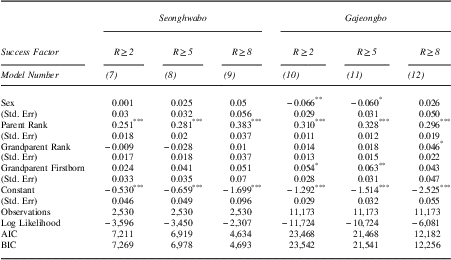
Table 8 shows the results from parents with siblings. These results need to be interpreted with care because of the G2 intrafamily resource allocation problem. Covariates that are positively correlated with allocated resources are likely to be underestimated and covariates that are negatively correlated with allocated resources are likely to be overestimated.
Poisson mixed-effects analysis of the number of successful children of parents with siblings

Notes: Random effects are added at the parent level and at the grandparent level. The dependent variable is the number of successful children. Generation fixed-effects are not reported to save space. Continuous variables are centered for the analysis.
*p<0.1. **p<0.05. ***p<0.01.
Again, the parent effect is positive across all measures and in both lineages. The size of the parent effect is similar to that in table 7. For example, 0.383 (under R≥8) in Seonghwabo substantively implies that parents with the highest government office had average 1.29 more highly successful children than parents with no government office.
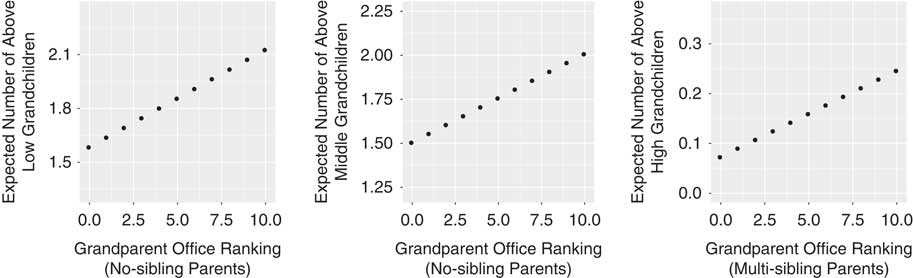
Next, the grandparent effect is found only in one case at the 95 percent confidence level, in column (12). However, the effect size is too small to be considered substantively meaningful. To better understand the estimated grandparent effects, we simulate predicted numbers of successful grandchildren from columns (4), (5), and (12). All continuous covariates are set at their mean values and the social status of grandparent varies from 0 to 10. Figure 4 visualizes predicted values and their confidence intervals.
Predicted numbers of successful grandchildren: Dots indicate expected values and vertical bars are 90 percent prediction intervals.

The panel on the left shows the grandparent effect in Gajeongbo column (4) where the number of successful children (defined as R≥2) changes as the social status of grandparents changes from 0 to 10. The panel in the center shows the grandparent effect in Gajeongbo column (5) where the number of successful children (defined as R≥5) changes as the social status of grandparents changes from 0 to 10. These two cases are from grandparents with a single child. The panel on the right shows the grandparent effect in Gajeongbo column (12) where we fit the same model to the data set consisting of grandparents with multiple children.
The panel on the left and the panel in the center show a similar pattern of the grandparent effect: A change in the grandparent’s social status from minimum to maximum increases the expected number of successful grandchildren from 1.5 to 2.0. In contrast, the panel on the right shows a very small effect. Note that the scale on the y-axis is different between the first two panels and the right panel.
To summarize, the results in table 7 and table 8 clearly show strong positive associations between parents’ social status and the number of successful children, in both the Seonghwabo and the Gajeongbo clans. Also, we find a positive grandparent effect on the number of successful children in two cases in the Gajeongbo.
Analysis of Reproduction Success
Multigenerational factors that affect social mobility also interact with fertility (Mare Reference Mare2011; Song et al. Reference Song, Campbell and Lee2015). As discussed, parents with high social status tend to have many children and thus encounter a more severe intrafamily resource allocation problem. By counting the number of successful children as outcome variables, our analysis is conditional upon the availability of offspring data. To complement our analysis, we investigate multigenerational factors affecting parents’ reproductive success.
We coded the dependent variable as 1 for parents with at least one child and 0 for parents who did not report any children in the jokbo. We employed a mixed-effects logistic regression model with random effects at the grandparent level:
 $$\eqalignno{ & {\rm logit}\left( {y_{{ijt}} {\equals}1} \right){\equals}x_{{ijt}} \beta {\plus}\alpha _{j} {\plus}\delta _{t} \cr & \alpha _{j} \,\sim\,N\left( {0,{\rm }\sigma _{\alpha }^{2} } \right) $$
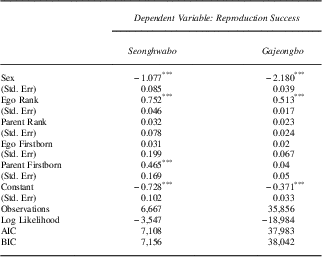
As we coded the reproduction success as 1, a negative coefficient indicates a lower chance of having at least one child and a positive coefficient is associated with a higher chance of having at least one child.
Table 9 reports the results of the mixed logit analysis on childlessness. First, ego’s social status is an important predictor of reproduction success in both lineages. That is, elite family members with high government office rankings are more likely to have at least one child than elite family members with low government office rankings. The odds of having a child increase by 6.20 (Seonghwabo) and 5.30 (Gajeongbo), respectively, when ego’s social status changes from minimum to maximum.Footnote 17 However, the parents’ social status does not have a statistically significant effect on reproduction success.
Mixed logit analysis on childlessness

Notes: The dependent variable is 1 if an ego has at least one child and 0 otherwise.
*p<0.1. **p<0.05. ***p<0.01.
Next, being a daughter (or, de facto, a son-in-law) significantly decreases the chances of reproduction. The odds of having a child among daughters are 66 percent (Sunghwabo) and 89 percent (Gajeongbo) lower than those among sons, respectively.Footnote 18
While we do not find a consistent effect of ego’s birth order relative to successful reproduction, we do see that the parents’ birth order has a statistically significant effect on a child’s reproductive success in Seonghwabo. With a parent as a firstborn, the child has a higher chance of gaining a successful government position. We do not find a similar effect in the Gajeongbo.
Discussion
A series of recent studies have shown new evidence of multigenerational effects in social mobility and demographic processes. This article aims to contribute to this line of research by extending multigenerational mobility studies into premodern Korea. The premodern Korean case is particularly useful thanks to the availability of jokbo, the multigenerational records of elite families. We hand-coded and digitized socio-demographic information in the two oldest extant jokbo, then reconstructed them into prospective genealogical microdata following their publication dates. The resulting data set covers the record of two elite lineages (N=42,525) over five generations (roughly from the late Goryeo dynasty [918–1392] to the early Joseon dynasty [1392–1910]). To our knowledge, this data set comprises the most detailed and extensive genealogical microdata that have ever been analyzed.
To investigate the nuanced processes of multigenerational social mobility, we developed a simple theory to explain an individual’s social status as a product of lineage strategies. In premodern Korea’s “ambiguous stratification system,” the most effective way to maximize an elite lineage’s social influence and long-term continuity was to produce eminent high-ranking government officials. The predominant importance of high-ranking officials to the reputation of a lineage and the limited number of these positions generated strong trade-offs between the quantity and quality of offspring’s government office rankings relative to a family’s lineage strategy. Parents and grandparents, as the agents directing mobility-related resources, had a strong incentive to concentrate their mobility-related resources into a few selected offspring with high chances of achieving high-ranking offices even though this decision might sacrifice the other offspring’s chances. Elite lineages pursued intrafamily interactions and intralineage interactions toward the goal of producing eminent high-ranking government officials. In this regard, we argue that an empirical search for associations between parents’ and individual children’s social status is likely to fail because of the multigenerational interactions leading up to the acquisition of government offices. To account for this difficulty, we present an empirical model that considers social status of offspring in aggregate.
We present several important findings to support our theory. First, mobility tables between parents’ and individual offspring’s social status show no meaningful pattern across ranks, which appears counterintuitive. When we use aggregate measures of the social status of offspring by counting the number of successful children, we were able to find strong evidence of intergenerational status inheritance in elite lineages.
Second, the Poisson mixed-effect analysis consistently demonstrates a positive and statistically significant effect of the parents’ social status on the number of successful children. The effect size was quite large. These results show that parents with the highest government office have about three more highly successful children (defined as R≥8) than parents with no government office on average. This implies not only a rigid intergenerational status inheritance but also a high correlation between social status and reproduction capacity. The findings of the mixed-effect logit analysis using reproductive success as the outcome variable show that parents’ social status has a strong positive effect on reproduction success. Parents with higher government office ranks are more likely to have at least one child than parents with lower government office ranks.
Third, we find that the social status of grandparents has a positive and statistically significant effect on of the status of grandchildren, particularly when grandparents have only one child. Grandparents with higher government offices tend to have more successful grandchildren (defined as either R≥2 or R≥5) than grandparents with lower government offices. The effect size is not small: Holding other things constant, grandparents with the highest government office have about 1.5 more successful grandchildren (defined as either R≥2 or R≥5) than grandparents with no government office.
Overall, the results from our analysis of premodern Korean genealogical data reaffirm the importance of a multigenerational approach to social stratification, as emphasized by Mare (Reference Mare2011). Our article highlights that the identification of the grandparent effect or even the parent effect, main quantities of interest in the statistical analysis of social mobility, can be confounded by parents’ and grandparents’ decisions to unequally allocate mobility-related resources across their children or grandchildren. This inferential problem, which we call the intrafamily resource allocation problem, poses a particularly daunting challenge when we analyze societies where multichild families are dominant and the allocation of rivalrous family resources has significant impact on the ensuing social status of offspring.
Although we did our best to collect all the available genealogical data in premodern Korea, the data collection is still in progress and a couple of limitations of our study should be acknowledged. First, our study examined only two eminent elite family lineages in premodern Korea, and these two lineages are not random samples of the entire elite family lineages. Although we strongly believe that major elements of social stratification processes observed in these two lineages are hardly outliers, the representativeness of the examined cases and the findings needs to be confirmed by future studies. Second, our study focuses on elite families and social stratification processes of nonelite families in premodern Korea, which is a highly important subject, is beyond our scope. Third, our study does not include other types of social ranks such as religious positions or royal connections, which must be important but difficult to compare with official ranks. We aim to examine these sources in our future research.
While this study focused on the instance of premodern Korea, there are many societies in which parental inputs of rivalrous mobility-related family resources affect children’s social ranks. Parents and grandparents in premodern Korea pursued a strategy maximizing the chance of producing high-ranking offices from their children and grandchildren. As a result, parents and grandparents sought to maximize their children’s social status in aggregate, rather than individually. The findings of our study suggest that when parents and grandparents maximize the quality of their children’s aggregate social ranks rather than individual children’s social ranks, an unequal distribution of rivalrous mobility-related family resources is highly common and pairwise associations between parents’ characteristics and children’s social ranks are dependent. The same is true for the grandparent-grandchildren relationship. The conventional regression analysis using children’s social ranks as the unit of analysis or mobility tables can suffer from an omitted variable bias. It is highly important to consider what types of goals (or strategies) parents and grandparents pursue in the allocation of mobility-related family resources across their children and grandchildren.
Supplementary material
To view supplementary material for this article, please visit https://doi.org/10.1017/ssh.2018.38