1. Introduction
Observation is the backbone of astronomy. By combining observations made by optical, radio, infrared, ultraviolet, and x-ray telescopes, astrophysicists can learn about the nature of various astronomical objects. Astrophysics faces methodological challenges as a result of having access to predominantly observation-based data rather than traditional experiments.Footnote 1 To circumvent these challenges, astrophysicists frequently rely on computer simulations. Recent technological innovation has brought unprecedented growth in the understanding of the universe through the use of computer simulations. Contemporary astrophysics deploys a blend of observation and simulation to develop theories and models about the nature of objects in our universe and the structure of the universe itself. It is clear that astrophysicists routinely use simulations to generate knowledge about systems in the universe that goes beyond the knowledge inferred from observations alone.
However, there is philosophical debate about whether simulations can genuinely produce knowledge about the world. Simulations are built using our prior knowledge of systems (either theoretical or observational), and some argue they cannot be ampliative. Simulations, in contrast to real-world experiments, do not allow direct access to the real-world target systems of interest and only investigate the real world indirectly. They are also constructed from information the simulator already has access to. So, it is unclear what, if any, new information can be learned from them. There is also disagreement regarding what, if anything, justifies making inferences about target systems from simulations.
In this article, I examine the inferential role of computer simulations in the context of astrophysics. I will argue that simulations do allow us to make inferences that go beyond inferences available from prior observations. I begin by arguing that obtaining a better understanding of the relationship between observation and simulation in astrophysics is necessary to support the inferences routinely made by scientists in this area (sec. 2). In section 3, I look at a case study of the development of simulations used to understand a particular astrophysical phenomenon: collisional ring galaxies. With this setup, in section 4, I argue that there are three epistemic roles computer simulations play in astrophysics: hypothesis testing, exploring possibility space, and amplifying observations.
2. Methodological Challenges of Astrophysics
Astrophysics faces challenges because it is an observational science (Weisberg et al. Reference Weisberg, Jacquart, Madore and Seidel2018). One of the sources of methodological challenges is that there is no access to traditional experiments—astrophysicists cannot perform experiments on stars and galaxies in any way. If material experiment is important for drawing inferences about a system, then astrophysicists are at a significant disadvantage because they do not have objects of study they can interact with directly. Astrophysicists cannot interact with or influence their objects of study; they face an observation-based epistemic challenge as they can only observe them in their natural environment.Footnote 2
A second source of methodological challenges stems from the fact that astrophysicists cannot observe change in the same object over relevant timescales—very rarely can one observe change in the same object over time.Footnote 3 The observational data that astrophysicists can obtain do not change quickly, often remaining static for thousands of years. Astrophysicists thus face a sparseness-of-data issue and are confined to one observational “snapshot”—a single time slice of the object under investigation.
In this situation of little to no capacity to intervene on the objects of study and limited observational data available, use of data one does have access to (i.e., observational snapshot data) is critical. To make the fullest use of what data are available, astrophysicists rely on computer simulations. Thus, the role of simulations in buttressing observations in astrophysics is of central importance. This raises philosophical questions about how observations and computer simulations work together to develop evidence and justify epistemic claims about astrophysical phenomena.
In philosophy, there is a broader debate about the epistemic status of computer simulations in science. Some philosophers have argued that a material object-target correspondence is a defining feature for experiments and that this correspondence is responsible for the advantage of experiments (Guala Reference Guala, Magnani and Nersessian2002; Morgan Reference Morgan2005). The suspicion, or conviction, is that the experimenter simply has more epistemic access to her target than those running simulations do. As such, computer simulations are thought to always be epistemologically inferior to real experiments. However, others (Parker Reference Parker2009; Parke Reference Parke2014; Morrison Reference Morrison2015) argue that material correspondence is not, and should not be, thought of as necessarily the best route to valid scientific inferences. Rather, they take simulations to be more on par with experimentation. Still others, such as Winsberg (Reference Winsberg2010), argue that if we want to characterize the difference between simulation and experiment we should focus on the epistemological features of how researchers justify their belief that an experiment or simulation (object) can stand in for the target system. In doing this we see the key difference is “the character of the argument given for the legitimacy of the inference from object to target and the character of the background knowledge that grounds the argument” (63). For simulations, the argument for their legitimacy is supported by aspects of the model-building practice.
In astrophysics, because experiments are simply not possible, it is not a question whether experiment or simulation is epistemically preferable. Beyond mere observation, computer simulations are generally the only means by which to investigate the systems of interest. Rather than showing how these computer simulations do or do not meet the epistemic standards philosophers have endorsed, I advocate that we look at how the scientists actually use these tools. If astrophysics is expanding its knowledge using simulations, then it seems simulations can be a legitimate route to knowledge.
3. Observations and Simulations in Practice: The Case of Ring Galaxies
In this section, I discuss the example of collisional ring galaxies to demonstrate how astrophysicists use simulations in order to investigate phenomena in a way that goes beyond the information available in their observational data. As detailed above, observationally, astrophysicists are confined to snapshots. Some examples follow.
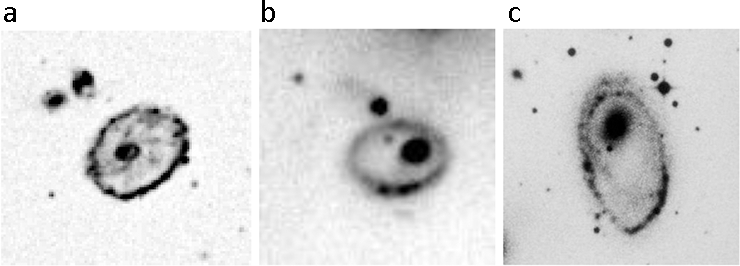
Most galaxies have relatively standard shapes that fall into two primary classification types: spiral or elliptical. However, not all galaxies will fall into these categories (Arp and Madore Reference Arp and Madore1987). The galaxies like those seen in figure 1 are much rarer in their occurrence and are categorized as a collisional ring galaxy. First observations of ring galaxies like the Cartwheel ring (fig. 1a) can be traced back to Fritz Zwicky, who considered them to “represent one of the most complicated structures awaiting explanation” with respect to how they obtained their shape (Zwicky Reference Zwicky1941, 137). Throughout the 1950s and 1960s, as astrophysicists developed catalogs and atlases of galaxies, a number of these ring galaxies were discovered. Technological advances allowed for observations of these systems at different wavelengths along the electromagnetic spectrum. However, the challenge still remained that it was not possible to observe these systems on the relevant timescales in order to see the changes in the objects’ structure or composition and, in particular, what led to their existence. The only other means by which to investigate these target systems was to construct a simulation in order to probe what could possibly cause the ring galaxy phenomenon.
Optical v-band images of collisional ring galaxies taken from NASA/IPAC Extragalactic Database. a, ESO 350-40, Cartwheel Galaxy; b, II Hz 4; c, AM 0644-741. (Photos: NASA.)

In 1976, astrophysicists Roger Lynds and Alar Toomre developed numerical simulations in order to investigate ring galaxies. Developing point-particle computer simulations, they explored their hypothesis that ring galaxies are the result of a head-on collision between a compact companion galaxy and a larger disk galaxy system of just the right mass (Lynds and Toomre Reference Lynds and Toomre1976).Footnote 4 In these early simulations, they did not aim to capture the exact trajectory of every element of the galaxy; they simply wanted to provide a general account for how these galaxies may have developed or obtained their ring shape. Through the use of the simulations, the velocity and masses of the two galaxies were varied as a means of exploring how the two galaxies might interact. They also varied the angle of impact, in order to determine what conditions are necessary for these ring galaxies to obtain their ring shape. The simulation results supported their hypothesis, giving rise to what is now astrophysicists’ basic understanding of collisional ring galaxy formation.
The ring shape is not the only observationally defining feature of these galaxies, however. Observational snapshots also indicate strong star formation (bright, blue stars developing as a result of the collision), indicating that ring galaxies are gas rich (Appleton and Struck-Marcell Reference Appleton and Struck-Marcell1996). As computational capacities developed, astrophysicists developed simulations that moved beyond simple point particles, incorporating self-gravity and gas dynamics. Incorporation of these features led to simulations having a higher resolution of features in the ring galaxies and more closely representing their intended target systems’ properties.
The development of better computational capacities resulted in the ability to incorporate more of what is known about the target system from the observational snapshots into the simulations. During this process, astrophysicists identified an additional observational signature of some ring galaxies: spoke structures (Hernquist and Weil Reference Hernquist and Weil1993). Spoke structures in ring galaxies (such as that seen in fig. 1a) is a spiral-like arm in the interior to the ring. There are often only one or a few spokes, and they are less clumpy in appearance.Footnote 5 By developing a suite of simulations that incorporate self-gravity and gas dynamics and varying parameters, astrophysicists developed a possible account of the origin of the spokes as resulting from gravitational instabilities in a mainly gaseous, rather than a stellar, disk (Hernquist and Weil Reference Hernquist and Weil1993). Additionally, these simulations allowed astrophysicists to identify at what temporal point in the ring galaxy collision spokes were likely to develop.
Contemporary simulations of ring galaxies aim to incorporate gas density, dark matter, stellar feedback of bulge stars and newly formed stars during the course of the simulation, as well as the concentration class of particles. Use of contemporary simulation codes, such as GIZMO (Hopkins Reference Hopkins2015), provides a theoretical foundation for the simulations of the collisional ring galaxies. The code is based on components of the universe, which is taken from the Lambda Cold Dark Matter (ΛCDM) understanding of the universe. It also includes as initial conditions constraints taken from the cosmic microwave background (CMB), which helps to constrain the possibility space and configurations that particles in simulations can take. Finally, the code includes the basic laws of physics, in particular that gravity drives structure formation. Some contemporary ring galaxy simulation projects also include FIRE: Feedback in Realistic Environments. GIZMO is one of the first codes to prioritize inclusion of fluid dynamics, including star formation and feedback as a critical part. Prior simulations (such as some developed through the GADGET code) have typically left out these features, yet these features are essential to how a single galaxy develops and evolves over time (Wetzel et al. Reference Wetzel, Hopkins, Kim, Faucher-Giguère, Kereš and Quataert2016). These simulation inputs are also partly based on observationally informed estimates of feasibility—including stellar mass-size relation, bulge-to-disc ratios of target galaxy, gas fractions and masses, gas scale length, Navarro-Frenk-White dark matter halo profile so that rotation curves lie on the baryonic Tully-Fisher relation, and the total mass-to-light ratio varying with mass. Each of these parameters can be further varied as a means to investigate the impact of the feature on the overall structure and development of the ring galaxies. This next generation of simulations incorporates even more observationally informed background knowledge of these systems, with the hope of increasing resolution and accuracy of single galaxy evolution over time.
4. The Epistemic Roles of Computer Simulations in Astrophysics
This case study of collisional ring galaxies shows that there are at least three key roles computer simulations play in astrophysical reasoning processes: hypothesis testing, exploring possibility space, and amplifying observations. Highlighting each of these three roles is important. While hypothesis testing may be the most controversial role for computer simulations, exploring possibility space is a role underemphasized in current discussions. Finally, the role of simulations in amplifying observations is not acknowledged in the current literature on modeling.
4.1. Hypothesis Testing
One role computer simulations play in astrophysics is in hypothesis testing. By this I mean cases when a scientist develops a specific hypothesis and uses a simulation to determine the likelihood of the hypothesis or to refute it completely. This can be seen in the initial 1976 simulations, in which the role of the simulation was to test a possible explanation for how a galaxy could obtain this peculiar ring shape. The simulations are testing the hypotheses of the rings obtaining their shape through these collisions and whether the cause is competent to produce the result. We also see continued hypothesis testing over varying complexities as the simulations develop from point-particle simulations to the more contemporary simulations with feedback and fluid dynamics. The simulations are further developed in order to account for more observational features of the real-world target system. As features of the target system are added in, we see the accuracy and details of these simulations improve as well. With the addition of details that might influence the results, the hypothesis continues to be tested and gains credence—even with additional details, a collision still produces the ring galaxy.
Winsberg (Reference Winsberg2010) thinks that the role of hypothesis testing cannot ordinarily be played by simulations (71). He argues this is because simulations “assume as background knowledge that we already know a great deal about how to build good models of the very features of the target system that we are interested in learning about” (71). Simulations can be used to calculate what a certain model would predict in a particular situation, and that prediction can then be compared with data from experiments and observation (69–70). But the role of simulations is in testing models, which is not the same sense of testing as in experiments.
I think Winsberg is right that the trustworthiness of a simulation depends on the quality of background knowledge (and skill with which that background knowledge is applied to develop the simulations). In the context of astrophysics, the simulation data are compared to observational data, and this helps determine the trustworthiness of the simulation. But again, because of the methodological challenges in astrophysics, comparison with observational data is extremely limited and in some cases impossible because there are no observations. Moreover (diverging from Winsberg), I think it is clear that the simulations are not just testing a model but are playing the role of hypothesis testing in astrophysics. Consider the basic nature of hypothesis testing: it involves producing a hypothesis, a conjectural statement, and determining expectations should that hypothesis hold, in order to boost the support of (or undermine) the hypothesis. In the case of ring galaxies, the hypothesis is that the object was originally a disc galaxy that underwent a collision and, as a result of that collision, obtained its ring shape. The hypothesis is tested by building simulations based on background knowledge obtained from observations of the systems and exploring whether a collision is competent to produce the result. Through the simulations, they were able to identify conditions under which ring galaxies were produced and conditions under which they were not produced. This led to a modified claim: that the ring galaxy is produced when two galaxies of the right masses undergo a head-on or near-head-on collision. While a direct experiment would be helpful, as discussed above, for these kinds of systems in astrophysics this is the only means by which hypotheses can be tested.
What is required of course in this reasoning is the additional (but often implicit) assumption or inference that what holds in the simulations should also be expected to hold in the real-world target system. In this context, this inference is warranted for exactly the reasons Winsberg highlights as fundamental to the methodology of simulations—that simulations can stand in for the target because of model-building practices. One can justify this inference along the lines of appeal to background knowledge (knowledge that stems from observations) and principles of model building (inclusion of knowledge from relevant theories, soundness of physical intuitions about the target system, and soundness of computational methods; Winsberg Reference Winsberg2010, 64–65). But what Winsberg does not acknowledge—and what is critical for the use of simulations in contexts like astrophysics—is that background knowledge based in observations gives the simulation the requisite similarity, providing grounding for the object-target correspondence needed for hypothesis testing. But it is the simulation that actually serves the role that allows the astrophysicists the means by which to test, and then support or refute, a hypothesis.
4.2. Exploring Possibility Space
A second role simulations play is exploring possibility space. By this I mean running a simulation with multiple different parameterizations to establish an understanding of the boundaries inside which a phenomenon takes place. A critical step in the development of simulations of ring galaxies is the changing of parameters in order to explore what impact they might have on the development of collisions that result in a ring galaxy formation. Through the process of changing various input parameters, astrophysicists are able to learn under what conditions a ring galaxy forms, and, perhaps more importantly, under what conditions a ring galaxy does not form. In the development of the simulations (of varying complexities), there are some same boundaries and conditions in which such a ring galaxy will fail to develop. While information from observational snapshots can provide a starting point for investigation, it is only through the use of the simulations that astronomers can determine the boundaries, thereby constraining the possibility space for when a ring galaxy will not form.
The role of simulations exploring possibility space can be likened to robustness analysis. The main idea in conducting robustness analysis is to compare several different models, each built using somewhat similar yet distinct assumptions. If these models all have a similar enough prediction as their output, or if all identify a similar common feature, then that prediction or feature is considered well supported, or robust. In Weisberg’s (Reference Weisberg2013) discussion, parameter robustness involves examining what happens when the values for the model’s parameters are varied. In this case, the simulator intends to examine to what extent the change of parameters changes the behavior. Structural robustness analysis involves adding new mechanistic features to the simulation in order to examine how parts of the causal structure represented in the model produce different behaviors or properties in the simulation (162). In the case of ring galaxies, the astrophysicists change parameter values in their simulation and compare the results, as well as compare results across different simulation techniques. Given that several simulations with different assumptions or features all provide the same output, one should consider this to be evidence that the feature is likely to be a feature of the real world as well.
In Weisberg’s discussion, the goal of robustness analysis is focused solely on positive results—development of robust theorems. Many philosophers and scientists have appealed to robustness analysis as a method for determining whether a model’s output is the result of something essential to the target system or an accident of the assumptions made in constructing the model (see Weisberg [Reference Weisberg2013] for further discussion). In order for robustness analysis to proceed, one must assume that the ensemble of models (in this case simulations) covers the possibility space of ways to represent the target system. Again, a clear role the simulations are playing in this context is exploring and constraining that possibility space by determining boundary conditions under which a ring galaxy will form.
Simulations in astrophysics, however, play more of an exploratory role than this focus on robustness analysis might suggest. The way simulations also explore the possibility space differs from robustness analysis in that the goal is less directed at determining the conditions that give rise to (or defeat) a particular phenomenon. The sense in which simulations can explore the possibility space is by attempting to completely characterize all the possible outcomes. Simulations can be useful for developing a compressive understanding of the mapping from parameterizations to outcomes. This is slightly different from robustness analysis, which aims to differentiate important predictions of our models from those that are accidents of representations by identifying “the different ways that the core structure can be defeated” (Weisberg Reference Weisberg2013, 160). Robustness analysis aims at identifying robust phenomena and robust theorems. The sense of exploring possibility space I argue for here is more open-ended and less directed. In the case of collisional ring galaxies, we determine under what conditions a ring galaxy structure does and does not occur. But we also explore how parameters, for example, might produce a tightly formed, dense ring or produce a loose, fluffier ring. This goes beyond merely determining what the defeating conditions for a hypothesis are and explores what effect various parameters might have on producing a suite of possible phenomenon.
4.3. Amplifying Observations
A third role of simulations in astrophysics is amplifying the observations. Amplifying observations occurs when the output of a simulation provides a new and sometimes unexpected context in which to interpret the data present in the observation. In this way, simulations allow astrophysicists to yield more information out of observational snapshots than they were able to before running the simulations. The simulations provide a means by which to learn about features of the target system that they did not know about before, thus enhancing the information derivable from the observations. In order to develop this point, I want to return to one specific feature of ring galaxies discussed above: spoke structures.
As mentioned above, some collisional ring galaxies observed thus far have a spoke structure, while some do not. From one or even a handful of ring galaxy snapshot observations, it is challenging to say much about how these structures emerge. But through running simulations, astrophysicists were able to learn about how and when the spokes form. From simulations, astrophysicists determined that the spokes are not a long-lived structure—they dissolve in just a few rotations, happening on relatively quick timescales. One might worry that in constructing the simulation the spokes were included as part of the code. Yet the spokes are not in any way a feature that the astrophysicists have input into the system by hand; there is not a parameter setting explicitly incorporating a single mechanism that produces the spoke structure. Furthermore, the spokes develop in some but not all of the simulations that have been run with varying, different parameterizations.
It is through simulations that astrophysicists determined that the spokes are short-lived structures in ring galaxies. Having run the simulations, an astrophysicist can then return to her observational snapshot images. She can now recognize that the cases in which there is a spoke structure present in the snapshot now tells her something about the relevant timescales of when the collision to form the ring galaxy happened. She now knows more about what is occurring in the snapshot because of what she has seen and learned through the simulation. The new knowledge garnered from the simulation about the timescales on which the spoke structures are present in ring galaxies allows her to learn more from the observational snapshot than she previously was able to. Namely, she now knows that the observed ring galaxy must be within a certain age range, when the spoke structure would still be present. The fact that the spoke is present has not changed, but the simulation has provided new context that allows the astrophysicist to learn more from its presence than she previously was able to.
Beyond the spokes, simulations have also amplified other defining properties and general evolution of the galaxy during and after the interaction. Many features related to how the galaxy appears in a snapshot also carry more significant information because of what we have learned about them from the simulations. In this context, the role of the simulation is not for the purposes of testing a specific hypothesis (as a hypothesis has not even been formulated) but rather developing a context in which to interpret the information already present in the observation. In that sense, the simulation amplifies the information available in the data. Given astrophysics’ limitations, this ampliative role is especially important as it is one of the ways to move from synchronic data of astronomy to diachronic data of astrophysics. The spoke structure is just one example of the kinds of identifiable features that occur on set timescales in these collisional ring galaxy systems. It is from the simulations that astrophysicists learn more details about how these systems evolve over time. As a result of the simulations already run, snapshots can give more information than they did before.
5. Conclusion
The relationship between observations and simulations in the case of ring galaxies can be used to motivate the value of simulation in astrophysics in general. I have argued for three epistemic roles of simulations: hypothesis testing, exploring possibility space, and amplifying observations. Astrophysics is often constrained to observational snapshots. The simulations provide amplified information from a single observational snapshot, as well as comparisons of multiple snapshots of numerous objects, offering plausible information about the evolution of the objects over time. By the simulations incorporating the information that astronomers have access to via observations, they can provide justification that the scientists are setting parameters to accurately reflect what they know about the real-world target system. This process allows for more information to be derived from astrophysical observations than if one considered the snapshots as synchronic data (absent simulation). Astrophysics is a field in which epistemic uses of simulations are particularly salient, given the limitations of the field’s access to data and its heavy reliance on technology. However, this analysis may be generalizable to other observation-based sciences (such as geology, paleontology, or archeology), particularly those that use simulations to provide a stand-in for system evolution over time.