Introduction
Conducting surfaces with minimal binding energy along the interface, such that energy is coupled between each other, can behave analogously to that of a tightly bound “ocean” plasma. This is constrained to an x, y plane in which appropriate energy impartation, coupled between electrons, can create equivalent mechanical dynamics associated with localized surface waves shaped in part by the ocean landscape and a host of related phenomena. The generation of these surface wave resonances using phase-matched optical coupling is achieved by a number of means including through prisms,[Reference Otto1–Reference Canning, Qian and Cook3] end coupling using various optical wave-guiding configurations and higher-order modes or skew rays,[Reference Kreuwel, Lambeck, Gent and Popma4–Reference Han, Canning, Cook, Hossain and Ding6] and diffractive grating configurations.[Reference Vukusic, Bryan-Brown and Sambles7–Reference Wood9] The optical generation of surface waves, which are sensitive to their environment, has proved to be particularly useful for diagnostic applications.[Reference Homola, Yee and Gauglitz10,Reference Altintas, Fakanya and Atlintas11] Yet the potential for utilizing such excitation pathways can go well beyond exciting sensitive interactions. Here, the optical driven displacement of mass along such a surface, using known processes, is proposed and demonstrated.
Optically assisted forces on a surface
On homogenous interfaces where, for example, resistive flow can be negated, physical displacement of an object on a surface should be possible. By exploiting a bound body of electrons capable of freely transferring kinetic energy in the direction of flow a resistance-free surface may be generated and, with optical assistance, plasmon-enabled movement of mass was demonstrated. Matter interacting with this interfacial sea should be capable of experiencing physical displacement, either plasmon, optical, or a combination thereof. In general, the light beam incident onto a thin film at an angle, θ, passing through a substrate of refractive index, n, will exert a physical force, P i, related to its incident momentum and irradiance, I f, orthogonal to an interface divided by the velocity, c:

This orthogonal incident radiation force is considered a pressure, arising as photons typically are absorbed—the factor of two takes into consideration the recoil force in reflection with no absorption (recoil pressure equivalent to elastic emission ideally). Radiation pressure has been explored across many areas, including solar sails subjected to photon forces from the sun.[Reference Forward12] The net force also has a component along the surface in the direction of travel:

It has typically negligible consequences in most materials when electrons are bound to a rigid surface even when absorption is present. The question is, rather than in the case of reflection, can they be non-negligent on a transmitting or conducting, plasma surface when passing through from below an ultra-thin film, particularly if electrons are assisted by excitation at an appropriate coupling condition? That is, in the case of surface plasmon resonance (SPR) at θ SPR, for example, excited surface waves have momentum transferred from the absorbed photon field to the plasmon field. Consequently, an SPR can have momentum coupled into it from light—in an ideal elastic coupling case on a perfectly smooth surface:

where m SPR and v SPR are the collective electron mass and effective velocity, or energy transfer, of the generated SPR for a given excitation over time t, indicating a finite but small energy transfer along the substrate.
Quantification of the actual forces depends on a number of factors, including the area of excitation, the profile of excitation, material conductivity and uniformity, confinement properties, and planar dimensions. There remains some debate as to the usefulness of qualitative approximations used to date in the analytical derivations of forces on solid particles, which relate particle size to wavelength (e.g. Rayleigh and Mie scattering approximations), a problem that is enhanced here for soft materials. For example, Neves and Cesar recently attempted to circumvent these issues by deriving analytic expression from rigorous electromagnetic treatments.[Reference Neves and Cesar13] It is, however, limited by an implicit starting point of hard spherical interactions with light, which ignores the dipole generation at surfaces of water drops. The problem is substantially more complex and will require follow-up studies beyond the scope of this present work. Otherwise, the qualitative description still holds generally, sufficing to describe the situation involved whilst identifying limitations.
In this work, metallic surfaces are considered. Gold (Au) is selected because it is widely used for SPR generation and diagnostics. Au otherwise may not be the most suitable material because it is difficult to make homogenously smooth surfaces at the scale required for reduced resistance at interfaces. Rather, other materials, such as 2D structures like graphene and silicene or even conducting liquids where roughness can be more readily reduced or eliminated, may be better suited. Nonetheless, an optical demonstration on Au where resistance may be high and the energy required greater would be more challenging, further demonstrating what is possible. Notably, excitation even on a rough surface should help lubricate movement by other means, either optical, thermal, or mechanical displacement of water along the surface.
An additional optical trapping force will be present if light can pass through the surface. In this case of light matching the SPR condition, some light will be ideally absorbed but that which does not is coupled elsewhere or passes through if the film is thin enough. It is this latter case we also explore here.
Water displacement
Water behaves like a dielectric medium and consequently similar traction forces to those observed with dielectric particles[Reference Ashkin and Dziedzic14] can be measured, although the scales are well beyond Rayleigh dimensions and the analysis of single water molecules versus entire drops of water will differ substantially. For a large drop, the spread across the optical gradient will lead to a dispersive force, complicated by the potential for optical beam distortion through refraction, for example, which impacts its momentum. The single molecules can be described by typical Lorentz forces working in the Rayleigh range and within a macroscopic gradient field, since they are much smaller than the wavelength of light; however, this is no longer true for a drop of water. Such a drop on a surface experiences a degree of self-assembly at all interfaces (solid–water, air–water, and air–water–solid contact points), complicating the treatment of a net dipole. Furthermore, surface tension of a drop belies organization at the water–air interface that is long range in nature, potentially well beyond the Rayleigh limit, and the microscopic treatment of the dipole magnitudes is no longer possible to consider as a sum of dipoles. The underlying self-assembly at the interface differs from the bulk within and has a very strong outward dipole, whose direction remains the subject of debate. For this reason, the mathematical analysis is unclear and will need to be the subject of extensive future work. However, it is clear that strong directional charge interactions may generate larger forces than what has been typically associated with small dielectric particles and that these can be tremendously useful now. To a first approximation, a qualitative description might be obtained by noting that the soft nature of the drop will give rise to a frictional drag, F, across one end of the drop at high intensity and the other end at low intensity. Following Stokes' law:

where η is ordinarily the viscosity of air, but given the soft nature of the particle (water drop on a surface) can be equated with the viscosity of the drop itself in air; r is the hemisphere radius, and v would be the measured velocity in the gradient between the intensity at the drop and the optical beam peak intensity to one side. The key here is to note that dragging forces used to analyze solid particles in solution are also impacting the charged solvent and so even existing tweezer methods need to consider the movement of the solvated molecules around the particle under traction. This is especially important because the water dipole alignment around dielectric silica particles is known to form clouds of aligned water that extend significant distances from the particle surface and so there remains ambiguity as to what is most strongly attracted along the optical beam gradient and indeed if it is the particle itself that is experiencing the bulk of the optical force.
The objective in this work is to look for direct evidence of water drop displacement on a gold surface, relying in part on two components: (i) lubricated momentum coupling to the surface waves and (ii) optical traction of a drop of water enabled on the lubricated surface.
Water at an interface experiences collective dipole generation, one which has raised questions about the sign of charge at an interface.[Reference Beattie, Djerdjev, Gray-Weale, Kallay, Lützenkirchen, Preočanin and Selmani15] If the water–air interface charge is initially negative akin to many silica microparticles, then the water drop on a surface might be attracted to the beam peak intensity passing through, whereas if it was positive the opposite may be anticipated.
As a liquid, water has good contact with the substrate interface, through thermal, electrostatic, and hydrogen bonding, leading to the presence of a thin ordered layer that stays on the surface long after most of the water drop appears to have evaporated.[Reference Canning, Tzoumis and Beattie16] The nature of these layers is a subject of significant intrigue—measurements on metal electrodes indicate self-assembled pentagon and hexagon-like arrays[Reference Tokunaga, Nosaka, Hirabayashi and Kobayashi17,Reference Suzuki, Osawa, Yukita, Kobayashi and Tokunaga18] whilst theoretical calculations suggest that the layer at the interface has the array significantly broken in places with OH pointing toward the gold surface.[Reference Stevens and Grest19] This latter interfacial contribution at the edges, along with surface roughness, can help account for the tendency of water to “pin” to a surface, generating some resistance to ideal unconstrained spreading over the surface. It may also explain the reduced electro-optic coefficients measured at metal–water interfaces compared with air–water interfaces on drops.[Reference Tokunaga, Nosaka, Hirabayashi and Kobayashi17] Water has also been used to highlight important microfluidic applications where what would ordinarily be the host medium supporting microparticles in conventional optical trapping work[Reference Bradac20] is instead what is manipulated.
Surface plasmon resonances
The components of the dielectric constant associated with a metal, for example, relate the physically distinct real parts of the refractive index (negative with respect to the dielectric) and the imaginary parts which, in metals, can involve energy loss through displacement and coupling (current) in the electron plasma. The complex dielectric is described as a sum of these two parts:

Light of p-polarization impinging on a metal from the transparent substrate side will generate a time-dependent polarization charge at the interface, whereas s-polarized light does not. Importantly, the plasma (ideally a non-bound charge layer in x, y space) does not have an instantaneous response resisting elastic dissipation of the coupled energy as a result of its association with the rigid surface and environment geometry and also through inefficient shared energy transfer to other electrons. Even on an ideal perfectly flat surface, electrons have a finite mass and scatter energy as phonons or through defect states, including electron–hole pairs, producing the resistive scattering measured as Ohmic loss (or Joule heating). The direction of scatter is determined by the k vector of the impinging light and therefore is controllable. This gives rise to a direct correlation between the SPR frequency and resistivity in the direction of flow—described earlier, there should be a corresponding “plasmo-motive” force present, which water on the surface would feel either in the direction of coupling or away. Whilst this force is probably too small and the surface too rough to be of use, it could aid other processes.
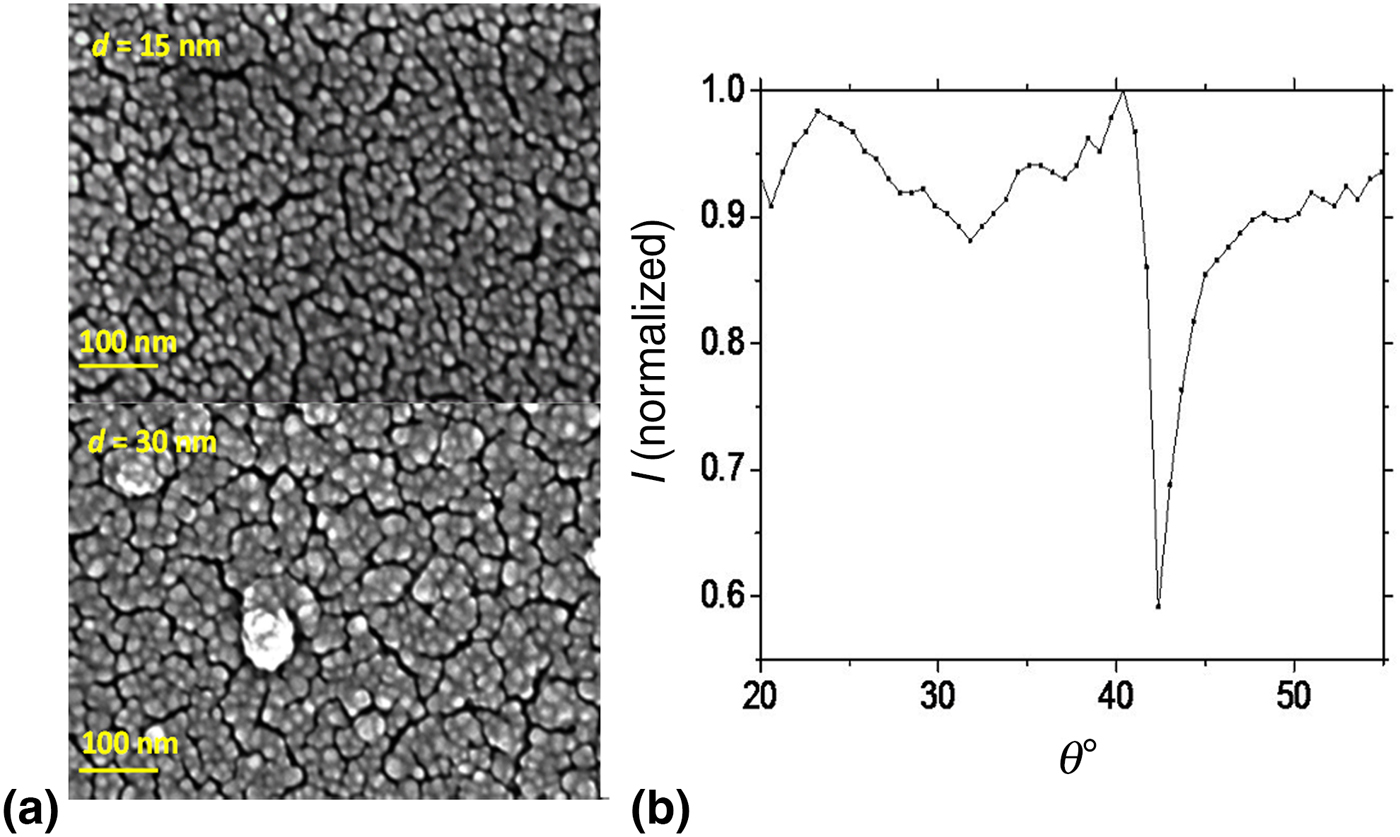
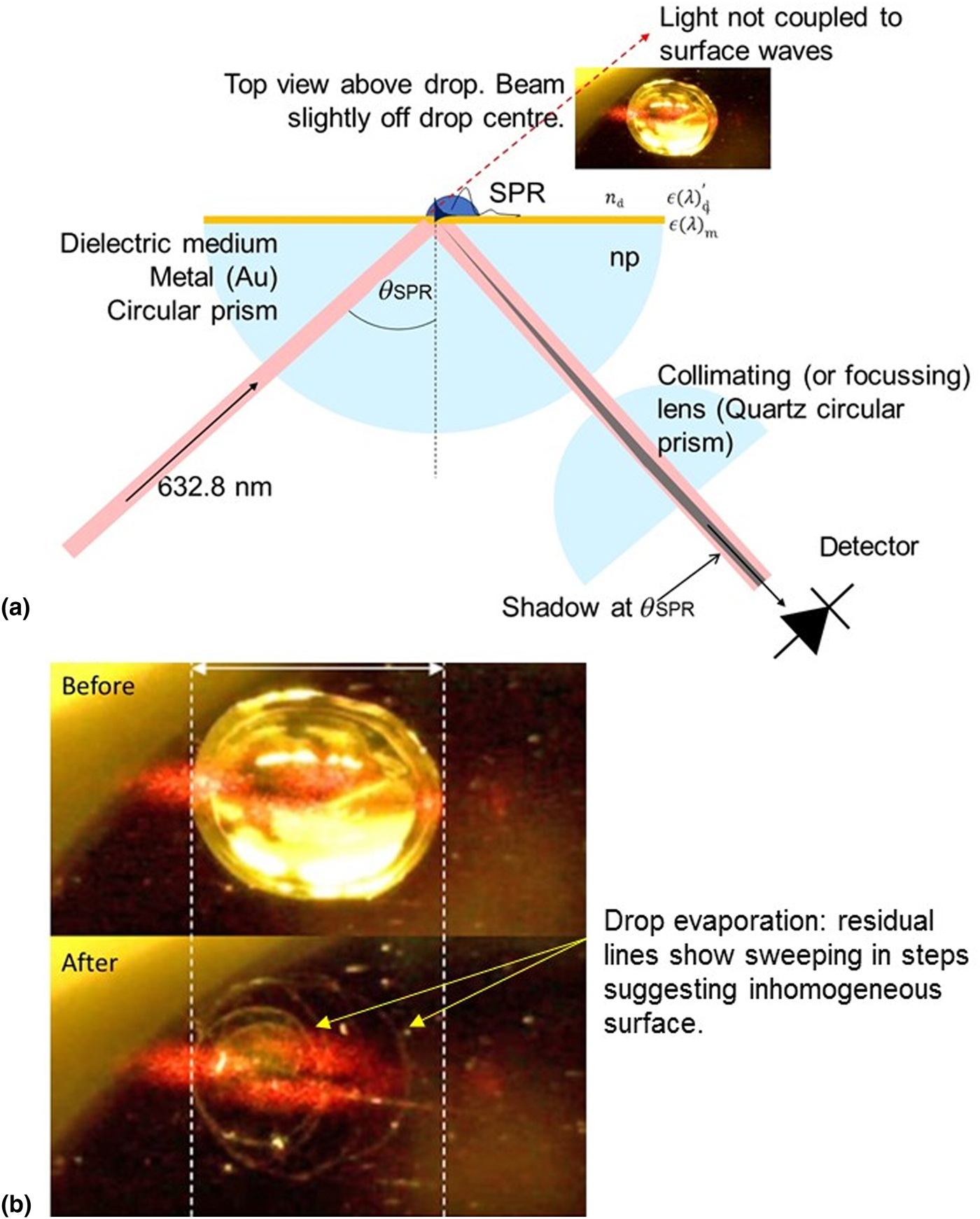
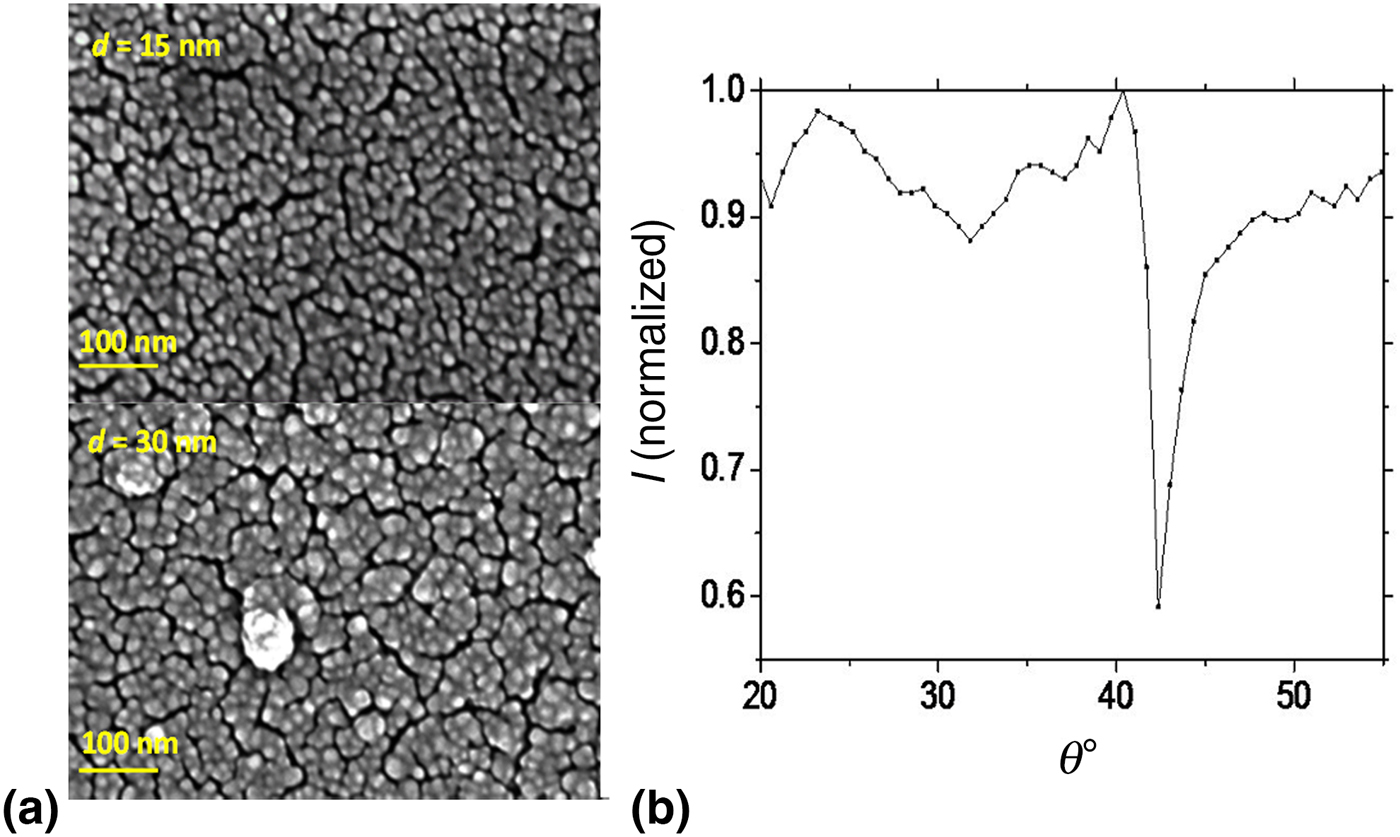
The SPR measurements analyzed here were carried out on a standard home-made Kretschmann setup (Fig. 2) that has also been described elsewhere.[Reference Canning, Qian and Cook3,Reference Canning, Tzoumis and Beattie16,Reference Canning, Karim, Tzoumis, Tan, Patyk and Gibson21] Surface roughness, as evidenced in Fig. 1, broadens and weakens the SPR and greatly exacerbates this resistance due to complicated out-of-plane interactions (analogous to the rough geoformations under an ocean that impact undersea currents). In fact, such out-of-plane interactions alone can lead to additional, emergent angular excitation of SPR conditions as previously demonstrated.[Reference Canning, Karim, Tzoumis, Tan, Patyk and Gibson21] Furthermore, the two-dimensional nature of the surface also constricts perfect oscillations. Consequently, there are discrete or diffuse coupling conditions for many surface phenomena that need to consider these boundaries and practicalities. These may, for example, be guided within strip line configurations for desired device applications and may be extremely important for novel device applications — they can be used, for example, to reduce the size of traditional antennas, including large bulky water antennas,[Reference Fayad and Record22] for next-generation 5G and beyond. An alternative method for tuning tunable liquid lenses[Reference Moran, Dhamatelleke, Khaw, Tan, Chan and Rodriguez23] and indeed tuning the Pockels coefficient at the water interface[Reference Canning24] is offered. Optimal energies below the plasma frequency exist where electrons can collectively respond and dispersion is sufficiently high. So whilst the premise of this work is to demonstrate motion of water at an interface, the physical implications are much greater.
(a) SEM images of two sputtered Au surfaces on borosilicate glass (15 and 30 nm). (b) Intensity spectra of reflected light from as-sputtered Au surface on borosilicate (τ ~ 30 nm). Result reported in Ref. [Reference Canning, Tzoumis and Beattie16]. The broad SPR band and non-zero transmission dip at θ ~ 42° along with the background variation are indications of significant surface roughness, consistent with SEM images.
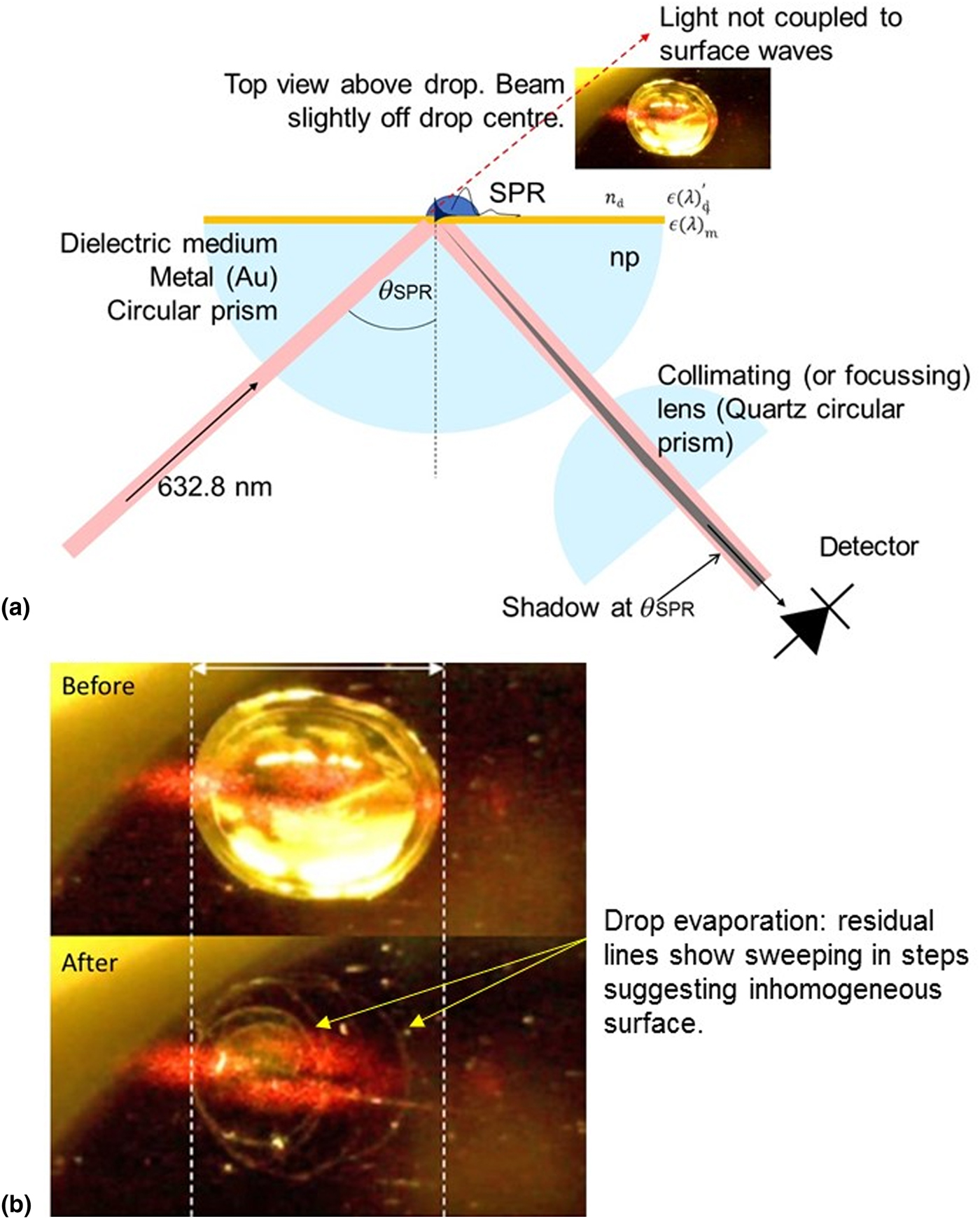
Configuration used to excite SPRs on gold films: (a) the Kretschmann setup used in the experiments and (b) the observable transmission of light through τ ~ 15 nm layers. The HeNe laser used in this work has P = 1 mW. That light matching the SPR condition is absorbed and is seen as a dark region in the center after evaporation. Residual interactions between water and Au can also be seen: outer and inner ring regions are revealed through the illumination of the edges of interfacial water that resists evaporation. These are forensic evidence of movement toward the optical peak on the left.
Generally, the natural sensitivity to electron–hole interactions and geometric constraints makes the surface interface extremely sensitive to environmental perturbations. Consequently, SPR-based detection, a primarily fixed-point approach to date, is therefore widely deployed because of this sensitivity. In many respects, however, a potentially closer analogy is the resemblance to the liquid interfacial state associated with water induced by physically imposed heating on a surface such as ice, one that permits the movement of objects with reduced drag arising from the induced water layer (consider an ice rink). If the impartation on the layer has a direction, then the body creating that impartation moves along accordingly with little resistance. In this analogy, it stands to reason the physical resistance of an object not chemically bound to the substrate under excitation should be greatly reduced and physical displacement with little energy possible. Such realization of physical movement enables an active approach to device fabrication and tuning of electronic, electromagnetic, and physical properties. A manifestation of this will be a greatly reduced energy or power needed to move matter than might otherwise be the case.
Experiments
Given the momentum coupling between light and the surface wave at Brewster-like conditions, the first experiments explored whether movement was feasible with this condition alone—essentially a plasmonic tractor or tweezer effect. Whilst in the approach proposed this should be possible, it may also be considered very unlikely given the quality of many surfaces such as sputtered gold and the importance of minimal and homogenous frictional resistivity. To explore this, a relatively simple measurement based on contact angle measurement, which provides accurate information about an interface, was adopted. A drop of distilled water with a sufficiently small volume to fall within the surface tension-driven spherical caplet limit (V ~ 2 µL)[Reference Dutra, Canning, Padden, Martelli and Dligatch25] was placed onto a gold surface optimized for SPR coupling with thicknesses of τ ~ 15, 30, and 45 nm. In this limit, standard wide-view contact angle measurements are made in combination with SPR excitation allowing a simple but powerful surface characterization technique that can monitor changes of surface properties and drop profile and center of mass during drop evaporation. In practice, a miniature portable microscope system was used to image the drops from the side when sitting on the Kretschmann setup. The drops had to be placed closer toward the prism edge to ensure good imaging. This combined method permitted a simple way to both monitor visual changes in drop shape, size, and position; all of which can be reflected in both images and contact angle for mutual consistency. The contact angle can be manually measured on the screen using microscope camera imaging software—changes arise from both evaporation and displacement as described earlier.
For a review of the potency of contact angle, θ c, measurements for interfacial studies, see Refs. [Reference Canning, Qian and Cook3,Reference Canning, Tzoumis and Beattie16,Reference Dutra, Canning, Padden, Martelli and Dligatch25,Reference Janeczko, Martelli, Canning and Dutra26]. The contact angle reflects the triple point interface between the solid surface, liquid, and air which pins the drop to the surface. The interface is extremely sensitive to chemical and physical properties from molecular to nanoscale and sometimes microscale length interactions depending on the surface viscosity of a liquid. They are are a standard tool to characterize nanoscale surface interactions between liquids and solids, offering a measure of wettability (or attractiveness) between the two states of matter. For the sputtered Au used in this work, water tends to be hydrophilic where the contact angle is θ c ~ 80° for pristine clean surface, typically dropping to θ c ~ 70° or more after initial drop evaporation because a self-assembled layer on the surface can be more tightly bound.[Reference Canning, Tzoumis and Beattie16] A more recent variation extracting the contact angle from diameter measurements from the top rather than directly measuring from the side allows complete surface mapping of an essentially nanoscale property in real time.[Reference Dutra, Canning, Padden, Martelli and Dligatch25] It can also determine asymmetry in surface wettability, making it a particularly powerful technique for studying surface properties and behaviors. For example, it was more recently applied to mapping wettability in orchid leaves over large areas.[Reference Janeczko, Martelli, Canning and Dutra26]
For the initial SPR measurements, the 45 nm layer had no significant SPR profile, consistent with the sample being too thick with little light reaching the surface. By displacing the relative position of the optical coupling below the drop of water, no corresponding displacement of the drop was observed throughout its entire presence after deposition through to full evaporation. Similarly, when light is transmitted at θ ~ 90° for all layer thicknesses (τ ~ 15, 30, and 45 nm), no displacement from optical traction alone is observed regardless of the light passing through. Given the mass of water and surface roughness and pinning, these results are as expected and support the notion that the excitation of the SPR will be important. Ideally, the same plasmo-motive force of the SPR would lead to the movement of a surface sample—unfortunately, close to optimal thickness (τ ~ 30 nm) for maximum optical absorption and coupling of an input HeNe laser beam, no visible displacement is observed, suggesting such a force is too small to overcome residual friction arising from surface variability, as confirmed by atomic force microscopy.
The question then is if inhomogeneity and variability in surface roughness play a key role in increasing resistivity across a surface, could sufficiently greater force be utilized to overcome this resistance? In this situation, optical forces related to the interaction between a light beam and a dielectric or conducting dielectric (such as a self-assembled water layer at the interface) may be exploited. Ordinarily, these optical forces are not considered substantive to move anything other than attract small micron-scale particles in unconstrained free space or within a flowing liquid. Given the potential of a plasmon-like sea to provide near frictionless movement of water; however, despite some resistance from surface variability, it should be feasible to physically displace well-constrained water along a metallic or conducting surface with additional force whilst simultaneously exciting the surface plasmon beneath. In this case, if it sits on an optically coupled surface wave whilst at the same time interacts with an excess of optical beam passing through the interface, then the attractive force of the beam on the dielectric may pull the drop of water toward it (consistent with known tweezer forces) after a certain threshold is reached. This is the starting point of the proposal, complicated in practice by both the mass of the water and its surface tension.
The Au layer is reduced in thickness (τ ~ 15 nm) such that some HeNe light interacts with the metal to generate a surface plasmon whilst the rest passes through. Here, the standard side measurement technique is able to capture and demonstrate “optical hoovering,” where the optical beam passing through sweeps up some of the water toward itself once a resistance to flow is overcome. This is effectively the beginnings of an optical tractor or tweezer on a chip coupled with an analogous plasmon sweep.
Hoover results
When the Au layer is only τ ~ 15 nm thick, significant transmission of HeNe light is observed, except where the exact matching condition is met. (Fig. 2(b) illustrates the off-center excitation required to observe this.) In contrast with the thicker samples where little or no light is observed at all, only at the incident angle closest to SPR matching is there an attenuation within the beam profile where light can be seen not passing through. For this situation during evaporation, there was a distinct jump in water diameter observed after a finite period of evaporation.
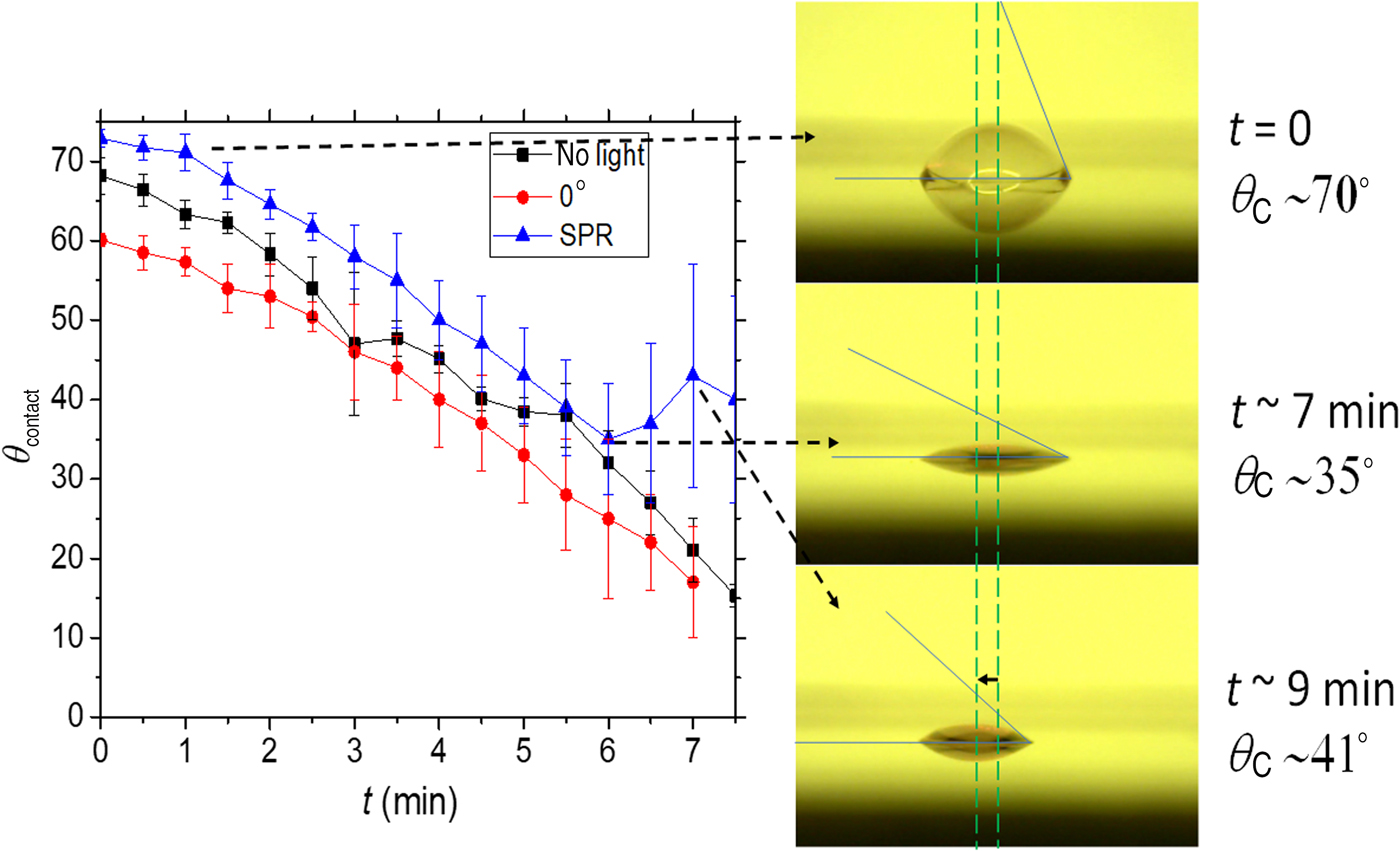
A summary of results is shown in Fig. 3. It shows a reversing contact angle as water is pulled, or dragged, toward the optical beam. There is an observable series of jumps arising from this dragging effect. These jumps are directly observable as trace residue lines where varying pinning has occurred at the surface. The origin of the residue is unclear but arguably related to OH interactions with the surface being the strongest at the drop edge. Despite Au's reputation as an inert material, deionized water can deprotonate on an Au surface, a property that is believed to explain how Au can catalyze reactions[Reference Saavedra, Doan, Pursell, Grabow and Chandler27] and which leads to self-assembly. Since de-ionized water has been used, the residual traces of water may be related to strong deprotonation and electrostatic binding of water to the inhomogeneous surface. As well, interfacial van der Waals attachment of water to silica surfaces leads to nanoscale layers of strongly bound residual water that requires a significant temperature (up to 40°C) to remove.[Reference Altintas, Fakanya and Atlintas11] The jumps may simply reflect increasing gradient forces overcoming these binding forces. They are, alternatively, consistent with predictions by Minkowski where sudden changes in refractive index, n, change the photon momentum (p = nℏω/c) as light reaches across the water interface, leading to a sudden change in force and consequently jump in movement.[Reference Pfeifer, Nieminen, Heckenberg and Rubinsztein-Dunlop28] Given there is some uncertainty about these jumps,[Reference Applegate, Marr, Squier and Graves29] separating this from a possible resistance, arising from surface roughness and interaction, deformity across the drop and interface properties that differ from the interior, to movement overcome during evaporation, also needs consideration. Furthermore, the Minkowski analysis is often done for direct pressure radiation on a scattering sample at an interface. At θ c ~ 35°, this occurs well before normal water pinning, that prevents drop contraction during evaporation, is overcome (θ c ~ 4–5°).
Progression of contact angle, θ c, with time, t, of a drop of water on the Au film with thickness τ ~ 15 nm (left). When water was evaporated, a residual layer on the surface is left behind. It alters the starting contact angle by Δθ ~ 10° (for pristine Au θ c ~ 60°). After a threshold angle corresponding to surface resistance, an optical HeNe beam (λ = 632.5 nm) exciting surface plasmons slightly off to the left of the drop accumulates water toward the light that passes through—an enhanced optical tweezer effect was enabled by creating a sliding electron layer at the Au/water interface. Such behavior is not observed away from the SPR condition. The data measured here have an error determined from five repeated measurements.
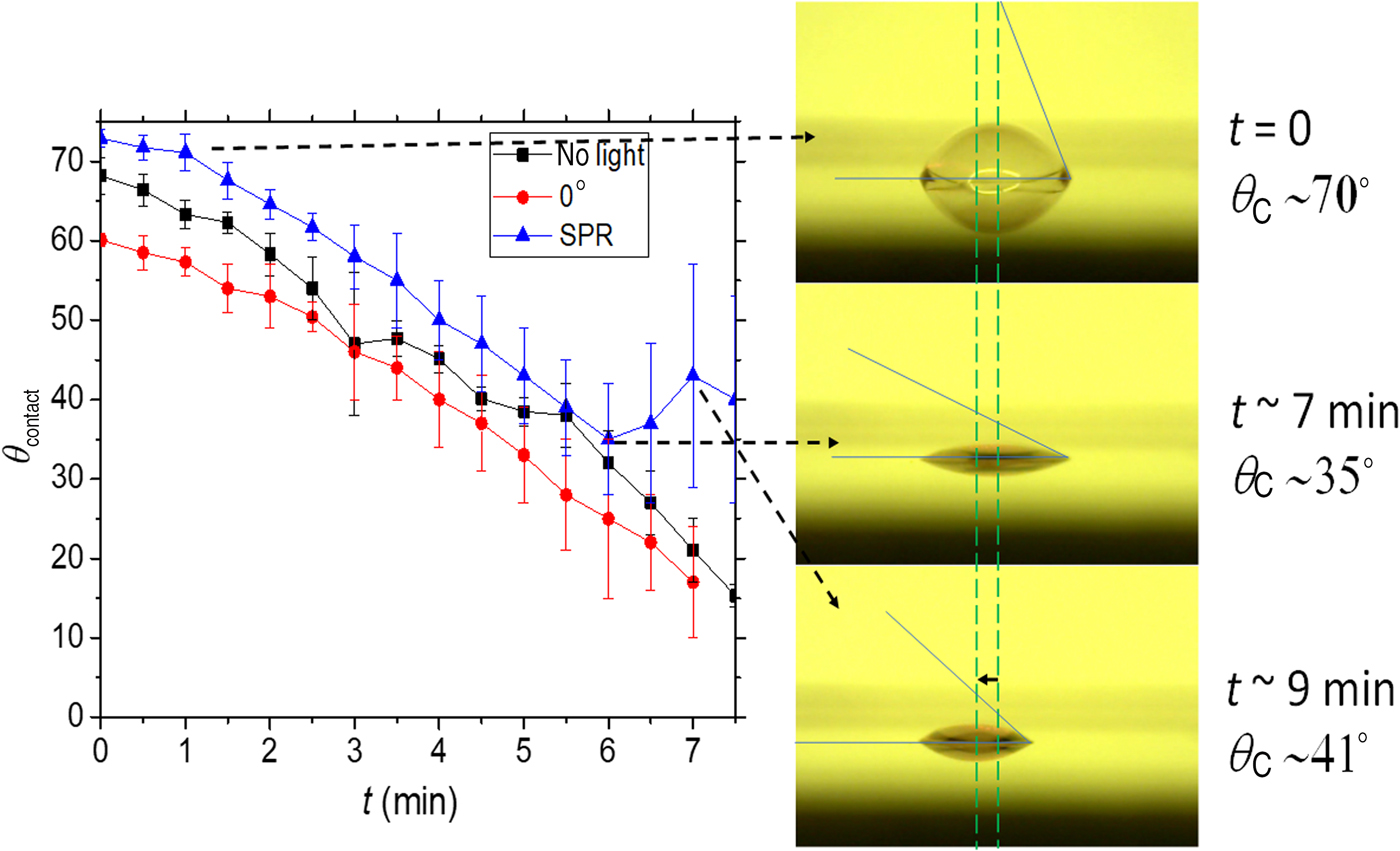
The rising contact angle with further evaporation indicates an optical pulling force more than strong enough to overcome surface pinning and hydrophilic spreading. A measure of how significant this effect is, the net mass of a 2 µL drop far exceeds the typical particle sizes used in optical tweezers. For example, the trapping of polystyrene particles up to 130 µm (weight ~10 ng) within a flowing capillary required watts of power from a 5 W diode bar.[Reference Åslund, Jackson, Canning, Texeira and Lyytikäinen30] By comparison, in this work, 2 µL of water (weight ~2 mg) has been swept with sub mW of optical power, a dramatic demonstration of the advantages of a frictionless support coupled with a contribution from a plasmon pushing force.
The amount of hoovering and timing during evaporation varied with different samples of a similar volume, some having lower resistance whilst others much higher. This was attributed to the variable-induced surface roughness on the sputtered films which generally impacts the quality of the SPR. There is also some uncertainty with regard to the self-assembly of water at the water–air interface and the strength of any induced net dipoles that may arise. It is clear that tremendous improvements are feasible with improvements in fabrication and optimization of conditions. The latter can be aided by recent developments of top-down contact angle mapping that offer a way to scale the number of measurements rapidly on a surface, enabling statistical information that can be used to both identify and reduce the source of errors.[Reference Dutra, Canning, Padden, Martelli and Dligatch25,Reference Janeczko, Martelli, Canning and Dutra26]
Conclusions
This work has demonstrated the beginning of an integrated form of optical tractor (or tweezer), taking advantage of surface wave resonances to reduce friction and allow the movement of significant mass along a thin-film surface. Water acts in a manner similar to dielectric silica toward the optical beam—this raises interesting questions about the contribution of potential water drag in conventional optical tweezer displacement of particles in capillaries containing water. The relative ease of the measurements also highlights a novel characterization based on combining SPR generation with contact angle monitoring of water on Au. In practice, the demonstration manipulates a significant body of water with little relative optical excitation power compared with conventional tweezer work to date — μL of water for sub-mWs of power, a marked improvement over existing tractor works. The reasons are thought to be a combination of additional momentum forces excited on the surface and potentially enhanced optical beam attraction arising from large collective dipole generation at water interfaces. This indicates that the entire system could be integrated into a compact form on a chip, perhaps using multimode waveguide or fiber and waveguide device approaches.[Reference Han, Canning, Cook, Hossain and Ding6,Reference Åslund, Jackson, Canning, Texeira and Lyytikäinen30] For example, additional integration of a pump waveguide alongside a microfluidic channel is possible. This approach has immediate use in dynamic diagnoses, combining potentially tunable lateral flow and novel separation with various spectroscopies or probes. Mindful of the extraordinary potential of water as a novel platform material for electro-optics,[Reference Canning24] the potential to manipulate, move, and tune water properties offers exciting new possibilities. The methods described here can also be applied to other liquids or solids that can be glided along the surface.
Acknowledgments
Ideas, project direction, analysis, and understanding are the authors. Special thanks goes to Mr. Chunyang Han, a visiting China Scholarship Council (CSC) student at the University of Sydney, for carrying out the SPR work reported in this paper and to Dr. Kevin Cook who took the SEM images reproduced here and helped organize the gold sputtering for Mr. Han. Both SEM and sputtering facilities were made available at cost from the Microanalysis Centre of the University of Sydney. This work was supported by the Australian Research Council (ARC) (DP 140100975) and private funding.