Introduction
The Cretaceous Western Interior Seaway (WIS; Fig. 1.1) is characterized by a depauperate fauna in which some marine invertebrate groups are rare or absent (Hay et al., Reference Hay, Eicher, Diner, Caldwell and Kauffman1993). For instance, compared to rocks of similar age elsewhere, few brachiopods, corals, sponges, or echinoids have been recorded from the WIS. Bryozoans are another group seldom recorded from this vast expanse of shallow sea (Cuffey, Reference Cuffey, Hayward, Ryland and Taylor1994). Only a small number of papers have described or mentioned Cretaceous bryozoans from the WIS, and the total known diversity of these colonial invertebrates is at least an order of magnitude less than that found in sediments deposited at the same time along the Gulf and Atlantic coasts of North America (Taylor and McKinney, Reference Taylor and McKinney2006), as well as in the Upper Cretaceous of Europe and elsewhere (see Taylor, Reference Taylor2019). Most of the WIS bryozoans are cheilostomes; cyclostome bryozoans have been recorded only in the Turonian of the WIS (Hattin, Reference Hattin1986), while an immured ctenostome Pierrella larsoni Wilson and Taylor, Reference Wilson and Taylor2013, is known from the Pierre Shale of South Dakota and Colorado. Apart from the ascophoran cheilostome Dysnoetopora demissa (White, Reference White1879) from the Mesaverde Formation of Wyoming (Toots and Cutler, Reference Toots and Cutler1962), the WIS cheilostomes are of malacostegan grade. Unlike the majority of cheilostome species, these lack ovicells and are thought to have possessed long-lived planktotrophic larvae like their living relatives (Taylor, Reference Taylor1988). The WIS malacostegans include: (1) Pyripora shawi Frey and Larwood, Reference Frey and Larwood1971 (= Herpetopora anglica Lang, Reference Lang1914) from the Niobrara Chalk of Kansas; (2) Eokotosokum bicystosum (Allan and Sanderson, Reference Allan and Sanderson1945) from the Edmonton Group of Alberta (Taylor and Cuffey, Reference Taylor and Cuffey1992); Villicharixa lintonensis (Cuffey et al., Reference Cuffey, Feldmann and Pohlable1981) from the Fox Hills Sandstone of North Dakota and the Edmonton Group of Alberta (Taylor and Cuffey, Reference Taylor and Cuffey1992); (3) Heteroconopeum ramosa (Toots and Cutler, Reference Toots and Cutler1962) from the Mesaverde Formation of Wyoming; and (4) un-named species attributed to Conopeum sp. from the Fruitland Formation of New Mexico (Kues, Reference Kues1983) and the Kaiparowits Formation of southern Utah (Roberts et al., Reference Roberts, Tapanila and Mijal2008). Here, we describe a new WIS species of Conopeum that is notable in having a very similar morphology to Conopeum seurati Canu, Reference Canu1928, an extant species unusual in being able to live in extremely low salinity, brackish waters (Winston, Reference Winston1977).
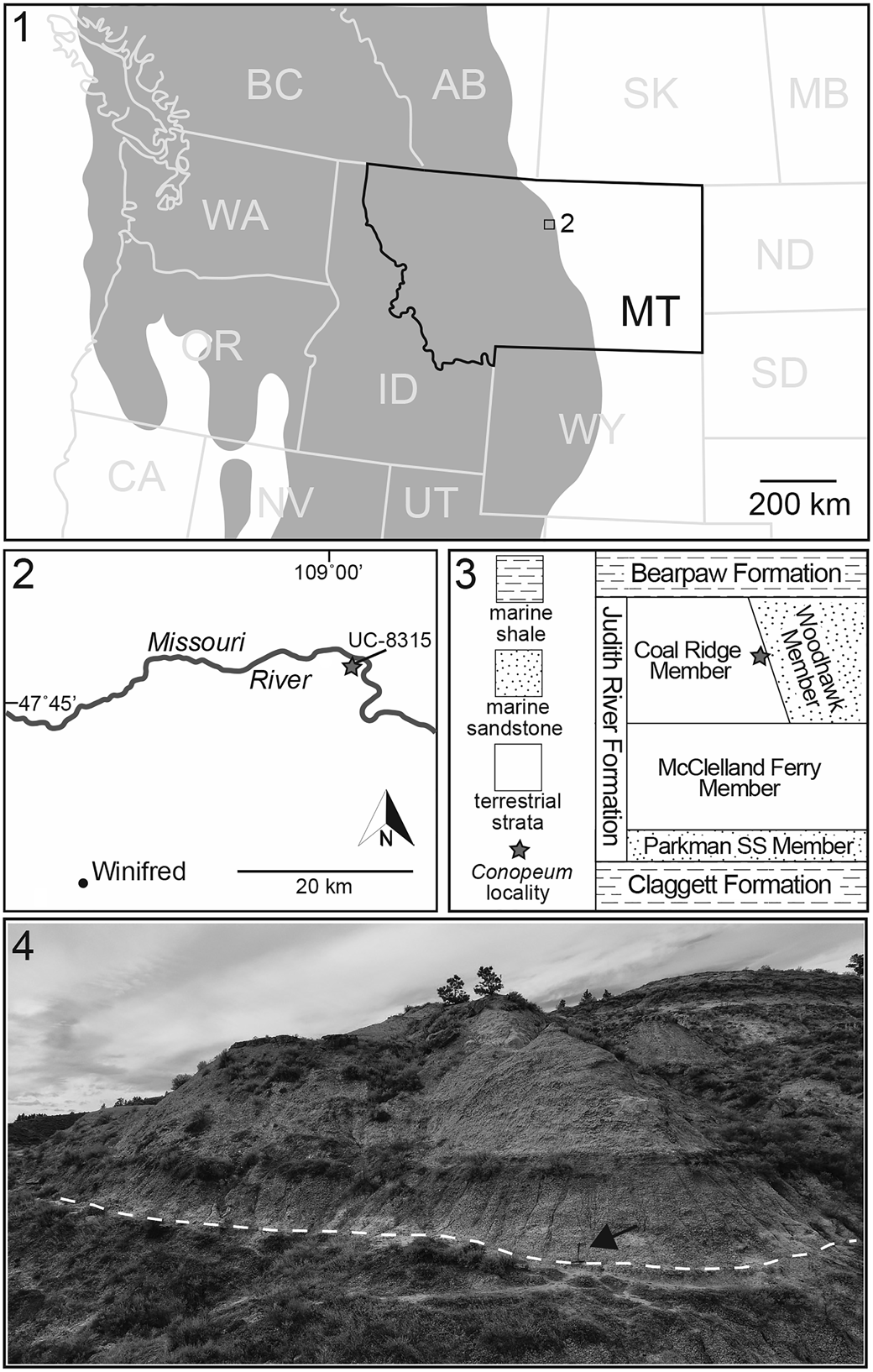
Location and stratigraphy of the locality (site UC-8315) containing Conopeum flumineum n. sp. in the Campanian Judith River Formation, Montana, USA. (1) Regional setting in relation to Campanian shoreline of Western Interior Seaway (WIS). Gray-shaded area represents approximate distribution of terrestrial landscapes in the Western Interior of North America during the Campanian, west of the WIS (based on Blakey, Reference Blakey2013 and Slattery et al., Reference Slattery, Cobban, McKinney, Harries and Sandness2015, modified from Rogers et al., Reference Rogers, Regan, Weaver, Thole and Fricke2020). (2) Location of site UC-8315 in Upper Missouri River Breaks National Monument. (3) Stratigraphy of site UC-8315 in Coal Ridge Member of Judith River Formation, in close proximity to transgressing shoreline of marine Woodhawk Member. (4) Field view of site UC-8315. Dashed line marks base of the bed containing Conopeum flumineum n. sp. Arrow points to 65 cm hoe pick resting on fossil-bearing stratum.

The Conopeum specimens described in this report were collected from the Upper Cretaceous Judith River Formation in north-central Montana, within the confines of the Upper Missouri River Breaks National Monument (Fig. 1). The Judith River Formation is noteworthy because the first skeletal remains of dinosaurs described from North America were collected in 1855 from Judith River strata near the confluence of the Judith and Missouri rivers (Leidy, Reference Leidy1856; Thomson, Reference Thomson2006). To this day, the Judith River Formation and age-equivalent units elsewhere in the Western Interior Basin (e.g., Two Medicine, Oldman, Dinosaur Park, Kaiparowits, Fruitland, and Aguja formations) remain the focus of intense sampling and study in relation to their vertebrate fossils, and together these Campanian units yield some of the richest records of non-avian dinosaurs known from the entire Mesozoic (Weishampel et al., Reference Weishampel, Barrett, Coria, Le Loeuff, Xu, Zhao, Sahni, Gomani, Noto, Weishampel, Dodson and Osmolska2004). In contrast, invertebrate fossils in the Judith River Formation remain relatively undocumented and understudied, despite their abundance and common occurrence alongside vertebrates in numerous localities. Here we describe the first bryozoans recovered from the Judith River Formation, and as clarified above, one of very few bryozoans known from the entire Western Interior Cretaceous record. Interestingly, specimens of this new cheilostome bryozoan were recovered in direct association with vertebrate, invertebrate, and plant fossils with indisputable terrestrial and freshwater affinities.
Geological setting
The Judith River Formation in its type area in the Upper Missouri River Breaks National Monument is represented by ~180 m of terrestrial, paralic, and shallow-marine strata that range in age from middle to late Campanian (Goodwin and Deino, Reference Goodwin and Deino1989; Rogers et al., Reference Rogers, Kidwell, Deino, Mitchell and Nelson2016). The formation correlates to the west (updip) with alluvial facies of the middle and upper Two Medicine Formation, and is bound above and below by open-marine shales of the Claggett and Bearpaw formations, respectively (Fig. 1). A recent reappraisal of the stratigraphy of the Judith River Formation by Rogers et al. (Reference Rogers, Kidwell, Deino, Mitchell and Nelson2016) advanced three new formal members and linked them to distinct accommodation regimes in both terrestrial and marine settings. The specimens described in this report were collected from the new Coal Ridge Member (Fig. 1.3), a succession of coastal-plain alluvial/paralic facies that accumulated in a high accommodation setting landward of backstepping shorelines during the initial transgression of the Bearpaw Sea (Rogers, Reference Rogers1994, Reference Rogers1998; Rogers and Kidwell, Reference Rogers and Kidwell2000; Rogers et al., Reference Rogers, Kidwell, Deino, Mitchell and Nelson2016). The Coal Ridge Member spans approximately the upper half of the Judith River Formation (up to 90 m) in the type area, and consists of fine-grained sandstone bodies of fluvial origin (often with indication of tidal influence) interstratified with overbank deposits, including beds of carbonaceous shale and lignite, that represent hydromorphic floodplains and expansive coastal swamps and mires. Recent 40Ar/39Ar analyses of sanidine crystals extracted from bentonite beds indicate that the Coal Ridge Member accumulated between 76.2 − 75.2 Ma (Rogers et al., Reference Rogers, Kidwell, Deino, Mitchell and Nelson2016), which renders it late Campanian in age.
Fossil vertebrates, invertebrates, and plants are well represented in the coastal paralic facies of the Coal Ridge Member. These fossils are often found concentrated in vertebrate microfossil bonebeds (also known as vertebrate microfossil assemblages or ‘microsites,’ sensu Brinkman, Reference Brinkman1990; Eberth et al., Reference Eberth, Rogers, Fiorillo, Rogers, Eberth and Fiorillo2007; Rogers and Kidwell, Reference Rogers, Kidwell, Rogers, Eberth and Fiorillo2007; Sankey and Baszio, Reference Sankey and Baszio2008; Rogers and Brady, Reference Rogers and Brady2010), which are localized accumulations of small bones and teeth, including a variety of skeletal components and fragmentary remains from small animals such as frogs, salamanders, fish, and mammals, and small skeletal components or broken skeletal fragments from larger animals, including turtles, crocodiles, and dinosaurs. These localized multitaxic concentrations of small disarticulated and dissociated vertebrate fossils also commonly include shells and shell fragments of freshwater mollusks (bivalves and gastropods), and degraded (coalified) plant debris. In fact, many of the known vertebrate fossil sites in the Coal Ridge Member were initially discovered due to their conspicuous veneers of mollusk shell debris on outcrop.
The vertebrate microfossil bonebed that yields the Conopeum specimens was discovered in 1983 by J.C. Harkson during a government-funded survey commissioned to identify fossil resources along the Missouri River corridor, and is designated site UC-8315 (Fig. 1). This well-documented locality has been featured in three previous reports that detail stratigraphic and taphonomic attributes of the Judith River fossil record (Rogers and Kidwell, Reference Rogers and Kidwell2000; Rogers and Brady, Reference Rogers and Brady2010; Rogers et al., Reference Rogers, Carrano, Curry Rogers, Perez and Regan2017). The matrix of site UC-8315 consists of light olive-gray (Munsell 5Y 6/2) mudstone. The tabular bed of mudstone that hosts the fossil concentration is ~60 cm thick, and can be traced laterally for 40+ m to the limits of exposure (due to modern-day erosion). The site yields abundant fossil bone in association with copious remains of freshwater mollusks and carbonaceous plant debris over its entire extent. Vertebrate taxa represented in the UC-8315 collection include hadrosaurian, ceratopsian, and theropod dinosaurs, crocodilians, champsosaurs, turtles, small teleosts, gar, amphibians (salamanders and frogs), lizards, and mammals. The molluscan sample includes unionid and sphaeriid bivalves and small viviparid gastropods. Trematode flatworm parasites, diagnosed by distinctive igloo-shaped reaction traces on sphaeriid shell fragments, are the most recent addition to the UC-8315 faunal list (Rogers et al., Reference Rogers, Curry Rogers, Bagley, Goodin, Hartman, Thole and Zatoń2018).
The sedimentology, fossil content, and facies associations of site UC-8315 are consistent with deposition in a low-energy aqueous setting, such as a lowland swamp or fluvial backwater, on the Judith River coastal plain. Based on regional mapping and thickness trends of the correlative marine Woodhawk Member of the Judith River Formation (Rogers et al., Reference Rogers, Kidwell, Deino, Mitchell and Nelson2016), which consists of three back-stepping, shallow-marine sequences composed of sandy shoreface and deltaic strata (Fig. 1), site UC-8315 was located very close to the western margin of the WIS, perhaps no more than 1 or 2 km inland from the contemporaneous marine strand.
Materials and methods
Bulk samples of fossiliferous matrix excavated from locality UC-8315 were processed using an automated sieve system that washed sets of nested sieve pairs with openings of 500 μm and 2 mm concurrently. The unconsolidated mudstone matrix of UC-8315 readily disaggregated in a water bath, and remnant bioclasts in the sieves were dried under heat lamps and sorted into vertebrate, invertebrate, and plant fractions under light microscopes.
Approximately 50, mm-scale specimens of Conopeum flumineum n. sp. were isolated from the UC-8315 bioclast fraction, and selected well-preserved specimens were imaged using backscattered electrons with a LEO ABT-55 SEM at the Natural History Museum in London.
Repositories and institutional abbreviations
Fossil material collected from locality UC-8315 is currently curated at the Science Museum of Minnesota (SMM) and the National Museum of Natural History, Smithsonian Institution (USNM). The type material described in this report is deposited at the USNM. Comparative material of the modern species Conopeum seurati is deposited in the Department of Life Sciences, Natural History Museum, London (NHMUK).
Systematic paleontology
Phylum Bryozoa Ehrenberg, Reference Ehrenberg1831
Order Cheilostomata Busk, Reference Busk1852
Suborder Membraniporina Ortmann, Reference Ortmann1890 (= Malacostegina Levinsen, Reference Levinsen1902)
Superfamily Membraniporoidea Busk, Reference Busk1854
Family Electridae Stach, Reference Stach1937
Genus Conopeum Gray, Reference Gray1848
Type species
Millepora reticulum Linnaeus, Reference Linnaeus1767, by monotypy.
Holotype
USNM PAL 771789 (Fig. 2.1–2.3). Cretaceous, upper Campanian, Judith River Formation, Coal Ridge Member; Upper Missouri River Breaks National Monument (locality UC-8315 of Rogers et al., Reference Rogers, Carrano, Curry Rogers, Perez and Regan2017, fig. 1), Montana, USA.
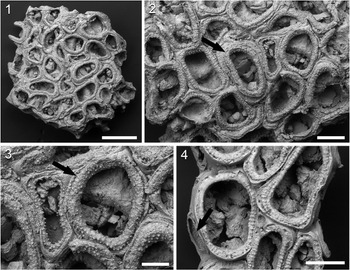
Conopeum flumineum n. sp. from the Campanian Judith River Formation of Upper Missouri River Breaks National Monument, Montana, USA. (1–3) Holotype, USNM PAL 771789; (1) general view of the colony fragment with irregularly arranged zooids (scale bar = 500 μm); (2) detail, including intramural bud indicated by an arrow (scale bar = 200 μm); (3) kenozooid (left) and autozooid (right) with cryptocystal groove arrowed (scale bar = 100 μm). (4) Paratype, USNM PAL 771790; broken edge of fragment (probably upside down with distal at the bottom) showing apparent pore chamber (arrow) and small kenozooid (center) (scale bar = 200 μm).

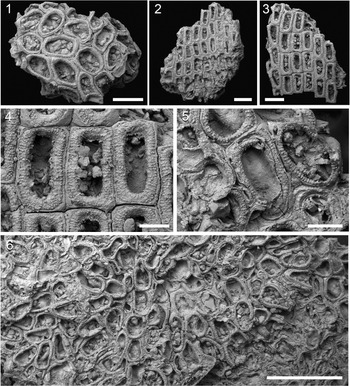
Conopeum flumineum n. sp. from the Campanian Judith River Formation of Upper Missouri River Breaks National Monument, Montana, USA. (1) Paratype, USNM PAL 771791, colony fragment with autozooids ranging from ovoidal to rounded rectangular in outline shape (scale bar = 500 μm). (2) Paratype, USNM PAL 771792, colony fragment consisting of rounded rectangular zooids (scale bar = 500 μm). (3, 4) Paratype, USNM PAL 771793; (3) general view (scale bar = 500 μm); (4) detail showing almost rectangular zooids with a narrow peripheral gymnocyst and a broad cryptocyst (scale bar = 200 μm). (5) Paratype, USNM PAL 771794, damaged intramural bud (scale bar = 200 μm). (6) Paratype, USNM PAL 771795, part of a larger fragment showing multilamellar colony with areas of autozooids aligned in rows and others where their arrangement is more chaotic (scale bar = 1 mm).

Paratypes
USNM PAL 771790–771795. Same details as for holotype.
Diagnosis
Conopeum with multilamellar colonies, small- to intermediate-sized autozooids, narrow gymnocyst not expanded proximally, no gymnocystal spines, circumopesial cryptocyst, granular and with an outer groove, closure plates not observed.
Occurrence
Upper Campanian, Judith River Formation, Coal Ridge Member; Upper Missouri River Breaks National Monument, Montana, USA.
Description
Colony encrusting, multiserial, multilamellar (Fig. 3.6), in some places with zooids arranged in well-defined longitudinal rows (Fig. 3.2, 3.3), but elsewhere chaotically arranged (Figs 2.1, 3.1). Possible pore chambers (Fig. 2.4) narrow and contained mainly within the thickness of the zooidal walls, not indenting the zooidal cavities. Basal zooidal walls convex on colony underside, without an uncalcified window. Ancestrula and early astogeny unknown.
Autozooids variable in size, small to intermediate, ovoidal (Fig. 2.3) to rounded rectangular (Fig. 3.4) in outline shape, on average 1.5x longer than wide, surrounded by a thin fissure (Fig. 3.4). Gymnocyst narrow, broadening slightly at the corners of the zooids, but not proximally expanded. Cryptocyst moderately broad, circumopesial, inwardly sloping, not shelf-like, a groove present near the outer circumference (Fig. 2.3), surface texture pustulose, the pustules sometimes radially aligned but usually evenly distributed. Spines and their bases not seen. Opesia occupying most of the frontal surface, ovoidal to rounded rectangular, on average about twice as long as wide. Intramural buds occasionally developed (Figs. 2.2, 3.5). Closure plates not observed. Ovicells not observed, presumed absent.
Kenozooids variable in size and shape, the smallest examples adventitious and seemingly lacking a cryptocyst (Fig. 2.4), but most interzooidal, infilling irregular spaces between the larger autozooids, with a pustulose cryptocyst similar to that of the autozooids (Fig. 2.3).
Avicularia not observed, presumed absent.
Etymology
Flumen is the Latin translation of river, referring to the Judith River Formation in which this species occurs.
Dimensions
Based on 5 zooids from each of 4 colony fragments. Zooid length: mean (x̄) 444 μm, standard deviation (SD) 89 μm, range 291–629 μm. Zooid width: x̄ 295 μm, SD 45 μm, range 200–359 μm. Opesia length: x̄ 326 μm, SD 67 μm, range 200–457 μm. Opesia width: x̄ 166 μm, SD 30 μm, range 109–215 μm.
Remarks
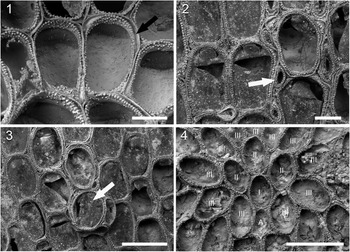
More than 50 Recent and fossil species have been assigned to Conopeum, including at least 11 from the Cretaceous. However, the generic attribution of many of these species warrants re-evaluation, although this is hampered by the simple skeletal morphology of the genus, which provides few taxonomic characters. Among the key features of Conopeum are the absence of ovicells and avicularia (but see Grischenko et al., Reference Grischenko, Dick and Mawatari2007 for a possible exception), and the poor development on the surface of the autozooids of the gymnocyst relative to the cryptocyst. Establishing the absence of both ovicells and avicularia depends on the availability of a large sample of specimens, which is often not the case for fossils. The numerous and well-preserved specimens from the Judith River Formation include neither ovicells nor avicularia, and the close similarity of this species to the extant Conopeum seurati (Fig. 4) leaves little doubt that it belongs to Conopeum.
Comparative images of Conopeum seurati from modern lagoons in Tunisia. (1–3) Topotypes from Wadi Bezirk, NHMUK 2020.1.3.1; (1) lightly bleached zooids with cryptocystal groove arrowed (scale bar = 200 μm); (2) dried, unbleached zooids showing two autozooids with flap-like opercula visible just above tears in their frontal membranes, and several small kenozooids, one of which is indicated by an arrow (scale bar = 200 μm); (3) raised intramural bud (arrowed) potentially forming the origin of an overgrowing layer of zooids (scale bar = 500 μm). (4) NHMUK 2020.1.3.2, Wadi Tinja; early astogeny with the ancestrula labelled ‘A’ and three succeeding generations of budded zooids labelled I, II, and III (scale bar = 500 μm).

Some of the Cretaceous species placed in Conopeum have since been transferred to Heteroconopeum (see Taylor and McKinney, Reference Taylor and McKinney2006), whereas others were provisionally reassigned by Martha et al. (Reference Martha, Taylor and Rader2019) to their new Albian–Maastrichtian genus Iyarisipora. The latter genus differs from the type and other Recent species of Conopeum, including C. flumineum n. sp., in having closure plates that are calcified across the entire frontal surface of the zooid and which contain pores. Many putative species of Conopeum described from the Cretaceous are difficult to evaluate because they lack adequate illustration. A bryozoan identified as ?Conopeum sp. from the late Campanian Fruitland Formation of New Mexico encrusting a dinosaur bone (Kues, Reference Kues1983) differs from C. flumineum n. sp. in having small distal spine bases. To judge from their figures, the Conopeum sp. described by Roberts et al. (Reference Roberts, Tapanila and Mijal2008) from the upper Campanian Kaiparowits Formation of southern Utah has zooids averaging ~700 μm in length compared to the mean value of 444 μm for C. flumineum n. sp.
As already noted, this new species most closely resembles Conopeum seurati Canu, Reference Canu1928, an extant species revised recently by Gordon et al. (Reference Gordon, Sutherland, Perez, Waeschenbach, Taylor and Di Martino2020) (Fig. 4). Autozooids in both the Cretaceous and Recent species have a groove around the outer edge of the cryptocyst (compare Figs. 2.3 and 4.1), a feature lacking in other species assigned to Conopeum. Differences between the two species include the appreciably broader cryptocyst and presence of a narrow gymnocyst in C. flumineum n. sp., as well as the occasional development of spines in C. seurati, which have not been seen in the Judith River Formation material. Closure plates occur in C. seurati, where they were described as ‘kleistozooids’ by Poluzzi and Sabelli (Reference Poluzzi and Sabelli1985), but have not been observed in C. flumineum n. sp. Autozooid size is similar in C. flumineum n. sp. and C. seurati: autozooid length ranges from 291–629 μm in C. flumineum n. sp., compared with 342–722 μm in C. seurati (Gordon et al., Reference Gordon, Sutherland, Perez, Waeschenbach, Taylor and Di Martino2020); autozooid width ranges from 200–359 μm in C. flumineum n. sp. compared with 150–501 μm in C. seurati (Gordon et al., Reference Gordon, Sutherland, Perez, Waeschenbach, Taylor and Di Martino2020).
The origin of multilamellar growth in C. flumineum n. sp. is not apparent from the available material. However, given that intramural buds are present in this species (Fig. 2.2), it is possible that multilamellar growth was achieved through eruptive overgrowths originating from these intramural buds, as is observed to occur in C. seurati (Fig. 4.3).
Fissures surrounding the zooids point to the past presence of organic cuticle of the outer layer forming the exterior walls that bound each zooid. Decay of the cuticle produces lines of weakness allowing taphonomic separation of the zooids. Parts of colonies with rectangular autozooids in longitudinal rows often have autozooids in adjacent rows at the same level (Fig. 3.2, 3.3) rather than in a brickwall-like alternation more typically found among cheilostomes. The difference between fragments with almost rectangular zooids aligned in rows (Fig. 3.2–3.4) and those with more ovoidal zooids arranged irregularly (Figs. 2.1, 2.2, 3.1) can be interpreted as reflecting growth freely across the substrate and confined growth, respectively.
Discussion
Terrestrial depositional environments in general, and dinosaur-bearing facies in particular, are not the most obvious places to expect to find fossil bryozoans, a phylum usually characterized as being stenohaline and fully marine. Admittedly, phylactolaemates and a few species of ctenostome bryozoans inhabit freshwater environments today, but both of these groups lack mineralized skeletons, in contrast to the stenolaemates and cheilostomes that constitute the overwhelming majority of bryozoans found in the fossil record. Yet, with the addition of the Judith River Formation example described here, three terrestrial localities associated with dinosaurs along the margins of the Cretaceous WIS are now known to yield cheilostome bryozoans (Kues, Reference Kues1983; Roberts et al., Reference Roberts, Tapanila and Mijal2008; this report). Such apparently anomalous occurrences can be understood in the context of the small number of bryozoans with calcite skeletons that flourish in very low salinity environments at the present-day. Most of these euryhaline species are malacostegan cheilostomes and are usually identified as species of either Conopeum or Einhornia (Electra in older publications).
Examples of present-day occurrences of brackish water malacostegans have been described from inland waterways of Holland (Bijma and Boekschoten, Reference Bijma and Boekschoten1985), the Coorong Lagoon of South Australia (Palinska et al., Reference Palinska, Scholz, Sterflinger, Gerdes and Bone1999), and the Albufeira coastal lagoon of Portugal (Freitas et al., Reference Freitas, Cacao, Cancela da Fonseca, Caroca and Galopim de Carvalho1994). Somewhat counterintuitively, bryozoan growth in the Portuguese example was observed to flourish after heavy rainfall caused salinity levels to drop to 6.5–9‰. It would be interesting to know whether this event also introduced terrestrial nutrients leading to an increase in phytoplankton that could trigger rapid bryozoan growth.
Some euryhaline cheilostomes are very fast-growing. For example, Dudley (Reference Dudley1973) reported that colonies of Conopeum tenuissimum (Canu, Reference Canu1908) could bud 150 zooids in the first week of their life. Kues (Reference Kues1983) noted that because modern Conopeum colonies are fast-growing, the Conopeum? sp. colonies he described encrusting Campanian dinosaur bones from the Fruitland Formation of New Mexico might conceivably have grown during a single season. If the Judith River species Conopeum flumineum n. sp. grew at a similar rate, suitable growing conditions would have been needed for only a brief amount of time to allow for the formation of mineralized colonies of the size found in this deposit.
Opportunistic growth of C. flumineum n. sp. during one or more short-lived episodes of elevated salinity is consistent with our current understanding of the paleoenvironment. Sedimentologic and paleontological evidence suggest that the aquatic setting represented by site UC-8315 was predominantly freshwater in nature, and was populated by a wide range of terrestrial, semi-aquatic, and aquatic animals, including groups that are generally salt intolerant, such as amphibians, sphaeriid bivalves, and viviparid gastropods. Taphonomic evidence suggests that the fossil assemblage preserved in site UC-8315 is time-averaged, with the accumulation of bioclastic debris transpiring over decades to centuries in a long-lived aquatic basin on the Judith River coastal plain (Rogers, Reference Rogers, Kidwell and Behrensmeyer1993; Rogers and Brady, Reference Rogers and Brady2010; Rogers et al., Reference Rogers, Carrano, Curry Rogers, Perez and Regan2017). Facies mapping indicates that site UC-8315 was located in very close proximity to the western shoreline of the WIS, being at most a few km inland, and thus occasional marine influence during deposition is certainly plausible, and arguably even likely given the low topographic gradient of the Cretaceous coastal plain in this region (Eberth, Reference Eberth1996). Sporadic storm surges linked to tropical cyclones (e.g., Eberth, Reference Eberth2015) and extreme tides may have been capable of transporting planktotrophic cheilostome larvae inland to the site, and resultant elevated salinities may have been established long enough for the development of mature colonies, especially if C. flumineum n. sp. was indeed fast-growing, like living representatives of the genus. Lastly, the preservational quality of the C. flumineum n. sp. specimens is consistent with an in situ interpretation, because the fragile well-preserved colonies would have been susceptible to abrasion and fragmentation during long-distance transport.
The close morphological similarity between the Campanian species Conopeum flumineum n. sp. and the living C. seurati, imply that C. seurati may be the best ecological analogue for the Campanian species. Conopeum seurati is generally characterized as a brackish-water species (e.g., Koletic et al., Reference Koletic, Novosel, Rajevic and Franjevic2014). According to Ryland (Reference Ryland1970), European populations of C. seurati can tolerate salinities down to 1‰. The species is widespread in the Baltic Sea, for example, encrusting rotten wood in the Kiel Canal where salinities are 12‰ (Nikulina and Schäfer, Reference Nikulina and Schäfer2006). However, C. seurati also occurs in higher salinity settings. At Avonmouth Dock on the Bristol Channel, UK, C. seurati has been found living in salinities of 18.5–27.6‰ (O'Dea and Okamura, Reference O'Dea and Okamura1999), and it is found in salinities of 30–38‰ at Ria de Aveiro, Portugal (Marchini et al., Reference Marchini, Cunha and Occhipinti-Ambrogi2007). It has also been recorded from hypersaline lagoons, such as the Karvasta lagoon system of western Albania (Nonnis Marzano et al., Reference Nonnis Marzano, Gravina, Fianchini, Portacci, Gherardi, Tursi and Corriero2010). The broad range of salinities over which C. seurati occurs at the present-day allows this species to be classified as euryhaline. If the morphologically similar Campanian species C. flumineum n. sp. was similarly euryhaline, its occurrence alone is uninformative about the paleosalinity of the Judith River Formation site UC-8315. That said, the association with unequivocal freshwater taxa is consistent with the site being characterized by freshwater conditions in general, with only occasional influxes of marine waters prompting higher salinities suitable for colonization by C. flumineum n. sp. (see above). The window for C. flumineum n. sp. to flourish may have been fleeting, and its fossils are decidedly rare in comparison with associated freshwater forms (e.g., sphaeriids, viviparids). It is also important to point out that C. flumineum n. sp. has only been found in this one Judith River site, despite the fact that several other similar fossil localities in the Coal Ridge Member have been collected and processed in identical fashion (Rogers et al., Reference Rogers, Carrano, Curry Rogers, Perez and Regan2017).
Finally, from a phylogenetic standpoint, the recognition of a Campanian cheilostome species closely resembling the extant Conopeum seurati is significant. A molecular phylogeny (Gordon et al., Reference Gordon, Sutherland, Perez, Waeschenbach, Taylor and Di Martino2020, fig. 8) recovered C. seurati as the basal species in a Conopeum clade forming the sister genus of the neocheilostomes with ‘conventional ovicells’ (Ostrovsky, Reference Ostrovsky and Schwaha2021), crownward of malacostegan and some other more minor groups of cheilostomes (see Taylor, Reference Taylor2020, fig. 8.8). The Conopeum clade has particular importance in understanding the origin of neocheilostomes, the dominant bryozoans living today, which began an explosive radiation in the mid Cretaceous (Taylor, Reference Taylor1988). Conopeum seurati has a planktotrophic larva, which is shell-less and less flattened than those typical of ‘malacostegines,’ and probably has a shorter duration before settlement and metamorphosis (Cook, Reference Cook1962). Such larvae are, in terms of morphology and time spent in the plankton, transitional to the non-planktotrophic coronate larvae that are brooded in the ovicells of neocheilostomes. Conopeum flumineum n. sp. from the Campanian may be an early example of a cheilostome possessing these traits.
Acknowledgments
We thank K. Curry Rogers, Z. Fulbright, J. Harkson, S. Kidwell, G. Liggett, K. Moffett, L. Rogers, B. Severy-Hoven, J. Thies, and J. Thole for insights, permits, and assistance in the lab and field. We also thank the many Macalester students who have worked to sieve and sort tiny fossils from various Judith River sites. Funding was provided by the National Science Foundation (grant EAR-1052673), the Bureau of Land Management (grant L10AC16281), Macalester College, and the Leverhulme Trust Research Project Grant (RPG-2016-429) ‘Molecules meet fossils—an integrated approach to studying palaeodiversity,’ awarded to A. Waeschenbach.