In 2017, a long-term vision of developing high-functioning, response ready, Health-Care Coalitions (HCCs) emerged from a keynote presentation given on behalf of the United States Department of Health and Human Services (HHS). 1 Today, national efforts guide HCCs toward achieving a robust readiness status when faced with disasters impacting local health-care systems. 1 HCCs are multi-disciplinary, jurisdictionally defined organizations, focused on mitigating impacts to health-care delivery during a disaster or planned event through planning and response efforts. While HCCs operate nationally, and cross-collaboration is vital, the literature and professional arenas have yet to identify a nationally endorsed definition of “high functioning.” The development of this definition will provide organizational tenets for meeting this collaborative goal for HCCs. Establishment of a standard definition can guide state and national leaders, and coalition members, in assessing and identifying the level of organizational maturity and overall progression toward a higher functioning operational status.
There are over 366 Assistant Secretary of Preparedness and Response (ASPR)-funded HCCs throughout the nation; however, no HCC has been officially deemed as a high-functioning organization. Reference Harvey2 Some HCCs have been in existence for more than 16 years, and many possess important qualities and characteristics of effective organizations. Given the broad spectrum of newly established to matured HCCs that exist, preparedness and response leaders face the difficult task of guiding HCCs to reach their full potential and supporting effective and efficient response efforts. This remains difficult as some HCCs lack a clear vision, have no metrics to assess baseline performance against high-functioning HCC benchmarks, lack engagement from leadership, lack dedicated paid staff to lead daily operations, or lack clarity in understanding systematic barriers and opportunities (Melissa Harvey, R.N., phone communication, April 19, 2019).
Compounding these issues are the lack of a nationally endorsed definition of what it means to be “high-functioning” and the absence of a standardized metric to assess maturation toward a higher-functioning state of operations. Thus, response leaders must rely solely on after action reports, improvement plans, and performance reports, which are submitted to ASPR-Hospital Preparedness Program (ASPR-HPP), as well as anecdotal information shared across venues to guide steps in maturation. This research attempts to begin to fill that gap, allowing for a better understanding of what it means to be “high functioning” and for critical factors that influence decision-making and practices to emerge.
While no HCC has been nationally designated as a high-functioning coalition, published studies exist in highlighting key successes of response efforts demonstrating their level for resiliency and influential impact to their communities. For example, the Gulf Coast Resilience Coalition developed strategic plans for knowledge transfer, post disaster surveillance, effective communications, and relationship building with key stakeholders, enhanced their response efforts by leveraging lessons learned, and improve behavioral health coordination during response. Reference Hansel, Osofsky and langhinrichsen-Rohling3
Likewise, strong models for coalition building does exist. Research on effective coalitions showed 3 key tenants. First, a high-functioning coalition has a strong foundation for partner engagement where partners see value in the work of the coalition, consist of local voices, and achieve a sense of solidarity among members. Reference Alexander, Zakocs and Earp4–Reference Zakocs and Guckenburg16 Second, a sound governance structure consists of: leaders who are visionary; a clear and unified direction; members with decision-making strengths and ability to navigate conflict; excellent communication processes; and effective networking practices. Reference Alexander, Zakocs and Earp4,Reference Schober and Fawcett7,Reference Walsh, Craddock and Gulley8,Reference McKay and Hewlett12,Reference Nowell and Foster-Fishman13,Reference Zakocs and Guckenburg16–Reference Robles-Schrader, Harper and Purnell18 Last, a sustainable HCC will plan for the future from the inception of their existence, access multiple funding streams, develop a strategic plan, and demonstrate an understanding of the necessary elements to be self-sufficient. Reference Scanlon, Alexander and McHugh6,Reference Walsh, Craddock and Gulley8,Reference McKay and Hewlett12,Reference Wynn, Johnson and Fouad15,Reference Zakocs and Guckenburg16,Reference Robles-Schrader, Harper and Purnell18–Reference Wells, Ford and Holt20
Institutional Logics Implications
To provide a foundation on which to conceptualize the experiences of HCCs and factors that support maturation toward higher functioning, the theory of institutional logics was selected as the guiding theoretical framework. Institutional theory provides a voice on how a belief or cultural system can impact an organization over time. Reference Wells21 Scholars leveraged this theory to better understand how culture, norms, practices, or beliefs impact and influence organizational populations. Reference Wells21 Much literature on the field of institutional logics looks to the work of Friedland and Alford (1991) as a key starting point for defining this concept. Friedland and Alford (1991) purport institutional logics represent “…a set of material practices and symbolic constructions—which constitutes its organizing principles and which is available to organizations and individuals to elaborate.” Reference Friedland, Alford, Powell and DiMaggio22 Logics, operating at the societal or institutional field level, have the capacity to influence the shape of an organization’s macro-level structure and practices. Reference Bohn and Roelfs23 This effect can support or influence leader’s decision-making, accounting for their own cultural embeddedness along with the values, interests, and organizational practices of the organizations engaged in each HCC and the HCC itself. Reference Thornton, Ocasio, Lounsbury, Thornton, OCascion and Lounsbury24
Institutions have also been discussed for the “complexity of relational networks” that are at their foundation which contributes to the applicability to discussions of coalitions. Reference Meyer and Rowan25,Reference Powell, Oberg, Greenwood, Oliver, Lawrence and Meyer26 Logics may be useful in the field of practice, particularly in coalition and partnership building involving cross-sectoral organizations. This approach may help organizations understand how partners react or behave differently when encountering a common stimuli (eg, federal or state policy). Reference Bohn and Roelfs23 Applying a logic to real-world examples, constructing them based on context and culture, and reinterpreting them accounting for internal and external factors provides a powerful tool to support decision-making for organizational and coalition leaders. Reference Thornton, Ocasio, Lounsbury, Thornton, OCascion and Lounsbury24,Reference Skelcher and Smith27
This article presents findings from a qualitative study designed to understand key tenets necessary in establishing high-functioning HCCs. Using institutional logics and building upon the tenants of effective coalition building, the study aimed to assess internal factors such as governance structures and its current sustainability efforts, while also assessing external factors like partner engagement, funding, and the influential aspects impacting its longevity. Through the lens of institutional logics, research questions were framed around each of these 3 logics and assessed internal or external influences hindering or reinforcing their success. Their unique internal and external factors (eg, culture, value systems, etc.) impact the influence of the logic on the HCC and its member organizations’ decision-making and state of operations. Reference Bohn and Roelfs23 In addition, the institutional logics were explored through the lenses of community, state, and federal institutional orders to further parse out the internal and external factors.
Methods
Recruitment
Before recruitment, this qualitative study’s protocol was approved by the University of South Florida Institutional Review Board (IRB) and ruled as exempt (IRB # Pro00032620) on November 29, 2017. Study procedures were conducted within the standard ethical expectations of public health research.
The lead author recruited participants through preparedness and response partners, who assisted in soliciting potential participants by sharing the opportunity with staff and organizational membership. Invitations were sent to partners including ASPR Field Project Officers, Directors of Public Health from the Association of State and Tribal Health Officials (ASTHO), and HCC point of contacts. Distribution was conducted in a manner to ensure invitations were extended nationally and all state and local representatives had the opportunity to participate. Partners were encouraged to share the invitation with colleagues or other potential participants. The invitation letter explained the goals of the project and inclusion criteria. To meet study eligibility, participants had to: (1) have a direct connection with the ASPR- Hospital Preparedness Program, and (2) hold a leadership role (paid or volunteer) where they were responsible for decision-making efforts on behalf of at least 1 HCC. Interested individuals used a Web-based program, YouCanBookMe, to schedule an interview.
Purposeful sampling was used to ensure equitable representation. Specifically, as participants were screened and confirmed, documentation of their leadership role and geographic representation was logged. Although no participant was declined, several were no-shows or unresponsive to scheduling an interview. Throughout the interview process, ongoing review of equity among participant roles and geographic location was achieved and concerted outreach efforts were made to close population gaps. When a state was represented by more than 1 interviewee, the participants had to have distinct leadership roles (eg, state vs regional representation) and represent distinct geographical environments.
Process and Procedures
Semi-structured interviews were conducted by the lead author between June 2019 and October 2019, which consisted of 14 open-ended questions designed to explore participant experiences with partner engagement, governance, and organizational sustainability. All interviews were conducted virtually using Zoom video conferencing software. Participants provided both written and verbal consent before the start of the interviews. Interviews lasted approximately 1 h in length, were audio-recorded, professionally transcribed verbatim, and analyzed.
The interview guide consisted of 3 sections: (1) Defining high-functioning HCCs, (2) Institutional Logics, and (3) Wrap-up. In the first section, participants responded to a series of questions regarding their perceptions of what it means to be a high-functioning HCC and factors that influence success. Questions were designed to elucidate a definition of high functioning from participant experience. The second section consisted of questions that were framed through the 3 logics, which were identified through a thorough review of the literature on institutional theory and high-functioning coalition organizations: Sources of Partner Engagement, Sources of Governance, and Sources of Sustainability. Questions in this section focused on assessing the current and ideal state of operations for HCCs through each logic. The final section included a wrap-up and allowed participants to share final comments.
Analysis
All data compilation and thematic analyses were conducted using Atlas. Ti 8.4.25. 28 A process of a priori and emergent coding was used. Initially, 5 interviews were coded by the first author to develop the codebook. Two members of the research team reviewed the codebook and transcripts and reached consensus on coding. Codebook development continued until saturation was met. Remaining blinded transcripts were coded by the first author. The research team then met to categorize codes into themes, which served as the foundation for the second phase of coding, focused coding. Reference Charmaz29 This process required attention in recognizing patterns/themes, as outlined by the first round of interviews. Focused codes were foundational in establishing a consistent process for analyzing patterns and identifying themes and subthemes in future interviews. Reference Charmaz29
Results
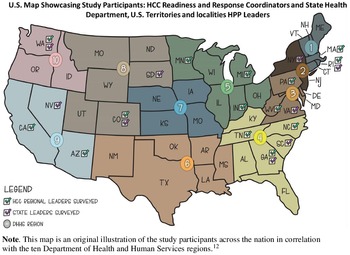
A total of 39 participants from 17 states were interviewed. Most participants were HCC Regional Response Coordinators (n = 26; 66.67%), followed by state representatives (n = 10; 25.64%) and 7.69% (n = 3) were federal leaders. Ten states were represented by a single participant (either a regional or state leader): Arizona, Connecticut, Florida, Illinois, Iowa, Massachusetts, New York, Pennsylvania, South Carolina, and Utah. Eight states had multiple participants, including Rhode Island (n = 2), Virginia (n = 3), Georgia (n = 4), North Carolina (n = 2), California (n = 4), Minnesota (n = 5), Colorado (n = 3), and Washington (n = 3). These 8 states consisted of multiple participants with at least 1 regional HCC leader interviewed. Figure 1 provides a visual representation of the scope of sampling specific to this project and the states represented within the study, as well as, the number and type of participants from each region. Reference Lemke30
Statewide Snapshot of Participants.
Note. This map is an original illustration of the study participants across the nation in correlation with the ten Department of Health and Human Services regions Reference McKay and Hewlett12 .

What Is a High-Functioning HCC?
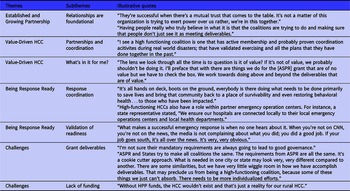
Primary to this study, participants were asked to define a high-functioning HCC. Unanimously, participants verbalized the importance and significance of the question, but struggled with a response. Some brought levity to the conversation by stating, “That’s the million-dollar question,” or “That’s what we are hoping to find out, right?” Thematic analysis of participants’ responses regarding a definition of a high-functioning HCC revealed several critical factors, specifically the importance of having an established yet growing partnership-base, being value-driven, and being response ready. The emergent themes, subthemes, and illustrative quotes are displayed in Table 1.
What makes up a high-functioning HCC?

After confirming no official definition of high functioning existed, interviewees were asked to identify if they considered any HCCs as high-functioning, based on their respective definitions. Many self-selected their own HCC or those within their state. While some specifically called out SouthEast Texas Regional Advisory Council (SETRAC), Minnesota HCCs, MESH Coalition, Colorado HCCs, Virginia HCCs, and Seattle King County HCC. A primary reason as to why these HCCs or states as a whole were identified was tied to their readiness to respond, based from their best practices and lessons learned.
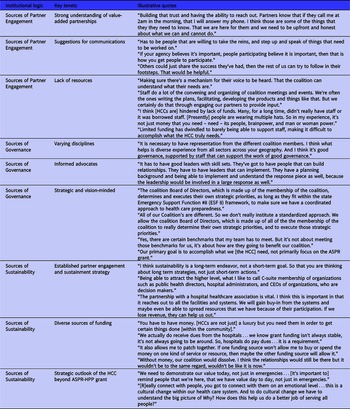
In addition, the thematic analysis of participants’ responses was coded for alignment across the 3 institutional logics of sources of partner engagement, sources of governance, and sources of sustainability and identified emergent themes and subthemes. Several vital themes emerged, including 3 institutional logics: Sources of Governance, Sources of Engagement, and Sources of Sustainability. For example, Source of Partner Engagement consists of the following themes: value added partnerships, communication, and resources. Sources of Governance consists of: varying disciplines, informed advocates, and leaders who are strategic and vision minded. Last, Sources of Sustainability consists of having an established partner engagement and sustainment strategy, having a diverse portfolio, and having a strategic outlook of HCCs beyond grant deliverables. Table 2 presents the 3 institutional logics, associated key tenets, and sample quotes that characterize and are representative of the corresponding institutional logic.
What are Ideal Partner Engagement, Governance, and Sustainability Strategies for HCCs?

Sources of Partner Engagement
Three themes related to successful partner engagement strategies emerged: (1) a strong understanding of value-added partnerships; (2) clear, concise, and consistent communications with all partners; and (3) an infrastructure supportive of the HCC staff and volunteers’ efforts in promoting, engaging, and supporting partner engagement.
Value-Added Partnerships
Many participants acknowledged that every partner brings value to the HCC, and it is incumbent on HCC leaders, both staff and volunteers, to ensure these relationships are reflective of value-centric efforts. Participants shared phrases such as: “…have regular contact,” “keep them engaged,” “have ongoing updates,” and “report on the positive and challenges.” An HCC participant shared, “…value is really determined by your leadership but more importantly our stakeholders, not our funders. Because at the end of the day it is all about the locals. All your coalitions have to have a voice. ‘What do they see as value? What’s important to them? What’s not important to them?’” Overall, participants expressed the importance of offering value-centric incentives.
Communication
Most participants shared that communication is vital, regardless of whether in a response or planning phase. One HCC participant shared, “To engage a member and keep them engaged, it is really important to educate them on and give them the platform to ask their questions and voice their concerns, share their ideas, and [provide their] opinions.”
Some participants communicated that this level of information-sharing fosters value-added discussions about how incidents could impact their resources and how the HCC can be of assistance. Some participants expressed the importance of an open communication environment, so HCC members have a sense of being heard. For example, an HCC participant shared, “making sure there’s a mechanism for their voice to be heard. That the coalition can understand what their needs are.” A state participant concurred, “…making sure that your members have a voice. I think that is a huge part. We have a lot of challenges within our state.”
Resources
The importance of access to resources also emerged as a vital attribute of high-functioning engagement strategies. Many of the participants expressed the importance of having paid staff as well as recognizing that teams may be small. For example, rural frontier health-care members have several roles to play, and they cannot take on more duties. Several participants shared comments such as, “…our partners wear many hats” or “…partners have competing priorities.” While proud of their work, participants noted the impacts of competing demands and many expressed the need for dedicated paid staff members to lead the HCC. For instance, a federal participant shared, I think HCCs are hindered by lack of funds. Many, for a long time, did not really have staff or it was borrowed staff. Presently, people are wearing multiple hats. So, in my experience, it is not just money that you need. It is people, brainpower, and man or woman power.
Some participants acknowledged challenges in hiring staff due to limited funds. “Funding keeps getting cut every year and we are trying to do more with less. At this point, we’re really just trying just maintain where we’re at right now,” shared an HCC leader. A state participant expressed that “limited funding has dwindled to barely being able to support staff, making it difficult to accomplish what the HCC truly needs.” Overall, participants reported that infrastructure was lacking for the HCCs, ultimately creating challenges for leaders, staff, and volunteers to focus on partner engagement.
Findings underscore the role of geography on participant experience. For instance, many rural participants indicated vast challenges in engaging partners due to distance, which created a barrier to in-person opportunities. Other HCC participants shared the difficulty in engaging large groups of partners when topics of interest were either too diverse or unable to meet the needs of all in attendance.
Sources of Governance
Most HCC and state participants stated that, at minimum, HCCs should incorporate diverse representation of their membership into the governance board to ensure a multi-disciplinary voice. This is aligned with the current vision set forth by ASPR-HPP capabilities, requesting that HCCs have governance in place, including executive representation. Participants also reported the difficulty of advisory members making decisions, which was linked to their lack of authority. For instance, an HCC participant shared, “If an advisory member can’t make a decision on behalf of my organization, I have to go back and explain, get the okay from my leadership, and bring it back to the HCC.” Most HCC and state participants expressed that having executive leaders sit on a governance board is beneficial as they hold a position of power within their organizations, which brings added value to the HCC. Some HCC and state participants shared that they already moved into having executives sit on their governance, while many HCC participants recognized this as a known gap that they are either actively working on closing or have just begun to identify.
In addition, HCC participants who represent rural HCCs shared how their geographic makeup served as a direct relation to their governance and leadership success. For instance, due to HCCs residing in large rural communities, lacking financial resources, competing priorities that access the same resources within their communities, having community leaders come together is a norm - second nature. As an HCC participant shared, “We take care of each other because we have to when we are so far away from larger communities or those with greater resources.”
Sources of Sustainability
Almost all participants shared they were not actively addressing sustainability planning, however, they agreed that HCCs should have a sustainable effort underway, both financially and/or programmatically. Participants across all 3 sample populations stressed the importance of building, fostering, and sustaining relationships among community partners as a key component to establishing a sustainable HCC. Emergent themes to achieve a high-functioning sustainable HCC included: the establishment of a partner engagement and sustainment strategy, a diverse funding portfolio, and developing relationships with large health care systems. Participants shared a varied definition on what a funding portfolio looked like. Some saw it as a means to charge a membership fee, become a nonprofit 501c3; however, regardless of the organizational structure, all focused on the importance of securing additional grant funding streams. Some interviewees expressed they were either an established 501c3 or in the process of exploring this status. Although a sustainable option for HCCs, it was also expressed by some HCC leaders that a 501c3 legal designation was not a viable option for their organizations. All of these efforts are currently leveraged by HCCs nationwide, however, it is not consistently achieved nationally. Participants expressed that health systems bring partners, resources, and infrastructure that are important to achieving sustainability.
The literature on effective coalitions and the analysis of findings led to identifying the 3 institutional logics as: Sources of Governance, Sources of Partner Engagement, and Sources of Sustainability. Reference Scanlon, Alexander and McHugh6–Reference Cheadle, Senter and Procello9,Reference McKay and Hewlett12,Reference Raynor17,Reference Kegler and Swan31,Reference Bopp, Sims and Vairo32 Each logic was explored through 3 institutional orders and their unique internal and external factors (eg, culture, value systems, etc.), which impacted the influence of the logic on the organization’s state of operations.
Insights from the interviews related to the Sources of Governance logic, confirmed the importance of informed advocates, strategic and vision-minded leaders, and diverse membership. Key themes highlight the importance of an infrastructure that promotes, supports, and engages a diversified partnership for the Sources of Partner Engagement logic. HCC attributes identified for diversified partnerships were value-added partnerships and communications that are clear, concise, and consistent across all partners. The Sources of Sustainability logic themes confirmed the importance of an established partner engagement and sustainment strategy. Last, the study confirmed the need for a diverse funding portfolio and outlook beyond the HCC grant expectations including community needs.
In addition, HCC participants who represented rural communities shared their great concern on the longevity and sustainability of their HCCs. They shared concerns regarding being held to the same standards of more affluent or urban communities and the level of inequality hindering them for ultimate success and sustainability of rural HCCs. A rural HCC participant shared, “If we are going to achieve sustainability [for our HCCs], we can’t be held to the same standards or expectations as other HCCs in larger communities, or who receive more money, or have more staff. We can’t follow a cookie-cutter approach.” Another rural HCC participant shared, “a rural HCC cannot follow or adhere to the same expectations as an urban HCC community…we just won’t survive.”
Discussion
The literature on best practices of effective coalitions, identifies the logics of an effective coalition as: sources of partner engagement, governance structures, and sustainability as supported by themes and quotes in Table 1. Reference Scanlon, Alexander and McHugh6–Reference Cheadle, Senter and Procello9,Reference McKay and Hewlett12,Reference Raynor17,Reference Kegler and Swan31,Reference Bopp, Sims and Vairo32 With regard to partner engagement, it is key to have trust in place to successfully gain buy-in from stakeholders. Reference Alexander, Zakocs and Earp4–Reference Walsh, Craddock and Gulley8,Reference McKay and Hewlett12,Reference Nowell and Foster-Fishman13,Reference Wynn, Johnson and Fouad15–Reference Raynor17,Reference Cha, Lawrence and Bliss19,Reference Meyer and Rowan25,Reference Bohn33–Reference Anthony, Appari and Johnson40 Leaders will use symbols, ceremonial activities, systems of beliefs, and stories or rational myths to gain the trust from their communities. Reference Meyer and Rowan25 These activities influence relationships on the micro, meso, and macro levels (eg, individual, group, entity/organization). Reference Bohn and Roelfs23 In relation to coalition governance, institutional logics are also a valuable analytical tool when organizing large-scale complex projects. Due to the vast complexity of megaprojects, leaders should consider institutional logics as they can influence cross-sectoral partner engagement in organizational and coalition governance and operations. Reference Biesenthal, Clegg and Mahalingam39 It is crucial to evaluate leadership structures or methods of recruiting and validating leaders to serve in governance positions.
Institutional logics are a representation of frames of reference for perception, actions for motivation, and self-identity that can vary across institutions. It is through these logics that an evaluation of both internal and external influences can expose potential barriers and successes for any organization. Leveraging the logics to serve as the foundation for collecting data from interview participants allowed for a more robust understanding of the implications and strengths experienced by an HCC of their current state and how that influences their achievement of a higher functioning state of operations.
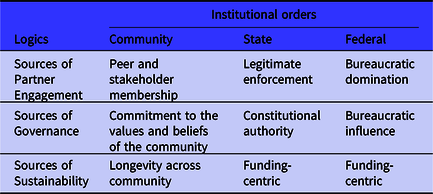
Each institutional logic has its own set of institutional orders (eg, community, state, and federal) that serve as a micro-level tier to institutional logics shown in Table 3. Each institutional order is distinguished hierarchically in organizing principles, practices, and symbols, all of which may influence behavioral changes or decision-making and actions of HCCs. Reference Thornton, Ocasio, Lounsbury, Thornton, OCascion and Lounsbury24
Institutional logics and orders for high-functioning HCCs

Table 3 aligns the 3 institutional orders and the 3 logics to represent the complimentary and contradictory elements through which logics will differ in practice. To elaborate further on Table 3, the following paragraphs are oriented around each institutional order (eg, community, state, and federal).
At a community institutional order level, Sources of Partner Engagement is heavily influenced by peer and stakeholder membership. Sources of Governance is guided by the values and beliefs of the community when it comes to decision making efforts. Last, Sources of Sustainability is greatly impacted by how the community views the longevity of the HCC. Across all 3 logics, the institutional order of community is influenced by people, existing infrastructures, and the culture of the HCC’s community.
There are a variety of influences across the state institutional order. For instance, Sources of Partner Engagement was found to be highly influenced by the legitimate enforcement of the state governance. The State expectations on which stakeholders should be involved in HCC engagement strategies, may be more stringent than federal expectations. In the case of Sources of Governance, decisions and efforts were highly influenced by the HCC’s state’s constitutional authorities. Last, Sources of Sustainability is heavily influenced by the availability of state funds and government leadership choosing to invest in HCCs.
The federal institutional order is heavily influenced by a variety of bureaucratic efforts across all 3 institutional logics. Bureaucratic domination directly influences partner engagement through the demands of federal political leaders, whom indicate baseline core membership of the HCC. Regarding Sources of Governance, decision-making is greatly influenced by bureaucratic decisions or requests. Last, Sources of Sustainability is greatly influenced by the available funding at the federal level of which would also provide scope and direction being requested by leaders.
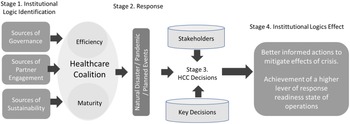
Upon applying institutional logics and their respective orders to the operational framework, leaders are better equipped to make more robust decisions based on the internal and external factors hindering their operations. Figure 2 represents the flow of logics influencing action on behalf of the organization and resulting in more refined and robust decision-making efforts. Every coalition begins analyzing its operations while in its current status – level of efficiency and maturity (Stage 1). In Stage 2, the HCC experiences an internal and/or external impact to its operations where leaders begin to explore the numerous decisions to be made. These decisions are greatly influenced by what stakeholders are experiencing, current policies in place or nonexistent, and overall assessment of the impacts made on the HCC’s operations (Stage 3). This reformation leads to better informed actions and achievement of a more robust, higher level of response readiness state of operations (Stage 4).
Framework for Logics to Action.

Limitations
There is a dearth of literature referencing the application of institutional logics on coalitions. While key aspects of similar studies served as a foundation of evidence to support this study’s central focus on evaluating maturity and sustainability of HCCs, no known studies have addressed this concept specifically. Despite this limitation, this study was able to pave a new line of research, leveraging key aspects of successful coalition operations, and applying institutional logics to determine the influences on establishing more robust decision-making efforts.
Though measures were put in place to have representation across the 10 United States Federal Emergency Management Agency (FEMA) geographic regions, this study was also limited by response bias. 41 Although data saturation was met, not every state with an HCC, nor every HCC, nor every federal leader associated with HCC was represented in the study. Though an attempt was made to ensure equity by widely disseminating invitations by means of multiple modes of communications, participants volunteered to participate, which could have biased results. Future studies should include interviewing a greater number of HCC leaders to lessen any potential bias as well as revisiting every 5 years to align with HHS-ASPR’s 5-year grant cycle. 41
Conclusions
This is the first known study to apply the theory of institutional logics to the national preparedness field and the development and characterization of HCCs. The study shares how engaging in informed and strategic governance, fostering active and ever-growing partnerships, establishing an organizational sustainability framework, and achieving higher level of response readiness sets HCCs up for success in having a higher-functioning state of operations. Future research could explore and define metrics for benchmarking that support and validate an HCC’s organizational development in strengthening these attributes and application of the logics. Establishing a high-functioning HCC is an evolving process and, therefore, the HCC’s tactics must be amendable to adapt to the changes. A high-functioning HCC must be constantly evolving, growing, pushing boundaries, and innovative to achieve a higher functioning state of operations.
Implications for Policy and Practice
This study makes a case for considering the importance of governance, partner engagement and sustainability as guiding logics for coalitions based on qualitative data collected from study participants across the United States. It also expresses the need for research on metrics for benchmarking coalition performance. But what are some policy and practice implications beyond this paper’s findings?
-
Policy-makers may consider the implications of these logics on policy stakeholders and needed actions that arise in a disaster recovery process. Reference Crow, Albright and Koebele42
-
Practitioners may focus on specific “disaster governance” to strengthen coalition sustainability and blend stakeholder efforts from public and private sectors to address evolving risk mechanisms and models along with response capacity to support vulnerable populations. Reference Tierney43
-
Jointly, practitioners and policy-makers need to collaborate on plans and sometimes emergent actions needed for “service restoration” in postdisaster efforts. Evaluation of these efforts through the lens of these 3 logics may help assess cultural issues that may impact the efficiency and effectiveness of such collaboratives. 44
Acknowledgments
The authors thank the study participants from across the nation that are discussed in this article. A special thanks to Ms. Melissa Harvey for sharing her passion and expertise regarding health care coalitions and emergency preparedness and response efforts to further enrich this study.
Funding statement
No funding was received from any sources to support its preparation.
Conflict(s) of interest
The authors declare there was no conflict of interest in preparing this manuscript.