Introduction
Both autism spectrum disorder (ASD) and schizophrenia spectrum disorder (SSD) are thought to exist on continua, where individuals in the non-clinical population can possess traits characteristic of the disorders (Fonseca Pedrero & Debbane, Reference Fonseca Pedrero and Debbane2017; Ruzich et al., Reference Ruzich, Allison, Smith, Watson, Auyeung, Ring and Baron-Cohen2015). Individuals with high levels of sub-clinical autistic traits may have pragmatic language difficulties and show aloofness or rigidity (Wainer, Ingersoll, & Hopwood, Reference Wainer, Ingersoll and Hopwood2011). Individuals with sub-clinical psychotic traits may exhibit positive symptom traits including unusual experiences and cognitive disorganisation, as well as negative symptom traits including social affective difficulties (Davidson, Hoffman, & Spaulding, Reference Davidson, Hoffman and Spaulding2016).
Historically, autism and schizophrenia were often referred to interchangeably and it was only in the 1970s that they were classified formally as separate disorders (Michael, Reference Michael2013). Recently there has been increasing focus on the overlap between ASD and SSD. Although the exact nature of their overlap is still contentious (Chisholm, Lin, Abu-Akel, & Wood, Reference Chisholm, Lin, Abu-Akel and Wood2015), shared clinical features include thought disorder, impaired verbal communication, social interaction deficits and stereotyped behaviours (De Crescenzo et al., Reference De Crescenzo, Postorino, Siracusano, Riccioni, Armando, Curatolo and Mazzone2019; Hommer & Swedo, Reference Hommer and Swedo2015), shared biological risk factors include increased paternal age, overlapping genetic liability and comparable abnormalities in brain development (Chisholm et al., Reference Chisholm, Lin, Abu-Akel and Wood2015; Kushima et al., Reference Kushima, Aleksic, Nakatochi, Shimamura, Okada, Uno and Ozaki2018), while shared environmental risk factors include obstetric complications (Hamlyn, Duhig, McGrath, & Scott, Reference Hamlyn, Duhig, McGrath and Scott2013). Regarding the co-occurrence of ASD and SSD at the diagnostic level, a recent systematic review noted a high prevalence of ASDs, reaching up to 52%, in SSD populations (Kincaid, Doris, Shannon, & Mulholland, Reference Kincaid, Doris, Shannon and Mulholland2017). Similarly, a high rate of psychosis, of up to 34.8%, has been reported in ASD populations (Larson et al., Reference Larson, Wagner, Jones, Tantam, Lai, Baron-Cohen and Holland2017; Mouridsen, Rich, & Isager, Reference Mouridsen, Rich and Isager2008). Moreover, research in non-clinical populations provides evidence for an overlap at the trait level. A large, longitudinal study demonstrated that the greater the number of early autistic traits in children, the greater their likelihood of developing psychotic experiences in adolescence (Bevan Jones, Thapar, Lewis, & Zammit, Reference Bevan Jones, Thapar, Lewis and & Zammit2012). Further, a large collection of studies conducted in university student populations has shown that self-reported autistic traits are positively associated with schizotypal traits (Dinsdale, Hurd, Wakabayashi, Elliot, & Crespi, Reference Dinsdale, Hurd, Wakabayashi, Elliot and Crespi2013; Hurst, Nelson-Gray, Mitchell, & Kwapil, Reference Hurst, Nelson-Gray, Mitchell and Kwapil2007; Mealey, Abbott, Byrne, & McGillivray, Reference Mealey, Abbott, Byrne and McGillivray2014; Russell-Smith, Maybery, & Bayliss, Reference Russell-Smith, Maybery and Bayliss2011; Sierro, Rossier, & Mohr, Reference Sierro, Rossier and Mohr2016; Wakabayashi, Baron-Cohen, & Ashwin, Reference Wakabayashi, Baron-Cohen and Ashwin2012). The strongest correlation has consistently been found in areas of social impairments and withdrawal. More recently, it has been reported that autistic and schizotypal traits co-occurred in 2.4–3.4% of healthy college students (Shi et al., Reference Shi, Liu, Shi, Yan, Wang, Wang and Chan2017). College students are a selected group and generally higher functioning. However, given the dimensional view of ASD and SSD, we also predict a positive association between autistic and psychotic traits within the wider population.
Both ASD (Ghaziuddin, Ghaziuddin, & Greden, Reference Ghaziuddin, Ghaziuddin and Greden2002; Hofvander et al., Reference Hofvander, Delorme, Chaste, Nydén, Wentz, Ståhlberg and Leboyer2009) and SSD (Buckley, Miller, Lehrer, & Castle, Reference Buckley, Miller, Lehrer and Castle2009) are associated with an increased risk of depression, which has long term consequences including self-harm and completed suicide (Maddox, Trubanova, & White, Reference Maddox, Trubanova and White2017; McGinty, Sayeed Haque, & Upthegrove, Reference McGinty, Sayeed Haque and Upthegrove2017; Upthegrove et al., Reference Upthegrove, Abu-Akel, Chisholm, Lin, Zahid, Pelton and Wood2018). These associations are also evident at the trait level. A number of studies have shown that individuals with high levels of autistic traits report increased depressive symptoms (Kanne, Christ, & Reiersen, Reference Kanne, Christ and Reiersen2009; Liew, Thevaraja, Hong, & Magiati, Reference Liew, Thevaraja, Hong and Magiati2015; Lundström et al., Reference Lundström, Chang, Kerekes, Gumpert, Råstam, Gillberg and Anckarsäter2011; Rosbrook & Whittingham, Reference Rosbrook and Whittingham2010) and one study found that autistic traits significantly predicted suicidal behaviour (Pelton & Cassidy, Reference Pelton and Cassidy2017). Similarly, sub-clinical psychotic traits have been linked to increased levels of depression (DeVylder, Burnette, & Yang, Reference DeVylder, Burnette and Yang2014; Fonseca-Pedrero et al., Reference Fonseca-Pedrero, Paino, Lemos-Giraldez, Sierra-Baigrie, Ordonez-Camblor and Muniz2011; Kaymaz et al., Reference Kaymaz, Drukker, Lieb, Wittchen, Werbeloff, Weiser and van Os2012), self-harm (Nishida et al., Reference Nishida, Sasaki, Nishimura, Tanii, Hara, Inoue and Okazaki2010) and suicidality (Saha et al., Reference Saha, Scott, Johnston, Slade, Varghese, Carter and McGrath2011).
The implications of co-occurring autistic and psychotic traits for depression, however, remain poorly understood. There is some evidence that co-occurrence of these traits could have a moderating effect on functional outcome. For example, studies found that co-occurrence of autistic and psychotic traits was associated with less impaired executive and social functioning in undergraduate students in China (Shi et al., Reference Shi, Liu, Shi, Yan, Wang, Wang and Chan2017), and better perspective taking abilities in university students in the UK (Abu-Akel, Wood, Hansen, & Apperly, Reference Abu-Akel, Wood, Hansen and Apperly2015). On the other hand, a study involving 381 university students undertaken in the UK suggested that co-occurrence of autistic and psychotic traits was associated with significantly increased levels of depression (Upthegrove et al., Reference Upthegrove, Abu-Akel, Chisholm, Lin, Zahid, Pelton and Wood2018). The conduct of these studies in student populations may limit the applicability of their findings to the general population. Further, to our knowledge, there has been no previous research investigating the implications of co-occurring autistic and psychotic traits for self-harm and suicidality. The existing evidence of, firstly an association between autistic and psychotic traits, and secondly their independent associations with depression, suggests that the impact of the co-occurrence of these traits on depression, self-harm and suicidality remains an important issue to examine. Given the significant health burden of depression, which currently stands as the leading cause of disability worldwide (World Health Organisation, 2018) a better understanding of potential contributing factors associated with depressive symptoms would be of great value.
The aims of this study were to (1) examine the relationship between autistic and positive psychotic traits and (2) determine if co-occurrence of autistic and positive psychotic traits increases depressive symptomatology, self-harm and suicidality. Positive psychotic traits were specifically focused on as previous research suggests that only positive psychotic symptoms can reliably discriminate between autism and psychosis spectrum disorders (Spek & Wouters, Reference Spek and Wouters2010). Based on the previous research in undergraduate students (Upthegrove et al., Reference Upthegrove, Abu-Akel, Chisholm, Lin, Zahid, Pelton and Wood2018), we hypothesised that co-occurring autistic and positive psychotic traits would be associated with an increase in depressive symptomatology, self-harming behaviour and suicidality compared to the risks for autistic or positive psychotic traits alone.
Methods
Recruitment
Cross-sectional data were collected using an online survey, created with LimeSurvey software (https://www.limesurvey.org/), between February and April 2018. Participants were self-selecting and were recruited using poster and online advertisements. Posters were distributed in cafes, cinemas, supermarkets, leisure centres and job centres across Birmingham and Leeds (UK) whilst online advertisements were placed on a free advertisement platform (Gumtree) and in over 190 Facebook community and buy-and-sell groups across the UK. Participants were required to provide informed consent and were given instructions as to who could take part. Inclusion criteria were (a) ages 18–65 years, (b) fluent in English and (c) able to access and navigate the online questionnaire. Exclusion criteria were a current diagnosis of psychiatric illness or neurological disorder including ASD, schizophrenia, epilepsy, brain injury, substance/alcohol misuse. As compensation for their time, participants were given the opportunity to enter into an optional prize draw to win one £100, and one of five £20, Amazon vouchers. Based upon previous findings of ~3.5 point difference in a standardised depression score between students with low levels of both autistic and psychotic traits and students with high levels of both traits (Upthegrove et al., Reference Upthegrove, Abu-Akel, Chisholm, Lin, Zahid, Pelton and Wood2018), an adequate sample size was calculated to be 271 participants, at 90% power and 5% significance level using the Pocock's formula n = f (α, P) 2σ 2/(μ 1 − μ 2)2. The study was approved by the University of Birmingham Internal Research Ethics Committee (IREC2017/1412375).
Participants
A total of 2117 individuals accessed the survey website and 1262 consented to participate. Following exclusion of participants with missing data (i.e. >10% of data missing for any measure), 653 participants were included in final data analysis [113 males, 528 females, 12 unspecified; mean age (s.d.) = 39.3 (13.12)]. The majority of participants had responded to advertisements on Facebook (method of recruitment: 1.3% posters, 88.3% online advertisements, 6.9% word of mouth and 3.5% not specified).
Measures
Demographics
Demographic information, including date of birth, gender, ethnicity, residing county, education level and qualifications, was collected at the start of the survey.
Autistic traits
The Autism-Spectrum Quotient (AQ) (Baron-Cohen, Wheelwright, Skinner, Martin, & Clubley, Reference Baron-Cohen, Wheelwright, Skinner, Martin and Clubley2001) was utilised to measure autistic traits. This self-report questionnaire is applicable only to individuals with normal cognitive ability and consists of 50 statements (e.g. I enjoy meeting new people) assessing five different domains: social skill (AQ SS), attention switching (AQ AS), attention to detail (AQ AD), communication (AQ CS) and imagination (AQ IM). The participant indicates how much they agree with each statement on a 4-point Likert scale ranging from ‘definitely agree’ to ‘definitely disagree’. One point is scored for each response demonstrating an autistic-like trait or behaviour, giving a total score out of 50. The AQ is well validated, with a Cronbach's alpha of 0.81 (Hurst et al., Reference Hurst, Nelson-Gray, Mitchell and Kwapil2007) and a test-retest reliability of 0.7 (Baron-Cohen et al., Reference Baron-Cohen, Wheelwright, Skinner, Martin and Clubley2001). In our sample, the Cronbach's alpha was 0.87.
Psychotic traits
Psychotic traits were measured with the Community Assessment of Psychic Experiences (CAPE) (Stefanis et al., Reference Stefanis, Hanssen, Smirnis, Avramopoulos, Evdokimidis, Stefanis and Van Os2002), a self-report questionnaire in which participants specify the lifetime prevalence of each of 42 psychosis like experiences (e.g. Do you ever feel as if some people are not what they seem?) on a 4 point Likert-scale ranging from ‘1 = never’ to ‘4 = nearly always’. The CAPE assesses three dimensions: positive symptoms, negative symptoms and depression. However, only scores from the 20 item positive dimension (CAPEp), which focuses on positive psychotic experiences such as hallucinations, bizarre experiences, magical thinking and paranoia (Schlier, Jaya, Moritz, & Lincoln, Reference Schlier, Jaya, Moritz and Lincoln2015), were included in our analysis, as previous research has suggested that only positive psychotic symptoms are a reliable discriminator between autism and psychosis spectrum disorders (Spek & Wouters, Reference Spek and Wouters2010). The CAPEp is psychometrically reliable, with a meta-analytic mean Cronbach's alpha of 0.84 (Mark & Toulopoulou, Reference Mark and Toulopoulou2016). In our sample, the CAPEp's Cronbach's alpha was 0.85.
Depressive symptomatology
The Centre for Epidemiological Study Depression Scale – Revised (CESD-R) measures symptoms of depression in nine different groups: dysphoria, anhedonia, appetite, sleep, concentration, worthlessness, fatigue, agitation and suicidal ideation (Van Dam & Earleywine, Reference Van Dam and Earleywine2011). It consists of 20 items in which participants report how often they have experienced symptoms (e.g. nothing made me happy) in the past week or so on a 5 point Likert scale from ‘not at all or less than 1 day’ to ‘nearly every day for two weeks’. This gives a total score between 0 and 80. It has been validated in a large community sample where Cronbach's alpha was 0.928 (Van Dam & Earleywine, Reference Van Dam and Earleywine2011). In our sample, the CESD-R's Cronbach's alpha was 0.95.
Self-harming behaviour
Self-harming behaviour was assessed with the Deliberate Self Harm Inventory (DSHI) (Gratz, Reference Gratz2001), a 17-item questionnaire that evaluates frequency, severity, duration and type of self-harming behaviour, defined as being ‘the deliberate, direct destruction or alteration of body tissue without conscious suicidal intent’. The DSHI has shown good psychometric properties with Cronbach's Alpha of 0.82 when being validated in a non-clinical population (Gratz, Reference Gratz2001). In our sample, the Cronbach's alpha was 0.64. The DSHI is relatively short and, unlike many other self-harm questionnaires, does not assess suicidal behaviour (Borschmann, Hogg, Phillips, & Moran, Reference Borschmann, Hogg, Phillips and Moran2012), which we chose to measure separately in order to be able to assess its distinct association with both traits. A dichotomous variable can be created from DSHI data, indicating if the participant has partaken in any form of self-harm in the past 4 months.
Suicidality
Suicidality was measured with the Suicide Behaviors Questionnaire – Revised (SBQ-R) (Osman et al., Reference Osman, Bagge, Gutierrez, Konick, Kopper and Barrios2001). This 4-item questionnaire assesses suicidal ideation and/or suicide attempt, frequency of suicidal ideation over past 12 months, threat of suicide attempt and self-reported likelihood of suicidal attempt in the future. Total scores can range from 3 to 18, with a cut-off score of 7 classifying those with suicidal risk. The questionnaire has been validated in a non-clinical population and has a Cronbach's alpha of 0.76 (Osman et al., Reference Osman, Bagge, Gutierrez, Konick, Kopper and Barrios2001). In our sample, the Cronbach's alpha was 0.80.
Statistical analysis
Statistical analysis was performed using IBM SPSS Statistics, Version 24.0 (SPSS Inc., Chicago, IL, USA). All statistical tests were 2-tailed using 0.05 as the level of statistical significance. Missing data were imputed using mean estimation if <10% of data per measure was missing (Tabachnick & Fidell, Reference Tabachnick and Fidell2013). If a participant had >10% of data missing for any measure, they were excluded. Descriptive statistics were reported for all study measures.
To address the first research aim and examine the relationship between sub-clinical autistic and psychotic traits, Spearman's correlation analysis was conducted on AQ total and domain specific scores and CAPEp scores.
To address the second research aim and determine whether the combined presence of autistic and psychotic traits increases depressive symptomatology, self-harming behaviour and suicidality, three separate regression models were tested using generalised linear models (GLMs). Models 1 and 3 utilised linear regression with CESD-R score and SBQ-R score as the dependent variable, respectively, and were performed with Robust estimators to reduce the risk of results being driven by outliers, and to accommodate data that deviate from normality (Rousseeuw & Leroy, Reference Rousseeuw and Leroy2005). Model 2 utilised binary logistic regression with the dichotomous DSHI variable as the dependent variable. In all models, standardised AQ and CAPEp scores and their interaction, AQxCAPEp, were included as predictor variables. Gender and age were included as statistical controls, as they were believed to be potential confounding factors (Mirowsky & Ross, Reference Mirowsky and Ross1992; Ruzich et al., Reference Ruzich, Allison, Smith, Watson, Auyeung, Ring and Baron-Cohen2015). Effect sizes for the GLMs were calculated in terms of Pseudo R 2 using the following formula: =1 − Deviance/Null Deviance. To investigate the potential contribution of specific AQ domains, regression analyses above were repeated with scores for each of the 5 AQ subscales. Significant interaction terms were probed with the Johnson–Neyman method using R Version 3.3.3. Multiple testing was FDR corrected (Benjamini & Hochberg, Reference Benjamini and Hochberg1995).
Results
Descriptive characteristics
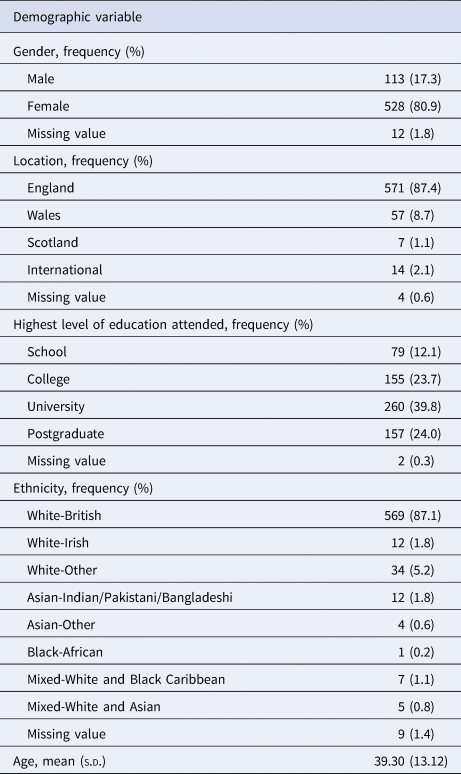
Demographic characteristics of the sample are provided in Table 1. We note that the majority (87.4%) lived in England, and compared to 2011 census data (Office for National Statistics, 2017), our sample was more often female, white and educated to tertiary level. Descriptive statistics are provided in Table 2. Median scores are presented as the data were not normally distributed. Median scores for AQ, CAPEp and CESD-R were 17, 25 and 10 respectively. A total of 13% of participants reported a history of deliberate self-harm in the past 4 months and 32.9% met cut-off for significant suicide risk, defined as a score of at least 7 (Osman et al., Reference Osman, Bagge, Gutierrez, Konick, Kopper and Barrios2001).
Demographic characteristics of sample (n = 653)

Descriptive statistics for study measures (n = 653)a

AQ, Autism-Spectrum Quotient; CAPEp, Community Assessment of Psychic Experiences – Positive symptoms; CESD-R, Centre for Epidemiological Study Depression Scale – Revised; SBQ-R, Suicide Behaviors Questionnaire – Revised; DSHI, Deliberate Self Harm Inventory.
a Median scores and quartiles are presented because the data were not normally distributed.
Research aim 1: to examine the relationship between autistic and psychotic traits
Spearman's test revealed a significant, moderate positive correlation between total AQ and CAPEp scores (rs = 0.509, p < 0.001; online Supplementary Fig. S1). Online Supplementary Table S1 shows results for each of the five AQ domains independently. Correlation with the CAPEp score was strongest for AQ AS (rs = 0.450, pcorr < 0.001) and weakest for AQ IM (rs = 0.205, pcorr < 0.001).
Research aim 2: to determine if co-occurrence of autistic and psychotic traits increases depressive symptomatology, self-harm behaviour and suicidality
Depressive symptomatology
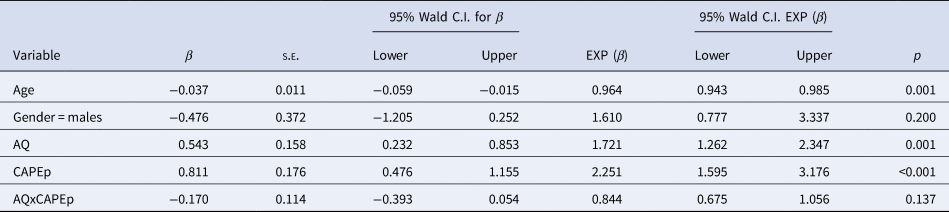
The overall GLM regression model with CESD-R as the dependent variable was significant (Table 3; χ2 = 327.073, df = 5.000, p < 0.001, Pseudo R 2 = 0.426), explaining 42.6% of the variance. Independently, AQ and CAPEp were significantly associated with an increase in CESD-R but did not interact. In considering the weights of their coefficients, relative to AQ, CAPEp has significantly a larger effect on CESD-R by a ratio of 1.70:1 (z = 3.08, p = 0.002). CESD-R scores were lower in older participants and in males.
Summary of regression coefficients in a GLM with CESD-R score as a dependent variable

AQ, Autism-Spectrum Quotient; CAPEp, Community Assessment of Psychic Experiences – Positive symptoms.
Self-harm
Table 4 shows the results of the binary logistic regression model with the dichotomous DSHI variable as the dependent variable. The overall model was significant (χ2 = 90.017, df = 5.000, p < 0.001, Pseudo R 2 = 0.194), explaining 19.4% of the variance. Both AQ and CAPEp were significantly associated with self-harm, such that with every s.d. increase in the AQ and CAPEp scores the odds for self-harm increased 1.7 and 2.25 times, respectively. However, these effects were comparable (z = 1.13, p = 0.256). The interaction of AQ and CAPEp scores was not significant. Moreover, the risk for self-harm was lower in older participants.
Summary of regression coefficients in a binary logistic regression model with DSHI dichotomous variable as a dependent variable

AQ, Autism-Spectrum Quotient; CAPEp, Community Assessment of Psychic Experiences – Positive symptoms.
Suicidality
Table 5 shows the results of the GLM regression analysis predicting SBQ-R. The overall model was significant (χ2 = 137.910, df = 5.000, p < 0.001, Pseudo R 2 = 0.208), explaining 20.8% of the variance. Again, AQ and CAPEp were independently significant positive predictors of SBQ-R but did not interact. In considering the weights of their coefficients, relative to AQ, CAPEp has a larger effect on SBQ-R by a ratio of 1.40:1, albeit non-significantly (z = 1.26, p = 0.209).
Summary of regression coefficients in a GLM with SBQ-R as a dependent variable

AQ, Autism-Spectrum Quotient; CAPEp, Community Assessment of Psychic Experiences – Positive symptoms.
Contribution of specific AQ domains
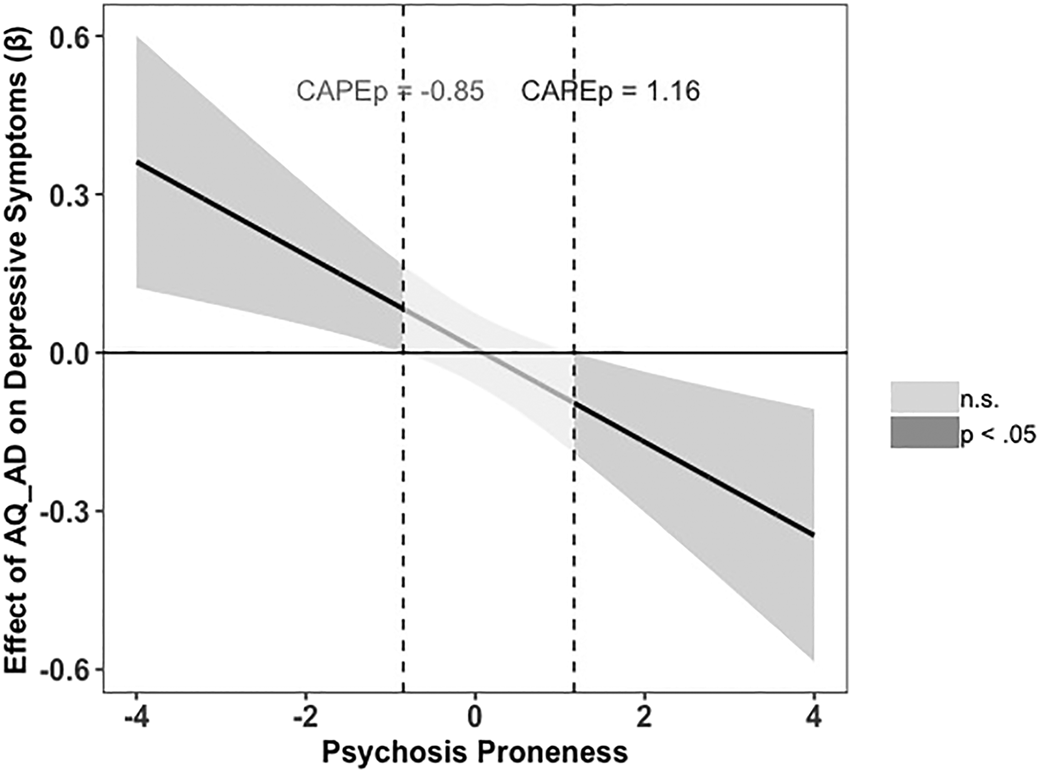
Online Supplementary Tables S2–S4 summarise the results of regression analyses with each of the five AQ subscales as predictor variables and CESD-R, DSHI and SBQ-R as dependent variables. We found that depressive symptomatology (CESDR), self-harm (DSHI) and suicidality (SBQ) were associated with female gender, younger age, and with higher CAPEp, AQ SS, AQ CS and AQ AS scores. AQ IM and AQ AD were not associated with DSHI or SBQ. However, we noted a significant negative interaction between AQ AD and CAPEp on depressive symptoms such that increasing AQ AD scores were associated with increasing depression symptoms when CAPEp scores were relatively low (CAPEp < −0.085 s.d.), but with reduced depressive symptoms when CAPE scores were relatively high (CAPEp > 1.16 s.d.) (Fig. 1, online Supplementary Table S2).
The interactive effect of psychosis proneness (CAPEp) and AQ attention to details (AQ_AD) scores on the depressive symptom (CESDR) scores. The figure displays the standardized effects (β weights) of the AQ_AD scores on the participants' depressive symptoms along the standardized scores of CAPEp. Dark grey shaded areas represent the zone of significant effects (p < 0.05), and the light grey shaded area represents the zone of non-significant effects.

Discussion
The aim of the study was to examine the relationship between autistic and psychotic traits and to determine if their co-occurrence was associated with greater levels of depressive symptomatology, self-harming behaviour and suicidality. Our results, obtained in a self-selecting adult sample, confirm a positive association between sub-clinical autistic and positive psychotic traits, and support autistic and psychotic traits being independent predictors of depression, self-harm and suicidality. Our study found no evidence for additional effects of combined autistic and psychotic traits measured by overall AQ and CAPEp scores, but suggests that positive psychotic traits may interact with the ‘attention to detail’ domain of autistic traits to reduce depressive symptoms.
The relationship between autistic and psychotic traits
A number of studies support a positive correlation between autistic and psychotic traits. For example, Russell-Smith et al. reported a positive correlation between total AQ and O-LIFE (Oxford-Liverpool Inventory of Feelings and Experiences) scores (Russell-Smith et al., Reference Russell-Smith, Maybery and Bayliss2011); Mealey et al. reported a significant positive correlation between total AQ and SPQ (Schizotypal Personality Questionnaire) scores (Mealey et al., Reference Mealey, Abbott, Byrne and McGillivray2014) and Dinsdale et al. reported a large degree of phenotypic overlap between autistic and schizotypal traits (Dinsdale et al., Reference Dinsdale, Hurd, Wakabayashi, Elliot and Crespi2013). This relationship appears to be well evidenced and provides strong support for an overlap between ASD and SSD that extends to the trait level. Our study provides a valuable addition to the existing literature as it is one of the very few studies to be conducted in a sample that is recruited from the wider population and not composed entirely of students.
Interestingly, our results specifically indicate a correlation between autistic and positive psychotic traits, which is a more controversial finding. A strong correlation between negative psychotic traits and autistic traits has been far more consistently reported (Spek & Wouters, Reference Spek and Wouters2010), probably reflecting the shared symptom of impaired social communication. Our findings suggest that overlap at the trait level is not just a result of shared phenotypic features but also a result of different phenotypes simultaneously co-occurring. This interpretation is consistent with a number of different models of overlap between ASD and SSD, including the associated liabilities model, the increased vulnerability model and the multiple aetiologies model (Chisholm et al., Reference Chisholm, Lin, Abu-Akel and Wood2015). In agreement with our findings, a number of studies have reported positive associations between autistic traits and positive psychotic traits or experiences, utilising a variety of measures of schizotypy (Bevan Jones et al., Reference Bevan Jones, Thapar, Lewis and & Zammit2012; Hurst et al., Reference Hurst, Nelson-Gray, Mitchell and Kwapil2007; Russell-Smith et al., Reference Russell-Smith, Maybery and Bayliss2011). However, other studies using principal component analyses have demonstrated an opposing relationship between positive psychotic traits and autistic traits (Dinsdale et al., Reference Dinsdale, Hurd, Wakabayashi, Elliot and Crespi2013; Sierro et al., Reference Sierro, Rossier and Mohr2016). Differing study populations, measures and analytic approaches could account for these discrepancies.
The impact of co-occurring autistic and psychotic traits on depression symptomatology, self-harm and suicidality
The finding that, independently, both autistic traits and psychotic traits are significantly associated with depression symptomatology, self-harm and suicidality is also in keeping with previous literature (e.g. DeVylder et al., Reference DeVylder, Burnette and Yang2014; Kanne et al., Reference Kanne, Christ and Reiersen2009). Although, notably, our study is the first to report an association specifically between autistic traits and self-harm. Previous research has identified that adults with ASD are at increased risk of engaging in self-harm, especially if they experience alexithymia, depression, anxiety and sensory difficulties (Maddox et al., Reference Maddox, Trubanova and White2017; Moseley, Gregory, Smith, Allison, & Baron-Cohen, Reference Moseley, Gregory, Smith, Allison and Baron-Cohen2019). Our findings suggest that this association may extend to the trait level and may help identify another high-risk group of individuals. The association between depression and both sub-clinical autistic and psychotic traits has now been consistently reported across a large number of studies conducted in differing samples and utilising a variety of measures, implying that this is a robust finding (DeVylder et al., Reference DeVylder, Burnette and Yang2014; Fonseca-Pedrero et al., Reference Fonseca-Pedrero, Paino, Lemos-Giraldez, Sierra-Baigrie, Ordonez-Camblor and Muniz2011; Kanne et al., Reference Kanne, Christ and Reiersen2009; Liew et al., Reference Liew, Thevaraja, Hong and Magiati2015; Lundström et al., Reference Lundström, Chang, Kerekes, Gumpert, Råstam, Gillberg and Anckarsäter2011; Matsuo et al., Reference Matsuo, Kamio, Takahashi, Ota, Teraishi, Hori and Kunugi2015; Nishida et al., Reference Nishida, Sasaki, Nishimura, Tanii, Hara, Inoue and Okazaki2010; Pelton & Cassidy, Reference Pelton and Cassidy2017; Rosbrook & Whittingham, Reference Rosbrook and Whittingham2010; Saha et al., Reference Saha, Scott, Johnston, Slade, Varghese, Carter and McGrath2011; Upthegrove et al., Reference Upthegrove, Abu-Akel, Chisholm, Lin, Zahid, Pelton and Wood2018; Zahid & Upthegrove, Reference Zahid and Upthegrove2017).
Our study is novel in finding that co-occurrence of autistic and positive psychotic traits, measured by overall AQ and CAPEp scores, has no added impact upon depression symptomatology, self-harming behaviour or suicidality. It also revealed that depressive symptoms, self-harm and suicidality appear to be specifically associated with positive psychotic traits, social functioning and attention switching difficulties, conceivably via their association with increased risk for social withdrawal and isolation (Abu-Akel, Baxendale, Mohr, & Sullivan, Reference Abu-Akel, Baxendale, Mohr and Sullivan2018). However, the negative interaction of the AQ's ‘attention to detail’ and positive psychotic traits on depressive symptomatology suggests that individuals who are specifically high on these trait dimensions may present with fewer depressive symptoms, and thus may be important in informing prevention and intervention strategies. Attentional biases for negative social stimuli (e.g. sad facial expressions) have been proposed to underlie depression (Hankin, Gibb, Abela, & Flory, Reference Hankin, Gibb, Abela and Flory2010) and it is conceivable that autistic ‘attention to detail’, which is characterised by noticing patterns in non-social systems, may mitigate biases to such depression-relevant stimuli. The association of the co-occurrence of autistic ‘attention to detail’ and positive psychotic traits with benefits is consistent with previous research, which found that the combined presence of autistic and psychotic traits was associated with improved social and executive functioning (Shi et al., Reference Shi, Liu, Shi, Yan, Wang, Wang and Chan2017), better perspective-taking abilities (Abu-Akel et al., Reference Abu-Akel, Wood, Hansen and Apperly2015) and better global functioning in bipolar disorder I during the worst depressive state (Abu-Akel et al., Reference Abu-Akel, Clark, Perry, Wood, Forty, Craddock and Jones2017). Research into how different cognitive styles and/or mechanisms associated with attention and information processing might converge in a compensatory manner would be important to elucidate the nature of this interaction (Abu-Akel et al., Reference Abu-Akel, Testa, Jones, Ross, Skafidas, Tonge and Pantelis2018; Jones et al., Reference Jones, Testa, Ross, Seal, Pantelis and Tonge2015).
The results of the present study oppose some previous research; Upthegrove and colleagues reported that the interaction between autistic and positive psychotic traits did have a significant impact on depression in a non-clinical population (Upthegrove et al., Reference Upthegrove, Abu-Akel, Chisholm, Lin, Zahid, Pelton and Wood2018). Their results indicated the association between autistic traits and depression was stronger when positive psychotic traits were present, and vice versa. The methodologies in both studies were similar, with the biggest difference lying in the sample. In the previous study, the sample size was smaller and the participants were younger and solely undergraduate students. Despite this, the distributions of sub-clinical traits were similar, with comparable AQ, CAPEp and CESD-R scores. Further research investigating the differences in the manifestation of, and outcomes associated with, sub-clinical traits between student and non-student populations is recommended, especially given that the majority of research in this field so far has been conducted in student populations. By contrast, our findings mirror those reported for individuals with the first episode psychosis, in which autistic traits and positive symptoms were associated with depression and suicidality, but without the significant interaction effect (Upthegrove et al., Reference Upthegrove, Abu-Akel, Chisholm, Lin, Zahid, Pelton and Wood2018). This suggests that the interaction effect on depression and suicidality is similar across the spectra of psychotic disorders, from sub-clinical to clinical manifestations.
Implications
There is growing recognition that current intervention and preventative treatments for depression might benefit from considering sub-clinical autistic and psychotic traits (Matsuo et al., Reference Matsuo, Kamio, Takahashi, Ota, Teraishi, Hori and Kunugi2015). Despite this, little research is being done to develop and test effective modification strategies that could be implemented by health care professionals. An important first step will be to explore how exactly the presence of sub-clinical traits affects treatment efficacy and compliance. The impact of autistic traits on the treatment outcome has been considered in preliminary studies in females with eating disorders (Stewart, McEwan, Konstantellou, Eisler, & Simic, Reference Stewart, McEwan, Konstantellou, Eisler and Simic2017), but remains unexplored in depression cohorts.
Our findings reinforce the need for health care professionals to be aware of the associations between sub-clinical autistic and psychotic traits and depression, as well as self-harm and suicidality. In order to develop better-targeted therapy for individuals with depression, routine assessment of both trait dimensions, as well as consequent tailoring of communication and treatment, may be helpful. Similarly, modifications may be required to intervention strategies for self-harm and suicidality. Moreover, a mixed-methods study suggests that most health care providers feel they lack skills and tools to care for and communicate with adults with ASDs (Zerbo, Massolo, Qian, & Croen, Reference Zerbo, Massolo, Qian and Croen2015). This highlights the necessity for improved education and strengthens the argument that future research should focus on developing and testing effective modification strategies that can be implemented by health care professionals.
Strengths and limitations
Our study has three main limitations. Firstly, the sample was not representative of the general population in a number of important ways: female bias, higher level of education bias, a potentially higher proportion of individuals meeting the AQ cut-off for Asperger's syndrome and a lack of representation of individuals with intellectual impairment. The high proportion of women in our sample is especially important to take into account given consistent findings of sex differences in autistic traits (Ruzich et al., Reference Ruzich, Allison, Smith, Watson, Auyeung, Ring and Baron-Cohen2015) and depressive disorders (Piccinelli & Wilkinson, Reference Piccinelli and Wilkinson2000). Secondly, as participants were self-selecting, our study was particularly at risk of responder bias. Although AQ, CAPEp and CESD-R measures appeared consistent with previous findings (Ruzich et al., Reference Ruzich, Allison, Smith, Watson, Auyeung, Ring and Baron-Cohen2015; Upthegrove et al., Reference Upthegrove, Abu-Akel, Chisholm, Lin, Zahid, Pelton and Wood2018; Van Dam & Earleywine, Reference Van Dam and Earleywine2011), levels of self- harm and suicidality were both higher in our sample than in previously published data (Meltzer, Corbin, Singleton, Jenkins, & Brugha, Reference Meltzer, Corbin, Singleton, Jenkins and Brugha2002), which may have biased our results. Finally, the traits and symptoms in our study were measured at one time-point only. Given that depression symptoms and psychotic traits typically fluctuate (Linscott & van Os, Reference Linscott and van Os2013; Rhebergen et al., Reference Rhebergen, Batelaan, Graaf, Nolen, Spijker, Beekman and Penninx2011), these may have been over, or under, represented in our sample. Future research should use a prospective longitudinal design to re-examine our research aims.
A strength of our study was a large number of participants. It is unlikely that significant findings were missed due to a lack of power. Rapid recruitment was achieved through Facebook advertisements. A number of recent studies in mental health have recognised the potential use of Facebook targeted advertisements in research recruitment (Carter-Harris, Reference Carter-Harris2016; Kayrouz, Dear, Karin, & Titov, Reference Kayrouz, Dear, Karin and Titov2016), but generalisability to a wider offline population is relatively unexplored. Additionally, unlike most previous studies, ours was not conducted exclusively in university students.
Conclusions
This study supports sub-clinical autistic and psychotic traits being independently associated with depression, self-harm and suicidality. However, the contribution of autistic and psychotic traits subdomains to depression, self-harm and suicidality should be considered further in future research. These findings highlight the importance of considering both autistic and psychotic traits in research and when developing prevention and intervention strategies.
Supplementary material
The supplementary material for this article can be found at https://doi.org/10.1017/S0033291720000124.
Financial support
KNS received an intercalated degree bursary from the Sir Arthur Thomson Trust and a £500 grant from the University of Birmingham Population Sciences and Humanities Intercalated Degree course (grant number not applicable).
Conflict of interest
None.
Ethical standards
The authors assert that all procedures contributing to this work comply with the ethical standards of the relevant national and institutional committees on human experimentation and with the Helsinki Declaration of 1975, as revised in 2008.