


Introduction
Stress Control (SC) is a large psycho-educational group approach (White, Reference White1998) incorporating cognitive behavioural therapy (CBT) approaches and self-help that is delivered in community settings and can be accessed by self-referral. It is ideal for a stepped-care model of service delivery (Simon et al. Reference Simon, Katon, Von Korff, Unützer, Lin, Walker, Bush, Rutter and Ludman2001; Scogin et al. Reference Scogin, Hanson and Welsh2003; National Collaborating Centre for Mental Health, 2004; Bower & Gilbody, Reference Bower and Gilbody2005; Scottish Executive, 2005) and can meet the needs of large numbers of people with mild mental-health problems (MHP) therefore increasing access to CBT (Lovell & Richards, Reference Lovell and Richards2000). It consists of six sessions that teach people strategies to manage their body symptoms, thoughts, and behaviours. Further information on SC is reported in White (Reference White1998, Reference White2000).
There is growing evidence that large psycho-educational groups (White et al. Reference White, Keenan and Brooks1992; Cuijpers, Reference Cuijpers1998; Watkins et al. Reference Watkins, Elliot, Stanhope, Button, Williams and Brown2000; Brown et al. Reference Brown, Elliot, Boardman, Ferns and Morrison2004), self-help groups (Den Boer et al. Reference Den Boer, Wiersma and Van Den Bosch2004) and group therapy (Scott et al. Reference Scott, Stradling and Greenfield1995; Allart-Van Dam, Reference Allart-Van, Hosman, Hoogduin and Schaap2003; Swan et al. Reference Swan, Sorrell, MacVicar, Durham and Mathews2004) are effective in helping mild MHP. The format appears to be highly accessible, efficient and satisfactory to patients (Brown et al. Reference Brown, Cochrane and Cardone1999, Reference Brown, Cochrane and Hancox2000). However, attrition rates can be high, particularly at the start of therapy and may possibly be greater with people suffering from depression compared to people with anxiety (Watkins et al. Reference Watkins, Elliot, Stanhope, Button, Williams and Brown2000).
There is also good evidence within individual psychotherapy (including CBT) of a positive association between the therapeutic relationship and therapy outcomes (Horvath & Symonds, Reference Horvath and Symonds1991; Martin et al. Reference Martin, Garske and Davis2000; Horvath, Reference Horvath2001; Waddington, Reference Waddington2002). The client's perspective is more closely associated with outcome and can be predictive when measured early in therapy (Squier, Reference Squier1990; Jones & Poulos, Reference Jones and Poulos1993; Muran et al. Reference Muran, Gorman, Safran and Twining1995; Krupnick et al. Reference Krupnick, Sotsky, Simmons, Moyer, Elkin, Watkins and Pilkonis1996; Horvath, Reference Horvath2001; Waddington, Reference Waddington2002). This association is apparent irrespective of the assessment measure used (Martin et al. Reference Martin, Garske and Davis2000; Horvath, Reference Horvath2001). The relationship appears to be more important than the type of therapy approaches used (Krupnick et al. Reference Krupnick, Sotsky, Simmons, Moyer, Elkin, Watkins and Pilkonis1996; Stiles et al. Reference Stiles, Agnew-Davies, Hardy, Barkham and Shapiro1998; Zuroff & Blatt, Reference Zuroff and Blatt2006).
In addition there is evidence that empathy is linked to outcome (Hartley & Strupp, Reference Hartley, Strupp and Masling1986; Burns & Nolen-Hoeksema, Reference Burns and Nolen-Hoeksema1992; Orlinsky et al. Reference Orlinsky, Grawe, Parks, Bergin and Garfield1994; Bohart et al. Reference Bohart, Elliot, Greenberg, Watson and Norcross2002). Warmth and empathy can significantly enhance therapy and speed recovery (Persons & Burns, Reference Persons and Burns1985). Within CBT, the importance of therapist empathy in recovery from depression has been demonstrated (Bohart & Greenberg, Reference Bohart, Greenberg, Bohart and Greenberg1997a, Reference Bohart, Greenberg, Bohart and Greenbergb; Marziali, Reference Marziali1984).
However, little is understood of the role of the therapeutic relationship and empathy within psycho-educational approaches. There is a view that the role of the group leader and the characteristics of the therapeutic relationship are not critical to outcome within psycho-education groups (Antonuccio et al. Reference Antonuccio, Lewinsohn and Steinmetz1982, Reference Antonuccio, Davis, Lewinsohn and Breckenridge1987). Cuijpers (Reference Cuijpers1998) suggests that the relationship between the ‘group leader’ and client is one of teacher and student rather than therapist and patient and thus does not rely on the therapeutic relationship as a key to success. White (Reference White1998) found that not being able to discuss your personal problems and emotional release did not appear to be important to the overall success of the group. Aligned to this, clinicians report concerns at using techniques that move away from the therapeutic relationship (Audin et al. Reference Audin, Bekker, Barkham and Foster2003; Rees & Stone, Reference Rees and Stone2005).
Therefore more information on the impact of large psycho-education groups on patient outcome is required, and whether empathy within this form of intervention makes a positive contribution to outcome. The principle aim of this service evaluation is: what is the impact of SC on patient outcome? Second, do participants perceive the therapist delivering a large psycho-educational group to be empathetic?, and third, is there a relationship between empathy and outcome?
Method
A before–after experimental design was used to investigate the impact of delivering large psycho-education groups on patient outcome and the relationship factors that influence outcome. All individuals attending two courses of SC between May and August 2006 were identified as the sample population. Consent to participate was obtained at the start of the course. Participants unwilling to participate were excluded from the study. To measure change over time, each attendee at two courses of SC were asked to complete a questionnaire at the beginning and end of the 6-week course.
Mental-health outcomes were measured with the Clinical Outcome Routine Evaluation (CORE) (Connell et al. Reference Connell, Barkham, Evans, Margison, McGrath and Milne1997; Barkham et al. Reference Barkham, Evans, Margison, McGrath, Mellor-Clarke, Milne and Connell1998; Evans et al. Reference Evans, Mellor-Clark, Margison, Barkham, McGrath, Connell and Audin2000, Reference Evans, Connell, Barkham, Margison, McGrath, Mellor-Clarke and Audin2002) and the Patient Enablement Instrument (PEI) (Howie et al. Reference Howie, Heaney, Maxwell and Walker1998, Reference Howie, Heaney, Maxwell, Walker, Freeman and Rai1999). The CORE is a well-validated serial measure of mental-health outcome, developed for use in psychological and psychotherapeutic settings, and has been used to measure psychological therapies in primary-care settings (Gilbert et al. Reference Gilbert, Barkham, Richards and Cameron2005).
The clinical thresholds reported by Evans et al. (Reference Evans, Connell, Barkham, Margison, McGrath, Mellor-Clarke and Audin2002) are separate for males and females; males with an ‘all items’ total over 1.19, and females with an ‘all items’ total over 1.29 are regarded as being within the ‘clinical’ range.
The PEI (Howie et al. Reference Howie, Heaney, Maxwell, Walker, Freeman and Rai1999) has been developed and validated as an immediate outcome measure of GP consultations within primary care. It was administered at the end of the first and last sessions; six questions asked people to rate whether, as a result of the session, they felt more able to cope with life.
Responses give a score range of 0–12. To enable comparison to other studies an average item score was calculated by totalling the valid answers (ignored, does not apply = 0, or same or less = 0) as reported by Bikker et al. (Reference Bikker, Mercer and Reilly2005). The total was divided by the valid number of answers (i.e. questions with ‘does not apply’ or ‘same or less’ were excluded) then multiplied by 6 to give a total.
The measure of empathy used in the present study was the modified Consultation and Relational Empathy (CARE) measure (Mercer & Reynolds, Reference Mercer and Reynolds2002; MacPherson et al. Reference MacPherson, Mercer, Scullion and Thomas2003; Mercer et al. Reference Mercer, Watt and Maxwell2004, Reference Mercer, McConnachie, Maxwell, Heaney and Watt2005). The CARE measure has been developed for use in primary-care settings and reflects patients’ views of the helping relationship (Mercer et al. Reference Mercer, Watt and Maxwell2004, Reference Mercer, McConnachie, Maxwell, Heaney and Watt2005) but has also been used in other settings (Bikker et al. Reference Bikker, Mercer and Reilly2005; Price et al. Reference Price, Mercer and MacPherson2006; Mercer et al. Reference Mercer, Hatch, Murray, Murphy and Eva2008; Mercer & Murphy, Reference Mercer and Murphy2008).
The CARE measure has been developed and validated for individual consultations. However, given the lack of suitable measures for group settings, and following discussions with the developer of the measure, the CARE was modified to suit large group settings by omitting question 2 (. . . letting you tell your ‘story’) and question 3 (. . . really listening).
To enable comparison with other studies an average item score was calculated by totalling the valid answers (does not apply = 0). The total score was divided by the valid number of answers (i.e. questions with ‘does not apply’ were excluded), then multiplied by 10 to give an average item score.
Two further engagement factors were included; sessions attended and homework (trying things out at home) to assess the attendees engagement with the SC model, and their own disposition to act to change things.
Two simple questions on the number of sessions attended and whether attendees had managed to try out the new techniques and strategies they learned on the course at home were included to assess engagement with the treatment model.
• How many sessions did you attend?
• Have you been able to try things out at home?
Answers were rated using a likert scale (1 = no, not at all; 2 = no, not very often; 3 = yes, most of the time; 4 = yes, all the time).
Demographics variables were also recorded in the questionnaire as follows: marital status, ethnicity, age, gender, reason for attending, postcode/deprivation scores/age at leaving school, general health over previous 12 months, co-morbidity, GP consultations over the last 12 months. Deprivation was assessed from individual postcodes using the Scottish Index of Multiple Deprivation (SIMD) (Scottish Executive, 2006). It uses the most up-to-date information available and consists of seven domains which are: current income, employment, health, education skills and training, geographical access to services, and housing and crime. It gives a score range of 0–80 with zero indicating affluence.
The data was analysed with SPSS software (SPSS Inc., USA); Spearman's correlations were also performed to identify any associations between the baseline outcome measures and empathy measures. Ethical permission was obtained from the Greater Glasgow Primary Care Division Ethics Committee in April 2006.
Results
Response rate to questionnaire
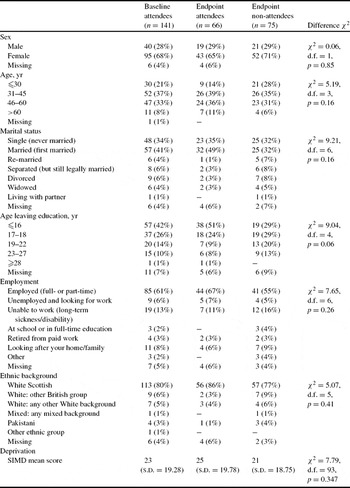
In total, 141 participants completed the baseline questionnaire at the first SC session during the two data collection periods in May 2007 (group 1, n = 65) and August 2007 (group 2, n = 76). Of these 141, 66 (47%) completed an endpoint questionnaire at the final session [group 1, n = 30 (46%); group 2, n = 36 (47%)]. The demographics of the 141 attendees who completed the baseline questionnaire at the first SC session are shown in Table 1. Out of the 141, two thirds (68%) were women. Most attendees were aged between 31 and 60 years (mean 42 years) and almost half were married or living with a partner (42%). Forty-two percent left education aged ≤16 years and 60% were employed full- or part-time. The majority (80%) described their ethnic background as White Scottish. The mean deprivation score based on individual postcode using SIMD score was 22.
Demographics of study population at baseline and endpoint

SIMD, Scottish Index of Multiple Deprivation.
Due to the relatively low response rate at endpoint (47% of those who completed the baseline questionnaire), a Pearson χ2 test was used to identify any significant differences between the demographic characteristics of those from the baseline population who completed a questionnaire at the last SC session (endpoint attendees) and those from the baseline population who did not (endpoint non-attendees) As can be seen from Table 1, there were no significant differences between the groups for any of the demographic variables.
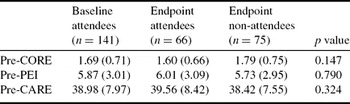
Equally there was no difference in baseline outcome measures and measures of empathy between the attendees who completed a questionnaire at the last SC session (endpoint attendees) and those from the baseline population who did not (endpoint non-attendees) (Table 2).
Difference in baseline measures between attendees and non-attendees
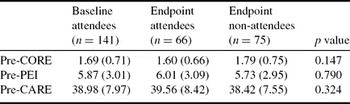
CORE, Clinical Outcome Routine Evaluation; PEI, Patient Enablement Instrument; CARE, Consultation and Relational Empathy measure.
Values are mean (s.d.).
The CARE score at the end of the first night was negatively associated with the CORE score at baseline (ρ = −0.246, n = 105, p = 0.011, two-tailed). That is the attendees’ views of the facilitators’ empathy at the end of the first night was influenced by severity of mental distress, with those with the highest CORE scores (the most distressed) perceiving the facilitator as less empathetic than those with lower scores (less distressed). Conversely, there was a significant positive relationship between pre-CARE and enablement (ρ = 0.317, n = 119, p = <0.001, two-tailed). Thus, it appears that perceptions of empathy and relationship established on the first night are inter-related and are also intimately related to first-night outcome.
Outcome of those attending SC
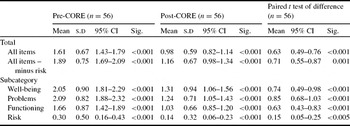
Of the 66 attendees who completed a questionnaire at baseline and endpoint, 56 (85%) completed the CORE at both time-points. The overall CORE score was reduced significantly by the end of the SC course (t = 9.18, d.f. = 55, p <0.001). Table 3 gives the mean scores for each subcategory of the CORE at baseline and endpoint. A statistically significant difference is present with each subcategory of the CORE.
Clinical Outcome Routine Evaluation (CORE) mean scores from baseline, endpoint and the difference between both timelines

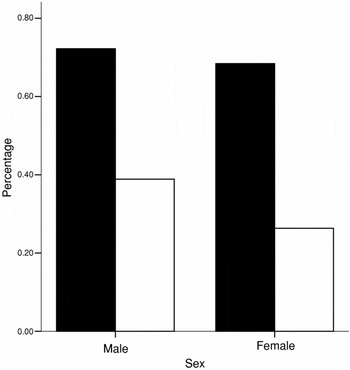
Figure 1 shows the CORE mean scores for attendees (n = 56) that completed SC, that are under or over the clinical threshold; the male clinical threshold = 1.19 and the female clinical threshold = 1.29. Before SC 72% males and 67% females were over the clinical threshold and by the end of SC there was a reduction in the number of people over the clinical threshold, with 39% males and 28% females continuing to be over the threshold.
Pre-CORE (▪) and post-CORE (□) percentage of males and females over clinical threshold.

Enablement scores were high on the first night (5.70), and rose further by the last night (7.52) with a mean difference of 1.70 (95% CI 2.54–0.86) (t = 5.21, d.f. = 57, p = <0.001). There was a significant positive correlation between pre- and post-PEI scores (ρ = 0.535, n = 58, p = 0.007, two-tailed); i.e. the enablement that an individual experiences on the first night is significantly predictive of the enablement they will report on the last night.
Perceived empathy
CARE scores were high at the end of the first session (39.49), and even higher by the end of the course (42.23). A paired t test of the difference gives a mean difference of −2.73 (t = −2.70, d.f. = 56, p = 0.009). There was a highly significant positive correlation between pre- and post-CARE scores (ρ = 0.501, n = 58, p ≤ 0.001, two-tailed); what people think of the course leader's empathy on the first night correlates with empathy ratings at the end of the course.
The attendees were asked at endpoint, how many sessions they were able to attend; 88% attended five or more sessions. Seventy-four of the attendees reported trying out techniques and strategies that were taught on the SC course at home.
Relationship between empathy and outcome
Univariate analysis (correlations) of key variables was initially used to explore the link between the relationship and outcome? This was conceptualized as ‘predictor correlations’ (i.e. correlations between empathy/relationship factors measured on the first night, and outcome measured at the end of the course) and ‘endpoint correlations’ which were associations between endpoint empathy/relationship factors and endpoint outcome (thus, one cannot say that these factors predicted outcome prospectively, but rather were associated with it).
There was no significant predictive relationship between the change in the main clinical outcome measure (CORE) and empathy measure. The correlations between measures of empathy and enablement tended to suggest a positive relationship between empathy and outcome therefore multiple regression analysis was performed to further investigate the relationship between variables.
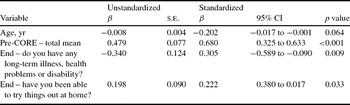
A number of exploratory models were investigated based on the correlations found and possible confounding demographic and baseline variables. Owing to the small sample size, not all possible independent variables could be entered in one model. Therefore a series of multi-regression models were examined all including age and the pre-CORE (mean minus risk) score as ‘confounding variables’; each pre- and end relationship and engagement variable was added separately (i.e. empathy was included with age and pre-CORE score and the model examined. Empathy was then removed, and CARE score entered, a new model run, and so on.) After this, the individual factors that emerged as being significant (or close to significant), were then all entered together (along with age and the pre-CORE score) to give a final model (as presented in Table 4).
Multiple regression – Clinical Outcome Routine Evaluation (CORE) mean score and engagement factors

F 4,42 = 13.544, p = <0.001, R 2 = 0.515.
Dependent variable = difference in CORE all items minus risk mean score.
Change in CORE (mean minus risk) score was explored first, as the main outcome measure used in the study. All of the ‘predictive’ empathy and relationship baseline variables from the first night were added separately. These models did not identify any significant independent predictive variables, i.e. there was no evidence that empathy or relationship measures predicted changes in the CORE; similarly none of the ‘endpoint’ empathy/relationship factors emerged as being related to outcome (results not shown). Table 4 shows the independent variables that did emerge as significant in explaining the change in CORE score.
These results indicate that age, the pre-CORE total mean, and having a long-term health problem were all significantly negatively related, and whether an attendee has been able to try things out at home was positively related, to patient outcome as measured by the change in CORE (all items minus risk) score. Overall 51.5% of the variance in the difference in the CORE (all items minus risk) score was explained by the model.
Discussion
Patient population
The follow-up response rate to the questionnaire between the first and last night was relatively low but there were no significant differences between the demographic characteristics and baseline measures of those who completed both baseline and endpoint questionnaires, and those who completed the baseline one only, giving some degree of confidence that attendees who did complete both questionnaires were representative of the population accessing the service. The sample within this current study found to be accessing SC were mostly women, aged between 31 and 60 years, in employment, and describing their ethnic background as White. Slightly more married than single people attended. Attendees were from the more affluent areas of the south-east of Glasgow with people from deprived communities being somewhat under-represented (Glasgow Centre for Population Health, 2008).
There are some similarities in the demographics of the people that attended the Glasgow SC to the demographics reported by Brown et al. (Reference Brown, Cochrane and Cardone1999, Reference Brown, Cochrane and Hancox2000, Reference Brown, Elliot, Boardman, Ferns and Morrison2004), regarding people accessing 1-day weekend workshops in London and Birmingham; the majority were women, middle-aged, employed, and from occupational groups II and III with occupational group IV being underrepresented. This raises concerns about equity and access to SC possibly being inversely related to health need (Watt, Reference Watt2002). However, if large numbers of people from affluent communities access SC and find it beneficial and have no further need for individual therapy, this could potentially reduce waiting lists for individual therapy, and release CBT staffing resources to be used more effectively to meet health needs in deprived communities.
Impact of SC on patient outcome
The CORE results are in accord with earlier studies (White, Reference White1998; Den Boer et al. Reference Den Boer, Wiersma and Van Den Bosch2004) and show that attendees at SC had significantly reduced MHP within all clinical domains by the end of the 6-week course. Although a direct comparison is not possible, it is interesting to note that 87% of the people attending SC made a statistically significant improvement which compares favourably to other studies with a similar demographic profile (Gilbert et al. Reference Gilbert, Barkham, Richards and Cameron2005), which report that 69% of patients who received up to six sessions of individual therapy made a reliable and clinically significant improvement. SC generally has a positive impact on patient outcome, with a similar percentage improving as that found for individual therapy within primary-care settings for people with possibly more severe MHP.
Conversely, however, just over a third of men (39%) and under a third of women (28%) continue to be over the CORE clinical threshold at the end of SC. It is possible that this group of people may require more intense therapies. Equally, considering a similar percentage is reported (Durham et al. Reference Durham, Fisher, Dew, Sharp, Power, Swah and Morton2004) for complex cases of generalized anxiety disorder receiving individual therapy who make low rates of recovery, and the open access to SC, it is possible that there may be people with complex MHP accessing SC and not finding it beneficial. The implications of this within a stepped-care approach are discussed below.
At the first SC session, the total CORE mean score for all items was 1.61 (95% CI 1.43–1.79) which is slightly lower than the ‘all items’ mean described in clinical populations (2.12, s.d. = 0.81) or the primary-care (1.81, s.d. = 0.67) and secondary-care populations (1.81, s.d. = 0.74) in previous studies. However, the total CORE mean score for all items at the start of SC is higher than the non-clinical population (0.88, s.d. = 0.66) described by Evans et al. (Reference Evans, Connell, Barkham, Margison, McGrath, Mellor-Clarke and Audin2002). This suggests that a different population of people with mild MHP are accessing SC.
The level of risk, or presence of suicidal ideation, is reported to be a factor that discriminates primary-care mental-health patient populations (mean = 0.47, s.d. = 0.63) from secondary-care mental-health patient populations (mean = 0.57, s.d. = 0.70) (Barkham et al. Reference Barkham, Evans, Margison, McGrath, Mellor-Clarke, Milne and Connell1998). The results from SC (mean = 0.30, s.d. = 0.50) are lower than those reported in other studies of individual therapy in primary care (0.47, s.d. = 0.63) or secondary care (0.57, s.d. = 0.70) (Barkham et al. Reference Barkham, Evans, Margison, McGrath, Mellor-Clarke, Milne and Connell1998) but are higher than those reported for a non-clinical population (0.20, s.d. = 0.45) (Evans et al. Reference Evans, Connell, Barkham, Margison, McGrath, Mellor-Clarke and Audin2002), but would not be regarded as ‘clinical’. Again this suggests that mainly people with mild MHP and low risk are accessing SC. This is a useful finding as it helps to allay concerns about offering stepped care to a mental-health population.
The PEI results show that SC attendees felt more enabled at the end of the SC course than at the end of the first session. In comparison to other studies the PEI mean score before and after SC was greater than that reported previously. Howie et al. (Reference Howie, Heaney, Maxwell and Walker1998) report a mean of 3.1 for GP consultations with English-speaking patients, while Mercer et al. (Reference Mercer, Reilly and Watt2002) report a higher mean of 4.7 across 200 consultations in patients attending the Glasgow Homeopathic Hospital. Other studies report means of 3.7 (Bikker et al. Reference Bikker, Mercer and Reilly2005) and 3.6 (Price et al. Reference Price, Mercer and MacPherson2006) at first consultation and 2.1 and 5.2 at follow-up within one-to-one alternative therapies (Mercer et al. Reference Mercer, Reilly and Watt2002; Bikker et al. Reference Bikker, Mercer and Reilly2005; Price et al. Reference Price, Mercer and MacPherson2006). Therefore in comparison to other studies of individual patient therapies, SC appears to result in a high level of enablement by the end of the course.
Perceived empathy
The CARE results suggest that the course leader is perceived to be relatively highly empathetic at the start of SC, and the rating increased significantly by the end of SC. Many of the factors that are considered necessary in forming empathy are absent from psycho-educational group settings (Bedi et al. Reference Bedi, Davis and Williams2005), e.g. active listening by the therapist, clients telling their story. Therefore it is interesting that the course leader is perceived as empathetic despite this.
Within the Mercer et al. (Reference Mercer, McConnachie, Maxwell, Heaney and Watt2005) study 3044 patients gave empathy ratings of their GPs and from this we were able to use Mercer et al.'s (Reference Mercer, McConnachie, Maxwell, Heaney and Watt2005) cut-off points for interpreting CARE measure scores. A mean score <38 is considered to be significantly below average, and a mean score >43 is considered to be significantly above average. Therefore the pre-SC (39.35) and post-SC (42.23) CARE scores are within the average range found in individual consultations with GPs. In comparing SC to other studies of one-to-one alternative therapies using the CARE measure, we found that the SC score is slightly lower than Bikker et al.'s (Reference Bikker, Mercer and Reilly2005) first consultation mean (45) and follow-up (40) scores and Price et al.'s (Reference Price, Mercer and MacPherson2006) initial (42.35) and follow-up (40.57) scores where ratings of empathy drop at 3-month follow-up. Within SC, ratings have increased at the end of the course but we were unable to check for a similar pattern at longer term follow-up.
Questions on the number of sessions attended and homework compliance were included as general measures of engagement with the CBT model, and the level of the clients own disposition to act to change things (Safran & Segal, Reference Safran and Segal1990). Within SC, trying things out at home appeared to be more important to outcome than the perception of the course leader as empathetic. Previous studies in CBT have found that the more active a client is within their own recovery, the greater the change (Burns & Nolen-Hoeksema, Reference Burns and Nolen-Hoeksema1992). However, the questions used in that study are not valid, reliable tests and may be biased by self-report (attendees may feel more inclined to make a favourable report), therefore the results should be interpreted with a degree of caution. High numbers of attendees reported attending more than five sessions and trying out the techniques they were learning on the course at home. This suggests that the population accessing and attending SC is motivated to make changes to improve their mental health.
Relationship between empathy and outcome
There was no apparent significant relationship between the principle measure of empathy (CARE) and the principle outcome measure (CORE) in this study. The significant independent variables associated with CORE outcome (change in CORE score) were: baseline CORE, age, long-term disability (entered as a binary), and how often attendees tried out techniques at home. Age and disability/long-term illness both had negative effects on outcome, i.e. older patients and those with disability/long-term illness had worse outcomes.
The link between empathy and enablement on the first night was demonstrated but ongoing ‘first night’ effects of empathy and enablement on outcome were not found. However the first night does seem to be critical in some ways – attendees appear to be making decisions about the course leader as an empathetic person. Attendees giving lower ratings of empathy were more likely to discontinue attending the course, and thus it is possible that the perception of the course leader as empathetic is important to engagement and remaining to attend the course (Waddington, Reference Waddington2002).
Thus evidence for an important relationship between empathy/relationship and outcome is somewhat inconclusive. Previous studies in non-psychiatric settings have found that empathy (as measured by the CARE), particularly at the first session, is crucial for enablement and that this relationship in turn, is strongly related to changes in outcome (Bikker et al. Reference Bikker, Mercer and Reilly2005; Price et al. Reference Price, Mercer and MacPherson2006). However, this was not found in the present study. It may be that the effects of empathy are indirect, but this has not been explored in the present study.
The CORE results from this study suggest that empathy is not important to outcome in large group psycho-education. The lack of a relationship confirms Cuijper's (Reference Cuijpers1998) view that perceptions of warmth, and the impact of the relationship are not critical for psycho-education (SC) to be effective. This is a similar finding to Gray & White (Reference Gray and White1998) who found that being able to discuss your personal problems and emotional release did not appear to be important to the overall success of the group.
However, small sample size, confounding variables, modified outcome measures and a lack of variability in the data in the empathy variables in the current study may affect the confidence we can have in the results and preclude a definitive answer to this question.
Implications for service provision
This service evaluation raises issues with attrition, access, and deprivation that offer important considerations for service provision. It is estimated that approximately 70% of the people that register to attend SC, attended the first night. Thirty-three percent of the people that registered actually attended and completed a questionnaire at the final session. Forty-seven percent of the people who attended the first SC session attended and completed a questionnaire on the final evening. The original studies on SC performed in Lanarkshire, report (White et al. Reference White, Keenan and Brooks1992; White, Reference White1998) a lower level of attrition (12–16% depending on treatment condition). The results from the current study of SC are closer to the attrition rates reported by Brown et al. (Reference Brown, Cochrane and Cardone1999, Reference Brown, Cochrane and Hancox2000) for 1-day workshops, between attending an introductory talk and the workshops; experimental group (27%) and control group (35%). In another study Brown et al. (Reference Brown, Cochrane and Cardone1999, Reference Brown, Cochrane and Hancox2000) report the attrition rate for each stage of the process of accessing the service and found a slightly higher number of people enquired and then completed attendance at the workshops (48%) than is apparent at SC. Similarly Allart-Van Dam et al. (Reference Allart-Van, Hosman, Hoogduin and Schaap2003) reported a 37% refusal rate of those eligible for the Coping with Depression course and a 25% drop-out rate (before and during the course). Limitations in the design and time-frame of this study restrict the conclusions that can be drawn. It may reflect the readiness for change in a primary-care population, or individuals may register to attend one course and then attend another outside the time-frame of this study. Equally it is possible that increasing access through self-referral to large groups and workshops does inevitably result in high attrition rates. Further work is required to understand the characteristics of clients who ‘drop-out’ from SC to ensure that appropriate follow-up is offered within a stepped-care model.
Importantly, around one third of attendees continued to have ‘caseness’ with the CORE measure at the end of the course. Within the stepped-care model, these people would be directed on to the next level of intervention. Clearly continuity with primary-care services and GPs in particular, may be a crucial factor in this.
Limitations of the study
This service evaluation has three main areas of limitation which could affect the results. First, the use of a before–after experimental design instead of a randomized control trial affects the confidence we can have in the results. The absence of a longer-term follow-up assessment prevents investigation of the duration of change observed, and direct comparison to other follow-up studies.
The project is at risk from acquiescence response and mood bias although this has been reported to have minimal impact (Burns & Nolen-Hoeksema, Reference Burns and Nolen-Hoeksema1992). However, the greatest source of bias within the project is the questionnaire response rate. Fifty-three percent of the attendees that completed a baseline questionnaire did not complete a questionnaire at endpoint. This is possibly due to the informal attendance pattern at SC which is run continuously throughout the year. Further work is required to investigate patterns of attendance and response.
Some of the assessment measures (excluding CORE) had not been used within this setting or with this sample population before. Adapting the measures for use with this population may have affected their overall reliability and validity. In administering the measures at SC, attendees may have felt under pressure to complete them and this may have affected results. This study did not assess whether attendees had previous contact with mental-health services, therefore we cannot make conclusions about this population being a ‘new population’ to health services (Watkins et al. Reference Watkins, Elliot, Stanhope, Button, Williams and Brown2000). This project investigated one aspect of the therapeutic relationship in detail – empathy – and there may be other factors within the relationship that have greater relevance to psycho-educational group formats, e.g. instilling hope or positive beliefs about health.
Future research
Future research would benefit from larger numbers of participants, across a greater time period, within a randomized control study design. All participants within SC would be followed up to minimize response bias. Random allocation to a control group or experimental group would allow further investigation of change. Assessment at follow-up would inform us if changes are maintained in the population. Extending the period of investigation would enable greater tracking of participants and patterns of attrition.
SC is delivered within a stepped-care model of service delivery, therefore further information on attendees that do not find SC beneficial, or continue to be over the CORE clinical threshold, would be very useful for enhancing the assessment of patients’ needs and matching their needs to the appropriate level of service delivery within the stepped-care model.
Further exploration of the therapeutic relationship with psycho-educational groups may identify the active ingredients or factors that impact greatest on patient outcome and may explain how other variables, such as personality factors, self-efficacy, readiness for change or an internal locus of control contributes to outcome.
Conclusions and recommendations
The findings of this service evaluation support the view that psycho-education groups are a suitable way of meeting the needs of a defined group of people with mild to moderate MHP. A picture emerges of younger people with reasonable overall health, being more likely to try out techniques and obtaining a better outcome. Equally, there is a sense that the greater the number of challenges to an attendee (with age and health) the worse the outcome. It could be argued that these approaches need to be provided within stepped-care models, to enable people who have not found, or are not likely to find SC beneficial to ‘step-up’ to alternative approaches. If large numbers of a defined group of people access SC and find it beneficial and have no further need for individual therapy, this could potentially reduce waiting lists of people wishing to access individual therapy, and release limited CBT staffing resources to be used more effectively to meet health needs in deprived communities. A variety of different approaches could be used to increase in the overall access to services for people with MHP.
Acknowledgements
The authors thank Jim White, the STEPS Primary Care Mental Health Team, and the participants at Stress Control for their help and support in carrying out this work.
Declaration of Interest
None.
Learning objectives
Upon reading this paper, the reader will be able to:
(1) Discuss the outcomes gained by participants in attending large scale psycho-educational self-help groups.
(2) Consider the impact of perceived empathy of the course leader within large-scale psycho-educational self-help groups.
(3) Debate the factors that relate to outcome in large-scale psycho-educational self-help groups.
(4) Analyse the service implications in delivering large-scale psycho-education groups.



Comments
No Comments have been published for this article.