INTRODUCTION
Yams (Dioscorea spp.) are a very important staple crop of great economic and cultural significance in West Africa (Coursey Reference Coursey1967), as well as being economically important in the Caribbean and in Asia (Scott et al. Reference Scott, Best, Rosegrant and Bokanga2000). They are grown for their tubers, which in the case of the most important species in West Africa, white yam (Dioscorea rotundata) and water yam (Dioscorea alata) are subterranean. Yams are usually propagated from seed tubers or sections of tuber (mini-setts), rather than true seed, because of the higher yield from seed tubers or setts as well as the unpredictable flowering behaviour in yam. Many useful clones, including popular landraces with potential as parents in a hybridization programme (Asiedu et al. Reference Asiedu, Ng, Bai, Ekanayake, Wanyera, Orkwor, Asiedu and Ekanayake1998), have never flowered or have only flowered irregularly and sparsely (i.e. few flowering plants, few flowers per plant). Sex ratios can also vary and yam clones may be dioecious, monoecious, or hermaphrodite (Sadik & Okereke Reference Sadik and Okereke1975; Abraham & Nair Reference Abraham and Nair1979; Abraham Reference Abraham1997; Bai & Ekanayake Reference Bai, Ekanayake, Orkwor, Asiedu and Ekanayake1998).
Flowering intensity (the product of the number of flowering spikes per inflorescence and number of flowers per spike), sex ratio and the proportion of plants that flower vary greatly with propagule (seed or tuber), genotype (clone), environment (year, location and sowing date) and the interactions between them (Edem Reference Edem1975; Sadik & Okereke Reference Sadik and Okereke1975; Abraham Reference Abraham1997; Bai & Ekanayake Reference Bai, Ekanayake, Orkwor, Asiedu and Ekanayake1998). Photoperiod, which has a major influence on yam flowering time (Ile et al. Reference Ile, Craufurd, Asiedu and Battey2007) and tuberization (Yoshida & Kanahama Reference Yoshida and Kanahama1999), as well as growth or vigour (Akoroda et al. Reference Akoroda, Wilson and Chheda1984; Doku Reference Doku1985) have been suggested as important factors affecting flowering behaviour (Bai & Ekanayake Reference Bai, Ekanayake, Orkwor, Asiedu and Ekanayake1998; Zoundjihekpon & Dansi Reference Zoundjihekpon, Dansi, Berthaud, Bricas and Marchand1998). However, there has been no systematic investigation of the effects of environment on flowering behaviour.
The present paper investigates whether variation in flowering intensity and the proportion of plants with flower buds (FBs) and open flowers (FLs) in one male and one female clone of white yam (D. rotundata Poir) grown in the field in Nigeria was related quantitatively to factors affecting development (photoperiod, temperature through sowing date, location and year) or growth (incident radiation and temperature).
MATERIALS AND METHODS
Clones
Two clones were used in these experiments, TDr 131 and TDr 99-9. TDr 131 is a male flowering clone that usually has a high proportion of profusely flowering plants. TDr 99-9 is a dioecious but largely female flowering clone.
Experimental locations and ecological characteristics
The current study was conducted in Nigeria at three locations: Abuja in the Guinea savanna, Ibadan in the forest/savanna transition and Onne in the humid rainforest. The experimental plots at each location had been planted to fallow rotations of Histrics and Mucuna for 2–3 years prior to the experiment and therefore had similar soil fertility management practices. Selected characteristics of the locations are presented in Table 1. Daily values of air temperature (°C), rainfall (mm) and solar radiation (MJ/m2/d) were obtained from meteorological stations at each research site.
Ecological characteristics of experimental locations in Nigeria

Sowing dates and experimental design
Experiments were conducted at Abuja, Ibadan and Onne in 1999 and 2000 (see Table 2). At Abuja and Onne, experiments were planted on two occasions in each year, while at Ibadan experiments were planted once in 1999 and on five occasions in 2000.
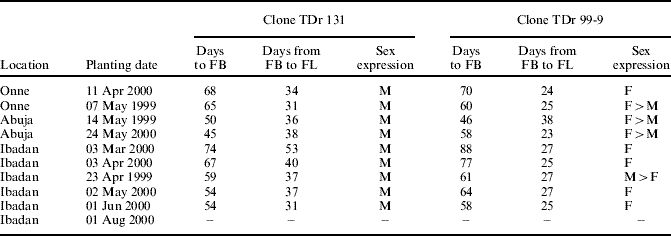
Effect of planting date on the duration from vine emergence to FB, FB to FL and sex expression (male=M; female=F) in clone TDr 131 and clone TDr 99-9
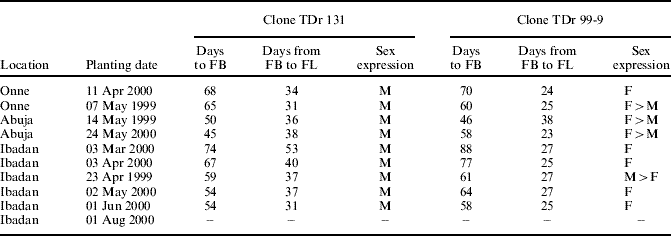
–, did not flower.
The two clones were planted in a randomized complete block design with three replicates. Each replicate comprised 30 plants except for Abuja in 1999, where there were 20 plants per replicate. Tuber setts (from the yam head region only, i.e. tuber region nearest to point of attachment of the corm) weighing 200 g were planted on ridges at a spacing of 1×1 m. Plants were staked 1 month after planting. All plots were hand weeded and no fertilizer was applied. There were no significant pest or disease problems.
Observations
Observations were made on every individual plant (n=90, except Abuja in 1999, where n=60). The dates of vine (shoot) emergence, appearance of FBs and FLs were recorded. Proportions of plants with FB and FL were calculated relative to the number of plants that emerged.
Sex ratios were scored as: 1, non-flowering; 2, male (staminate) flowers only [M]; 3, female (pistilate) flowers only [F]; 4, more male than female flowers [M>F]; and 5, more female and than male flowers [F>M].
Flowering intensity was measured once, at the opening of the first flower within a planting date and clone. By this stage no more FBs were expected to appear. At each planting date, a random sample of 15 (i.e. five plants per replicate) plants was tagged for the estimation of flowering intensity. In any instance where the number of flowering plants per planting date was less than 15, then flowering intensity was measured on all available flowering plants.
TDr 131, which is a male flowering clone, has numerous short spikes (inflorescences) and the flowers are small. Therefore, manual counting of individual spikes and flowers was impractical under field conditions, especially as yams are trained on stakes >3 m high. The number of flowering spikes was therefore estimated using the following scoring system, modified from Abraham (Reference Abraham1997) : 1, ⩽10 spikes; 2, 11–20 spikes; 3, 21–30 spikes; 4, 31–40 spikes; and 5, ⩾41 spikes. The number of flowers per spike was estimated by counting the number of FBs on five randomly selected spikes per plant. Flowering intensity in clone TDr 131 was estimated from the number of spikes×number of flowers per spike. In contrast, female flowers are much larger and easily distinguished, and so in clone TDr 99-9 the total number of female flowers per plant was recorded to give flowering intensity.
Data analysis
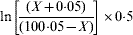
Numbers of plants with FB were converted to proportions of emerged plants (δFB), and FL plants as a proportion of FB (δFL) plants. All proportions and flower counts were transformed prior to analysis to make the distribution normal and to improve homogeneity of variance. In biological data analysis, square root transformations are common for count data while log transformations are usually best for size data (McDonald Reference McDonald2008). Count and intensity data were transformed using the square root function, while proportion values (X) were transformed using the following logit function:
Mean or total values of minimum and maximum temperature, rainfall and solar radiation were calculated from daily values for each clone at each site between vine emergence, appearance of FBs and anthesis. Average photoperiod (civil twilight) between vine emergence and FB and the photoperiod at vine emergence were also estimated from daily photoperiod. Simple linear regressions were used to examine relations between flowering behaviour and climatic factors.
RESULTS
Sex ratios
FBs and FLs were recorded at all planting dates/locations except that at Ibadan in August 2000, where no flowering occurred (Table 2). All flowering plants of clone TDr 131 were male (M) only. In contrast, clone TDr 99-9 exhibited sex types that were variants of dioecism and monoecism. At the majority of sites, plants were dioecious and female flowering (i.e. F). However, at some sites in 1999 monoecious and dioecious plants were found, generally with more female than male plants, as well as more female than male flowers. In the monoecious types, variants of monoecism were observed. In some plants, a spike carried both male and female flowers, while in other plants, a spike could be completely female, another completely male and the rest have both male and female flowers. The April 1999 planting at Ibadan was the only site where male plants predominated over female plants.
Clone TDr 131
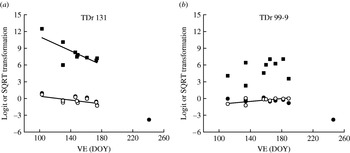
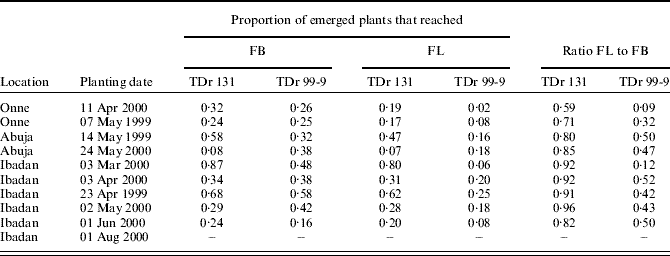
The proportion of emerged plants was high in the male flowering clone TDr 131, >0·80 and there was no significant effect of planting date on the proportion that emerged (P>0·50). In contrast, the proportion of emerged plants that produced FBs (δFB) varied with planting date. Values ranged from 0·87 for the earliest planting date (March at Ibadan) to zero for the last planting date in August at Ibadan, and at Abuja and Onne values were also higher at the earlier sowing date. There was a significant negative linear relationship between δFB and date of vine emergence (r=0·80, P<0·001, n=10; excluding August planting date r=0·43, P<0·05, n=9), and earlier vine emergence at Onne, Ibadan or Abuja resulted in more plants with FB (Fig. 1a).
Relations between δFB (•), δFL (○), flowering intensity (▪) and day of vine emergence (VE) in TDr 131 and TDr 99-9 grown at different sowing dates at three locations in Nigeria. Proportions (δ) are logit transformed; intensity is square root (SQRT) transformed. Fitted lines: TDr 131: ○, y=17·41–0·063x, R 2=0·53; ▪, y=2·13–0·017x, R 2=0·43; TDr 99-9: ○, y=−2·28+0·016x, R 2=0·46.

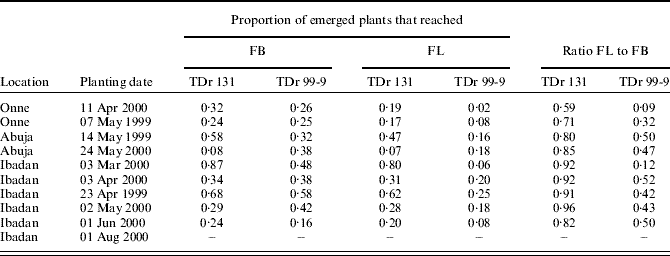
The number of plants with FB that subsequently produced FLs (δFL) was fairly consistent in clone TDr 131 and was >0·80 at all sowings except those at Onne, with no effect of sowing date (Table 3). This proportion also declined with later vine emergence, though not significantly (R 2=0·34, P=0·057, n=9), thereby reflecting the effect of vine emergence on δFB (Fig. 1a). Overall, the proportion of plants that had FLs in clone TDr 131 was 0·34 on average, but only the sowings at Ibadan in April 1999 and March 2000 had a ratio >0·50 of flowering plants.
Effect of planting date on the proportions of emerged plants that had FBs and FLs and the ratio of FL to FB in clone TDr 131 and clone TDr 99-9
–, did not flower.
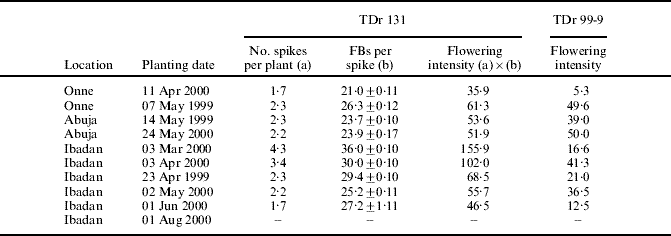
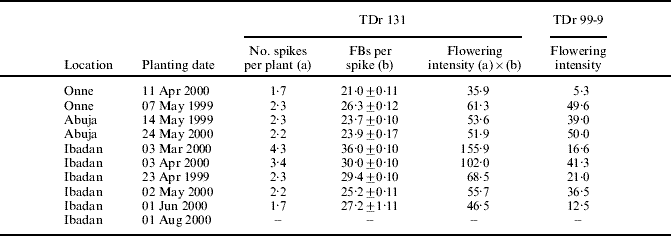
In the male flowering clone TDr 131, flowering intensity was estimated as the product of the number of flowering spikes or inflorescences per plant and the number of flowers per spike (Table 4). The number of spikes per plant ranged from 1·7 to 4·3, and flowers per spike from 21 to 36. The greatest number of spikes per plant and flowers per spike were produced at the earliest planting date, March 2000 at Ibadan and there was a strong response to planting date at Ibadan. However, at Onne and Abuja planting date did not have the same effect. Nonetheless, there was a strong response of flowering intensity (expressed on a square root scale) to time of vine emergence (r=0·53, P<0·05, n=9; Fig. 1). The flowering intensity in the planting at Onne in April 2000 (VE DOY=134) was lower than expected based on the other data.
Effect of planting date on number of spikes per plant, FBs per spike per plant and flowering intensity per plant in clone TDr 131 and flowering intensity in clone TDr99-9
–, did not flower.
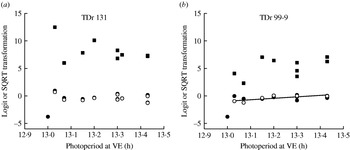
A strong relationship with the date of vine emergence is indicative of a developmental response to photoperiod and/or temperature. The duration from vine emergence to FB in clone TDr 131 (Table 2) was affected by photoperiod at vine emergence (Ile et al. Reference Ile, Craufurd, Asiedu and Battey2007), durations being shorter when photoperiod at vine emergence was longer (i.e. a long-day response). However, in clone TDr 131, photoperiod at vine emergence apparently had no effect on δFB or δFL, though flowering intensity was generally lower when photoperiod at vine emergence was higher (Fig. 2a). This suggests that in clone TDr 131 photoperiod per se had little influence on flowering behaviour. There was also no effect of rate of development (the inverse of duration from vine emergence to FL), i.e. of an indirect effect of photoperiod (not presented).
Relations between δFB (•), δFL (○), flowering intensity (▪) and photoperiod at vine emergence (VE) in TDr 131 and TDr 99-9 grown at different sowing dates at three locations in Nigeria. Proportions (δ) are logit transformed; intensity is SQRT transformed. Fitted line: TDr 99-9: ○, y=−35·19+2·63x, R 2=0·65.

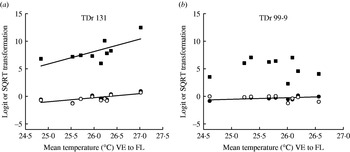
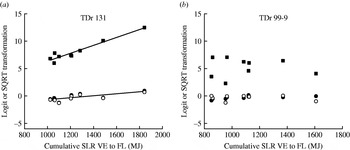
Warmer temperature, in addition to influencing the rate of development, also affects growth rate, which has been implicated in flowering behaviour in yam (Degras Reference Degras1993). Warmer temperatures, which occurred in the earlier sowing dates at Ibadan and at Onne, did increase both δFB and δFL (r=0·50, P<0·05, n=9) and flowering intensity (r=0·49, P<0·05, n=9) in clone TDr 131 (Fig. 3a). Another factor that strongly influences growth is radiation intensity (Degras Reference Degras1993), which varied greatly between locations (highest in the savanna at Abuja, lowest in the forest at Onne). In clone TDr 131, δFB, δFL and the intensity of flowering were greater (R 2=0·85 to 0·9, P<0·001, n=9) at higher levels of incident radiation (Fig. 4a). The low value of flowering intensity associated with Onne (Fig. 1a) could be explained by low incident radiation level at this location in 2000.
Relations between δFB (•), δFL (○), flowering intensity (▪) and mean temperature between vine emergence (VE) and flowering (FL) in TDr 131 and TDr 99-9 grown at different sowing dates at three locations in Nigeria. Proportions (δ) are logit transformed; intensity is SQRT transformed. Fitted lines: TDr 131 ○, y=−50·47+2·254x, R 2=0·49; ▪, y=−19·39+0·737x, R 2=0·50; TDr 99-9: •, y=−7·61+0·284x, R 2=0·32.

Relations between δFB (•), δFL (○), flowering intensity (▪) and total cumulative solar radiation between vine emergence (VE) and flowering (FL) in TDr 131 and TDr 99-9 grown at different sowing dates at three locations in Nigeria. Proportions (δ) are logit transformed; intensity is SQRT transformed. Fitted lines: TDr 131: ○, y=−0·86+7·210x, R 2=0·93; ▪, y=−2·49=1·81x, R 2=0·85.

Clone TDr 99-9
The value of δFB was lower in the predominantly female clone TDr 99-9 than in TDr 131, ranging from 0 in August 1999 at Ibadan to 0·58 in April 1999 at Ibadan. However, there was no relationship between δFB and vine emergence (Fig. 1b) when the August planting date was excluded (r=0·08, n=9; including August r=0·62, P<0·01, n=10). The value of δFL was both lower (average 0·34) and slightly more variable than in clone TDr 131 (Table 3) and in contrast to clone TDr 131 there was a positive relationship between δFL and the date of vine emergence (r=0·46, P<0·01, n=9; Fig. 1b). Hence later vine emergence in clone TDr 99-9 had little or no effect on the number of plants with FB but did increase the proportion of these plants that flowered slightly. The overall proportion of plants that flowered in clone TDr 99-9 was therefore very low, 0·13 on average, and only in April sowings at Ibadan in 1999 and 2000 did the proportion reach 0·20–0·25.
In clone TDr 99-9, the total number of flowers per plant was counted to give flowering intensity (Table 4). The number of flowers ranged from 5·3 to 50 per plant with the greatest number of flowers at Abuja. There were no effects of planting date at Ibadan on the number of flowers. In contrast to clone TDr 131, then, there was no relationship between intensity and vine emergence (Fig. 1b) and flowering intensity was greatest when vine emergence occurred between day of year 160 and 180.
Photoperiod also affected the rate of development in clone TDr 99-9 (Ile et al. Reference Ile, Craufurd, Asiedu and Battey2007), though in contrast to TDr 131 there was no clear effect of planting date on the duration from FB to FL (Table 2), which was between 23 and 27 days at all plantings except Abuja in 1999. Photoperiod at vine emergence had no significant effect on δFB in clone TDr 99-9 (Fig. 2b), but longer photoperiods did increase δFL slightly (r=0·65, P<0·01, n=9). Flowering intensity was not affected by photoperiod at vine emergence (Fig. 2b). Mean temperature from vine emergence to FL affected δFB very slightly (r=0·40, P<0·05, n=9) but not δFL or flowering intensity (Fig. 3b). In contrast to clone TDr 131, there were no relationships between δFB, δFL, flowering intensity and cumulative radiation (Fig. 4b).
DISCUSSION
The present study has shown that plants of clone TDr 131 are consistently unisexual, bearing male flowers only (i.e. androecious). In contrast, clone TDr 99-9 exhibited a number of sex types; some plants were female flowering (i.e. gynoecious), some were found to be monoecious, while others were trimonoecious (i.e. on the same plant some spikes carried both male and female flowers, while others were either completely male or female). Androecious, gynoecious and monoecious plants have been reported in D. rotundata as well as a few occurrences of hermaphrodite flowers (Burkill Reference Burkill1960; Coursey Reference Coursey1967; Sadik & Okereke Reference Sadik and Okereke1975; Abraham & Nair Reference Abraham and Nair1979; Degras Reference Degras1993), but not trimonoecious flowering types. Sex expression has been reported to vary with generation (seed-derived plants v. clonal plants) and year (Sadik & Okereke Reference Sadik and Okereke1975; Abraham & Nair Reference Abraham and Nair1979; Doku Reference Doku1985; Segnou et al. Reference Segnou, Fatokun, Akoroda and Hahn1992), and environment has been postulated as an important factor. In the present study, monoecious and trimonoecious plants were observed at all three locations in 1999 and also at Abuja in 2000. Rainfall between the appearance of FBs and FLs was lower than normal in 1999 at Abuja and Ibadan, but not at Onne, and mean temperatures slightly higher in all four locations. However, there were insufficient observations to say whether this variation in weather was significant. Sex expression is not, however, related to flowering intensity.
Both clones exhibited a low proportion of flowering plants, 0·34 on average in the male clone TDr 131 and 0·13 in the female clone TDr 99-9. Most of this variation was due to variation in the number of plants with FBs rather than variation in the proportion of FB that produced FLs (δFL); this proportion was about 0·85 (n=8) in clone TDr 131 and 0·45 (n=7) in clone TDr 99-9. It is perhaps to be expected that flower bud abortion or arrested development is greater in the female clone, as female flowers are much larger (100 times) and require a larger investment of resources (Abraham Reference Abraham1997). Many other studies have reported similar variation in yam flowering characteristics under contrasting environments created by planting at different dates, locations or years (Edem Reference Edem1975; Okereke Reference Okereke, Ene, Okereke, Odurukwe, Okoli and Arene1978; Akoroda Reference Akoroda1984; Abraham Reference Abraham1997). For example, Sadik & Okereke (Reference Sadik and Okereke1975) reported floral abortion of between 0·38 and 0·86 in three female cultivars of D. rotundata. The above studies, however, did not investigate this phenomenon in any systematic way to see if planting date or other factors control it.
The time of vine emergence clearly has some influence on the proportion of flowering plants and on flowering intensity, and the two clones responded differently (Fig. 1). The male clone TDr 131 had more flowering plants and flowering spikes at earlier sowing dates. Although photoperiod directly influences the rate of progress towards flowering in yam and the rate of flower appearance in legumes (e.g. Flohr et al. Reference Flohr, Williams and Lenz1990), photoperiod or the rate of development did not appear to be important in influencing proportion of flowering plants. These responses in clone TDr 131 suggest that growth-related factors have the largest influence on flowering. Earlier sowings experience warmer temperatures, and due to longer life-cycle durations (Table 2) associated with shorter photoperiod at vine emergence (Ile et al. Reference Ile, Craufurd, Asiedu and Battey2007), potentially greater radiation interception. The period of floral bud differentiation and growth (between FB and FL), for example, varied from 31 to 53 days. Other studies in yam have also shown that growth and vigour influence flowering behaviour (Akoroda et al. Reference Akoroda, Wilson and Chheda1984; Akoroda Reference Akoroda1985; Degras Reference Degras1993). For example, flowering intensity was positively linked to vigour or leafiness (Akoroda et al. Reference Akoroda, Wilson and Chheda1984; Doku Reference Doku1985) and was reduced by shading (Degras Reference Degras1993).
The female clone TDr 99-9 responded differently to clone TDr 131. The proportion of plants with FBs or δFL, and flowering intensity, generally increased with later sowing and δFL was positively associated with longer photoperiod at vine emergence. There was a small effect of temperature on δFB, but no effect of radiation, suggesting that growth was not a major factor in determining the number of flowering plants or flowering intensity in clone TDr 99-9. Given that the duration from FB to FL did not vary much in clone TDr 99-9 either, a strong response to cumulative radiation is less likely. The response to photoperiod and temperature was, however, not strong, though the temperature response of flowering intensity could be interpreted as an optimum temperature response (Fig. 3b). The control of flowering behaviour is therefore still unclear in clone TDr 99-9, though plantings close to the middle of the year or the longest day seem to produce more flowering plants and flowers per plant.
No flowering plants were observed in either clone in the August sowing. This sowing experienced the shortest photoperiod at vine emergence among sites and sowing dates, and rapidly shortening days thereafter. The response of flowering to photoperiod in yam appears to be a long-day response (Ile et al. Reference Ile, Craufurd, Asiedu and Battey2007), and it is possible that 13 h, the photoperiod at vine emergence in the August sowing, is close to a critical value below which flowering does not occur (Roberts & Summerfield Reference Roberts, Summerfield and Atherton1987). Controlled environment experiments would be required to ascertain this.
There are two other factors that could affect flowering: partitioning and seedling vigour. Yams exhibit a short-day response with regard to the timing of tuber initiation and growth (Yoshida & Kanahama Reference Yoshida and Kanahama1999) and so later sowings would have less time to accumulate biomass before tuber initiation, which occurs 4–70 days after sowing (Swannell et al. Reference Swannell, Wheeler, Asiedu and Craufurd2003). Later sowings also flower sooner, which may reduce the number leaves and leaf axils, the cells of which have the capacity to differentiate into floral buds or branches, i.e. reduce the number of potential flowering sites (Degras Reference Degras1993). Hence partitioning of resources to tubers rather than shoots may reduce the proportion of plants with FBs in later sowings. Another factor that may influence plant vigour and hence flowering in yams is prolonged sprouting during storage. Clone TDr 131, for example, typically begins to sprout in March. Yams planted at this time that are supplied with adequate moisture will germinate and rapidly produce true leaves. Yams that are not planted will produce a xerophytic vine, but will not produce true leaves (Craufurd et al. Reference Craufurd, Summerfield, Asiedu and Vara Prasad2001). Nevertheless, the physiology of the storage organ does change when dormancy breaks, starch starts to be broken down and respiration increases (Hariprakash & Nambisan Reference Hariprakash and Nambisan1996). So it is possible that yams planted later, even if stored in cold rooms to delay sprouting, may have inherently lower storage organ reserves and hence vigour. This was probably the case in the August planting date. Although the present study was not intended to determine the effects of edaphic factors on flowering behaviour, a study that determines and quantifies the contribution of variable soil fertility levels (especially available nitrogen and phosphorus and potassium) on flowering characteristics may provide additional information. Currently, it is contentious whether a difference in nitrogen level contributes to variability in yam flowering behaviour (Bai & Ekanayake Reference Bai, Ekanayake, Orkwor, Asiedu and Ekanayake1998).
It is concluded that in the male flowering clone TDr 131 the proportion of flowering plants and flowering intensity is strongly influenced by growth potential, which in the present study is the product of duration (early v. late planting) and radiation environment (savanna v. forest). The female clone TDr 99-9, on the other hand, exhibited no clear relations between flowering and growth or developmental factors, with the proportion of flowering plants and flowering intensity flowering being greatest at planting dates close to the longest day and at temperatures of 25–26°C.