INTRODUCTION
Shortly after the Cultural Revolution in 1978, Deng Xiaoping launched economic reform and the opening up of China. The reform was part of Deng's doctrine of “Socialism with Chinese characteristics” which emphasised both state-owned enterprises and an open-market economy. After more than three decades, the achievements of the reform are obvious. In 2010, China finally surpassed Japan and became the world's second-largest economy. What is happening in China has drawn increasing attention from all around the world.
RECENT POLITICAL DEVELOPMENTS IN CHINA
The 18th National Congress of the Communist Party of China (CPC), held on 8–14 November 2012, has been regarded as the most important political meeting in China in ten years. This once-in-a-decade power transition has brought new leaders as well as new prospects to the world's most populous country. The meeting gained international media attention and attracted more than 2,700 domestic and foreign correspondents from all around the world.
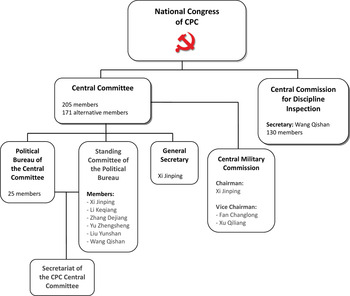
Eighteenth Communist party of China (pc) Central Committee Organisation Chart.

All eyes were focused on the succession of China's fifth generation of leaders, particularly Xi Jinping and Li Keqiang. Everyone was curious to see how Xi and Li as well as the new Politburo Central Committee, were going to rule China in the next decade. It has also triggered a lot of speculation over the future direction of the country's political as well as economic policies.
Though widely reported in the media, many people still find the transition quite confusing. On the one hand, there are reports saying that Xi and Li have taken over the leadership. But on the other hand, one may also notice that Hu Jintao and Wen Jiabo still remain seated as the President and the Premier. Also, there are news reports saying that Hu broke with past precedent by not remaining as the Chairman of the Central Military Commission for two years after stepping down as the party chief. Equally, one may still find Hu's name as the Chairman of Central Military Commission of China!
The political system of China is quite unique from the Western mainstream system. It is a system that is not familiar and not easy to understand by those who are living in a liberal democracy.
THE NATIONAL PARTY CONGRESS
Nominally, the Chinese Government and the Chinese Communist Party are two different organisations. Nevertheless, many are puzzled on their relations and have difficulties in distinguishing the two. The National Party Congress (also called the Party Congress) and the National People's Congress (NPC) are two separate assemblies but their names are similar.
The Party Congress' functions and powers are to hear, as well as to examine, the report of the CPC Central Committee and the Central Commission for Discipline Inspection, to discuss and decide on major issues of the Party, to revise the Party's constitution and to elect members of the CPC Central Committee and the Central Commission for Discipline Inspection. The Central Committee is the highest authority of the CPC and represents a symbol of power. Becoming a Central Committee member implies that one has already gained an important position in the nation. Many of the Central Committee members normally occupy the key leadership roles in the government such as heads of the State Council, provincial or municipal party secretaries, army generals and heads of the state-owned enterprises.
There were 2,270 elected delegates in the 18th National Party Congress representing more than 82 million CPC members. Theoretically, the process of electing delegates to the Party Congress is quite democratic. The election process has gone through a five-part procedure: nomination of candidates, qualification checks, public notification of candidates, short-listing and final voting. In practice, the entire process is just an intra-party democracy with zero transparency for outsiders. From another perspective, the CPC delegate election still acts as a critical step in establishing a symbolic democracy.
Apart from the ‘once-every-five-years meeting,’ each Party Congress also holds several Central Committee plenary sessions. Since the 14th Party Congress in 1992, the mechanism of convening the Central Plenary Sessions has been quite well-established. There are normally seven plenary sessions and each session will have either a special objective or a theme. The First Plenary Session will be convened immediately after the closing of the Party Congress. This is to elect the Party's Central Committee, to elect the new Politburo members, the General Secretary and the Central Military Commission. The Second Plenary Session prepares for the new State Councils, the summons of the NPC, the National Committee of the Chinese People's Political Consultative Conference (CPPCC), the Supreme People's Procuratorate and the Supreme People's Court. The last plenary session, that is the Seventh Plenary Session, is for the preparation of the next Party Congress. There are also various themes for the other four plenary sessions. Each will have a specific topic, like discussing economic research and the three agricultural-related issues (that is, problems with agriculture, rural areas and peasantry), party construction and political system reform, to given examples.
Xi Jinping was elected as the General Secretary of the CPC in the First Plenary Session of the 18th CPC Central Committee. It is believed that such significant decisions are already made before the meeting. Many have suggested that Xi was ordained several years ago to be appointed the General Secretary. Despite this, the appointment of Xi and the other new leaders still indicates that China will be entering into a new era.
THE NATIONAL PEOPLE'S CONGRESS
The National People's Congress is the organ of state power of China. It acts as the parliament and the top legislative body of China. There are roughly 3,000 NPC delegates and the election process is said to be quite democratic. The delegates are elected through both direct, and indirect, election with candidates from all provinces, autonomous regions, municipalities, Special Administrative Regions and the People's Liberation Army. The number of delegates for the current 11th NPC is 2,985. It is, in fact, very difficult to become a delegate as the ratio of representation is very low in comparison with China's population. In rural areas, only one out of 800,000, and in the city only one out of 200,000, can become a delegate. Delegate nominations are mainly from political parties, people's organisations and individuals. Among them, nominations from political parties (from the CPC in this sense) accounts for the largest proportion. Though delegates need not be Communist, about 70% of the current NPC delegates are members of the CPC. Their loyalty is always to the Party. Another interesting phenomenon of the NPC is that it has a long list of millionaries. Bloomberg quoted (from the figures of the Hurun Report) in a news report in February 2012 that the net worth of the 70 richest delegates in China's National People's Congress rose to 565.8 billion yuan (US$89.8 billion) in 2011; a gain of $11.5 billion from 2010. The Hurun Report tracks China's wealthy and, according to the Hurun Rich List 2012, there are 76 delegates to the NPC. Four out of the 161 members in the Standing Committee of the NPC are also listed. It seems that the higher up the Rich List, the more likely the delegates are to have a senior political appointment. Six of the top ten, and 39% of the Top 50, are either delegates to the 18th Party Congress, the NPC or the CPPCC.Footnote 1
According to the Constitution, the NPC has the power to appoint and dismiss government heads including the President, the Vice-President, the Premier, Ministers, the Chairman of the Central Military Committee (Army Chief) as well as the President of the Supreme People's Court (Chief Justice). It has the right to amend the Constitution and supervise its enforcement. It also has the right to examine and approve the budget as well as the country's economic and social development plans. NPC has the legislative power to formulate and to amend the civil, criminal and national laws. Moreover, it has control over issues of war and peace.
Each NPC has a 5-year term and it normally meets once a year. Special meetings may be convened if the Standing Committee of the NPC deems it necessary, or if more than one-fifth of the delegates propose it. The Standing Committee consists of a Chairman, Vice-Chairmen, Secretary General and members that is responsible for, and report on, the work of the NPC. The members are elected from the NPC delegates but they cannot serve in key roles in the Central Government. However, the NPC is by no means an independent body in the Western sense of a parliament. The Standing Committee is a permanent body to execute the authority being regulated by the Constitution. It is conducting a wide range of government functions both at the national and at the local levels. It also acts nominally by virtue of the NPC's authority but it is worth noting that CPC Central Committee members are also NPC delegates.
THE CENTRAL PEOPLE'S GOVERNMENT
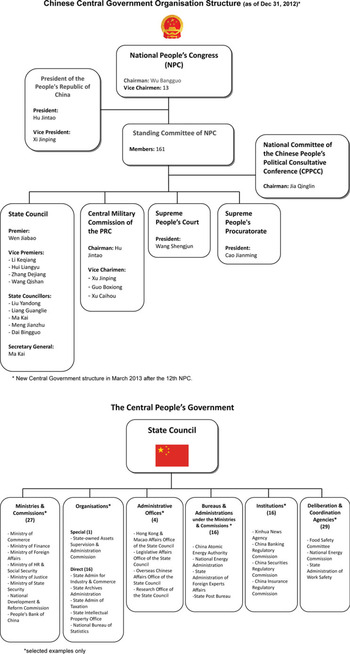
The State Council is directly under the NPC and it is the Congress' operational body. It simply means the Central People's Government and it is responsible for the administrative work internally, as well as for foreign affairs. It also leads the work of all local administrative authorities and formulates the provisions of all local authorities. The State Council functions in a quite similar way to the Cabinet in the West.
China's national defense, foreign affairs and sovereignty issues are handled by the Central Government. The Premier is the head of the government. He also advises the NPC on the appointment and dismissal of the State Council members. The Deputy Premiers are senior assistants to the Premier. The State Councilors are equivalent to the level of the Deputy Premiers. They will assist the Premier in his work and may help with some regional works or tasks being assigned by the Premier. The State Councilors also represent the State Council participating in the foreign affairs activities. The State Council is also composed of posts like the Ministers, the Auditor-General and the Secretary-General.
POLITICAL PARTIES IN CHINA
The Chinese political party system is described by the Chinese Government as a “multi-party cooperation and political consultation system” under the leadership of the CPC. Apart from the core, leading CPC, China still has eight other democratic political parties. They are the Revolutionary Committee of the Chinese Kuomintang, China Democratic League, China National Democratic Construction Association, China Association for Promoting Democracy, Chinese Peasants and Workers Democratic Party, China Zhi Gong Dang, Jiu San Society and Taiwan Democratic Self-Government League. The system in China is fundamentally different from the western two-party, or multi-party competition, system and the one-party system in other countries. Those democratic parties in China act as “participating parties”. Many people in the West think that China is adopting a form of “one-party dictatorship” but not many understand how this system works. People simply know that the CPC has ruled China since 1949. It is not obvious that the CPC has a concrete position, in the Chinese Central Government.
All NPC delegates, in theory, can be appointed as a Minister or to other key positions in the government. But in fact, those being elected are mainly CPC members. All major government and military positions therefore are held by the CPC members. CPC is the paramount source of power. The ultimate authority rests with members of the CPC politburo.
RELATIONSHIP BETWEEN THE CPC AND THE CENTRAL GOVERNMENT
The number of the CPC members nowadays is more than the population of most European countries. CPC was founded in 1921 largely imitating the structure of the Soviet Union. Like the Communist Party of the Soviet Union, the CPC by then also faced the problem of “Reds” versus “Experts”. “Reds” meant the Communists. Many of the Communists in the early establishment were not well educated. They were just revolutionaries without good professional knowledge and technique for running a government. “Experts” meant professionals with various skills in running government. Unfortunately, most of the “experts” in the New China were officials from the Kuomintang National Government. The new Communist Government decided to absorb nearly all the experts from the previous reign. To have close supervision, nearly all heads of various organisations were served by the Communist Cadres. The Communist Government also set up party member groups and party secretaries in various government departments, enterprises and institutions around the country.
Since 1949, the Communist Government has gradually begun to combine “redness” with expertise. They trained up the Communists with professional skills. This, however, also raised another question. There were contradictions between the relationship of the party and the government as well as the relationship between the party and the state-owned enterprises. In the mid-50s, nearly all levels in the government and all units of enterprises and institutions were occupied by middle to senior Communist Cadres. That meant nearly all experts were Communists. Those party groups or committees being formed within the government and the enterprises became overlapped.
To breakthrough the contradictions, the role of Communist Cadres in the government did gradually change. The role of supervising the experts had been faded out. Nearly all Communists who occupied the senior posts of the Government were working on practical and concrete issues. In other words, they were actually running the Government. The line between “Reds” and “experts” is no longer easy to distinguish.
The old concept of supervising non-Communists by Communists may still appear today in some local communities, small agencies and some minor government departments. One can become a government official in China nowadays by passing the civil servants examination. But key posts in central and local Government, as well as the state-owned enterprises, are still being occupied by the Communists through appointments.
In parallel with the government departments at all levels, from central to local, there are still party groups or committees at the same rank. The CPC secretaries are always top-level officials with higher decision-making authorities than the department heads and executives. Although the secretaries from the CPC may not have higher status than the department heads, important departmental decisions normally still need to get approval from the party committee or party group.
It is now quite common for the same person to wear the same hat as the party group secretary as well as the head of the department. Some departments even have the same function as the CPC party organisations. For example, the CPC Central Military Commission is also the nation's Central Military Commission. The two commissions consist of the same members. But CPC Central Military Commission is elected by the party congress whereas the country's Central Military Commission is elected by the NPC. Their responsibilities are to command the nation's armed forces and on the formulation of the country's national defence policy.
The difference between the nature of the National Academy of Governance and the Party School of the Central Committee of CPC are also not clearly drawn. The State-owned Assets Supervision and Administration Commission and the Central Enterprise Work Committee of CPC are also quite similar. An article from the 21 Century Economic Herald in 2003 reported a source that was close to the CPC Central Enterprise Work Committee and mentioned that the plaque of the Central Enterprise Work Committee was replaced by the plaque of the State-owned Assets Supervision and Administration Commission shortly after the NPC meeting in March.Footnote 2 So there remains some confusion.
Governement Structure in China.

THE LEGAL SYSTEM WITH CHINESE CHARACTERISTICS
We often come across the term “bicameral”. This is a common practice for most of the democratic countries in the world though some may have different names for the two ‘Houses’. However, this is not the story in mainland China as the country has adopted the unicameral approach. NPC is a unicameral legislature which has the unified exercise of state power.
On the second session of the 11th NPC in March 2009, the Chairman of the NPC Standing Committee, Wu Bangguo, declared, in the working report of the NPC Standing Committee, that there is a fundamental difference between the political system in China and that of the West. China can “never simply copy the system of Western countries”.Footnote 3 Hu Jintao also solemnly reiterated, in the working report at the opening of the 18th Party Congress, that China, “will never copy a Western political system.” In the report, Hu elaborated on the importance of “keeping to the socialist path of making political advance with Chinese characteristics”.Footnote 4 He mentioned that the CPC would promote reform of the political structure in various respects. Hu also stated in the working report that the party system in China was a multi-party cooperation and political consultation system under the leadership of the CPC which varies from the multi-party system in the West.
The Chinese government has emphasised that China is a unified multi-ethnic country with 56 ethnic groups. Each group may have their own characteristics and it is not easy for each of them to compromise. In dealing with the relationship between the central and local governments. It is easier to implement a system of regional ethnic autonomy. However, China still needs to ensure the unified leadership of the Central government. Powers are concentrated in the centre, as the history of the republics of the ex-Soviet Union was a great warning signal to this one of the world's last five Communist countries! The Chinese government claims that China is implementing the principle of “democratic centralism”. The National People's Congress and it's Standing Committee have centrally exercised the state power towards the government, the courts and the prosecutors. This is to ensure the smooth running of the government and the unity of state power.
The government system in China is a combination of legislative and executive powers. It is a management of one government with two houses. According to the Constitution of China, people hold all the powers of the state. There is no separation of powers in China and all authorities (including the executive and the judiciary) report their duties to the NPC, the country's highest authority.
NEW LEADERSHIP IN CHINA
The name of Xi Jinping and other leaders are becoming more familiar to the West but their faces are less known. People have started to know that Xi is now the General Secretary of the CPC. He is also the Chairman of the Party Central Military Commission. Nearly everyone believes that he will become the President of China at the next NPC in March 2013. There is no doubt that Xi will finally hold the military and political power. Apart from that, Xi is still unfamiliar to the West.
The fifth generation leadership in China further demonstrates a mixture between the “Reds” and “Experts”. Unlike the Communist leaders in the old days, all the Central Committee members of the CPC in the latest 18th Party Congress are university graduates. Xi Jinping and Li Keqiang both obtained their doctorates.
Some scholars believe that the experience Xi gained from the “Down to the Countryside Movement” has let him become more sensible. This may provide a better chance of progress in the political reforms. During the Cultural Revolution, Mao Zedong encouraged secondary school students to go “up to the mountains, down to the villages” for re-education. Students stayed with poor peasants and learnt from them. As a result, millions of high school students, the so-called “Rusticated Youth”, were relocated from the urban areas to the rural areas. More than half of the 18th CPC Central Committee had experienced the life of the rusticated youth during the Cultural Revolution. Xi Jinping went to the Liang Jia He village in North Shaanxi. Li Keqiang went farming in Fengyang of Anhui. Zhang Dejiang and Wang Qishan had experience in the mountains and the countryside. Scholars researching the rusticated youth of China believe that this experience in the rural areas may introduce different elements to China's political environment.
In 2003, Fujian's Other Province University Alumni Association compiled a series, “The Charisma of Doctorates in Fujian”. The first volume included 381 articles written by PhD graduates. An article by Xi Jinping was included. Xi worked for a long period in the Fujian province from 1985 to 2002. He also studied the doctoral program, part-time during this period in the Tsinghua University and finally obtained his doctorate in 2002. Xi recalled that the rural life experience had a great impact on him. It also helped him to build up a tough and strong character. Xi said in his article that when facing difficulties, simply focus on the tasks one can work through; “you then will find courage in dealing with challenges”. Xi also said that, “no matter what problems one has to face, don't hesitate and panic. We should be able to overcome the difficulties and continue”.Footnote 5
THE SITUATION AFTER THE 18TH PARTY CONGRESS
Before discussing the current situation in China, it is better to have an overview of the reforms in this country in the past three decades.
After the Cultural Revolution, the Communist Party decided that China would have no prospects, if it did not carry out reforms. Since then, China started its reforms by introducing the socialist market economy. The Third Plenary Session of the 11th Central Committee of the CPC Party Congress was held in December 1978. It was significant to the contemporary history of China as it established the reform and ‘opening up policy’ for China and focused on the goal of modernising socialism. On the closing of the 11th Party Congress, Deng Xiaoping presented a speech with the title, “Emancipating the Mind, Be Realistic, Collaborating together and Look Forward”. This became the task of the Third Plenary Session of the 11th CPC Central Committee Party Congress. Deng pointed out that if China did not implement the economic reforms, the modernisation and socialism elements of the whole country would be ruined. Reforms were pioneered in the rural areas from the enterprises in the villages and the small towns, with focuses on mainly small businesses. The cost was relatively small and, even if it failed, the impact to the whole society would be minimal. Deng's idea in 1978 broke the dilemma and opened up a new hope. His doctrine of socialism with Chinese characteristics and the socialist market economy had unexpected repercussions. It proved to be very successful in economic terms. Since then, China's economic development has never stopped. A recent World Bank report indicated that even if future growth is moderate, China is still, “likely to become a high-income economy and the world's largest economy by 2030”.Footnote 6 With the retrogress of the global economy, the world is under recession. In comparison with the western countries, the economy in China is relatively healthy’. More people are therefore exploring the chance of ‘doing business’ with China.
The political and the economic reforms are two key issues in China. Though gaining success in the economy, the progress of China's political development is far behind the pace of western countries. At least, this is a general perception that is ingrained in the West.
The greatest attention of the 18th National Congress Report made by Hu Jintao was the part on political system reform. The Report elaborated on the party's ruling objectives as well as the policy directions. This accounted for one-tenth of the whole report. The agenda of the Party Congress included discussion on fighting corruption, innovative social management and the establishment of grassroots democratic self-governance. These issues not only summarised the policy development of the last party congress, it has also shown the future trend of China's political reform.
Xu warned that corruption could kill the party and ruin the country. He therefore urged China's top leaders to root out corruption and asked them to prevent their relatives and intimates from abusing their influence for personal gain. The government has announced a trial program in Guangdong that requested officials to report their income as well as their families' assets regularly in 2014.
During the Hu-Wen era, China has rapidly gained an important status in the international stage. The economic achievements in China are significant. But at the same time, internally the gap between rich and poor has continued to widen. With external relations, China has tensions with countries in the South China Sea and also with Japan in the East China Sea over a group of uninhabited islets (the islands are called Diaoyu in Chinese and Senkaku in Japanese). Xi has also urged for the improvement of relations with the rest of the world.
After taking over the General Secretary of CPC, Xi Jinping went for his first official trip outside Beijing. He spent five days (7–11 December 2012) visiting the Pearl River Delta region in Guangdong Province. These places are indicators of the success of Deng Xiaoping's open-door policy. Guangdong Province, in the past 20 years, is on the front-end of the economic reforms. Xi has tried to build an approachable image to the public. The trip also had great symbolic significance for Xi. Deng Xiaoping's 1992 trip to the south started a new round of reforms to China. It resulted in the accelerated development in China's economy. During his visit this time, Xi reiterated that Deng's reforms and ‘opening up’ were the key ways in “determining the destiny of China”. He wants to continue the implementation of Deng approach and to deepen the route of reforms and opening up. Xi is not the first Chinese Communist leader talking about reforms, but his tone is more powerful than the previous leaders.
Xi Jinping shows his boldness and performs quite like a reformist. Though all the tasks waiting for him are difficult, the charm Xi shows at the moment may let some believe that he does have the ability. But the world should not expect that Xi can do the same as Deng Xiaoping when pushing on the reforms. A decade ago’ when Hu Jintao first came to power, the world had similar expectations on him. Xi is trying to build up a friendly image as well as be a leader. However, there are many restrictions and uncertainties on China's political environment.
CONCLUSION
The economic reform in China has resulted in a rapid growth in the country's economy. It also resulted in the growing importance of China in the world's political arena. People are more and more concerned by its development but many things in this country are still quite mysterious to the world. The legal system in China is still something that causes confusion. Despite progress, it is still yet to be modernised. The new leaders in China may bring a new picture to this country but since there are still so many uncertainties, there are still lot of variables. On his conversation with 500 local and foreign correspondents after the First Plenary Session of the CPC Party Congress, Xi mentioned that his responsibilities are quite heavy. It seems that restrictions from the seniors in the Party remain quite strong. The shadow influences of Hu jintao, and even Jiang Zemin, may obstruct Xi's policy direction.