INTRODUCTION
In the Argentine Sea, in particular in the Buenos Aires Coastal Zone (34°S–41°S), cohabit 94 fish species belonging to 49 families including marine and freshwater species (Jaureguizar et al., Reference Jaureguizar, Menni, Lasta and Guerrero2006). These species form an ecological ichthyc group known as asociación íctica demersal costera bonaerense (Díaz de Astarloa et al., Reference Díaz de Astarloa, Aubone and Cousseau1999) or ‘Bonaerense Coastal Ecosystem' (Jaureguizar et al., 2006). The Bonaerense Coastal Ecosystem supports a multispecific demersal fishery with different commercial fleet types (craft, bay or creek, coastal and off-shore). Sciaenidae and Rajidae families are the most important in terms of abundance and catch levels (Cousseau, Reference Cousseau and Yañez Arancibia1985).
Within the Buenos Aires Coastal Zone, the Sciaenidae family is represented for seven species: whitemouth croaker (Micropogonias furnieri); striped weakfish (Cynoscion guatucupa); king weakfish (Macrodon ancylodon); black drum (Pogonias cromis); Argentine croaker (Umbrina canosai); banded croaker (Paralonchurus brasiliensis); and southern kingcroaker (Menticirrhus americanus). Some of these species are estuarine residents; others live in marine waters, while others develop part of their life cycle in estuaries and into adulthood living in marine environments. Rico (Reference Rico2000) analysed the abundance distribution (t/mn2) of sciaenids in the Buenos Aires Coastal Zone associated with bottom salinity, defining two groups. A first group with preferences for marine environments (striped weakfish, Argentine croaker, southern kingcroaker and banded croaker) whose abundances decrease as they enter the estuary and a second group composed of species that tolerate a wide range of salinity (whitemouth croaker, king weakfish and black drum) who increase their abundance in diluted water.
Carozza et al. (Reference Carozza, Navarro, Jaureguizar, Lasta and Bertolotti2001) and Fernández Aráoz et al. (Reference Fernández Aráoz, Lagos and Carozza2005) analysed the composition of commercial landings during 1986–2003. These authors found that catches of demersal species were composed of 30 species dominated by whitemouth croaker, striped weakfish, 3 flatfishes species (Paralichthys patagonicus, Paralichthys orbignyanus and Xystreuris rasile), 9 rays coastal species (Rajidae family) and shark species among others. From a commercial or operative standpoint, this group is known as variado costero (Carozza et al., Reference Carozza, Navarro, Jaureguizar, Lasta and Bertolotti2001).
Research on reproduction of exploited fish stocks is essential in the development of fisheries science for several reasons. For example, age or size at sexual maturity is a parameter used in most stock assessment models, directly affecting the estimation of spawning biomass and productivity. Also, the reproductive effort measured by the size or age of a species is central in Stock–Recruitment models to understand the variability in the strength of recruitment. Other reproductive traits such as fecundity, spawning frequency and length of the spawning season are essential to properly estimate egg and larvae production, especially, in indeterminate fecundity species, such as many pelagic ones (Hunter & Macewicz, Reference Hunter and Macewicz1985). Annual changes in these variables could affect the stock productivity and produce variability in fish recruitment (Macchi et al., Reference Macchi, Pájaro and Ehrlich2004). On the other hand, some reproductive variables may be associated with changes in the population structure, as size or age at first maturity, which may decline over the years as a consequence of over-exploitation (Hubold, Reference Hubold1978; Beacham, Reference Beacham1983; Trippel, Reference Trippel1995).
Marine fishes exhibit wide heterogeneity in reproductive strategies and a key issue in the estimation of the egg production of any species is to correctly identify its reproductive strategy. Most marine fish species of commercial importance are iteroparous, gonochoristic and exhibit external fertilization without parental care (Murua & Saborido-Rey, Reference Murua and Saborido-Rey2003). Based upon the rhythm that oocytes are spawned (ovulated), Tyler & Sumper (Reference Tyler and Sumper1996) described two types of spawning patterns: synchronous or total spawners (the whole clutch of developed oocytes is shed in a unique event or ever a short period time); and asynchronous or batch spawners (eggs are released in batches usually over a protracted spawning period). Only a portion of the yolked oocytes is selected to be spawned and hydrated in each batch. Within the Sciaenidae family, batch spawning with indeterminate fecundity (potential annual fecundity is not fixed before the onset of spawning: Hunter et al., 1992) is the spawning pattern adopted by all species, in particular those inhabiting the Bonaerense Coastal Ecosystem (Vizziano & Berois, Reference Vizziano and Berois1990; Macchi & Christiansen, Reference Macchi and Christiansen1992; Macchi, Reference Macchi1998; Macchi et al., Reference Macchi, Acha and Lasta2002). This reproductive feature is difficult for estimating the annual fecundity because it is necessary to know the number of oocytes released per spawning (batch fecundity), the percentage of females spawning per day (spawning frequency) and the duration of the spawning season (Hunter et al., Reference Hunter, Macewicz, Lo and Kimbrell1992; Barbieri et al., Reference Barbieri, Chittenden and Lowerre-Barbieri1994).
In the Buenos Aires Coastal Zone, whitemouth croaker, striped weakfish and king weakfish have been most studied from the standpoint of reproduction (Cassia, Reference Cassia1986; Macchi & Christiansen, Reference Macchi and Christiansen1992; Macchi, Reference Macchi1998; Macchi & Acha, Reference Macchi, Acha and Lasta1998; Acha et al., Reference Acha, Mianzan, Lasta and Guerrero1999; Macchi, et al., Reference Macchi, Acha and Militelli2003; Militelli & Macchi, Reference Militelli and Macchi2004, Reference Militelli and Macchi2006), although no comparative studies have been conducted among the members of this family.
Given the economic importance of some members of this fish family in Argentina and Uruguay and the biological characteristics presented, the aim of this paper is to develop a comparative analysis on various aspects of the reproduction in sciaenids, that include the duration of the reproductive season, the assessment of length at first maturity and the estimation of batch fecundity, spawning frequency and size–mass of the oocytes.
MATERIALS AND METHODS
Sample collections
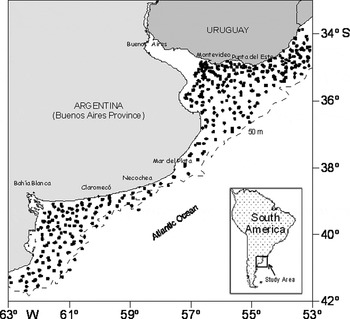
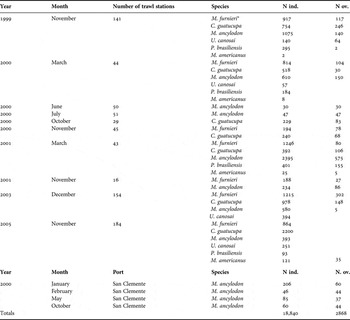
Specimens of the Sciaenidae family and oceanographic data were obtained from the Bonaerense coastal area (34°–41°S) during 13 Instituto Nacional de Investigación y Desarrollo Pesquero research cruises carried out between 1999 and 2005; most of them corresponded to fisheries evaluation cruises (Figure 1). Furthermore, in some years samples from commercial landings coming from San Clemente port became available. Table 1 shows a summary of the basic data obtained from each sampling trawl. Total length (TL) in centimetres and total weight (TW) in grams were recorded for each fish sampled. Individuals were sexed and the stage of reproductive development was determined macroscopically. For this, a five-stage maturity key was employed: (1) immature; (2) developing; (3) spawning capable; (4) regressing; and (5) regenerating (Brown-Peterson et al., Reference Brown-Peterson, Wyanski, Saborido-Rey, Macewicz and Lowerre-Barbieri2011).
Spatial distribution of demersal trawl stations during Instituto Nacional de Investigación y Desarrollo Pesquero research cruises carried out between 1999 and 2005.

Basic data from research surveys, commercial landings, number of individuals sampled per species (N ind.) and number of ovaries collected for histological examinations (N ov.).

*, for species names in full see text.
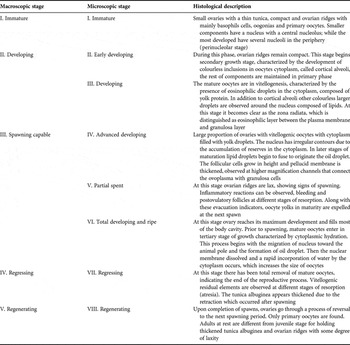
For histological examinations, ovaries in different maturity stages were removed after capture and preserved in 10% neutral buffered formalin (Table 1). Fixed gonads were weighed (GW) to the nearest 0.1 g and a portion of tissue was removed from the centre of each ovary, dehydrated in ethanol, cleared in xylol and embedded in paraffin. Tissues were sectioned at approximately 4 µm thick and stained with Harris's haematoxylin followed by eosin counterstain (García del Moral, Reference García del Moral1993). Histological classification of the ovaries was adapted from Brown-Peterson et al. (Reference Brown-Peterson, Wyanski, Saborido-Rey, Macewicz and Lowerre-Barbieri2011). A maturity scale for sciaenids was established that basically coincides with the macroscopic classification (Table 2). The main difference lies in the recognition of different microscopic substages in the developing phase.
Sciaenids ovary maturity scale.

Reproductive parameters
Analysis of the duration of the breeding season was based both on observation of the maturation stages (macroscopic and microscopic) as well as in the case of some species in the literature. The seasonal appearance of the developing stages was used to describe the reproductive cycle. Females were considered as reproductively active when they were capable of spawning at the time of capture or in the near future (Hunter et al., Reference Hunter, Macewicz, Lo and Kimbrell1992). Description of the stages of postovulatory follicle (POF) degeneration was adapted from that reported for M. furnieri and M. ancylodon of the Río de la Plata estuary (Macchi et al., Reference Macchi, Acha and Militelli2003; Militelli & Macchi, Reference Militelli and Macchi2004). In these species the degenerative process of the POFs was faster than that observed for other species (Hunter & Goldberg, Reference Hunter and Goldberg1980). The highest speed of degeneration was associated with the higher water temperatures in the Río de la Plata estuary during summer (Macchi et al., Reference Macchi, Acha and Militelli2003).
The size at first maturity (L50) was obtained by logistic regression by length-class using the maximum likelihood method (Kendall & Stuart, Reference Kendall and Stuart1967); all individuals with gonad stages other than immature (1) were considered reproductive, thus the frequency of mature individuals was used as a response variable and the total length as the explanatory variable. This analysis was performed only for fish species with sufficient sample numbers of immature and mature gonads.
The material used for fecundity and spawning frequency estimations came from three research cruises carried out in the spawning peak (November 1999, December 2001 and December 2003) and from two surveys performed at the end of the spawning period (March 2000 to March 2001) (Table 1).
Batch fecundity (BF, number of oocytes released per spawning) was estimated gravimetrically with the hydrated oocyte method (Hunter et al., Reference Hunter, Lo, Leong and Lasker1985). Samples were examined histologically to determine the presence of POFs and hydrated oocytes. To avoid biases when estimating batch fecundity, only ovaries with hydrated oocytes and without POFs were used. Three pieces of ovary of approximately 0.1 g each were sampled from the anterior, middle and posterior section of each gonad, weighed (0.1 mg) and the number of hydrated oocytes counted. Batch fecundity was the product of the mean number of hydrated oocytes per unit ovarian weight and total ovarian weight (GW). Relative fecundity (RF, number of hydrated oocytes per gram of ovary-free body weight) was estimated as the batch fecundity divided by female weight (without ovaries).
Spawning frequency was only estimated for whitemouth croaker. This variable was obtained from the incidence of females with POFs, following the method described by Hunter & Goldberg (Reference Hunter and Goldberg1980). The description of the stages of POF degeneration in March was based on that given by Macchi et al. (Reference Macchi, Acha and Militelli2003) who observed that POF degradation in M. furnieri was faster than that reported by Hunter & Goldberg (Reference Hunter and Goldberg1980) for northern anchovy (Engraulis mordax). 24-hours-old POF showed advanced signs of degeneration similar to those observed in E. mordax 48 hours after spawning. This more rapid degeneration was attributed to water temperature in the spawning area, which was higher (20–25°C) than that recorded for the northern anchovy (Hunter & Goldberg, Reference Hunter and Goldberg1980). Because of this, spawning frequency at the end of the reproductive period (March) was estimated by taking the total of females with POF, which correspond to a period of less than 24 hours from spawning (Hunter et al., Reference Hunter, Macewicz and Sibert1986). For samples taken in December 2003, as temperature in the spawning area was similar to that reported for E. mordax (about 16°C: Hunter & Goldberg, Reference Hunter and Goldberg1980), spawning frequency was estimated using the criteria given by Hunter & Goldberg (Reference Hunter and Goldberg1980), who considered only the day 1 POF (24–48 hours from spawning) to calculate the daily spawning proportion.
The size and appearance of unfertilized eggs can tentatively be used to evaluate or estimate the overall developmental potential of the eggs after fertilization. For instance, the size of the egg was sometimes considered to be beneficial for the future development of the embryo. In order to obtain an estimate of the quality of spawning in different species, diameter (OD) and dry weight (DW) of hydrated oocytes were measured. For these, ovarian samples of whitemouth croaker (N = 40), Argentine croaker (N = 9), banded croaker (N = 16) and southern kingcroaker (N = 8) were collected and samples of 100 hydrated oocytes were removed from each individual. The oocyte diameter was measured and each sample was rinsed in distilled water, dried for 20 hours at 60°C and weighed (0.1 mg).
In the case of black drum, striped weakfish and king weakfish batch fecundity, spawning frequency, OD and DW values estimated by Macchi et al. (Reference Macchi, Acha and Lasta2002) and Militelli & Macchi (Reference Militelli and Macchi2004, Reference Militelli and Macchi2006) were used for comparison between different species.
Statistical analysis
Coefficients of the logistic regressions obtained to estimate L50 for males and females and from the different sampled years were compared using a Chi-square test (Aubone & Wöhler, Reference Aubone and Wöhler2000). The relationships between BF and the variables TL and TW (ovary-free) were described using simple standard regression (Draper & Smith, Reference Draper and Smith1981). A power model and a linear model were fitted to the relationships of BF versus TL and BF versus TW (ovary-free), respectively. Comparisons between the relationships BF versus TL obtained from different spawning seasons were based on the overlapping length-ranges of females applying an analysis of covariance (Draper & Smith, Reference Draper and Smith1981). Differences in spawning frequency between years were tested using a Chi-square test. Diameter and dry weight of the hydrated oocytes were related to female size by linear regression. Values obtained during the spawning peak (November–December) and at the end of the breeding season were compared by analysis of variance. Results were considered significant if P < 0.05.
RESULTS
Spawning period
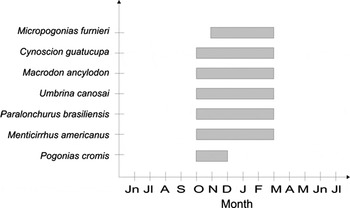
Figure 2 shows the extent of breeding season for different sciaenid species in the Buenos Aires Coastal Zone. The determination thereof was based on the presence of female reproductive activity; in cases that were not available samples were considered as described in the literature. The reproductive season in general was extensive (approximately six months) covering the spring–summer period. An exception to this pattern was observed in black drum, which showed its main spawning activity between October and December, for samples collected in Samborombon Bay.
Range of the spawning season for sciaenids species inhabiting the Río de la Plata Estuary and Buenos Aires Coastal Zone.

Length at first maturity
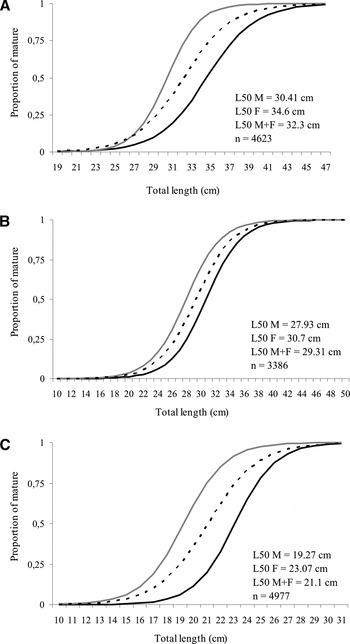
The estimates of length at first maturity (L50) in whitemouth croaker, obtained from samples collected during different seasons, showed highly significant differences between the sexes (χ2 = 27.85, df = 1, P < 0.01). Despite some differences observed between years, these were not significant. Figure 3A shows the logistic regression obtained grouping the values of all years. Males reached first sexual maturity at smaller size than females. By bringing together individuals of both sexes, the length at first maturity had an average of 32.2 cm TL.
Length at first maturity of females (black fill line), males (grey fill line) and both sexes combined (dashed line) for (A) Micropogonias furnieri, (B) Cynoscion guatucupa and (C) Macrodon ancylodon.

The size at maturity for C. guatucupa was evaluated fitting a logistic regression combining the values obtained in 1999 and 2005 (Figure 3B). Females matured at larger sizes than males, with estimated sizes at first maturity of 30.7 cm TL for females and 27.93 cm TL for males (χ2 = 33.3, df = 1, P < 0.001).
For king weakfish, as in the above mentioned species, the L50 estimated showed highly significant differences between sexes (χ2 = 20.02, df = 1, P < 0.001). Non-significant differences were observed between years and grouping the values of different years, the size at maturity for M. ancylodon obtained was 19.27 cm TL and 23.07 cm TL for males and females, respectively (Figure 3C).
In the case of Argentine croaker (Umbrina canosai) and southern kingcroaker (Menticirrhus americanus) L50 was only estimated with data collected in 2003 and 2005, respectively, due to the small number of samples and low representation of juveniles in other years. In December 2003 the L50 obtained for Argentine croaker showed significant differences between sexes (χ2 = 4.33, df = 1, P < 0.05) and was 23 cm TL for males (N = 196) and 25.9 cm TL for females (N = 198). L50 estimated by taking both sexes together was 24.3 cm LT. For southern kingcroaker length at first maturity estimated in November 2005 was 20 cm TL for males (N = 67) and 22.27 cm TL for females (N = 54). The L50 obtained for both sexes combined was 21.58 cm TL. It should be noted that M. americanus is often found in very low density in the Río de la Plata Estuary compared to other sciaenids as whitemouth croaker or king weakfish.
For black drum and banded croaker it was not possible to estimate L50 in any of samples taken. In the case of banded croaker, mature individuals lower than 14 cm TL were not found and all specimens larger than 22 cm LT corresponded to adults.
Fecundity
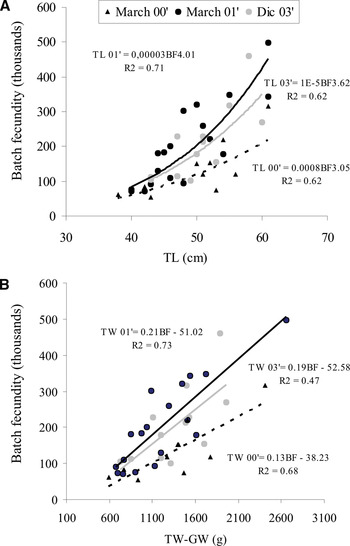
Batch fecundity (BF), estimated for whitemouth croaker in March 2000 (N = 10), March 2001 (N = 18) and December 2003 (N = 12) showed a potential relationship with total length and lineal with total weight (ovary-free) of individuals (Figure 4). BF estimated for females caught in March 2000 ranged between 53,600 (43 cm TL) and 315,000 (61 cm TL) hydrated oocytes, with a mean value of 134,673 (±50,290) hydrated oocytes. In March 2001, the BF values were significantly higher (t = 2.39; df = 22; P < 0.05) and ranged between 70,300 (42 cm TL) and 498,000 (61 cm TL) hydrated oocytes with a mean value of 204,202 (±55,483) hydrated oocytes. In December 2003 BF values ranged between 101,445 (49 cm TL) and 460,230 (58 cm TL) hydrated oocytes, with a mean value of 206,866 (±59,913) hydrated oocytes. Comparisons of mean values and covariance analysis made for the data set corresponding to the same size-range showed no significant differences with March 2001 (t = 0.95, df = 24, P > 0.05). However, these estimates were significantly higher than those obtained in March 2000 (t = 3.19, df = 16, P < 0.01). Relative fecundity (RF), estimated with data of the three cruises, ranged from 50 to 276 hydrated oocytes/g of female (ovary-free). This variable showed a great dispersion based on the length of the females and it did not demonstrate any tendency in relation to the female size. As with BF, the RF values estimated for March 2000 were significantly lower than those obtained for March 2001 and December 2003 (t = −3,86; df = 26; P < 0.01). The mean RF obtained for every year was 97 ± 19, 161 ± 26 and 148 ± 28 oocytes/g, respectively.
Batch fecundity of Micropogonias furnieri as a function of total length (A) and total weight (without ovary) (B) obtained from March 2000 (triangles and dashed line), March 2001 (black dots and black fill line) and December 2003 (grey dots and grey fill line).

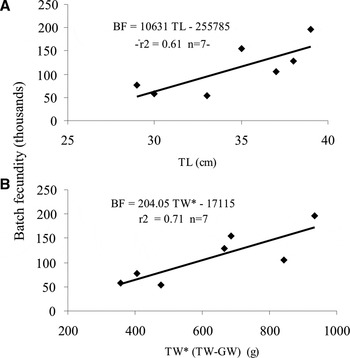
Batch fecundity obtained for Umbrina canosai in November 1999 and December 2003 ranged between 53,200 and 197,000 hydrated oocytes for a size-range between 29 cm and 39 cm TL. This variable showed a positive relationship with size and weight of females (ovary free) (Figure 5). Relative fecundity ranged between 105 and 207 oocytes/g of female (ovary-free) with a mean value of 161 ± 25 oocytes/g of female (ovary-free), and no relationship with total size or weight was observed.
Batch fecundity of Umbrina canosai as a function of total length (A) and total weight (without ovary) (B).

In the case of Paralonchurus brasiliensis, samples of gravid female were only obtained in March 2001. BF estimations ranged between 5560 (19 cm TL) and 32,400 (21 cm TL) hydrated oocytes, with an average value of 18,683 (±4,552) hydrated oocytes. This variable did not show a relationship with total length or weight of females; this may be due to the narrow size-range of the samples. RF ranged from 58 to 320 hydrated oocytes per gram of female (ovary-free) with a mean value of 199 ± 49 oocytes/g of female (ovary-free).
As mentioned previously, Menticirrhus americanus is a species whose abundance in the area of the Rio de la Plata is very low, which makes it very difficult to obtain samples of gravid females. Only in November 2005 eight hydrated females of southern kingcroaker were captured to estimate the reproductive potential. BF ranged between 45,115 and 273,188 hydrated oocytes and RF ranged between 143 and 374 hydrated oocytes per gram of female (ovary-free) with a mean value of 217 ± 70. BF showed a positive relationship with length (TL) and weight of females (ovary-free) described by the equations:
BF = 312.13 TW* −40677 (r2 = 0.58)
BF = 0.0054 TL4.72 (r2 = 0.71)
Spawning frequency
Spawning frequency of whitemouth croaker was estimated for March 2000, March 2001 and December 2003. In March 2000, 33.2% (N = 77; CV = 0.49) of females had POF <24 hours, indicated an interval between spawning close to 3 days during this month. In March 2001 the percentage of females with POF <24 hours was 26.25% (N = 240; CV = 0.09) which corresponds to a spawning frequency of 4 days. The daily percentage of mature females with day 1 POF in December 2003 was 18.58% (N = 226; CV = 0.8), equivalent to a frequency close to 5 days for this month. These differences between sampled years were highly significant (χ2 = 12.07, df = 2, P < 0.005).
Size and weight of the oocytes
Whitemouth croaker oocyte diameter and oocyte dry weight were estimated for March 2000, 2001 and December 2003. The diameter of hydrated oocytes showed no significant differences between the three years sampled (t = 1.90, df = 25, P > 0.05) and showed an average of 868 µm. This variable did not show a significant relationship to the size or weight of females. With regard to oocyte dry weight, the average value obtained for a sample of 100 hydrated oocytes during March 2000 (2.1 ± 0.1 mg) and March 2001 (2.3 ± 0.2 mg) showed no significant differences (t =1.33, df = 28, P > 0.05), however in December 2003 (3.1 ± 0.1 mg) (t = −12.48, df = 25, P < 0.01) was significantly higher. These results suggest that yolk reserves of hydrated oocytes were lower in samples collected at the end of the spawning season (March).
In the case of Argentine croaker, banded croaker and southern kingcroaker hydrated females were obtained only from one year. The average values of diameter and dry weight of 100 hydrated oocytes was: 860 ± 55 µm and 1.7 ± 0.07 mg for U. canosai (November); 758 ± 17 µm and 1.3 ± 0.09 mg for P. brasiliensis (March) and 999 ± 14 µm and 2.5 ± 0.03 mg for M. americanus (November).
Table 3 summarizes the results obtained in the present study including the values of length at first maturity (L50), batch fecundity, oocyte size and spawning frequency obtained for the different species of the sciaenid family, including data reported by Macchi et al. (Reference Macchi, Acha and Lasta2002) for Pogonias cromis and by Militelli & Macchi (Reference Militelli and Macchi2004, Reference Militelli and Macchi2006) for Macrodon ancylodon and Cynoscion guatucupa, respectively.
Values of reproductive variables of Sciaenidae family species in Buenos Aires Coastal Zone. TL, total length; L50, length at first maturity; BF, batch fecundity; RF, relative fecundity; SF, spawning frequency; HD, hydrated diameter; DW, oocyte dry weight (100 eggs).

*Militelli & Macchi (Reference Militelli and Macchi2006); **Militelli & Macchi (Reference Militelli and Macchi2004); +Macchi et al. (Reference Macchi, Acha and Lasta2002); •Murphy & Taylor (Reference Murphy and Taylor1989).
DISCUSSION
The size at maturity is subject to variation between species and within species. Thus all fishes of the same cohort or size need not attain maturity at some fixed age or length. In the case of M. furnieri and C. guatucupa, length at first maturity (L50) values estimated in this work were similar to those previously reported for these species in coastal waters of the Buenos Aires Coastal Zone (Cousseau et al., Reference Cousseau, Cotrina, Cordo and Burgos1986; Macchi & Acha, Reference Macchi, Acha and Lasta1998; Militelli & Macchi, Reference Militelli and Macchi2006). The difference between the sexes indicates that females tend to mature at larger size than males. L50 obtained for M. ancylodon was lower than other estimates reported for the Rio de la Plata area (Norbis & Pagano, Reference Norbis and Pagano1985; Cordo, Reference Cordo1986) and for the southern Brazil population (Juras & Yamaguti, Reference Juras and Yamaguti1989). L50 estimated for U. canosai was higher than those estimated for this species in southern Brazil. Haimovici (Reference Haimovici1982), working with samples from Rio Grande do Sul, considered a L50 for males between 17.1 and 18.8 cm TL and between 19.8 and 22.9 cm TL for females. L50 obtained for M. americanus was higher than other estimates obtained for this species with individuals collected in waters of Santos Bay, San Pablo (Brazil) (Giannini & Paiva, Reference Giannini and Paiva-Filho1992), in the North Atlantic region (Smith & Wenner, Reference Smith and Wenner1985) and in the Gulf of Mexico (Harding & Chittenden, Reference Harding and Chittenden1987); however, these estimates should be used as preliminary due to small sample size. A recent study carried out by Lewis & Fontoura (Reference Lewis, dos and Fontoura2005) in southern Brazil reported a length at first maturity for P. brasiliensis of 15.4 cm TL. At present, no information about length at first maturity of P. cromis inhabiting Argentine waters has been reported. In north-eastern Florida (USA) it was found that L50 of this species differ between sexes, as in the rest of the sciaenids. This parameter was about 59 cm TL (4–5 years) for males and ranged between 65 and 69.9 cm TL (5–6 years) for females (Murphy & Taylor, Reference Murphy and Taylor1989). On the other hand, in Laguna Madre (Texas coast) these differences were not found and the age at first maturity for both sexes was estimated around 4 years (Bumguardner et al., Reference Bumguardner, Colua, Young, Westbrook and Buckley1995).
Some biomass assessment models such as the egg production method require an estimate of spawning frequency. This requirement exists because the method was developed for fishes, such as sciaenids, which have indeterminate annual fecundity. Thus, the rate of egg production can be calculated only from estimates of spawning frequency and batch fecundity made during a survey period (Hunter & Macewicz, Reference Hunter and Macewicz1985). In this paper, estimates of fecundity and spawning frequency of sciaenids were compiled, which can serve to obtain spawning-stock biomass estimates for the assessment of these stocks in the Buenos Aires Coastal Zone. Daily percentage of spawning females estimated for whitemouth croaker was consistent with the values reported by Macchi et al. (Reference Macchi, Acha and Militelli2003), who reported a spawning frequency between 3 and 4 days during 1995–1996 spawning season. These estimates of daily percentage of spawning females were also similar to those reported for black drum (P. cromis) (Macchi et al., Reference Macchi, Acha and Lasta2002), but higher than those estimated for other sciaenids, such as M. ancylodon (Militelli & Macchi, Reference Militelli and Macchi2004) and C. guatucupa (Macchi, Reference Macchi1998).
Descriptions of reproductive strategies and the assessment of fecundity are the fundamental topics in the study of the biology and population dynamics of fish species (Hunter et al., Reference Hunter, Macewicz, Lo and Kimbrell1992 in Murua & Saborido-Rey, Reference Murua and Saborido-Rey2003). Batch fecundity estimates for M. furnieri showed interannual variations, based on samples collected in the Río de la Plata estuary (Macchi et al., Reference Macchi, Acha and Militelli2003). Data from the reproductive seasons 1995–1996 and 1997–1998, showed that fecundity of whitemouth croaker decreases at the end of the reproductive period, coinciding with an increase in atresia percentages. In fact, during December 2003 fecundity values were much higher than those estimated in March 2000 and 2001. Nevertheless, this variable varies among years, depending on environmental or nutritional factors (Nieland & Wilson, Reference Nieland and Wilson1993). This result agrees with analysis of the oocyte dry weight in hydrated females, which showed lower values in March. Seasonal decrease in egg size was reported for this and other species (Kjesbu et al., Reference Kjesbu, Solemdal, Bratland and Fonn1996; Macchi et al., Reference Macchi, Acha and Militelli2003), which may be associated with temperature or nutritional condition of the spawning females (Hinckley, Reference Hinckley1990; Wooton, Reference Wootton1994). Similar results were reported for Cynoscion guatucupa (Militelli & Macchi, Reference Militelli and Macchi2006) and Macrodon ancylodon (Militelli & Macchi, Reference Militelli and Macchi2004).
When considered together some aspects of reproduction were similar for all sciaenid species inhabiting the Río de la Plata estuary and Buenos Aires Coastal Zone (Table 3). For example, all species are multiple spawners with indeterminate fecundity, the reproductive season in general is extensive (approximately six months) covering the period spring–summer (Militelli, Reference Militelli2007), except for black drum whose spawning season is more delimited (Macchi et al., Reference Macchi, Acha and Lasta2002). However, there are differences between the spawning areas and some reproductive tactics. Militelli (Reference Militelli2007) taking into account temperature and salinity ranges of the spawning areas, grouped the sciaenids into three spawning tactics: (a) estuarine spawner associated with the bottom salinity front: the species that spawn in the inner area of the estuary in accordance with the main horizontal salinity gradients in the bottom (M. furnieri, P. cromis and M. ancylodon); (b) estuarine spawner non-associated with the bottom salinity front: the spawning of these species was mainly located in the middle of the estuary in brackish water with salinities ranging between 24 and 30 psu (P. brasiliensis and M. americanus); and (c) marine spawner: reproduction occurred always in salt water (values higher than 30 ups) in the outer area of the Rio de la Plata estuary or El Rincón, at the south of Buenos Aires Province (C. guatucupa, U. canosai and M. furnieri).
With regard to reproductive potential, there are wide differences in fecundity values mainly due to the different sizes attained by each species (batch fecundity ranged between 5000 and 2,800,000 hydrated oocytes). But, when relative fecundity values (size independent variable) were compared, average values of this variable in general were similar, ranging approximately between 150 and 200 hydrated oocytes per female gram. Black drum is the exception within this group, because the mean relative fecundity mean ranged between 75 and 98 hydrated oocytes per ovary-free female gram. This difference may be as consequence of the greater oocyte size reached by P. cromis eggs (1100–1400 µm) compared to the rest of sciaenids. In the particular case of black drum, the largest diameter reached by hydrated oocytes was also associated with an increase of dry weight (Macchi et al., Reference Macchi, Acha and Lasta2002), so that low relative fecundity recorded in this species may be compensated in part for increased egg quality, which would encourage the survival of early life stages. At the time of using these data for biomass estimates it should be noted that in 4 (M. furnieri, C. guatucupa, M. ancylodon and P. cromis) of the 7 species, significant differences in reproductive parameters values obtained for the spawning peak and end of the spawning season were observed.
From species studied, whitemouth croaker, striped weakfish and Argentine croaker are those with higher biomass in the Buenos Aires Coastal Zone. These species have in common the fact of sharing areas of distribution and reproduction larger than black drum, king weakfish or banded croaker. Moreover, these most abundant species are also characterized by reproductive periods generally more extensive, as is the case at least of whitemouth croaker and striped weakfish (Militelli, Reference Militelli2007). These aspects of reproductive strategy may be associated with differences in abundance recorded for these species, since greater extension of the area and spawning period involves higher reproductive potential and a greater chance of survival of spawning products. These characteristics may influence the possibility of colonizing new areas and eventually the development of more abundant populations.
ACKNOWLEDGEMENTS
This research was conducted within the INIDEP's Coastal Project. We express our gratitude to H. Christiansen, M. Estrada and T. Carlé for the preparation of histological sections. This is INIDEP contribution No. 1753.