

Introduction
In Italy, tomato is an important vegetable crop. From 2006 to 2008, there was a significant reduction in agricultural areas in Italy dedicated to tomato production (from 103,254 to 92,842 ha)Reference Sgroi and Testa1. This was mainly due to political reasons [uncertainty regarding Common Market Organization (CMO) for Fruit and Vegetables reformReference Sgroi and Testa1] and financial reasons (high-production fixed costs)2. Poor spring yields of early tomatoes in northern Italy in 2008, along with a fall in cereal pricesReference Bazzana3, resulted in high prices paid for tomato that year and an increase in the harvested area of tomatoes to approximately 98,000 haReference Sgroi and Testa1 in 2009. This increased production of tomatoes could cause a reduction in subsidies as a result of the new system adopted by the Common Agricultural Policy, with negative consequences on the profitability of both tomatoes and cereals in ItalyReference Turrini4. In this context, the organic production of tomatoes could help by providing better profits for farmers and, at the same time, protecting the environment and safeguarding consumers’ health.
The characteristics and the quality of an agricultural product are affected by several factors, including the system of farm productionReference Barrett, Weakley, Diaz and Watnik5. There is still debate on the difference between organic and conventional products in terms of quality and nutritive valueReference Bazzana and Angelini6. Research has shown that organically grown produce has a higher mineral, vitamin and antioxidant content than conventionally grown produceReference Kazimierczak, Hallmann, Rusaraczonek and Rembialkowska7–Reference Chassay, Bui, Renaud, Van Horn and Mitchell11. In addition, the antioxidant content of food obtained using organic production methods may be more bioavailable for human healthReference Worthington8. A study on the factors affecting food choice with respect to fruit and vegetable intake has also proved that personal ideologies are essential in consumer choice, and this explains the increase in sales of organic products, despite their higher costReference Pollard, Kirk and Cade12.
Weed control, in particular within crop rows, is one of the main problems in organic farmingReference van Der Weide, Bleeker, Achten, Lotz, Fogelberg and Melander13, including organic processing tomato. Some researchers in Spain evaluated the effectiveness of various cultivation equipment and mulches on tomatoReference Cirujeda, Aibar, Fernàndez-Cavada, Zuriaga, Anzalone, Zaragoza and Cloutier14–Reference Cirujeda, Anzalone, Pardo, Leon, Zaragoza and Cloutier16. According to these authors, the timing of mechanical treatment is a key factor in order to obtain good weed controlReference Cirujeda, Aibar, Fernàndez-Cavada, Zuriaga, Anzalone, Zaragoza and Cloutier14–Reference Cirujeda, Anzalone, Pardo, Leon, Zaragoza and Cloutier16, and perennial weed species with rhizomes, such as Cyperus rotundus, are very difficult to control with this kind of equipmentReference Cirujeda, Aibar, Fernàndez-Cavada, Zuriaga, Anzalone, Zaragoza and Cloutier14–Reference Cirujeda, Anzalone, Pardo, Leon, Zaragoza and Cloutier16. However, the authors maintain that good control of this ‘problematic weed’ can be achieved with brown kraft paper mulchingReference Anzalone, Cirujeda, Aibar, Pardo and Zaragoza15, and moreover the presence of the drip line can hinder mechanical controlReference Cirujeda, Aibar, Fernàndez-Cavada, Zuriaga, Anzalone, Zaragoza and Cloutier14.
Growing tomatoes in paired rows is a popular practice in Italy, and is preferred over evenly spaced rows in central areas of the countryReference Tei, Natalini, Bruni, Bufacchi, Lucaccioni, Motta, Marcelli and Casagrande17. Fruits tend to ripen more uniformly when plants are arranged in paired rowsReference Tei, Natalini, Bruni, Bufacchi, Lucaccioni, Motta, Marcelli and Casagrande17, and the need for only one irrigation line for paired versus equally spaced rows simplifies general field practices and reduces costsReference Tei, Natalini, Bruni, Bufacchi, Lucaccioni, Motta, Marcelli and Casagrande17. However, physical weed control in paired rows can be difficult because of the irrigation hose between the two rows in the narrow inter-row space. Our objective was to develop weed control strategies for processing tomato that relied exclusively on physical control methods.
Materials and Methods
The experiment was conducted during three growing seasons (2006–2008) at a conventional farm located near Pisa, Italy (+43°46′14.04″ +10°23′3.83″), on sandy-loam soil (sand 60%, silt 22%, clay 18%, organic matter 1.7% and pH 8.2). Tomatoes were grown in a 4-year tomato–wheat–maize–sunflower rotation.
Two tomato hybrids were used: ‘Leader’ in 2006 and ‘Reflex’ in 2007 and 2008. Leader F1 is a mid-season hybrid that produces joint-less fruit (mean weight=80 g) with thick, deep-red walls that are recommended for dicing and paste. Reflex F1 is an early hybrid that produces oval-blocky, joint-less, fruit (mean weight=85 g) which are firm and fleshy and recommended for both dicing and paste.
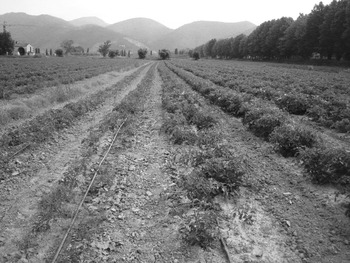
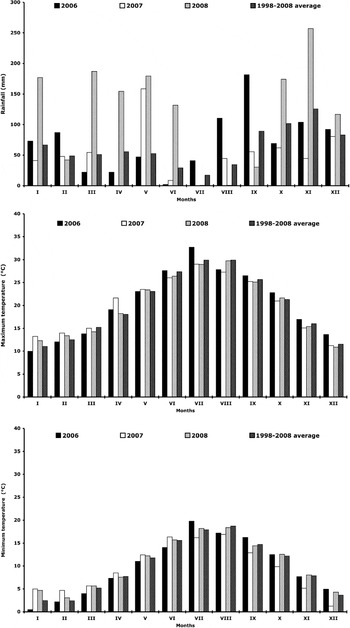
The crop was transplanted mechanically into paired rows at a density of 33,000 plants ha−1, with a 1.1 m distance between adjacent pairs, 0.4 m distance between the rows within the pair and 0.4 m in-row spacing between plants (Fig. 1). The crop was irrigated by drip hoses placed between pairs at an average rate of 2900 m3 ha−1 yr−1. Organic–mineral fertilizer was broadcasted before crop planting at 1.2 Mg ha−1 ‘Organagro’ (N-P-K 5-5-2). Post-transplanting fertilizers consisted of 41 kg ha−1 N as 100 kg ha−1 of urea-based fertilizer, 45 kg ha−1 P2O5 as 150 kg ha−1 of concentrated superphosphate, 25 kg ha−1 K2O as 50 kg ha−1 of potassium sulphate and 100 kg ha−1 of ternary fertilizer (21-21-21). Total seasonal (March–August) rainfall and temperature followed the long-term average of the area during 2006 and 2007, while 2008 was particularly wet (Fig. 2).
Tomato field near Pisa, Italy in 2007 showing paired rows with the drip line in place. Spacing between the paired rows (center to center) is 150 cm, spacing between the two rows in each pair is 40 cm and spacing between plants within a row is 40 cm.

Climatic data recorded in the municipality of San Giuliano Terme (Pisa, Italy) in 2006, 2007, 2008 and 20-year (1998–2008) averages: total monthly rainfall values (upper panel), average monthly maximum temperature values (middle panel) and average monthly minimum temperature values (lower panel).

Weed management techniques and operating machines
Conventional weed control strategy included three different herbicide treatments: 1 kg ha−1 Stomp (a.i. Pendimetalin, 317 g ha−1) and 1 kg ha−1 Ronstar (a.i. Oxadiazon, 341 g ha−1) applied before transplanting, 250 g ha−1 of Sencor (a.i. Metribuzin, 87.5 g ha−1) applied after transplanting and 40 g ha−1 of Titus (a.i. Rimsulfuron, 10.0 g ha−1) applied after transplanting. Herbicides were broadcasted using flat, anti-drift spray nozzles at 0.2 MPa in solution at approx. 500 litres ha−1 using a Barigelli self-propelled applicator. In the conventional weed management system, two post-transplanting, PTO-powered rotary hoe treatments were also performed between adjacent paired rows by tilling to a depth of 7 cm at an average travel speed 2 km h−1. The first rotary hoeing was conducted between 15 and 20 days after transplanting, and the second between 35 and 40 days after transplanting. Several hand-weeding treatments were also performed on the paired rows.
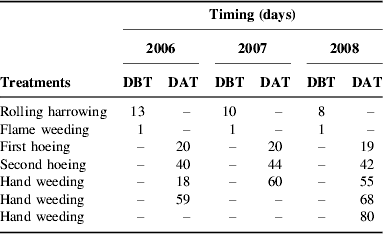
The physical strategy was carried out using the stale seedbed technique (performed by a rolling harrow pass and one flaming treatment) and two post-transplanting precision hoeing treatments (Table 1). In the first year, hand-weeding was performed before the first and after the second precision hoeing; in the second year, after the second precision hoeing; and, in the third year, three times after the second hoeing. The exact time sequence of physical weed control management is reported in Table 1.
Time sequence of the different treatments carried out on processing tomato for the physical weed control management for the 3-year experiment (2006–2008) near Pisa, Italy.
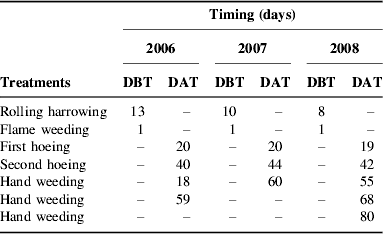
DBT, days before transplanting; DAT, days after transplanting.
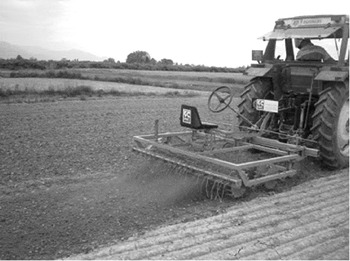
The equipment used for the physical strategy was built at the University of Pisa. A 2-m maximum wide rolling harrowReference Peruzzi, Raffaelli, Fontanelli, Ginanni, Lulli and Frasconi18 (set with a working width of 1.5 m) equipped with flexible tines was designed to provide effective weed control both by creating a false-seedbed and in precision hoeing after crop transplanting. The machine consisted of spike discs in the front and cage rolls at the rear of the unit (Fig. 3). The discs and rollers were inserted into two axles, connected by means of a chain drive with easily adjustable gear ratios. The discs and cage rolls were placed close together for shallow tillage and non-selective mechanical weed control when preparing a stale seedbed, and spaced further apart for mechanical inter-row weeding after the crop had been transplanted. The spike discs tilled the soil to a 3 to 4 cm depth, while the cage rolls separated weed seedling roots from the soil by rotating with a higher peripheral speedReference Peruzzi, Raffaelli, Fontanelli, Ginanni, Lulli and Frasconi18–Reference Peruzzi, Raffaelli, Ginanni, Lulli, Frasconi, Fontanelli and Failla20.
Rolling harrow, designed and developed at the University of Pisa, equipped with flexible teeth and used during a pre-transplanting weed control treatment on processing tomato near Pisa, Italy, in 2008.

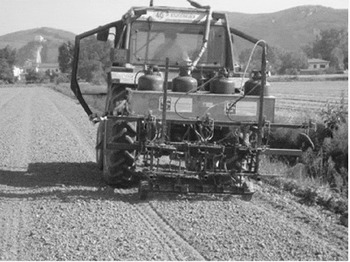
The flaming machineReference Raffaelli and Peruzzi21 was equipped with three 50-cm wide rod burners, for a total working width of 1.5 m, connected to three 15 kg liquefied petroleum gas (LPG) tanks placed in a hopper (Fig. 4). A heat exchange system used the exhaust gas from the tractor endothermic engine to prevent the tanks from cooling during flaming. Each LPG tank was equipped with a pressure regulator and a manometer and was connected to a control system. The control system of each burner consisted of two manual valves and one automatic safety valve. The manual valves enable the LPG feed to be adjusted (closed, high or low levels). The automatic safety valve was connected with a thermocouple located inside the burner, which closes the LPG feed if the flame goes out.
Flaming machine, designed and developed at the University of Pisa, in a field near Pisa, Italy, in 2008 during a pre-transplanting weed control treatment on processing tomato.

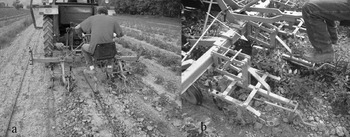
The precision hoe was 1.5 m wide and consisted of a central goose-foot sweep and two side ‘L’-shaped sweeps along with flexible tines for intra-row selective weed controlReference Peruzzi, Raffaelli, Ginanni, Lulli, Frasconi, Fontanelli and Failla20, Reference Raffaelli, Barberi, Peruzzi and Ginanni22, Reference Raffaelli, Bàrberi, Peruzzi and Ginanni23. A steering handle was used to adjust the position of the working tools. Weeds were controlled by using the precision hoe inside the crop-paired rows, with the drip line in place (Fig. 5a). The precision hoe had a ‘V’-shaped crop protector for gently opening the tomato vegetation during late hoeing and preventing damage to vegetable plants (Fig. 5b).
(a) Early precision hoeing treatment performed, with a machine designed and developed at the University of Pisa, in processing tomato without removing the drip line between paired rows in 2007; (b) late precision hoeing in 2006. The hoe was equipped with ‘V’-shaped elements in order to open the developed crop vegetation.

Experimental assessments
Machine and yard operational characteristics
All the main operational characteristics concerning weed management for both systems were recorded. These included tillage depth, operating speed, working productivity, operating time, fuel and LPG consumption for all equipment used, and labor requirements for manual weeding.
Weeds
Weed density was recorded before and after each physical weed control treatment by counting the number of weeds within three 0.25 m×0.3 m quadrants within each 1.5 m×50 m plot−1. Quadrants were oriented following the row direction, with one placed in the inter-row space between paired rows, one placed within a single row and one placed between two pairs. At tomato harvest, weed samples were collected from two 1.5 m×0.8 m quadrants oriented in the perpendicular direction to the rows across a row pair in each plot. Weed samples were oven dried until constant weight and the biomass was reported on a g m−2 dry weight basis.
Crop yield
Fruit was harvested manually from four plants in a 1.2 m2 area in each plot. Marketable tomato yield was reported in Mg ha−1. At harvest, measurements were performed on four sample units of 1.2 m2 area plot−1 to evaluate the marketable tomato yield.
Experimental, sample design and statistical analysis
Weed strategy treatments were arranged in a randomized complete block and replicated four times. Weed and tomato yield data were subject to analysis of variance using CoStat software (CoHort Software version 6.311). Weed density data were transformed according to the square root function before the analysis, but presented in back-transformed values. Weed biomass and yield were assessed using the block sampling design, a technique in which all the plots of the same block (i.e., replication) are subjected to the same randomization scheme (i.e., using the same sample location in the plot) and different sampling schemes are applied separately and independently for different blocks. A Bartlett test was performed to test the homogeneity of variance. Treatment means were separated using a protected LSD test at P⩽0.05.
Results and Discussion
Equipment performance
The performance of the rolling harrow was consistent over the 3 years. The harrow tilled soil to an approximate 3 cm depth and consumed roughly 3 kg fuel ha−1. A relatively high speed (>6.4 km h−1) minimized operating times (<1.34 h ha−1). In each of the 3 years fuel consumption was approximately 3 kg ha−1 (Table 2). The flaming treatment was applied at a ground speed of 3.5 km h−1 (2.08 h ha−1) and operating pressure of 0.2 MPa with an LPG consumption of roughly 20 kg ha−1. Precision hoeing was applied at a ground speed ranging from 2.5 km h−1 (3.03 h ha−1) to 1.2 km h−1 (5.9 h ha−1), depending on the operational conditions. The depth of soil tilled by precision hoeing was always shallower at the first date (2.8 cm average) than at the second date (4.1 cm average). Fuel consumption averaged 13 kg ha−1 for each hoeing.
Performance of the machines used for physical weed control and hand weeding working time in the 3 years of experiment (2006–2008) in processing tomato near Pisa, Italy.

Working width was equal to 1.5 m for all the experiment; tractor engine capacity was always equal to 55.0 kW in 2006, 44.2 kW in 2007 and 58.3 kW in 2008.
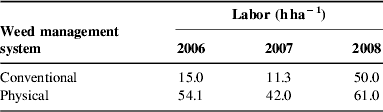
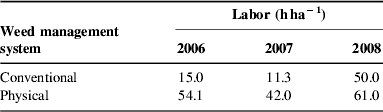
The performance of the precision hoe indicated that it was particularly suited to the crop and its spatial arrangement. Total operating time for practices included in the physical weed control strategy totaled 40–60 h ha−1, depending on the year (Table 3). This range in time reflected differences in the amount of hand weeding that occurred. Hand weeding was done twice totaling 33.7 h ha−1 in 2006, once totaling 16.6 h ha−1 in 2007 and three times totaling 40 h ha−1 in 2008. The conventional weed control strategy had lower labor requirements in each of the 3 years. Differences in labor needs between the two strategies were least in 2008 because of generally wet conditions, creating optimal climatic conditions for weed growth and timely application of other weed control measures.
Total labor hours for weed control for two different weed control strategies carried out in processing tomato near Pisa, Italy (2006–2008).
Weed control and yield
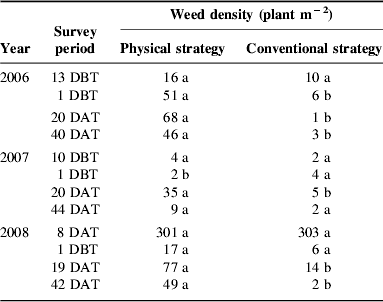
During 2006, before crop-transplanting, the weed community was made up of Solanum nigrum L. (70%), Convolvulus arvensis L. (8%), grass species (6%) and other weeds (16%). As the cropping cycle proceeded, Portulaca oleracea L. became the major weed with a relative density varying from 30 to 40%. Low and constant weed densities were observed in the conventional system (1–10 plants m−2; Table 4). Weed density fluctuated more and tended to be higher for the physical system, ranging from 16 to 68 plants m−2, even though it appeared that complete weed control was achieved immediately after broadcasted physical treatments (rolling harrowing and flaming before crop transplanting).
Weed density recorded before each physical treatment for two different weed control strategies carried out in processing tomato near Pisa, Italy (2006–2008). In each row, means followed by the same letter are not significantly different at P⩽0.05.
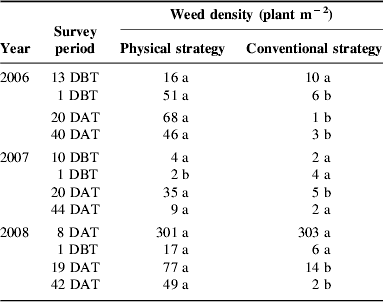
DBT, days before transplanting; DAT, days after transplanting; letters indicating differences between mean weed density values (actual values) were computed using square root-transformed data.
Rolling harrowing (before crop transplanting), flaming (before crop transplanting) and the first precision hoeing appeared to control the weeds completely, immediately after treatments were applied in 2006. The effectiveness of the second hoeing was about 50%, probably because of the presence of more developed weeds in the row which had not been removed by manual weeding. Vigorous development of the crop made weeding more difficult and consequently lowered the effectiveness of weeding. Weed biomass at the end of the cropping cycle was similar for both farming systems and averaged between 103 and 126 g m−2 (Table 5).
Table yield and weed biomass at harvest (2006–2008) for two different weed control strategies carried out in processing tomato near Pisa, Italy. In each column and year, means followed by the same letter are not significantly different at P⩽0.05 (LSD test).

In 2007, initial weed composition consisted primarily of various grass weeds (50%) and Chenopodium album L. (over 30%). Later on, the main components were Cynodon dactylon (L.) Pers. (50%), Chenopodium album L. (13%), Cyperus spp. (10%) and Amaranthus retroflexus L. (10%). The conventional system showed a constant and low density (on average between 2 and 5 plants m−2), while weed density varied from 2 to 35 plants m−2 for the physical system (Table 4). The stale seedbed technique achieved 100% weed control immediately after the flaming treatment, while weed control varied from 70 to 90% right after plots were hoed. Differences in weed dry biomass at harvest were not detected between the physical system and the conventional system in 2007 (Table 5).
Weed composition was similar in 2008 to that in 2006. Initial weed density was about 300 plants m−2. The rolling harrow appeared to achieve 100% weed control immediately after being used. Before flaming, weed density was about 20 plants m−2, and complete control of emerged weeds resulted after imposing the flaming treatment. Weed density before the first and the second post-transplanting pass with the precision hoe was about 80 and 50 plants m−2, respectively. Hoeing effectiveness was similar to 2006 and 2007. Weed density averaged between 2 and 14 plants m−2 in the conventional system and between 17 and 77 plants m−2 in the physical system (Table 4). Weed dry biomass at harvest was significantly lower for the conventional system than the physical system (5 versus 56 g m−2, Table 5).
The conventional system was generally more effective in controlling weed density than the physical system (Table 4). However, weed biomass differences between the two systems were detected only in 2008 (Table 5), and these differences did not result in a lower tomato yield in the alternative system. In fact, fresh tomato yield in 2006 and 2007 for the physical system was 14–21% greater than in the conventional system. This increase in crop yield for the physical system could be due to benefits in root system growth resulting from soil crust breaking, soil aeration and soil water capillary rise interruptionReference Buckingham, Buckingam, Espenschied, Hoerner and Carlson24, Reference Cloutier, Leblanc, Vincent, Panneton and Fleurat-Lessard25 provided by the tillage performed in the physical system. Precision hoeing enabled soil between the paired rows to be tilled, which was not possible with the conventional system using a PTO-powered rotary hoe.
The lack of consistency in rank of the two control systems across the 3 years confirms that it is not possible to identify the best strategy in absolute terms, since efficacy was dependent on the environmental conditions present when the various control methods were applied. However, this study indicates that physical weed control can be an effective alternative to herbicides in some environments. In some instances, crop yield can be elevated when physical control methods are used rather than chemical methods.
Conclusions
Results of this study indicate that the equipment can be modified for physical weed control in tomato, even when planted in paired rows, where physical weed control can be problematic. The physical strategy required a higher labor input than the conventional strategy. Weed density tended to be lower in the conventional control system which included herbicide applications, but weed density was lowered and suppressed using the physical control strategy. Physical management enabled the weed presence to be reduced and contained without affecting crop yield. In fact tomato yield was never lower and was sometimes greater using the physical control strategy, possibly because of precision hoeing methods that allowed soil within the paired rows to be tilled. This study confirms that the efficacy of weed control methods is closely linked to environmental factors. Nevertheless, physical control methods seem to be an effective alternative to herbicides for weed control in tomato. Good weed control and high crop yield can occur when physical weed control methods are used in tomato production. An advantage of relying on physical weed control methods is that a premium might be paid for the tomato crop that is grown.
Alternative strategies for weed control are very important for European farmers, as the new regulations will lead to a significant reduction in the active ingredients allowed, including herbicides. Pesticide applications in Europe are ruled by an EU directive on the promotion of sustainable and reduced risks for crop protection plans. The EU's general principles of integrated pest management encourage the use of non-chemical, mechanical and physical methods.
Weed control is always a key problem in agriculture; thus, there is a clear need for further research in this field. Over the past two decades, agricultural land has been increasingly managed according to the availability of new technologies, including global positioning systems, geographic information systems, sensors, the automation of agricultural machinery and high-resolution image sensing. In fact, non-chemical weed control could be enhanced by implementing specific machines with automatic and robotic systems for the mechanical and thermal management of spontaneous flora. There is now a variety of equipment dedicated to specific crops and agricultural environments. Row detection systems represent the first level of implementable technology for all precision hoeing machines. A camera, connected to a specific electronic device, can recognize crop rows and move the precision hoe in accordance. This saves labor times as the back-seated operator is no longer required. Intelligent weeders are equipped with software that can move specific tools in and out of the crop row and/or around the crop.
The machines and strategies presented in this work are low-tech machines but at the same time are cheap and effective. Providing low-tech machines with electronic devices for physical weed control may be possible in the near future and would be a good way to save on labor. The cost of producing a dedicated machine would be much higher. In this sense, the machines built and tested at the University of Pisa are versatile, as they can be reliably used without electronic devices (i.e., for family-run farms, small farms, developing countries, etc.) but are still implementable with hi-technologies (i.e., for large farms, hi-value crops, etc.).
Acknowledgements
The authors wish to express their sincere thanks to Roberta Del Sarto and Calogero Plaia of DAGA, and Paolo Gronchi and Alessandro Pannocchia of CIRAA ‘E. Avanzi’ (University of Pisa), for their valuable contribution to this research.