Pinoxaden is an acetyl coenzyme A carboxylase (ACCase)-inhibiting herbicide in the phenylpyrazolin chemical family that was introduced commercially in 2006 for POST control of annual and perennial grassy weeds in barley and wheat (Hofer et al. Reference Hofer, Muehlebach, Hole and Zoschke2006; Muehlebach et al. Reference Muehlebach, Cederbaum, Cornes, Friedmann, Glock, Hall, Indolese, Kloer, Le Goupil, Maetzke, Meier, Schneider, Stoller, Szczepanski, Wendeborn and Widmer2011). Until 2019, pinoxaden was registered in the United Kingdom for turfgrass to remove ryegrass species (Lolium spp.) in maintained fine fescue (Festuca spp.) and annual bluegrass turf (Anonymous 2015). In 2018, pinoxaden was labelled in the United States for use on bermudagrass [Cynodon dactylon (L.) Pers.], zoysiagrass (Zoysia spp.), and St. Augustinegrass [Stenotaphrum secundatum (Walter) Kuntze]. It is limited to use only on bermudagrass and zoysiagrass fairways, roughs, tee boxes, athletic fields, sod farms, and home lawns. Pinoxaden cannot be applied to putting greens and in St. Augustinegrass is restricted to sod production use only (Anonymous 2018a).
ACCase-inhibiting herbicides can be used in turfgrass because of differential response between grasses and the relative difficulty of controlling a grass weed within another grass. For example, diclofop controls goosegrass in bermudagrass (McCarty et al. Reference McCarty, Higgins, Corbin and Whitwell1990). Sethoxydim injures bentgrass (Agrostis stolonifera L.) and tall fescue [Lolium arundinaceum (Schreb.) Dumort. nom. cons.] (Hosaka et al. Reference Hosaka, Inaba and Ishikawa1984; Hugh et al. Reference Hugh, Butler and Appleby1986); however, red fescue (Festuca rubra L.), and centipedegrass [Eremochloa ophiuroides (Munro.) Hack.] are tolerant (Hugh et al. Reference Hugh, Butler and Appleby1986; McCarty et al. Reference McCarty, Higgins, Miller and Whitwell1986). Fenoxaprop is labelled for use in perennial ryegrass, tall fescue, fine fescue, Kentucky bluegrass (Poa pratensis L.), and creeping bentgrass, but the relative tolerance among these species varies greatly (Dernoeden Reference Dernoeden1987). Fenoxaprop significantly injures creeping bentgrass at rates as low as 0.05 kg ha−1 (Carroll et al. Reference Carroll, Mahoney and Dernoeden1992) but does not injure velvet bentgrass (Agrostis canina L.) at rates as high as 0.07 kg ha−1 (Henry and Hart Reference Henry and Hart2004). The wide selectivity of ACCase herbicides, even within the same chemical family, makes testing a variety of grass species necessary to understanding the efficacy and selectivity of a particular ACCase herbicide.
The relationship between herbicide rate and plant response is fundamentally important in understanding herbicide efficacy and selectivity (Seefeldt et al. Reference Seefeldt, Jensen and Fuerst1995). Grass selectivity of pinoxaden is not yet fully understood. There are many weeds that pinoxaden may potentially control but for which it is not currently labelled. In turfgrass, pinoxaden is not labelled for foxtail species (Setaria spp.), although foxtails are labelled in crop production. Several cool-season turf species were labelled for use in the United Kingdom; however, the turfgrass label in the United States does not allow for applications on any cool-season turfgrasses.
The objectives of this research were to (1) evaluate the rate response of several grassy weeds to increasing rates of pinoxaden and (2) determine the application rate at which 50% of the weed species were injured (I50) and the 90% (I90) rate, as determined by visible injury and the application rate at which there was a 50% reduction in fresh weight (WR50) and the rate at which there was a 90% reduction (WR90) for each weed species evaluated, using a nonlinear regression model. We hypothesized that a differential response will be observed among all species tested.
Materials and Methods
Greenhouse experiments were conducted between November 2018 and May 2019 at the Auburn University Weed Science Greenhouse in Auburn, AL (32.35°N, 85.29°W), to evaluate the rate response of select grassy weeds to pinoxaden. Nine species of grassy weeds were evaluated: yellow foxtail, southern sandbur, annual bluegrass, roughstalk bluegrass, large crabgrass, dallisgrass, bahiagrass, goosegrass, and perennial ryegrass. Species were examined between November 2018 and May 2019 when greenhouse day/night temperatures were maintained at 32/28 C (± 1 C). Although temperatures were not optimum for cool-season species, at no time did we observe a decrease in plant vigor or disease infestation that would indicate poor plant growth. All species tested were optimally growing at the time of treatment. Relative humidity averaged approximately 70% throughout the experiment.
All seeds were harvested from local populations near Auburn, AL, and stored at 4 C until this study was initiated. Seeds were planted in flats of potting medium (Scotts Miracle-Gro Products Inc., Marysville, OH) and allowed to grow for 4 wk. Individual seedlings were then transplanted into separate 230 cm3 pots filled with soil medium (Marvyn sandy loam). Seedlings were fertilized when transplanted (28-8-16 Miracle-Gro Water-Soluble All-Purpose Plant Food; Scotts Miracle-Gro Products Inc.) at approximately a rate equivalent to 6 kg N ha−1. Plants were irrigated three times daily by an elevated misting system and by hand as needed throughout the experiment. Applications were made 6 wk after germination (2 wk after transplanting) for all species.
Foliar applications were delivered via a hand-held CO2-pressurized sprayer equipped with TeeJet TP8002 flat fan nozzles (TeeJet Technologies, Glendale Heights, IL) calibrated to deliver 280 L ha−1 at 206 kPa. Treatments were 10 rates of pinoxaden (Manuscript®; Syngenta Crop Protection LLC, Greensboro, NC): 4, 10, 19, 39, 77, 156, 310, 621, 1,240, and 2,490 g ai ha−1 with surfactant (Adigor®, Syngenta Crop Protection LLC), added at 0.5% vol/vol, included in all treatments.
Treatments were arranged in a randomized complete block design with four replications and the trial was repeated in time. Treatments were compared with a nontreated control. Herbicide injury was visibly evaluated relative to the control on a 0% (no phytotoxic effect) to 100% (complete plant death) scale at 14, 28, and 35 d after treatment (DAT). Plants were clipped at soil level 35 DAT, and fresh weights were recorded. Fresh weight data were transformed into a percentage of the nontreated control for consistency in graphical presentations.
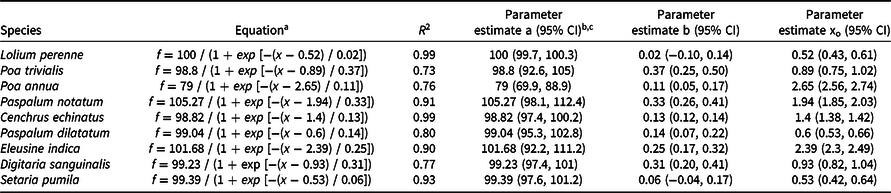
Data were subjected to ANOVA with the PROC GLM procedure of SAS, version 9.4 (SAS Institute Inc, Cary, NC) to test for significance (P < 0.05) of species, pinoxaden rates, and runs with the visible plant injury and fresh weight variables. No significant interaction between runs was found on the basis of evaluation of the pinoxaden rate by species by run interaction (P > 0.05), so data were pooled over runs. A significant pinoxaden rate by species interaction (P < 0.05) was detected, thus individual species response to pinoxaden was analyzed further. Herbicide rate, including the nontreated control, was log-transformed to create equal spacing to facilitate nonlinear regressions. Nonlinear regressions were modelled with SigmaPlot 13.0 (Systat Software, San Jose, CA). Species were modelled with appropriate models that best described plant response. Plant visible injury data were fitted to a three-parameter sigmoidal model equation (Equation 1):
 $$F = a/\left( {1 + exp\left[ { - \left( {x - {x_o}} \right)/b} \right]} \right)$$
where f represents the percent visible injury relative to the nontreated control, x represents the log-transformed pinoxaden rate, and a, b, and x o represent the regression parameters. This equation was used to calculate the I50 and I90. Equation parameters and 95% confidence intervals for the visible injury data are displayed in Table 1. Fresh weight data were fit to a two-parameter exponential decay model (Equation 2):
 $$f = a \times exp( - b \times x)$$
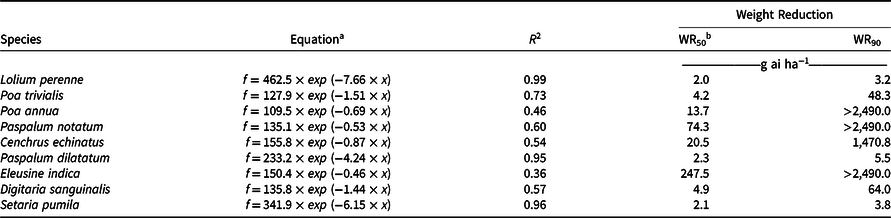
where f represents weight as a percent of the nontreated control, x represents the log-transformed pinoxaden rate, and a and b represent the regression parameters. This equation was used to calculate the WR50 and WR90 for each species relative to that of the nontreated check. Equation parameters and 95% confidence intervals for the biomass reduction data are displayed in Table 2.
Predictive model for percent visible injury in response to increasing rates of pinoxaden.

a The three-parameter sigmoidal model equation was f = a / (1 + exp [−(x − x o ) / b]), where f represents the percent visible injury relative to the nontreated control, x represents the log-transformed pinoxaden rate, and a, b and x o represent the regression parameters.
b Parameter estimates and parameter estimate 95% CIs are presented as a means of model comparison.
c Abbreviation: CI, confidence interval.
Predictive model for weed species weight presented as a percent of the nontreated, in response to increasing rates of pinoxaden.

a The two-parameter exponential decay model equation was f = a × exp(−b × x), where f represents weight as a percent of the nontreated control, x represents the log-transformed pinoxaden rate, and a and b represent the regression parameters.
b Parameter estimates and parameter estimate 95% CIs are presented as a means of model comparison.
c Abbreviation: CI, confidence interval.
Results and Discussion
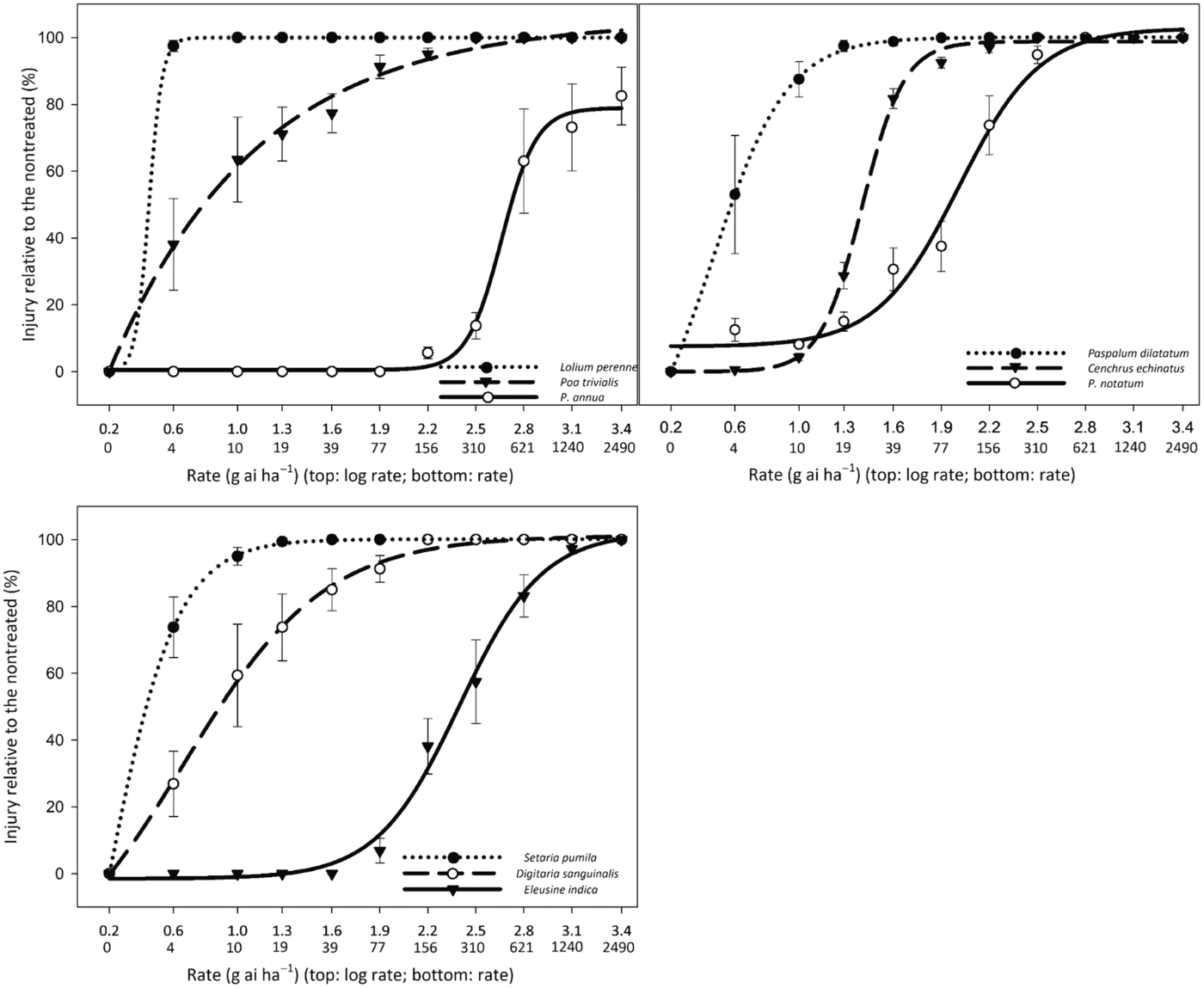
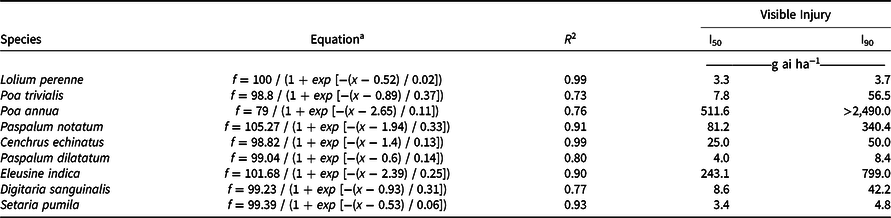
We hypothesized that the grass species examined would have a differential response to pinoxaden. Distinct differences based on grass physiology were not observed (Figures 1 and 2). Rather, seemingly random differences in grass response were observed between both C3 and C4 grasses. On the basis of visible injury data, the grass species examined were ranked from lowest to highest I90 value as follows: perennial ryegrass > yellow foxtail > dallisgrass > large crabgrass > southern sandbur > roughstalk bluegrass > bahiagrass > goosegrass > annual bluegrass (Table 3).
Percent visible injury response relative to the nontreated control of nine grassy weeds 35 d after treatment with increasing rates of pinoxaden. Response was modelled using a four-parameter sigmoidal model based on the log rate of pinoxaden to create equal spacing between rates. The equation used was: f = y0 + a / (1 + exp [-(x - x0) / b]). Non–log-transformed rates are presented for reference. Means are expressed using different symbols for each weed species and regression equation models are represented by different line type for each species. Vertical bars represent SE (P = 0.05).

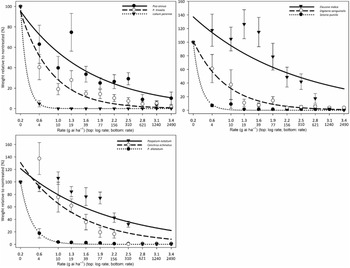
Aboveground biomass, presented as a percentage of the nontreated, 35 d after treatment with increasing rates of pinoxaden. All regressions were modelled on the basis of the log rate of pinoxaden to create equal spacing between rates with the equation f = y0 + a × exp (−b × x). Non–log-transformed rates are presented for reference. Means are expressed using different symbols for each weed species and regression equation models are represented by different line type for each species. Vertical bars represent SE (P = 0.05).

Estimated rate of pinoxaden required to injure each species by 50% and 90% based on visible injury ratings collected 35 d after treatment.

a The three-parameter sigmoidal model equation was f = a / (1 + exp [−(x − x o ) / b]), where f represents the percent visible injury relative to the nontreated control, x represents the log-transformed pinoxaden rate, and a, b and x o represent the regression parameters.
Abbreviations: I50, application rate at which 50% of the weed species were injured; I90, application rate at which 50% of the weed species were injured.
Perennial ryegrass was the most susceptible species tested, based on visible control data. All rates of pinoxaden applied injured perennial ryegrass more than 95% (Figure 1) and the I50 and I90 values determined for perennial ryegrass visible injury were 3.3 and 3.7 g ai ha−1, respectively. Pinoxaden injured yellow foxtail greater than 95% at rates of 10 g ai ha−1 or higher, and the I50 and I90 values determined for yellow foxtail visible injury were 3.4 and 4.8 g ai ha−1, respectively. Dallisgrass susceptibility to pinoxaden was similar to that of yellow foxtail. Pinoxaden injured dallisgrass greater than 95% at rates of 10 g ai ha−1 or higher. The I50 and I90 values determined for dallisgrass visible injury were 4.0 and 8.40 g ai ha−1, respectively. Pinoxaden injured large crabgrass, southern sandbur, and roughstalk bluegrass greater than 90% at rates of 77 g ai ha−1 or higher. The I50 and I90 values determined for large crabgrass visible injury were 8.6 and 42.2 g ai ha−1, respectively; for southern sandbur, the values were 25.0 and 50 g ai ha−1, respectively; for roughstalk bluegrass, the values were 7.8 and 56.5 g ai ha−1, respectively. Pinoxaden injured bahiagrass greater than 90% at rates of 310 g ai ha−1 or higher. The I50 and I90 values determined for bahiagrass visible injury were 81.2 and 340.4 g ai ha−1, respectively.
Both goosegrass and annual bluegrass were tolerant to pinoxaden applications. Pinoxaden injured goosegrass and annual bluegrass less than 5% at rates of 77 g ai ha−1 or lower. Pinoxaden only injured goosegrass greater than 90% at rates of 1,240 g ai ha−1 or higher. No rate of pinoxaden injured annual bluegrass greater than 90%. Pinoxaden at 2,490 g ai ha−1 injured annual bluegrass 82%. The I50 and I90 values determined for goosegrass and annual bluegrass visible injury were 243.1 and 799.0 g ai ha−1, respectively, for goosegrass and 511.6 or greater than 2,490.0 g ai ha−1, respectively, for annual bluegrass.
Mass of aboveground tissue followed a pattern similar to that of visible injury ratings (Table 4). Pinoxaden was very effective on perennial ryegrass and yellow foxtail, with all rates of pinoxaden tested reducing perennial ryegrass and yellow foxtail biomass greater than 90% and WR50 and WR90 values of 2.0 and 3.2, and 2.1 and 3.8 g ai ha−1, respectively (Figure 2). Pinoxaden reduced dallisgrass biomass greater than 95% at rates of 10 g ai ha−1 or higher, and the WR50 and WR90 values determined for dallisgrass biomass reduction were 2.3 and 5.5 g ai ha−1, respectively. Pinoxaden reduced large crabgrass and roughstalk bluegrass biomass greater than 90% at rates of 65 g ai ha−1 or higher, and the WR50 and WR90 values determined for large crabgrass and roughstalk bluegrass biomass reduction were 4.9 and 64.0 g ai ha−1 and 4.2 and 48.7 g ai ha−1, respectively.
Estimated rate of pinoxaden required to reduce the aboveground biomass of each species by 50% and 90%, based on weights collected 35 d after treatment.

a The two-parameter exponential decay model equation was f = a × exp (−b × x), where f represents weight as a percent of the nontreated control, x represents the log-transformed pinoxaden rate, and a and b represent the regression parameters.
b Abbreviations: WR50, rate of pinoxaden required to reduce the aboveground biomass of each species by 50%; WR90, rate of pinoxaden required to reduce the aboveground biomass of each species by 90%.
Low rates of pinoxaden caused an increase in plant biomass in southern sandbur, bahiagrass, and goosegrass. This is not uncommon in herbicides applied at low rates. Several herbicides stimulate plant growth when applied at sublethal dosages (Velini et al. Reference Velini, Alves, Godoy, Meschede, Souza and Duke2008; Wiedman and Appleby Reference Wiedman and Appleby1972). However, this increase in plant biomass led to disproportionately high WR90 values, due to an inability of the nonlinear regression model to account for the initial increase in biomass at low rates.
Pinoxaden applied at 4 g ai ha−1 increased southern sandbur biomass 37%, but pinoxaden applied at 156 g ai ha−1 or higher reduced southern sandbur biomass greater than 85%. The WR50 and WR90 values determined for southern sandbur biomass reduction were 20.5 and 1,470.8 g ai ha−1, respectively. Pinoxaden increased bahiagrass biomass by 5% at rates of 10 g ai ha−1 or lower, but reduced bahiagrass mean biomass greater than 95% at rates of 621 g ai ha−1 or higher. The WR50 and WR90 values determined for bahiagrass biomass reduction were 74.3 and greater than 2,490.0 g ai ha−1, respectively. Pinoxaden increased goosegrass biomass by greater than 15% at rates of 39 g ai ha−1 or lower. Application rates of pinoxaden of 1,240 g ai ha−1 or higher were required to reduce goosegrass mean biomass greater than 90%, and the WR50 and WR90 values determined for goosegrass biomass reduction were 247.5 and greater than 2,490.0 g ai ha−1, respectively.
Pinoxaden had a growth regulatory effect on annual bluegrass without causing visible injury. All rates of pinoxaden reduced annual bluegrass biomass by greater than 25%. However, rates of 621 g ai ha−1 or higher were required to reduce annual bluegrass biomass greater than 85%. No rates examined reduced annual bluegrass biomass greater than 95%. The WR50 and WR90 values determined for annual bluegrass biomass reduction were 13.7 and greater than 2,490 g ai ha−1, respectively.
Based on these data, pinoxaden may be a viable POST control option for some of the weed species examined in this study that have a limited number of POST herbicides labelled in turfgrass. Foxtail species have become more prevalent in turfgrass situations (J. Scott McElroy, personal observation), but only quinclorac is currently labelled for POST control in turf. Although quinclorac has POST activity on both broadleaf weeds and grasses, including foxtails, it has limited efficacy when applied to grasses that have started to tiller (Anonymous 2018b; Curran et al. Reference Curran, Ryan, Myers and Adler2011). Topramezone and fenoxaprop also are both labelled for POST foxtail control, but neither is labelled for use in bermudagrass turf (Anonymous 2018b; Anonymous 2019). Acceptable control of dallisgrass in warm-season turfgrass is difficult to obtain because dallisgrass has few POST options for control. Henry et al. (Reference Henry, Yelverton and Burton2007) observed that foramsulfuron can be used for suppression of mature dallisgrass in warm-season turf, but complete control is difficult to obtain. Southern sandbur has limited control options in warm-season turf, as well, with imazapic being safe to use on bermudagrass and efficacious against sandbur species (Grichar et al. Reference Grichar, Baumann, Baughman and Nerada2008). Large crabgrass POST control in bermudagrass is limited to quinclorac and dithiopyr. However, dithiopyr must be applied pretillering for effective POST crabgrass control (Keeley et al. Reference Keeley, Branham and Penner1997; Reicher et al. Reference Reicher, Weisenberger and Throssell1999). Quinclorac is also more effective when POST applications are made earlier in the growth stage of the crabgrass plant (Enache and Ilnicki Reference Enache and Ilnicki1991).
Results from this study indicate there is a differential response between grasses to pinoxaden. This is not uncommon among ACCase-inhibitor herbicides and may be attributed to differential metabolism of the pinoxaden molecule between species. For example, McCarty et al. (Reference McCarty, Higgins, Corbin and Whitwell1990) detected only trace amounts (<1%) of sethoxydim in centipedegrass tissue 6 h after an application of sethoxydim. In contrast, 81% to 98% of sethoxydim was detected in goosegrass tissue.
Based on this research, pinoxaden has the potential, at maximum labelled spot-spray rates (310 g ai ha−1), to effectively control (>90%) all grasses tested except goosegrass, bahiagrass, and annual bluegrass. Among the weed species tested, only large crabgrass, bahiagrass, and dallisgrass are labelled for POST pinoxaden applications in turfgrass (Anonymous 2018c). This research was conducted on seedlings only and mature dallisgrass and roughstalk bluegrass plants will most likely be less susceptible than seedlings to pinoxaden.
Pinoxaden is not considered a resistance breaker (Basak et al. Reference Basak, McElroy, Brown, Goncalves, Patel and McCullough2019; Hofer et al. Reference Hofer, Muehlebach, Hole and Zoschke2006), which is an herbicide that has the same mode of action to which the plant is resistant to but that can still control the resistant plant. However, weed biotypes that are already resistant to an ACCase inhibitor will most likely have developed cross-resistance to pinoxaden. Therefore, the I50 and I90 values determined from this experiment may be used as a baseline for ACCase resistance screenings. Of the weed species examined, yellow foxtail, dallisgrass, southern sandbur, roughstalk bluegrass, bahiagrass, and large crabgrass do not have an ACCase-inhibiting herbicide labeled for bermudagrass turfgrass use. Pinoxaden may give turf managers an ACCase option to allow for herbicide mode-of-action rotation. An additional mode of action available for turfgrass use may help reduce the number of resistance cases observed in these weed species.
Acknowledgements
This publication was supported by the Alabama Agricultural Experiment Station and the Hatch program of the National Institute of Food and Agriculture, U.S. Department of Agriculture. No conflicts of interest have been declared.