1. Introduction
Southeastern China is characterized by the widespread occurrence of Mesozoic igneous rocks, which have been the subject of extensive study due to their tectonic significance and related large-scale mineralization (Chen & Jahn, Reference Chen and Jahn1998; Zhou & Li, Reference Zhou and Li2000; Wang et al. Reference Wang, Wyman, Xu, Zhao, Jian, Xiong, Bao, Li and Bai2006 b, Reference Wang, Xu, Zhao, Song and Kynicky2015; Li & Li, Reference Li and Li2007; Zhou et al. Reference Zhou, Jiang, Zhao, Liao and Jin2012). Previous studies of these Mesozoic igneous rocks have provided numerous petrological, geochemical and isotopic insights into their origins, petrogenesis and regional tectonic setting. The Jurassic igneous rocks are predominantly crust-derived granites with limited ferroan (A-type) granites and basalts (Li, Reference Li2000; Li et al. Reference Li, Li, Li, Liu, Yuan, Wei and Qi2007), but the Cretaceous rocks are dominated by granites with mixed crustal and mantle contributions, and rare ferroan (A-type) granites (Li, Reference Li2000; Zhou et al. Reference Zhou, Sun, Shen, Shu and Niu2006).
The Cretaceous tectono-magmatic evolution of southern China is debated (e.g. Charvet, Lapierre & Yu, Reference Charvet, Lapierre and Yu1994; Martin et al. Reference Martin, Bonin, Capdevia, Jahn, Lameyre and Wang1994; Li, Reference Li2000; Zhou & Li, Reference Zhou and Li2000; Xie et al. Reference Xie, Xu, Zou, Jiang, Zhang and Qiu2006; Zhou et al. Reference Zhou, Sun, Shen, Shu and Niu2006; Li & Li, Reference Li and Li2007; Wong et al. Reference Wong, Sun, Xing, Li, Zhao, Wong, Yuan, Xia, Li and Wu2009; Liu et al. Reference Liu, Gao, Hu, Gao, Zong and Wang2010a). Various processes have been proposed to have occurred in the Cretaceous, such as subduction-related compression (Jahn, Chen & Yen, Reference Jahn, Chen and Yen1976; Huang et al. Reference Huang, Sun, DePaolo and Wu1986; Charvet, Lapierre & Yu, Reference Charvet, Lapierre and Yu1994; Martin et al. Reference Martin, Bonin, Capdevia, Jahn, Lameyre and Wang1994; Lan et al. Reference Lan, Jahn, Mertzman and Wu1996; Lapierre et al. Reference Lapierre, Jahn, Charvet and Yu1997), continental margin subduction of the palaeo-Pacific Plate beneath Eurasia (Maruyama & Seno, Reference Maruyama and Seno1986; Lapierre et al. Reference Lapierre, Jahn, Charvet and Yu1997; Maruyama et al. Reference Maruyama, Isozaki, Kimura and Terabayashi1997; Xu, Tang & Zhou, Reference Xu, Tang and Zhou1999; Li, Reference Li2000; Zhou & Li, Reference Zhou and Li2000; Zhou & Chen, Reference Zhou and Chen2001) and slab break-off and rollback (Li & Li, Reference Li and Li2007; Li et al. Reference Li, Li, Li, Liu, Yuan, Wei and Qi2007).
The timing and cause of Cretaceous extension are key issues for understanding the tectonic evolution of SE China during the Mesozoic. Some studies have proposed that extension started in the Jurassic (e.g. Gilder et al. Reference Gilder, Keller, Luo and Goodell1991; Li, Reference Li2000), based on the emplacement of subordinate rift-related alkaline basalts and syenites (e.g. Wang et al. Reference Wang, Xu, Zhao, Bao, Xu and Xiong2004), bimodal volcanic and intrusive rocks (Chen et al. Reference Chen, Guo, Tang and Zhou1999 b; Wang et al. Reference Wang, Mcdermott, Xu, Bellon and Zhu2005), and mafic dykes in SE China (Li & McCulloch, Reference Li, McCulloch, Flower, Chung, Lo and Lee1998). Other studies have argued that extension in SE China began in the Cretaceous (e.g. Charvet, Lapierre & Yu, Reference Charvet, Lapierre and Yu1994; Martin et al. Reference Martin, Bonin, Capdevia, Jahn, Lameyre and Wang1994; Lapierre et al. Reference Lapierre, Jahn, Charvet and Yu1997), as indicated by A-type granites and bimodal volcanic rocks that were emplaced at c. 100 Ma in the coastal region.
The Honggong granite pluton is the largest A-type granite pluton in SW Zhejiang Province (Figs 1 and 2). In this study, we report zircon U–Pb ages, major and trace element, and isotopic (Sr–Nd–Hf) data for the pluton, and we use these data to further constrain the Late Mesozoic tectonic evolution of SE China.
Geological map of ferroan (A-type) granites in southern China.

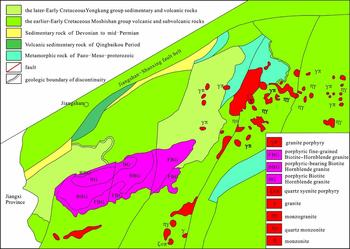
Geological map of the Honggong pluton.

2. Geological background and sample descriptions
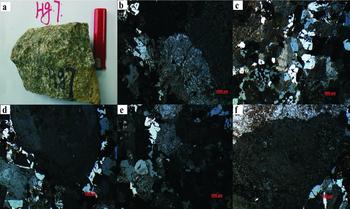
The Honggong pluton is a stock with an outcrop area of ~470 km2 emplaced into Early Cretaceous Moshishan Group volcanic and sub-volcanic rocks, and covered by Early Cretaceous Yongkang Group sedimentary and volcanic rocks (Fig. 2). The pluton can be classified into three units according to petrography: (1) a marginal facies of fine-grained porphyry biotite granite; (2) a transitional facies of porphyry biotite granite; and (3) an internal facies of porphyry biotite granite (Lu et al. Reference Lu, Wang, Dong and Dong2006; Gong & Lu, Reference Gong and Lu2008). The main minerals present are microperthite, plagioclase, quartz, biotite and hornblende; aegirine is present locally in the internal facies and is enclosured by the biotite (Lu et al. Reference Lu, Wang, Dong and Dong2006). Biotite occurs as mineral aggregates along the boundary of coarse-grained minerals, such as plagioclase, K-feldspar and quartz, indicating that it grew later than the felsic minerals (Fig. 3). These characteristics are similar to ferroan alkali (A-type) granites (Chen et al. Reference Chen, Zhang, Kong, Cai, Ling and Ni1998; Bonin, Reference Bonin2007; Frost & Frost, Reference Frost and Frost2011). Accessory minerals include magnetite, ilmenite, zircon, apatite, allanite, rutile and tourmaline. A biotite 40Ar/39Ar age for the Honggong pluton of 124.5 Ma has previously been published (Chen, Zhou & Yin, Reference Chen, Zhou and Yin1991).
Photomicrographs of granites from the Honggong pluton.

3. Analytical procedures
3.a. Zircon U–Pb dating
Representative zircon grains were hand-picked under a binocular microscope after using conventional heavy-liquid and magnetic mineral separation techniques at the Regional Investigation Laboratory of Regional Geological Investigation and Mineral Resources, Langfang, Hebei Province, China.
Analyses of U–Pb in zircons were conducted by laser ablation–multi-collector–inductively coupled plasma–mass spectrometry (LA-MC-ICP-MS) at the Institute of Mineral Resources, Chinese Academy of Geological Sciences, Beijing, China. Detailed operating conditions for the laser ablation system and the MC-ICP-MS instrument, and data reduction processes have been described by Hou, Li & Tian, (Reference Hou, Li and Tian2009). Laser analysis was performed using a Newwave UP 213 laser ablation device. A Thermo Finnigan Neptune MC-ICP-MS instrument was used to acquire ion-signal intensities. The array of four multi-ion counters and three Faraday cups allows for simultaneous detection of 202Hg (on IC5), 204Hg, 204Pb (on IC4), 206Pb (on IC3), 207Pb (on IC2), 208Pb (on L4), 232Th (on H2) and 238U (on H4) ion signals. Helium was used as a carrier gas. Argon was used as the make-up gas and was mixed with the carrier gas via a T-connector before entering the ICP. Each analysis incorporated a background acquisition of 20–30 s (gas blank) followed by 30 s of data acquisition from the sample. Offline raw data selection and integration of background and analyte signals, time-drift correction, and quantitative calibration for U–Pb dating were performed using the software ICPMSDataCal (Liu et al. Reference Liu, Gao, Hu, Gao, Zong and Wang2010 b).
The zircon GJ1 was used as an external standard for U–Pb dating, and was analysed twice every 5–10 analyses. Time-dependent drifts of U–Th–Pb isotopic ratios were corrected using a linear interpolation (with time) for every 5–10 analyses according to the variations in GJ1 (i.e. 2 zircons GJ1 + 5–10 samples + 2 zircons GJ1) (Liu et al. Reference Liu, Gao, Hu, Gao, Zong and Wang2010 b). Preferred U–Th–Pb isotopic ratios used for GJ1 are from Jackson et al. (Reference Jackson, Pearson, Griffin and Belousova2004). Uncertainty in preferred values for the external standard GJ1 was incorporated in the final results for these samples. In all analysed zircon grains, correction for common Pb was not necessary due to the low signal of common 204Pb and high 206Pb/204Pb values. U, Th and Pb concentrations were calibrated by analysing the zircon M127 (U: 923 ppm; Th: 439 ppm; Th/U: 0.475; Nasdala et al. Reference Nasdala, Hofemister, Norberg, Martinson, Corfu, Dorr, Kamo, Kennedy, Kronz, Reiners, Frei, Kosler, Wan, Gotze, Hager, Kroner and Valley2008). Concordia diagrams and weighted mean calculations were completed using Isoplot/Ex_ver3. The zircon Plesovice was dated as an unknown sample and yielded a weighted mean 206Pb/238U age of 337 ± 2 Ma (2SD, n = 12), which is in good agreement with the recommended 206Pb/238U age of 337.13 ± 0.37 Ma (2SD) (Sláma et al. Reference Slama, Kosler, Condon, Gerdes, Hanchar, Horstwood, Morris, Nasdala, Norberg, Schaltegger, Schoene, Tubrett and Whitehouse2008).
3.b. Major and trace-element analyses
Whole-rock major element concentrations were determined using X-ray fluorescence spectrometry. Major and trace-element analyses were conducted by LA-ICP-MS at the State Key Laboratory of Geological Processes and Mineral Resources (GPMR), China University of Geosciences, Wuhan. Detailed operating conditions for the laser ablation system and the ICP-MS instrument and data reduction are the same as the description by Liu et al. (Reference Liu, Hu, Gao, Günther, Xu, Gao and Chen2008). Laser sampling was performed using a GeoLas 2005. An Agilent 7500a ICP-MS instrument was used to acquire ion-signal intensities. Helium was applied as a carrier gas. Argon was used as the make-up gas and mixed with the carrier gas via a T-connector before entering the ICP. Nitrogen was added into the central gas flow (Ar + He) of the Ar plasma to decrease the detection limit and improve precision (Hu et al. Reference Hu, Gao, Liu, Hu, Chen and Yuan2008). Each analysis incorporated a background acquisition of c. 20–30 s (gas blank) followed by 50 s data acquisition from the sample. The Agilent Chemstation was utilized for the acquisition of each individual analysis. Element contents were calibrated against multiple-reference materials (BCR-2G, BIR-1G and BHVO-2G) without applying internal standardization (Liu et al. Reference Liu, Hu, Gao, Günther, Xu, Gao and Chen2008). The preferred values of element concentrations for the US Geological Survey (USGS) reference glasses are from the GeoReM database. Offline selection and integration of background and analyte signals, and time-drift correction and quantitative calibration were performed by ICPMSDataCal (Liu et al. Reference Liu, Hu, Gao, Günther, Xu, Gao and Chen2008 Reference Liu, Gao, Hu, Gao, Zong and Wang2010 b).
3.c. Nd–Sr isotopic analyses
Whole rock Rb–Sr and Sm–Nd isotopic ratios were determined using a Finnigan Triton TIMS, housed at GPMR, Wuhan. The ratios 147Sm/144Nd and 87Rb/86Sr were calculated using Sm, Nd, Rb and Sr isotope concentrations measured by an ICP-MS (Agilent 7500a), and error uncertainties are ~0.3 % and ~1 % (relative), respectively, based on USGS standard analyses. Total analytical blanks were 5 × 10⁻¹¹ g for Sm and Nd, and (2–5) × 10−10 g for Rb and Sr. Accurately weighed samples were dissolved in a sealed bomb with tetrafluoroethylene and 3 ml of HF + HNO3. After dissolution and drying, 3 ml of HF + HNO3 was again added, and the container was sealed and placed in an oven at 190 °C for complete dissolution. An AG50X8 cation resin column and HDEHP were used for Sm–Nd separation. Mass fraction corrections for Nd isotropic ratios were based on a value of 146Nd/144Nd = 0.721900. The measured values of standard sample BCR-2 are 143Nd/144Nd = 0.512643 ± 0.000015 (2σ), 147Sm/144Nd = 0.1365, and Nd = 28.32 ppm, and the 143Nd/144Nd value for the La Jolla standard is 0.511856 ± 0.000012. For details of the analytical procedure for the Sr and Nd isotopic measurements, see Ling et al. (Reference Ling, Duan, Xie, Zhang, Zhang, Cheng, Liu and Yang2009).
3.d. Zircon Hf isotopic analysis in situ
Zircon Hf Isotope analyses were carried out in situ using a Newwave UP213 laser-ablation microprobe attached to a Neptune MC-ICP-MS at the Ministry of Land and Resources Key Laboratory of Metallogeny and Mineral Assessment, Institute of Mineral Resources, Chinese Academy of Geological Sciences, Beijing, China. Instrumental conditions and data acquisition followed Hou et al. (Reference Hou, Li, Zou, Qu, Shi and Xie2007) and Wu et al. (Reference Wu, Yang, Xie, Yang and Xu2006). A stationary spot was used for these analyses, with a beam diameter of either 40 or 55 μm depending on the size of the domain to be ablated. Helium was used as a carrier gas to transport the ablated sample from the laser-ablation cell to the ICP-MS torch via a chamber where the sample was mixed with argon. To correct for isobaric interferences of 176Lu and 176Yb on 176Hf, the ratios 176Lu/175Lu = 0.02658 and 176Yb/173Yb = 0.796218 were determined (Chu et al. Reference Chu, Taylor, Chavagnac, Nesbitt, Boella, Milton, German, Bayon and Burton2002). For instrumental mass-bias correction, Yb isotope ratios were normalized to a 172Yb/173Yb value of 1.35274 (Chu et al. Reference Chu, Taylor, Chavagnac, Nesbitt, Boella, Milton, German, Bayon and Burton2002), and Hf isotope ratios to a 179Hf/177Hf value of 0.7325 using an exponential law. The mass-bias behaviour of Lu was assumed to follow that of Yb. The mass-bias correction protocol followed Wu et al. (Reference Wu, Yang, Xie, Yang and Xu2006) and Hou et al. (Reference Hou, Li, Zou, Qu, Shi and Xie2007). Zircon GJ1 was used as a reference standard during routine analyses, using a weighted mean 176Hf/177Hf ratio of 0.282007 ± 0.000007 (2σ, n = 36). This is not statistically different from the weighted mean 176Hf/177Hf ratio of 0.282000 ± 0.000005 (2σ) reported by Morel et al. (Reference Morel, Nebel, Jacobsen, Miller and Vroon2006) using a solution analysis method.
4. Results
4.a. Zircon U–Pb geochronology
Previous studies have shown that the main rock type in the Honggong pluton is a biotite granite that yields an 40Ar/39Ar age of 124.5 Ma (Chen, Zhou & Yin, Reference Chen, Zhou and Yin1991) and a laser ablation–inductively coupled plasma–mass spectrometry (LA-ICP-MS) U–Pb zircon age of 127.2 ± 1.6 Ma that represents the crystallization age (He & Xu, Reference He and Xu2012).
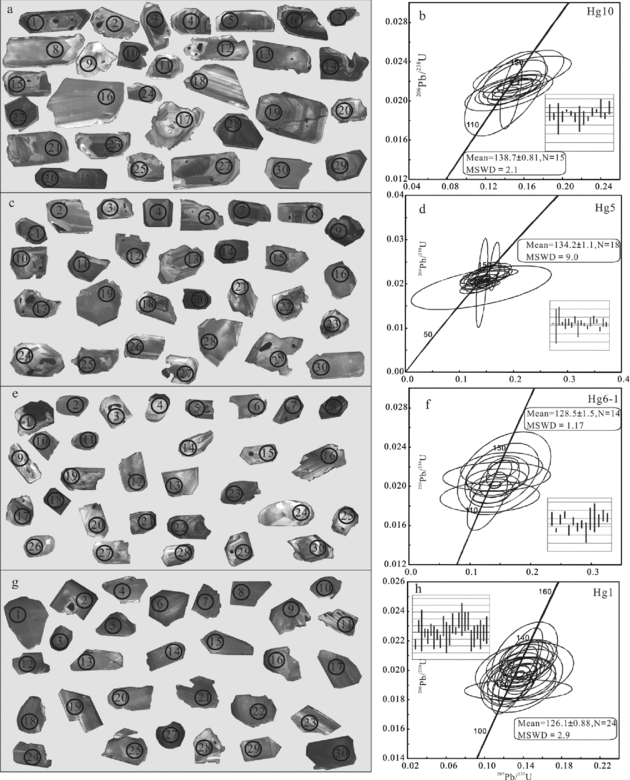
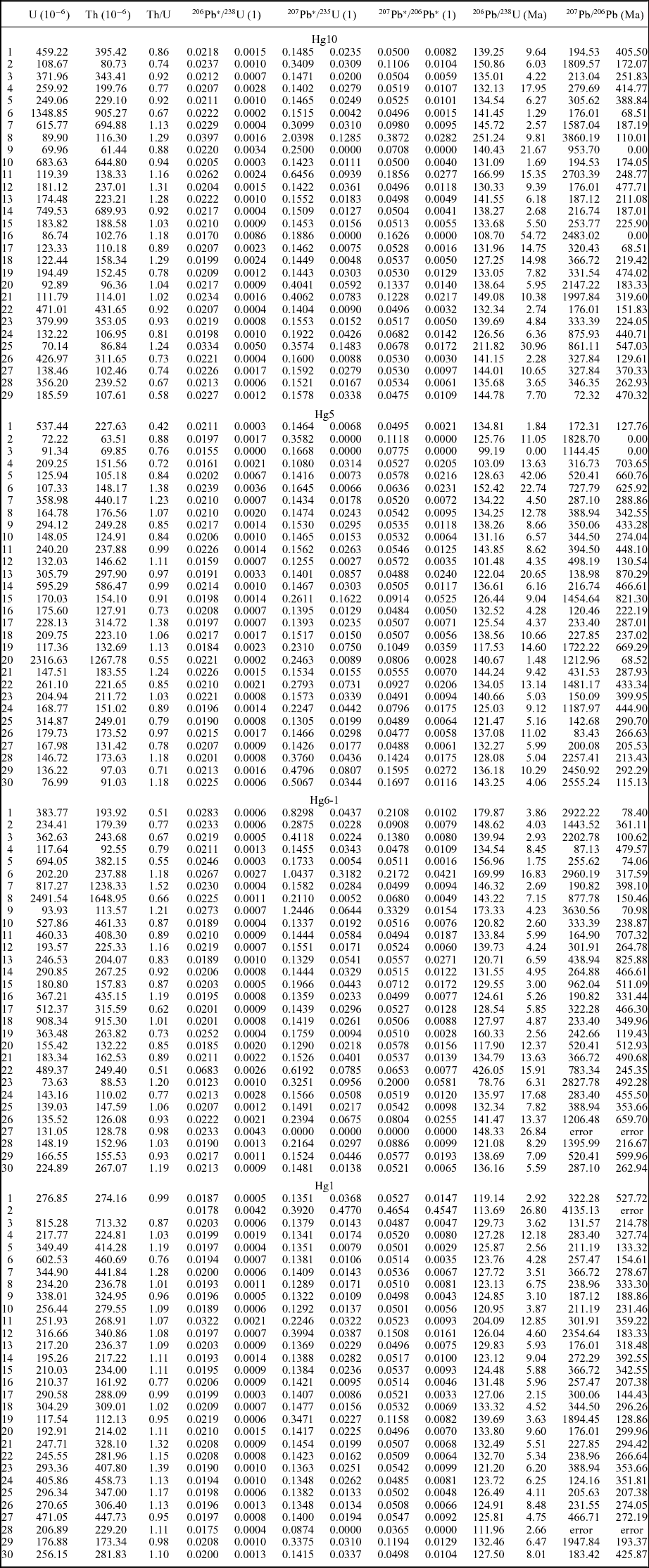
Cathodoluminescence (CL) images of representative zircons from four samples are shown in Figure 4, and the U–Pb isotopic results are listed in Table 1. U–Pb isotopic data were obtained for 30 spots in zircons from each of these four samples, which were selected using the CL images.
Cathodoluminescence (CL) images and concordia diagrams for zircons from the Honggong pluton. The LA-ICP-MS analysis spots are shown by numbered circles on the CL images. The numbers correspond to the analyses in Table 1.

LA-ICP-MS U–Pb geochronology results for zircons from four samples of the Honggong pluton.

Zircons from sample Hg10 are long euhedral prisms with pyramidal terminations showing clear oscillatory zoning, with length-to-width ratios of 1.5:1 to 3.5:1 (Fig. 4a). Th/U values range from 0.58 to 1.31, which are characteristic of magmatic zircons (Belousova et al. Reference Belousova, Griffin, O'Reilly and Fisher2002; Wu & Zheng, Reference Wu and Zheng2004). Fifteen analyses of areas of oscillatory zoning form a coherent age group with a mean 206Pb/238U age of 138.7 ± 0.8 Ma (mean square weighted deviation (MSWD) = 2.1) (Fig. 4b), which is interpreted to be the crystallization age of the porphyry biotite–hornblende–quartz syenite and is older than the 40Ar/39Ar isochron age of 124.5 Ma (Chen et al. Reference Chen, Zhou and Yin1991).
Zircons from sample Hg5 are long euhedral prisms with pyramidal terminations, showing clear oscillatory zoning and with length-to-width ratios of 1.5:1 to 3:1 (Fig. 4c). Th/U values vary from 0.42 to 1.38 (average = 0.95), which are typical of magmatic zircons (Belousova et al. Reference Belousova, Griffin, O'Reilly and Fisher2002; Wu & Zheng, Reference Wu and Zheng2004). Eighteen analyses of areas with oscillatory zoning yield a mean 206Pb/238U age of 134.2 ± 1.1 Ma (MSWD = 9.0) (Fig. 4d).
Zircons from sample Hg6 are long euhedral prisms with pyramidal terminations, exhibiting clear oscillatory zoning and with length-to-width ratios of 1.5:1 to 2.5:1 (Fig. 4e). Th/U values vary from 0.51 to 1.52, which are characteristic of magmatic zircons (Belousova et al. Reference Belousova, Griffin, O'Reilly and Fisher2002; Wu & Zheng, Reference Wu and Zheng2004). Fifteen analyses of areas with oscillatory zoning yield a mean 206Pb/238U age of 128.5 ± 1.5 Ma (MSWD = 1.17) (Fig. 4f).
Zircons from sample Hg1 are long euhedral prisms with pyramidal terminations, showing clear oscillatory zoning and with length-to-width ratios of 1.5:1 to 3:1 (Fig. 4g). Th/U values range from 0.76 to 1.39, which are also characteristic of magmatic zircons (Belousova et al. Reference Belousova, Griffin, O'Reilly and Fisher2002; Wu & Zheng, Reference Wu and Zheng2004). Twenty-four analyses of areas with oscillatory zoning in the zircons yield a coherent age group with a mean 206Pb/238U age of 126.1 ± 0.9 Ma (MSWD = 2.9) (Fig. 4h).
These zircon dating results show that the crystallization ages of the syenite become progressively younger from the margin to the centre of the pluton.
4.b. Major element data
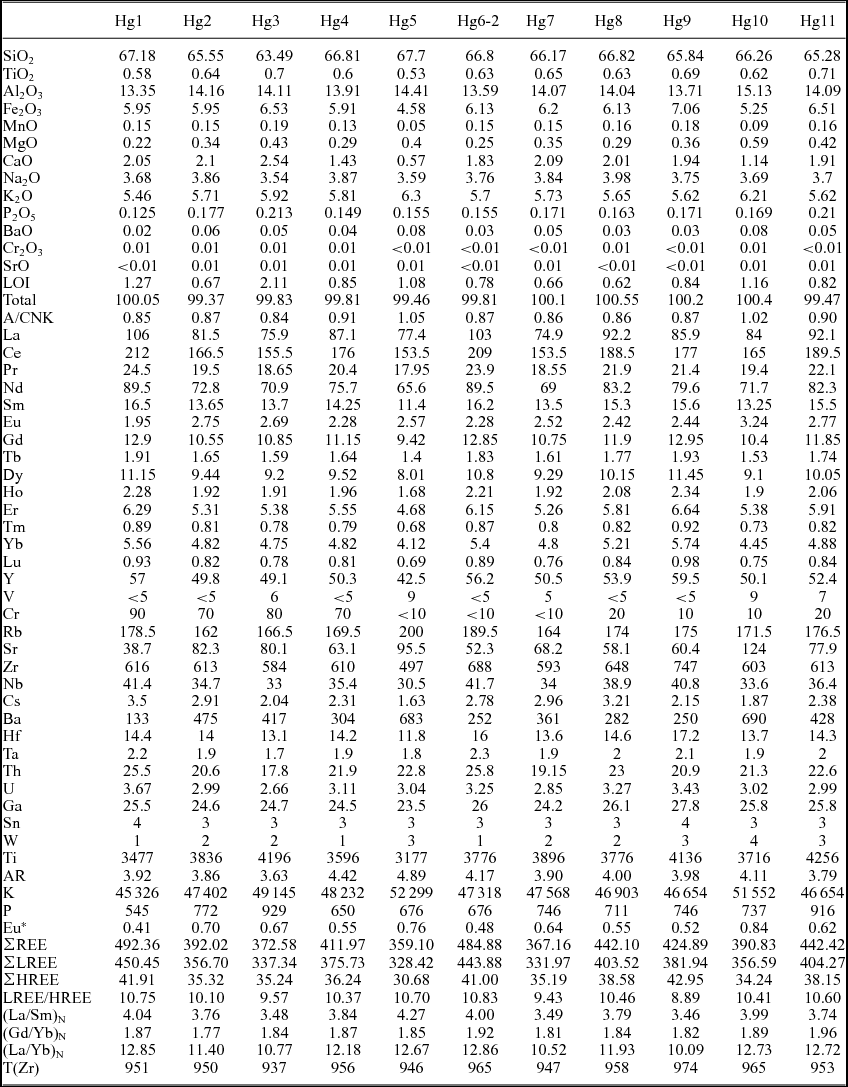
Eleven samples were analysed for major and trace element compositions; the data are summarized in Table 2. Data for ten samples previously published by Lu et al. (Reference Lu, Wang, Dong and Dong2006) are also presented and discussed in this section.
Major (wt %) and trace element (ppm) data for samples from the Honggong pluton.

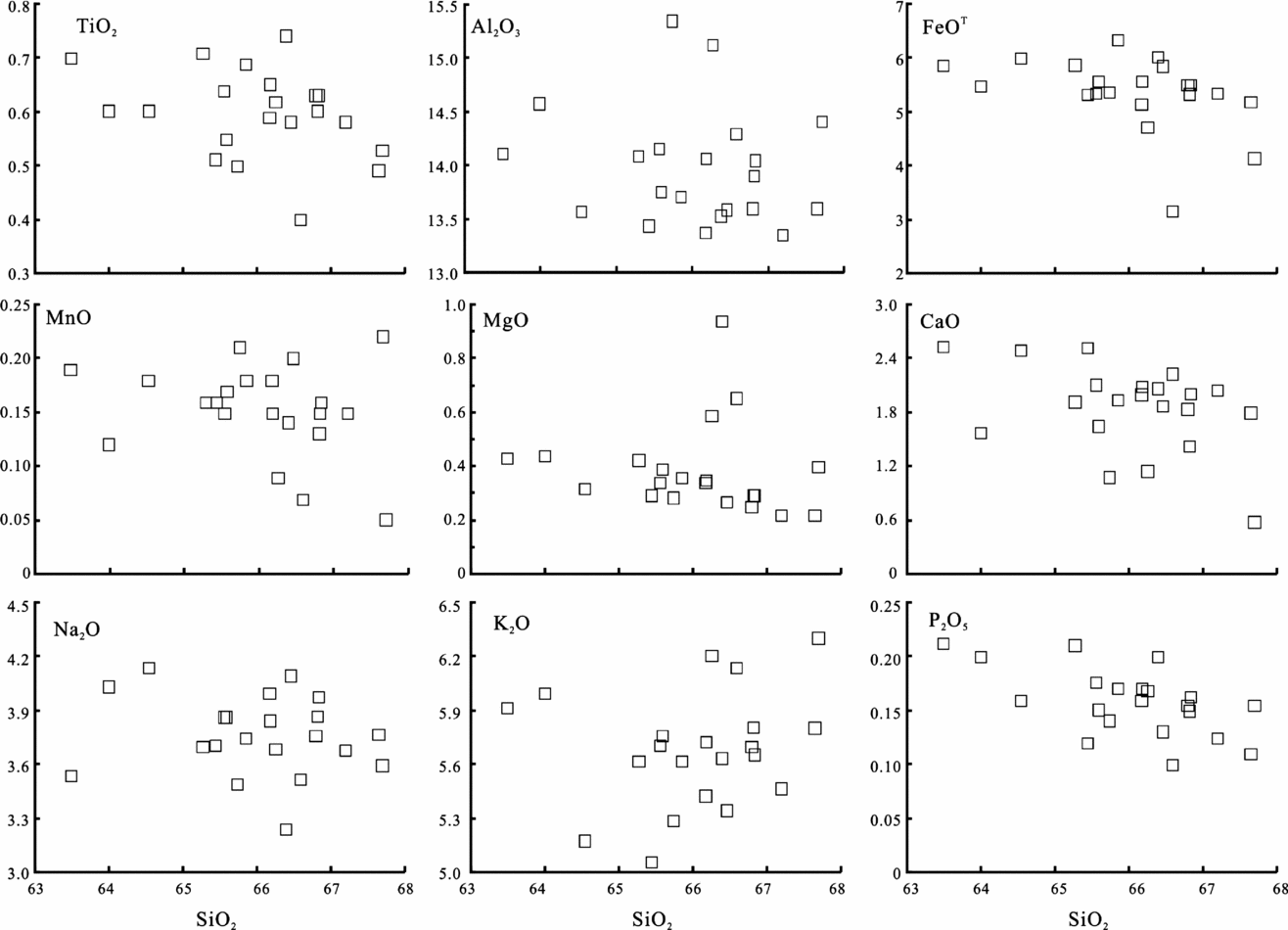
All of the samples have moderate SiO2 contents and are characterized by high Fe2O3 T and Na2O + K2O contents, high K/Na and Fe/Mg ratios, and low Al2O3, TiO2, MgO and CaO contents. On Harker diagrams, SiO2 exhibits clear negative correlations with FeOT, TiO2, MgO, CaO and P2O5, but no correlation with Na2O and K2O (Fig. 5). Figure 5d shows that all the samples formed at temperatures of >900 °C, which is similar to many other A-type granites (e.g. Loiselle & Wones, Reference Loiselle and Wones1979; Harrison & Watson, Reference Harrison and Watson1984; Green & Pearson, Reference Green and Pearson1986; King et al. Reference King, Chappell, Allen and White2001; Bonin, Reference Bonin2007; Yang et al. Reference Yang, Jiang, Zhao, Jiang, Ling and Luo2012; Zhao et al. Reference Zhao, Jiang, Yang, Dai and Lu2012, Reference Zhao, Jiang, Chen, Chen and Ling2013), but higher than the temperatures of formation of common I- and S-type granites (typically <800 °C; e.g. King et al. Reference King, White, Chappell and Allen1997; Clemens, Reference Clemens2003; Jung & Pfäinder, Reference Jung and Pfänder2007; Jiang et al. Reference Jiang, Jiang, Dai, Liao, Zhao and Ling2009).
Harker variation diagrams showing data for samples of the Honggong pluton (including data (n = 10) from Lu et al. Reference Lu, Wang, Dong and Dong2006).

4.c. Trace element data
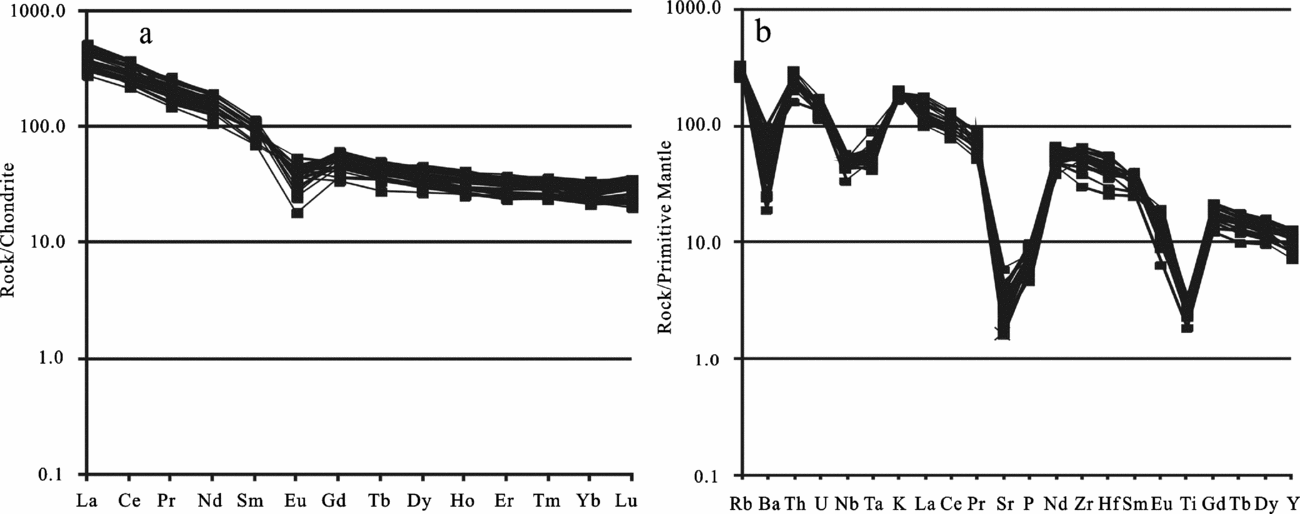
All samples from the Honggong pluton have high contents of total rare earth elements (REE) (ΣREE = 313–524 ppm; average = 425 ppm) and light REE (ΣLREE = 248–488 ppm; average = 390 ppm), but are depleted in heavy REE with chondrite-normalized (La/Yb)N= 10.1–20.2 (average = 13.7). Chondrite-normalized REE plots show that the samples are enriched in light REE relative to heavy REE and exhibit negative Eu anomalies (Fig. 6a), which are features similar to ferroan (A-type) granite as defined by Loiselle and Wones (Reference Loiselle and Wones1979). The Eu anomalies are indicative of plagioclase fractional crystallization during magma evolution.
Chondrite-normalized rare earth element (a) and primitive-mantle-normalized trace element date for samples of the Honggong pluton (including data (n = 10) from Lu et al. Reference Lu, Wang, Dong and Dong2006). Normalizing values are from Sun & McDonough (Reference Sun and McDonough1989).

The samples are also characterized by high concentrations of large-ion lithophile elements (LILE), such as K and Rb, and high-field-strength elements (HFSE), such as Zr, Hf and Th (Table 2). Negative anomalies in Ba and Sr are consistently evident in primitive-mantle-normalized trace element plots (Fig. 6b), which are also suggestive of plagioclase fractional crystallization. The progressive depletion of Ti, Nb and Ta suggests the crystallization of ilmenite, rutile and titanite (Ti-bearing minerals), with ilmenite being stable at high temperatures and low pressures (Liou et al. Reference Liou, Zhang, Ernst, Liu and McLimans1998). Rutile and titanite typically contain high concentrations of Nb and Ta (Manning & Bohlen, Reference Manning and Bohlen1991; McDonough, Reference McDonough1991; Green, Reference Green1995; Rudnick et al. Reference Rudnick, Barth, Horn and McDonough2000; Foley, Tiepolo & Vannucci, Reference Foley, Tiepolo and Vannucci2002; Xiong, Adam & Green, Reference Xiong, Adam and Green2005).
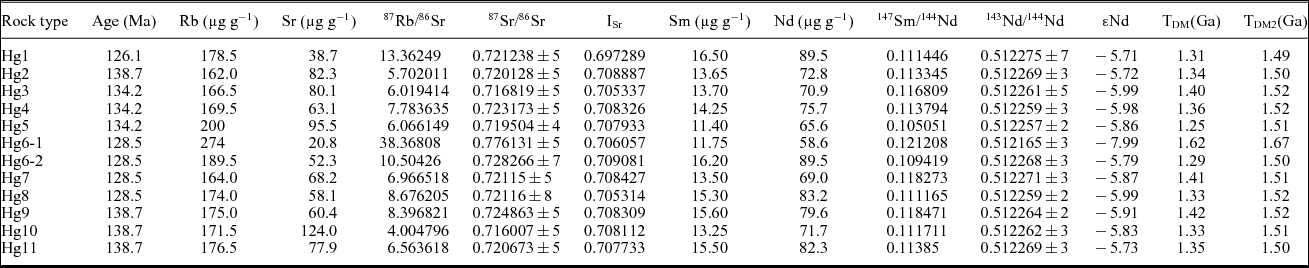
4.d. Whole-rock Nd–Sr isotopic data
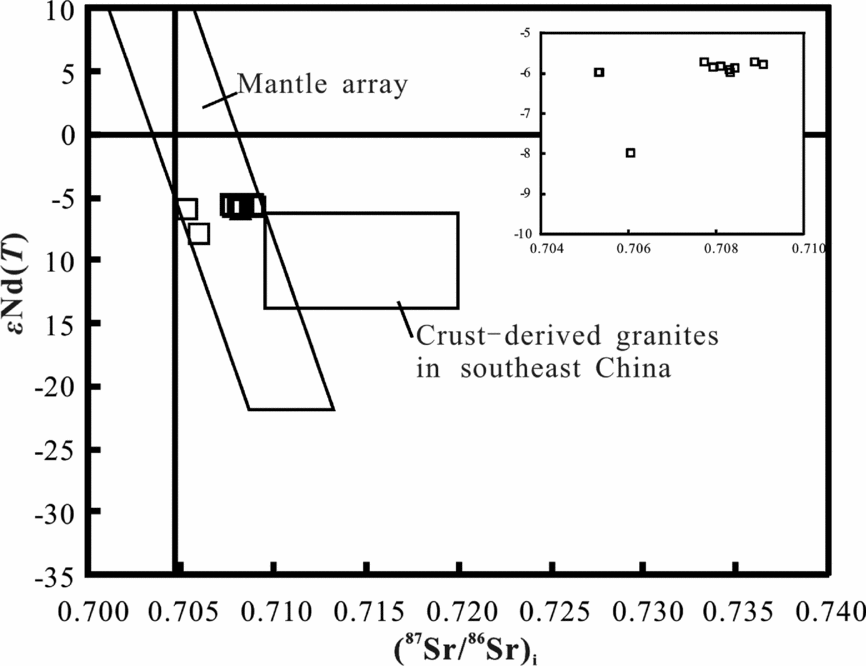
Rb/Sr and Sm/Nd ratios, and Sr–Nd isotopic data of 11 whole-rock samples are listed in Table 3. The Honggong pluton has uniformly high initial εNd(t) values and low initial 87Sr/86Sr ratios. The measured initial 87Sr/86Sr ratios vary from 0.705314 to 0.709081 (average = 0.706733). εNd(t) values range from –5.71 to –7.99 (average = –6.03). Two-stage Nd model ages (T2DM) range from 1.49 to 1.67 Ga (average = 1.52 Ga) (Fig. 7).
Rb–Sr and Sm–Nd isotopic data for granodiorites from the Honggong pluton.

Plot of εNd(t) versus (87Sr/86Sr)i.

4.e. Zircon Hf isotopic data
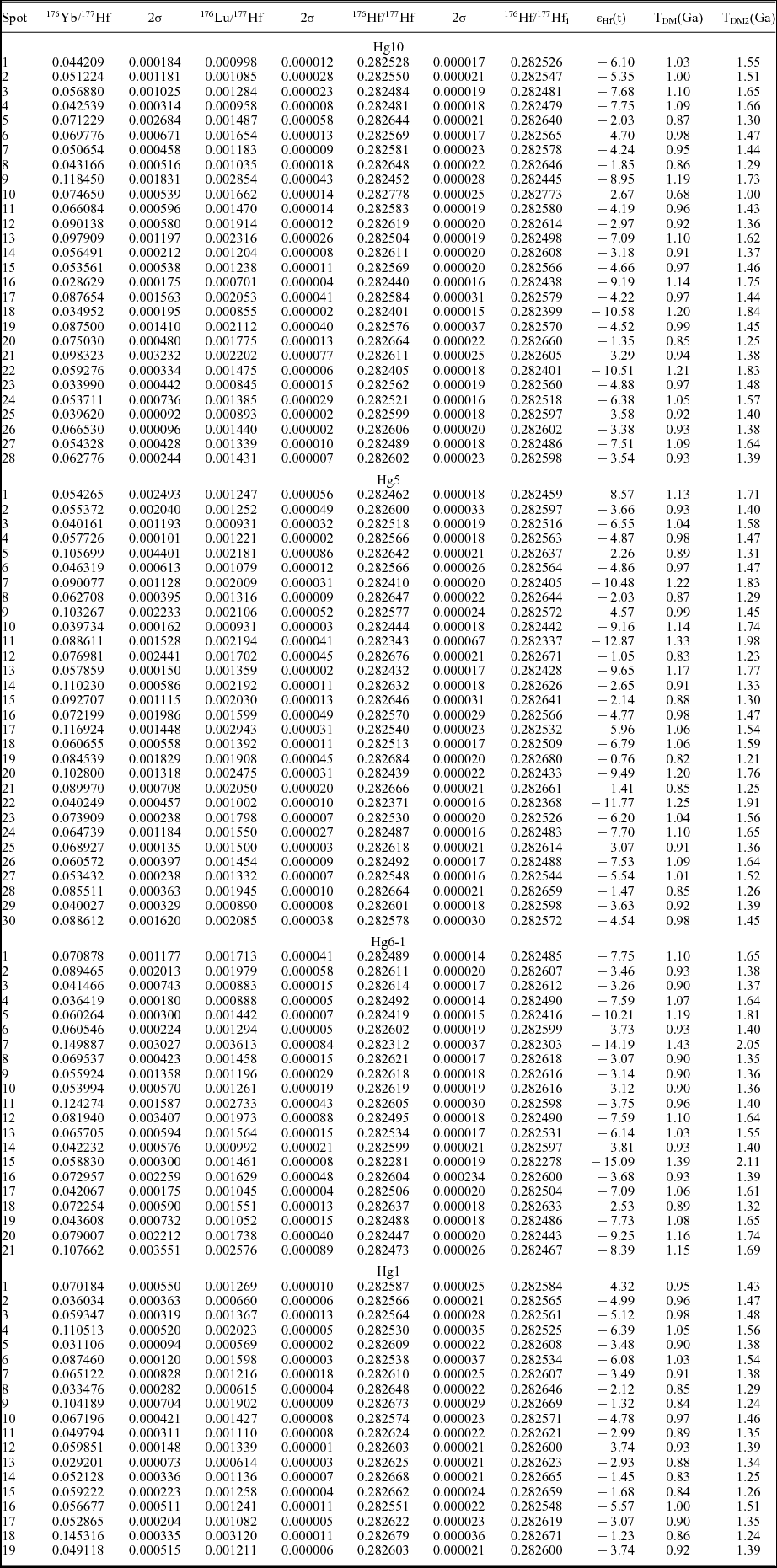
The Lu–Hf isotopic compositions of zircons from the four samples subjected to U–Pb dating are listed in Table 4. 176Yb/177Hf and 176Lu/177Hf ratios of the 98 measured zircons are similar, with average values of 0.0679 and 0.00152, respectively. Most of the 176Lu/177Hf values are <0.002, which represent the 176Lu/177Hf values at the time of zircon formation (Wu et al. Reference Wu, Yang, Xie, Yang and Xu2006).
LA-MC-ICP-MS Lu–Hf isotope data for zircons from the Honggong pluton.

4.e.1. Sample Hg10
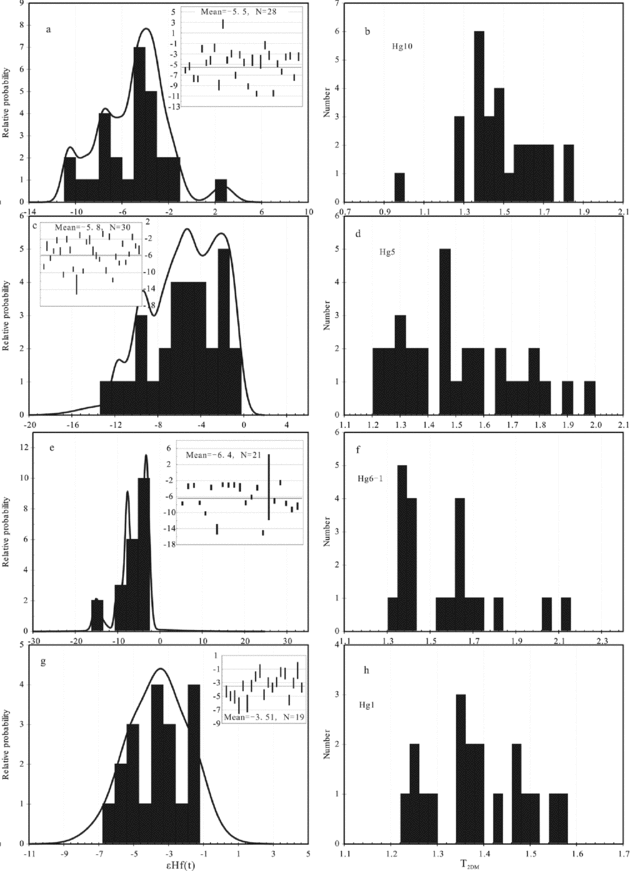
The εHf(t) values of magmatic zircons from sample Hg10 (n = 28) range from –10.6 to +2.7 (average = –5.0). TDM ages range from 0.68 to 1.21 Ga (average = 0.99 Ga), and two-stage Hf model ages (T2DM) range from 1.00 to 1.83 Ga (average = 1.49 Ga) (Fig. 8a, b).
Histograms of zircon εHf(t) values and two-stage Hf model ages relative to depleted mantle for the Honggong pluton (inset figures show weighted mean εHf(t) values).

4.e.2. Sample Hg5
The εHf(t) values of magmatic zircons from sample Hg5 (n = 30) range from –0.8 to –12.9 (average = –5.5), corresponding to TDM ages of 0.82 to 1.33 Ga (average = 1.01 Ga) and two-stage Hf model ages (T2DM) of 1.21–1.98 Ga (average = 1.51 Ga) (Fig. 8c, d).
4.e.3. Sample Hg6-1
The εHf(t) values of magmatic zircons from sample Hg6-1 (n = 21) range from –2.5 to –15.1 (average = –6.4). TDM ages range from 0.89 to 1.39 Ga (average = 1.04 Ga), and two-stage Hf model ages (T2DM) range from 1.21 to 2.11 Ga (average = 1.57 Ga) (Fig. 8e, f).
4.e.4. Sample Hg1
The εHf(t) values of magmatic zircons from sample Hg10 (n = 19) range from –2.5 to –15.1 (average = –6.4), which yields TDM ages of 0.89–1.43 Ga (average = 1.04 Ga) and two-stage Hf model ages (T2DM) of 1.32–2.05 Ga (average = 1.57 Ga) (Fig. 8g, h).
5. Discussion
5.a. Granite classification
Granitic rocks are genetically divided into I-, S-, M- and A-types according to their protolith (Chappell & White, 1974; Loiselle & Wones, Reference Loiselle and Wones1979; Bonin, Reference Bonin2007). Frost & Frost (Reference Frost and Frost2011) suggested that the ‘A-type’ terminology should be discontinued and should be replaced by the non-genetic term ‘ferroan granite’, which has been accepted by a number of studies (Clemens, Brich & Dudley, Reference Clemens, Brich and Dudley2011; Fourie & Harris, Reference Fourie and Harris2011; Plavsa et al. Reference Plavsa, Coooins, Foden, Kropinski, Santosh, Chetty and Clark2012). In this paper we also follow this convention and refer to such samples as ‘ferroan (A-type) granites’.
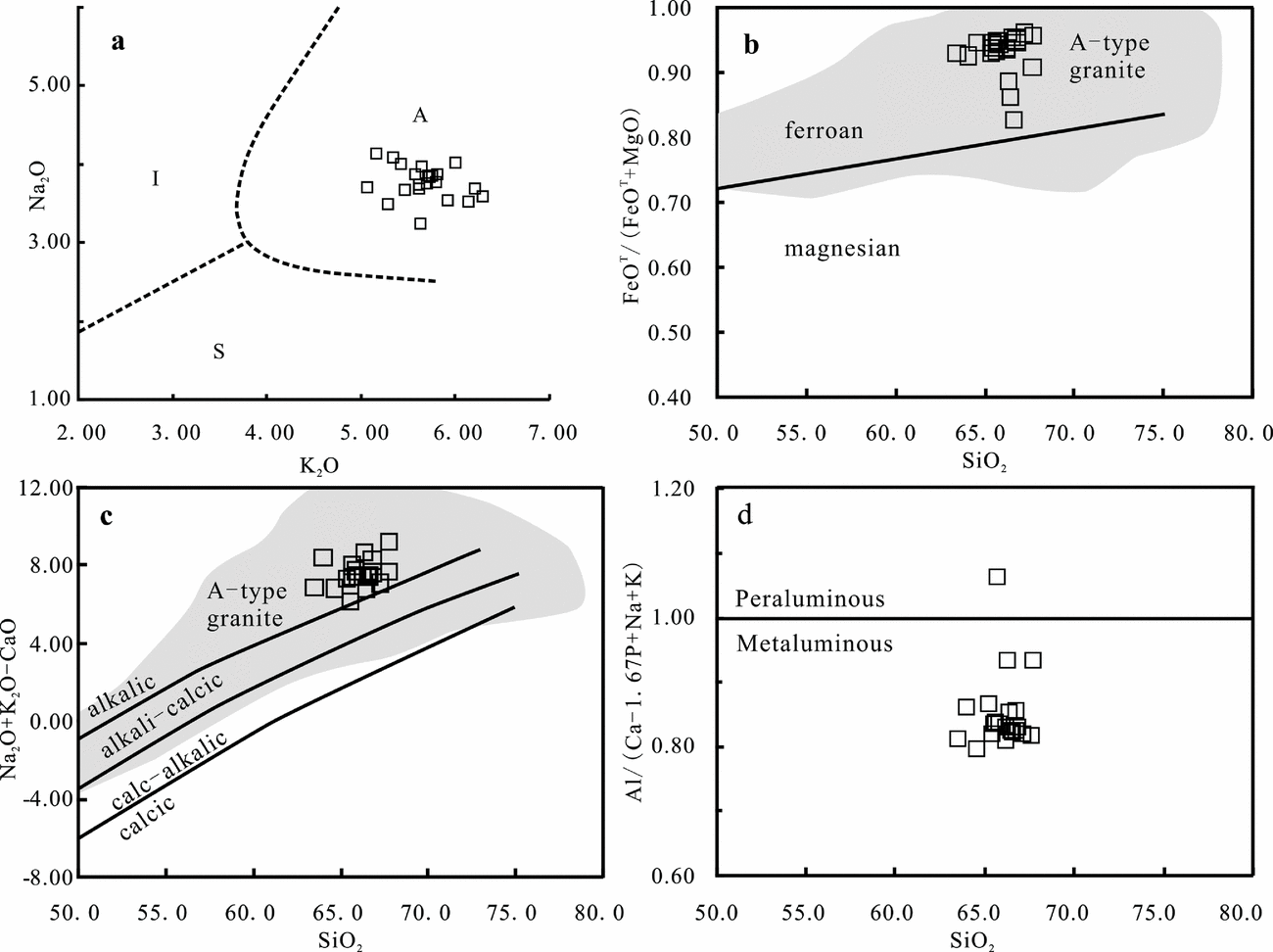
Samples from the Honggong pluton have higher Na2O + K2O (9.14–9.89 wt %; average = 9.54 wt %), FeOT/(FeOT + MgO) (0.89–0.96; average = 0.94), 10 000 Ga/Al (3.08–3.83; average = 3.41), HFSE, and Zr + Nb + Ce + Y (723–1024 ppm; average = 884 ppm) values, and lower CaO, Sr and Eu contents than typical I-type granites (Loiselle & Wones, Reference Loiselle and Wones1979; Collins et al. Reference Collins, Beams, White and Chappell1982; Whalen, Currie & Chappell, Reference Whalen, Currie and Chappell1987; King et al. Reference King, White, Chappell and Allen1997; Bonin, Reference Bonin2007). In major element diagrams for ferroan alkalic (A-type) granites such as Na2O versus K2O, FeOT/(FeOT + MgO) versus SiO2, Na2O + K2O versus SiO2, and Al/(Ca – 1.67P + K + Na) versus SiO2, data for all our samples fall in the ferroan alkalic (A-type) granite field (Fig. 9a–c) and are metaluminous (Fig. 9d) (Frost et al. Reference Frost, Barnes, Collins, Arculus, Ellis and Frost2001; Frost & Frost, Reference Frost and Frost2011). The presence of interstitial biotite is also consistent with an A-type character (Landenberger & Collins, Reference Landenberger and Collins1996; Bonin, Reference Bonin2007), and the aegirine in the Honggong pluton highlights its alkaline affinity.
Major element discrimination diagrams for A-type granites and the Honggong pluton. (a) K2O versus Na2O (Collins et al. Reference Collins, Beams, White and Chappell1982). (b) SiO2 versus FeOT/(FeOT + MgO) (Frost et al. Reference Frost, Barnes, Collins, Arculus, Ellis and Frost2001). (c) SiO2 versus Na2O + K2O–CaO. (d) Al/(Ca–1.67P + K + Na) versus SiO2 (Frost & Frost, Reference Frost and Frost2011) (including data (n = 10) from Lu et al. Reference Lu, Wang, Dong and Dong2006).

Zircon saturation temperatures (T Zr) calculated for the Honggong pluton range from 937 to 974 °C, with an average of 955 °C (Watson & Harrison, Reference Watson and Harrison1983), which are similar to other A-type granites (e.g. King et al. Reference King, Chappell, Allen and White2001; Yang et al. Reference Yang, Jiang, Zhao, Jiang, Ling and Luo2012; Zhao et al. Reference Zhao, Jiang, Yang, Dai and Lu2012, Reference Zhao, Jiang, Chen, Chen and Ling2013) but higher than those of typical I- and S-type granites (typically <800 °C; e.g. King et al. Reference King, White, Chappell and Allen1997; Clemens, Reference Clemens2003; Jung & Pfänder, Reference Jung and Pfänder2007; Jiang et al. Reference Jiang, Jiang, Dai, Liao, Zhao and Ling2009). The relatively high magmatic temperatures of the Honggong granites suggest that they were derived from a refractory or dry source.
In summary, mineralogical evidence and major and trace element data show that the Honggong pluton is a ferroan alkalic (A-type) granite.
5.b. Granite petrogenesis and source(s)
Ferroan alkalic (A-type) granites have been extensively studied since the term was introduced by Loiselle & Wones (Reference Loiselle and Wones1979), due to their unusual composition and tectonic settings (e.g. Collins et al. Reference Collins, Beams, White and Chappell1982; Whalen, Currie & Chappell, Reference Whalen, Currie and Chappell1987; Creaser, Price & Wormald, Reference Creaser, Price and Wormald1991; King et al. Reference King, White, Chappell and Allen1997; Bonin, Reference Bonin2007). Several petrogenetic models have been proposed for the origin of A-type granites, as follows: (1) fractional crystallization of alkaline basaltic magmas (Loiselle & Wones, Reference Loiselle and Wones1979; Turner, Foden & Morrison, Reference Turner, Foden and Morrison1992; Litvinovsky et al. 2002; Mushkin et al. Reference Mushkin, Navon, Halicz, Hartmann and Stein2003); (2) high-temperature partial melting of intracrustal tonalitic I-type granites (Creaser, Price & Wormald, Reference Creaser, Price and Wormald1991; King et al. Reference King, White, Chappell and Allen1997; Patino Douce, Reference Patino Douce1997); and (3) melting of mantle-derived tholeiitic basalts (Frost & Frost, Reference Frost and Frost1997). However, of these models, interaction of mantle-derived magma with crustal rocks and melting of deep continental crust are considered the most important (Rämö & Haapala, Reference Rämö and Haapala1995; Bonin, Reference Bonin and Demaiffe1996). Frost & Frost (Reference Frost and Frost2011) suggest that ferroan alkalic granites are products of extensive fractionation of basaltic melt.
Increasing numbers of studies have reported ferroan (A-type) granites with ages of 125–140 Ma in SE China, such as the Huangshitan (126 Ma) and Ruhong granites (129 Ma) (Li et al. Reference Li, Zhou, Mao, Santosh, Yu, Li, Hu, Langmuir, Chen, Cai and Hu2013), Yangmeiwan granite (135 Ma) and Daqiaowu granitic porphyry (133–136 Ma) (Yang et al. Reference Yang, Jiang, Zhao, Jiang, Ling and Luo2012), Damaoshan granite (122–126 Ma) (Jiang et al. Reference Jiang, Zhao, Zhou, Liao and Jin2011), Tongshan granite (129 Ma) (Jiang et al. Reference Jiang, Zhao, Zhou, Liao and Jin2011), Xiangshan volcanic–plutonic complex (135–137 Ma) (He et al. Reference He, Xu, Yu and Zou2009) and Baijuhuajian granite (126 Ma) (Wong et al. Reference Wong, Sun, Xing, Li, Zhao, Wong, Yuan, Xia, Li and Wu2009).
Li et al. (Reference Li, Zhou, Mao, Santosh, Yu, Li, Hu, Langmuir, Chen, Cai and Hu2013) proposed that the ferroan (A-type) granites in Zhejiang Province formed by partial melting, followed by fractional crystallization in the upper crust. Yang et al. (Reference Yang, Jiang, Zhao, Jiang, Ling and Luo2012) suggested that these granites were largely generated by partial melting of granulite-facies Mesoproterozoic metamorphic basement rocks and subsequent fractional crystallization. However, Yang et al. (Reference Yang, Jiang, Zhao, Jiang, Ling and Luo2012) emphasized the important role of mantle-derived materials in their petrogenesis. Similarly, Jiang et al. (Reference Jiang, Zhao, Zhou, Liao and Jin2011) proposed that upwelling of asthenospheric mantle triggered partial melting of both metasedimentary and metaigneous rocks. However, Wong et al. (Reference Wong, Sun, Xing, Li, Zhao, Wong, Yuan, Xia, Li and Wu2009) considered that a juvenile mantle component was the predominant magma source of the Baijuhuajian pluton.
Frost & Frost (Reference Frost and Frost2011) suggested that ferroan alkalic (A-type) granites are derived from differentiation of transitional or alkali basalts, which may have assimilated crustal materials. This view is supported by both trace element data and the isotopic compositions of the Honggong ferroan alkalic (A-type) granites. These rocks have low Y/Nb ratios (1.35–1.49) and high Zr contents, which also suggest that crustal material was an important component in the magma source. The εHf(t) zircon values and εNd(t) values of the Honggong granite vary from −15.1 to +2.7 (average = –5.2) and –5.7 to –8.0 (average = –6.0), respectively, indicating the input of juvenile, mantle-derived materials during magma generation. Geochemical data for Mesozoic granitoids along the coastal region of SE China suggest that mantle input was significant in the petrogenesis of these rocks (Jahn, Zhou & Li, Reference Jahn, Zhou and Li1990; Chen & Jahn, Reference Chen and Jahn1998). Whole-rock Sr–Nd isotopic data and zircon Hf isotopic compositions of the Honggong granite indicate that crustal contamination has occurred, and the Nd model age (1.52 Ga) is similar to those of other Mesozoic granites in SE China (Chen & Jahn, Reference Chen and Jahn1998; Chen et al. Reference Chen, Guo, Tang and Zhou1999 a). Thus, the ferroan alkalic (A-type) rocks of the Honggong pluton were probably derived via extensive crystal fractionation of a mixture of melts of Mesoproterozoic crustal components and the asthenospheric mantle.
5.c. Implications for the generation of A-type granites
As detailed above, the tectonic setting of Mesozoic intracontinental magmatism in southern China is debated (e.g. Qiu, Wang & Mcinnes, Reference Qiu, Wang and Mcinnes1999; Zhou & Li, Reference Zhou and Li2000; Li et al. Reference Li, Chen, Liu and Li2003; Wang et al. Reference Wang, Wyman, Xu, Zhao, Jian, Xiong, Bao, Li and Bai2006 a, b; Zhou et al. Reference Zhou, Sun, Shen, Shu and Niu2006; Li & Li, Reference Li and Li2007; He, Xu & Niu, Reference He, Xu and Niu2010; Wong et al. Reference Wong, Sun, Xing, Li, Zhao, Wong and Wu2011). The influence of the subduction of the palaeo-Pacific Plate is of particular importance in this regard (e.g. Chen, Lee & Shinjo, Reference Chen, Lee and Shinjo2008 a; Chen et al. Reference Chen, Lee, Lu and Hsieh2008 b). Most studies consider that late Mesozoic magmatism resulted from subduction of the palaeo-Pacific oceanic crust and subsequent slab break-off or intracontinental extension, and both scenarios involved a contribution from mantle-derived magmas (Zhou & Li, Reference Zhou and Li2000; Zhou et al. Reference Zhou, Sun, Shen, Shu and Niu2006; Li & Li, Reference Li and Li2007; Li et al. Reference Li, Li, Li, Liu, Yuan, Wei and Qi2007; Chen, Lee & Shinjo, Reference Chen, Lee and Shinjo2008 a; Chen et al. Reference Chen, Lee, Lu and Hsieh2008 b; Guo et al. Reference Guo, Fan, Li, Zhao, Li and Yang2012; Liu et al. Reference Liu, Li, He and Huang2010a ).
Ferroan (A-type) granites form in extensional tectonic environments (Whalen, Currie & Chappell, Reference Whalen, Currie and Chappell1987; Eby, Reference Eby1992; Turner, Foden & Morrison, Reference Turner, Foden and Morrison1992). Geochronological data show that the ferroan (A-type) granites in southern China have five age groupings at 235–225, 190, 165–155, 100–90 and 140–120 Ma (Fig. 1). The granites that formed at 235–225 Ma are not extensive and are located mainly in southern inland areas, such as the Caijiang (232 Ma) and Gaoxi (229 Ma) (Zhao et al. Reference Zhao, Jiang, Chen, Chen and Ling2013), Dashuang (Gao et al. Reference Gao, Wang, Song, Wang and Li2014), Wengshan (224 Ma) (Sun et al. Reference Sun, Zhang, Ling, Ding, Chung, Zhou, Yang and Fan2011 a), and Dayinchang (237 Ma) (Wang et al. Reference Wang, Sun, Chen, Ling and Xiang2013) plutons. These plutons formed in response to localized extension associated with subduction of the palaeo-Pacific Plate or collision between the Indochina and South China blocks. The Wengong pluton in Guangdong Province is the only ferroan (A-type) granite that formed at 190 Ma, and is an expression of anorogenic magmatism driven by the onset of asthenospheric mantle upwelling triggered by the break-up of a subducted slab beneath SE continental China (Zhu et al. Reference Zhu, Zhong, Li, He, Song, Ren, Chen, Sun and Liao2010). The granites that formed at 165–155 Ma are distributed in the southern inland area of Nanjing in an E–W-trending magmatic belt related to continental extension (Li, Watanabe & Yonezu, Reference Li, Watanabe and Yonezu2014; Wang et al. Reference Wang, Xu, Zhao, Song and Kynicky2015). The granites that formed at 100–90 Ma mainly crop out along the coastal area in eastern Zhejiang and Fujian provinces, suggesting they were related to the peak of back-arc extension in SE China (Yang et al. Reference Yang, Jiang, Zhao, Jiang, Ling and Luo2012). Magmatism at 140–120 Ma is restricted to rare occurrences along the Yangtze River (Sun et al. 2007, Reference Sun, Zhang, Ling, Ding, Chung, Zhou, Yang and Fan2011 b; Li et al. Reference Li, Ling, Li, Zhang, Ding, Yang, Fan, Li and Sun2012). Sun et al. (2007, Reference Sun, Zhang, Ling, Ding, Chung, Zhou, Yang and Fan2011 b) suggested that a change in the subduction orientation of the Pacific Plate and subduction of an ocean ridge influenced the lower reaches of the Yangtze River region at this time.
Recent studies have reported occurrences of ferroan (A-type) granites in Zhejiang Province. Li et al. (Reference Li, Zhou, Mao, Santosh, Yu, Li, Hu, Langmuir, Chen, Cai and Hu2013) proposed that these granites formed in a post-orogenic setting during the Early Cretaceous (145–120 Ma). At this time, lithospheric thinning and continental extension accompanied by slab rollback of the palaeo-Pacific Plate took place after earlier subduction and collision. However, Yang et al. (Reference Yang, Jiang, Zhao, Jiang, Ling and Luo2012) suggested that these granitic rocks in Zhejiang Province signify an important Mesozoic extensional event in SE China, which represents either back-arc extension or an intra-arc rift due to rollback of the palaeo-Pacific Plate. Jiang et al. (Reference Jiang, Zhao, Zhou, Liao and Jin2011) considered that crustal thinning formed the ferroan (A-type) granitic magmas in areas that experienced the greatest back-arc extension. Wong et al. (Reference Wong, Sun, Xing, Li, Zhao, Wong, Yuan, Xia, Li and Wu2009) also emphasized the role of localized extension driven by rollback of the Pacific Plate. In summary, all lines of evidence show that this magmatism was linked to local extension produced by rollback of the Pacific Plate.
Based on the age of the Baijuhuajian pluton, Wong et al. (Reference Wong, Sun, Xing, Li, Zhao, Wong, Yuan, Xia, Li and Wu2009) suggested that extension in SE China could have started as early as c. 125 Ma. However, our dating of the Honggong pluton suggests that extension in SW Zhejiang Province began as early as 138 Ma and continued to 126 Ma, which indicates a significant Early Cretaceous extensional event triggered by localized rollback of the Pacific Plate.
6. Conclusions
Our geochemical and geochronological study of the Honggong pluton in SW Zhejiang Province, SE China, has yielded the following conclusions.
(1) LA-ICP-MS U–Pb zircon dates of 138.7 ± 0.8, 134.2 ± 1.1, 128.5 ± 1.5 and 126.1 ± 0.9 Ma become progressively younger from the marginal to central facies of the pluton.
(2) The Honggong pluton has an obvious ferroan alkalic (A-type) geochemical signature in terms of major and trace element data.
(3) εHf(t) zircon and εNd(t) values of the Honggong pluton vary from −15.1 to +2.7 and –5.7 to –8.0, respectively, highlighting the input of juvenile material into the magma source and variable contributions of crustal components. We propose that the Honggong pluton was derived by extensive crystal fractionation of melts derived from both Mesoproterozoic crustal components and the asthenospheric mantle.
(4) The rare ferroan (A-type) granites in southern China were emplaced in five stages at 235–225, 190, 165–155, 100–90, and 140–120 Ma. The age of the Honggong pluton suggests that extension in southwestern Zhejiang Province began at 138 Ma and continued until 126 Ma. This provides strong evidence for Early Cretaceous extension related to localized rollback of the Pacific Plate.
Acknowledgements
This work was supported by funded projects of the China Geological Survey (Nos 121201008000150002 and 12120113070800).