


1. INTRODUCTION
The advance of attosecond physics has provided a remarkable approach for investigating ultrafast processes with unprecedented accuracy and resolution (Drescher et al., Reference Drescher, Hentschel, Kienberger, Uiberacker, Yakovlev, Scrinzi, Westerwalbesloh, Kleineberg, Heinzmann and Krausz2002; Varro & Farkas, Reference Varro and Farkas2008; Baeva et al., Reference Baeva, Gordienko and Pukhov2007). High-order harmonic generation (HHG) has shown itself to be the most promising method for the production of attosecond pulses, by interaction between an intense laser pulse and atomic or molecular system (Dombi et al., Reference Dombi, Racz and Bodi2009; Dromey et al., Reference Dromey, Bellei, Carroll, Clarke, Green, Kar, Kneip, Markey, Nagel, Willingale, McKenna, Neely, Najmudin, Krushelnick, Norreys and Zepf2009; Gupta et al., Reference Gupta, Sharma and Mahmoud2007; Hafeez et al., Reference Hafeez, Shaikh and Baig2008; Ozaki et al., Reference Ozaki, Bom, Ganeev, Kieffer, Suzuki and Kuroda2007; Sharma & Sharma, Reference Sharma and Sharma2009; Verma & Sharma, Reference Verma and Sharma2009; Zeng et al., Reference Zeng, Cheng, Song, Li and Xu2007, Zheng et al., Reference Zheng, Zeng, Li, Chen, Liu, Xiong, Lu, Zhao, Wei, Zhang, Wang, Liu, Cheng, Li. and Xu.2008; Zhang et al., Reference Zhang, Lu, Hong, Liao, Lan and Wang2009; Hong et al., Reference Hong, Lu, Li and Zhang2009). Although HHG from ions (Teubner & Gibbon, Reference Teubner and Gibbon2009; Krausz & Ivanov, Reference Krausz and Ivanov2009) can be more efficient due to the higher laser intensity (above 1015–1016 W/cm2) being applicable, the phase matching condition of harmonic generation is difficult to achieve due to the presence of strong plasma. According to the well-known semiclassical theory, a HHG process in gas mainly includes three steps (Corkum, Reference Corkum1993): electrons are tunnel ionized near the peak of the laser field, then excurse in the oscillating field until being driven back when the field reverses the direction, and finally it recombines with its parent ion and releases the energy by emitting an energetic photon. Through waveform control, many techniques have been developed to produce an ultrabroad extreme ultraviolet (XUV) supercontinuum, which ultimately can support an ultrashort pulse. With a phase-stabilized few-cycle driving pulse (Hentschel et al., Reference Hentschel, Kienberger, Spielmann, Reider, Milosevic, Brabec, Corkum, Heinzmann, Drescher and Krausz2001; Kienberger et al., Reference Kienberger, Goulielmakis, Uiberacker, Baltuska, Yakovlev, Bammer, Scrinzi, Westerwalbesloh, Kleineberg, Heinzmann, Drescher and Krausz2004), quantum path control has been achieved by reducing periodical HHG process to ones for generating an isolated attosecond pulse. Polarization gating technique (Ivanov et al., Reference Ivanov, Corkum, Zuo and Bandrauk1995; Sansone et al., Reference Sansone, Benedetti, Calegari, Vozzi, Avaldi, Flammini, Poletto, Villoresi, Altucci, Velotta, Stagira, De Silvestri and Nisoli2006) has successfully controlled the HHG within a half-cycle of laser field and produces an isolated attosecond pulse based on the recombination process depending sensitively on polarization state. Many efforts have been made to investigate the two-color field scheme experimentally (Liu et al., Reference Liu, Kanai, Sekikawa and Watanabe2006; Mansten et al., Reference Mansten, Dahlström, Johnsson, Swoboda, L’Huillier and Mauritsson2008) as well as theoretically (Pfeifer et al., Reference Pfeifer, Gallmann, Abel, Neumark and Leone2006; Zeng et al., Reference Zeng, Cheng, Song, Li and Xu2007), enhancing the HHG intensity or broadening the bandwidth of the XUV supercontinuum.
In the HHG process, electrons can be tunnel ionized by the interaction of an intense few-cycle 800 nm pulse and atomic or molecular gas, which achieve considerable kinetic energies after traveling freely in the oscillating light field (Corkum, Reference Corkum1993). Most of them, however, cannot be driven back toward its parent ions for contributing to the generation of high-order high harmonic but fails to make full use of the high ionization rate. If the longer wavelength pulse is employed alone for harmonic emission, the HHG cut-off energy can be improved while the harmonic yield is reduced greatly owing to the enhanced electron wave packet spreading (Tate et al., Reference Tate, Auguste, Muller, Salières, Agostini and DiMauro2007). In this paper, we aim at synthesizing a favorable two-color optical waveform that is composed of an intense leading half-cycle of an 800 nm laser pulse for sufficient tunnel ionization, and a relatively weaker trailing half-cycle of a 2400 nm laser pulse serving as the reverse field for driving back more high-energy electrons than a monochromatic 800 nm waveform does. Numerical simulation proves that the novel waveform not only extends the harmonic cut-off energy but also enhances the conversion efficiency significantly. It is worth noting that a dramatic improvement of cut-off energy can also be achieved when multi-cycle laser pulses at the 800 nm and 2400 nm are employed to synthesize the two-color field, however, in such a case, single attosecond pulse cannot be generated. Therefore, in this work, both the durations for the pulses at 800 nm and 2400 nm wavelengths are restricted to a half-cycle optical period in order to facilitate the single attosecond pulse generation and simplify the analysis as well. It should be noted that laser pulses with sub-half-cycle structures can also find applications in laser acceleration, as has been discussed before (Cheng & Xu, Reference Cheng and Xu1999).
2. THEORETICAL MODEL
In our simulation, a 1.2 fs, 800 nm fundamental pulse and a 4 fs, 2400 nm subharmonic pulse are chosen for synthesizing the driving pulse, which intensities are 3.5 × 10¹⁴ W/cm2 and 1.7 × 10¹⁴ W/cm2, respectively. With these intensities, the above-mentioned half-cycle pulses at 800 nm and 2400 nm wavelengths will ionize argon at the ionization rates of 5% and 0.5%, respectively. The method of our simulation for HHG is based on the single-atom response calculated by the strong field approximation (Lewenstein et al., Reference Lewenstein, Balcou, Ivanov, L’Huillier and Corkum1994; Priori et al., Reference Priori, Cerullo, Nisoli, Stagira, De Silvestri, Villoresi, Poletto, Ceccherini, Altucci, Bruzzese and De Lisio2000). The description of half-cycle pulses is employed as indicated in Lin et al. (Reference Lin, Zheng and Becker2006), and the synthesized two-color field can be expressed as follow,
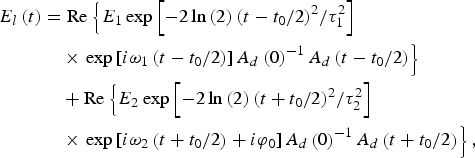
where

Here E 1 and E 2 are the amplitudes of electric fields of the fundamental and the subharmonic pulses, respectively; ω1 and ω2 are the frequency of corresponding pulse; τ1 and τ2 are the temporal durations (full width at half maximum) of corresponding pulses; and t 0 = −2.67 fs (same with the period of 800 nm wave) and φ0 = π define the relative delay between the two pulses and the carrier-envelope phase, respectively. The electric fields of the above two pulses and the two-color pulse are shows in Figure 1. For comparison, a single-color 2 fs, 800 nm wave with the same delay is shown as well, which intensity is 5 × 10¹⁴ W/cm2. We attempt to reveal how the difference between the recombination half-cycles of the 2 fs single-color and the synthesized two-color will influence the HHG processes and the corresponding spectra.
(Color online) Electric fields of the synthesized two-color pulse with a time delay 2.67 fs (solid line), 1.2 fs, 800 nm pulse (dashed line), 4 fs, 2400 nm pulse (dotted line), and 2 fs, 800 nm pulse (dot-dashed line).

The strong field approximation has been shown to provide a good qualitative agreement with the numerical solution of the Schrödinger equation. The nonlinear dipole moment can be written as
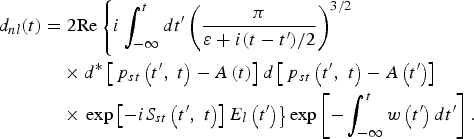
Here, E l(t) is the electric field of the laser pulse, A(t) is its associated vector potential, ɛ is a positive regularization constant, p st and S st are the stationary values of the momentum and quasiclassical action, and d is the dipole matrix element for bound-free transitions, shown as follows,


where w(t′) is the tunnel field ionization rate calculated by the Ammosov-Delone-Krainov theory (Ammosov et al., Reference Ammosov, Deone and Krainov1986).
3. RESULTS AND DISCUSSION
As shown in Figure 2, the 2 fs, 800 nm pulse (dot-dashed line) leads to a HHG spectrum with the cut-off energy 95 eV. When it comes to the synthesized two-color field (solid line), as we have expected, a HHG spectrum with much broader XUV supercontinuum is generated, corresponding to cut-off energy 225 eV. Owing to the high intensity in the leading half-cycle, electrons are first extracted near the peak of electric field, and then pulled away from the parent ion. Later, in the relatively weak laser field with an opposite direction formed by the 2400 nm pulse, most of the electrons ionized by the first half-cycle are driven back and recombine with its parent ion for emitting high-order harmonic photons. Accordingly, prolonging the electron excursion time can result in two major benefits: first, the cut-off energy is extended dramatically; second, due to the fact that more extracted electrons can be driven back to recombine with the parent ion, the conversion efficiency of harmonic field for synthesized waveform is nearly one order of magnitude stronger in the energy range from 50 eV to 95 eV than that for 2 fs, 800 nm waveform, which will be a remarkable advantage for application. As for 2400 nm pulse (dotted line), the HHG cut-off energy is high while the conversion efficiency is too low to be acquired.
(Color online) Spectra of the XUV supercontinua generated with the synthesized two-color pulse (solid line), 2 fs, 800 nm pulse (dot-dashed line) and 4 fs, 2400 nm pulse (dotted line).

To reveal the physics underlying HHG in the synthesized waveform, we perform the classical electron trajectory by the three-step model to investigate the electron kinetic energy as functions of ionization and recombination times, as shown in Figure 3. Furthermore, in Figure 4, we compare the time-frequency analysis of the XUV spectra generated in the two-color pulse and that of the single-color 2 fs, 800 nm field. From Figure 4 one can obtain the emission time and cut-off energy of high-order harmonic and whether the long trajectory or short trajectory contributes more significantly for HHG. As for 800 nm waveform in Figure 4b, electrons tunnel ionized around time t 1 (indicated in Fig. 1) are driven back to its parent ion in the −0.27T for the emission of high-energy harmonic up to 95 eV at peak A, leading to the high cut-off energy. On the other hand, in the next half-cycle, more electrons are ionized around time t 3 (Fig. 1) due to the stronger strength of the electric field, whereas most of which are driven away from its parent ion and never come back due to the insufficient strength of the reversed electron field in the next half-cycle. The kinetic energy of the recombination election at peak B is only about 36 eV. To overcome this limitation of the weak reverse electron field in a single-color few-cycle pulse with a cosine-waveform and make the best use of the electrons ionized at the peak of the strongest half-cycle, the waveform controlled two-color field can be employed. As one can clearly see, in the synthesized waveform as shown in Figure 4a, much more electrons ionized from the peak of leading half-cycle wave with higher intensity, i.e., around time t 2 (Fig. 1), are driven back to recombine with its parent ion by the reverse electron field in the longer half period and release its energy for emitting the high-energy photons at nearly 225 eV around peak B. Electrons extracted in the half-cycle around time t 4 (Fig. 1) are driven back within the next half-cycle as well, however, they do not lead to high photon energy at the recombination time around peak C. It should also be noticed that, for the two arms of the XUV radiation in peak B in Figure 4a, the arm corresponding to the short trajectory is more intense than another arm corresponding to the long trajectory by at least one order of magnitude. That is why the interference between the two trajectories is not obvious and little modulation appears in the spectrum of the XUV supercontinuum for the two-color situation.
(Color online) The classical electron energy as functions of ionization (●) and recombination (○) times in (a) the two-color laser field, and (b) the single-color 2 fs, 800 nm field.

(Color online) Time-frequency diagrams of HHG in (a) the two-color laser field, and (b) the single-color 2 fs, 800 nm field.

It is possible to produce an isolated attosecond pulse with the XUV supercontinuum by blocking the low-order harmonics. Figure 5 shows the temporal profiles of the attosecond pulses by performing inverse Fourier transforms of the XUV supercontinua generated with both two-color and single-color driving pulses. The photons with energy less than 50 eV are blocked for both cases. The emission time of high-order harmonics is identified with the above time-frequency analysis. One can see that the intensity of attosecond pulse for two-color waveform is almost four times stronger than that for the single-color waveform without any phase compensation. If the phase dispersion is properly compensated for, an isolated 31as pulse will be generated in two-color field, whose pulse duration is significantly shorter than the attosecond pulse generated in sing-color field.
Temporal profiles of the attosecond pulses generated by Fourier syntheses of the harmonics of (a) in the two-color laser field from the spectral ranges of 50 eV–225 eV without (solid line) and with phase compensation (dotted line), and (b) in the single-color 2 fs field from the spectral range of 50 eV–95 eV without (solid line) and with phase compensation (dotted line).

4. CONCLUSION
To summarize, we theoretically investigate the HHG emitting via a novel waveform, which consists of a fundamental wave as the leading half-cycle and a subharmonic wave as the trailing half-cycle. In comparison with the single-color field, both a significant extension of the cut-off energy and an enhancement of harmonic emission are achieved in the synthesized two-color field. That is because the trailing half-cycle contributed by 2400 nm wave is able to pull back most of the high-energy electrons ionized during the leading half-cycle for HHG. In addition, the isolated attosecond pulse can be obtained from the broadband XUV supercontinuum, whose intensity is almost four times stronger than that produced by the single-color 800 nm field, without any phase compensation.
ACKNOWLEDGMENTS
The authors thank Professor Ya Cheng for stimulating discussion and Professor Zhinan Zeng for his kind assistance in simulation. This work was supported by the National Basic Research Program of China (Grant No. 2006CB806000) and National Natural Science Foundation of China (No. 10804116).



