INTRODUCTION
Orangutans (family Pongidae) represent the only great ape in Asia. The 2 existing species inhabit the islands Borneo (Pongo pygmaeus) and Sumatra (Pongo abelii) in Indonesia and Malaysia (Rijksen and Meijaard, Reference Rijksen, Meijaard, Rijksen and Meijaard1999). Due to human activities such as logging and hunting, total population numbers are rapidly decreasing. In 1997, the population of Bornean orangutans was estimated to be down to 7% of the population in 1900 (Rijksen and Meijaard, Reference Rijksen, Meijaard, Rijksen and Meijaard1999), and the species is classified as endangered by the IUCN (2010). Re-introduction programmes in Borneo aim at releasing confiscated orangutans into protected forest habitats. These programmes rely on re-introduction centres where large numbers of individuals are kept over several years. The health of orangutans is affected by a wide variety of intestinal parasites among which nematodes of the genus Strongyloides are of major importance. Infections can be fatal and may represent a major cause of death in captive individuals (Warren, Reference Warren2001). Especially young orangutans are considered to be susceptible to developing strongyloidosis (Wells et al. Reference Wells, Sargeant, Andrews, Anderson and Wells1990), and prevalences in these individuals are high (e.g. 54% in rehabilitating orangutans ⩽5years of age; Labes et al. 2010). Strongyloides has also been reported from wild orangutan populations (Collet et al. Reference Collet, Galdikas, Sugarjito and Jojosudharmo1986; Djojoasmoro and Purnomo, Reference Djojoasmoro and Purnomo1998; Warren, Reference Warren2001) but only few data exist on the occurrence and distribution of Strongyloides species or subspecies in these apes. Of the more than 50 species of Strongyloides that have been described so far (Grove, Reference Grove and Grove1989; Dorris et al. Reference Dorris, Viney and Blaxter2002) and which parasitize a wide range of vertebrate hosts, 2 species are of particular importance to humans and non-human primates. Strongyloides stercoralis is primarily a human parasite in the southern hemisphere (Fisher et al. Reference Fisher, McCarry and Currie1993; Gilles and Cook, Reference Gilles, Cook and Cook1996) but infections have occasionally also been described in non-human primates (Grove and Northern, Reference Grove and Northern1982; Genta, Reference Genta1989) causing severe disease or death. Examples include a young orangutan in an English zoo, fatal infections in 2 Bornean orangutans, and 1 rhesus macaque at a US Primate Research Centre (see Grove, Reference Grove and Grove1989). Strongyloides fuelleborni occurs naturally in non-human primates but is widespread also in human populations in Africa and Southeast Asia (Nolan et al. Reference Nolan, Genta, Schad, Palmer, Soulsby and Simpson1998; Viney, Reference Viney2006; Viney and Lok, Reference Viney, Lok, Viney and Lok2007). Two subspecies have so far been described morphologically. Strongyloides f. fuelleborni mainly occurs in African primates and humans. Strongyloides f. kellyi was identified in Papua New Guinea with a high prevalence, especially in infants without an obvious non-human primate source (Ashford et al. Reference Ashford, Barnish and Viney1992). However, molecular phylogenetic analysis did not support the status of a subspecies (Dorris et al. Reference Dorris, Viney and Blaxter2002).
Several cross-species transmission experiments have confirmed the zoonotic character of S. f. fuelleborni which included several monkey species, humans and also dogs (reviewed by Grove, Reference Grove and Grove1989). Both species have also been identified under natural conditions in humans in Zambia with prevalences of 67% for S. stercoralis and 30·8% for S. fuelleborni (Hira and Patel, Reference Hira and Patel1980).
Identification of Strongyloides is based on morphological criteria of the adult female and the fact that either first-stage larvae (S. stercoralis) or eggs (S. fuelleborni) are excreted with the feces (Little, Reference Little1966). Although specific morphological and morphometric characters, particularly in the parasitic female, seem to be robust, strain variation, within-population variability, variation according to age, environmental conditions, host or geographical origin may have an effect on the unequivocal identification of species (effect of intra- and interspecific variability and/or of external factors, respectively) (Grove, Reference Grove and Grove1989). Through molecular analysis, additional (sub-)species of Strongyloides might be identified in orangutans since these methods offer much more in-depth investigation.
The aim of this study was therefore to genetically characterize Strongyloides infecting wild and captive/semi-captive Bornean orangutans in order to get insight into the occurrence and distribution of these nematodes in the ape which might offer valuable clues as how to protect these endangered animals, as well as humans, from infections.
MATERIALS AND METHODS
Examined individuals
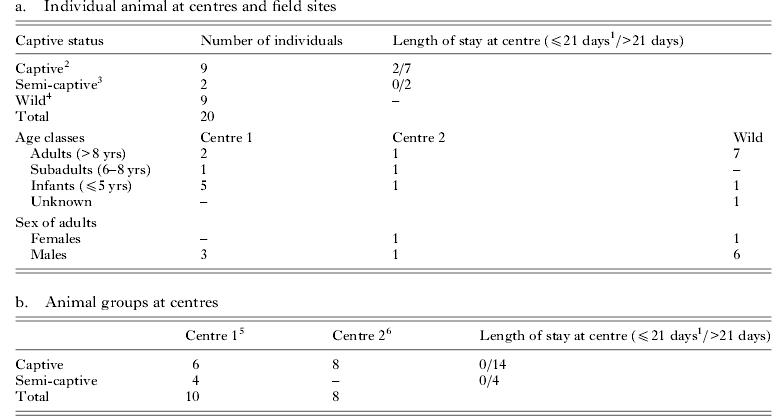
Fecal samples from 20 individual Bornean orangutans and from 18 groups (2–28 individuals per group, total n=97) were investigated (Table 1). Between 1 and 3 samples per individual or group were examined. In addition, a Strongyloides isolate from a person working at one of the field-sites was investigated.
Features of the orangutan cohorts investigated

1 “new arrival”;
2 confiscated, mostly young individuals;
3 wild, mostly adult individuals rescued from oil-palm plantations;
4 free-ranging populations at 3 field sites in the province of Central Kalimantan;
5 orangutan re-introduction centre in Central-Kalimantan;
6 orangutan re-introduction centre in East-Kalimantan.
Study sites
One of the 2 re-introduction centres (centre 1) is located 28 km north of Palangka Raya (2°21′56·27″S, 113°55′12·48″E), the capital of the province Central Kalimantan. The centre neighbours a 62·5 ha lowland swamp forest. The second re-introduction centre (centre 2) is located in the centre of a village, 35 km north of the city Balikpapan (1°16′01·03″S, 116°50′01·46″E) in the province East Kalimantan, Borneo. Samples from free-ranging (wild) orangutans were collected from 3 distinct populations in the province of Central Kalimantan (2°09′06·1″S, 114°26′26·3″E; 2°19′40·72″S, 113°54′39·74″E). All 3 field sites consisted of disturbed forest habitat which had previously been subject to selective logging. Because of their different geographical location, the majority of orangutans at centre 1 belonged to the subspecies P. pygmaeus wurmbii, whereas centre 2 had more individuals belonging to the subspecies P. pygmaeus morio. The 3 field sites were inhabited by P. pygmaeus wurmbii.
Collection of larvae
Strongyloides larvae were isolated from fecal material with the Baermann technique. Larvae were identified microscopically to genus level based on the morphological characteristics of either the first- or third-stage larvae (L1: 316·6±104·1×18·3±10·4 μm, rhabditiform oesophagus, short buccal capsule, genital primordium in posterior half of total length; L3: 566·7±57·7×26·7±5·8 μm, filariform oesophagus, slit tail). Isolated larvae were conserved in 75–95% (v/v) ethanol in 1·5 ml centrifuge tubes.
DNA extraction from isolated larvae
After centrifugation of the larvae for 5 min at 5000 g, the supernatant was removed and 200 μl of 50% (w/v) Chelex (Bio-Rad Laboratories, Reinach, Switzerland) were added per tube. The tubes were vortexed and larval cells were lysed by 4 cycles of freezing/thawing (liquid nitrogen for several sec and boiling in 100°C heater for 1 min). The tubes were centrifuged at 13 000 g for 2 min, and the supernatant containing the DNA was transferred into new 1·5 ml centrifuge tubes. Genomic DNA was isolated using a commercial kit according to the manufacturer's instructions (Qiamp DNA mini kit, Qiagen, Hilden, Germany) and were stored at −20°C until PCR was performed.
Amplification, sequencing and sequence analysis
Parts of the 18S rRNA gene were amplified by PCR using primers StrongF (5′-ATTGATAGCTCTTTCATGATTTAG-3′) and StrongR (5′-AACAGGAACATAATGATCACTAC-3′) which were designed to be specific for the genus Strongyloides and which span a variable region. Amplification of the rDNA internal transcribed spacer 1 (ITS1) was done with primers ITS1-F and 5.8S-R as described (Sato et al. 2006). PCRs were done in 100 μl assays containing 5 μl of template DNA sample, buffer (50 mm KCl, 20 mm Tris-HCl, pH 8·4, 2·5 mm MgCl2, 0·5% (v/v) Tween 20), each deoxynucleoside triphosphate at a concentration of 0·2 mm (with dUTP replacing dTTP) (all reagents from Sigma-Aldrich, Buchs, Switzerland) and each primer at a concentration of 1 μ m. In order to prevent PCR carry-over contamination, 0·5 U of uracil DNA glycosylase (Longo et al. Reference Longo, Berninger and Hartley1990) was also included in the reactions, aerosol-guarded tips were consistently used, and DNA isolation, PCR and amplicon analyses were performed in strictly separated laboratories. An initial step at 37°C for 10 min was performed in an automatic thermal cycler (DNA engine, MJ Research, Waltham, MA, USA) and after 10 min of heat inactivation of the uracil DNA glycosylase, 2·5 U of Taq polymerase were added in a hot start. Each PCR cycle of 40 in total consisted of denaturation for 30 sec at 94°C, annealing for 30 sec at 58°C, and elongation for 30 sec at 72°C. Amplicons were detected in 1·5% (w/v) agarose gel, following staining with ethidium bromide. Sequencing was carried out by a private company (Synergene Biotech, Schlieren, Switzerland) either directly or on the cloned (Topo TA cloning-vector pCR 2.1, Invitrogen, Carlsbad, CA, USA) amplicons. DNA isolation, PCRs and sequencing were done once per specimen.
Sequences were aligned using ClustalW, and neighbour-joining trees were constructed using MEGA version 4 (Tamura et al. Reference Tamura, Dudley, Nei and Kumar2007) with the gap opening penalty set to 10 and the gap extension penalty to 3.
RESULTS
From a total of 30 Strongyloides isolates, part of the 18S rRNA gene was determined by PCR/direct sequencing (sequence reads between 134 and 400 bp). With 1 exception from centre 1, all sequences originating from 9 captive, 2 semi-captive and 9 wild orangutans as well as the one derived from a human clustered with a published sequence of S. fuelleborni fuelleborni (GenBank AB272235), originating from a Japanese macaque (Macaca fuscata fuscata), with sequence identities between 98·5% and 100%. The sequences differed by 5–7% from the corresponding published sequences of S. procyonis, S. robustus, S. callosciureus, S. cebus, S. stercoralis and S. ratti. A single isolate (no. 9), originating from a captive orangutan, which had arrived at the centre 1 week prior to sample collection, had a sequence identical to an available one of S. stercoralis (AF279916).
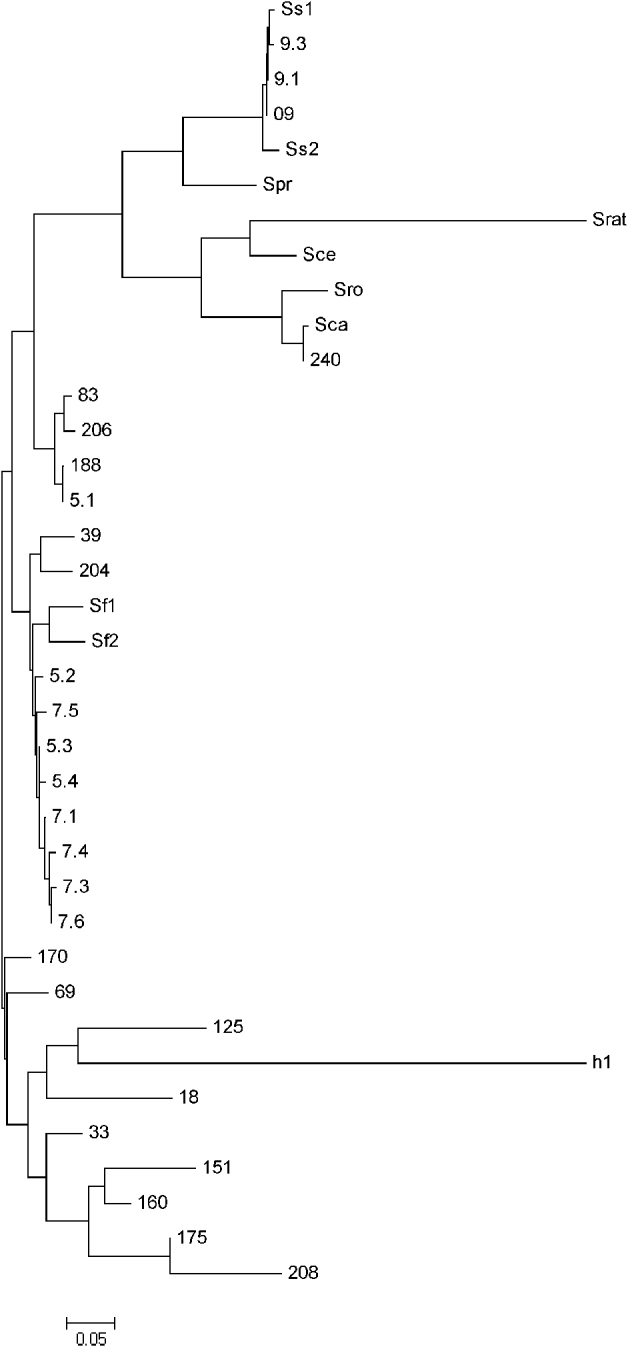
PCR spanning the rDNA ITS1 region was successful, with 19 Strongyloides isolates derived from orangutans (male and female captive, semi-captive animals, kept at both centres either individually or in groups, and wild) and from 1 human. Direct sequence reads between 157 and 387 bp were obtained from 17 isolates; the sequences of isolate nos. 5 and 7 could only be determined after cloning. ITS1 sequences of the 18 isolates that were assigned to S. fuelleborni fuelleborni based on partial 18S rRNA gene sequences, including the isolate from the human, were highly variable, being 81–98% identical with the corresponding sequences of this species deposited in GenBank (U43581, AB272235) (Fig. 1). Furthermore, the 4 sequences determined from cloned amplicons of isolate no. 5 (designated 5·1–5·4 in Fig. 1) displayed variability at 17 polymorphic sites, and 4 of the 5 sequenced clones of isolate no. 7 revealed unique sequences. Direct sequencing of the amplicon of isolate no. 9 (S. stercoralis) revealed 99% identity (2 polymorphic sites from total 203) as compared with GenBank entries U43576, U43578 and U43579. This amplicon was also cloned, and 4 of the 5 sequences were identical to the direct sequence, whereas the 5th sequence (9·3, Fig. 1) differed at a single polymorphic site.
Dendrogram of rDNA ITS1 sequences of Strongyloides spp. Numbers: directly sequenced amplicons of isolates from Bornean orangutans, decimal numbers: sequences of cloned amplicons; h1: directly sequenced amplicon from an isolate from a human. Isolates 5 and 7 could not directly be sequenced; the 4 sequences obtained from the cloned amplicon of isolate no. 5 (5·1–5·4) all had unique sequences; the 6 sequences of isolate no. 7 revealed 5 different sequences. The amplicon of isolate 9 could directly be sequenced, and 4 of 5 sequences of the cloned amplicon were identical to this directly obtained sequence (the sixth one differing at a single polymorphic site). Published sequences (GenBank) include S. fuelleborni fuelleborni (Sf1) (AB272235, from captive Macata f. fuscata from Japan), S. fuelleborni fuelleborni (Sf2) (U43581, undisclosed origin); S. stercoralis (Ss1) (U43576, U43578; U43579; identical sequences from isolates from East Asia, Caribbean, USA); S. stercoralis (Ss2) (U43962, USA); S. callosciureus (Sca) (AB272230), S. cebus (Sce) (AB272236), S. robustus (Sro) (AB272232), S. procyonis (Spr) (AB205054). Nucleotide sequence data reported in this paper are available in the GenBank™ under accession numbers JF699139 - JF699167.

DISCUSSION
In this study, primers specifically designed to cover variable regions of the 18S rRNA gene of the genus Strongyloides and primers amplifying the ITS1 locus combined with sequencing (either directly or after cloning) were used to identify Strongyloides spp. aiming at providing more information on the presence of these nematodes in Bornean orangutans under natural and husbandry conditions. The chosen genetic locus contains both slow and fast evolving regions (Baldwin, Reference Baldwin1992; Sato et al. Reference Sato, Torii, Une and Ooi2007) providing useful genetic markers for the identification and characterization of Strongyloides (Ramachandran et al. Reference Ramachandran, Gam and Neva1997; Fisher and Viney, Reference Fisher and Viney1998; Dorris et al. Reference Dorris, Viney and Blaxter2002; Sato et al. Reference Sato, Torii, Une and Ooi2007; Hasegawa et al. Reference Hasegawa, Hayashida, Ikeda and Sato2009).
To our knowledge, this study provides the first molecular data on infections with S. f. fuelleborni and S. stercoralis in Bornean orangutans. One isolate identified as S. f. fuelleborni originated from a person working at one of the field sites, indicating that wild Bornean orangutans serve as carriers for S. f. fuelleborni and that this parasite has a zoonotic potential. In fact, infections with S. f. fuelleborni in humans in Borneo might be more common than expected. Further, since the majority of captive individuals in this study had been living at the centres for 3 weeks up to several years, S. f. fuelleborni could have established stable populations within these centres and possibly is transferred back and forth between the animal host and the human caretakers. Indeed, a recent study on intestinal parasites in Bornean orangutans revealed Strongyloides-infected human caretakers at 1 of the 2 re-introduction centres also investigated in this study (Labes et al. 2010).
Analyses of the ITS1 locus of the S. f. fuelleborni isolates revealed huge variability. There was no obvious pattern detectable, neither with respect to geography nor to the status of the host animal of being either captive or semi-captive.
Surprisingly, the sequence of an isolate (no. 240, wild adult male from the central area) identified as S. f. fuelleborni at the 18S rRNA locus clustered with sequences of S. callosciureus und S. robustus and had 99% identity with S. callosciureus (GenBank AB272230) at the ITS1 locus. Thus, there seem to be unresolved issues with regard to Strongyloides taxonomy (see for example Dorris et al. Reference Dorris, Viney and Blaxter2002). Indeed, when analysing GenBank entries of the 18S rRNA gene of Strongyloides spp., identical sequences are deposited ascribed to S. f. kellyi (AJ417029), S. vituli (EU885229), S. papillosus (AJ417027) and S. cebus (AJ417025).
As it was not possible to directly sequence the ITS1 amplicons of isolates no. 5 and 7, sequences were determined of cloned amplicons, revealing considerable variability at this locus, indicating concurrent infections with different genotypes. Thus, analysing single worms instead of pools should be the preferred approach for future such studies.
Strongyloides stercoralis was isolated from 1 male orangutan (⩽8 years of age) which was confiscated from a private household and had arrived at the centre within 1 week prior to sample collection. Thus, the infection had probably been transferred from humans to the ape. Analyses of the ITS1 locus of this isolate revealed, in contrast to the situation in S. f. fuelleborni, a very high degree of identity with corresponding sequences of S. stercoralis from geographically very distinct locations (East Asia, Caribbean, USA). Hence, the population genetics of these two nematode parasites seems to differ considerably.
The consequences of both S. f. fuelleborni and S. stercoralis existing in wild and in captive orangutans in Indonesia needs to be further determined with respect to parasite virulence, mortality, risk factors and treatment programmes, as well as the infection risk for humans working closely with this primate.
ACKNOWLEDGEMENTS
We are grateful to the Indonesian Institute of Science (LIPI) and the Indonesian Nature Conservation Service (PHKA) for permission to work in Indonesia. Sincere thanks are given to the Borneo Orangutan Survival Foundation in Indonesia for their support and the permission to work in their re-introduction centres. We highly appreciate the field staff at the Tuanan Research Station, the Natural Laboratory of Peat Swamp Forest, Sabangau, and the Sungai Lading Research Station as well as the staff of BOS’ 2 re-introduction centres Nyaru Menteng and Wanariset for their assistance. We thank the Centre for Biotechnology, University Gadjah Mada, for offering their facilities. We also acknowledge the Centre for the International Cooperation in Management of Tropical Peatlands for permission to work in Sabangau and are thankful to Helen Morrogh-Bernard and Suwido Limin for their support. This work was supported by a grant from the Messerli Foundation, Switzerland.