INTRODUCTION
It is estimated that 53,000 children die each year in the United States (Hoyert et al., Reference Hoyert, Mathews and Menacker2006). Over 10,000 children over the age of 1 die annually from malignant neoplasms, congenital anomalies, heart diseases, respiratory diseases, cerebrovascular diseases, and other nonaccidental injury or suicide-related causes (Hoyert et al., Reference Hoyert, Mathews and Menacker2006). Given the shortened lifespan of children with life-threatening illnesses, it is crucial that health care providers seek to provide these children with optimal quality of life. The World Health Organization purports that palliative care is “an approach that improves the quality of life of patients and their families facing the problem associated with life-threatening illness, through the prevention and relief of suffering by means of early identification and impeccable assessment and treatment of pain and other problems, physical, psychosocial and spiritual” (World Health Organization, 2007). Among the recommendations given by parents and health care providers, improved communication is noted as one of the most important factors in enhancing end-of-life care in a pediatric setting (Huddleston & Alexander, Reference Huddleston and Alexander1999; Sahler et al., Reference Sahler, Frager and Levetown2000; Wolfe et al., Reference Wolfe, Klar and Grier2000; Hilden et al., Reference Hilden, Emanuel and Fairclough2001; Contro et al., Reference Contro, Larson and Scofield2002; Davies & Connaughty, Reference Davies and Connaughty2002; Studdert et al., Reference Studdert, Burns and Mello2003; Mack et al., Reference Mack, Hilden and Watterson2005; Solomon & Browning, Reference Solomon and Browning2005).
Among the few studies that have examined quality of health care provider communication in pediatric palliative care, parents have emphasized the importance of receiving honest and complete information from staff (James & Johnson, Reference James and Johnson1997; Hinds et al., Reference Hinds, Oakes and Quargnenti2000; Davies & Connaughty, Reference Davies and Connaughty2002; Meyer et al., Reference Meyer, Burns and Griffith2002, Reference Meyer, Ritholz and Burns2006), having ready access to staff (Meyer et al. Reference Meyer, Burns and Griffith2002, Reference Meyer, Ritholz and Burns2006), and having continuous, caring relationships with compassionate staff (Hinds et al., Reference Hinds, Oakes and Quargnenti2000; Meyer et al., Reference Meyer, Burns and Griffith2002, Reference Meyer, Ritholz and Burns2006; Heller & Solomon, Reference Heller and Solomon2005). Parents also reported that it was important to have the child communicate directly with the physician. In a survey of 144 parents of children with cancer who had died, parents favored physicians who directly communicated with the child, when appropriate (Mack et al., Reference Mack, Hilden and Watterson2005). Across studies (Hinds et al., Reference Hinds, Oakes and Quargnenti2000, Reference Hinds, Drew and Oakes2005; Contro et al., Reference Contro, Larson and Scofield2002; Davies & Connaughty, Reference Davies and Connaughty2002; Meyer et al., Reference Meyer, Burns and Griffith2002, Reference Meyer, Ritholz and Burns2006; Heller & Solomon, Reference Heller and Solomon2005; Mack et al., Reference Mack, Hilden and Watterson2005) parents consistently identified the following as key elements in physician communication: relationship-building skills, sharing of information, attending to emotions, and appropriate level of communication with both the parent and child.
Although these studies reveal many important findings about the quality of communication parents seek in a health care provider during pediatric palliative care, the child's perspective on this topic is absent. Because parents and children may have different ideas about the child's communication needs, gaining the child's perspective is critical if there is to be a cohesive relationship among all members of the pediatric triad (i.e., child, parent, and provider), especially for end-of-life decision making. In a recent study, researchers interviewed 20 terminally ill children in pediatric oncology and found that their end-of-life decision making was heavily influenced by relationship-based factors and their concern and caring for others such as family and health care staff (Hinds et al., Reference Hinds, Drew and Oakes2005). Because communication is an essential component in the formation of relationships, children who feel comfortable communicating with their physicians may benefit from a stronger, direct relationship with the health care team and thus may experience an increased satisfaction with their care. Building on the work of Hinds et al. (Reference Hinds, Drew and Oakes2005) and Young et al. (Reference Young, Dixon-Woods and Windridge2003), who interviewed children with cancer, and that of Kreicbergs et al. (Reference Kreicbergs, Valdimarsdottir and Onelov2004) and Mack et al. (Reference Mack, Hilden and Watterson2005), who surveyed parents of children with cancer who had died, our study examines both the child and parent perspectives on physician communication not only for families of children with cancer but also families of children with other life-threatening conditions.
METHODS
The current study is part of a larger mixed-methods study using both qualitative and quantitative research methodology to assess communication in pediatric palliative care. The quantitative aspect of the study, not the focus of this article, included a battery of psychosocial measures administered to the study parents and children following written informed consent and child assent.
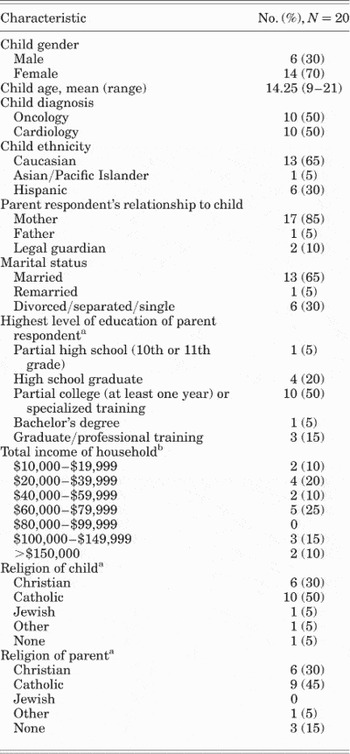
Pediatric health care professionals (two psychologists and one doctoral level nurse) administered questionnaires and interviewed parents and their children, ages 7–22 years, with physician-determined life-limiting conditions as operationalized in this study as having a <20% chance of survival beyond 3 years. Exclusion criteria included children and parents who were unable to speak English fluently enough to participate and parents who were not mentally competent. For this qualitative component of the study, children and their parents were recruited from all subspecialty divisions at one children's hospital, the hematology/oncology division of another children's hospital, and at an in-home children's hospice. Institutional Review Board approval for the study protocol was granted from each of the three institutions where participants were recruited. Potential participants were identified from referrals by health care providers affiliated with these institutions. The current report examines the interviews of the first 20 parent–child dyads (child mean age 14.25 years, range 9–21 years). Fourteen (70%) participating patients were female, 65% were Caucasian, 35% Hispanic, 5% Asian. Response rate for invited subjects for this qualitative study was 57%. Reasons for not participating consisted of “being too busy to participate” (7 families), “not a good time” (4 families), did not return phone calls (3 families), and child passed away before the meeting time was rescheduled (1 family). All enrolled subjects completed the study. The demographic characteristics of the patients and parents are shown in Table 1.
Demographics of research participants

aMissing one participant's information.
bMissing two participants' information.
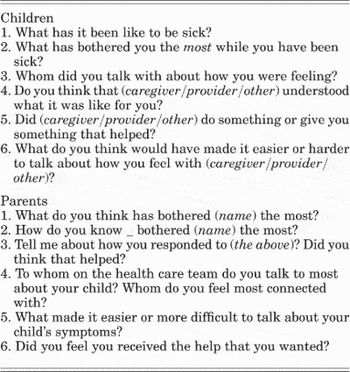
The semistructured interviews provided an opportunity for participants to tell their personal narratives while also ensuring that they responded to particular questions regarding communication (see Table 2). The interviewers asked children to share what it has been like for them to be sick and asked parents to talk about their child's experience during his/her illness. This broad prompt allowed the children and parents to tell their stories in their own words without interruption. Parents and children were interviewed separately. The child was given a toy or age-appropriate gift for participating. The interviewer stayed actively engaged throughout the interview, asking follow-up questions and prompting the participants if they did not answer the planned questions in the initial narrative. This methodology allowed for narrative and yet included a standard set of issues to be addressed across all children and parents.
Interview prompts

Qualitative Data Analysis
All interviews were audiotaped and videotaped. They were then transcribed verbatim, with at least one individual performing a reliability check on each transcript and correcting any errors of transcription. After each interview was transcribed in a standard format, lengths of interview transcripts were compared. The average parent interview was 16.5 pages, mode: 15 pages, range: 5–31 pages (16/20 interviews in 10–30 page range), and for the 20 children, average: 17.8 pages, mode: 12 pages, range: 5–34 pages (17/20 interviews in 10–30 page range). The five children who were under 12 years of age had relatively shorter interview transcripts (average 10.2 pages, range 5–18 pages). In addition, the two younger children with the shortest transcripts (5 and 6 pages each) had cognitive deficits, which made communication difficult. Length of the child or parent interview transcript did not vary by child's diagnosis or gender. Given that the interview elicited narratives, differences in lengths of interview may reflect differences in individual communication styles.
Transcripts were then analyzed for themes using grounded theory approach, an established qualitative research method that allows concepts and theories to emerge from the data itself (Maxwell, Reference Maxwell1992; Miles & Huberman, Reference Miles and Huberman1994; Weiss, Reference Weiss1994; Strauss & Corbin, Reference Strauss and Corbin1998; Gubrium & Holstein, Reference Gubrium and Holstein2002; Patton, Reference Patton2002; Auerbach & Silverstein, Reference Auerbach and Silverstein2003). This form of qualitative analysis resulted in the identification of specific themes, as well as an understanding of the illness experience beyond that provided by quantitative questionnaires.
Research assistants and the project coordinator individually analyzed an initial subsample of interviews and then met to identify a preliminary list of themes and concepts based on initial review of interviews as well as from literature on palliative care and interactions between children, parents, and health care professionals. These themes were then grouped into a set of codes that were then used as a higher order thematic framework for coding the narratives. A preliminary codebook with definitions of each code was generated to promote consistency between coders and help eliminate individual coder bias. Blocks of texts ranged in size from a single sentence to several lines. Text blocks that could be coded in more than one category were marked as double-coded items.
Using this preliminary codebook, a random subsample of interviews was separately coded by two research assistants trained in qualitative content analysis. Where differences occurred, the two coders met with the project coordinator and appropriate adjustments were made to the set of codes, such as adding a new code or refining a code definition. Interrater reliability was determined by comparing the double-coded interviews for consistency in the manner in which codes were applied to the same narrative. After achieving interrater reliability of .80 or higher in three consecutive interviews, the final set of codes was applied to all the transcripts by the two coders. Randomly selected interviews were double-coded by the researchers and interrater agreement (m = 0.85) remained consistent. Periodic coding meetings continued to be held and a qualitative analysis diary was maintained for reference. The focus of the current study is on all codes concerning physician communication.
RESULTS
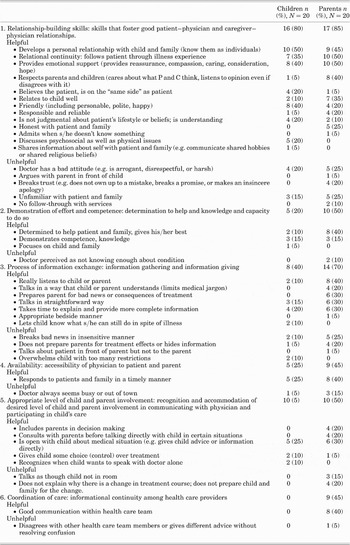
Five domains of physician communication emerged that both child and parent participants identified as salient and influencing comfort level. These included relationship building, demonstration of effort and competence, information exchange, availability, and appropriate level of child and parent involvement. Parents alone identified the sixth category, coordination of care. Table 3 shows the different subthemes within each major communication domain along with the percentages of parents and children endorsing each of these subthemes in their narratives. Both helpful and unhelpful communication traits are categorized in the table. The primary domain of child/parent disagreement was in level of involvement in direct communication between the child and physician.
Physician communication traits identified by children and parents

Relationship Building
A majority of both children and parents endorsed physician relationship-building skills, skills that facilitated the growth of trust, credibility, rapport, and friendship, reporting that these traits increased their comfort level when speaking with a physician (Table 3). Children and parents appreciated doctors who took the time to get to know the patients as individuals and develop a friendship with the patients. Respect was also mentioned by both parents and children.
Child (C): “It's not really a doctor-patient kind of thing. … It's more just— I would say a friendship. … It helps me deal with my pain, you know, when we talk to each other.”
Parent (P): “The doctors, the way they speak to her, it's like they're on a … friend level. They have this friendship and … she said they feel like … family to her.”
P: “That's one thing I like about Dr. Smith, … we felt that he respected our opinions, even though he did not agree with that.”
Children reported feeling comfortable talking with physicians who took the time to inquire about personal or social concerns in addition to treating physical symptoms. Children also emphasized the importance of doctors believing the children's words, reporting that they could tell when the physicians did not believe what the child was saying.
C: “They're comfortable … talking to patients and their parents. Starting the conversation of with, ‘How's high school? I hated high school when I was a kid for such and such a reason.’ … Just people skills and just the general love for the profession.”
C: “Well, she [the doctor] believes me too. When I'm talking about pain, she believes me, basically.”
Relational continuity, or having the same doctor(s) provide care so a long-term relationship can be developed was one of the most frequently identified themes by children and parents alike.
C: “They know also the back story. … They were there when I was sick, so they know kind of where I'm coming from, pretty completely.”
Children and parents also identified physician characteristics that tended to hinder communication. These qualities included arrogance or pessimism, care that was impersonal, insensitive, or disrespectful, and the breaking of trust in the relationship.
C: “Because the doctors keep on wanting to go against you instead of trying to find other ways to make it better for you.”
There were other physician characteristics identified by parents and children, and these are noted in Table 3. Subjects reported that satisfying communication with physicians helps builds trust, a factor that then facilitates further good communication.
Demonstration of Effort and Competence
Parents and children reported that they felt more comfortable communicating with physicians whom they believed were demonstrating their best efforts and who exhibited competence and knowledge about the child's care. Across interviews, 50% of parents and 20% of the children endorsed this aspect of physician communication as being important.
C: “They really have a visible care for the patients … a determination and … doggedness to help them in any way to go past the call [of duty].”
P: “I think it's important to have that relationship with a physician because … here is your child, … the most important part of your life, … and you want everyone that's connected with them to do a hundred percent at all times.”
Information Exchange
The process of information exchange was one of the most consistently identified domains by both children and parents and included the physician's ability to listen, talk in an understandable, straightforward manner, give clear explanations, and provide complete information.
P: “Doctors have their own little codes, which we don't … understand much of it. We're not doctors. We're not like in the medical place all the time. Sometimes … [it's] like ‘can you please repeat it again in another way?’”
Many parents reported being devastated when physicians broke bad news in an insensitive manner or when they believed that the physicians hid information about the child's treatment, leaving parents unprepared for the outcome.
P: “They called me in the room and uh, I remember her [the doctor] saying that they found brain tumors. And I just thought, how … devastating that was. But the important part of that was … the phone call. I thought that was very inappropriate. (Crying) … I'll never forget that.”
P: “He [the physician] did a great job of giving me the information. … I think he was very clear about what expectations. … Tell me, what am I going to see? I want to know what I'm going to see. I don't want to be surprised. I hate surprises.”
Children also had recommendations for other children when it came to communicating with the physician, including being straightforward with the physician, asking questions, and talking about their feelings. One child recommended to physicians: “I think they should like approach the children instead of the children trying to approach the grown-ups.”
Both children and parents reported that the information process itself was a critical element of communication, and when the information exchange was experienced as unsatisfactory, both parents and children reported feeling frustrated, dismayed, and even devastated.
Availability
Parents and children expressed a desire to communicate with physicians who were easily accessible (e.g. respond quickly to e-mails and phone calls), emphasizing that this was not only to obtain information, but also to provide a sense of security and “emotional peace.”
P: “The key is … feeling secure that you can reach them [the physicians] and that is a very big key now. … I never know when something is going to go wrong with Mark.”
Children and parents both reported that, when doctors seemed rushed or very busy, it created a barrier to communication about their needs, another factor that inhibited satisfying communication with physicians.
Level of Child and Parent Involvement
Children and parents endorsed various desired degrees of involvement in communicating with physicians and direct involvement in the child's care (Figure 1).
Spectrum of child and parent preferences for child communication with physicians.

Some parents (20%) and children (10%) expressed the importance of active participation in the child's care and wanted the physicians to facilitate the parent/child involvement.
P: “You know it's a scary thing to participate with the doctors cuz they're all so smart but you know what? I'm her mama. I'm watching everything. So they should ask the parent for the parent report.”
C: “[More information] helps me basically by letting me know what's going on because it's my life, I should know what's going [on].”
Many parents (30%) and children (25%) reported wanting physicians to be open and straightforward with the child.
P: “You [the parent] need to talk to your child from the very beginning about what his or her condition is. … Never understate something or oh this won't hurt. … And don't deceive them, and I'll say the same for clinicians and physicians.”
Some parents (20%) and children (10%) expressed that at times they would have liked to have had private discussions with the physicians. A few parents reported that they preferred first hearing bad news or changes in treatment from the physician without the child present and then filtering the information to the child themselves.
P: “Do not talk in front of Marly, and any information that was gonna happen that day, like if any new things were going to change for Marly, … I want to know about it and I was going to tell her … of any changes. Because the way I was going to tell her would be a little different than perhaps someone else communicating that information.”
One child commented that he did not feel comfortable talking to the physician in front of his mother.
C: “But still I only like talk talking to him [the physician] when I'm by myself with him, not when my mom's in the room, … It's cuz every time I just feel weird when my mom's in the room and I have pain or a problem. … I don't want her to see me weak.”
Parents and their children did not always agree on the level of knowledge and involvement in the child's care. For example, one mother said that she believed that some information should only be given to the parents who could then tell the child, and her child reported appreciating honest information directly from the physician and not filtered through the parent.
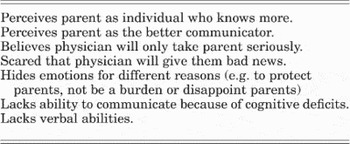
The study also identified some obstacles to children's abilities and comfort in directly communicating information to physicians (Table 4). Some quotes include:
C: “I guess like they [the physicians] overwhelm me sometimes and I feel easier having my mom tell them. … She's a better communicator I think.”
C: “That's why I always have my dad around. He's the only one that I could get them [the physicians] to listen to.”
Although many children and parents reported wanting more information or involvement in the child's care, they expressed varying degrees of desired involvement. They also identified barriers that hindered direct child–physician communication, including children believing that the parent is more knowledgeable and better at communicating and that physicians will only take the parent seriously, and children hiding their emotions for different reasons, for example, to protect their parents.
Obstacles to children directly communicating information to physicians

Coordination of Care
Themes within coordination of care, regarding informational fluidity and continuity within the health care team, were identified only by parents.
P: “And actually it was clear to me that, that people were reporting just about everything that I'd said to each other so that everybody was on the same page.”
Some parents reported feeling confused when physicians gave different information.
P: “I'm just trying to get some stability … in her care. … You know whatever's best for her. One says this, the other one says that and it's like which is it?”
Differences by Age, Gender, or Diagnosis
Only two patients mentioned “listening” as a helpful physician communication trait, and both were older adolescents (19 years old). In addition, mostly older children (mean 17.2 years, range 13–19) indicated that they valued physicians who demonstrated effort and competence in their communication with the patient. Only three older children (ages 19–20) reported preferring blunt, direct communication with their physicians, though parents of younger children also indicated similarly the importance of physicians' straightforward communication with their children, although there was lack of support in the narratives of younger children for this communication characteristic. Each of the four children who made no mention of physicians in their interviews were young (mean 10.3 years, range 9–14), and only two younger children (ages 12–13 years) reported that they appreciated being provided with self-care-related choices by their physicians. Parents of younger children and their children themselves (ages 12, 13, and 15 years) reported that the child hid emotions or pain for a variety of different reasons, including to protect their parents. Two younger children (ages 12 and 13 years) also reported that they would be more likely to speak with their doctors about their symptoms or concerns if their parents were not in the room.
There did not appear to be any differences in salient areas of communication reported by children with cancer and with other diagnoses or by the parents of these two groups of children. The only apparent diagnosis-group-related differences were found in the subgroup of cardiology patients. For example, the only two adolescents (19 and 20 years) with cardiac disease reported disliking communication with physicians who told them (the adolescents) what they could not do, such as activity restrictions.
DISCUSSION
Qualitative analyses of the narrative interviews of our first 20 pairs of children with life-limiting illnesses and their parents identified six salient characteristics in physician communication. The important communication domains reported by both parents and children included relationship building, demonstration of effort and competence, information exchange, availability, and appropriate level of child and parent involvement. Parents also reported coordination of care as important. Parents and children reported that the physician's communication style was a key factor in the type of relationship that they had with the physician, a finding that suggests that identifying and improving key areas of communication in pediatric palliative care may lead to higher quality of care and parent/child satisfaction with care for children facing life-limiting conditions.
A good relationship between physician and patient/family is crucial for effective communication. Our study findings support many of the physician communication characteristics noted in other studies, such as showing respect and compassion, providing emotional support, getting to know the children and parents as individuals, demonstrating investment in the child's care, and being available for the family (Hinds et al., Reference Hinds, Oakes and Quargnenti2000, Reference Hinds, Drew and Oakes2005; Davies & Connaughty, Reference Davies and Connaughty2002; Meyer et al., Reference Meyer, Burns and Griffith2002, Reference Meyer, Ritholz and Burns2006; Heller & Solomon, Reference Heller and Solomon2005). Narratives by both parents and children in our study identified the importance of trust in facilitating communication. We also found isolated incidents in which parents reported that their trust was betrayed, such as a physician not admitting a mistake, a finding similar to that found in another report (Contro et al., Reference Contro, Larson and Scofield2002). In both studies, parents reported that this perceived betrayal led to emotional distress and resentment toward the physician. Although these are isolated incidents, the message conveyed is the importance of honesty in the development of a trusting relationship between physicians, parents, and children.
Both parents and children identified the process of information exchange as a critical part of communication. Consistent with our findings, previous studies have found that desired physician characteristics include really listening to the child and parent, talking in a straightforward way, and taking the time to provide more complete information (Kirschbaum, Reference Kirschbaum1990; James & Johnson, Reference James and Johnson1997; Davies & Connaughty, Reference Davies and Connaughty2002; Meyer et al., Reference Meyer, Burns and Griffith2002, Reference Meyer, Ritholz and Burns2006) whereas unhelpful traits include breaking bad news in an insensitive manner and not providing adequate information to the children or parents (Davies & Connaughty, Reference Davies and Connaughty2002; Contro et al., Reference Contro, Larson and Scofield2002).
Our study found that children and parents reported different degrees of desired child–physician communication. Some parents advocated open and direct communication with the child; others wanted to be given information first so they could filter it to their child and act as “gatekeepers” of information or withhold information altogether, as supported by findings by Ellis (Reference Ellis and Leventhal1993). Children also displayed a diverse profile of communication preferences, with some children expressing a desire for more direct communication with the physicians and others preferring to have their parents speak for them. Some barriers to direct communication between children with life-threatening illnesses and physicians were identified that are supported by an earlier study (Young et al., Reference Young, Dixon-Woods and Windridge2003), including children perceiving that their parent was more knowledgeable and the better communicator or perceiving the physician as only taking the parent seriously. Previous research in general pediatric consultations has also shown a marginalization of the child's role, especially in regard to discussions about treatments (van Dulmen, Reference van Dulmen1998; Stivers, Reference Stivers2001; Tates & Meeuwesen, Reference Tates and Meeuwesen2001; Tates et al., Reference Tates, Elbers and Meeuwesen2002a, Reference Tates, Meeuwesen and Elbers2002b; Young et al., Reference Young, Dixon-Woods and Windridge2003; Wassmer et al., Reference Wassmer, Minnaar and Abdel Aal2004; Nova et al., Reference Nova, Vegni and Moja2005). In addition, there were some discrepancies in communication preferences within dyads in our study, specifically with children who desired direct information but had parents who were gatekeepers. More research needs to be done to explore the prevalence of marginalization of the child's role in his/her own care as well as the prevalence of discordant communication profiles between parents and children in pediatric palliative care and the impact that these phenomena have on outcomes of care.
Given that our study and previous studies (Hinds et al., Reference Hinds, Drew and Oakes2005) found that both child and parent perceptions of pediatric palliative care appear to be heavily influenced by relationship-based factors, it is fortunate that there has been growing emphasis on ensuring relational skills along with communicative competence in educational models (Sahler et al., Reference Sahler, Frager and Levetown2000; von Guten et al., Reference von Guten, Ferris and Emanuel2000; Browning, Reference Browning2002; Chochinov, Reference Chochinov2002; Solomon & Browning, Reference Solomon and Browning2005; Browning & Solomon, Reference Browning and Solomon2005). Studies have shown that education and training in interpersonal communication skills for clinicians can have a positive impact on patient encounters (van Dulmen et al., Reference van Dulmen and Holl2000; Fallowfield et al., Reference Fallowfield, Jenkins and Farewell2003) and there is emerging evidence that, in adult palliative care, a more family-centered approach utilizing strategies such as formal and informal family meetings improves communication at the end of life (Boyle et al., Reference Boyle, Miller and Forbes-Thompson2005). Communication guidelines can be used to help clinicians actively listen, handle silences, encourage disclosure, and impart information in a sensitive and effective manner (Buckman, Reference Buckman2001; Curtis et al., Reference Curtis, Wenrich and Carline2001; Makoul, Reference Makoul2003; Back et al., Reference Back, Arnold and Baile2005; Edwards, Reference Edwards2005; Howells et al., Reference Howells, Davies and Silverman2006).
Finally, parents highlighted coordination of care as an important component of effective communication. Parents of children with life-threatening illnesses may feel overwhelmed by the number of health care professionals involved in their child's care (Meyer et al., Reference Meyer, Ritholz and Burns2006). Good communication between members of the health care team can mitigate anxiety and confusion for the parents. Having formal and informal family meetings, regular team meetings, or palliative care/ethics team consults may help prevent fragmented care (Boyle et al., Reference Boyle, Miller and Forbes-Thompson2005; Meyer et al., Reference Meyer, Ritholz and Burns2006).
In addition to physicians, children and parents described many other health care providers (e.g., nurses and social workers) as playing a crucial role in the child's care. The communication skills that children and parents desired in these professionals were themes identified earlier, and therefore could also be categorized into the identified six domains. For example, one child conveyed that she felt most comfortable talking with her psychologist about psychosocial issues because her psychologist really listened, asked questions, and offered ideas and suggestions. Nurses were identified as effective liaisons to the physicians. One parent said, “Well if I had a question, for the doctor or for whomever, I could go through her [the nurse]. … I knew that I would get the answers that I was looking [for].” Communication skills of a child life specialist, case manager, and social worker were also mentioned by some of the parents and their role as a liaison to the doctor was reported, emphasizing the importance of informational continuity within the health care team.
Study Limitations
One limitation of the larger mixed-methods study (from which this current qualitative study is drawn) is the exclusion of non-English speakers, because families that have a language barrier may have different needs when it comes to communicating with their physician. The current study is also limited by its modest sample size, limiting generalizability. Also, there is limited geographical, ethnic, and religious variation in the patient population. Self-selection bias may also have been a factor because those subjects who chose to participate may be more open to communicating with unfamiliar people than those who refused to be contacted. Another limitation was our recruitment of patients through health care providers who may have differing opinions on whether a patient fits the prognosis criteria (<20% chance survival beyond 3 years), especially given the difficulty in predicting length of life for many of the childhood diseases that result in premature death (American Academy of Pediatrics, 2000).
Future Research Directions and Clinical Implications
Despite its limitations, this study's findings are consistent with previous research on parents' preferences regarding communication in pediatric palliative care (James & Johnson, Reference James and Johnson1997; Hinds et al., Reference Hinds, Oakes and Quargnenti2000, Reference Hinds, Drew and Oakes2005; Vickers & Carlisle, Reference Vickers and Carlisle2000; Contro et al., Reference Contro, Larson and Scofield2002; Davies & Connaughty, Reference Davies and Connaughty2002; Meyer et al., Reference Meyer, Burns and Griffith2002, Reference Meyer, Ritholz and Burns2006; Heller & Solomon, Reference Heller and Solomon2005; Mack et al., Reference Mack, Hilden and Watterson2005) and this study is one of the few that reveals the voices of children with life-threatening illnesses regarding their care and preferences regarding communication about their illness. Future research can examine these physician communication domains in terms of outcomes for the child at the end of life and for the parent during bereavement. It would also be of interest to collect data from the health care provider's perspective and thus gain the clinician's viewpoint regarding this communication triad. This study also provides support for the development of interventions that address these communication domains to help enhance child–parent–physician communication and ultimately help improve quality of care and patient and family satisfaction. If patients and their parents trust their providers and engage in more communication with them, then health care professionals may be better able to assess the needs of seriously ill children, whether about symptom management or psychosocial concerns. This study highlights the importance of communication in pediatric palliative care; as one parent stated, “Doctors and nurses have to remember that things they say impact us because all of our hope and our dreams of the future are with you.”
ACKNOWLEDGEMENT
The authors gratefully acknowledge the Elizabeth Glaser Pediatric Research Network for the funding of this study.