INTRODUCTION
Teotihuacan is one of the most studied archaeological sites in Mesoamerica because of its exceptional size and urban planning, with a highly urbanized capital surrounded by villages and hamlets (Millon Reference Millon1973; Sanders et al. Reference Sanders, Parsons and Santley1979), its corporate organization (Blanton et al. Reference Blanton Richard, Feinman, Kowalewski and Peregrine1996; Manzanilla Reference Manzanilla2001, Reference Manzanilla2006; Pasztory Reference Pasztory and Berlo1992), and multiethnic character (Price et al. Reference Price, Manzanilla and Middleton2000; Manzanilla Reference Manzanilla2015). However, the chronology for the different occupational phases and the process of abandonment are still under debate, partly due to the fact that the radiocarbon (14C) calibration curve has some problematic periods during the times of the development and subsequent occupations of Teotihuacan that make it difficult to differentiate ages of samples from different temporalities as suggested by archaeological evidence (Cowgill Reference Cowgill and Stone2007; Manzanilla Reference Manzanilla2019). Specifically, there are two plateaus; one between 140 and 220 CE, coincident with the period of the first urban planning (Millon Reference Millon1973); and the other between 420 and 530 CE, coincident with a new construction level in Xolalpan phase and close to the Big Fire, the moment of abandonment of the city by the Teotihucanos (Manzanilla Reference Manzanilla, Inomata and Webb2003; Soler-Arechalde et al. Reference Soler-Arechalde, Sánchez, Rodríguez, Caballero-Miranda, Goguitchaishvili, Urrutia-Fucugauchi, Manzanilla and Tarling2006; Beramendi-Orosco et al. Reference Beramendi-Orosco, González-Hernández and Soler-Arechalde2012). Other issues that further complicate the chronology construction for Teotihuacan are related to samples and altered contexts. Regarding samples the difficulties arise from the fact that it was a common practice to reuse big constructing elements, such as wooden beams and pillars, from previous phases introducing the problem of significant inbuilt age. On the other hand, it is known that the abandoned city was looted and reoccupied by later cultures, such as the Coyotlatelco and Aztec during Epiclassic and Postclassic times, resulting in the alteration of some archaeological contexts (Millon Reference Millon, Yoffee and Cowgill1988; Cowgill Reference Cowgill and Stone2007; Nichols Reference Nichols2016).
In an effort to contribute towards a better understanding of the urban development and abandonment of the city, we previously reported a Bayesian chronology for Teopancazco, a multiethnic neighborhood center located in the south of the City of Teotihuacan, which made it possible to differentiate in time four constructing phases, as well as estimating the time of the Big Fire and abandonment of the site by the teotihuacanos around 550 CE (Beramendi-Orosco et al. Reference Beramendi-Orosco, González-Hernández, Urrutia-Fucugauchi, Manzanilla, Soler-Arechalde, Goguitchaishvili and Jarboe2009, Reference Beramendi-Orosco, González-Hernández and Soler-Arechalde2012). Furthermore, we recently reported a chronology for a different site inside the main city with the monumental constructions, the palatial complex of Xalla, contrasting a Bayesian 14C model to archaeomagnetic dates on lime plasters (Beramendi-Orosco et al. Reference Beramendi Orosco, González Hernández, Soler Arechalde and Manzanilla2019).
In this contribution we report a new high-resolution chronology for the same site including 14C ages and archaeomagnetic dates on burned and unburned lime-plasters, in a Bayesian chronological model constructed with detailed archaeological information about sample type and archaeological context. This new chronology and that previously reported for Teopancazco (Beramendi-Orosco et al. Reference Beramendi-Orosco, González-Hernández, Urrutia-Fucugauchi, Manzanilla, Soler-Arechalde, Goguitchaishvili and Jarboe2009, Reference Beramendi-Orosco, González-Hernández and Soler-Arechalde2012) are part of a bigger project with the aim of building a robust chronology with high resolution for the Teotihuacan Valley, covering from formative times through late postclassic occupations.
METHODOLOGY
The Palatial Complex of Xalla, Teotihuacan
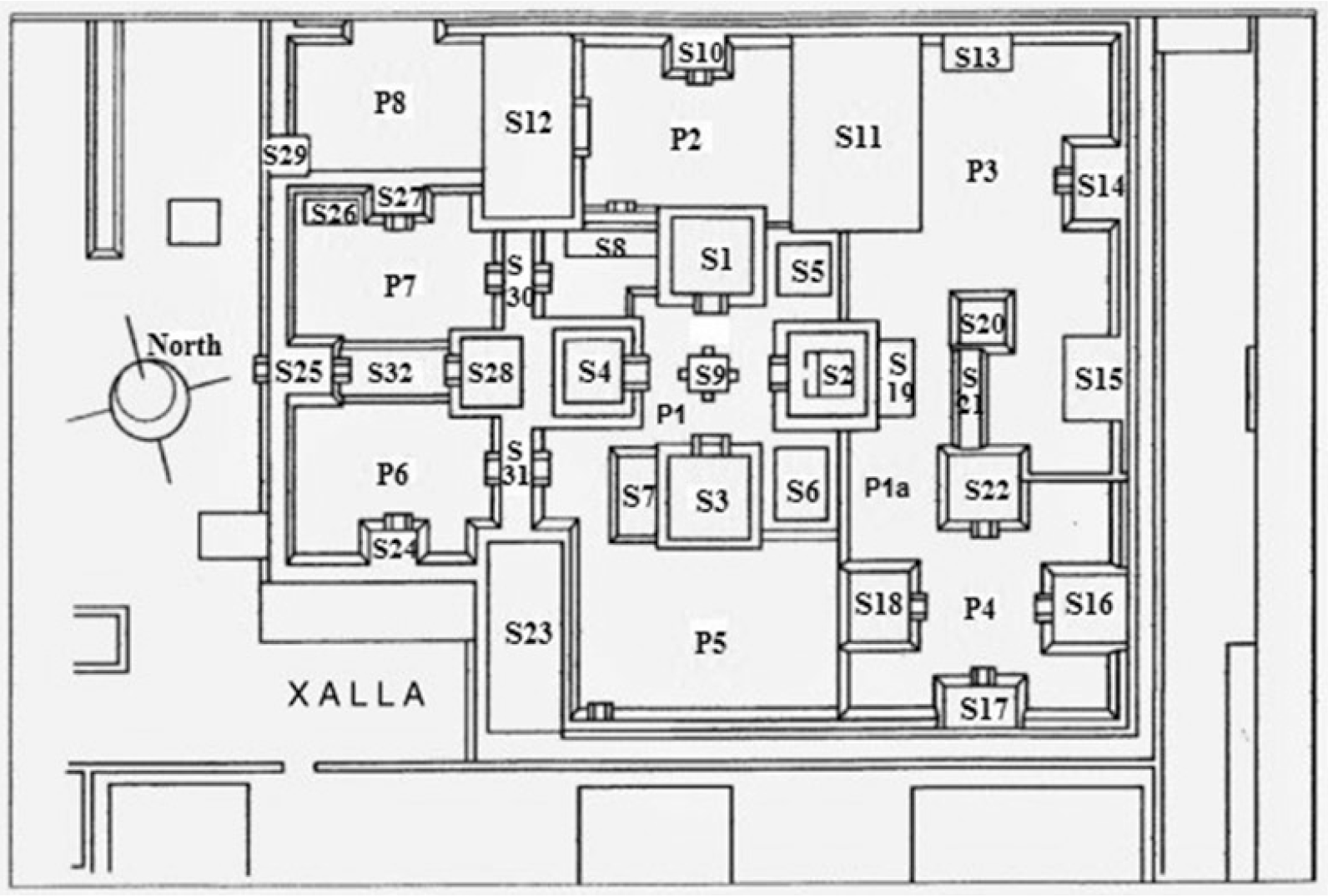
Xalla is a palatial compound of classic Teotihuacan located 235 m north of the Pyramid of the Sun (Manzanilla and López-Luján Reference Manzanilla and López-Luján2001, Figure 1). It has been extensively excavated by Linda R. Manzanilla since 2000 as part of the project “Teotihuacan. Elite and Rulership. Excavations at Xalla and Teopancazco.” It may have been one of the seats of power for ancient Teotihuacan, it has an unusual size with a surface of 50,787 m2. It is not located along the Street of the Dead but 235 m from this avenue, revealing a sense of privacy; it is isolated by a ca. 3-m-wide double wall, to allow watchmen to walk around it. This palace has 8 plazas and ca. 29 structures (Figure 2). It was perhaps a multifunctional palace with precincts presumably for decision-making of the members of the ruling elite of Teotihuacan, with ritual sectors, treasure of the co-rulers consisting of foreign mica from Oaxaca (southern Mexico), an area for associated craftsmen, and some domestic sectors (Manzanilla Reference Manzanilla and Rob2017). The main plaza has four equivalent structures with elevated precincts, each to a cardinal point, and each dedicated to a different deity. These surround a temple set in the center of the main plaza. One of the outstanding activities found at Xalla is the cutting of mica plaques (Rosales-de-la-Rosa and Manzanilla Reference Rosales-de-la-Rosa and Manzanilla2011). Some of the higher rooms surrounding Plaza 5 had large plaques of mica on the floor or attached to the lower portions of rear walls (Manzanilla Reference Manzanilla2019). Together with the Viking Group, Xalla is characterized for concentrating most of the mica that came from Oaxaca to Teotihuacan. At present, 37 kg of mica has been found only in Xalla, ca. 10 kg of which were treasured in Structure 12 (S12), a ritual tumulus. This palace has evidence of the shattering of cult sculptures and destruction by the Big Fire, which was the first episode precluding the collapse of the city. After the abandonment of the complex, Epiclassic and Postclassic groups such as Coyotlatelco (650–800 CE) and Aztec (1000–1400 CE) used the space and looted it (Manzanilla Reference Manzanilla2019).
Location of Teotihuacan and the Xalla complex (based on Soler-Arechalde et al. Reference Soler-Arechalde, Sánchez, Rodríguez, Caballero-Miranda, Goguitchaishvili, Urrutia-Fucugauchi, Manzanilla and Tarling2006).

Schematic layout of the Xalla palatial complex (Manzanilla Reference Manzanilla and Rob2017). The alphanumeric codes mean S: structure and P: plaza.

Archaeomagnetic Dating
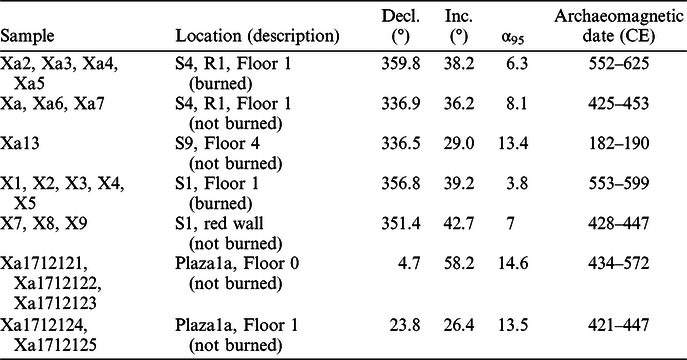
Samples for archaeomagnetic dating correspond to lime plasters from floors and red-painted walls (Table 1). It has previously been demonstrated that lime plasters can date different events depending on if they are burned or not (Hueda-Tanabe et al. Reference Hueda-Tanabe, Soler-Arechalde, Urrutia-Fucugauchi, Barba, Manzanilla, Rebolledo and Gogitchaishvili2004). Unburned samples date the time of manufacture because the volcanic magnetic minerals contained within the plaster mixture acquire a detrital magnetization, recording the direction of the Earth’s magnetic field at the moment of solidification. On the other hand, burned lime plasters date the fire event if they are heated up to temperatures higher than the Curie temperature, losing the detrital magnetization and acquiring a thermoremanent magnetization that records the direction of the Earth’s magnetic field at the moment of cooling down. Furthermore, if there are lime plasters from a single manufacture but with burned and unburned areas, it is possible to date both events in the same context.
Archaeomagnetic dates on lime plasters from Xalla complex.

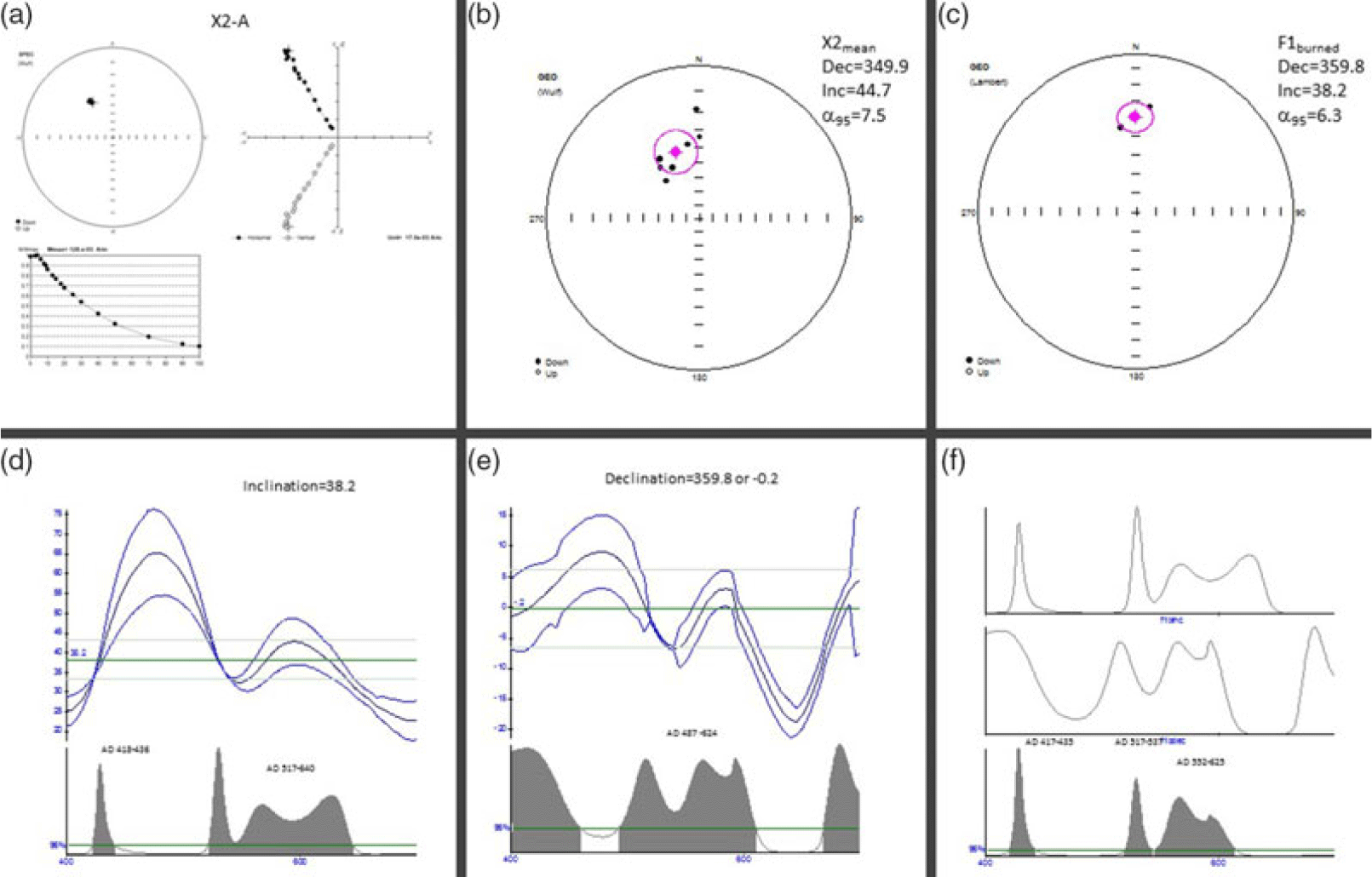
Samples were obtained during different excavation campaigns as follows: 15 samples in 2001, 11 in 2003, and 2 samples in 2012. Sampling consisted in removing a block of plaster oriented in situ with a Brunton compass. Samples were analyzed at the Laboratorio de Paleomagnetismo at the Instituto de Geofísica of the National Autonomous University of Mexico (UNAM) following the methodology previously reported elsewhere (Soler-Arechalde et al. Reference Soler-Arechalde, Sánchez, Rodríguez, Caballero-Miranda, Goguitchaishvili, Urrutia-Fucugauchi, Manzanilla and Tarling2006); briefly, the oriented blocks were cut in subsamples and encapsulated within two 2.5-cm-diameter wooden discs using a non-magnetic epoxy resin to obtain cylindrical specimens that fit in an AGICO JR6 spinner magnetometer. The main remanence components and stability of the magnetization of each specimen were investigated by detailed stepwise alternating field demagnetization over 8–12 steps up to 100 mT with a Molspin demagnetizer (Figure 3a). The mean direction (inclination and declination) for each sampled plaster were obtained by means of Fisher’s statistics together with the α95 parameter, which is a measure of the dispersion of the magnetic data of all specimens from the same plaster and is considered acceptable when lower than 10° for burned samples and 15° for unburned samples (Figure 3b, c). Finally, the archaeomagnetic dates were estimated using the last version of the Secular Variation curve for Central Mexico reported by Soler-Arechalde et al. (Reference Soler-Arechalde, Caballero-Miranda, Osete, López-Delgado, Goguitchaishvili, Barrera-Huerta and Urrutia-Fucugauchi2019) with the RENDATE program (Lanos and Dufresne Reference Lanos and Dufresne2008), which uses Bayesian statistics to assign a probability to the different periods when the magnetic properties of the sample coincide with the curve (Figure 3d, e, f). From the 28 lime plasters sampled, it was possible to obtain only 7 reliable archaeomagnetic dates (Table 1); the rest of samples had highly dispersed magnetic data (α95 > 15°) and could not be used for dating (Soler-Arechalde et al. Reference Soler-Arechalde, Sánchez, Rodríguez, Caballero-Miranda, Goguitchaishvili, Urrutia-Fucugauchi, Manzanilla and Tarling2006).
Example of archaeomagnetic dating process: (a) every specimen (X2A in this example) is demagnetized by alternate fields to get its magnetization direction (declination and inclination); (b) the magnetization of X2 sample (declination, inclination and α95) is obtained by Fisher statistics of all the specimens (X2A, X2B, etc.); (c) Fisher mean (declination, inclination and α95) of all the samples from the same floor (X2, X3, X4, X5); (d) using the software RENDATE (Lanos and Dufresne Reference Lanos and Dufresne2008) the intersection of inclination and its error with the curve for Central Mexico (Soler-Arechalde et al. Reference Soler-Arechalde, Caballero-Miranda, Osete, López-Delgado, Goguitchaishvili, Barrera-Huerta and Urrutia-Fucugauchi2019) is obtained; (e) same process with declination; and (f) combination of inclination and declination results to get the common time-intervals with a probability of 95% by RENDATE.

There is a sequence of floors sampled at the different construction stages of structure 9 (S9). The first one (deepest level, floor 4, sample Xa13) was dated by archaeomagnetism to 182–190 CE and because the plaster is not burned, this date would correspond to the manufacture of the first construction level of the structure. The floors from the next two construction levels in S9 could not be dated using archaeomagnetism because they had highly dispersed magnetic data (α95>15°). There are other archaeomagnetic dates from unburned plastered-floors from the last construction phases and/or associated with artifacts with Xolalpan characteristics: floor 1 in structure S4 (425–453 CE; samples Xa1, Xa6, Xa7), floor 1 in the plaza P1 (dated to 421–447 CE; samples Xa1712124, Xa1712125) and floor 0 in the plaza P1a (dated to 434–572 CE; samples Xa1712121, Xa1712122, Xa1712123). Further, the red-painted lime plasters on walls from last construction phase in structure 1 (S1) were also dated to the Xolalpan period, with an archaeomagnetic date of 428–447 CE (sample X7, X8, X9). Regarding burned lime plasters, there is a sample from the last construction phase (floor 1) in S4 dated to 552–625 CE (samples Xa2, Xa3, Xa4, Xa5), and samples from the burned floor 1 from S1 (last construction phase), with an archaeomagnetic date between 553–599 CE (samples X1, X2, X3, X4, X5). Both dates are contemporaneous and are presumably dating the same event, the Big Fire, as they are in good agreement to the date previously reported for burned lime samples in Teopancazco (Soler-Arechalde et al Reference Soler-Arechalde, Sánchez, Rodríguez, Caballero-Miranda, Goguitchaishvili, Urrutia-Fucugauchi, Manzanilla and Tarling2006; Beramendi-Orosco et al Reference Beramendi-Orosco, González-Hernández, Urrutia-Fucugauchi, Manzanilla, Soler-Arechalde, Goguitchaishvili and Jarboe2009 and 2012), further supporting that the Big Fire was indeed between 550 and 600 CE, earlier than was previously proposed for the moment of abandonment of Teotihuacan (650 CE; Cowgill Reference Cowgill and Stone2007).
Radiocarbon Dating
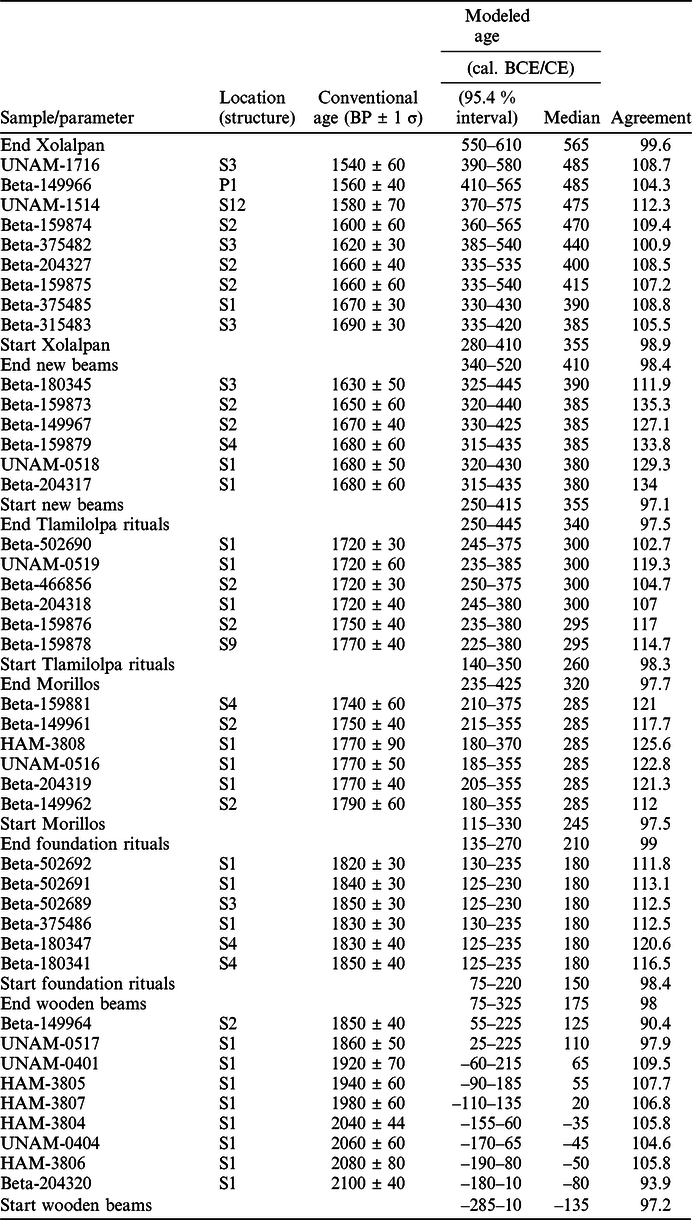
There is a total of 42 14C ages (Table 2) on charcoal samples obtained during the last 16 years by Accelerator Mass Spectrometry (AMS) and Liquid Scintillation Spectrometry (LSS), depending on sample size, analyzed in three laboratories: Beta Analytic in Florida USA (Beta, analyses by AMS and LSS), the Laboratorio Universitario de Radiocarbono at the National Autonomous University of Mexico (UNAM, analyses by LSS) and the Radiocarbon laboratory at the Institut für Bodenkunde, University of Hamburg, Germany (HAM, analyses by LSS) (Table 2). Samples Beta-204317, Beta-204319, UNAM-0516, UNAM-0518, HAM-3807 and HAM-3808 come from the same archaeological context as sample P from the Fifth International Radiocarbon Intercomparison (VIRI), which was a big charred wooden beam from a collapsed ceiling a with a VIRI consensus PMC value of 80.457% (Scott et al. Reference Scott, Cook and Naysmith2010).
Radiocarbon ages on charcoal samples from Xalla complex ordered according to the Bayesian model groups.

Samples analyzed at the UNAM laboratory were dated following previously reported procedures (Beramendi-Orosco et al. Reference Beramendi-Orosco, González-Hernández, Urrutia-Fucugauchi and Morton-Bermea2006). Briefly, samples were cleaned with an acid/alkali/acid (AAA) pretreatment at 50°C using 1M hydrochloric acid (HCl) and 0.1M sodium hydroxide (NaOH), neutralized and dried prior to their transformation to benzene in a vacuum synthesis line. Benzene samples were mixed with 0.5 mL of scintillation cocktail (2,5-diphenyloxazole [PPO] + 1,4-Bis(5-phenyl-2-oxazolyl)benzene [POPOP] dissolved in dead spectrophotometric-grade benzene) in 3-mL Teflon® vials. Analysis was performed in a Quantulus™ 1220 ultra-low level liquid scintillation spectrometer counting each sample for 2500 min, distributed in 50 cycles, alternating sample vials with oxalic acid SRM 4990C standard and background vials. The counting window was set to optimize the figure of merit with a 14C counting efficiency higher than 65% and the background <0.2 CPM/g C.
Bayesian Chronological Model
The Bayesian model was generated by grouping conventional ages and the archaeomagnetic dates in 6 independent phases according to sample type and archaeological information regarding context (Table 2 and supplementary file). The first group corresponds to charcoal samples from big construction elements, mainly carbonized wooden beams from collapsed ceilings identified as Pinus pseudostrobus (Xelhuantzi Reference Xelhuantzi2002) a long-lived species, with conventional 14C ages significantly earlier than expected according their contexts which have archaeological evidence related to Tlamimilolpa (200–350 CE) and Xolalpan (420–550 CE) styles, suggesting a problem of inbuilt age (as defined by McFadgen Reference McFadgen1982), which could presumably be a result of the reuse of structural elements, a common practice in Mesoamerican cultures. The second group includes charcoal samples coming from a foundation offering found in the core of one the structures surrounding the main plaza (structure 4) including a jade necklace, Spondylus shells from the Pacific Ocean, and a conch shell from the Caribbean (Manzanilla Reference Manzanilla and Rob2017); charcoal samples from beneath a Tlamimilolpa habitational area, and the archaeomagnetic date for the deepest unburned plaster floor from structure 9 dated to 182–190 CE. Samples included in the third group correspond to charcoal from small construction elements from ceilings known as “morillos” which were short-lived wooden laths used as the foundation for the plaster covering the ceilings. The fourth group includes charcoal samples from rituals with Tlamimilolpa style ceramic and/or figurines, and samples in the fifth group correspond to charcoal from wooden beams from collapsed ceilings but with conventional ages significantly younger than the first group and related to Xolalpan architectural style. The last group includes small charcoal samples found in ritual contexts with Xolalpan style ceramic and/or figurines and four archaeomagnetic dates for unburned plasters from floors and walls, dated to between 421 and 570 CE. The archaeomagnetic dates of the burned plasters, treated as one date in the Bayesian model because they are dating the same event, were included as the final boundary for the Xolalpan phase (samples X1, X2, X3, X4, X5 and Xa2, Xa3, Xa4, Xa5; dated to 553–599 CE and 552–625 CE, respectively). Despite there is archaeological evidence that the site was looted and occupied by Coyotlatelco and Aztec people, such as looting piths, stone circles characteristic of Coyotlatelco people and early Aztec-style pottery shards (Manzanilla Reference Manzanilla and Rob2017, Reference Manzanilla2019), there are no dated samples from those contexts neither by 14C nor by archaeomagnetism.
The Bayesian model (see supplementary file) was calibrated using the online version of Oxcal 4.3 (Bronk Ramsey Reference Bronk Ramsey2009a) with the IntCal_13 calibration curve (Reimer et al. Reference Reimer, Bard, Bayliss, Beck, Blackwell, Bronk Ramsey, Buck, Cheng, Edwards and Friedrich2013). Modeled ages are reported as high probability density intervals at the 95.4% level in cal BCE/CE, the median is also included for facilitating the interpretation. The model was evaluated in terms of the Agreement index (A) calculated by the program, considering a threshold of 60% for both, individual samples and the model (Bronk Ramsey Reference Bronk Ramsey2009b), and further assessed by contrasting the model with the chronology reported for Teopancazco (Beramendi-Orosco et al. Reference Beramendi-Orosco, González-Hernández, Urrutia-Fucugauchi, Manzanilla, Soler-Arechalde, Goguitchaishvili and Jarboe2009, Reference Beramendi-Orosco, González-Hernández and Soler-Arechalde2012).
RESULTS AND DISCUSSION
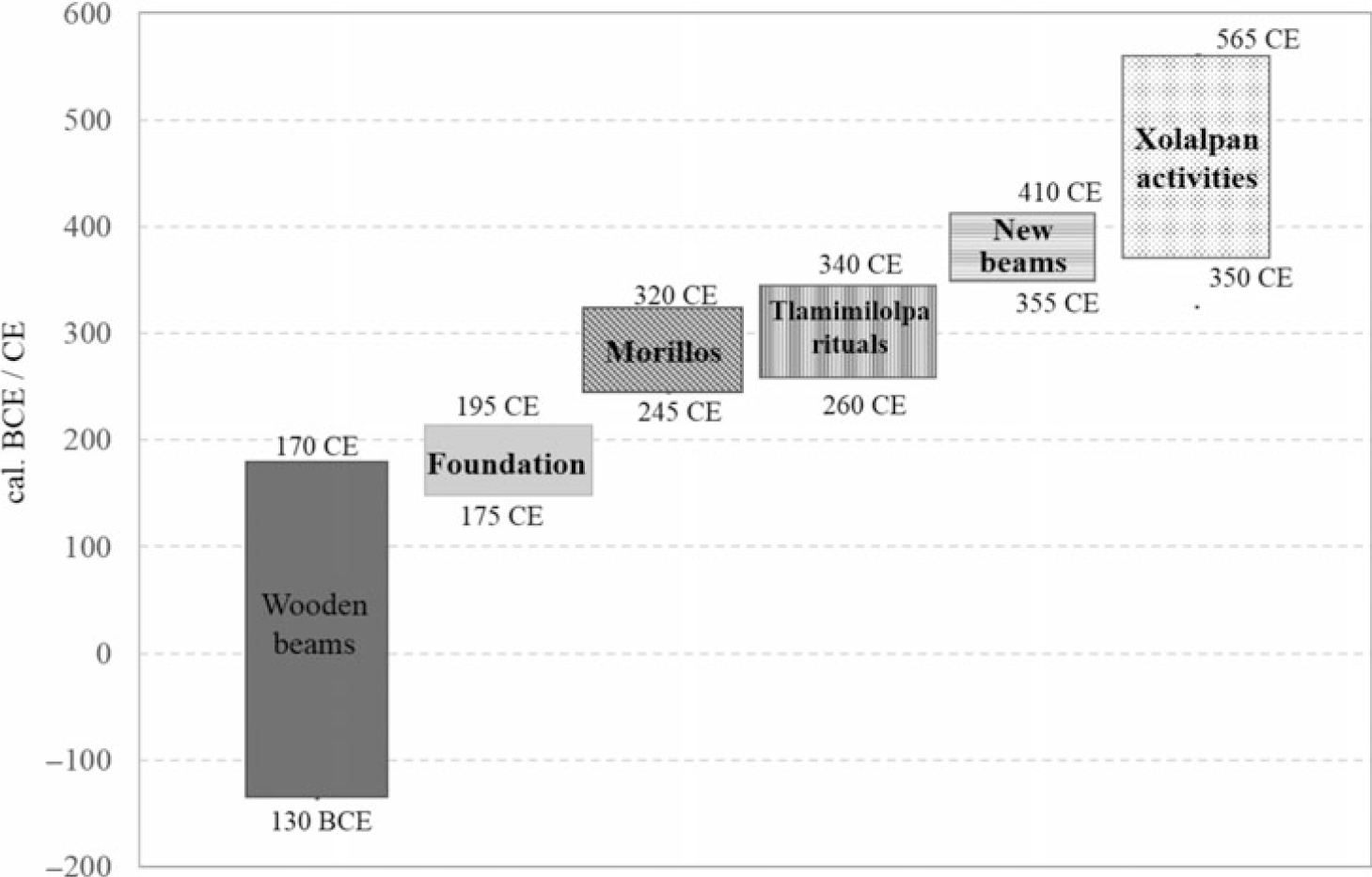
The calibrated model resulted in an A index of 211.8% and individual A indices higher than 90% for all samples, indicating that the model is consistent with the data and validating the chronology. The Bayesian calibrated intervals are up to 65% shorter than individual calibrated ages. Moreover, it is possible to distinguish groups and assign temporalities for beginning and ending for each phase (Table 2, Figure 4).
Schematic figure of the calibrated Bayesian model for Xalla including median age of the boundaries for each group.

The phase including the big construction elements resulted with the beginning dated to 280–5 cal BCE (median 130 cal BCE) and the ending to 70–320 cal CE (median 170 cal CE), significantly earlier than expected for ceilings from classic Teotihuacan (150–550 CE; Cowgill Reference Cowgill and Stone2007), supporting further the hypothesis of a problem of inbuilt age resulting from the reuse of big structural elements. The boundaries of the foundation group resulted with modeled ages dated to 120–195 CE (median 175 CE) for the beginning and 175–245 CE (median 195 CE) for the ending, with all samples included in this group with contemporaneous calibrated 14C ages (median 185 CE) and in good agreement with the manufacture date of the deepest floor in structure 9 dated by archaeomagnetism to 182–190 CE. Results for the following group which includes the small construction elements (morillos) has the beginning dated to 110–330 CE (median 245 CE) and an ending towards 235–430 cal CE (median 320 cal CE) and modeled ages for all samples within this group are contemporaneous, with a median of 285 cal CE. The Tlamimilolpa rituals group overlaps with the previous one, with modeled ages for the beginning dated to 140–350 cal CE (median 260 cal CE) and the ending dated to 250–455 cal CE (median 340 cal CE); further, the modeled ages for samples in this group have a median dated to 300 cal CE, in good agreement with the modeled ages for the morillos samples, confirming that the morillos, despite coming from the collapsed ceilings, do not have the problem of a significant inbuilt age and are dating the moment of construction for the ceilings in the Tlamimilolpa period. The fifth group, which includes charcoal from big wooden beams with conventional ages significantly younger than the first group, has a modeled age for the beginning dated to 250–415 cal CE (median 355 cal CE) and an ending towards 340–505 cal CE (median 410 cal CE), suggesting this group corresponds to a new constructional phase with wooden beams that, despite being big and with the potential of having significant inbuilt age, are dating the moment of construction of this new phase; moreover, this group is in good agreement with the Early Xolalpan phase reported in the Teopancazco chronology (Beramendi-Orosco et al. Reference Beramendi-Orosco, González-Hernández and Soler-Arechalde2012). Finally, the sixth group, corresponding to charcoal samples from Xolalpan activities and unburned lime plasters from floors of the last construction level, has a modeled beginning at 275–410 cal CE (median 350 cal CE) with the ending, according to the Bayesian model, being the archaeomagnetic dates for the lime plasters presumably burned during the Big Fire (previously dated to 575 ± 25 CE by archaeomagnetism); however, all 14C ages included in this group resulted in modeled ages earlier than the Big Fire, with medians between 380 and 485 cal CE. The earlier samples are consistent with the ages of the new wooden beams dating the new construction phase in the fifth group, and the later ones are consistent with the Late Xolalpan phase reported in the chronology for Teopancazco (Beramendi-Orosco et al Reference Beramendi-Orosco, González-Hernández, Urrutia-Fucugauchi, Manzanilla, Soler-Arechalde, Goguitchaishvili and Jarboe2009, Reference Beramendi-Orosco, González-Hernández and Soler-Arechalde2012).
With the results of the calibration of the Bayesian model and the archaeological information it is possible to date different events within the same archaeological context depending on the sample type and dating method. This was possible for the partially burned floor 1 from room 1 in structure 4, having an archaeomagnetic manufacture date of 425–453 CE for the unburned area, and a date of the burned area dated to 552–625 CE, presumably dating the Big Fire of Teotihuacan. There is a 14C age for this context corresponding to a charcoal sample from the collapsed ceiling (median of modeled age dated to 385 CE). The 14C age is in good agreement with the manufacture of the underlying floor, so both ages (14C and archaeomagnetic of unburned plaster) would be dating the construction of the structure, whereas the burned floor is presumably dating the Big Fire at the moment of abandonment, which is also in accordance to the Big Fire dated at Teopancazco.
CONCLUSIONS
By combining 14C and archaeomagnetic dating, and having a good understanding of the context and nature of the samples, it was possible to generate a Bayesian model that resulted in a high-resolution chronology for a relevant complex of one of the most important archaeological sites in Mesoamerica. This research highlights the importance of having a good understanding of the relation between the sample and the context to establish the event that is being dated. An essential thing to achieve this is a close and thorough collaboration among archaeologists, 14C and archaeomagnetism specialists.
By constructing a Bayesian model grouping 14C conventional ages and archaeomagnetic dates according to sample type and archaeological context, it was possible to differentiate different phases in time with calibrated ages with shorter intervals. It was also possible to demonstrate the reuse of building materials by identifying samples with problems of inbuilt age. Furthermore, by contrasting the results of the Bayesian model to the archaeomagnetic dates, and understanding the event each sample would be dating, we could even differentiate events within a single archaeological context.
Another relevant issue arising from this work is the good correspondence of the chronology for Xalla with the previously reported chronology for Teopancazco, indicating that both sites are contemporaneous from their foundation through the abandonment, providing a further understanding of the urban importance of Xalla before the Big Fire of Teotihuacan.
ACKNOWLEDGMENTS
The excavations at Xalla and the dating of samples were performed through the project “Teotihuacan. Elite y Gobierno: excavaciones en Xalla y Teopancazco” led by Linda Manzanilla and funded by CONACyT and DGAPA–UNAM. Technical support in the Laboratorio Universitario de Radiocarbono from Caridad Hernández-Bernal is gratefully acknowledged as well as the funding from CONACyT to the Laboratorio Nacional de Geoquímica y Mineralogía. Comments from two anonymous reviewers that helped to improve this manuscript are gratefully acknowledged.
SUPPLEMENTARY MATERIAL
To view supplementary material for this article, please visit https://doi.org/10.1017/RDC.2020.130