Introduction
Older adults acknowledge and contemplate their own mortality when they witness the deaths of their friends and family members. Because of this awareness, it is common for older adults to have a life review and a search for the meaning of life. Krause (Reference Krause, Bengston, Silverstein, Putney and Gans2009) considered old age the time for deep retrospection, reviewing one's life and reconciling the gap between accomplished and expected goals, hopefully to weave one's life stories into a coherent whole. The emphasis on wholeness has the same root as a major concept in Gestalt psychology (Gestalt means a whole). Individuals tend to fill in visual gaps between discrete parts so as to form a complete figure or an ordered whole (Wertheimer, Reference Wertheimer and Ellis1938). This property of physical sensation is further extended to the psychological level in Gestalt therapy. Having unfinished business leads to a strong urge to complete this business, and is the major source of disturbance in the here and now (Perls, Reference Perls1973).
Similarly, classical developmental theorist Erikson (Reference Erikson1959) proposed that the crisis of the final stage of life is the struggle of integrity versus despair. Despair is defined as “the feeling that the time is short, too short for the attempt to start another life and to try out an alternate road to integrity” (Erikson, Reference Erikson1959, p. 98). These findings all point to a common goal for older adults – or more appropriately, all human beings – of leaving the world with no regrets.
Regret is a commonly reported experience of older adults, having up to 90% prevalence (Wrosch et al., Reference Wrosch, Bauer, Miller and Lupien2007). In a comprehensive review, Wrosch et al. (Reference Wrosch, Bauer, Miller and Lupien2007) stated that regret among older adults predicts negative emotions such as depressive symptoms, reduced quality of life and life satisfaction, and increased physical health problems. In their study, the authors saw repeated results of the association between regret and physical health problems. Specifically, they found that secretion of diurnal cortisol, a stress hormone, was higher in those who have intense regret. Landman et al. (Reference Landman, Vandewater, Stewart and Malley1995) also found that the emotions of depression and anxiety were significantly correlated with regret in middle-aged women. Despite these negative correlations of regret with well-being, they found that regret has mobilizing effects and can enhance emotional well-being in the long run. In sum, regret is a common phenomenon in older adults, one that affects physical and emotional well-being. Thus, workers who care for older adults should address this topic in their helping process.
Chinese concern about regret is usually expressed as a sense of completeness or having a regretless life. This sense of completeness is valued by Chinese culture. A full moon, which is complete and whole, is considered a symbol of happiness and satisfaction, whereas a crescent moon is considered an imperfect moon and is associated with sadness. The preference for completeness is projected to natural phenomena and is reflected in social relationships. For special festivals, the whole family is expected to gather for dinner together, and absence at this dinner is strongly condemned. In 2008, there was a serious snowstorm in northern China before Lunar New Year, the most important festival in Chinese culture. Nearly all transportation connecting north and south was suspended. Hundreds of thousands of migrant workers in southern China (who had come from the north to work) were stranded at a railway station for more than ten days, trying to get home (Zhai, Reference Zhai2008). The determination to fulfill the family's wish for a dinner together is thus evidenced.
The perceived importance of a sense of completion among older Chinese adults is found in the daily work of the authors. In working with older adults, the authors found that fulfillment, perceived completeness of life, or life without regrets is often initiated by older adults in conversation. As mentioned, regret has commonalities with completeness but not its equivalent. There is no measurement in the sense of completeness or fulfillment among Chinese people, though this construct is a common concern of older adults and might have correlations with physical and psychological well-being. A three-stage study was thus carried out to develop, validate, and examine the psychometric properties of a measurement on the sense of fulfillment, in collaboration with the Hong Kong Sheng Kung Hui Welfare Council (HKSKH). The council, a prominent social welfare organization in Hong Kong, operates a full spectrum of social services for elderly people. Respondents of these three studies were recruited from the council's elderly service units and interviewed by the social workers of the council.
Methods
Study 1: Development of the item pool
An item pool of the measurements was generated from individual in-depth interviews with older adults. Purposive sampling was used to select cases that would provide useful, insightful, and diverse data addressing the research question. Adults aged 60 years or more who were service recipients of the Council were chosen. They included both sexes, and various ages, residential areas, living conditions, marital status, religion affiliations, health conditions, and financial backgrounds.
Interviews were carried out by the staff of the service units after consent was sought. The interviews were audio-or videotaped. Interviewers reviewed the tapes and jotted down statements in Chinese related to the content and nature of the wishes. In five meetings, ten interviewers and seven experts in elderly services shared and aggregated all the statements into groups according to the content.
Study 2: Initial validation
Study 2 comprised a cross-sectional survey. Again, adults aged 60 years and over who were receiving services from the Council and had good mental and communication capacities were included in the study. The desired sampling size was estimated according to the suggested minimum ratio of 1 item to 10 subjects (Nunnally, Reference Nunnally1978). Thus, at least 260 subjects were needed for the 26-item measurement. About 2,265 individuals were on the list. Simple random sampling was used, and every fifth case on the list of service recipients was drawn. There were 453 individuals identified and invited to join the study. Those who agreed to participate were interviewed by workers and helped to complete the questionnaire. In order to avoid social bias, workers caring for the individuals were not assigned as the interviewers. The questionnaire consisted of the demographic data and the 26 items of wishes. The perceived importance of the 26 items of wishes was measured on an 11-point scale ranging from 0 (not important at all) to 10 (extremely important). A binary yes-no response to perceived fulfillment of the 26 items was measured at the same time.
Study 3: Validation
Study 3 was carried out to examine the test-retest reliability, confirmatory factor analysis (CFA) of the five-factor model, and the convergent validity of the newly developed scale. The survey was the data collection method. The main measurement instrument in this study was the advanced version of the 31-item Chinese Significant Wish Fulfillment Scale (CSWFS), developed from the earlier 26-item scale. The five extra items were generated to represent the general theme of the five factors developed in Study 2. They were used to test an alternative short form of five items, representing the five factors of the measurements. The 26 items, instead of the 23-item CSWFS developed from EFA in Study 2, were used because the original three-factor model of 26 items would be compared with the new five-factor model of 23 items in CFA. To examine the convergent validity, we used a measurement of regret, an antonymic construct of wish fulfillment, measured by the Future Regret Scale (Tomer and Eliason, Reference Tomer and Eliason2005), derived from the Goal Mode Values Inventories (GMVI) of Braithwaite and Law (Reference Braithwaite and Law1985). The inventory includes 12 statements of life goals, constructed into three components: cultivating relationships, pursuing spirituality, and pursuing status. For each statement, participants were asked to rate on a 7-point scale how upset they would be if something occurred that prevented them from reaching the stated goal. Cronbach's α of this inventory was 0.80.
Some other measurements on emotional reactions, life satisfaction, and a construct similar to wish fulfillment were included in the study as well. Because this paper mainly reports the test-retest reliability and CFA, information on the testing of validities will be reported in another paper. Demographics of age, gender, marital status, place of birth, family condition, education level, and religious affiliation were collected as well.
The scaling of the measurement was also slightly adjusted. Instead of a binary response format on the perceived level of fulfillment, an 11-point scale ranging from 0 (not fulfilled at all) to 10 (completely fulfilled) was introduced, so that a higher variability over perceived fulfillment could be obtained. It is predicted that the emotional reactions and life satisfaction are correlated with the perceived fulfillment rather than with the perceived importance of the wishes. However, the perceived importance of wishes, which is about conceptual preference and is not affected by environmental factors, is more suitable for use in the factor analysis.
To test the test-retest reliability of the scale, two time points were selected for the scale: T1 and T2 are one month apart.
Inclusion criteria for subjects of Study 3 were the same as for the two previous studies. The desired sampling size was estimated according to the suggested minimum ratio of 1 item to 10 subjects. The scale has 31 items and 310 subjects. Based on the floor number of 310 and the distributing ratio, a sample size of 355 and 534 was planned for T1 and T2 studies respectively. The stratified random sampling method was used.
Results
Study 1: Development of the item pool
The 22 participants in this study were recruited from five districts, four or five participants from each district. Of the 22 participants, ten were male, one was from long-term care services and the others from community services. The majority were older than 70; two were never married, seven were married, one was divorced, and 12 were widowed. Seven did not have any religion, eight were Protestant, one was Catholic, and six worshipped traditional Chinese gods. The items were aggregated into three categories: psychosocial, spiritual, and physical. Statements with similar meanings were deleted and the most representative statement included. Twenty-six statements were identified. The pool of statements became one of the measurements used in Study 2.
Study 2: Initial validation
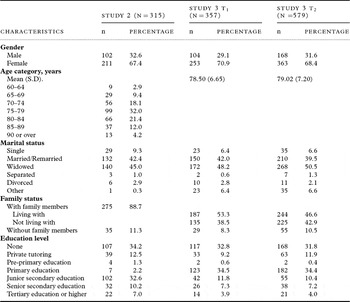
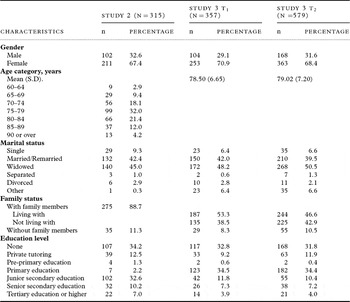
Of the 453 individuals chosen from the list, 138 were not included because of loss of contact, change in mental or communication capacity, or refusal to join. The demographics of the 315 participants are shown in Table 1. There were more females than males in the study, and more than half were aged over 75. About half were widowed, separated, or divorced, and about one third of the participants had never received any education. Except for gender ratio, the distribution of demographic background of the participants in this study resembles that of the overall population of older adults.
Background of the participants in Study 2 (N = 315) and Study 3 (N = 579)
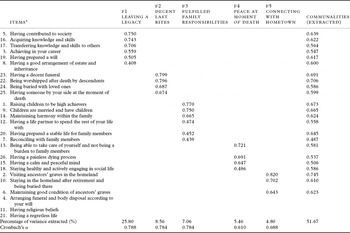
Exploratory factor analysis of the principal axis factor with varimax rotation was performed with the perceived importance of the 26 items of wishes. The correlation matrix was considered to be factorable (KMO = 0.860, Bartlett's test of sphericity = 2339.45, p < 0.000). Examination of the Scree Plot and initial factor analysis identified seven eigenvalues over 1, and the percentage of variance explained ranged from 3.86% to 25.80%. Factors 6 and 7 were discarded, as only two items were included in these factors. The factor loadings are shown in Table 2. Items with loading smaller than 0.40 or double loading were excluded. The 23 items that were left formed the five-factor structure. The first factor, leaving a legacy, consisted of six items describing the contribution to others through transfer of knowledge, skills, and materials. The second factor was related to death rituals that reassure connection with others after death, and labeled decent last rites. Six and four items formed the third and fourth factors, fulfilled family responsibility and peace at moment of death, respectively. The fifth factor was related to the cultural emphasis on returning home, called connection with hometown. The reliability of the five factors is good; Cronbach's α ranged from 0.610 to 0.788. This implies that the items, though correlated well with one another, contribute some unique characteristics in the factor.
Factor loadings for exploratory factor analysis with varimax rotation of Chinese Significant Wish Fulfillment scales and Cronbach's α for each factor
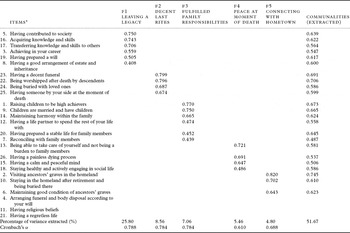
*The English translated version of Chinese items in the measurement
Study 3: Validation
There were 357 and 579 participants for T1 and T2 study. Their demographics are shown in Table 1.
Confirmatory factor analysis
Confirmatory factor analyses were conducted with LISREL-8.8. The first model tested was the five-factor model of 23 items. Item 3, Achieving in your career, was deleted from factor one and formed the second model of five factors with 22 items. It was deleted because interviewers identified a gender difference in the perception of career achievement. In Hong Kong, most women of the older generation were homemakers when they were young. They might not see homemaking as a formal career.
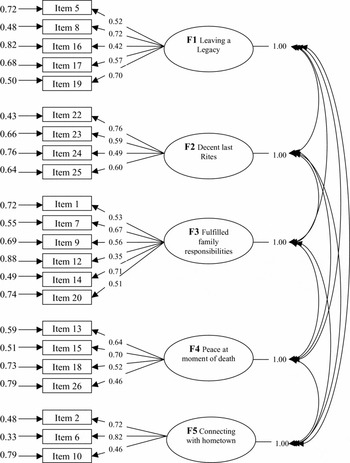
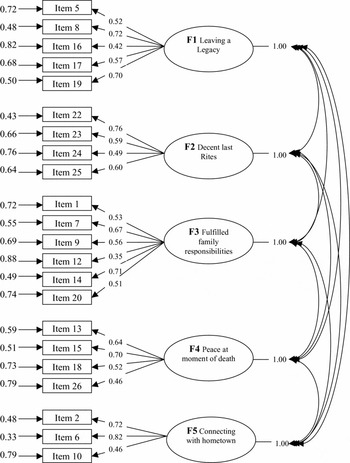
The third model, a three-factor model of 26 items, was based on the findings of Study 1, dividing the items into three dimensions: psychosocial, spiritual, and physical. Lastly, a one-factor model of 26 items was included as a comparison. The indicators of goodness-of-fit of the four models are summarized in Table 3. Of the four models, the second, as shown in Figure 1, is the best fit model. According to Sun (Reference Sun2005), the rule of thumb of cutoff criteria for fit indices is 0.90 for an acceptable model, and 0.95 for a good fit model. For RMSEA with significant p, a value of less than 0.08 is acceptable, though 0.06 is preferred for rigorous standards. In addition, χ2 to df ratio is suggested to be less than 3 under the straight rule, but less than 5 is still within the acceptable level. The slightly larger ratio might be affected by the relatively larger sample size of over 500. Based on these criteria, the second model of five factors and 22 items is still an acceptable model.
Indicators of goodness-of-fit of the four models

NNFI = non-normed fit index; CFI = comparative fit index; GFI = goodness-of-fit index, AGFI = adjusted goodness-of-fit; RMSEA = root mean square error of approximation.
The five-factor model of the CSWFS-22 with standardized parameter estimates.
Test-retest reliabilities
The test-retest reliabilities of the subscales in CSWFS were examined over a one-month interval. They were demonstrated by the correlation coefficients of T1 and T2 measurements of the five factors based on model 2 identified by CFA. All measurements of the five factors and the complete scale obtained at the two time points are correlated with statistical significance. The value of r for the subscales leaving a legacy (F1), decent last rites (F2), fulfilled family responsibilities (F3), peace at moment of death (F4), and connection with hometown (F5) are 0.736, 0.651, 0.670, 0.538, and 0.658 respectively. As for the complete scale of 22 items, the r is 0.724. The general rule of thumb is that 0.7 is an acceptable level. It can be affected by the length of time interval and the fluidity of the construct over time. As CSWFS measures a construct of value that can change over time, a slightly lower value is expected. Except for factor four (peace at moment of death), which is lower than 0.65, the r value of measurements of all other factors have a value higher than 0.65. This can still be considered as having acceptable test-retest reliabilities.
Convergent validities of CSWFS-22
Future regret is expected to have some commonalities with wish fulfillment. The Future Regret Scale was used to test the convergent validity with CSWFS-22.
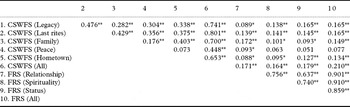
Specifically, a high and significant correlation is hypothesized between CSWFS (Legacy) and FRS (Pursuing Status), CSWFS (Family) and FRS (Pursuing relationship), and CSWFS (All) and FRS (All). The correlation coefficients between the individual factors of CSWFS-22 and Future Regret Scale are shown in Table 4. Though most of the subscales correlated with statistical significance, the order of magnitude of the correlation coefficient is relatively small. All three specific hypothesized correlations are less than 0.2, which are weak correlations. It can be concluded that future regret, as measured by the Future Regret Scale, and wish fulfillment, as measured by CSWFS, seem to have a weak correlation. Convergent validity is not supported.
Summary of intercorrelations for scores of CSWFS-22 and Future Regret Scale (N = 530)
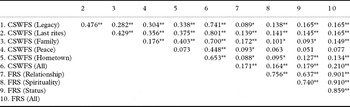
p < 0.05, **p < 0.01.
CSWFS = Chinese Significant Wish Fulfillment Scale; FRS = Future Regret Scale.
Discussion
Psychological measurements used in Hong Kong are commonly Chinese-translated versions of English scales. CSWFS is a measurement grounded in data collected from the local Chinese population. More importantly, instead of consulting local literature, the items were developed from older Chinese adults in Hong Kong, the real experts on the topic and the potential users of the measurement. This approach can be sounder, especially when developing measurements on constructs that are more culturally specific, of which wish fulfillment is one.
The result in Study 1 was surprising. The items generated from the interviews were new to the available literature in Western countries. The emphasis on the connection with the hometown, the perceived importance of caring for the younger generation, and the physical condition at the time of death, appears to be unique for older Chinese adults and might be generalized to other cultures. Further studies can be carried out along this line.
The exploratory factor analysis helps to line up logically the discrete items into five factors. The items in each factor have good internal reliability. The five-factor model, upon more rigorous confirmatory factor analysis in Study 3, was confirmed to be acceptable. Because it is a newly developed measurement, it was difficult for its good-of-fit indexes to meet all the strict cut-off criteria. The current attainment of these indexes to good and acceptable levels demonstrates the promising development of CSWFS. The appropriateness of the test-retest reliabilities also reflects the nature of the measurement. It is relatively stable over time with significant correlation coefficients of 0.6–0.7. However, as the measurement is about the value of one's wishes, some fluctuations over time are expected. Thus, instead of a 0.7 to 0.8 correlation coefficient, a slightly lower one was found.
Conceptually, regret seems to share an underlying construct with wish fulfillment. Surprisingly, the convergent validity of these two constructs cannot be demonstrated empirically in this study. The low correlation might be due to the problem of measurement. The two scales were developed in different cultures, for different age groups, and at different times. The concern and focus of wishes or unfulfilled goals might vary across cultures and time. As reflected by the factors of the two measurements, three factors in CSWFS had difficulty matching the factors of Future Regret Scale. The concern over last rites, connection with hometown, and peacefulness at the moment of death are qualitatively different from the factor of pursuing status, spirituality, or cultivating relationships. Moreover, the relative small sample size, and the inclusion of Chinese older adults from social service centers in Hong Kong only might have some biases for generalization. The CSWFS can be further tested in other populations, examining the generalizibility to other cultural or age groups.
Torges et al. (Reference Torges, Stewart and Nolen-Hoeksema2008) found that those who resolved their regrets had fewer depressive symptoms than those who did not resolve them. Further analysis on correlates of the perceived fulfillment responses of CSWFS with health outcomes can be carried out. The present analysis is focused on the perceived importance of the wishes rather than the perceived level of fulfillment. It examines the cognitive component and value preference of wish or areas of regret. Analysis on perceived fulfillment is more related to the emotional or sensational component of regret, and can give further information on the predictive validity of the scale. If CSWFS is found to have good predictive validity, it can be used as an assessment tool for identifying areas of intervention and for evaluation.
Conflict of interest
None.
Description of authors' roles
All authors were involved in designing the study. A. Chow analyzed the data and wrote the paper. M. Chow and C. Wan supervised the data collection and assisted with writing the paper. K. Wong and R. Cheung supervised and carried out the data collection and assisted with writing the paper.