1. Introduction
In recent years, the impact of party leaders on voting behavior has attracted increasing attention (e.g. Bittner, Reference Bittner2011; Blais, Reference Blais, Aarts, Blais and Schmitt2011; Curtice and Holmberg, Reference Curtice, Holmberg and Thomassen2005; Karvonen, Reference Karvonen2010; King, Reference King and King2002; Nadeau and Blais, Reference Nadeau and Blais1995; Shamir, Reference Shamir1994), leading some scholars to identify a phenomenon of ‘presidentialization’ (Mughan, Reference Mughan2000; Pogunkte and Webb, Reference Poguntke, Webb, Poguntke and Webb2005). While leaders have always been central in presidential systems, studies of parliamentary papers mostly focused on the role of parties. However, even among countries with parliamentary systems, the trend of declining party identification, in conjunction with personality-centered media coverage of politics, combine to make voters pay greater heed to party leaders when they decide how to mark their ballots. Instead of devoting considerable time and effort to comprehend and compare policies advocated by each party, many voters find it easier to rely on leaders as a shortcut to vote choice. In this sense, leader evaluations serve a similar function to party and ideological cues.
Many studies on the electoral impact of leaders (henceforward ‘leader effect’) only focus on a single election (Brown et al., Reference Brown, Lambert, Kay and Curtis1988; Conover and Feldman, Reference Conover and Feldman1989; Stewart and Clarke, Reference Stewart and Clarke1992; Mendelsohn, Reference Mendelsohn1994). While these works provide important insights into the extent and contents of the leader effect, one may question whether their results reflect a long-term development, or are limited to specific contexts of a given election. Extending the analysis by Krauss and Nyblade (Reference Krauss and Nyblade2005), the present paper investigates this question by examining longitudinal data from Japan that cover nearly three decades. This span coincides with periods of fundamental party system changes, thus allowing us to compare the impact of leaders not only over time but also between established and new parties.
Compared with other democracies, leaders in Japan are often depicted as weak due to constraints by both formal and informal power structures (Hayao, Reference Hayao1993; Shinoda, Reference Shinoda2000), so much so that scholars have referred to Japan's ‘missing leader’ (Massey, Reference Massey1975). However, the early 2000s seemed to herald a drastic change. The media often characterize this period as the ‘Koizumi theater’, named after a dominant prime minister whose charisma and often-confrontational style culminated in his party's landslide victory in the 2005 House of Representative election. How important was the personality of Koizumi in bringing about this outcome, and, more importantly, was this example of the leader effect limited to one charismatic individual at a single point in time, or does it represent a prevalent tendency? The following pages seek to answer these questions.
The paper is organized as follows: The next two sections review important works on presidentializationFootnote 1 in parliamentary systems and leaders' electoral impact. This is followed by a review of the literature on the impact of leaders in Japan. Section 5 introduces the data and variables. Section 6 presents and analyses empirical results for the impact of leader evaluation on all voters, while section 7 examines the magnitude of the leader effect by partisanship and media exposure. The last section summarizes and discusses major findings.
2. Personalization of politics in parliamentary systems
Unlike presidential candidates, leaders in parliamentary systems are more closely identified with their parties and less visible in the electoral process (Bean and Mughan, Reference Bean and Mughan1989) because elections revolve around ‘choices about parties, combining policies, teams of legislative candidates, and collective leadership’ rather than individual leaders (McAllister, Reference McAllister, LeDuc, Niemi and Norris1996). Butler and Stokes' observation that ‘attitudes towards the parties were a better guide to voting behavior than attitudes toward the leaders’ (1974: 363) seems applicable to parliamentary contests in general. This is mainly because voters in parliamentary systems tend to associate policies with parties rather than leaders (Bean, Reference Bean1993: 117-18).
However, recent social and technological developments have created conditions for an enhanced leader effect. Graetz and McAllister (Reference Graetz, McAllister, Clarke and Czudnowski1987b) identify three trends that help to raise leaders' electoral impact: the decline of class voting, growth of the electronic media, and weakening of party attachments, while Schmitt and Ohr (Reference Schmitt and Ohr2000) classify these causes into supply and demand sides (de-alignment and media, respectively) that facilitate a growing leader effect. As traditional channels of mobilization become less effective, parties seek to substitute them by focusing on the leader (Graetz and McAllister, Reference Graetz and McAllister1987a). Leaders can exert greater influence when the electorate is de-aligned (Bean and Mughan, Reference Bean and Mughan1989; Clarke et al., Reference Clarke, Jenson, LeDuc and Pammett1991), because independents ‘are more likely to consider all the options, and to look especially at how they feel about the various leaders’ when deciding how to vote (Blais, Reference Blais, Aarts, Blais and Schmitt2011: 5). Analysis of cross-national data leads Curtice and Hunjan to confirm that ‘leadership evaluations matter more in countries with relatively few party identifiers’ (2011: 102). These arguments can be succinctly summed up as ‘where parties matter less, leaders tend to matter more’ (Holmberg and Oscarsson, Reference Holmberg, Oscarsson, Aaats, Blais and Schmitt2011: 50).
Voters are frequently assumed to lack familiarity with details on specific issues, relying instead on information shortcuts when deciding how to vote. Where strong partisan and class identification once provided such low-cost cues, party leaders may have come to play part of this role today (Poguntke and Webb, Reference Poguntke, Webb, Poguntke and Webb2005; Schmitt and Ohr, Reference Schmitt and Ohr2000).Footnote 2 Edelman emphasizes that leaders are more readily utilizable symbols because ‘it is easier to identify with them, support or oppose them, love or hate them’ (1988: 39). Similarly, Maeda states that leaders are easy to assess, whereas parties constitute ‘a far more difficult object of evaluation’ (2011: 157). The ease of identification means that voters also demand accountability from individual leaders rather than the more abstract institutions (McAllister, Reference McAllister, LeDuc, Niemi and Norris1996). One can thus expect an inverse relationship between the importance of long-term effects and more immediate causes such as leader profiles on vote choice.Footnote 3
Changes in forms of political communication, particularly television, also contribute to amplifying the electoral impact of leaders (Norris et al., Reference Norris, Curtice, Sanders, Scammell and Semetko1999; Swanson and Mancini, Reference Swanson and Mancini1996) television is inherently more suited to the visual and oral projection of personalities than examination of complex policy issues (e.g. Kavanagh, Reference Kavanagh1995; Scammell, Reference Scammell1995). Leaders provide convenient visual shortcuts to capture the attention of audiences, and parties take advantage of this by marketing their policies through leaders (McAllister, Reference McAllister2004). Consequently, leader evaluations have a greater impact on vote choice among voters with greater exposure to media coverage of election campaigns (Gidengil et al., Reference Gidengil, Blais, Nevitte, Nadeau, Farrell and Schmitt-Beck2001; Mendelsohn, Reference Mendelsohn1996).Footnote 4 Furthermore, one can interpret this leader-centered presentation as an appeal to individual voters' emotions rather than to their social or partisan ties (Combs and Nimmo, Reference Combs and Nimmo1993).
Parties are not merely reluctant followers of media trends, but often-complicit partners in the personalization of politics which cater to media demands by concentrating on symbolism (Bowler and Farrell, Reference Bowler, Farrell, Bowler and Farrell1992). Mughan (Reference Mughan1993) attributes responsibility for personalization to parties rather than the media, and Pogunkte and Webb also assert that ‘much of this so-called mediatization of politics may be the result of conscious choice by politicians to exploit the visual media's potential for simplification and symbolism for their own ends’ (2005: 15).Footnote 5 Parties may even attempt to change their image by choosing new leaders (LeDuc, Reference LeDuc, Mancuso, Price and Wagenberg1994).
Institutions also make a difference. With regard to electoral rules, the leader effect is generally stronger in plurality or majoritarian systems than proportional systems (Holmberg and Oscarsson, Reference Holmberg, Oscarsson, Aaats, Blais and Schmitt2011). Scholars have long analyzed personal votes for candidates, which were prevalent under the previous single-member non-transferable vote (SNTV) system used prior to 1994. To the extent that a personal vote highlights the role of individual candidates at the expense of party labels or policy platforms, it detracts from a focus on parties and their leaders. Similar to Karvonen's (Reference Karvonen2010) list of how electoral system changes in established democracies affect the propensity for personal vote, one can assume that rules which emphasize the party label and allow leaders a greater say in determining party nominations and platforms would rank higher on a list of how institutional arrangements influence the extent of leader effects. Rahat and Sheafer (Reference Rahat and Sheafer2007) attribute institutional change as a major reason behind personalization in Israel, and Krauss and Pekkanen (Reference Krauss and Pekkanen2011) provide details of how reforms in not only electoral but also administrative institutions enhanced the power and profile of the prime minister in Japan.
In sum, party leaders in parliamentary democracies have come to play a more salient electoral role in recent years, due to both increasing de-alignment among the electorate and the growing importance of the electronic media as a source of political information. Changes in institutional rules may also enhance the profile of leaders. Parties may adapt to or even accelerate this trend by choosing to conduct leader-centered campaigns.
3. The electoral impact of leaders
The personalization of politics does not imply that voters now consider leaders more important than other factors such as partisanship and ideological proximity, nor does it mean that a party only needs a popular leader to win an election. Instead, the emphasis is on the increasing impact that leaders have on the electoral performance of their parties, as evidenced by parties that sought to improve their fortunes through leadership changes (e.g. Nadeau and Mendelsohn, Reference Nadeau and Mendelsohn1994). Mughan emphasizes that, especially in multi-party systems, ‘parties cannot afford to ignore the difference, even if only at the margins, that their leaders can make’ (2000: 114). Similarly, LeDuc's Canadian study shows that ‘leaders are a consistently important part of the electoral equation, both in their unique effects on individual voting behavior and in conjunction with issues’ (1994: 71).Footnote 6 Note that while favorable impressions of a leader can motivate voters to support his/her party, it is also possible that the direction of causation may be reversed, namely that loyalty to a given party may prompt voters to rate its leader more positively.
The scope of leader effect may vary not only as a function of institutional structures, but also depending on specific contexts. For example, Schmitt and Ohr (Reference Schmitt and Ohr2000) observe significant leader effect for large German parties, but not small ones, on both party preference and vote choice. Explaining vote choice within each ideological block in Portugal, Lobo (Reference Lobo2006) finds significant leader effect for parties on the right, but not those on the left. Shamir (Reference Shamir1994) argues that leader effect would be stronger in elections where issues are less well defined, and also where leaders are more independent of their parties. In a comparative study of seven European countries, Lobo (Reference Lobo2008) highlights differences by party type: leader effect is more important in explaining support for catch-all parties than class- and denomination-based parties.
One can better appreciate the scope of leader effect by comparing it with other factors that influence voting behavior. Stewart and Clarke (Reference Stewart and Clarke1992) find that leader effect has greater predictive power for vote choice in the UK than issues and economic evaluations combined. Party identification is still by far the most influential variable in explaining vote choice in Australia, New Zealand, and the UK, though leader effect is not negligible (Bean, Reference Bean1993; Mughan, Reference Mughan1993).Footnote 7 In a comparative study, Bittner reports that ‘voters’ perception of leaders play a role that is larger than the effect of either socio-demographic characteristics or attitudes towards policy issues areas, and are more on par with the effects of ideology and partisanship’ (2011: 113).
Scholars have also investigated whether leader effect is specific to certain leaders and circumstances, or constitutes a long-term structural trend. McAllister (Reference McAllister2004) presents two rival hypotheses: presidentialization, referring to increasing leader effect due to changes in administrative and media organization, and incumbency, namely that the effect varies with individual leaders. Mughan argues that personalization of politics is ‘a change that is here to stay’, because parties increasingly rely on the ‘the essentially visual and personality-based medium of television’ to communicate with voters (2000: 127, 129). Pogunkte and Webb consider this trend as deriving from structural developments, and hence ‘unlikely to be reversed’ (2005: 21). However, this is not to suggest that contexts make little difference. For example, Kaase concludes that ‘it is the specific combination of candidates and political context which defines the candidate impact for each individual election’ (1994: 222), and Mughan points out that ‘the salience of party leaders varies with the circumstances and personalities of individual elections’ (1993: 196).
At the same time, one should note that the question of whether party leaders do indeed play an increasingly prominent electoral role is still a subject of debate, as a number of studies report inconclusive or negative results (e.g. Bartle and Crewe, Reference Bartle, Crewe and King2002; Brettschneider and Gabriel, Reference Brettschneider, Gabriel and King2002; Kaase, Reference Kaase1994). Curtice and Holmberg find that, after controlling for a range of factors, including party identification and evaluation, there has been no upward trend in the effect of leader ratings on vote choice over time (2005: 241–6). Similarly, Karvonen points out that ‘it would be exaggerated to speak of a pervasive and linear development across the universe of parliamentary democracy’ with respect to the electoral impact of party leaders (2010: 35). Instead, patterns vary considerably across countries. Thus, the extent to which party leaders in parliamentary democracies have come to play a more salient electoral role in recent years, due to both increasing de-alignment among voters and the growing importance of the electronic media as a source of political information, remains an open empirical question, which can best be tested through longitudinal analysis.
4. Leader effect in Japan
In the Japanese context, leader effect has garnered much attention since Koizumi JunichiroFootnote 8 formed his first cabinet in 2001, with some scholars identifying this date as the beginning of ‘a new model of political leadership that is based on public popularity’ (McElwain and Umeda, Reference McElwain and Umeda2011: 173). ‘Populist’ Koizumi tactically exploited media coverage to show himself as a strong leader who stood against the old cadre of the ruling Liberal Democratic Party (LDP). In 2001, the Koizumi cabinet started with an 80% approval rate, based on support from not only LDP identifiers but also its rival Democratic Party of Japan (DPJ) supporters and independents (Ikeda, Reference Ikeda2007). Although his popularity gradually declined, especially among the opposition party supporters, Koizumi's popularity directly exerted an impact on voting behavior independent of party support (Ikeda, Reference Ikeda2007; Hirano, Reference Hirano and Seiji2008). One study specifically cites the 2005 election as a case ‘in which the high popularity of the prime minister [Koizumi] overrode local contexts and candidate characteristics’ (Maeda, Reference Maeda, Reed, Mori McElwain and Shimizu2009: 50). At the same time, despite the common perception that ‘Koizumi theater’ enthralled voters to support the LDP, the amount of TV programs people watched did not mediate the extent of leader effect (Ikeda, Reference Ikeda2007).
Findings on leader effect prior to the Koizumi era are mixed. Maeda (Reference Maeda2011) notes that the correlation between cabinet approval (proxy for prime minister appraisal) and LDP support was much stronger under Nakasone Yasuhiro, a popular prime minister in the 1980s, compared with Koizumi. On the other hand, another study finds that Nakasone had little influence on people's vote in 1983 after controlling for party support (Miyake, Reference Miyake1989).Footnote 9 Analyzing a survey in Sapporo City, Hokkaido, Araki, Aiuchi, Kawato, and Hasuike (Reference Araki Toshio, Aiuchi Toshikazu, Sadafumi and Minoru1983) find that Ohira Masayoshi, a traditional consensus-oriented type of prime minister, exerted weak impact on vote choices in the 1979 and 1980 elections. Miyake (Reference Miyake1989) asserts that positive leader appraisal is not sufficient to boost party evaluation. On the other hand, Mori Yoshiro, another consensus-oriented leader, influenced people's choice in the proportional tier of the 2000 lower house election, and former prime minister Obuchi Keizo had an impact on vote choice in the district tier vote in the 2000 election (Kabashima and Imai, Reference Kabashima and Imai2001).
The most systematic study on the impact of leaders was carried out by Krauss and Nyblade (Reference Krauss and Nyblade2005), who trace support for the cabinet and the long-ruling LDP since the 1960s, and report increasing divergence between these two indicators that, in combination with a growing proportion of non-partisan voters, led to the conclusion that (1) ‘prime ministerial support has increasingly affected support for the LDP and election results’, and (2) ‘the impact of prime ministers’ popularity on voters has increased significantly in the last twenty years' (Krauss and Nyblade, Reference Krauss and Nyblade2005: 365, 367). While a major overhaul of the electoral system enhanced the salience of leaders, Krauss and Nyblade show that a leader effect was already evidence in the late 1980s, partly due to changes in media coverage of political news. The implication is that focus on the leader is positively related to media exposure, a point to which we will return. Another study specifically points to the contrast between relatively constant rates of LDP support and very high approval for the Koizumi cabinet as evidence of the party's dependence on its leader's image (Krauss and Pekkanen, Reference Krauss and Pekkanen2011: 240).
There are only a few studies on the effect of opposition party leaders. While no leader effect was observed for Asukata Ichio of the Japan Socialist Party (JSP) (Araki et al., Reference Araki Toshio, Aiuchi Toshikazu, Sadafumi and Minoru1983), Ishibashi Masashi of JSP affected voting behavior in 1983 (Miyake, Reference Miyake1989). Kabashima and Imai (Reference Kabashima and Imai2001) found that Hatoyama Yukio and Ozawa Ichiro of DPJ separately influenced vote choices in both the district and PR tiers in the 2000 election.
One possible explanation for the increasing role of party leaders lies in administrative reforms which enhanced prime ministerial policy-making powers vis-à-vis intra-party organs (e.g. Estevez-Abe, Reference Estevez-Abe2006; Takenaka, Reference Takenaka2006). The prime minister was given both explicit legal authority to initiate policymaking, and a Cabinet Office that contains advisory councils to the prime minister and increased staff (Krauss and Pekkanen, Reference Krauss and Pekkanen2011: 234–5). These institutional renovations boosted the potential to exert executive leadership. One high-profile example of how this boosted prime ministerial power is Koizumi's use of the Council on Economic and Fiscal Policy, and thus circumvented the finance ministry and interest groups connected to it, in pursuing his reform program.
Meanwhile, a major reform of electoral rules in 1994 has contributed to strengthening the electoral salience of leaders, directly by inducing a shift from candidate-centered to more party-centered electioneering, and indirectly by creating incentives toward a two-party system. There is evidence that campaigns have indeed become more focused on parties (Maeda, Reference Maeda, Reed, Mori McElwain and Shimizu2009), and that the electoral outcome now depends on national trends rather than local factors (McElwain, Reference McElwain2012: 325). Against the background of a de-aligned electorate, this pattern of competition means that leaders can have a greater impact on the fortunes of their parties than in the past. In particular, the proportional component of the electoral systemFootnote 10 focuses exclusively on party labels, and gives leaders with the chance to determine candidate ranking on the party list. Kabashima and Imai (Reference Kabashima and Imai2001) and Hirano (Reference Hirano and Seiji2008) suggest differences in leader effect between the district and proportional tiers of the new electoral system: while Mori had a greater impact in the party list than the district tier in the 2000 election (Kabashima and Imai, Reference Kabashima and Imai2001), Hirano (Reference Hirano and Seiji2008) finds that the Koizumi effect was stronger in the latter than the former.
Since many of the studies cited above focus on one specific election, or at most a few elections under the same prime minister (with the significant exception of Krauss and his colleagues), it is difficult to interpret their mixed findings due to the different models used. To examine changes in and causes of the electoral impact of party leaders, it is necessary to analyze comparable survey data over time. Doing so would enable one to place findings reported in previous works within a longitudinal perspective. Our study takes a step beyond Krauss and Nyblade (Reference Krauss and Nyblade2005) by (1) examining leaders of opposition as well as governing parties, (2) using direct evaluations of party leaders, rather than the indirect proxy of cabinet approval, as an independent variable, (3) analyzing individual-level data to investigate the causes of vote choice, rather than macro-level electoral results, and (4) controlling for other factors that can influence vote choice, such as party assessment and ideology. After confirming a growing leader effect over time, we will attempt to relate this to two key structural trends observed in Japan, namely decreasing party attachment and expanding media role. The proportion of independent voters increased in the early 1990s, and people now not only spend more time watching TV than in the past, but are also more oriented toward news programs rather than entertainment.
5. Data and variables
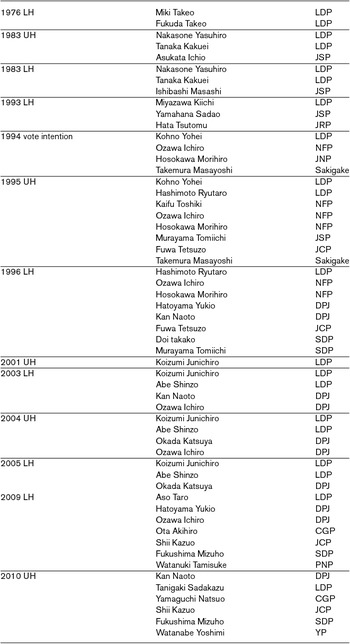
To investigate the presence and magnitude of leader effect in Japan, we use all currently available datasets which contain questions on leader evaluations, along with partisanship and ideology, two other variables that have often been found to influence vote choice. Data analyzed in this paper include the Japan Election Study (JES) series during three periods (JES I: 1983; JES II: 1993–96; JES III: 2001–05), as well as surveys conducted by the GLOPE center at Waseda University for more recent elections (2009–10).Footnote 11 This covers a total of six House of Representatives (lower house) and four House of Councilors' (upper house) elections over more than a quarter-century, plus a non-election year, 1994, that allows us to explore leader effect for new parties. Table 1 lists all leaders examined below.
List of party leaders and abbreviations

Note: LH = lower house (House of Representatives) election; UH = upper house (House of Councillors) election.
Party labels: LDP = Liberal Democratic Party; JSP = Japan Socialist Party; JRP = Japan Renewal Party; NFP = New Frontier Party; JNP = Japan New Party; DPJ = Democratic Party of Japan; SDP = Social Democratic Party; CGP = Clean Government Party (Komeito); PNP = People's New Party; YP = Your Party.
This longitudinal span is particularly important in view of drastic party system changes over the past two decades. At the risk of over-simplification, one can identify three stages of party system development: the so-called 1955 system which persisted until the early 1990s, characterized by the LDP's single-party dominance and its rivalry with the JSP; a period of reconfiguration involving frequent party mergers and splits from the 1990s until the early 2000s; and the gradual emergence of bipolar competition between the LDP and the DPJ since the mid-2000s. During the second stage, the proportion of independent voters increased dramatically, while the third stage witnessed the DPJ's rise with a corresponding decline in independents (Tanaka et al., Reference Tanaka, Kohno, Hino and Iida2009). Our data include at least one upper and lower house election from each stage.
The dependent variable is coded dichotomously, 1 for respondents who reported voting (or intending to vote) for a given party, and 0 otherwise. Using the party list vote would allow for a straightforward test of the role that each leader played in attracting voters to his/her party, since it precludes any influence exerted by district candidates. Yet one should keep in mind that, prior to an electoral reform law passed in 1994, voters could only mark their ballots for candidates rather than parties in lower house elections.Footnote 12 Thus, for the purpose of comparability over time, we run separate equations for each leader in both the district and proportional tiers.
Leader effect, the key independent variable in this study, is measured by a feeling thermometer score ranging from 0 (least favorable toward a leader) to 100 (most favorable).Footnote 13 The inclusion of party and ideology variables in the same equation provides some reassurance that any leader effect we find is not a proxy for partisanship or policy preference. Furthermore, we explore the effect not only of each party's titular leader at the time of an election, but also other leading figures in its ranks whose names appear in the survey questionnaires. Where these items are available, one can compare whether party leaders exert a greater influence than their lieutenants.
While each survey questionnaire solicited respondents' party identification, we choose a separate party feeling thermometer variable (also on a 0 to 100 scale) for the analysis below, because this allowed us to measure gradations of support. In a context of multi-party competition, having a favorable attitude toward one particular party does not necessarily imply uniformly negative appraisals with respect to all its competitors. Using a dichotomous coding of party identification would not capture this dynamic. Furthermore, recent decades saw a sharp increase in the proportion of Japanese voters who do not identify with any party, rendering the feeling thermometer item more appropriate due to sample size considerations.
The ideological self-placement question does not always contain the same number of response categories over time. Since each election is examined separately, retaining the original coding (1–5 in 1983; 1–10 in 1993–96; 0–10 in 2003–2010; higher scores denote more conservative positions) does not impair the purpose of our study. All equations contain six demographic controls: age, gender, education, household income, length of residence, and the size of respondents' community.
It is important to note that while there may be voters who cast a ballot for a given party, then cite positive assessments of the party and its leader as retrospective justification, the literature on voting behavior in general, and on presidentialization in particular, treats leader evaluations (along with party identification and ideology) as casually prior to vote choice. We follow this established practice in the analyses below.
6. Testing leader effect over time
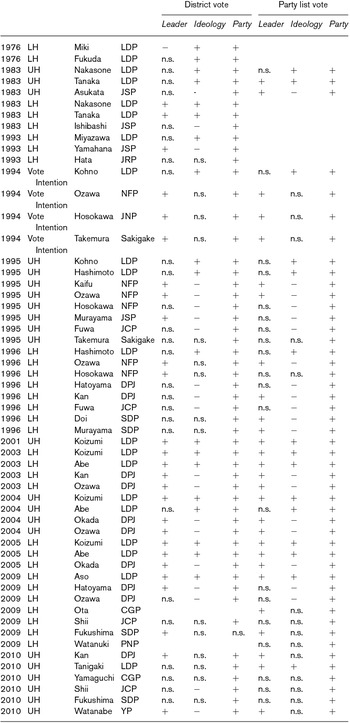
Since the dependent variable is dichotomous, the most appropriate method for analyzing our data is binomial logistic regression. Results for the aforementioned three stages of party system development – the 1955 system, reconfiguration with frequent mergers and splits, and emerging bipolar competition – are shown in Table 2; findings for each leader are presented separately.Footnote 14 The most significant variable in almost all equations is the party feeling thermometer, an unsurprising finding that requires little comment. Instead, what we are most interested in is whether leaders influence vote choice independent of their parties.
Effect of party favorability, ideology, and leader evaluation on vote choice

Note: LH = lower house (House of Representatives) election; UH = upper house (House of Councillors) election.
Significance at p< 0.05 level.
Data from the 1980s are limited to one upper and lower house election each, and respondents were only asked to assess leaders of the two major parties: LDP and JSP. The fact that results appear quite mixed is in itself worthy of note. Prime minister Nakasone and former prime minister Tanaka Kakuei were among the most prominent and charismatic politicians of their era, and are still touted as examples of executive leadership today, yet how voters rated these two leaders had no significant impact on whether they supported the LDP in the 1983 upper house election (district tier).
Comparing the impact of Nakasone and Tanaka evaluations over two elections, one may infer that leader effect is more likely to be found in House of Representatives than in House of Councilors' polls, though this seems counter-intuitive because during this period a party list vote was only available on upper house ballots (all lower house members were elected from districts). Ideology is consistently significant, with self-identified conservatives and progressives significantly inclined to support the LDP and JSP, respectively. This is in line with a common characterization of the 1955 system as ideologically polarized.
The 1955 system broke down in the early 1990s, with the birth of several new centrist parties (including parties that split from the LDP) and the JSP's decline from major to minor party status. Surveys in the mid-1990s contain questions about a larger number of politicians, including not only leaders of new parties but also other major political figures. One of the most notable findings is the difference between old and new parties. Ratings of neither any LDP leader (Miyazawa Kiichi, Kohno Yohei, Hashimoto Ryutaro) nor the Japanese Communist Party's (JCP) Fuwa Tetsuzo affected voters' likelihood of supporting these established parties. In contrast, leaders of three new parties – Ozawa Ichiro of the Japan Renewal Party (JRP),Footnote 15 Hosokawa Morihiro of the Japan New Party, and Takemura Masayoshi of Sakigake – all exerted a significant influence. Faced with an unfamiliar party name, it may be easier for voters to associate it with the concrete image of its leader rather than a set of abstract policies. This does not apply to all new parties, however, as evidenced by insignificant coefficients for the co-founders of the Democratic Party of Japan (DPJ), Hatoyama Yukio and Kan Naoto, in the 1996 lower house election (district tier).
Another noteworthy contrast between old and new parties is that, for most of the latter, ideology did not initially affect vote choice. The example of JRP, which merged into the New Frontier Party (NFP), illustrates a typical trajectory in determinants of support. In 1994, ideology played no role while appraisal of Ozawa had a significant impact. As voters became more familiar with this party, the support base of NFP shifted from a non-ideological center ground toward a progressive position, even though many of its leaders and members originated from the LDP.Footnote 16 The same can be said of Sakigake, another new party with its roots in the LDP. In contrast to these new parties, ideology remained significant for the LDP, JSP, and JCP through this period of party system upheaval.
While new parties continued to be formed well into the 2000s, most scholars and practitioners characterize this as a period of two-party system consolidation centered around the LDP and DPJ, with small parties only able to become junior coalition partners at best. The first half of this decade was dominated by the charismatic and unconventional LDP Prime Minister Koizumi, but he was by no means the only party leader to exert a significant impact on vote choice. In contrast with the previous two decades, coefficients for leaders of both major parties are consistently significant in the 2000s. These results confirm the existence of a substantial leader effect for not only Koizumi, but also his LDP successors as well as DPJ opponents.
One also finds significant leader effect among minor parties, such as Fukushima Mizuho of the Social Democratic Party (SDP; successor to the JSP) in the 2009 lower house election and Watanabe Yoshimi of the newly established Your Party in the 2010 upper house polls. The JCP is the only party impervious to any leader effect. However, one must be cautious in interpreting these results, since they are based on relatively small sample sizes (reflecting the declining vote shares of small parties throughout the 2000s).
Small N may also partly explain the surprising finding that ideology no longer animated support for SDP and JCP, both of which have long anchored the progressive end of the left right scale. At the same time, one may also detect an overall decline in the impact of ideology on voting behavior: for the 2010 upper house election, this variable is insignificant for not only CGP and Your Party, but also the DPJ. Whereas DPJ had consistently attracted progressive voters throughout the 2000s, ideology ceased to make any difference once it took over the reins of government. Nevertheless, it would be hasty to draw conclusions based on results from a single election.
In sum, empirical results indicate that leader evaluations have become more important over the last three decades as a factor affecting vote choice. At the same time, one should also note that the increasing salience of the leader effect has not diminished the impact of partisan attitudes. Feelings toward parties continue to exert a substantive influence on vote choice. In contrast, ideological orientations seem to have less bearing on vote choice today, though one must wait for analysis of future elections to affirm whether this represents a definite trend.
How much difference do leaders make? Comparing magnitudes of leader effect
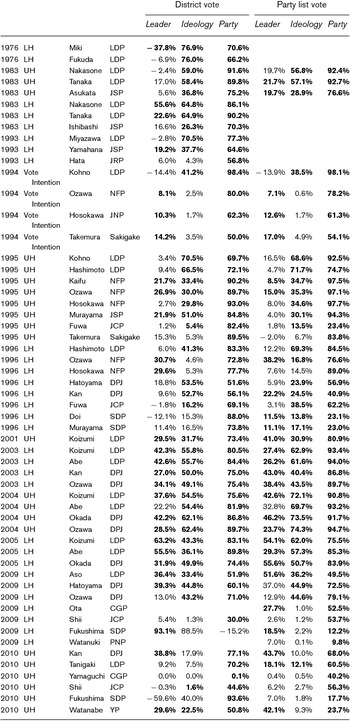
Since coefficients from logistic regressions are difficult to interpret, we calculated the likelihood of voting for each party by comparing probabilities (ranging from 0 to 1) between the maximum and minimum values of a selected independent variable while holding all other variables at their mean. This procedure allows one to quantify how much difference it makes if a leader is universally admired or abhorred. Results comparing the impact of party favorability, ideology, and leader effect are shown in Table 3. Once again, it comes as no surprise that someone who assigns a given party the score of 100 would be much more likely to vote for it than someone who rates this party at 0, and this effect held true throughout the entire time span covered by our analysis, though one notes a decrease in the importance of party favorability in the more recent rounds of elections (2009 and 2010).
Change in probability of vote by party favorability, ideology, and leader evaluation

Note: Bold Numbers indicate statistical significance.
A similar observation can be made with respect to the impact of ideology. This variable exerted as much influence in 1983 as in 2003–05, changing party system configurations notwithstanding, but did not make much difference by 2010. Furthermore, the effect of ideology seems to have become one-sided, exerting a more substantial and consistent impact on the conservative than the progressive side of politics. Ideology has always played a highly significant role for LDP voters. This applies not only to the early 1980s, under the polarized 1955 system (though this variable did not motivate JSP voters to the same extent), but also in the mid-1990s and early 2000s, when the LDP no longer faced an ideologically distant main rival. In fact, DPJ support became as inspired by progressive inclinations as the LDP vote was driven by conservative orientations in 2003–05, despite a long-term trend toward party system de-polarization.
The most remarkable development in the past quarter-century, however, is the increasingly substantial role of leader evaluations. In the 1980s and 1990s, where this variable is significant, moving a leader's feeling thermometer score from 0 to 100 only makes a voter 10–20% more likely to vote for his/her party on average.Footnote 17 This was true even for parties that were identified more with their leaders than policies, such as Hosokawa's Japan New Party and Takemura's Sakigake. The only exceptions were Nakasone for the LDP in the 1983 House of Representatives election and Ozawa for the NFP in 1996 – both of which are examples of strong personalities leading large parties. These exceptions seem to confirm the rule that a leader effect existed only where dominant, visionary figures led their parties into an election campaign.
In stark contrast, we see a substantial leader effect evident in every election during the 2000s. While one would expect such a finding for Koizumi, whose charisma was widely credited for the LDP's landslide victory in the 2005 House of Representatives election, the same result applied to his DPJ opponents with less forceful personalities, Kan and Okada Katsuya. Indeed, even politicians who were not party leaders sometimes exerted considerable influence over how their parties fared (Abe Shinzo for the LDP, Ozawa for the DPJ in 2003). Leaders continued to have a large impact after the curtain fell on the so-called ‘Koizumi theater’: appraisals of both LDP leader Aso Taro and DPJ leader Hatoyama substantially affected whether voters supported their respective parties in the 2009 election, even though both leaders only assumed their positions not long before the election (this also applies to the DPJ's Kan in the 2010 election). In short, while feelings toward Koizumi heavily influenced LDP support, this effect was limited neither to him nor to his party.
7. Partisan de-alignment, media exposure, and leader effect
Having demonstrated that party leader evaluations have come to exert an increasing influence on voting behavior, the next logical step is to investigate mechanisms which propel this trend. Two main explanations for the growing importance of party leaders are identified in the literature: partisan de-alignment and greater television exposure. We therefore examine two hypotheses below:
– leader evaluations would have a greater impact on vote choice for citizens without partisan affiliations;
– leader evaluations would have a greater impact on vote choice for citizens who watch more news programs on television.
To test the first hypothesis, we classify respondents who voted for a given party into three categories: those who identify with this party (‘party base’); those who identify with another party (‘other party supporter’); and those who do not support any party (‘independent’). We expect that the last group would be more likely to consider leader’ attributes and qualifications when deciding how to vote, while those belonging to the party base would be least likely to do so, since their choice is motivated by partisan loyalty rather than positive impressions of any particular leader. Leader ratings may have a greater influence on ‘other party supporters’ than the party base, since among the former group liking the leader of the party they vote for may be one reason why they turned away from the party they normally identify with.
To test the second hypothesis, we divide respondents into three groups according to the number of election-related television news programs they saw. The 1983 survey asked about the frequency of watching television coverage about the election (how many times a week), while subsequent surveys provided respondents with a list of news programs from which they could choose multiple answers. While the programs mentioned in each survey necessarily vary across time, we count them similarly for the purpose of longitudinal comparability.Footnote 18 We expect a linear increase in the importance of leader evaluations for vote choice as respondents watch more reports about the election. Note that this variable is limited to television, since it is the most common source of political information, and also due to the propensity of visual (rather than print) media to use images and sound-bites that facilitate leader-centered coverage.
Dividing respondents who voted for each party into smaller groups obviously raises concerns about sample size. Due to the limited number of voters supporting small parties, the analysis below only focuses on the two largest parties contesting each election.
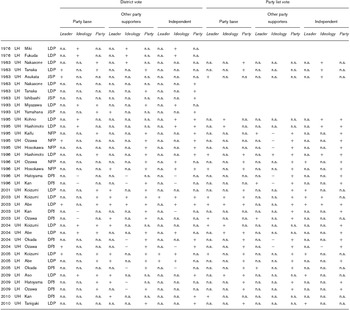
Similar to the preceding section, Table 4 presents logistic regression results for party evaluation, ideological orientation, and leader rating, among three groups of partisans. It is notable that party evaluations were largely insignificant among the party base during the 1990s, but became an important factor in the 2000s. Greater variance in party ratings and voting behavior among the base implies that these respondents may now defect if they deem their “own” party inadequate. This variable is also frequently significant among independents. Even though they do not identify with any party by definition, they may still have more favorable views toward some parties than others. Ideology has not mattered greatly for vote choice in the more recent elections, as a convergence of (major) party positions on many salient issues led to the blurring of parties' ideological profiles.
Effect of party favorability, ideology, and leader evaluation on vote choice by partisanship

Note: LH = lower house (House of Representatives) election; UH = upper house (House of Councillors) election.
The hypothesis that independent voters are more likely to vote based on leader evaluations is not confirmed, since leader ratings are not more frequently significant among independents than either the party base or supporters of other parties. This finding is similar to results reported by Karvonen (Reference Karvonen2010) that party switchers do not have stronger preferences on leader evaluations than the party base. Insofar as Table 4 reveals any pattern, it has to do with variations over time rather than type of partisanship. Specifically, whereas leader evaluations did not have much impact on vote choice in most cases in the 1990s, they came to exert considerable influence in elections during the first half of the 2000s. Also, while one may expect a larger leader effect for the DPJ since voters are less familiar with its policies than those of the long-established LDP, comparing the importance of leader evaluations between these two parties reveals that leader ratings actually mattered more frequently for LDP voters. Indeed, leader evaluations were never significant for independents who decided to vote for the DPJ.
Interestingly, while leader effect (or the absence thereof) for the DPJ are similar across both single-member district and PR tiers, glancing through the LDP results reveals a striking difference: significant leader effect is often found among ‘other party supporters’ in district contests, but not for the party list. It is reasonable to surmise that the ‘other party supporter’ category probably included many voters who identified with a small party that did not nominate a district candidate. Short of abstention, they were compelled to choose a candidate from another party (in most cases either the LDP or DPJ), and how they assessed each available candidate's party leader could play an important role in their decision. In contrast, these voters could cast a PR ballot for their preferred party, so one does not observe a leader effect in the party list tier.
It is not coincidental that all cases where a leader effect is evident among more than one group of voters are found in the early 2000s, and nearly all these instances involve then Prime Minister Koizumi and his right-hand man, LDP secretary general Abe. This highlights not merely the mass appeal of these two leaders but also their successful media management (or ‘spin’). Since subsequent leaders did not usually have the same impact on the electorate, results in Table 4 suggest that greater leader effect among non-partisans (and other groups of voters) may not constitute a linear trend, but is instead highly dependent on individual leaders' personal attributes.
We should also note that the correlation between evaluations of a given party and its leader(s) is generally lower among independents, and often highest among other party supporters. Not surprisingly, these correlations are usually high, mostly ranging from 0.6 to 0.8, though one cannot deduce whether this implies any causal relationship. Interestingly, correlations between party and leader ratings are notably lower for Ozawa (DPJ) in 2004 and especially Koizumi (LDP) in 2001. Ozawa was not party leader in 2004, and had only joined the DPJ one year before the election. In contrast, Koizumi's case can be explained by his projected image as being different from traditional LDP party bosses, allowing him to win a landslide victory in 2001 by in effect running against his own party.
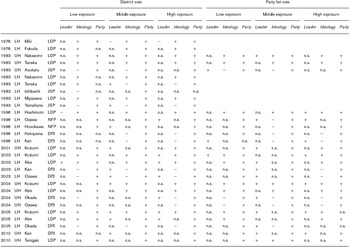
Turning to the effect of media exposure on vote choice, Table 5 presents results by the amount of election-related coverage respondents watched on television. A quick glance through the leader columns for each group of voters reveals a striking difference between the ‘low exposure’ category and the rest of our sample: whereas a significant leader effect is often found among respondents who watched two or more news programs, leader evaluations rarely made any difference for those who hardly followed the election on TV. This confirms that exposure to visual media outlets does indeed exert a powerful political influence. At the same time, similar frequency of significant leader effect between the ‘medium’ and ‘high’ exposure groups suggests a (low) threshold for the effect of TV coverage. Once citizens show some interest in election-related news (i.e. watch at least two programs), increasing exposure does not necessarily lead to a corresponding rise in the magnitude of leader effect.
Effect of party favorability, ideology, and leader evaluation on vote choice by TV exposure

Note: LH = lower house (House of Representatives) election; UH = upper house (House of Councillors) election.
Significance at p< 0.05 level.
Once again, we find that evaluations of Koizumi and Abe often exerted considerable influence on LDP voting; ratings of DPJ leaders such as Kan, Ozawa, and Okada also yielded significant coefficients. Thus, while television provides a widely accessible channel for politicians to showcase personal charisma, leader effect is not limited to those politicians regarded as charismatic. Instead, it is likely that the very nature of TV reportage, which tends to concentrate on what (major) party leaders said and did on the campaign trail at the expense of discussions on specific policies, prompts viewers to weigh leaders more heavily when deciding how to vote regardless of which party they choose. Furthermore, while Table 5 confirms the common perception of a personality-centered ‘Koizumi theatre’, it is by no means a singular instance representing the height of TV influence on voting behavior. Medium or high exposure to television news also mattered on several occasions during the 1980s and 1990s, as well as in the more recent election in 2010.
8. Summary and discussion
Results from analyzing the electoral impact of party leaders on vote choice in Japan over a period of nearly three decades support the proposition that political competition in this parliamentary democracy is characterized by increasing ‘presidentialization’. Krauss and Nyblade's conclusion that ‘the public image of the prime minister as a factor in Japanese politics has grown significantly in the past twenty-five years’ (2005: 368) seems to apply not only to LDP prime ministers but to many opposition party leaders as well. The leader effect was relatively rare during the 1980s and 1990s, evident only in cases of particularly strong and forceful leaders, but became the norm in the 2000s, when almost all leaders exerted significant influence on the fortunes of their parties. At the same time, it warrants noting that the growing importance of leader appraisal has not diminished the role of party favorability and ideology (with the exception of the 2010 election) in voters' minds.
One possible elucidation is that leaders' electoral impact grew due to increasing de-alignment; that is, as more citizens became detached from parties, they turn to leaders as voting cues. This explanation seems valid at first sight, since the growing impact of leaders on voting behavior from the 1980s to the 2000s coincides with a sizeable increase in the proportion of independents. However, a closer look at these two trends reveals a chronological discrepancy: the most notable rise in the percentage of independent voters took place in the early 1990s, as the 1955 system broke down, but leader effect only became more ubiquitous a decade later. Moreover, empirical analysis demonstrates that leader effect is found as frequently among partisans as independents. Thus, while de-alignment may be a contributing factor, it is not a sufficient condition for greater influence of leaders on vote choice.
The hypothesis that changes in means of political communication, including television coverage, contributed to an increasing emphasis on party leaders is empirically confirmed, as voters who watched little or no coverage of election-related news on TV are significantly less prone to any leader effect than those with greater media exposure. Also, compared with the beginning of our period of analysis, the party system today is markedly less polarized. As the major parties converge ideologically, voters face a daunting challenge in differentiating among the policy packages they must choose from.Footnote 19 As Holmberg and Oscarsson (Reference Holmberg, Oscarsson, Aaats, Blais and Schmitt2011) point out, decreasing party polarization is associated with a stronger leader effect. It follows that instead of trying to distinguish between LDP and DPJ platforms, voters may find it easier to concentrate on differences between the party leaders.
Advocates of the electoral reform bill passed in 1994 hoped that the new electoral rules would make campaigns more party- rather than candidate-centered, and greater focus on parties in media coverage would necessarily highlight their leaders. In this sense, one can reasonably argue that the new electoral system facilitates greater leader effect. Yet when the new rules first came into effect in the 1996 lower house election, a substantial leader effect was only evident for one party (Ozawa's NFP). Despite his relative popularity, the incumbent Prime Minister (Hashimoto) did not prove a significant asset to the LDP. While this gives cause for hesitation in drawing a direct causal arrow between electoral reform and greater leader effect, one should consider the 1996 lower house poll a ‘transitional’ election, in the sense that both elites and voters were still not accustomed to the new set of rules.
The fact that very few party leaders lasted from the pre-reform period until well into the post-reform era precludes the possibility of isolating the independent impact of electoral rule change on the magnitude of leader effects, but findings reported above which show significant results even for leaders not known for charisma suggest the likelihood of this important institutional alteration contributing to an increasing focus on leaders. One possible causal mechanism is that by facilitating the emergence of two potential governing parties, the new electoral rules in effect gave voters a say over who should become the prime minister – a choice that they did not realistically have before the 2000s. This creates a situation more similar to other parliamentary democracies where voters can evaluate not just the prime minister but also his/her main challenger(s) (e.g. Bean and Mughan, Reference Bean and Mughan1989; Stewart and Clarke, Reference Stewart and Clarke1992). Indeed, leader evaluations are more important both for larger parties and under a two-party system (Curtice and Hunjan, Reference Curtice, Hunjan, Aaats, Blais and Schmitt2011). Consequently, major parties leaders command attention due not to their personalities but the position they hold.
Under the new electoral rules, voters cast separates district and party list ballots in both upper and lower house elections, which permits us to compare leader effect between these two tiers. In district contests, voters may be swayed by factors associated with individual candidates other than their party labels (e.g. personal reputation, constituency service), which may dilute any leader effect. This leads one to expect leaders to exert greater influence in the proportional tier, but empirical evidence does not always support this proposition. In most cases, results from both tiers do not differ for the same leader. Furthermore, the difference in probabilities between the two tiers is usually not substantial.
In view of the trend toward greater leader effect, it is worth exploring the extent to which parties consider candidates' media appeal when selecting their leader (McAllister, Reference McAllister2004). If leaders in Japan exert a growing impact on their parties' electoral fortunes, then vote-seeking parties have an incentive to choose as leader someone who resonates with the public. The election of Koizumi as LDP leader is often portrayed as a triumph of mass appeal over intra-party factional dynamics, and one may cite Abe and Aso as further examples of the LDP choosing leaders due to their popularity among the public. Indeed, the importance of leaders' electoral impact can lead MPs worried about their own reelection chances to dump unpopular leaders, resulting in frequent opinion poll driven leadership turnovers (McElwain, Reference McElwain2012: 344). Yet it may be too hasty to speak of any long-term trend. For instance, the DPJ did not elect the most popular candidate in opinion polls as leader in 2009 and 2011 (Okada and Maehara Seiji, respectively), and neither did the LDP in 2012 (Ishiba Shigeru). More importantly, Maeda (Reference Maeda2011) points out that while having a popular, ‘presidential’ prime minister can boost the governing party's support in the short run, this may lead a party to search for charismatic leadership candidates instead of focusing on electoral and policy-related work required for its long-term prospects.
On a normative level, greater emphasis on leaders during election campaigns raise questions about accountability, especially in countries such as Japan where major party leaders often do not remain in their posts for even a single legislative term. In addition, leaders may be tempted to bypass their parties and seek to connect with voters directly through ‘personality’ and ‘vague slogans emphasizing “change”’ (Otake, Reference Otake, Mizuno and Phongpaichit2009: 214). While the trend toward ‘presidentialization’ may be irreversible due to long-term, structural developments, whether this trend signifies party competition devoid of policy debates is a vital topic for further research.
Finally, we should note a number of shortcomings in the analysis above. First, it is difficult to identify the causal mechanism between attitudes toward a leader and his/her party. Whether party assessment drives leader evaluation or vice versa may have some bearing on the true extent of leader effect. More importantly, we only included variables for the party a respondent voted (or intended to vote) for and its leader, without accounting for the possibility that vote choice may be motivated not only by positive attitudes toward this specific party/leader, but also by negative attitudes toward another party/leader. Vote choice may be based not simply on appraisals of a particular party leader in isolation, but how he/she is assessed in comparison with his/her rivals. Future studies should therefore take negative voting into consideration.
About the authors
Willy Jou received a PhD in political science from the University of California, Irvine, and is currently assistant professor in the Faculty of Humanities and Social Sciences, University of Tsukuba. His research interests include public opinion, party systems, and ideology, with particular emphasis on new democracies.
Masahisa Endo is Lecturer in the Faculty of Humanities and Economics, Kochi University, Japan. His research interests are in voting behavior, public opinion, party politics, Japanese politics, and survey methodology. He is a co-author of Japan Decides 2012: The Japanese General Election (Palgrave Macmillan, 2013).