Implications
The authors assessed the associations between management practices and reproductive parameters of 23 784 Holstein cows on 34 large commercial farms. The results showed that heat abatement with ventilation plus sprinklers, lack of a minimum 50-day long voluntary waiting period (VWP), and transrectal ultrasonography significantly improved cows’ reproductive performance. Therefore, the authors suggest the uptake of these practices on large dairy farms, however, it has to be kept in mind that all management decisions must be tailor-made according to the circumstances of each individual farm.
Introduction
Suboptimal reproductive performance is one of the most important sources of economic loss on large dairy cattle farms (Lucy, Reference Lucy2001; Ózsvári and Kerényi, Reference Ózsvári and Kerényi2004). Therefore, numerous management practices have been introduced in order to improve reproduction in cows (e.g. Double-OvSynch; Souza et al., Reference Souza, Ayres, Ferreira and Wiltbank2008), making reproductive management increasingly complex on dairy farms. Clinical trials do not necessarily reflect how efficiently the particular practice works under practical circumstances as an integral part of the complex reproductive management, therefore it may be useful to explore and evaluate differences in reproductive management based on retrospective data. The aim of our study was to examine and evaluate the associations of herd characteristics, general and reproductive management practices in cows with reproductive indices on large commercial dairy farms.
Material and methods
Data collection
Information about the management practices applied to cows were gathered between 22 May and 6 November 2015 during personal interviews performed on farm visits in 34 large Holstein-Friesian dairy herds in Hungary. The inclusion criteria for the farms were as follows: (1) use of computerized on-farm records, (2) continuous participation in milk recording at least since 1 January 2014, (3) herd size above 250 cows and (4) willingness to provide data to the authors.
Individual cow data from the farms participating were gathered from the Livestock Performance Testing Ltd (Gödöllő, Hungary), and the data of cows that calved between 1 January 2014 and 31 December 2014 were analyzed. Herd, animal ID, date of birth, date and number of inseminations, results of pregnancy diagnoses, date and number of calvings, 305-day milk yield and culling date were collected. Cows with a gestation length out of the 265- to 290-day range were excluded from the analyses. In case a cow calved twice in 2014, the latter lactation with a known outcome (culling or calving again) was taken into account. After data editing a total of 23 784 cows from 34 farms remained in the dataset. Data were edited in MS Excel 2013 (Microsoft Corporation, Redmond, WA, USA).
The analyzed management practices and reproductive parameters
Herd characteristics included in the analyses were herd size and herd-level 305-day milk yield. Regarding herd size, three categories were created: herds with 250 to 499, 500 to 999 and ⩾1000 cows. Farms were divided into two categories according to the average 305-day milk yield: herds producing ⩽10 000 kg and herds producing >10 000 kg/cow. The analyzed general management practices were body condition scoring, heat abatement and the employment of a reproduction advisor. Regular body condition scoring was lacking on many of the farms involved; in these herds the body condition score was assessed individually for thin cows. Although the threshold was very diverse among the different farms, cows were usually not inseminated below a body condition score of 2.5 (on a five-point scale). The farms were located in the continental climate with warm, dry summers and cold winters. The heat abatement methods applied were ventilation with or without sprinklers. Ventilators and sprinklers were turned on above a certain temperature, which was different among farms (e.g. 24°C). A Temperature Humidity Index above 68 is generally considered in this region as the threshold for heat stress (Reiczigel et al., Reference Reiczigel, Solymosi, Könyves, Maróti-Agóts, Kern and Bartyik2009).
Specific reproductive management practices included the application of VWP, use of estrus detection aids, application of estrus synchronization and pregnancy diagnosis policy. In the analysis of VWP, two categories were created: those farms that applied a VWP of at least 50 days (VWP: yes), and those that applied a VWP of <50 days combined with those that reported not to use a well-established VWP (VWP: no). The estrus detection aids used on the surveyed farms were pedometers, activity meters, tail chalking or a combination of these methods. The estrus synchronization protocols generally applied by the herds were OvSynch (gonadotropin-releasing hormone (GnRH), 7 days later prostaglandin F2alpha (PGF2α ), followed by GnRH 48 to 56 h later, then insemination after 16 to 24 h), CoSynch (insemination at the time of the second GnRH of the OvSynch protocol) and PreSynch-OvSynch (two PGF2α injections 14 days apart, followed by an OvSynch protocol 10 to 14 days later).
Regarding pregnancy diagnosis policy, the use of transrectal ultrasonography and the frequency of pregnancy diagnosis were analyzed. In addition to pregnancy diagnosis, farms applied transrectal ultrasonography to determine the stage of the ovarian cycle, as well. It was also evaluated whether performing early pregnancy diagnosis before day 60 postinsemination coupled with recheck around day 60 was associated with better reproductive performance.
The associations of the management and fertility practices with the following reproductive indices were evaluated: days to first service (DFS), breeding interval (IBI, the average number of days between consecutive inseminations), calving to conception interval (CCI), first-service conception risk (CR1, the number of first inseminations that resulted in a pregnancy as the percentage of the total number of first inseminations) and pregnancy status at 200 days in milk (P200). When calculating DFS (n=19 796) and IBI (n=11 648), those cows that were not inseminated were excluded. Calving to conception interval was calculated for those cows that were diagnosed pregnant after the date of the last insemination (n=15 709). First-service conception risk was quantified for cows with at least one insemination followed by a known pregnancy diagnosis outcome (n=19 796). When calculating P200, only cows still present in the herd by 200 days in milk (DIM) were included (n=19 134).
Statistical analysis
Associations among herd characteristics and management practices were analyzed by Fisher’s exact test. The relationships between the continuous variables (i.e. DFS, IBI, CCI) and the management practices were examined with linear mixed effects models using the lme4 and emmeans packages in R (Bates et al., Reference Bates, Machler, Bolker and Walker2015; Lenth, Reference Lenth2017). The continuous dependent variables were Box–Cox transformed to eliminate skewness of the data (Box and Cox, Reference Box and Cox1964). The relationships between dichotomous dependent variables (i.e. CR1, P200) and reproductive management practices were analyzed with logistic regression including mixed effects using the lme4 and emmeans packages in R (Bates et al., Reference Bates, Machler, Bolker and Walker2015; Lenth, Reference Lenth2017). In each mixed model a management practice was included as the fixed effect, whereas herd was the random effect. Those management practices that were associated (P<0.05) were analyzed in mixed models that included two management practices and their interaction as fixed effects, and herd as the random effect. Only cows with complete records were included in the models. Pairwise comparisons were performed by Tukey’s post hoc test when more than two options were examined within a given management practice, using the multcomp package in R (Hothorn et al., Reference Hothorn, Bretz, Westfall and Heiberger2008). The statistical analyses were performed in R version 3.4.0. (R Core Team, 2017).
Results
Herd characteristics and general management
The number of cows that calved in 2014 (mean±SD) was 420±110, 719±149 and 1079±122 in the 250 to 499, 500 to 999 and ⩾1000-cow herd size categories, respectively. Parity of the cows was 2.38±1.55, 2.31±1.46 and 2.14±1.36, on average, in the different herd size categories, respectively. The age of cows at calving was 1401±700, 1346±650 and 1247±587 days in the herd size categories, respectively. The 305-day milk yields in these categories were 9570±1879, 10 079±2140 and 10 667±2200 kg, respectively.
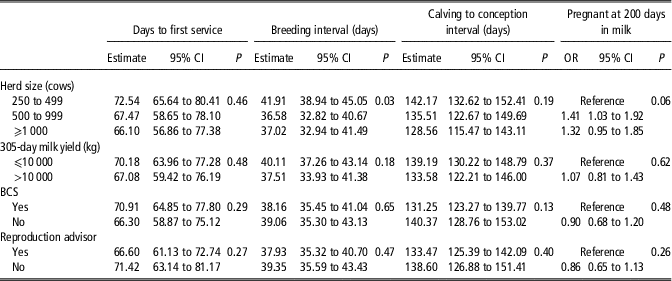
Herds with 500 to 999 cows had significantly shorter IBI (P=0.04), and herds with ⩾1000 cows tended to have shorter IBI (P=0.09), compared with herds with 250 to 499 cows (Table 1). Herds with 500 to 999 cows tended to have more pregnant cows by 200 DIM compared with smaller herds (P=0.07).
Associations of herd characteristics and general management with the reproductive indices of dairy cows

CI=confidence interval; OR=odds ratio; BCS=body condition scoring.
Herd-level 305-day milk yield was not associated with any reproductive parameter (P>0.05). However, not performing regular body condition scoring was associated with lower CR1 (OR=0.76, 95% confidence interval=0.60 to 0.96, P=0.02). No associations were found between herd size, average herd-level milk yield, body condition scoring, and other management practices (P>0.05).
Employing a reproduction advisor was associated with hormonal synchronization protocols: every herd that employed a reproduction advisor used hormonal synchronization, as well (P=0.02). However, employing a reproduction advisor was not associated with any of the analyzed parameters (P>0.05).
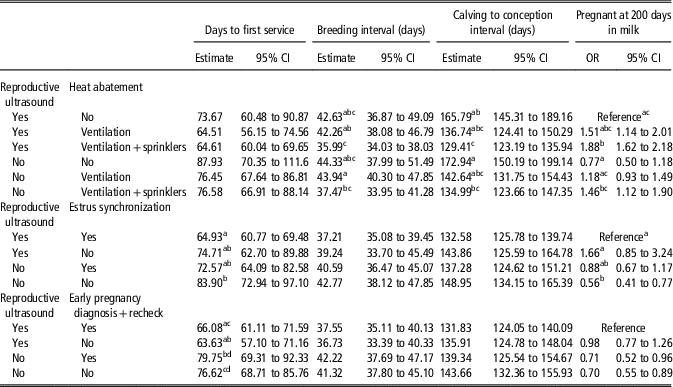
Heat abatement was associated with the use of transrectal ultrasonography (P=0.03). The method of heat abatement was associated with IBI (P<0.01), CCI (P<0.01) and P200 (P<0.01). Ventilation with sprinklers performed better than ventilation only or no heat abatement, however, using ventilation only was not significantly better than no heat abatement (Table 2).
The relationship of reproductive ultrasonography and the associated management practices with the reproductive indices of dairy cows

CI=confidence interval; OR=odds ratio.
a,b,c,dDifferent superscripts indicate significant differences (P<0.05).
Voluntary waiting period, estrus detection and hormonal synchronization protocols
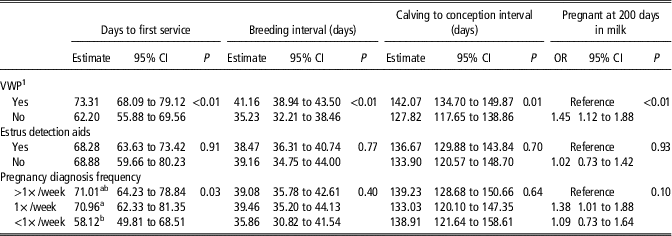
Cows in those herds that did not apply a VWP (or where VWP was shorter than 50 days) showed superior reproductive performance compared with VWP users (Table 3), except for CR1, where no relationship was found. Method of estrus detection (visual observation v. estrus detection aids) was not associated with any of the analyzed parameters. The use of hormonal synchronization protocols was associated with performing transrectal ultrasonography (P<0.01). The application of hormonal synchronization protocols was not associated with the reproductive parameters, however, the interaction of synchronization and transrectal ultrasonography was significantly associated with P200 (P=0.02).
Associations of voluntary waiting period, method of estrus detection and pregnancy diagnosis frequency with the reproductive indices of dairy cows

CI=confidence interval; OR=odds ratio; VWP=voluntary waiting period.
1 Yes: VWP was ⩾50 days; No: VWP was <50 days or no VWP was applied.
a,bDifferent superscripts indicate significant differences (P<0.05).
Pregnancy diagnosis
The application of transrectal ultrasonography was associated with the method of heat abatement (P=0.03), hormonal synchronization (P<0.01) and early pregnancy diagnosis followed by pregnancy recheck (P=0.03). Therefore, transrectal ultrasonography was analyzed together with these practices. When ultrasonography was evaluated together with heat abatement, the application of ultrasound was associated with reduced time to first insemination (P=0.02) and showed a tendency towards more pregnant cows by 200 DIM (P=0.07) (Table 2). In the analysis of CR1, the interaction of heat abatement and ultrasonography was significant (P=0.04). When ultrasonography was evaluated together with hormonal synchronization, those farms that used both practices had significantly shorter DFS than those that applied none of these methods (P<0.01). Transrectal ultrasonography showed a tendency towards increased P200 (P=0.07), and the interaction of synchronization and ultrasonography was significant, as well (P=0.02). When analyzed in combination with early pregnancy diagnosis and recheck, ultrasonography was associated with DFS (P<0.01), IBI (P=0.04) and P200 (P=0.02), however, performing early pregnancy diagnosis and recheck was not associated with any of the parameters. The odds of pregnancy by 200 DIM tended to be higher when weekly pregnancy checks were performed compared with more frequent checks (P=0.09).
Discussion
Herd size and milk yield
According to our results, herds with 500 or more cows outperformed smaller farms in reproductive performance. One possible explanation is that as herd size increases, the need for better organized management is increased, as well. Larger herds may use advanced practices more commonly compared with the small ones, because of difficulties in overseeing a large number of animals, and due to the shorter pay-back time of the investments. Similarly to Hungary, the trend in the dairy farming in the USA is toward consolidation of the dairy industry into large farms with >500 cows. This creates new challenges, for example in estrus detection, thereby increasing the need for estrus detection aids and hormonal synchronization protocols (Lucy, Reference Lucy2001).
We could not find any associations between the average herd-level milk production and reproductive indices. At individual level, genetic antagonism exists between milk yield and reproduction (Stevenson, Reference Stevenson2005). However, on the farm level, this antagonistic relationship can be offset by management, and herds with higher 305-day milk yield can have better reproductive performance, because the feeding, animal health status and reproductive management are generally better, as well (Lucy, Reference Lucy2001; LeBlanc, Reference LeBlanc2010).
Body condition scoring and the role of reproduction advisors
In our study, performing body condition scoring on a regular basis was associated with higher CR1. This can be explained by body condition scoring being a suitable practice for tracking the changes of the metabolic status of a cow after calving, and when the energy balance of the cow is taken into consideration at the decision to inseminate, the success of the insemination is higher. Timing of breeding after calving is based on the assessment of change in body condition and on milk production (Chapel et al., Reference Chapel, Muiño, Pereira, Castillo, Hernández and Benedito2017). Non-optimal body condition score can lead to reduced CR1 and increased days open (Chapel et al., Reference Chapel, Muiño, Pereira, Castillo, Hernández and Benedito2017).
We found no associations between the employment of a reproduction advisor and the cows’ reproductive indices. It is possible that the involvement of the advisor in the reproductive management is different on each farm, or the level of the implementation of the advice is different. Derks et al. (Reference Derks, van Werven, Hogeveen and Kremer2014) found that discussing fertility in the veterinary herd health management program did not influence any reproductive parameters, except for age at first calving. However, in seasonal calving herds, the uptake of a sophisticated herd reproductive management program resulted in a two percentage point increase in 6-week in-calf rate (McDougall et al., Reference McDougall, Heuer, Morton and Brownlie2014).
Heat abatement
In our study, ventilation coupled with sprinklers was associated with the best reproductive performance, however, applying ventilation fans only was hardly better than using none of the available heat abatement methods. Farms using ventilation fans only often reported that fans with sprinklers were originally implemented, but due to technical problems or planning errors (e.g. the bedding in the milk producing barn had become very wet), sprinklers had finished working or were switched off. Efficient heat abatement is very important, as the metabolic rate of lactating dairy cows is so high, that they are extremely sensitive to heat stress (Lucy, Reference Lucy2001). Sprinklers in the holding area during summer were associated with increased service rate (Schefers et al., Reference Schefers, Weigel, Rawson, Zwald and Cook2010).
Voluntary waiting period
In our study, the application of a minimum 50-day long VWP was associated with longer time to first insemination, longer IBI and delayed conception after calving, resulting in a lower proportion of pregnant cows by 200 DIM, but no relationship was found with the success rate of first inseminations. Some, but not all studies suggest that longer VWP is associated with improved CR (Stevenson, Reference Stevenson2005; Schefers et al., Reference Schefers, Weigel, Rawson, Zwald and Cook2010). When no complications occur around calving, no more than 40-day long VWP is needed for uterine involution (Stevenson, Reference Stevenson2005). Generally every VWP above 6 weeks was less profitable than the 6-week long VWP, and, therefore early breeding was profitable (Inchaisri et al., Reference Inchaisri, Jorritsma, Vos, van der Weijden and Hogeveen2011).
Estrus detection and estrus synchronization protocols
Method of estrus detection showed no associations with reproductive performance. One possible explanation for this is the widespread use of hormonal synchronization protocols that can mask the possible effect of estrus detection aids. Michaelis et al. (Reference Michaelis, Burfeind and Heuwieser2014) found that activity monitoring coupled with visual observation performed significantly better than either method alone. According to Neves and LeBlanc (Reference Neves and LeBlanc2015), implementing an activity monitoring system increased the number of inseminations in a given time period, leading to better pregnancy rate, however, no significant differences were found between activity monitoring and estrus synchronization.
In our study, the use of hormonal synchronization protocols was associated with the application of transrectal ultrasonography, but no associations between synchronization and reproductive parameters were found. Estrus synchronization protocols have become so popular, because herds with poor estrus detection are able to shorten the time to first service and time to conception after calving, however, conception risk is often negatively affected (Lucy, Reference Lucy2001). Farms should use hormonal synchronization protocols that are simple and can be managed easily (Stevenson, Reference Stevenson2005). In herds with low estrus detection efficiency the cost of a pregnancy can be decreased by the introduction of OvSynch. However, when OvSynch is introduced into a herd with more efficient estrus detection, the cost of a pregnancy may slightly increase despite the improved reproductive results (Stevenson, Reference Stevenson2005).
Early pregnancy diagnosis and the frequency of pregnancy checks
In our study, those farms that applied transrectal ultrasonography were more likely to use heat abatement, hormonal synchronization protocols, and to perform early pregnancy diagnosis followed by a pregnancy recheck. Those reproductive management programs that applied ultrasonography were generally superior regarding reproductive performance compared with those that did not use this practice. Frequency of pregnancy checks was associated with reproductive results, as well. Transrectal ultrasonography enables professionals to examine the status of the reproductive tract besides pregnancy diagnosis. Early pregnancy diagnosis methods create the opportunity to identify cows that fail to conceive early postbreeding. If early pregnancy check is coupled with management measures aiming at the quick reinsemination of open cows IBI can be reduced (Fricke, Reference Fricke2002). In a field trial that compared reproductive results using solely rectal palpation v. transrectal ultrasonography, DFS, IBI and CCI were reduced by 7.0, 29.6 and 12.0 days, respectively, in the ultrasound group, which generated 43.89 EUR additional net income per cow per year compared with the palpation group (Fodor et al., Reference Fodor, Cziger and Ózsvári2016). It is widely accepted that early pregnancy diagnosis must be followed by a recheck at the time when the rate of pregnancy loss is reduced (Fricke, Reference Fricke2002). Although this practice yields unquestionable benefits, we could not detect any significant associations with reproductive parameters.
In conclusion, although clinical trials are the fundamental components of improving reproductive management, it is worthwhile to examine how these practices work under practical circumstances as parts of the complex reproductive management. Heat abatement with ventilation and sprinklers, lack of VWP of minimum 50 days, and performing transrectal ultrasonography were the most related to improved reproductive performance, therefore, these practices are recommended to use on large dairy farms.
Acknowledgments
The authors would like to thank all the farm managers and veterinarians who took part in the survey for providing farm data and information. The authors thank Andrea Harnos for her useful suggestions regarding statistical analysis. The research was supported by the Hungarian Ministry of Human Capacities (grant no. 12190/2017/FEKUTSTRAT). The Project was also supported by the European Union and co-financed by the European Social Fund (grant agreement no. EFOP-3.6.1-16-2016-00024, project title: Innovations for intelligent specialization on the University of Veterinary Science and the Faculty of Agricultural and Food Sciences of the Széchenyi István University cooperation).
Declaration of interest
None.
Ethics statement
None.
Software and data repository resources
None.