Introduction
Foliicolous lichens are one of the most widespread groups of lichenized fungi in tropical South-East Asia, but studies on these lichens in this region are comparatively few (Krempelhuber Reference Krempelhuber1874; Müller Reference Müller1890a, Reference Müllerb; Nylander Reference Nylander1891; Vainio Reference Vainio1920, Reference Vainio1923; Santesson Reference Santesson1952; Vězda Reference Vězda1977; Aptroot & Sipman Reference Aptroot and Sipman1993; Lücking & Sérusiaux Reference Lücking and Sérusiaux1997; Boonpragob et al. Reference Boonpragob, Homchantara, Coppins, McCarthy and Wolseley1998; Papong et al. Reference Papong, Boonpragob and Lücking2007, Reference Papong, Lücking, Thammathaworn and Boonpragob2009; Sérusiaux et al. Reference Sérusiaux, Lücking and Sparrius2008; Nguyen et al. Reference Nguyen, Joshi, Lücking, Wang, Dzung, Koh and Hur2010, Reference Nguyen, Joshi, Lücking, Nguyen, Wang, Koh and Hur2011; Neuwirth et al. Reference Neuwirth, Stocker-Wörgötter, Boonpragob and Saipunkaew2014; Naksuwankul & Lücking Reference Naksuwankul and Lücking2019), and no modern systematic inventory has yet been undertaken.
Thailand has a great diversity of suitable biotopes for the growth of foliicolous lichens. However, its foliicolous taxa remain underexplored, although recent studies have recorded a total of 132 foliicolous species (Boonpragob et al. Reference Boonpragob, Homchantara, Coppins, McCarthy and Wolseley1998; Papong et al. Reference Papong, Boonpragob and Lücking2007, Reference Papong, Lücking, Thammathaworn and Boonpragob2009; Neuwirth et al. Reference Neuwirth, Stocker-Wörgötter, Boonpragob and Saipunkaew2014; Naksuwankul & Lücking Reference Naksuwankul and Lücking2019).
Pilocarpaceae in its broad sense is a crustose, cosmopolitan family comprising 29 genera, with 424 currently recognized species (Lücking et al. Reference Lücking, Hodkinson and Leavitt2017). Species of Pilocarpaceae are characterized by adnate to sessile, biatorine or lecideine apothecia, non-septate to muriform, colourless ascospores, and its conidiomata are pycnidia or campylidia. It is widely distributed in tropical regions around the world, where most species grow on leaves (Lücking Reference Lücking2008).
Until recently, morphological characters have been the main tool for the delimitation of clades within Pilocarpaceae, with DNA-based phylogenies still scarce. Andersen & Ekman (Reference Andersen and Ekman2005) studied the phylogeny of Micareaceae and suggested that this family should be reduced to synonymy with Pilocarpaceae; Badimia, previously classified in Pilocarpaceae, has recently been included in Ramalinaceae following molecular work (Kistenich et al. Reference Kistenich, Timdal, Bendiksby and Ekman2018). In the present study, we aimed to produce new DNA sequence data for tropical Pilocarpaceae and to study their morphology in order to increase knowledge of the phylogenetic relationships of these lichens.
We generated new sequence data from specimens primarily collected in China and Thailand for a phylogenetic reconstruction of taxa in Pilocarpaceae. We also report some additional results of taxonomic studies of Thai foliicolous lichens. A main finding is the discovery of a new species of the genus Tapellaria, with a further eight new species records for Thailand from families Arthoniaceae, Gomphillaceae, Pilocarpaceae and Ramalinaceae.
Materials and Methods
Morphology and anatomy
The study is based on the extensive collections of the first author from Thailand and China during fieldwork and lichenological research in 2017–2019. The material is deposited in the herbaria HMAS-L and RAMK, with the exception of one sample from Surinam which is in the private herbarium of Pieter van den Boom. Morphology and anatomy were examined using a Motic dissecting microscope and an Olympus CX21 compound microscope. Micrographs were taken with a Leica M125 dissecting microscope equipped with a Leica DFC450 camera. Anatomical mounts were photographed with a Zeiss Imager A2 compound microscope equipped with a Zeiss AxioCam MRc5 camera. Colour reactions of apothecium sections were tested with KOH (a 10% aqueous solution of potassium hydroxide) and I (a 10% aqueous solution of potassium iodide). Paraphyses were investigated in 10% KOH when they were indistinct due to strong gelatinization.
DNA extraction, PCR amplification and sequencing
DNA was extracted from 8–30 apothecia per specimen using the DNAsecure Plant Kit DP320-03 (200preps; Tiangen, Beijing, China). Apothecia were cut from the thallus with a razor blade, thoroughly cleaned and then ground with a tissue grinding instrument. The instructions of the kit were closely followed and finally the DNA was stored in 1.5 ml microcentrifuge tubes and kept at −20 °C. The PCR amplification of ITS rDNA was performed with the primers ITS1F (Gardes & Bruns Reference Gardes and Bruns1993), ITS1 and ITS4 (White et al. Reference White, Bruns, Lee, Taylor, Innis, Gelfand, Sninsky and White1990), and mtSSU rDNA with the primers mrSSU1 and mrSSU3R (Zoller et al. Reference Zoller, Scheidegger and Sperisen1999). Amplifications were performed in a 25 μl volume: 12.5 μl 2 MasterMix (TaqDNA Polymerase (0.1 units/μl), 4 mM MgCl2, 0.4 nM dNTPs; Aidlab Biotechnologies Co., Ltd, Beijing, China), 1 μl of each primer, 8.5 μl ddH2O and 2 μl of DNA. Thermal cycling parameters were as follows: initial denaturation at 94 °C for 5 min, followed by 30 cycles of 94 °C for 30 s, 53 °C for 30 s and 72 °C for 1 min 30 s, and a final extension at 72 °C for 8 min. PCR products were purified (magnetic bead method) and Sanger sequenced by the Beijing Ruibio Biotech Co., Ltd (China).
Sequence alignment and phylogenetic analysis
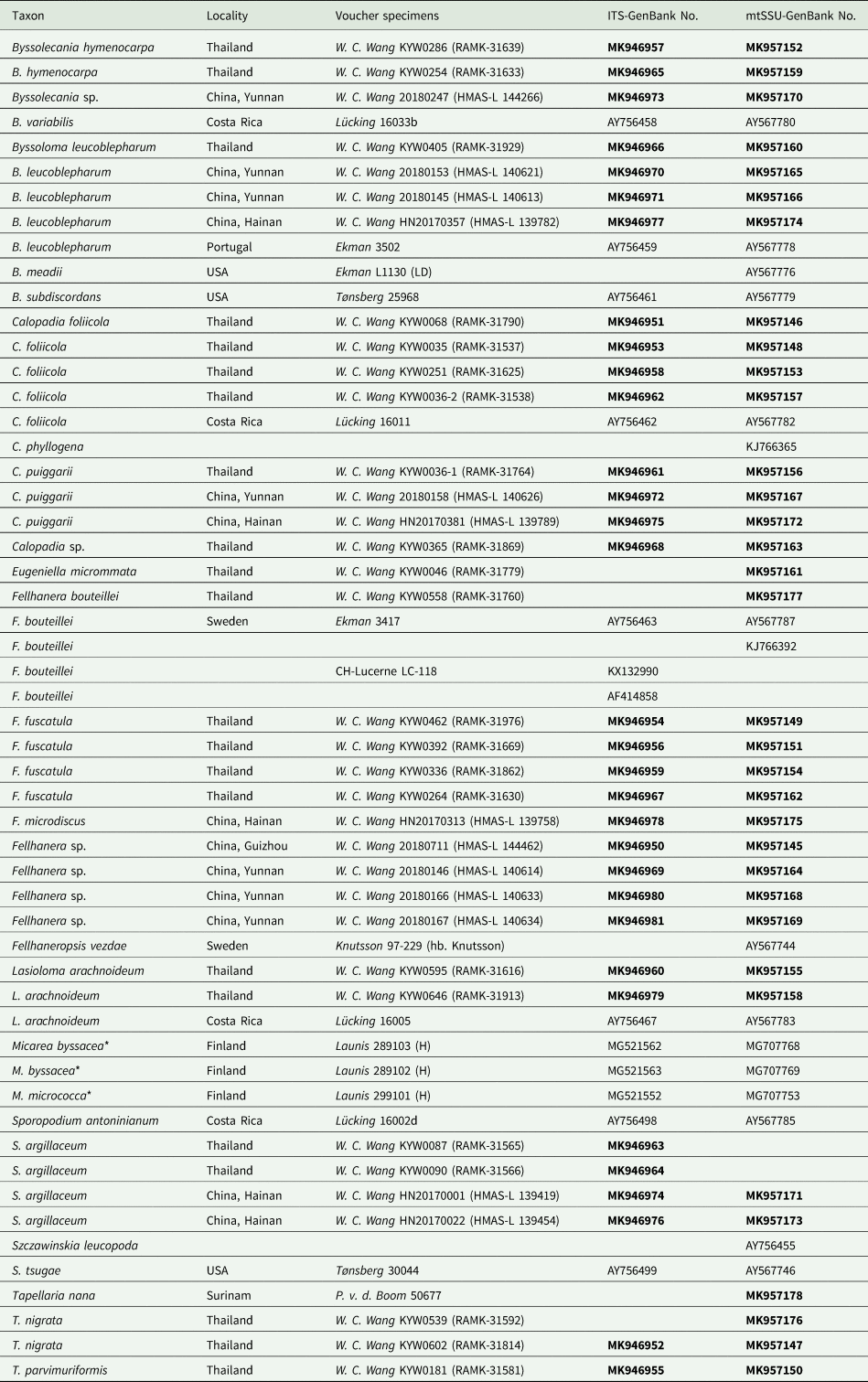
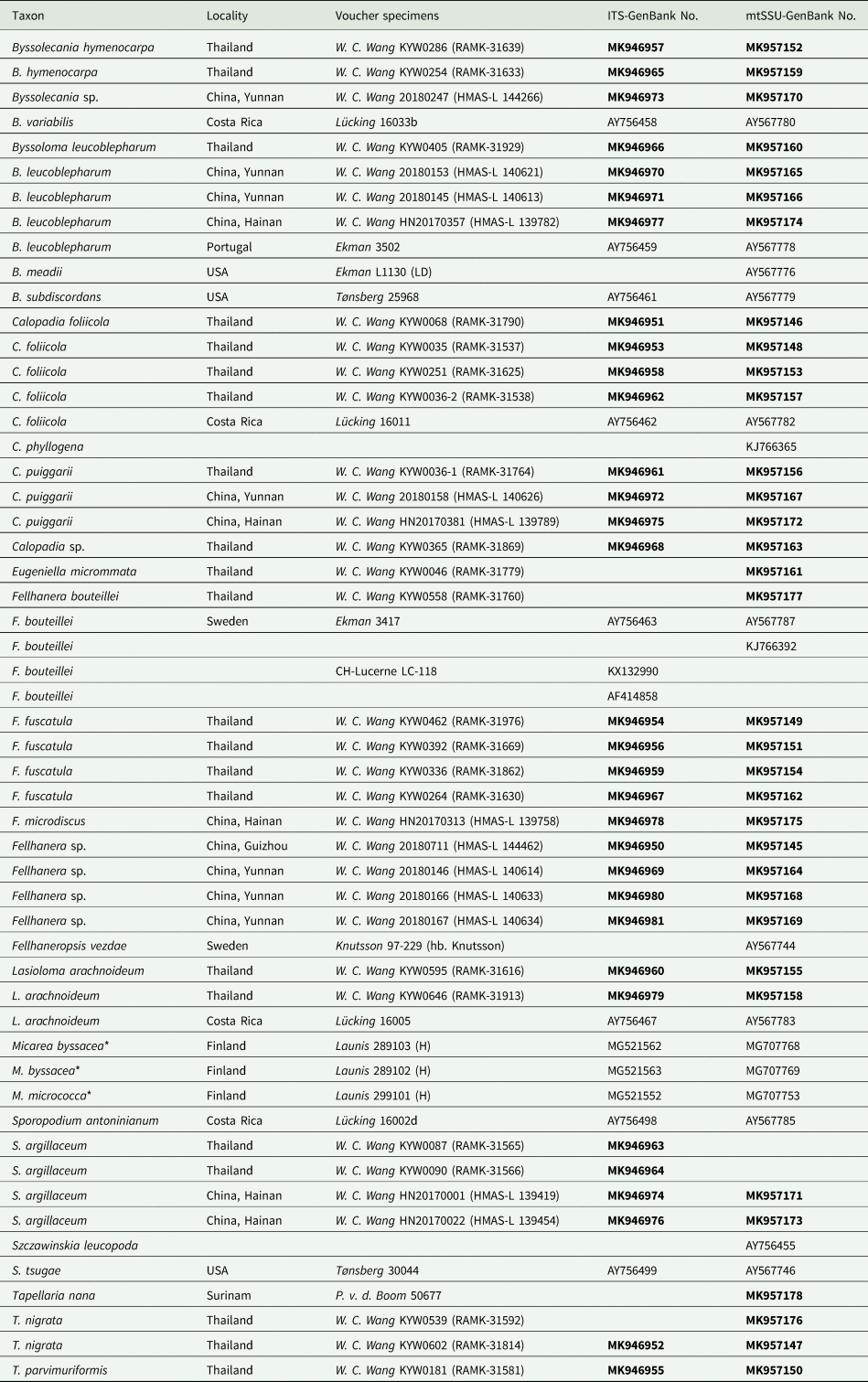
The program Geneious v.6.1.2 (Biomatters Ltd., Auckland, NZ) was used to assemble and edit primary sequences. A total of 66 newly generated sequences were aligned together with 29 sequences retrieved from GenBank (Table 1). Two species of Micarea were chosen as outgroup based on previous phylogenetic analyses (Andersen & Ekman Reference Andersen and Ekman2005). The assembled sequences were aligned using online MAFFT v.7 (Katoh et al. Reference Katoh, Asimenos and Toh2009). The program Gblocks v.0.91b (Castresana Reference Castresana2000) was used to delimit ambiguous regions, implementing all the options for a less stringent selection (http://molevol.cmima.csic.es/castresana/Gblocks_server.html), which yielded final alignments of 489 bp (ITS) and 789 bp (mtSSU), respectively. The two alignments were concatenated in Geneious v6.1.2 for the multilocus phylogenetic analysis.
Details of specimens (species name, locality, herbarium, GenBank numbers) of Pilocarpaceae used in the phylogenetic analysis in this study. Newly generated sequences are in bold. * = outgroup (Byssolomataceae).
Maximum likelihood (ML) analysis and Bayesian inference (BI) were used to infer phylogenetic trees based on the concatenated ITS and mtSSU data sets. ML analysis was performed using RaxML-HPC v8.2.6 (Stamatakis Reference Stamatakis2014) on the Cipres Science Gateway (http://www.phylo.org) and support values were based on 1000 non-parametric bootstrap pseudoreplicates. Bayesian analysis was performed using MrBayes v3.2.6 (Huelsenbeck & Ronquist Reference Huelsenbeck and Ronquist2001; Ronquist & Huelsenbeck Reference Ronquist and Huelsenbeck2003). For the Bayesian analysis, the best substitution models were estimated using jModelTest 2.1.4 (Darriba et al. Reference Darriba, Taboada, Doallo and Posada2012). Based on the results, we used the GTR + I + G model for ITS and the TVM + I + G model for mtSSU. Markov chain Monte Carlo (MCMC) was initiated from a random tree using 5 million generations and sampling every 1000 steps, with the first 25% of trees discarded as burn-in. Stationarity of analysis was determined by examining the standard deviation of split frequencies (< 0.01). A majority-rule consensus tree was constructed from the remaining trees to estimate posterior probability (PP), with values ≥ 0.95 considered as significantly supported. ML and BI trees were visualized with the program FigTree v.1.4.3.
Results
The final alignment consisted of 32 ITS sequences and 34 mtSSU sequences newly generated from 36 global Pilocarpaceae specimens, and 13 ITS sequences and 16 mtSSU sequences downloaded from NCBI (Table 1).
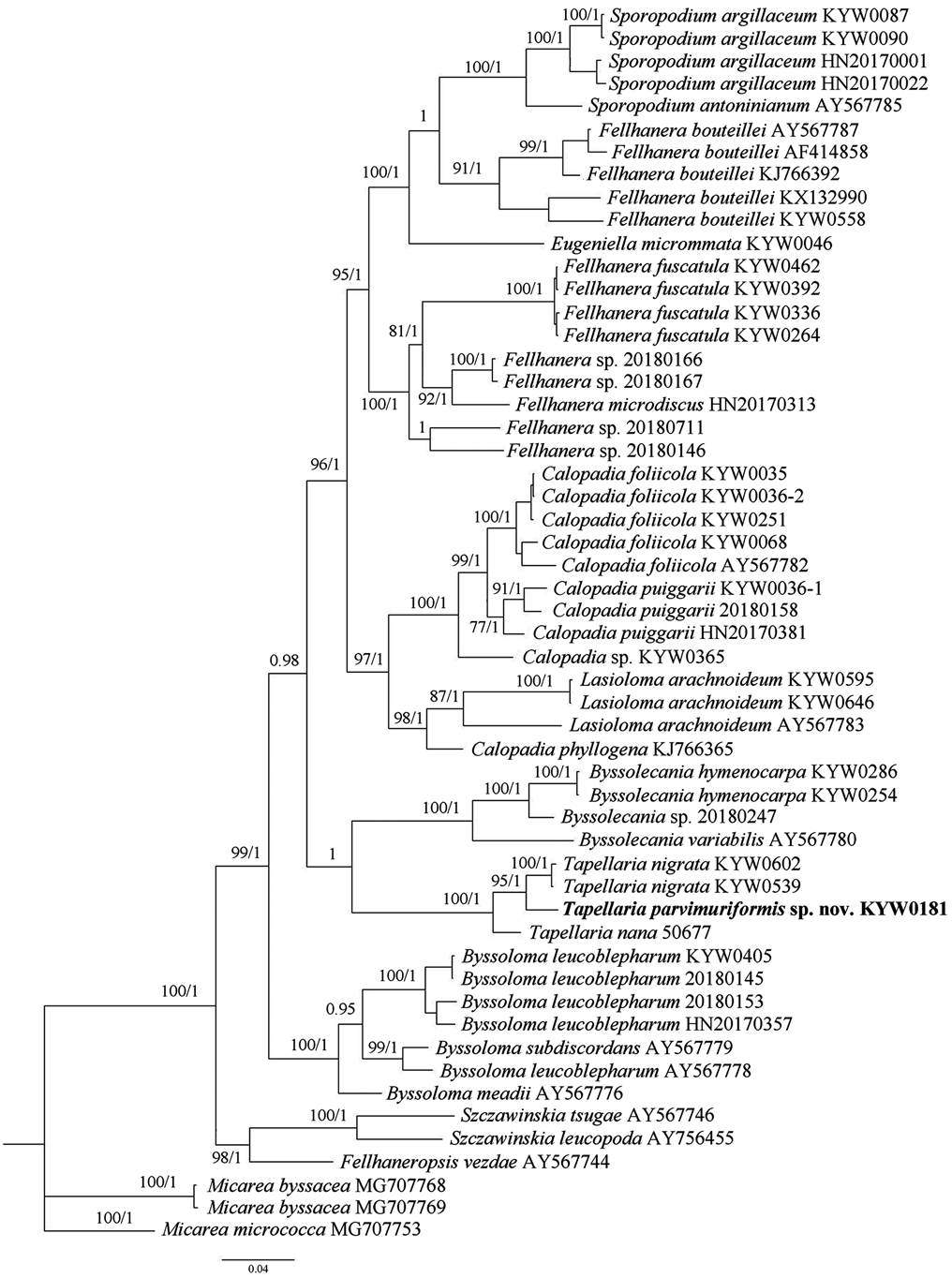
The phylogenetic trees obtained from maximum likelihood (ML) and Bayesian inference analysis (BI) exhibited the same topology; we therefore present only the Bayesian tree, with bootstrap support ≥ 75% for the ML analysis and posterior probabilities ≥ 0.95 for the Bayesian analysis (Fig. 1).
Phylogram produced in MrBayes after the analysis of a combined ITS+mtSSU-alignment of species in the family Pilocarpaceae. Bootstrap supports ≥ 75 for maximum likelihood (ML) and posterior probabilities ≥ 0.95 (second value) for Bayesian methods are indicated above or below the branches. Newly described species are marked in bold. Scale = 0.04 substitution per site.
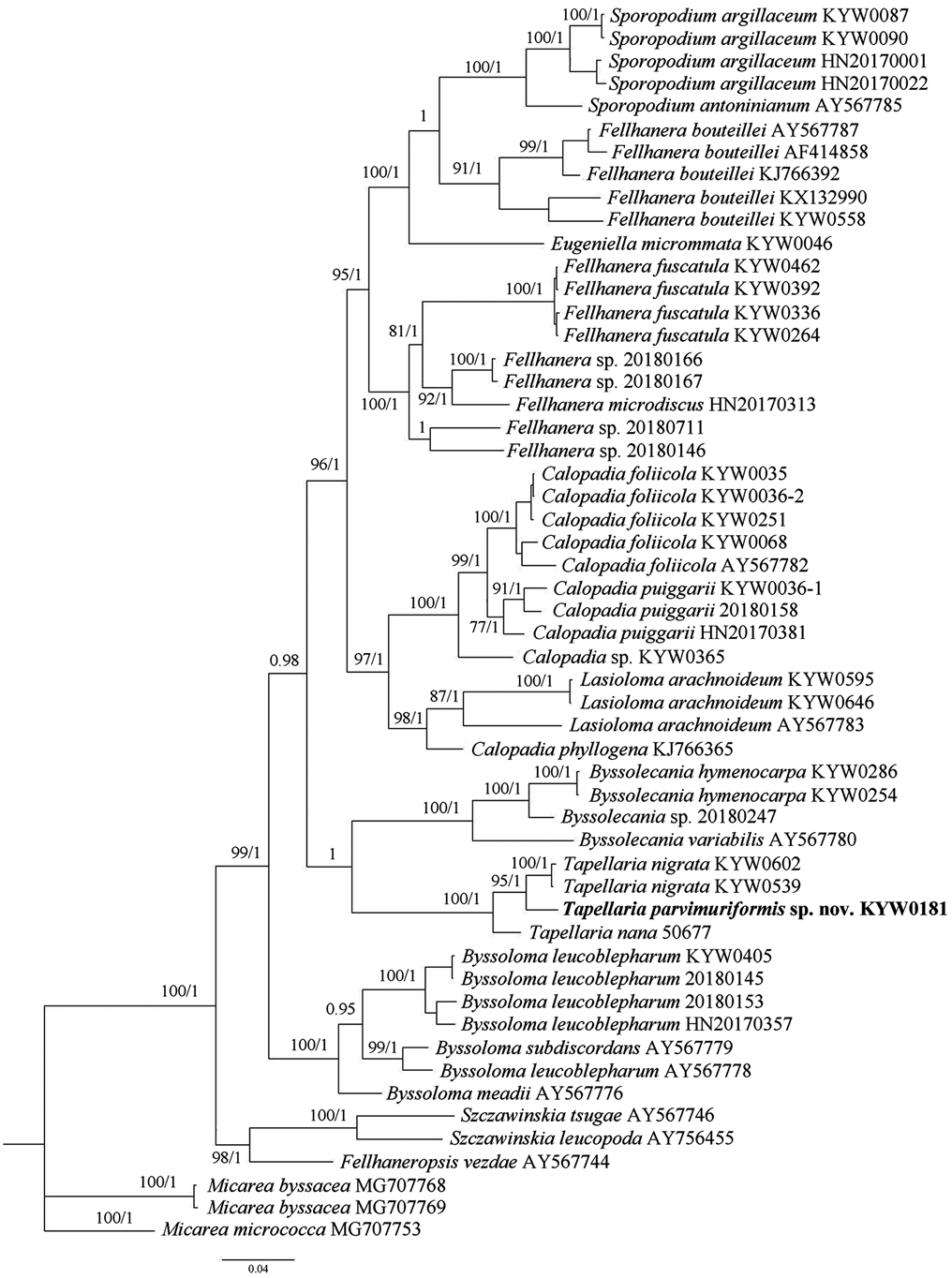
The phylogenetic tree shows five distinct and well-supported clades: 1) Fellhaneropsis and Szczawinskia, 2) Byssoloma, 3) Byssolecania and Tapellaria, 4) Calopadia and Lasioloma, 5) Fellhanera, Eugeniella and Sporopodium (Fig. 1). The genus Fellhaneropsis is strongly supported as sister to Szczawinskia and the sister relationship of the monophyletic genera Byssolecania and Tapellaria also receives high support. The new species Tapellaria parvimuriformis, described and discussed below, is supported (BS = 95, PP = 1) as sister to T. nigrata. The phylogenetic distinctness, being placed on a rather long branch compared to the short branches in T. nigrata, supports its description as a separate species.
Three accessions of Lasioloma arachnoideum form a monophyletic clade sister to most Calopadia samples, but due to a sample of Calopadia phyllogena falling at the base of this clade, Lasioloma appears to be nested within Calopadia. Calopadia s. lat. (incl. Lasioloma) forms a well-supported sister group to a clade containing the genera Fellhanera, Sporopodium and Eugeniella. However, Fellhanera is polyphyletic, forming two groups: Fellhanera bouteillei is strongly supported as sister to the Sporopodium clade, whereas Fellhanera s. str. (F. fuscatula and related species) is sister to a clade including Eugeniella, Fellhanera bouteillei and Sporopodium.
Discussion
Our analysis shows that most of the genera with a distinct, paraplectenchymatous excipulum (Fellhanera, Eugeniella, Sporopodium, Calopadia, Lasioloma) form a monophyletic group, whereas other genera (Byssolecania, Byssoloma, Szczawinskia, Fellhaneropsis), as well as the outgroup Micarea, have a prosoplectenchymatous excipulum or excipulum composed of branched and anastomosing hyphae. This indicates that the excipulum type is phylogenetically informative, although the genus Tapellaria, with a paraplectenchymatous excipulum, represents an exception. Lücking (Reference Lücking2008) suggested that the prosoplectenchymatous excipulum type is an ancestral character within the family and our preliminary results are congruent with such an interpretation. However, a larger taxon sampling and ancestral character reconstruction analyses will be necessary to test this hypothesis.
In our molecular analysis, Lasioloma arachnoideum (type species of the genus) is nested within Calopadia, indicating that the distinction of the two genera requires further investigation. Both genera share a dispersed thallus, mostly muriform ascospores, and campylidia with large, hood-shaped lobes. However, they differ in several characters: Lasioloma has a woolly prothallus, filiform conidia with 3–5 branches originating from one single point, and an apothecial margin with excipular hairs, whereas Calopadia has a glabrous developed prothallus, unbranched filiform conidia with clavate apex and apothecia with glabrous margins. Since the nested topology of Lasioloma within Calopadia is caused by a single sample, C. phyllogena (Netherland Antilles, Sipman 54818), it might be prudent to revise the identification of that species, as the hairs typical of Lasioloma are sometimes difficult to discern. Given the small-scale diversity of foliicolous lichens on single leaves, it is also possible that a specimen of Lasioloma present in a mixed sample of C. phyllogena was accidentally sequenced.
Another genus that appears related to Fellhanera is Eugeniella, even though only one species of that genus was included in the current study. Eugeniella shares with Fellhanera the usually brown apothecia and the pycnidial anamorph, but differs in the excipulum strongly encrusted with crystals and the indistinct, mostly unbranched paraphyses (Lücking Reference Lücking2008).
The genus Fellhaneropsis was established to accommodate some species resembling Fellhanera (Sérusiaux Reference Sérusiaux1996) but the genus is not closely related to Fellhanera. Morphologically, Fellhaneropsis has emarginate apothecia, a feature that is also present in Micarea. Its pycnidia and conidia are also different.
The identity of the accession of Byssoloma leucoblepharum (AY567778) downloaded from GenBank is questionable; it should not form a clade with B. subdiscordans because the two Byssoloma species are quite distinct from each other.
The New Species
Tapellaria parvimuriformis W. C. Wang & J. C. Wei sp. nov.
Fungal Names: FN570656
Similar to Tapellaria floridensis but differs by its green thallus, grey-white campylidia, shorter conidia (6–9-septate, 45–50 × 2–2.5 μm) and foliicolous growth.
Type: Thailand, Nakhon Ratchasima Province, Khao Yai National Park, Lam Ta Khong camping ground, 14°23′N, 101°22′E, 800 m alt., on leaves, 4 May 2018, W. C. Wang 31581 (holotype!—RAMK).
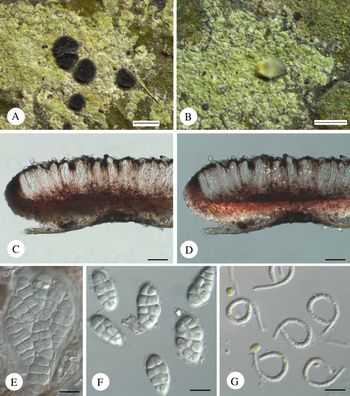
(Fig. 2)
Tapellaria parvimuriformis (holotype, Wang 31581, RAMK). A, thallus with apothecia. B, thallus with a campylidium. C & D, section of apothecium showing pigmentation in normal light (C) and crystals in exciple and apothecial base in polarized light (D). E, ascus with ascospores. F, muriform ascospores. G, curved filiform conidia, 6–9-septate. (E–G observed in differential interference mode). Scales: A = 0.5 mm; B = 200 μm; C & D = 50 μm; E–G = 10 μm.
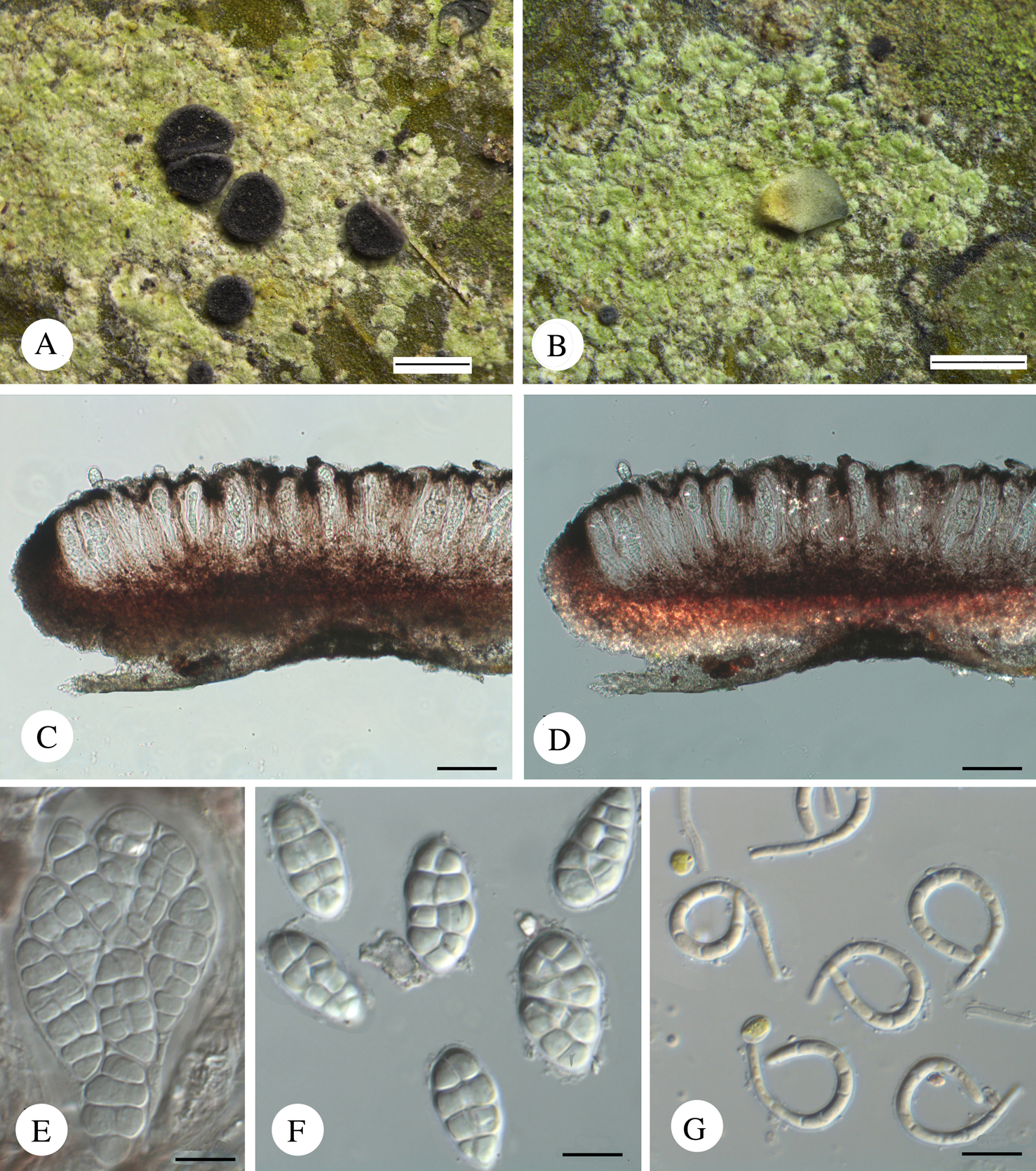
Thallus crustose, epiphyllous, pale green, surface uneven, 4–8 mm diam., dispersed in patches, patches slightly convex; hypothallus indistinct. Photobiont chlorococcoid with globose green cells, 5–7 μm diam.
Apothecia rounded, sessile, basally constricted, 0.3–0.6 mm diam., 180–200 μm high; disc flat, black, dull, epruinose; margin thick, prominent and persistent, covered with a thin grey pruina, c. 60 μm wide, never irregular in outline; excipulum well developed, paraplectenchymatous (cells angular-rounded), inner parts red-brown (K+ red) but with blackish tinge in outer parts, 40–65 μm wide, encrusted with a few crystals which dissolve in K; epithecium dark brown or blackish brown, c. 12.5 μm high, K+ red; hymenium hyaline, mixed with red-brown, 50–65 μm high; hypothecium dark red-brown, 25–40 μm high, K+ red; apothecial base red-brown, encrusted with a few crystals which dissolve in K, but usually tight because of the existence of crystals, 50–65 μm high, K+ strongly red; paraphyses indistinct due to strong gelatinization, branched and anastomosing; asci clavate, 60–65 × 9–12 μm, ascus apex I+ dark blue. Ascospores 8 per ascus, ellipsoid, hyaline, muriform, with 3–5 transverse septa and 0–1 longitudinal septum per segment, 7–10 cells, without gelatinous perispore, 20–23 × 10–14 μm.
Campylidia sessile, 0.3–0.4 mm wide, 0.4–0.6 mm long; lobe well developed, hood-shaped, dark grey with white-grey base, base not thickened; conidia filiform with slightly clavate apex, curved, 6–9-septate, 45–50 × 2–2.5 μm.
Chemistry
Not tested.
Etymology
The epithet of the new species ‘parvimuriformis’ is a Latin compound consisting of ‘parvus’ (small) and ‘muriformis’ (muriform), referring to the small muriform ascospores of the new species.
Habitat and distribution
So far this species is known only from Khao Yai National Park, Thailand, growing on the leaf surface, not abundant, in the shady understory of lowland rainforest near the river.
Notes
Tapellaria parvimuriformis is characterized by its small muriform ascospores, grey campylidia with a white-grey base, and short conidia (45–50 μm long). Tapellaria floridensis Common & Lücking is morphologically similar but can be distinguished by the white to pale grey thallus, black campylidia and longer conidia (80–90 μm) (Lücking et al. Reference Lücking, Seavey, Common, Beeching, Breuss, Buck, Crane, Hodges, Hodkinson and Lay2011). Tapellaria parvimuriformis is also close to T. schindleri Kalb & Vězda, which differs by its distorted apothecial margin with blue pruina, its smaller ascospores (16–20 × 9–11 μm) and longer conidia. The new species is also similar to T. granulosa Lücking & Rivas Plata, which differs by its granulose thallus and pure black apothecia. Furthermore, all three similar species are corticolous and their distribution is restricted to the Neotropics.
Two species of Tapellaria, T. nigrata and T. parvimuriformis, were found in Khao Yai National Park. The former is much more common than the new taxon and differs by having 5-septate ascospores, and smaller apothecia (up to 0.4 mm diam.) with an epruinose margin and usually irregular in outline.
The new species can be inserted into the key by Neuwirth & Stocker-Wörgötter (Reference Neuwirth and Stocker-Wörgötter2017) as follows:
-
19(18) Campylidia black, conidia 7–13-septate, 80–90 μm long T. floridensis Common & Lücking Campylidia grey to dark grey with white-grey base, conidia 5–9-septate, 40–50 μm long20
-
20(19) Apothecia with grey margins; thallus smooth; foliicolous, South-East Asia T. parvimuriformis W. C. Wang & J. C. Wei Apothecia pure black; thallus granulose; corticolous; FloridaT. granulosa Lücking & Rivas Plata
New Records of Foliicolous Lichens for Thailand
Arthonia lecythidicola (Bat. & H. Maia) Lücking & Sérus.
Lichenologist 30, 135 (1998).
(Fig. 3A)
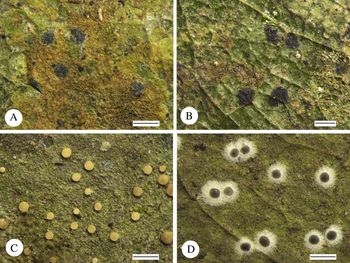
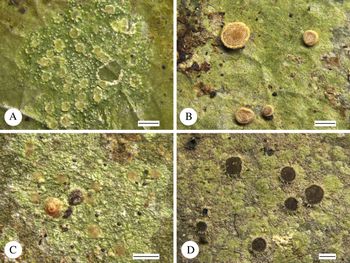
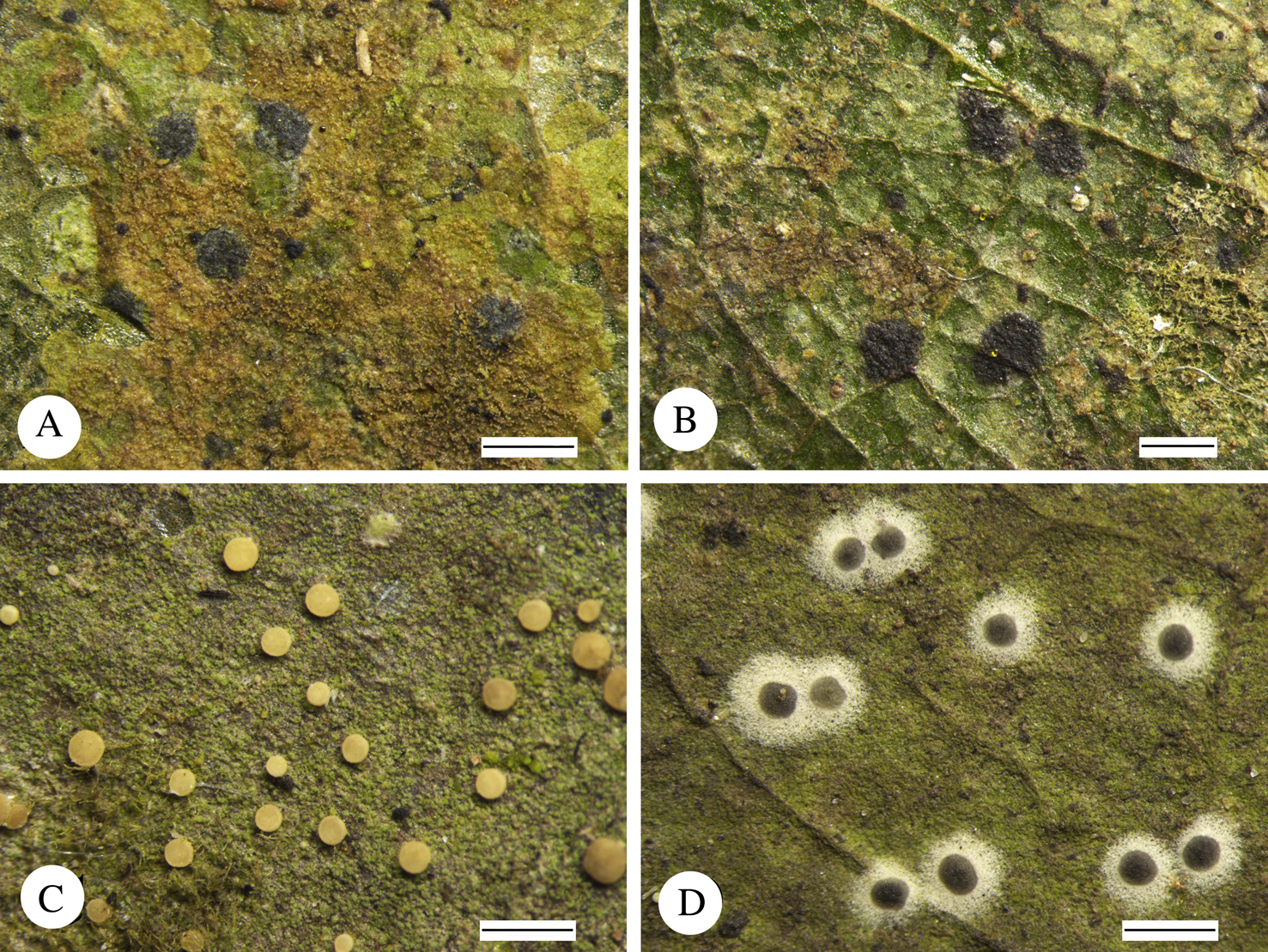
New records of foliicolous lichenized fungi for Thailand. A, Arthonia lecythidicola (Wang 31573, RAMK). B, Arthonia palmulacea (Wang 31849, RAMK). C, Bacidina apiahica (Wang 31675, RAMK). D, Byssoloma vanderystii (Wang 31547, RAMK). Scales: A–D = 0.5 mm. In colour online.
Notes
This species is most similar to A. palmulacea, with which it shares brown-black apothecia without pruina and macrocephalic ascospores, but it differs in having 3-septate ascospores (A. lecythidicola) versus 4–5-septate ascospores (A. palmulacea).
Distribution
Neotropics (Lücking Reference Lücking2008). New to Thailand.
Specimens examined
Thailand: Nakhon Ratchasima Province: Khao Yai National Park, Lam Ta Khong camping ground, 14°23′N, 101°22′E, 800 m alt., on leaves, 2018, W. C. Wang 31573 (RAMK).
Arthonia palmulacea (Müll. Arg.) R. Sant.
Symb. Bot. Upsal. 12(1), 87 (1952).
(Fig. 3B)
Distribution
Pantropical (Lücking Reference Lücking2008), China (Wang & Wei Reference Wang and Wei2018). New to Thailand.
Specimens examined
Thailand: Nakhon Ratchasima Province: Khao Yai National Park, Pha Kluay Mai Waterfall to Haew Suwat Waterfall, 14°23′N, 101°22′E, 800 m alt., on leaves, 2018, W. C. Wang 31849, KYW0235, KYW0242, KYW0559, KYW0643 (RAMK).
Bacidina apiahica (Müll. Arg.) Vězda
Folia Geobot. Phytotax. 25(4), 432 (1991).
(Fig. 3C)
Notes
This species is distinct in the pale yellow, translucent apothecia and in the 3-septate, narrowly clavate ascospores.
Distribution
Pantropical (Lücking Reference Lücking2008). New to Thailand.
Specimens examined
Thailand: Nakhon Ratchasima Province: Khao Yai National Park, Pha Kluay Mai Waterfall to Haew Suwat Waterfall, 14°23′N, 101°22′E, 800 m alt., on leaves, 2018, W. C. Wang 31988, 31675 (RAMK).
Byssoloma vanderystii Sérus.
Lichenologist 11, 181 (1979).
(Fig. 3D)
Notes
The main morphological and anatomical features distinguishing B. vanderystii are the strongly convex apothecia with a well-developed byssoid margin and the 7-septate ascospores.
Distribution
Pantropical (Lücking Reference Lücking2008), Vietnam (Nguyen et al. Reference Nguyen, Joshi, Lücking, Wang, Dzung, Koh and Hur2010). New to Thailand.
Specimens examined
Thailand: Nakhon Ratchasima Province: Khao Yai National Park, Haew Narok Waterfall, 14°23′N, 101°22′E, 800 m alt., on leaves, 2018, W. C. Wang 31547, 31548, 31549, 31550, 31783, 31552, 31553, 31554, 31555, 31556, 31557, 31791, 31559 (RAMK); Khao Yai National Park, Pha Kluay Mai Waterfall to Haew Suwat Waterfall, 14°23′N, 101°22′E, 800 m alt., on leaves, 2018, W. C. Wang 31657, 31880, 31659, 31884, 31666, 31898 (RAMK).
Calenia lueckingii C. Hartmann
Mycotaxon 59, 484 (1996).
(Fig. 4A)
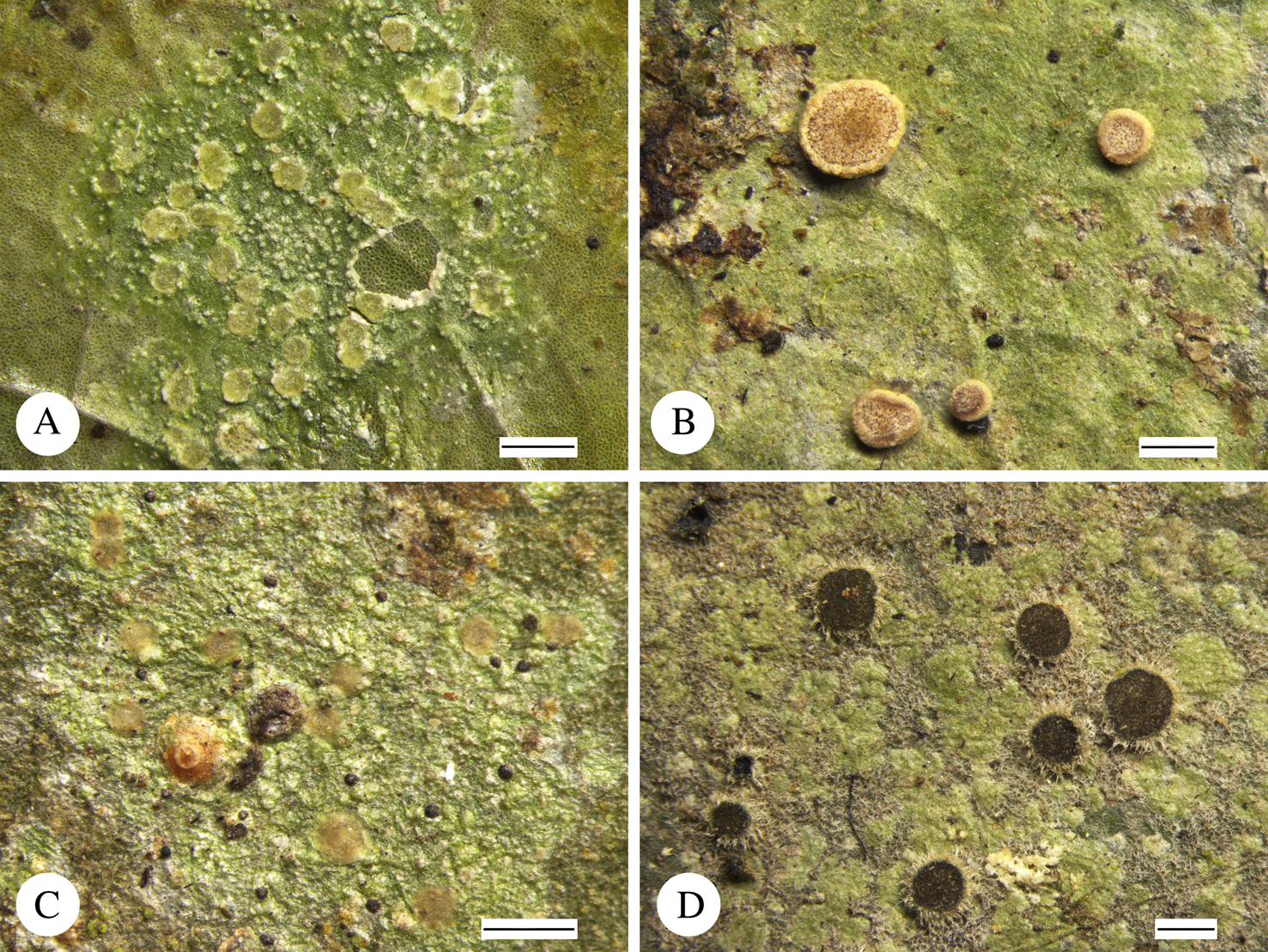
New records of foliicolous lichenized fungi for Thailand. A, Calenia lueckingii (Wang 31563, RAMK). B, Calopadia foliicola (Wang 31537, RAMK). C, Echinoplaca melanothrix (Wang 31607, RAMK). D, Lasioloma arachnoideum (Wang 31626, RAMK). Scales: A–D = 0.5 mm. In colour online.
Notes
This species can be recognized by its verrucose thallus, the green apothecial disc that contains a layer of epithecial algae, the entire apothecial margin and the muriform ascospores, 1 per ascus.
Distribution
Neotropics (Lücking Reference Lücking2008), China (Wang & Wei Reference Wang and Wei2018). New to Thailand.
Specimens examined
Thailand: Nakhon Ratchasima Province: Khao Yai National Park, Haew Narok Waterfall, 14°23′N, 101°22′E, 800 m alt., on leaves, 2018, W. C. Wang 31563 (RAMK); Khao Yai National Park, Pha Kluay Mai Waterfall to Haew Suwat Waterfall, 14°23′N, 101°22′E, 800 m alt., on leaves, 2018, W. C. Wang KYW0570, KYW0572 (RAMK).
Calopadia foliicola (Fée) Vězda
Folia Geobot. Phytotax. 21(2), 215 (1986).
(Fig. 4B)
Notes
Because of the small number of apothecia, it is an inconspicuous species and easily overlooked if not observed closely. Despite this, the species is unmistakable due to its yellow-brown apothecia with pale yellow pruina and narrowly muriform ascospores, 2 per ascus. Calopadia puiggarii may be the species that is most likely to be confused with C. foliicola in the field due to their identical habitat and thallus, but it is distinguished by grey-brown apothecia without pruina and shorter ascospores, 1 per ascus.
Distribution
Pantropical (Lücking Reference Lücking2008). New to Thailand.
Specimens examined
Thailand: Nakhon Ratchasima Province: Khao Yai National Park, Haew Narok Waterfall, 14°23′N, 101°22′E, 800 m alt., on leaves, 2018, W. C. Wang 31536, 31537, 31538, 31769, 31790, 31552, 31553, 31554 (RAMK); Khao Yai National Park, Pha Kluay Mai Waterfall to Haew Suwat Waterfall, 14°23′N, 101°22′E, 800 m alt., on leaves, 2018, W. C. Wang 31902, 31594, 31818, 31997 (RAMK).
Echinoplaca melanothrix Lücking
Biblioth. Lichenol. 65, 58 (1997).
(Fig. 4C)
Notes
This species is unique in the genus in having an uneven-verrucose thallus, pale yellow-brown apothecia, and medium-sized (30–50 μm long), muriform ascospores, 1 per ascus.
Distribution
Neotropics (Lücking Reference Lücking2008). New to Thailand.
Specimens examined
Thailand: Nakhon Ratchasima Province: Khao Yai National Park, Haew Narok Waterfall, 14°23′N, 101°22′E, 800 m alt., on leaves, 2018, W. C. Wang 31798 (RAMK); Khao Yai National Park, Pha Kluay Mai Waterfall to Haew Suwat Waterfall, 14°23′N, 101°22′E, 800 m alt., on leaves, 2018, W. C. Wang 31607 (RAMK).
Lasioloma arachnoideum (Kremp.) R. Sant.
Symb. Bot. Upsal. 12(1), 547 (1952).
(Fig. 4D)
Distribution
Pantropical (Lücking Reference Lücking2008), China. New to Thailand.
Specimens examined
Thailand: Nakhon Ratchasima Province: Khao Yai National Park, Pha Kluay Mai Waterfall to Haew Suwat Waterfall, 14°23′N, 101°22′E, 800 m alt., on leaves, 2018, W. C. Wang 31624, 31625, 31626, 31627, 31852, 31942, 31593, 31825, 31905, 31911, 31913, 31940 (RAMK).
Acknowledgements
We thank Dr Khwanyuruan Naksuwankul (Mahasarakham University, Thailand) and the lichen staff at Ramkhamhaeng University (Thailand) for offering their help with this study. We thank Dr H. Thorsten Lumbsch (Field Museum, Chicago, USA) and Prof. A. J. S. Whalley (Liverpool John Moores University, School of Pharmacy and Biomolecular Sciences, Liverpool, UK) for revision of the language. This research was funded by the Southeast Asia Biodiversity Research Institute, Chinese Academy of Sciences (Y4ZK111B01), the Ministry of Science and Technology of China (2013FY110400), and the National Natural Science Foundation of China (31470149).
Author ORCID
Wei-Cheng Wang, 0000-0002-8391-5120.