Introduction
The rocket plant, referring to both Eruca and Diplotaxis from the Brassicaceae, has been known since antiquity (Morales and Janick, Reference Morales, Janick, Janick and Whipkey2002). These genera are distributed in southern Europe, Central Asia and Mediterranean countries (Warwick et al., Reference Warwick, Gukel, Gomez-Campo and James2007), where they are used as a condiment in salads (Kim and Ishii, Reference Kim and Ishii2006), cooked vegetables, functional plants or for medicinal purposes (Bhandari and Chandel, Reference Bhandari, Chandel, Padulosi and Pignone1997) and as an oil crop. Rocket is a common vegetable in Europe, North America and (to a lesser extent) Asia and is becoming popular also in other countries, namely Argentina and South Africa, due to introductions made by Italian immigrants. Even though the importance of rocket has risen in many countries, including Turkey, due to higher demand preference by consumers, very limited rocket cultivars are so far available. The scientific conservation community has been also mobilizing efforts in support of the domestication of Diplotaxis species in view of the increasing pressure on wild populations of Diplotaxis tenuifolia (Pignone, Reference Pignone, Padulosi and Pignone1997).
A diverse range of natural ecosystems in Turkey has resulted in the country being means that it is one of the richest countries in the world in plant genetic resources (Vavilov, Reference Vavilov1926; Balkaya et al., Reference Balkaya, Yanmaz, Apaydin and Kar2005). This wide diversity (Yılmaz, Reference Yılmaz1998) plays an important role in domesticating, selecting, conserving and using plant genetic resources, including vegetables such as rocket (Pagel and Mace, Reference Pagel and Mace2004). Eruca sativa is well known in Turkey, and is widely cultivated and used as vegetable in the preparation of fresh salads or in traditional Turkish foods (Eşiyok, Reference Esiyok, Padulosi and Pignone1997). Although some other Diplotaxis species are also distributed across in different Turkish areas, natural distribution of wild E. sativa and Diplotaxis species in different regions of Turkey has been reported by some researchers (Karaer and Kılınç, Reference Karaer and Kilinc2001; Akçiçek, Reference Akcicek2003), but unfortunately no information available on the genetic diversity of this Diplotaxis species is available in Turkey. Another species, Eruca cappadocica Reut. ex Boiss (syn. Eruca vesicaria subsp. sativa), has been cultivated in Central Anatolia for oil production for centuries. Most probably the name cappadocica originates from the cultivated region of the Cappadocia province in Central Anatolia (Davis, Reference Davis and Davis1967). Ertuğ (Reference Ertug2000) indicated that E. cappadocica should be considered the synonym of E. sativa, although E. cappadocica leaves are characterized by a bitter taste and hence not consumed by local people. Baytop (Reference Baytop1948, Reference Baytop1984, Reference Baytop1994) supported the view that both species should be kept distinct, a position that is also corroborated by the early domestication and continuous cultivation of E. cappadocica in Central Anatolia. The wild species D. tenuifolia L. is widely distributed across southern and western parts of Turkey, but it is not cultivated or used by local populations as a salad vegetable but mainly as livestock feed. In spite of the wide distribution of several forms of rocket plants in Turkey, no information on the genetic diversity of naturally existing wild and cultivated rocket plant is available.
Genetic diversity and ecogeographical pattern of variability are of prime importance in plant breeding and germplasm conservation (Alemayehu and Becker, Reference Alemayehu and Becker2002). Several methods have been developed in order to assess diversity through biochemical, physiological and morphological characterization (Greene et al., Reference Greene, Gritsenko and Vandewark2004; Geleta et al., Reference Geleta, Labuschagne and Viljoen2005). The phenotype is the first and easiest approach for the appraisal of genetic diversity in plant genetic resources and useful as a guide to follow up characterization and evaluation studies. The overall objective of this study was to achieve a better understanding of the diversity of Turkish rocket germplasm. In particular, the study aimed at (1) characterizing Turkish rocket genotypes based on morphological and agronomic data using multivariate methods, (2) understanding the patterns of distribution of their diversity and (3) examining whether the clustering pattern is related to the geographical origin of genotype.
Materials and methods
Plant material
The study involved a total of 35 accessions of rocket (Eruca and Diplotaxis), of which 24 had been obtained from the USA (USDA-GRIN) originating from different regions of the world; seven were collected from the Mediterranean (southwest) and Aegean Regions of Turkey, where many Diplotaxis species are indigenous; one accession, E. cappadocica ‘Izgın’, was gathered from a market in the East of Turkey; and two Diplotaxis genotypes and one E. sativa cultivar were from Italy (Supplementary Table S1, available online only at http://journals.cambridge.org). The accessions were analysed based on the USDA-GRIN database for diversity-rich areas. The Turkish rocket accessions represent germplasm in the USDA-GRIN collection. All accessions from each country were evaluated, and at least one accession, randomly chosen from each country, was stored in the USDA collection.
Morphological and agronomic characterization and data collection
The study was conducted at the Ege University, Faculty of Agriculture, Department of Horticulture in Bornova (Izmir Province), Turkey, located at 38°28′N, 27°15′E and 25 m.a.s.l. The experiment was carried out in spring 2005 and repeated in 2006. Seeds were sown on the third week of February in both years in a 20 l containers (75 × 26 × 21 cm), containing a mixture of peat and perlite (3:1), and grown in a polyethylene-covered glasshouse until the appearance of the first true leaves after which the pots were placed in an open field. In each container, 30 seeds were sown and thinned to ten plants after leaf expansion. The experimental design was a randomized complete block design with three replications per genotype. No fertilizer was applied. Weeds were controlled mechanically by hand, and the plots were irrigated daily. Traits of each genotype were characterized from emergence to crop maturity (Supplementary Fig. S1, available online only at http://journals.cambridge.org).
For each genotype, 51 morphological and agronomic traits were recorded (Supplementary Tables S2 and S3, available online only at http://journals.cambridge.org) based on the International Plant Genetic Resources Institute Descriptors for Eruca spp. (IPGRI, 1999). Seedling traits were scored at the third to fourth leaf stage using 20 plants per accession, randomly selected from each genotype before thinning. Flowering traits were determined from ten plants per accession in each replication from bolting initiation to last flowering, and maturity traits were gathered from post-anthesis to the end of seed harvest.
Data analysis
Evaluation was based on 18 quantitative traits (agronomic) and 33 qualitative traits (morphological) (Supplementary Tables S2 and S3, available online only at http://journals.cambridge.org). The data were divided into two groups, and principal component (PC) analysis was applied to both. Hierarchical agglomerative clustering was performed on the PC by using unweighted pair-group method with arithmetic average (UPGMA) to provide overall phenotypic similarities among genotypes (Sneath and Sokal, Reference Sneath and Sokal1973; Duzyaman, Reference Duzyaman2005). The first two principal coordinates were extracted from the correlation matrix used to produce a two-dimensional (2D) scatter plot in order to visualize the genetic similarity in genotypes. All data were processed using the software package Statistica 6 (Statsoft Inc., 2004).
Results
Agronomic characters
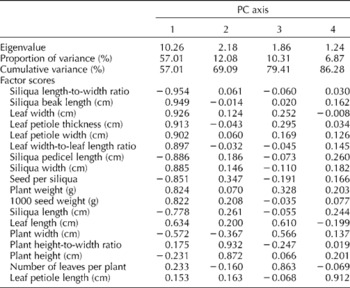
The first PC concentrated 57.01% of the total variance of the agronomic data, the second 12.08%, the third 10.31% and the fourth 6.87% (Table 1). The characters in the PCs were identified on the basis of eigenvectors. Siliqua beak length, leaf width, leaf petiole thickness, leaf petiole width, leaf width-to-length ratio, siliqua width, plant weight, 1000 seed weight and leaf length had relatively large positive influence on the first component. Conversely, siliqua length-to-width ratio, siliqua pedicel length, seed per siliqua, siliqua length and plant width had negative influence. The second component separated plant height-to-width ratio and plant height. The third PC axis emphasized the number of leaves per plant, while the fourth separated leaf petiole length (Table 1).
Eigenvalue and proportions of variability as assessed by agronomic traits contributed to four PCs of germplasm

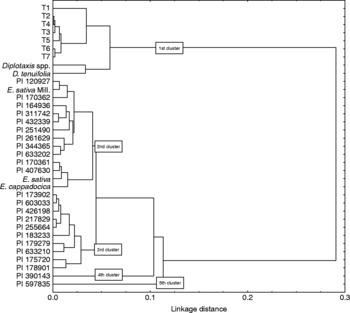
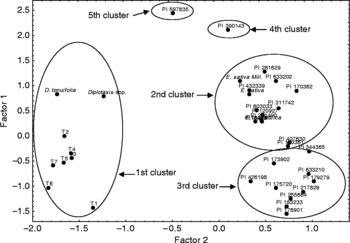
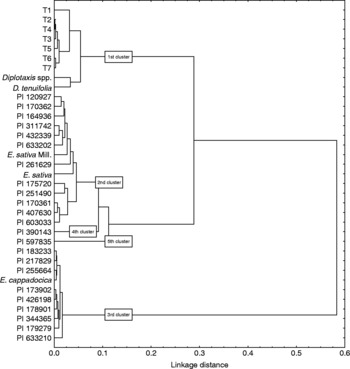
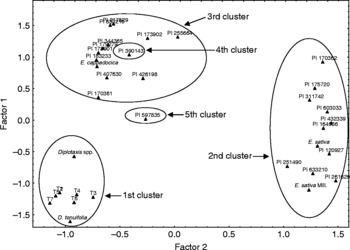
The pattern of divergence between the 35 genotypes of Eruca and Diplotaxis for the first three PCs is given in Fig. 1. The cluster analysis performed with 18 characters classified the accessions into five independent clusters. The first cluster included nine genotypes and composed of Diplotaxis genotypes collected from different parts of Turkey and Italy characterized by yellow petals and perennial growth habit (Fig. 2). In the first cluster, leaf width was 2.69 cm and the length was 12.77 cm, these being the smallest leaf values among the accessions, leaf width-to-length ratio was 0.21. Siliqua length was longer in this cluster than in the other clusters, while the siliqua beak length was very short and the 1000 seed weight was the lowest obtained (Fig. 2). The second cluster was made up of 14 accessions and represented the largest group of genotypes. This cluster included accessions characterized by number of leaves per plant (41.56) and petiole thickness (0.34 cm). The third cluster observed had greater leaf width, leaf length, leaf length-to-width ratio and plant height-to-width ratio. The fourth cluster consisted of the accession PI 390143 (from Pakistan), characterized by the greater petiole, plant weight and 1000 seed weight, a wider siliqua and longer siliqua beak length than other genotypes (Supplementary Table S4, available online only at http://journals.cambridge.org). The accession PI 597835 (from Algeria) was grouped in the fifth cluster and was characterized by shorter petiole length, plant height, siliqua length and width, siliqua pedicel length, lower plant width-to-height ratio and fewer seeds per siliqua, which distinguishes this genotype from all the other Eruca and Diplotaxis accessions.
Dendrogram of Eruca spp. and Diplotaxis spp. genotype obtained from different geographical region revealed by UPGMA cluster analysis based on agronomic traits.

Scatter diagram of the genotype revealed by 2D scaling analysis based on the first two PCs of agronomic 2D Euclidean distance values.

Morphological characters
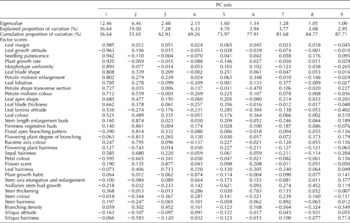
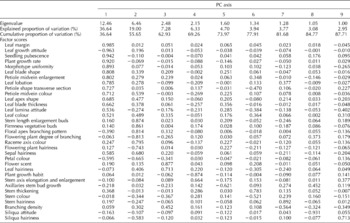
A total of 33 morphological traits were investigated, and their descriptive values and their frequency are given in Supplementary Table S5, available online only at http://journals.cambridge.org. The PC analysis observed nine PC axes (Table 2). The first PC axis separated leaf margin, leaf growth attitude, seedling pubescence, plant growth rate, morphotype uniformity, leaf blade shape, petiole midvein enlargement, leaf lobation, petiole shape transverse section, petiole midvein colour, leaf apex shape, leaf blade thickness, leaf lamina attitude and leaf colour. Stem length enlargements buds, firmness of vegetative buds, plural apex branching pattern, flowering degree of branching, raceme axis colour, flowering plant hairiness, sepal hairiness, petal colour had higher coefficients in the second PC axis. The first and second PC axes explained more than half of the total variation, and it is possible to include the corresponding amount of variance in two plots. The remaining seven axes were related to other leaf, plant and siliqua traits (Table 2).
Eigenvalue and proportions of variability as assessed by morphological qualitative traits contributed to nine PCs of germplasm
Cluster analysis not only confirmed the results obtained from PC analysis, but also revealed extreme variation among genotypes and their grouping. This was due to the difference in genotypic geographical origin and diversity of the accessions. The patterns of divergence between the 35 accessions for the first two PCs are given in Figs. 2 and 4 based on agronomic and morphological traits. Both Figs. 2 and 4 reveal that phenotypic diversity of Eruca and Diplotaxis genotype is very large (Fig. 3). It was observed that two PCs extracted a cumulative of about total 69%, and 55.6% of the total phenotypic diversity was observed among the Eruca and Diplotaxis genotypes for agronomic and morphological traits, respectively. Genotypes were grouped in five main clusters not only for plant properties but also related to the site from which the genotypes were collected.
Dendrogram of Eruca spp. and Diplotaxis spp. genotype obtained from different geographical region revealed by UPGMA cluster analysis based on morphological traits.

The cluster analysis performed with 33 characters distinguished the accessions into five independent clusters (Fig. 4). The first cluster includes Diplotaxis spp. from the South-west region of Turkey and two other Diplotaxis species from Italy. This cluster accession is characterized by crenate leaf margins, very sparse seedling pubescence, obovate leaf blade shape, no leaf lobation, semi-round petiole shape transverse section, very thin leaf blade thickness, but very soft vegetative buds, single flower raceme, sparse hairiness in flowering plants, white raceme axis colour and light green stem colour. The second cluster mainly consists of the genotypes collected from European countries (Cyprus, England, Italy, Poland, Spain and Turkey) but also includes genotypes from Iran and Pakistan. The leaf of this cluster has an undulate leaf margin, marked leaf lobation, round petiole shape transverse section, broadly rounded leaf apex shape, red green raceme axis, and the flower has a cream yellowish petal. The third cluster, mainly originating from Asia (Afghanistan, China) Near East (Pakistan) and Egypt, is the second largest cluster among the investigated genotypes and is characterized by leaf blade thickness, elongate plant growth habit, branching stem supporting with leaves, green raceme axis and intermediate stem hairiness. The fourth cluster consists of only the accession PI 390143, which was collected in Pakistan and characterized by a dense seedling pubescence, white petiole, sparse sepal hairiness, green stem and intermediate siliqua hairiness. The fifth cluster, made up of the accession PI 597835, is characterized by double dentate leaf margin, prostrate leaf growth attitude, spatulate leaf blade shape, green petiole, straight leaf lamina attitude and red or purple green stem.
Scatter diagram of the genotype revealed by 2D scaling analysis based on the first two PCs of morphological 2D Euclidean distance values.

Discussion
This study provided data to confirm that rocket is characterized by a wide diversity based on agronomic and morphological plant properties. These observations confirm previous work that underlined the presence of a great genetic variation in rocket germplasm for agromorphological characters such as plant type, branching pattern, pigmentation, fruit habit, pod size, shape and grain size and colour Chandel and Bhandari (Reference Chandel and Bhandari1989) and plant height, siliqua length and seeds per siliqua (Sharma et al., Reference Sharma, Agrawal and Satry1991). Warwick et al. (Reference Warwick, Gukel, Gomez-Campo and James2007) argue that Eruca genotypes observed most of their variability with regard to flowering time and plant height at flowering stage. Egea Gilabert et al. (Reference Egea Gilabert, Fernandez, Migliaro, Martinez Sanchez and Vicente2009) also describe considerable morphological variation in most agronomic and morphological traits.
The PC analysis showed that 86.28% of total variation accounted for four PC axis in quantitative and nine PC axes for qualitative traits. The variance accumulated by the first two components was 55.65%, in which agronomic traits relatively had high percentage of the total variation, which according to Mardia et al. (Reference Mardia, Kent and Bibby1979) and Veasey et al. (Reference Veasey, Schammass, Vencovsky, Martins and Bandel2001) explains satisfactorily the variability manifested between individuals. The cluster and PC analyses results confirmed the presence of remarkable phenotypic variability between these two taxa. Wild and cultivated rocket genotypes are clearly distinguished and constitute different clusters. The results are also in line with the findings of De Leonardis et al. (Reference De Leonardis, De Santis, Fichera, Padulosi, Zizza, Padulosi and Pignone1997) who distinguished Eruca and Diplotaxis species based on seed affinity, and Blangiforti and Venora (Reference Blangiforti, Venora, Padulosi and Pignone1997) reported differences at the chromosome level (length and karyotype formula) between D. tenuifolia and Eruca species.
The cluster analysis performed with 18 agronomic characters allowed the distinction of examined accessions into five independent clusters. The first and second PC axes explained more than half of the total variation of morphological traits, and it is possible to include the corresponding amount of variance in two plots. The agronomic and morphological traits used in the study allowed the separation of the examined rocket populations into clusters. Such a clustering was not, however, possible on the basis of single trait analyses (Sodani et al., Reference Sodani, Sastry and Nehra1990; Warwick et al., Reference Warwick, Gukel, Gomez-Campo and James2007; Egea Gilabert et al., Reference Egea Gilabert, Fernandez, Migliaro, Martinez Sanchez and Vicente2009).
Eruca cappadocica is used as oil crop across Anatolia (Ertuğ, Reference Ertug2000). Today, this practice is still very common particularly in the Konya province and Black Sea coast. Previous ethnobotanical and research studies showed that linseed oil production was started 100 years before the rocket vegetable cultivation. This study has shown that E. sativa and E. cappadocica are characterized by similar agronomic traits, which led to them being grouped into the same cluster. This cluster is cultivated in Europe, Middle East (Iran) and Near East (Pakistan), where rocket grown for oil is widely distributed and has been cultivated for a long time. Warwick et al. (Reference Warwick, Gukel, Gomez-Campo and James2007) indicate that the subspecies sativa is cultivated in southern Europe, the Middle East, north and north-east Africa, central Asia, and north and central India, and it also occurs as a wild plant in the Mediterranean area, north and north-east Africa, the Balkans, and Near and Middle East to Afghanistan. Gomez Campo (Reference Gomez-Campo2003) reported that it is difficult to discriminate E. vesicaria subsp. sativa and E. sativa subsp. sativa based on morphological traits. On the other hand, some findings are in contrast with other studies based on plant architecture (indicating that both species differ noticeably for leaf morphological traits) (Baytop, Reference Baytop1948) and on observations (made also through this study) that oil rocket plant can be easily distinguished from vegetable rocket for its bitter leaves, more hairy and fibrous leaves and different uses (E. cappadocica is not used for human consumption, but only as livestock feed and oil crop). In the light of these facts and contrary to what has been proposed earlier by Davis (Reference Davis and Davis1967), it is difficult to keep these two taxa as distinct species. In addition, Warwick et al. (Reference Warwick, Gukel, Gomez-Campo and James2007) argue that the taxonomic position of E. vesicaria (L.) Cav., E. sativa Mill. and Eruca pinnatifida (Desf) are controversial and referred these taxa as E. vesicaria subsp. sativa, subsp. vesicaria and subsp. pinnatifida.
Assessment of phenotypic and genotypic variability is useful both for practical application in breeding and for conservation of plant genetic resources. In general, there is a close relationship between the morphological and physiological properties of plants and their habitats. Different geographical locations mainly differ with respect to ecogeographical factors (Arora, Reference Arora, Hossain, Arora and Mathur1997) such as latitude, altitude, temperature. In this study, genotypes could be clustered based on the geographical origin of genotype with only a few exceptions. Egea Gilabert et al. (Reference Egea Gilabert, Fernandez, Migliaro, Martinez Sanchez and Vicente2009) clustered Eruca accessions by geographical origin, and Warwick et al. (Reference Warwick, Gukel, Gomez-Campo and James2007) separated Mediterranean and Asian E. sativa subsp. sativa accessions due to their primary usage and cultivated or wild condition.
In conclusion, this study revealed that Turkish rocket plant gene pools are diverse and include E. vesicaria subsp. sativa and E. sativa subsp. sativa accessions, which have been used as a vegetable and oil plant. The level of variation that was assessed in the present germplasm is a good source of diversity to use in modern Eruca breeding programmes. The study has also contributed to a further understanding of the phenotypic relationship between oil and vegetable rocket plants, considered by several authors as the same species. In this study, we identified similar agronomic traits among the two taxa. Several differences were also detected (e.g. texture, hairiness, unpalatability of leaves), but these do not warrant the distinction of these taxa from one another. This finding is supported by Gomez Campo (Reference Gomez-Campo2003) who stated that it is difficult to discriminate E. sativa subspecies based on morphological traits. Further studies at the DNA level will be needed to confirm the results of the phenotypic characterizations carried out through this study. Furthermore, our results provided useful information on morphological and agronomic characterization of Turkish wild and cultivated rocket, and also on the natural distribution of D. tenuifolia populations in the Mediterranean (south-west parts of Turkey) and Aegean Region.
Future research
In order to produce a comprehensive dataset for the genetic resources in Turkey of wild, cultivated oil and vegetable rocket, research activities will be established based on effective genetic conservation programmes that cover natural distribution, collection, characterization (via morphological and molecular markers) and evaluation of Eruca spp. and Diplotaxis spp. to provide useful information for plant breeders.
Acknowledgements
The authors thank Prof. Dr. Jules Janick for critical reading and useful suggestion to the manuscript, providing the seeds, and North Central Regional Plant Introduction Station, Ames, Iowa, USA, for providing seed samples. Dr. Allison Powell and Dr. Stefano Padulosi are also acknowledged for their valuable comments on the paper. This study was supported through funds from the Ege University Research Foundation under grant no. 2005-TTUM-002.