

Introduction
Indigenous peoples the world over affirm a special relationship to their ancestral lands and territories.Footnote 1 Normally prized as a collective or corporate heritage, land is valued not only as a source of daily livelihood but also because it carries spiritual, social, cultural, and intergenerational values and meaning. Land long occupied is a lived experience, and it is from a deep sense of attachment to particular lands, landscapes, and places that individuals and groups derive much of their identity and cultural vitality. For most indigenous peoples, however, the single greatest challenge they face is the refusal of states to recognize their customary land rights, and to demarcate and title the lands they claim as their own.Footnote 2
In Malaysia, the federal government and state governments have increasingly targeted indigenous peoples' homelands for mainly capital-intensive resource extraction and commodity production. Generally lacking secure property rights and powerless to prevent the corporate and the political elite from appropriating their lands and resources, many communities have, ironically, been further marginalized by what passes for development. It is therefore hardly surprising that the number of disputes and conflicts over access to and ownership of indigenous lands has risen sharply in recent years. Among the ingredients of many disputes are contrasting conceptions of land tenure, conflicting views of what land is worth, and opposing visions of the good life. Invariably excluded from decisions that affect their lives, and generally having failed in other ways to make their voices heard by the authorities, many communities have sought to have their customary land rights upheld in the nation's courts.
Malaysia's indigenous peoples, like all other Malaysians, have rights in land under the Federal Constitution, and certain statutes provide for limited recognition of their customary land rights. In addition, Malaysia's courts have recognized the existence of native title at common law. They have ruled that native title rights do not have their origins in legislative, executive or judicial declaration but rather in the rights that arise out of traditional laws and customs, and that such rights can only be extinguished by clear and unambiguous legislative intent.
This paper summarizes several court cases concerning indigenous peoples' land rights in Malaysia, and examines the evolution of Malaysian case law in this complex subject area. In addition, it looks at certain of the issues that have resulted from the cases and discusses the responses of indigenous communities, as well as those of the federal and state governments, to the court judgments. But first, we set the scene by briefly describing Malaysia's indigenous peoples, the nature of their land rights, and the impact of development policies on their lives and livelihood.
Context
Malaysia and its indigenous peoples
Created in 1963, the Federation of Malaysia comprises the 11 states of Peninsular Malaysia (hereafter called ‘the Peninsula’) on the Asian mainland, the states of Sabah and Sarawak (East Malaysia) on the island of Borneo, and three Federal Territories.Footnote 3 The political regime has been variously described as a form of ‘illiberal’, ‘pseudo-’ or ‘quasi-’ democracy.Footnote 4 Although civil society is weak and fragmentary, the growth of an increasingly affluent middle class, urbanisation, rising education levels, and continuing globalisation have fostered a proliferation of non-governmental organisations (NGOs) and social movements in recent decades, including advocacy-oriented groups that champion issues such as environmental protection, human rights, gender concerns, and the land rights of indigenous peoples.Footnote 5 By and large, ‘English-speaking, middle-class, urban non-Malays predominate in secular advocacy groups, most of which are small and concentrated in Kuala Lumpur, Penang, and a few other cities’.Footnote 6
Under the Ninth Schedule of the Federal Constitution, the executive and legislative powers of the federation are divided between the federal and state governments. State powers include jurisdiction over land, forests, and agriculture, a matter that has considerable significance for resource management, nature conservation and, among other things, indigenous land rights. In practice, however, the federal government exerts considerable direct and indirect control over the states. This has been achieved, in part, through its control over the allocation of development funds and because power has been increasingly centralized in the hands of the executive.Footnote 7
Malaysia has enjoyed several decades of rapid economic growth. Since the 1970s, its economy has been rapidly transformed by the growth of export-oriented manufacturing. As Harold Brookfield observes, industrial production has propelled Malaysia ‘from being merely a high-growth economy to becoming one of the world's most outstanding economic performers’.Footnote 8 The government aims to transform Malaysia into a fully developed nation by 2020.Footnote 9
The benefits of Malaysia's impressive economic growth include a sharp drop in the national incidence of poverty, major improvements in overall living standards, and the creation of a new Malay middle class. On the other hand, development has taken a heavy toll on the environment, failed to reach several endemically poor regions, and largely bypassed the country's indigenous peoples, namely, the Orang Asli of the Peninsula and the natives (as they are officially called) of Sabah and Sarawak.Footnote 10
In 2000, Malaysia's multicultural population numbered close to 22.2 million.Footnote 11 The Malays, Chinese, and Indians, the three largest ethnic groups, comprised about 53.4 per cent, 26.0 per cent, and 7.7 per cent of the total population, respectively. In addition, a large number of separately named indigenous ethnic groups made up 11.7 per cent of the population.Footnote 12 The government regards the Malays, the natives of Sabah and Sarawak, and (albeit grudgingly) the Orang Asli as the country's indigenous peoples, or bumiputera (literally, ‘sons of the soil’).Footnote 13 As Kirk Endicott points out, however, the concept of ‘indigenous peoples’ normally ‘does not include nationally dominant majority peoples like the Malays’, and consequently we disregard them as such in this paper.Footnote 14
The Orang Asli are the non-Malay indigenous inhabitants of the Peninsula. They comprise at least 19 linguistically and culturally distinct groups. In 2003, they numbered about 140,000, or a mere 0.6 per cent of the national population in that year.Footnote 15 Traditionally, most Orang Asli groups ‘lived by various combinations of hunting, fishing, gathering, shifting cultivation, arboriculture, and trading forest products’.Footnote 16 Today, their economic pursuits include combining subsistence and cash-crop production, petty commerce, commercial fishing, salaried jobs, and wage labour.Footnote 17 Most Orang Asli are at the bottom of the socio-economic ladder. Compared with the national population, they endure higher rates of poverty, suffer disproportionately from preventable diseases, have higher infant and maternal mortality rates, are poorly provided with basic services and utilities, and have lower levels of education.Footnote 18
Whereas the Orang Asli are a tiny minority, the many non-Malay, predominantly non-Muslim native peoples of Sabah and Sarawak numbered approximately 2.2 million in 2000, or about 50 per cent of the combined population of those states, and close to 10 per cent of the national population.Footnote 19 Traditionally, most groups combined shifting cultivation of mainly upland rice with hunting, fishing, collecting forest products for subsistence and sale, and crop production for the market. Today, the cultivation of perennial cash crops and the adoption of various forms of non-farm employment have largely supplanted shifting cultivation in many areas.Footnote 20 Export-oriented production of mainly oil, gas, timber, and palm oil has resulted in considerable economic growth in Sabah and Sarawak in recent decades. For the most part, however, the benefits of growth, such as improvements in health care and general living standards, are enjoyed by a minority of mainly Malay/Melanu and Chinese urban dwellers and not by the predominantly rural-dwelling natives, the great majority of whom continue to suffer widespread and persistent poverty, high rates of illiteracy, and limited access to medical care.Footnote 21
Land Rights
The Federal Constitution, certain federal and state statutes, and the common law, protect land rights in Malaysia. Malaysian citizens' land rights are enshrined in Article 13 of the Federal Constitution, which states that ‘No person shall be deprived of property save in accordance with law’, and that, ‘No law shall provide for the compulsory acquisition of property without adequate compensation’. Private ownership of land is administered by the Torrens system of land-title registration,Footnote 22 and federal and state statutes authorize the compulsory acquisition of land for public purposes and provide for the determination of compensation.Footnote 23
In addition to their constitutional land rights, indigenous peoples' customary land rights receive some recognition in three separate statutes, namely, the federal Aboriginal Peoples Act 1954 (revised 1974), the Sabah Land Ordinance 1930 (revised 1996), and the 1958 Sarawak Land Code. But before looking at the statutes' provisions, it is important to note that all indigenous communities in Malaysia have customary rights in land and that an elaborate body of customs and conventions, termed adat, governs these rights.Footnote 24 Generally speaking, land is held under various community-based systems of tenure, each village community occupies a distinct territory with recognized boundaries, and the household is the basic holder of rights in land. Tenure arrangements provide for ownership and use of land but no one has the power to alienate it, and exclusive individual or family property rights usually extend only to the collected or harvested products of the land and to certain fruit trees or other highly prized resources.Footnote 25
The Aboriginal Peoples Act (APA) narrowly circumscribes Orang Asli land and other rights. Originally motivated mainly by security concerns during the Emergency (1948–1960),Footnote 26 but still in force today, the APA defines the legal status of the Orang Asli and makes the federal Department of Aboriginal Affairs (Jabatan Hal Ehwal Orang Asli) the arbiter of virtually all aspects of their lives.Footnote 27 Under the APA, state governments can, but are not obliged to, designate certain areas as ‘aboriginal reserves’, or ‘aboriginal areas’.Footnote 28 As of the mid-1990s, however, only about 15 per cent of the more than 770 villages where the Orang Asli lived had been officially gazetted as reserves.Footnote 29 Yet even in these gazetted areas, Orang Asli can secure no better title to the land that has been allocated to them than that of tenants at will. What this means is that no tenancy for life is possible.Footnote 30 In short, the APA fails to provide Orang Asli with actual ownership of their ancestral lands. Nor do Orang Asli have any security of tenure because the APA provides for the resumption of any land allocated to them.Footnote 31 Since the 1970s, many Orang Asli in the interior of the Peninsula have been concentrated in so-called regroupment schemes within or close to their traditional homelands. A major goal of the schemes is to encourage Orang Asli to participate more actively in cash-crop production for the market. Yet even regrouped Orang Asli enjoy no security of tenure because they ‘cannot get freehold title from the State land office for land in the regroupment schemes’.Footnote 32 Bearing in mind that all untitled land under the Torrens system is state land, and that very few of the Orang Asli possess land titles, the vast majority of the Peninsula's indigenes are legally ‘squatters’ on state land.Footnote 33 As a result, they can be dispossessed at the stroke of a ministerial pen.Footnote 34 On the other hand, the APA does not specifically say that Orang Asli land rights at common law are extinguished.
Compared with the Orang Asli, the native peoples of Sabah and Sarawak enjoy greater, although still limited, recognition of their customary land rights.Footnote 35 In Sabah, Part IV of the Land Ordinance recognizes ‘native lands’ held under native titles or under customary tenure, which is defined, in part, as ‘the lawful possession of land by natives either by continuous occupation or cultivation for three consecutive years or more’.Footnote 36 A native who can establish customary tenure acquires an indefeasible interest in land that is not dependent on possession of a documentary title, although the holder of such land may be required to take out title by entry in the Register of Native Titles. There is provision for native customary rights to be conferred as communal native titles and for state land to be declared a Native Reserve.Footnote 37
In Sarawak, the Land Code provides for five classes of land, only three of which are relevant here,Footnote 38 namely, Native Area Land, which is land held by natives under title; Native Customary Land, which is untitled and defined, in part, as ‘land in which native customary rights, whether communal or otherwise, have lawfully been created prior to the 1st day of January, 1958, and still subsist as such’;Footnote 39 and Interior Area Land. A native who wishes to occupy Interior Area Land for the purposes of creating customary rights must first obtain a permit from the government, but it is no longer government policy to issue such permits. In addition, there is provision for state land to be declared a Native Communal Reserve. Since all untitled land is state land, and since few natives possess land titles, the vast majority of Sarawak's indigenous peoples occupy their ancestral lands as mere licensees of state land.Footnote 40 In brief, native peoples' customary rights have little force in law, and such rights as they possess do not amount to ownership of their lands.
The customary land rights of Sabah and Sarawak's indigenous peoples are severely restricted and far from secure. Both states claim ultimate authority over land, both retain the entire property in rivers and other watercourses, both place strict limitations on access to forest reserves and conservation areas, and both have introduced amendments to their land laws to facilitate the extinguishment of customary land rights. In short, indigenous land rights have been incrementally whittled away.Footnote 41
A new component of indigenous land rights, and indeed of Malaysian jurisprudence, came to the fore in 1996 with a ruling by the High Court that Malaysian common law recognizes native title rights based on indigenous laws and customs and that such rights do not have their origins in legislative, executive or judicial order.Footnote 42 The matter requires brief explanation.
The contemporary concept or doctrine of indigenous peoples' land rights at common law, called ‘native title’ or ‘aboriginal title’ (hereafter called ‘native title’), is largely the product of jurisprudence originating in Canada and Australia since the 1970s.Footnote 43 In recent years, courts in a growing number of other common law jurisdictions, among them Belize, Botswana, Kenya, and Malaysia, have referred to the doctrine in decisions regarding indigenous communities' land rights.Footnote 44
Native title is the right of indigenous peoples to their traditional lands, waters, and territories. It is a collective right that exists irrespective of any formal recognition. This legal right derives from indigenous peoples' historic occupation and possession of their ancestral homelands and is rooted in their own laws and customs. As Gilbert observes, national courts have acknowledged that ‘indigenous peoples’ land rights are grounded in pre-existing customary laws which have survived colonization'.Footnote 45 (In Malaysia, as previously noted, such customary laws are called adat.) Since such rights neither conform to common law concepts of property nor to indigenous notions of land and resource rights, but rather to the perspectives of both, they are regarded as unique, or sui generis.Footnote 46
It is important to emphasize that native title can be extinguished by legislative or executive order (provided there is plain and clear statutory intention to do so) and by the creation of third-party rights in indigenous lands by the governing power.Footnote 47 In other words, the concept ‘is itself discriminatory in that it provides only defective, vulnerable and inferior legal status for indigenous land and resource ownership’.Footnote 48 Furthermore, since extinguishment is a process or procedure that applies only to indigenous peoples, it would appear to be starkly at odds with principles of equality and non-discrimination.Footnote 49
Development, displacement, and dispossession
The majority of Malaysia's indigenous peoples, like most of those elsewhere in Southeast Asia, occupy marginal or peripheral upland areas that are outside and relatively distant from the national core area, which is firmly fixed in the Peninsula's western lowlands. Many Orang Asli occupy rural areas in the central and northern uplands of the Peninsula, and the great majority of Sabah and Sarawak's natives live in the hilly interior of those states. Government policies aim to incorporate the lands and resources of peripheral spaces into national and global markets, and to integrate their peoples, whose ways of life are widely regarded as ‘backward’ and a stumbling block to development, into the ‘mainstream’ of society. The politics of ethnicity plays an important role in growing struggles over access to and control of indigenous lands, because local customary rights claims are invariably superseded by the ‘national interest’ claims of the ‘mainstream society’, which should be understood to mean Malay society.Footnote 50
Development projects on indigenous peoples’ lands are geared to producing commodities for national and global markets. The government asserts that they are in the national economic interest, that they alleviate poverty in depressed marginal areas, and that they contribute to nation-building and national unity. As Peter Brosius observes, in pseudo-authoritarian Malaysia, where ‘development stands as a totalizing discourse of legitimation’, further justifications for development policies are rarely necessary.Footnote 51 Three kinds of projects, namely, dam construction, logging, and land development, have extensively appropriated or encroached on lands and forests that many indigenous communities depend upon for material and cultural survival. We look very briefly at certain of their effects.
Many large dams have been constructed for hydroelectric power, water supply, and irrigation. They include the Temenggor, Kenyir, Linggiu, Nenggiri, and Sungai Selangor dams in the Peninsula; the Babagon Dam in Sabah; and the Batang Ai and Bakun dams in Sarawak. These and other dams have resulted in loss of valued land, forest resources, and burial grounds; displacement and resettlement; and disintegration of formerly viable communities. Dams have had their greatest impact in Sarawak. Some 3,000 Iban were resettled to accommodate the Batang Ai Dam, and the controversial Bakun Dam, now nearing completion, has displaced about 10,000 mainly Kenyah and Kenyan from their ancestral lands.Footnote 52 Development-induced displacement, whether resulting from dams or other projects, ‘doesn't just remove people from their livelihoods: it removes them from their sense of place and their identity and, in some instances, from their sense of worth’.Footnote 53
State governments have control over forests and the power to grant logging concessions, even though native communities may claim the forests as their own. An important source of revenue for states’ coffers and a road to great wealth for a coterie of politicians and their favoured clients, logging has brought few long-term benefits to native communities.Footnote 54 The process itself is notoriously destructive: it damages residual trees, depletes wildlife and non-timber forest products, increases rates of soil erosion and stream sedimentation, thereby affecting aquatic life, and destroys or damages places with which indigenous communities have deep historical associations.Footnote 55 The traditionally nomadic (but now almost entirely settled) Penan living in interior Sarawak have felt some of the harshest impacts of the industry because logging depletes or destroys the forest resources they still depend upon for subsistence and trade.Footnote 56 Little or no compensation is usually offered or paid for lost resources.
Land development schemes have replaced vast areas of species-rich lowland and hill forests with mainly rubber and oil palm.Footnote 57 The effects of the schemes on indigenous communities include loss of valued forest resources and displacement from their land, often without compensation. At Cawang in Perak, for example, some 2,000 hectares of Orang Asli forest lands were cleared and turned into an oil-palm estate, leaving behind only about 40 hectares of forest occupied by five families.Footnote 58 Almost all the beneficiaries of the schemes in the Peninsula are Malays, not Orang Asli, many of whom have been dispossessed to make way for new arrivals. Loss of land and forest resources to agricultural schemes often results in impoverishment and growing dependence on government assistance for survival.
In Sabah and Sarawak, extensive areas of so-called ‘idle’, ‘waste’ or ‘empty’ land held mainly under customary communal tenure by shifting cultivators have been converted into oil-palm plantations.Footnote 59 Generally ignoring the anxieties of many (though by no means all) native groups that they will eventually lose their ancestral lands to large plantation enterprises, the continuing rapid expansion of the area devoted to the crop has resulted in a growing number of disputes over land, especially in Sarawak, where many native communities have sought to defend their rights in the courts.Footnote 60 Progressively whittled away since colonial times, and now under mounting pressure from market forces that seek to replace ‘unproductive’ shifting cultivation with plantation crops, the land area under customary tenure in both Sabah and Sarawak appears destined to shrink dramatically in the near future.Footnote 61
In Malaysia, as in other parts of Southeast Asia, development projects at the margins have often merely served to increase native communities’ vulnerability to poverty, unwanted resettlement, loss of autonomy, and political disempowerment.Footnote 62 While it is true that some groups have benefited from development schemes—for example, new roads facilitate market exchange—many others have, ironically, been further impoverished by what passes for ‘progress’. Increasingly alienated from the means of making their own places in the world, and often regarded as little more than ‘extras’ in resource-based schemes, many indigenous communities have been increasingly marginalized, ‘not because they are remote from the centre but because they have been incorporated by the centre through economic and/or political means’.Footnote 63
Going to court
Malaysia's indigenous peoples want secure land rights, freedom of religious and cultural expression, recognition of the right to speak their own languages, and a certain degree of political autonomy, including some latitude to make decisions that affect their lands and livelihood. They also want to share in any benefits that accrue from economic development, such as provision of roads, electricity, piped water, better housing, educational opportunities, and adequate health care. In short, they want what most other indigenous peoples want, and they are not, contrary to what certain government officials claim, hidebound conservatives who are opposed to all forms of development. In short, it is not the concept of development that they oppose but rather the negative effects of the unsolicited ‘development initiatives’ that have been foisted upon them.
Faced by mounting predation on their lands and resources, lack of recognition of their customary rights, and continuing injustice, indigenous communities have adopted various strategies to ward off further marginalization and to have their voices heard by outsiders. Far from being passive ‘victims of development’, they have, for example, engaged government officials in various forms of confrontation, negotiation or collaboration over development schemes, formed NGOs to represent their interests, organized media campaigns to highlight their grievances, and engaged in various forms of both passive and active resistance.Footnote 64 But in large part because they lack political clout, their voices have usually fallen on deaf ears. As frustration over land rights issues has intensified, many communities have sought to have their grievances addressed in the courts. In Sarawak in particular, there is a large backlog of cases waiting to be heard.
Court Cases
Indigenous communities’ statutory and common-law land rights have been upheld in Malaysia's courts. This is a welcome outcome, because both federal and state authorities have paid scant attention to such rights; it is also a somewhat surprising outcome, because the judiciary's independence was significantly weakened under the former premiership of Dr Mahathir Mohamad. Following a brief description of the Malaysian court system and judiciary, we describe seven statutory customary land rights cases and four cases involving native title at common law.Footnote 65
The Malaysian court system and judiciary
The Malaysian legal system is based on English law, although certain of the system's components accommodate local culture and religion. The Federal Constitution clearly provides for the separation of legislative, executive, and judicial powers. Part IX of the Constitution relates to the judiciary, and Article 121 therein specifies the judicial powers of the federation. The court system is hierarchical, with superior and subordinate courts: the former category comprises the High Court, the Court of Appeal, the Special Court, and the apex Federal Court, and the latter category includes the Sessions and Magistrates’ Courts, the Court for Children, and the Penghulus’ and Native Courts. In addition, there are Syariah Courts in each of the states that have limited powers over matters concerning Islamic law.Footnote 66 The High Court, the Court of Appeal, and the Federal Court have heard all but one of the native customary land rights cases discussed in this paper.Footnote 67
Judges are appointed by the King (the Yang di-Pertuan Agong) pursuant to Article 122B of the Federal Constitution. The King acts on the advice of the Prime Minister, following consultation with the Chief Justice and the chief judge of the court in question. The Malaysian judiciary was long held in high esteem and earned a reputation for being impartial and independent. Beginning in the mid-1980s, however, faith in the judiciary's impartiality was shaken when former Prime Minister Dr Mahathir Mohamad dismissed the Lord President of the Federal Court and two Supreme Court judges. A constitutional crisis ensued, resulting in constitutional amendments that eroded the judiciary's independence.Footnote 68
Statutory rights and community challenges
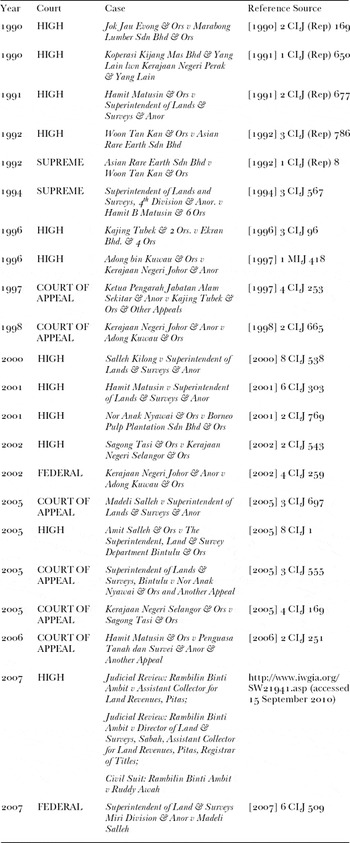
Beginning in the 1980s, indigenous communities and individuals increasingly sought to have their rights in land and resources upheld in the courts, ushering in a new era of indigenous activism in Malaysia. Between 1983 and 1996, seven cases were lodged with the High Court, resulting in judgments between 1990 and 2002. In more recent years a large number of cases have been lodged with the courts and a slow trickle of judgments has appeared.Footnote 69 There are two types of cases: those seeking redress for breaches of existing statutes, and those seeking recognition of customary rights in land at common law, including claims for compensation. Seven cases concerning statutory rights are described in this section and four relating to native title at common law in the following two sections.
Of the seven statutory rights cases, two sought redress in the granting of logging licences, three in the expulsion from claimed customary land without appropriate compensation, one for the alleged wrongful granting of statutory native title, and one in procedural processes associated with an Environment Impact Assessment (EIA).Footnote 70
Jok Jau Evong
The first of the seven decisions relating to statutory matters was handed down in 1990. It concerned the granting of a licence in 1981 to log primary forest in the Lemiting Protected Forest Reserve at Kampong Uma Bawang, near Baram, in Sarawak that a local Kayan community used for foraging and hunting (their menoa).Footnote 71 The Kayan claimed to be aware that the reserve had been proclaimed but denied any knowledge that a logging licence had been issued until, in 1988, the licensee's contractor arrived to commence logging operations.
Kayan who were opposed to the logging lodged a writ with the High Court against the contractor (the First Defendant), the licensee (the Second Defendant), and the Sarawak Forest Department (the Third Defendant), arguing that the area licensed for logging was part of their native customary land.Footnote 72 The plaintiffs sought a court declaration confirming that they had customary rights in the land and an order that logging operations should cease.Footnote 73 The defendants claimed that Kayan customary land rights did not extend to the primary forest (menoa) in question and that the granting of the licence was therefore legal, and that there was no case to answer; furthermore, they contended that the case should be struck out because the statute of limitation had been exceeded.
The judge advised that the court would have to resolve three issues: whether the case could proceed as a representative action by the plaintiffs; whether any limitation law might bar the plaintiffs’ claims for declaratory orders; and whether, on the basis of their pleadings and affidavits, the plaintiffs had ‘any cause of action against the defendants’.Footnote 74 He accepted that the plaintiffs were part of the legally recognized Kayan community and that the 1958 Sarawak Land Code recognized native customary land rights. He therefore held that an action relating to such rights had merit and could be regarded as a community action, regardless of the fact that some Kayan supported the logging. The validity of the Kayan's case was not tested, however, because the court ruled that the statute of limitation had been exceeded.Footnote 75 In dismissing the case, the judge commented, somewhat unsympathetically, that ‘If the plaintiffs sleep on their rights then they take the risks that their rights may be extinguished’.Footnote 76 In light of the dismissal, there was no need for the court to consider the third issue, namely, whether the plaintiffs had a reasonable cause for action.
Koperasi Kijang Mas
In the second logging licence case, a group of Orang Asli in Perak requested that the High Court order that logging cease on land that had been reserved for their use.Footnote 77 The plaintiffs contended that the Perak state government had breached the Aboriginal Peoples Act by including land within two aboriginal reserves at Sungai Banun and Pos Legap in a logging licence. The defendants claimed that they had not breached the act, asserting that the two government-approved reserves had not been officially gazetted. The High Court ruled that the Aboriginal Peoples Act had been breached and that the creation of aboriginal reserves does not rely on their being gazetted. The court ordered logging to cease. The judgment confirmed that local Orang Asli have exclusive rights to forest products in the two reserves, thereby setting a precedent for the recognition of such rights in similar reserves elsewhere in the Peninsula.
Hamit Matusin
The third of the seven cases concerned a claim for redress by members of a Melanu community at Kampong Dagang, near Miri, Sarawak. In 1983, the plaintiffs had been evicted from seven allotments that they considered their own, and their houses had been destroyed without compensation.Footnote 78 The defendants argued that the land in question was either owned by Sarawak Shell or was within a river-bank reserve, and that both the 1958 Sarawak Land Code and the earlier Land (Classification) Ordinance 1948 prevent the acquisition of native customary rights in such land. The plaintiffs argued that this evidence should be disregarded because it had not been included in the original plea. The judge concurred on legal grounds and found for the plaintiffs, with damages to be assessed, commenting that:
In a nutshell, it would appear to me that the defendants practised double standards in respect of those people who claimed native customary rights in Kampong Dagang where certain people were given compensation but the plaintiffs were deprived of the same for reasons best known to the defendants.Footnote 79
The defendants appealed the judgment, and in 1994 the Supreme Court overturned the decision. The Court was of the opinion that the disregarded evidence should have been heard and ordered a retrial before a different judge.Footnote 80
The retrial did not take place until 2001, when the parties agreed that the only issue to be considered was whether the land in question (as noted above, it comprised seven allotments) was located within a river-bank reserve.Footnote 81 The trial judge concluded that four of the seven allotments were within a river-bank reserve. He awarded the successful plaintiffs damages and costs and ordered the three unsuccessful plaintiffs to pay costs for the trial, as well as for the earlier trials. The unsuccessful plaintiffs and the defendants appealed the decision.Footnote 82 The Court of Appeal re-examined the survey evidence relating to the location of the river-bank reserves and decided not to disturb the lower court's findings.
Salleh Kilong
Turning now to the fourth case, in 1995 a Malay villager from near Miri in Sarawak also lodged a case with the High Court, seeking redress for eviction from alleged customary land.Footnote 83 The state government had reserved the land for a park on which a religious school was subsequently built. The villager considered that he was entitled to compensation. The defendants contended that the land was part of a 1921 Shell concession area and that therefore customary land rights could not have been established in the area. The High Court ruled that the land in question was state land, as defined in the Sarawak Land Code, and that customary land rights could only have been acquired if a permit had been issued pursuant to Section 5(7) of the Code. Since the plaintiff could not produce a permit, judgment was for the defendant, and the plaintiff's call for compensation was dismissed.Footnote 84
Kajing Tubek
The judgment in a statutory case of a very different nature was brought down by the High Court in 1995. It concerned three longhouse dwellers affected by the construction of the controversial Bakun Dam in Sarawak. Ekran, the firm awarded the dam contract, had prepared a detailed Environmental Impact Assessment (EIA), as required by the federal Environmental Quality Act 1974 (EQA).Footnote 85 A key procedural requirement for such an EIA is that a draft of the assessment must be made available to the public to ensure accountability and to allow for community responses to be made to an independent review panel appointed to advise the federal Director General of Environmental Quality.Footnote 86 Before the EIA was released to the public, however, the federal Minister of Environment introduced a new Order removing Sarawak from the provisions of the 1987 Order and making the Order retrospective to 1 September 1994.Footnote 87 The Director General then announced that the EIA would be subject to the Sarawak Natural Resources and Environment (Prescribed Activities) Order 1994.Footnote 88 In contrast to procedures under the federal EQA, there is no requirement in the Sarawak legislation that the public be made aware of an EIA.Footnote 89 Following its submission to the Sarawak Natural Resources and Environment Board, the EIA was duly approved.
Claiming that they had been deprived of their accrued or vested rights, the longhouse dwellers sought a declaration that the contractor must make a copy of the EIA available for comment before work could begin, as required by the federal EQA.Footnote 90 The defendants contended, inter alia, that the plaintiffs did not have standing (locus standi) because they had not suffered any specific, direct or substantial damage over and above that suffered by the public at large. They also argued that the High Court did not have the power to make a declaratory judgment regarding land and water because, according to the Federal Constitution, such matters rest with the state of Sarawak.Footnote 91
The court accepted the standing of the three plaintiffs, the trial judge commenting that the sufferings and damages they had endured ‘definitely are “particular, direct and substantial” to the plaintiffs themselves which are obviously different and apart from what other members of the public would suffer’.Footnote 92 On the question of justiciable power, the court ruled that the federal EQA applied to the Bakun project, irrespective of the existence of a concurrent state law. The judge granted a declaration that the Environmental Quality (Prescribed Activities) (Environmental Impact Assessment) (Amendment) Order 1995 was invalid and a further declaration requiring compliance with the federal EQA and related guidelines. Costs were awarded to the plaintiffs.
The defendants appealed to the Court of Appeal, which overturned the High Court decision.Footnote 93 The appeal court focused on whether or not the three plaintiffs had standing and whether federal or state law applied in the case. On the question of standing, it took a more restrictive view of the matter than did the High Court,Footnote 94 holding that the plaintiffs did not have substantive standing because they were attempting to enforce a penal sanction, that their claimed deprivation of life under Article 5(1) of the Federal Constitution was not supported because actions affecting them were in accordance with law, and that they had suffered no injury above what was common to others.Footnote 95 In light of this ruling, there was no need for the court to consider other matters, although it commented that if the respondents had been deemed to have standing it would have supported the appeal because the Federal Constitution provides that state rather than federal law applies to land and water within a state.Footnote 96 This conservative ruling may serve as a precedent for other states to ignore the application of the federal EIA act, possibly putting its future efficacy in doubt.Footnote 97
Amit bin Salleh
In 2005, the High Court handed down a judgment that almost certainly will be cited as a precedent for plaintiffs seeking compensation for loss of customary land rights.Footnote 98 In 1987, the Sarawak government declared land at Kuala Nyalau, near Bintulu, a Native Communal Reserve to serve the agricultural needs of local Kedayan, Melanau, and Malay communities. The communities entered into a joint venture agreement with a non-indigenous company to grow setang (Azadirachta excelsa) and teak (Tectona grandis) trees for sale. In 1997, the government issued a rescission order extinguishing the reserve, replacing it with another piece of land, but provided no compensation for the loss of the commercial trees. In April 2000, the communities took out a writ of summons against the government that included a claim for special damages of RM10, 493,180 (US $2,958,840)Footnote 99 and a claim for general damages. The defendants claimed that the plaintiffs did not belong to the Kedayan/Melanau/Malay communities of Kuala Nyalau and that they did not have customary rights in the land in question.
At the court hearing, the State Counsel accepted that the plaintiffs were native community members, making their identity a non-issue. The judge ruled that the 1987 Order establishing the Native Communal Reserve had given the communities customary rights to use the land, and he examined in considerable detail whether the plaintiffs were entitled to compensation. Drawing support from the Adong case (see below), he decided that they were so entitled and ordered that compensation be paid for the loss of the trees, with the requirement that the plaintiffs provide proof of their loss and its value. Costs were awarded to the plaintiffs.
Rambilin binti Ambit
In July 2007, the High Court in Sabah brought down another native customary rights decision. It involved a civil suit between a Dusun woman, called Rambilin, and her brother Ruddy over native customary land rights and the granting of native titles, as well as two related Judicial Reviews.Footnote 100 The three actions were heard together because they concerned the same 6.1-hectare parcel of land, divided into two lots, at Kampung Gailun Salimpodon in the Pitas District of Sabah.
Rambilin binti Ambit, who purchased the land in 1982 from two natives, cleared the land and built a house on it in 1983; she then improved the land and erected a boundary fence. On the other hand, she did not reside permanently on the land because her husband was a public servant who moved around the state. In 1989, Rambilin formally applied for native title to the land in accordance with customary rights and legislative provision. In 1996, Ruddy entered the land and, despite Rambilin's protests, the Office of the Assistant Collector of Land Revenue and the Registrar of Titles, Pitas District, issued native titles to Ruddy in 2001. Rambilin commenced High Court proceedings in 2000, seeking possession of the land and damages from Ruddy for trespass. In 2002, sanction was given for two judicial reviews: the first was an order of mandamus to direct the Assistant Collector of Land Revenue to deliver a decision on Rambilin's application for native customary rights; and the second was an order of certiorari against the Director to quash his decision to grant Ruddy title to the land before a decision had been reached regarding Rambilin's application.Footnote 101
Ruddy's counsel raised a number of arguments, including that Rambilin could not claim customary rights in the land because it was state land that she did not have permission to enter and that, furthermore, she had not continuously resided on the land. Justice Chin examined in detail whether Rambilin could hold native customary rights in the land and, if so, whether those rights had been extinguished by legislative order. Drawing support from the Canadian Calder and Delgamuukw cases and from the Malaysian Adong and Nor cases (see below), he found that Rambilin did indeed hold customary rights in the land and that they had not been extinguished. He also conducted a thorough examination of the history of Sabah's land laws, and concluded that none of the statutes or orders contained clear and plain intent to abolish customary land rights. Justice Chin deemed that continuous occupation was not necessary, provided that exclusive acts of ‘dominance’ could be demonstrated, and he concluded that Rambilin's actions on the land clearly indicated that she had control over it. Finding that Ruddy's evidence and that of a supporting witness lacked credibility, he opined that some ‘characters’ were guilty of fraudulent conduct and that the authorities had acted in an inhumane manner.
Regarding the Civil Suit, Justice Chin ruled that Rambilin was entitled to take possession of the land, and he ordered Ruddy to pay damages, as well as rent for the time that he had occupied the land.Footnote 102 With respect to the judicial reviews, he ordered the authorities to revoke the titles issued to Ruddy and immediately to process Rambilin's applications. Costs were awarded to Rambilin.
The indigenous plaintiffs in the seven cases discussed above were rewarded with several favourable or partially favourable judgments: the High Court found in favour of a group of Perak Orang Asli, the three Bakun longhouse dwellers, and the indigenous families at Kuala Nyalau, and supported a Dusun woman's statutory customary rights; furthermore, the Court of Appeal ruled on the side of a Malay villager. Although the High Court dismissed the Kayans’ case, it did so on a legal technicality, the Court acknowledging the community's right to lodge a representative class action. Also of note, in the case of the longhouse dwellers, was the assertion by the plaintiffs’ counsel that their rights under Article 5 of the Federal Constitution, namely, that ‘No person shall be deprived of his life or personal liberty save in accordance with the law’, had been violated. In short, the cases demonstrated that indigenous peoples and communities could successfully challenge government departments and the private sector.Footnote 103
Native title at common law
In addition to the statutory land rights cases summarized above, several communities have lodged suits alleging violation of their customary land rights at common law. They were undoubtedly encouraged by the favourable judgments handed down on statutory matters, and it is likely that their counsels were aware that judgments rendered in several overseas jurisdictions had recognized the existence of native customary rights at common law. To date, judgments have been delivered in four cases and these are discussed in the following two sections.
The landmark Adong case
The High Court decision in favour of three indigenous villagers in the Bakun Dam case in June 1996 was followed five months later by another High Court judgment in favour of indigenous Malaysians.Footnote 104 To the surprise of many, the court recognized that Jakun (Orang Asli) living in Johor held native customary land rights at common law.Footnote 105 The decision has been lauded as a ‘milestone in the recognition of traditional or ancestral rights to land in Malaysia’ and referred to as Malaysia's ‘Mabo case’.Footnote 106
In the early 1990s, the Johor state government evicted a number of Jakun families from part of the Sungai Linggiu valley to make way for a dam to supply water to the Republic of Singapore. The Jakun asserted that the land in question, comprising 21, 559 hectares, was their traditional and ancestral land (kawasan saka) ‘upon which they depended to forage for their livelihood in accordance with their tradition’.Footnote 107 The plaintiffs sought compensation, claiming that they had been deprived of both their common law rights and statutory proprietary rights as provided for in Article 13 of the Federal Constitution. The defendants submitted that although the plaintiffs were not living in the area, they were not barred from entering it.
Justice Mokhtar Sidin accepted that the families were Orang Asli and that, just as their forefathers had always been, they were dependent on the area in question for foraging, according to their traditions. He then explored in detail whether the plaintiffs held native title in the land at Malaysian common law, commenting that ‘I took my time to do my research and I believe that this is the first case in the country where the aboriginal people have sued the government for their traditional rights under law’.Footnote 108 He examined and took guidance from cases concerning native land rights at common law in the United States, British Africa, Canada, and Australia,Footnote 109 observing that ‘The study of native rights shows that the common law recognizes native land rights, even in countries practicing the Torrens land system where the authorities issue titles pursuant to statutory powers’.Footnote 110 He concluded that unless they are lawfully extinguished, ‘the aborigines’ common law rights include, inter alia, the right to live on their land as their forefathers had lived and this would mean that even the future generations of the aboriginal people would be entitled to this right of their forefathers’.Footnote 111
Justice Sidin declared that the Aboriginal Peoples Act had not extinguished aboriginal peoples’ native land rights in the Peninsula. Furthermore, he found that the common law and statutory rights could be looked at conjunctively and that they could be complementary.Footnote 112 Turning next to the question of compensation, he examined Articles 4, 8, and 13 of the Federal Constitution, which deal, respectively, with the Constitution as the supreme law of the Federation, equality before the law, and property rights.Footnote 113 He ruled that Article 13 might be used to provide compensation for loss of native title rights. Consequently, he awarded the plaintiffs compensation, holding that they had suffered deprivation of five types of interest in the land: ‘deprivation of heritage land; deprivation of inhabitation or movement under art 9(2) [of the Federal Constitution]; deprivation of produce of the forest; deprivation of future living for himself and his immediate family; and deprivation of future living for his descendants’.Footnote 114
Justice Sidin awarded compensation for the produce of the land but not for the land itself, and he advised that he would not award compensation for sentimental, cultural or heritage reasons because, in his opinion, this was not objectively possible. No ruling was made with respect to costs. The amount of compensation awarded, RM 26,500,000 (US $7,487,291), was based on a person's loss of income over a working life of 25 years at a poverty-level wage of RM300 (US $85) per month. In closing, the court expressed the hope that the plaintiffs would make good use of the compensation ‘so that they and their families would be able to survive for generations to come’.Footnote 115
The Johor government appealed the decision on the grounds that the High Court had erred in holding that the Orang Asli possess customary rights at common law, contending that the Aboriginal Peoples Act exclusively governs their rights.Footnote 116 The Court of Appeal upheld the High Court's decision.Footnote 117 The Johor government then appealed to the Federal Court, the highest legal body in Malaysia.Footnote 118 It dismissed the appeal without comment, thus bringing to conclusion a landmark case in Malaysian legal history and setting a precedent for the recognition of indigenous communities’ land rights at common law. As M. B. Hooker notes, Malaysia had ‘joined the rest of the common law world in recognizing native title’.Footnote 119
Native title at common law: Reaffirmation
Given the High Court's favourable ruling in the Adong case, indigenous communities awaited with anticipation two other High Court decisions in cases relating to common law rights, namely, the Nor case and the Sagong Tasi case. The plaintiffs’ cases were successful in the High Court, but the defendants appealed the decisions. The Court of Appeal overturned the lower court's decision in the Nor case but upheld the Sagong Tasi decision.
The Nor case
In 2001, the High Court brought down its judgment in the Nor case. As in Adong, it acknowledged that Malaysian jurisprudence recognizes native title at common law.Footnote 120 The plaintiffs, a group of Iban living in the Bintulu Division of Sarawak, claimed that they held native customary rights over their longhouse, surrounding gardens (permakai menoa), secondary forest that had previously been cultivated (temuda), and primary forest (pula) where they hunted and gathered. They sought an injunction to prevent a private company from clearing trees on their customary land to establish a tree plantation to feed a pulp mill.Footnote 121 The defendants claimed that the plaintiffs were not natives within the meaning of the term ‘native customary law’ and thus could not claim native customary rights, that they did not practice native customary rights in the disputed area, and that if any such rights existed, legislation had extinguished them.Footnote 122
The court accepted that the plaintiffs were Iban, noting that they had spoken the Iban language during the four days of the trial and that the Sarawak Interpretation Ordinance 1958 lists the Iban (Sea Dayaks) as one of the ‘native races’ of Sarawak. Then, contrary to the defendants’ contention, the judge ruled that the plaintiffs were entitled to lodge a representative action, citing the Jok Jau Evong case (see above) as his ‘authority’. Following Calder, Mabo, Wik, and Adong, he accepted that the ‘common law respects the pre-existing rights under native law or custom though such rights may be taken away by clear and unambiguous words in a legislation’.Footnote 123 As in Adong, he noted that the authorities must take into account articles in the Federal Constitution guaranteeing that no person shall be deprived of life, personal liberty or property except in accordance with law, and that lawful compulsory acquisition of property cannot occur without adequate compensation. He concluded that the plaintiffs held customary land rights because their ancestors had been living in the area since at least 1930 and that they followed customs that could be traced back to 1841. His examination then ‘took a journey through history’, after which he concluded that the plaintiffs’ customary rights had not been extinguished by any orders or legislation. Ruling that the plaintiffs were entitled to exercise their customary rights in the disputed area, the court issued an injunction forbidding the First and Second defendants from entering the area, and declared that the titles issued to the First Defendant were void. Although the plaintiffs were awarded costs, they did not receive damages because of insufficient evidence.
The Sarawak government appealed the decision and, in 2005, the Court of Appeal overturned the High Court ruling.Footnote 124 The reversal was based on the appeal court's ruling that the lower court had erred in accepting two unsubstantiated claims by the plaintiffs, namely, that they were the traditional occupants of the disputed area, and that the 1951 aerial photographs they entered into evidence did not, as they purported, show any evidence of former cultivation in the area.Footnote 125 In allowing the appeal, however, the court implied that had proof of continuous occupancy been provided, the appeal might have been rejected.
The Iban sought leave to appeal certain aspects of the Court of Appeal's judgment to the Federal Court. According to a Borneo Post report of 4 November 2008, the Federal Court dismissed the application to hear the appeal because, in its view, the challenge concerned the Court of Appeal's finding of facts, which it accepted, regarding the Iban's claim to have continuously occupied the area in question.Footnote 126
The Sagong Tasi case
Only 11 months after the High Court handed down its decision in the Nor case, indigenous communities enthusiastically greeted another High Court decision recognising native customary land rights at common law.Footnote 127 In this case a number of Temuan families (the Temuan are one of the largest Orang Asli groups) living at Bukit Tampoi in Selangor were evicted to make way for a highway to the new Kuala Lumpur International Airport. Their houses, fruit trees, and crops were destroyed, and under protest they were paid what they considered inadequate compensation. The families lodged a representative action seeking declarations that they were the owners and original title holders of the land, that they possessed usufructuary rights in the land, that the Selangor state government had a fiduciary obligation to protect their rights, and that the state government had no authority to extinguish their rights without adequate compensation pursuant to the federal Land Compensation Act 1960. They also sought damages for trespass and eviction. The defendants contended that the plaintiffs did not hold customary or fiduciary rights to the land, that their occupation of the land was by virtue of statutory approval, and that their eviction was therefore lawful.Footnote 128 The defendants accepted that the plaintiffs were Temuan but challenged whether they continued to practice their culture.
On the basis of evidence placed before the judge by the plaintiffs and expert witnesses, the court accepted that the plaintiffs were Temuan, that they had occupied the area continuously for at least 210 years, and that they continued to follow the customs and religion of their forebears.Footnote 129 The trial judge then examined the question of the Temuan's rights at common law, taking guidance from the Adong High Court and Court of Appeal rulings, the Nor High Court decision, and a number of overseas cases.Footnote 130 He observed that
. . .to be in keeping with the worldwide recognition now being given to aboriginal rights I conclude that the proprietary interest of the orang asli in their customary and ancestral lands is an interest in and to the land. However, this conclusion is limited only to the area that forms their settlement but not to the jungles at large where they used to roam to forage for their livelihood in accordance with their tradition. As to the area of settlement and its size it is a question of fact in each case. In this case as the land is clearly within their settlement I hold that the plaintiffs’ proprietary interest in it is an interest in and to the land.Footnote 131
This approach to compensation clearly differs from the one adopted in the Adong case, in which the judge awarded compensation only for the loss of land produce and not for the value of the land itself.
The judge followed the Adong decision regarding compensation, noting that Article 13 of the Federal Constitution provides that compulsory acquisition can only occur if there is ‘adequate compensation’. Concluding that the compensation paid to the plaintiffs was inadequate and unlawful and that it should have been in accord with the provisions of the federal Land Compensation Act 1960, he also ruled that the federal and state governments had a fiduciary obligation to the plaintiffs on constitutional grounds, by virtue of the APA, and on the basis of a 1955 departmental document accepting responsibility for Orang Asli in the Bukit Tampoi area.Footnote 132 In addition, he awarded damages for trespass.
The defendants appealed the decision and the Court of Appeal brought down its judgment in September 2005.Footnote 133 The Court dismissed the appeal in no uncertain terms, observing that:
These defendants put it out of their contemplation that they were the ones there to protect these vulnerable First Peoples of this country. Whom else could the plaintiffs turn to?. . .I am yet to see a clearer case of a party taking advantage of its own wrong.Footnote 134
It continued:
But this is a sad case. Sad, because of the treatment that the plaintiffs received at the hands of the defendants. Here you have a case where the very authority—the State—that is enjoined by the law to protect the aborigines turned upon them and permitted them to be treated in a most shoddy, cruel and oppressive manner. It is my earnest hope that an episode such as this will never be repeated.Footnote 135
The defendants appealed to the Federal Court, although it was reported in April 2009 that the Selangor government had withdrawn from the appeal, and in 2010 that the Federal Court had recorded a settlement between the remaining defendants and the Temuan, with the former paying the latter a lump sum of RM 6.5 million (US$2.11 million).Footnote 136
The Madeli bin Salleh case
The Malaysian courts’ acceptance that the common law of the country recognizes native customary rights was also reaffirmed in two appeals concerning the Salleh bin Kilong High Court judgment. As described earlier, the High Court ruled that a Malay villager did not hold customary rights in a piece of land near Miri on which the state government had built a religious school. The plaintiff appealed and, in 2005, the Court of Appeal overturned the lower court's judgment.Footnote 137 The Court accepted that Madeli bin Salleh's ancestors had acquired native customary rights in the land prior to the granting of the Shell concession in 1921, and it ruled that the concession did not extinguish these rights. It drew support for the former decision from the Adong, Nor, and Calder cases, all of which recognized native customary rights at common law. The appeal was allowed, with damages to be assessed. The defendants appealed to the Federal Court.
The Federal Court handed down its judgment in October 2007. It supported the Court of Appeal's ruling and dismissed the appeal with costs, ordering that the case be resubmitted to the High Court for assessment of damages.Footnote 138 The Federal Court considered two issues: whether the 1921 Order granting the concession area to Shell Oilfields Limited extinguished any native customary rights; and whether the Court of Appeal, or in fact any court in Malaysia, could rely on the Adong and Nor judgments, given that they were guided by the Australian Mabo (No. 2) and Canadian Calder cases. Regarding the latter issue, the appellants contended vehemently that the earlier judgments should not be considered.Footnote 139 After detailed consideration, the Court concluded ‘that we wholly agree with the view expressed in Adong bin Kuwau and Nor ak Nyawai that the common law respects the pre-existence of rights under native laws and customs’, and that the 1921 Order did not extinguish those rights.Footnote 140 The Sarawak government disputed the judgment and applied to the Federal Court, pursuant to Rule 137 of the Rules of the Federal Court 1995, for the court to review the case. In May 2009, another panel of the Federal Court rejected the application for a review on the grounds that the Federal Court had not committed any error of law or fact.Footnote 141
Issues arising from the judgments
Two main questions arise from the judgments: whether native title at common law recognises land used by indigenous communities for foraging and hunting, and what criteria should be used to assess compensation. In the Adong case, compensation was awarded for the loss of an extensive foraging area; in the Sagong Tasi case, compensation for loss of foraging land did not arise because the highway to the airport did not traverse such land. The judge in the latter case noted, however, that it would not be appropriate to seek compensation for the loss of usufructuary rights in such areas.Footnote 142 The Court of Appeal in the Nor case clearly supported this view, commenting that:
The common feature which forms the basis of a claim for customary rights is the continuous occupation of land. The claim should not be extended to areas where the natives used to roam to forage for their livelihood in accordance with their tradition. Such view is logical as otherwise it may mean that vast areas of land could be under native customary rights simply through assertions by some natives that they and their ancestors had roamed or foraged the areas in search for food.Footnote 143
Future court rulings on the status of indigenous forest lands that are currently used for hunting, fishing, and foraging are likely to be of great interest and significance to governments and indigenous communities alike: the former are concerned that rulings in favour of the latter will require them to pay compensation if these extensive areas are targeted for development purposes, while the latter regard such areas as rightfully part of their ancestral homelands. Unlike most government officials, indigenous communities do not view their foraging and hunting territories as empty and featureless spaces, but rather as intimately known landscapes and places with deep historical associations.Footnote 144 Referring to the Kelabit people of Sarawak, Ramy Bulan observes that although they may not precisely demarcate their territorial domains, they nevertheless have ‘a keen sense of territorial space and boundaries woven into their customary practices and oral histories by which inter- and intra-community relations have been structured for centuries’;Footnote 145 and commenting elsewhere on the Court of Appeal's view in the Sagong Tasi case that Temuan customary land rights did not extend to hunting and gathering areas, she asserted that, ‘Limiting occupation to actual settlement and separating it from the surrounding lands on which rests a native community's traditional culture and livelihood strikes at the very basis of claims based on customary practice’.Footnote 146
The courts’ handling of compensation has been inconsistent, and legal scholars have criticized the basis on which it has been awarded.Footnote 147 In the Adong case, the judge awarded compensation to Orang Asli for the loss of land use and the produce of the land, basing the estimated amount of payment on a person's loss of potential earnings at a poverty-level income.Footnote 148 Steven Gray argues that this approach does not treat the Orang Asli fairly and that it is at odds with the courts’ implicit acceptance that the amount of compensation paid to indigenous plaintiffs should be commensurate with the amount awarded to other Malaysians.Footnote 149 In the Sagong Tasi case, the court ruled that the plaintiffs’ proprietary interest was an interest in the land itself. In the Nor case, the issue of compensation was not addressed.
In both the Adong and Sagong Tasi cases, the courts cited Article 13 of the Federal Constitution as the basis for awarding compensation. Article 13 clearly states that a person cannot be deprived of property except in accordance with law and that no law shall provide for compulsory acquisition without adequate compensation. In the Sagong Tasi case, the High Court ruled that the amount of compensation was clearly inadequate and ordered that the federal Land Acquisition Act 1960 should be used to determine the amount of compensation to be paid. Legal scholars in Malaysia consider this ruling to be a step in the right direction but still inadequate because it fails to consider the cultural and spiritual deprivation that normally accompanies the loss of hearth and homeland. The experience of this kind of loss would appear to warrant a level of compensation above and beyond that which is provided for by the act.Footnote 150 It is important to note here that Malaysian and international jurisprudence, as well as Malaysian legislation, recognizes the need to provide indigenous persons or communities with compensation not only for loss of tangible assets such as land, dwellings, fruit trees, and other economic or material assets but also for the imposed distress and emotional suffering associated with social disruption and the severing of social networks.Footnote 151
Ramy Bulan suggests that it would be more appropriate to consider indigenous plaintiffs’ claims for compensation under Articles 5 and 8 of the Federal Constitution rather than under Article 13, because the former articles govern deprivation of personal liberty and equality before the law, and because they could be used to halt government projects and restore property.Footnote 152 She notes that the courts have the power to issue directions and orders to halt development projects, if fundamental rights are breached. In light of the government's high modernist development goals, however, both federal and state governments would almost certainly vigorously oppose any such court action.
Two other issues emerged during the Kajing Tubek Court of Appeal case: the matter of standing (locus standi), and whether the federal EQA applies to development projects affecting state lands and waterways. The court took a restrictive view of standing. As Ainul Jaria points out, however, Malaysia's courts have adopted an inconsistent position on this matter, some taking a liberal and others a more conservative view of standing, their particular stance depending for the most part on the cogency of the plaintiffs’ arguments and on judicial temperament.Footnote 153 Ramy Bulan suggests that ‘The full potential and impact of ‘complementary’, sui generis rights depends on how far the judiciary is willing to be creative in moulding remedies or in finding new grounds for their decisions in principles of justice, equality and human rights’.Footnote 154 On the second matter, that of the application of the federal EQA, the Court of Appeal ruled that Sarawak legislation prevailed over federal law. If other courts follow this approach, the federal EQA could be undermined to the detriment of indigenous peoples and a growing number of others who are concerned about the environmental and cultural impacts of development.Footnote 155
Community and government reactions to the judgments
The generally negative impact of development schemes on indigenous communities’ lands and livelihood has resulted in a rapidly growing number of land-use disputes, especially in Sarawak, where a flood of cases has been lodged with the High Court. Drawing on local press reports, Marcus Colchester and his co-workers note that ‘there are currently some 150 cases in the courts of Sarawak relating to such disputes. Of these we have been able to identify about 100 cases filed by native plaintiffs, 40 of which are cases that include charges against oil palm developers’.Footnote 156 The fact that certain judicial rulings have favoured indigenous plaintiffs appears to have encouraged others to seek redress of their grievances in the courts. There is currently a backlog of cases, and it can be expected that the elapsed time between issuing writs of summons and High Court and appellate court decisions, already measured in years, will get longer. The time taken for legal proceedings to unfold is a pressing issue for indigenous communities because most of them lack financial resources to engage legal counsel, because they often find it difficult to attend lengthy hearings for family or economic reasons, and because their elders, whose testimony at hearings is often crucial, pass away. Given these circumstances, ‘resistance fatigue’ may ensue.
The courts’ recognition of native customary rights in land at common law has prompted indigenous communities to document the nature and extent of their ancestral lands, mainly through the use of community maps, or so-called ‘counter-maps’.Footnote 157 The court's decision in the Nor High Court case to accept into evidence a map prepared by an unlicensed surveyor encouraged other communities to engage in counter-mapping.Footnote 158 In Sabah and Sarawak, NGOs such as PACOS (Partners of Community Organisations), BRIMAS (Borneo Resources Institute), and the Borneo Project continue to help communities prepare counter-maps.Footnote 159
Far from being neutral instruments, maps have the power to include and exclude people and places. Combining detailed knowledge of their homelands with the techniques and manner of representation of dominant groups, ‘maps drawn by communities utilise memory (oral histories) and markers (fruit trees, sites of old settlements) as tools for claiming territory and customary rights’.Footnote 160 Often remarkably detailed and including a great many named places and other spatial associations that go unrecorded on conventional topographical maps, the everyday mapping and map-making of local communities can mount challenges to state hegemony, act as a medium of empowerment and resistance, help bolster claims to land and other resources, and (re-)establish community bonds, as well as project, reflect, and reinforce cultural identities.
Although the statutory and common law land rights of indigenous peoples have been acknowledged and affirmed by the courts, both the federal government and most of the state governments have adopted an adversarial or unsympathetic stance on the matter of indigenous land rights. Largely as a result, they have introduced no new policies or legislation to reflect the courts’ recognition of native title at common law; they have allowed or encouraged resource-depleting development schemes to proceed apace on indigenous communities’ customary lands; and they have continued, either directly or indirectly through their departments, to challenge indigenous land rights claims in the courts. In short, they have displayed little or no willingness to help indigenous persons and communities to secure and protect their ancestral land rights.
Indigenous land rights claims in Sarawak have been greeted with overt hostility. During the public debate over the controversial Bakun Dam project, the state government introduced its own EIA legislation, allowing for more limited public consultation than does its federal counterpart. Acting in collusion with the state government, the federal government supported the state's action by removing Sarawak from an order requiring compliance with the federal act.Footnote 161 The High Court in Kajing Tubek ruled that the dam project should comply with the requirements of the federal act, but the Court of Appeal overturned this decision.
In response to the High Court's decision in the Nor case to allow a counter-map to be entered into evidence, the Sarawak government immediately introduced the Land Surveyors Bill, 2001. Section 23 of the bill makes it an offence for anyone who is not a licensed surveyor to prepare a survey map or plan, and Section 20 bars the acceptance of any cadastral land survey or survey plan without the approval of the Director General of Lands and Surveys. Swept through the legislature without debate, the bill came into effect in November 2001, just six months after the High Court decision.Footnote 162
Native title at common law can be extinguished by legislation containing plain and clear intention to do so, although this action is subject to the payment of fair compensation. Malaysia's courts have been guided on this matter by overseas rulings, particularly by the Australian Mabo (No. 2) case, and they have referred to the right of extinguishment in certain of their rulings.Footnote 163 To date, however, governments have not acted to extinguish native title. That they have eschewed this route can probably be attributed, as R. A. Cramb suggests, to the likelihood that they would become embroiled in compensation disputes with indigenous communities.Footnote 164
Indigenous communities have few opportunities to participate in decision-making processes that affect their lands and livelihood. Their own aspirations and life projects are generally ignored, officials rarely seek their free, prior, and informed consent to development schemes on their customary lands, and protests against unwanted development are usually greeted with intimidation rather than consultation. There is, in short, a pressing need to establish a mechanism for dealing with the complaints and grievances of indigenous persons and communities.Footnote 165
The federal and the state governments already have the legislative power to introduce formal consultative and mediatory procedures. The Federal Constitution enables the federal government and the governments of Sabah and Sarawak to make laws on indigenous matters,Footnote 166 and each of the states has legislative jurisdiction over land that could accommodate negotiated settlements with indigenous communities. In addition, the federal government has, as already mentioned, power under Article 83 of the Federal Constitution to acquire state land for federal purposes, if such acquisition is deemed to be in the national interest.Footnote 167
Governments and their departments have continued to oppose the land rights claims of indigenous communities. Forsaking mediation in favour of confrontation, they have opted to ‘fight’ indigenous plaintiffs in the courts, including appealing against judicial rulings that have upheld the latter's customary land rights claims. Although the Malaysian judiciary has clearly recognized that native title at common law is consistent with the Federal Constitution and the country's common law, the governments’ counsels continue to deny its existence, to question whether indigenous cultures and customs have been maintained, and to challenge certain plaintiffs’ to prove that they are legally indigenous persons.Footnote 168
The Pakatan Rakyat coalition governments that came to power in Perak and Selangor following the March 2008 general election appear to have adopted a more sympathetic and consultative approach to indigenous land rights. In Perak, the new government returned a 196-hectare parcel of land that had been slated for development as a national arboretum to the Orang Asli community of Kampung Chang Sungai Gepai, liaised with a private company to find an alternative site for an oil-palm development project approved by the former government that would have required the clearing of Orang Asli customary forest land, and proposed to give a 3.34-hectare plot of land to each Orang Asli family in the state; in addition, it established the Perak Orang Asli Land Task Force comprising government officers and representatives of several indigenous organisations to help Orang Asli communities obtain greater security of land tenure. In February 2009, however, four members of the Pakatan Rakyat government defected to the Barisan Nasional (National Front) coalition, enabling the latter to form a government.Footnote 169 In Selangor, it has been reported that the new state government has established an Orang Asli Land Task Force to protect the property rights of indigenous communities, and, as mentioned earlier, withdrew its appeal to the Federal Court in the Sagong Tasi case.Footnote 170
Closing remarks
Indigenous peoples around the world have long affirmed a profound and enduring relationship to their ancestral lands. In this regard Malaysia's indigenous peoples are no exception. Land is prized not only because it forms the basis of subsistence and livelihood but also because it carries emotional, spiritual, cultural, and intergenerational value and meaning. This special relationship to land normally has a collective dimension, and it is from a keen sense of attachment to and affinity with particular lands and landscapes—that is, from a sense of ‘having a place in the world’ or of ‘being in place’—that individuals and groups derive much of their identity and cultural vitality.Footnote 171 Conversely, indigenous peoples who are dispossessed of their lands or their rights in land are robbed of their culture, their traditions, and their historical associations with homeland—they are rendered ‘out of place’—with the result that they may suffer acutely not only from economic distress but also from emotional upheaval and loss of authentic identity.
Lack of political empowerment is a major problem for Malaysia's indigenous peoples. Among the factors that handicap them politically are their own ethnic diversity, enduring religious and racial cleavages, generally low population numbers, relative geographical isolation, numerous restrictive laws that inhibit or discourage the activities of civil society organisations, and continuing marginalization by the Malay-dominated ruling coalition, the Barisan Nasional. Although they are officially regarded as bumiputera, the reality is that they exercise little or no influence over policy decisions that affect their lands and livelihood. In short, a major factor behind the continuing dispossession and marginalization of Malaysia's non-Malay indigenous minorities is their lack of power vis-à-vis the dominant Malay majority.
It should be kept in mind that indigenous communities’ claims to their ancestral lands, territories, and natural resources are based on customary laws and practices (adat) that pre-date formal land laws and bureaucratic rules and regulations. Their claims find strong support in the ecological relations they have long maintained with particular lands and forests, in place-specific experiences that are reflected and embodied in songs, stories, myths, and memories, and in the many tangible markers of their presence in the landscape, including swiddens, boundary markers, named and managed fruit trees, and sacred burial sites.Footnote 172 The fact that certain court rulings have recognized customary land rights at common law is a step in the right direction, although it remains to be seen whether they will have any real influence on federal or state development policies.
Indigenous communities have adopted several forms of resistance to unwanted development projects, including creating advocacy-oriented NGOs and physically obstructing logging roads. A number of indigenous communities and individuals have sought and obtained redress in the courts for violations of their statutory and common law land rights, initially as an action of last resort but increasingly as a matter of course. The Malaysian judiciary has demonstrated its independence by ruling against the federal and certain state governments and their agencies and contractors. It has consciously aligned Malaysia's approach to the doctrine of native title at common law with the position adopted on that matter in a number of other countries with an English-based legal system, notably Australia and Canada. As Andrew Harding observes, the courts’ decisions favouring indigenous plaintiffs, and the always-present possibility of costly litigation, may influence governments (as well as foreign and local companies) to adopt a more cautious and consultative approach to development projects on indigenous communities’ customary lands.Footnote 173 Court judgments in support of indigenous plaintiffs’ claims have not resulted in any significant policy or legislative changes on the part of governments, either federal or state; on the contrary, they continue to oppose indigenous land claims and to favour litigation rather than mediation. Court cases can take years to reach a conclusion, particularly if there are appeals to higher courts, and the current backlog of cases indicates that the situation will deteriorate. Meanwhile, community elders, whose testimonies are often crucial, pass away, and indigenous witnesses find the adversarial court procedures stressful and time consuming. Court proceedings are costly, and although counsels for indigenous parties often work pro bono, there is always the risk that unsuccessful litigants may be required to pay costs.
Litigation is also costly for governments, but we are not aware of any willingness on their part (with the recent exception of the Pakatan Rakyat governments in Perak and Selangor) to work towards mediated settlements of indigenous land claims. The Federal Constitution clearly bestows a fiduciary obligation on governments to uphold the rights of indigenous peoples, and it also provides them with the necessary powers to establish legal mechanisms to facilitate formal dialogues with indigenous communities.Footnote 174 As formal, legally binding agreements between governments and indigenous communities on land issues in Australia, Canada, and New Zealand demonstrate, mutually beneficial outcomes can be reached in a structured manner through consultation, negotiation, and mediation, obviating the need for adversarial court action.Footnote 175
Malaysia's indigenous peoples continue to suffer numerous injustices, including dispossession of lands and territories they claim as their own, depletion or destruction of prized natural resources by extractive industries, loss of subsistence, involuntary removal and relocation, economic and political marginalization, and unwanted assimilation. The political and corporate elite have long viewed their land-use practices as economically unproductive and their communal land tenure regimes as hampering the efficient operation of market mechanisms. In short, their presence on the land is seen as a barrier to capitalist economic development, and it is primarily for this reason that their customary land rights have been incrementally whittled away. While the courts’ recognition of native title at common law promises to provide at least some communities with greater security of tenure, there is an urgent need for governments to recognize, demarcate, and protect indigenous lands. Meanwhile, it can reasonably be expected that the juggernaut of development will continue to forge ahead inexorably, asserting power and control over indigenous communities and progressively incorporating more and more of their lands and resources into national and global markets.
Annex: Malaysian court cases discussed in this paper