Introduction
Benzodiazepines are among the most frequently prescribed psychotropic drugs in the adult population. Their use varies across different populations, age groups, and care settings. With several indications, among which anxiety and sleep disorders, 24% of adults and 47% of older adults are long-term users of benzodiazepines in Europe and North America (Kurko et al., Reference Kurko2015). On one hand, the benefits related to the chronic use of benzodiazepines are rather questionable, on the other hand, their potential harms are quite well established. This is particularly true when it comes to the elderly population. In such age group, the use of benzodiazepines has been consistently associated with several adverse events, including falls, fractures, and delirium that trigger frequent health services use, dependence, and death (Pariente et al., Reference Pariente, Dartigues, Benichou, Letenneur, Moore and Fourrier-Reglat2008).
The effect of benzodiazepines on cognition has recently been pointed out (Pariente et al., Reference Pariente, De Gage, Moore and Begaud2016). Namely, users of benzodiazepines have been reported to have a 10–80% higher risk of developing Alzheimer's disease and dementia on the long run (Billioti de Gage et al., Reference Billioti De Gage2014; Shash et al., Reference Shash2016). Hence, due to lack of disease-modifying drugs, benzodiazepines, together with others, sound as a candidate removable potential risk factor for dementia. This might have strong implications during the very early stages of the disease, when the first contact with the patient with cognitive complaints should embed the evaluation of any potential condition that could have a negative impact on the cognitive performance.
The first referral to the practitioner is often triggered by self-reported cognitive complaints, which also represents a strong predictor for the subsequent development of cognitive impairment and dementia (Jessen et al., Reference Jessen2014). We here investigate the impact of benzodiazepines use on cognitive performance in primary care patients with first cognitive complaints.
Materials and methods
Data were derived from the REMIND—REte Milanese INtegrata per le Demenze—database, which is an ongoing prospective study, including 4,249 patients enrolled by 353 General Practitioners (GPs) in the Milan metropolitan area, Italy. Details regarding data collection and study design have been reported elsewhere (Grande et al., Reference Grande2017). Briefly, GPs consecutively recruited patients aged 45+ years with a first cognitive complaint, perceived by the patient, his or her relatives, and/or the GP. Patients with a previous diagnosis of dementia, neurological diseases affecting cognition, and patients with decompensated organ failure were excluded. The REMIND project was approved by the Regional Ethical Board in Milan, Italy. Written informed consent was collected from participants. All the participants underwent a comprehensive clinical evaluation including drug use assessment. The following chronic diseases were collected: hypertension, cardiovascular (ischemic heart disease, heart failure, and atrial fibrillation) and cerebrovascular diseases, diabetes mellitus, respiratory, renal and hepatic failure, psychiatric diseases (depression, anxiety, sleep disorders), and thyroid disease.
Benzodiazepines have been categorized into short acting (half-life <24 h) and long acting (half-life ≥24 h), as previously proposed (Landi et al., Reference Landi2005). Cognitive function evaluation has been performed by ad hoc trained GPs, through the Mini Mental State Examination (MMSE) (Folstein et al., Reference Folstein, Folstein and Mchugh1975). A raw MMSE score less than 24, indicating possible cognitive impairment (Creavin et al., Reference Creavin2016), was considered the outcome of the present study.
Statistical analysis
Participants’ characteristics were compared according to the benzodiazepine use with the two-tail Pearson's χ 2 test for categorical variables, and ANOVA for continuous variables. Adjusted MMSE means, according to benzodiazepine use, were obtained through the analysis of covariance. A logistic regression model was used to assess the association between benzodiazepine use and poor MMSE score (<24). All the analyses were adjusted for age, sex, education, chronic diseases, and number of drugs. Statistical interaction was tested between benzodiazepine use and MMSE score with sex, age, and psychiatric diseases. Several sensitivity analyses were carried out: (1) using the age and education adjusted MMSE scores (Measso et al., Reference Measso, Cavarzeran, Zappalà, Lebowitz, Crook and Pirozzolo1993); (2) using an alternative MMSE cut-off of 27 (O'Bryant et al., Reference O'bryant2008); (3) including the Z-drugs (i.e. zolpidem, zoplicone) within the short acting benzodiazepine group; (4) excluding patients scoring <18 at the MMSE; (5) investigating the impact of benzodiazepines on the sub-items of the MMSE; (6) considering all the benzodiazepines as a unique group despite their half-life. All analyses were performed using Stata version 14 (StataCorp, Texas, USA), with an α level of 0.05.
Results
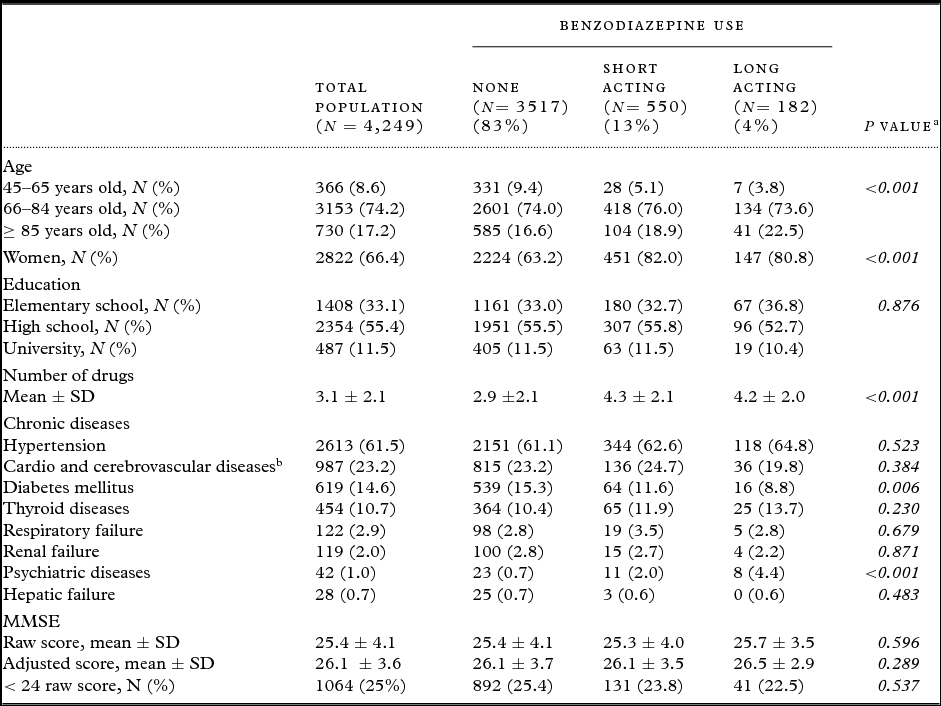
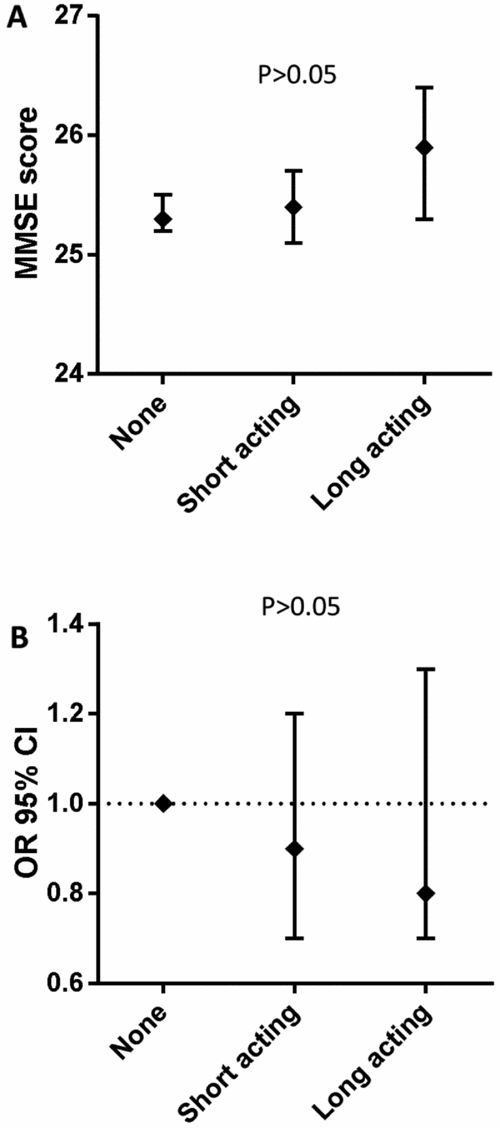
Within the 4,249 participants (mean age 77.0 ± 8.2; 66.4% women), 732 (17%) were on benzodiazepines. Among them, 75% were prescribed with short-acting benzodiazepines and the remaining with long acting. As compared with non-users, benzodiazepine users were more likely to be older, women, to suffer from diabetes mellitus and psychiatric diseases, and being on a higher total number of drugs. No significant differences arose for the remaining measures, including other chronic diseases and MMSE scores (Table 1). When compared with non-users, short- and long-acting benzodiazepine users presented overlapping adjusted MMSE mean scores (respectively, 25.3; 95%CI 25.2–25.5; 25.4; 95%CI 25.1–25.7 and 25.9; 95%CI 25.3–26.4; p = 0.156; Figure 1a). When tested according to the logistical regression model, after adjusting for potential confounders (age, sex, education, thyroid diseases, diabetes mellitus, hypertension, cardio and cerebrovascular diseases, psychiatric diseases, and number of drugs), no association was found between short and long acting benzodiazepine use and a MMSE <24 (respectively, OR 0.9, 95%CI 0.7–1.2; OR 0.8, 95%CI 0.7–1.3; Figure 1b). All the sensitivity analyses led to consistent results (data not shown). No interactions have been detected between benzodiazepine use and MMSE scores with sex (p = 0.570), age (p = 0.878) or the presence of psychiatric diseases (p = 0.165).
Sample characteristics by benzodiazepine half-life use

a P-values were obtained through χ2 tests for categorical and ANOVA test for continuous variables.
b Intended as ischemic heart disease, heart failure, atrial fibrillation, and cerebrovascular diseases.
Abbreviations: SD = Standard deviation; MMSE = Mini Mental State Examination.
Association between benzodiazepines use and cognitive function. (a): Adjusted Mini Mental State Examination (MMSE) means with 95% confidence intervals by benzodiazepines use. (b) Odds Ratios (OR) and 95% Confidence Intervals (95%CI) of scoring <24 at the MMSE, by benzodiazepines use (reference None). All analyses are adjusted for age, sex, education, number of drugs, and chronic diseases: hypertension, cardiovascular (ischemic heart disease, heart failure, and atrial fibrillation) and cerebrovascular diseases; diabetes mellitus; psychiatric diseases (depression, anxiety, sleep disorders); and thyroid disease.

Discussion
According to our results, benzodiazepines are commonly used—one out of six—among individuals assisted in primary care and presenting to the GP with a first cognitive complaint. In our study, their use is not associated with a lower cognitive performance in such population. Although previous findings have already reported the negative impact of benzodiazepines on cognitive performance, here, for the first time, we address this issue in the context of a cohort of subjects spontaneously presenting to the GP with cognitive complaints, focusing our attention on a population at higher risk of cognitive decline.
Self or informant's report of cognitive complaint have been associated with the future development of cognitive decline (Mitchell, Reference Mitchell2009), identifying a particular target population to which devote efforts in the detection of dementia. From a public health standpoint, as no effective treatments have been identified for Alzheimer's disease and other neurodegenerative dementias, the search of putative modifying risk factors remains a priority.
While the acute detrimental effects of benzodiazepines on cognition are well documented (Mitchell, Reference Mitchell2009), their role in the long-term development of overt dementia is still a matter of debate due to the inconsistent results of several studies addressing the issue. For example, a case-control study (Billioti de Gage et al., Reference Billioti De Gage2014) reported a 43–51% higher risk of Alzheimer disease among benzodiazepines home-dwelling users. At the same time, according to a prospective cohort study, only the use of long half-life benzodiazepines was associated with a higher risk of dementia (Shash et al., Reference Shash2016). Conversely, according to a prospective cohort study, only a minimal, and not the highest, exposure to benzodiazepines was associated with the onset of dementia (Gray et al., Reference Gray2016). Eventually, some studies reported either no association (Lagnaoui et al., Reference Lagnaoui2002), as in the present one, or even a protective effect (Fastbom et al., Reference Fastbom, Forsell and Winblad1998).
The chronic GABAergic action and glutamate pathways inhibition have been pointed out as the mechanism promoting the steeper cognitive worsening described in long-term benzodiazepine users. However, none association arose between the benzodiazepines use and cognitive function in our study, both for the long and short half-life drug users, even after running several sensitivity analyses. Several reasons could explain such findings: benzodiazepines use has been shown to selectively affect specific cognitive domains, namely: attention, processing speed, and working memory (Barker et al., Reference Barker, Greenwood, Jackson and Crowe2004). MMSE is a widely used screening tool that allows the detection of early cognitive deficits, with a fair good predictive power for the future onset of dementia. However, it mainly explores temporal and spatial orientation, memory, and visuo-spatial abilities. Considering this potential mismatch between the expected cognitive deficit and the tool used, we might hypothesize that MMSE is not adequate to detect the benzodiazepines induced deficits previously described. Second, the sample selection of previous studies and the adopted methodologies could have been not able to fully rule out a confounding by indication bias. In fact, anxiety and insomnia, common benzodiazepine indications, are among the prodromal symptoms of dementia, often occurring years before its formal diagnosis.
Our results need to be interpreted with caution in the context of their strengths and limitations. The major strength is the inclusion of a large sample of real-life primary care patients reporting first cognitive complaints. On the other hand, some limitations should be acknowledged. First, the lack of significance in our results, despite such a large sample size and the numerous sensitivity analyses performed, suggests the absence of a negative impact of benzodiazepine use on cognitive performance in primary care patients with first cognitive complaints. However, due to the study design, we are not able to fully rule out any possible source of residual confounding potentially explaining our results. Second, the cross-sectional design of the study does not allow us to fully rule out the previously reported association between benzodiazepines use and cognitive impairment. Third, the sample was not randomly selected but was driven by the willingness of the GPs to adhere to the study; this may limit the generalizability of our findings. Fourth, the lack of information about the indication and the duration of the benzodiazepine treatment might be responsible for a residual confounding potentially explaining the relationship existing between the exposure and the outcome. In the present study we were able to take into account only the total number of medications used. Apart from benzodiazepines and few other classes, no information was available on specific ATC classes used in our sample. Finally, in the present study, the GPs participating in the study recruited all the consecutive patients with either self- or informant-reported (intended as both caregiver or the GP) cognitive complaint; thus we could not further differentiate whether the complaint was corroborated by an informant perception of worsening in the cognitive performance of the patient. Although the exact role of awareness in the prodromal phase of cognitive decline is not fully understood yet, we acknowledge the lack of this information as a limitation of the present study.
As REMIND is an ongoing prospective study, as part of the future directions of this project, we will compare the findings of this study with the clinical diagnosis of dementia made by the specialists (neurologists and geriatricians), once they will be available.
In conclusion, in our study the use of benzodiazepines was not associated with a poorer cognitive performance in primary care patients with first cognitive complaints. However, the conflicting results from this and previous studies suggest the need for further and ad hoc investigations in order to better disentangle the association between benzodiazepines use and cognition.
Conflicts of interest
None declared.
Description of authors’ role
GG, GF, and IT contributed to the conception and design of the study. GG, DLV, IT, and SP did the statistical analyses. All authors contributed to interpretation of the results. GG and DLV drafted the manuscript. GF, CM, IT, and SP critically revised the manuscript for important intellectual content. All the authors made a significant contribution to the research and the development of the manuscript and approved the final version for publication.
Acknowledgments
Grants of the Italian Ministry of Health (RFPS-2007-1-626141; RF-2010-2318922). Grant of the Lombardy Region (Regional decree, Direzione Generale Sanità n 12786). Grant of the Milan Health Authority (Clinical Governance 2013—14).