



Non-technical Summary
Père David’s deer (Elaphurus davidianus) is the only living species of Elaphurus, inhabiting wetland environments of China. However, fossil records show that several species within this genus once lived throughout East Asia during the Pleistocene, including Tainan, Taiwan. The taxonomy of the Tainan species, E. formosanus, has been debated due to incomplete fossil material and its similarities with E. davidianus predavidianus. In this study, we examine new antler fossils of Elaphurus from the Pleistocene of Taiwan, which are more complete and include previously unknown anatomical features. Our analyses include antler morphological comparison, size measurements, geological age, and paleobiogeographic evidence, with the results supporting the identification of E. formosanus as a valid, endemic species. Interestingly, our findings reveal that E. formosanus was the smallest member of the genus, implying that the species underwent dwarfism, marking the first record of this phenomenon in Elaphurus and the first confirmed dwarfed deer species in Taiwan. Furthermore, the unique antler shape of E. formosanus highlights how these structures were used in social displays and competition, while also suggesting that geographic isolation played a crucial role in shaping how this species evolved over time. Our revision of E. formosanus not only adds to our understanding of variation within Elaphurus but also sheds new light on how this species modified its antler morphology to adapt to environment through dwarfism.
Introduction
Taiwan, situated on the eastern margin of Eurasia between Japan and the Philippine archipelago, is an island that holds a unique geographical setting. Since its repeated emergence and connection with the Eurasian continent, this island has fostered a diverse array of terrestrial vertebrates. Vertebrate fossils from Taiwan have been studied since the 1930s, especially those from the Zuojhen area of Tainan (Hayasaka, Reference Hayasaka1942). In 1937, Shikama described the first cervid fossils from the Zuojhen area, naming Cervus (Deperetia?) kokubuni Shikama, Reference Shikama1937; Cervus (Deperetia?) syatinensis Shikama, Reference Shikama1937; and Capreolus (?) formosanus Shikama, Reference Shikama1937. However, the type specimens of each preserved only the base of the antlers and accordingly lack certain diagnostic features, e.g., branches and bifurcations. Due to the absence of more complete material, it remained unclear whether these antlers were diagnostic at the generic level. In 1971–1972, a more complete fossil antler (ESK 6041) was discovered and assigned to Elaphurus Milne-Edwards, Reference Milne-Edwards1866 based on distinctive characters, including a long base between the burr and first bifurcation, and the anterior beam stretching vertically, forming large angles (90°+) with the posterior beam (Otsuka and Shikama, Reference Otsuka and Shikama1978). Furthermore, based on this better-preserved specimen, Otsuka and Shikama (Reference Otsuka and Shikama1978) re-examined previous specimens described by Shikama (Reference Shikama1937) and reassigned all three taxa to a single species, Elaphurus formosanus, retaining the specific epithet from Capreolus (?) formosanus.
Although Elaphurus is a cervid endemic to Asia, with E. davidianus Milne-Edwards, Reference Milne-Edwards1866 (Père David’s deer) as its sole extant species, several fossil species have been described that demonstrate a higher diversity in the past, including E. bifurcatus Teilhard de Chardin and Piveteau, Reference Teilhard de Chardin and Piveteau1930 from Nihowan, Hebei; E. chinnaniensis Chia and Wang, Reference Chia and Wang1978 from Shanxi; and E. b. shikamai (Otsuka, Reference Otsuka1968) from Japan. In Taiwan, antler fossils from Tainan also document the presence of Elaphurus (Otsuka and Shikama, Reference Otsuka and Shikama1978). However, a recent study reclassified all fossil Elaphurus species, combining E. formosanus and E. davidianus predavidianus Dong et al., Reference Dong, Wei, Bai, Zhang, Liu, Chen and Wu2019. Although the Tainan specimen ESK 6041 (Otsuka and Shikama, Reference Otsuka and Shikama1978) shows morphological similarities to E. d. predavidianus, including the proportion of the anterior and the posterior beams, it is incomplete, comprising only parts of the anterior beam, the posterior beam, and the base. The lack of additional specimens and comprehensive study hinders a full assessment of the Tainan Elaphurus and makes comparative analysis difficult. We describe herein new Elaphurus fossils from Tainan, representing the most complete antlers yet discovered, and possessing detailed and previously unknown morphological features of the Tainan species of Elaphurus. The results of our analyses (including morphological comparisons and antler size measurements) indicate that E. formosanus is a valid species, possessing a body size that suggests that it exhibited dwarfism and representing a distinctive evolutionary history within the Elaphurus lineage.
Geological setting
The Tainan Elaphurus specimens described in this study were collected from the Zuojhen area of Tainan City, southern Taiwan. The primary geological reference point is the locality and stratigraphic context of specimen ESK 6041, as documented by Otsuka and Shikama (Reference Otsuka and Shikama1978). This antler was discovered in situ from mudstone deposits in Chouchu, Tsailiao River, Zuojhen District, during excavations conducted in 1971–1972 (Otsuka and Lin, Reference Otsuka and Lin1984). It was unearthed near a fossilized rhinoceros skeleton, currently referred to Nesorhinus hayasakai (Otsuka and Lin, Reference Otsuka and Lin1984) (Antoine et al., Reference Antoine, Reyes, Amano, Bautista, Chang, Claude, De Vos and Ingicco2022; Tsai et al., Reference Tsai, Otsuka and Fang2024; Fig. 1).
Location and generalized stratigraphic column for antler ESK 6041 of Elaphurus formosanus (Shikama, Reference Shikama1937), 23.0574°N, 120.3842°E, with a figure of the specimen, a bone map of the excavation site, and an on-site photo (modified and remade from Otsuka and Shikama, Reference Otsuka and Shikama1978; Otsuka and Lin, Reference Otsuka and Lin1984).
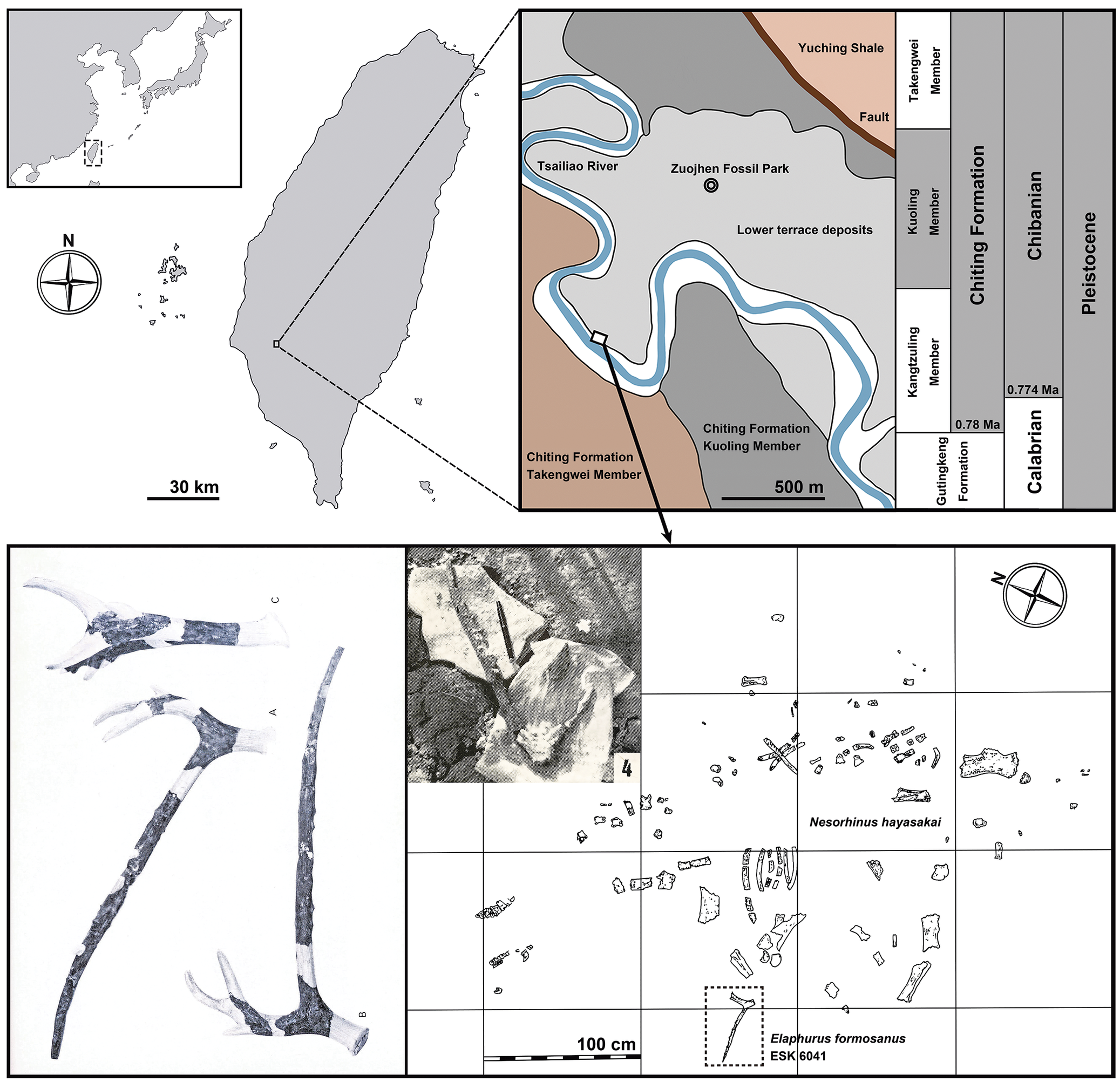
Figure 1. Long description
The graphic consists of five main components.
1. Top-Left: A regional map of East Asia with a dashed box around Taiwan, and a larger map of Taiwan showing a specific site in the Southwest. A scale bar indicates 30 km.
2. Top-Right: A detailed site map and stratigraphic column. The map shows the Tsailiao River winding through the Chiting Formation (Kuoling and Takengwei Members) and the Zuojhen Fossil Park. To the right, a vertical stratigraphic chart lists the Pleistocene epoch, divided into Chibanian (0.774 M a) and Calabrian (0.78 M a) stages, within the Chiting Formation.
3. Bottom-Left: Three black and white photos (labeled A, B, and C) of the E S K 6041 antler specimen from different angles, showing a dark, fossilized texture with lighter reconstructed areas.
4. Bottom-Center: A square on-site photo labeled 4 shows the fossilized antler embedded in sediment during excavation.
5. Bottom-Right: A bone map of the excavation site divided into a grid. A scale bar indicates 100 cm. Various fossil fragments are scattered across the grid. A central cluster is labeled Nesorhinus hayasakai. In the bottom-center grid square, a dashed box highlights the specific location of the Elaphurus formosanus E S K 6041 antler, which is oriented vertically with its base pointing South.
The fossil-bearing layer belongs to the upper Kuoling Member of the upper Chi-ting Formation (Ho et al., Reference Ho, Shieh, Kao and Chen2005; Jhuang et al., Reference Jhuang, Wei and Wu2009). In earlier literature, this stratum was also referred to as KU-4 or the Elaphurus formosanus-Rhinoceros sinensis hayasakai Biozone (Otsuka and Shikama, Reference Otsuka and Shikama1978; Otsuka and Lin, Reference Otsuka and Lin1984). Based on nannofossil biostratigraphy conducted by Jhuang et al. (Reference Jhuang, Wei and Wu2009), the age of this layer is estimated to range from 0.89–0.46 Ma, which is nearly coeval with the Chibanian stage, Middle Pleistocene.
Material and methods
Specimens examined
A total of 16 Elaphurus antler specimens from Tainan were examined in this study. Among them, three specimens preserve relatively complete beams and tines: NMNS F046482 (Fig. 2.1, 2.2); F046485 (Fig. 2.3, 2.4), and F046487 (Fig. 2.5–2.7). To assess size variation in the Tainan species of Elaphurus and facilitate comparison with other Elaphurus spp., we also referred to 10 specimens that preserve only the base and burr: NTM I04825 (Fig. 3.1); NMNS F046618 (Fig. 3.2); NTUM-VP 250224 (Fig. 3.3), 250225 (Fig. 3.4); ZFP Shu-135 (Fig. 3.5), 186 (Fig. 3.6), 190 (Fig. 3.7), 193 (Fig. 3.8), 197 (Fig. 3.9), and 200 (Fig. 3.10).
Elaphurus formosanus (Shikama, Reference Shikama1937): (1, 2) NMNS F046482, a right antler including burr, base, anterior beam, tine, and partial posterior beam: (1) medial view; (2) lateral view; (3, 4) NMNS F046485, a left antler including burr, base, anterior beam, and two tines: (3) lateral view; (4) medial view; (5–7) NMNS F046487, a right antler including burr, base, anterior beam, tine, and partial posterior beam: (5) medial view; (6) lateral tine, ventral view; (7) lateral view.
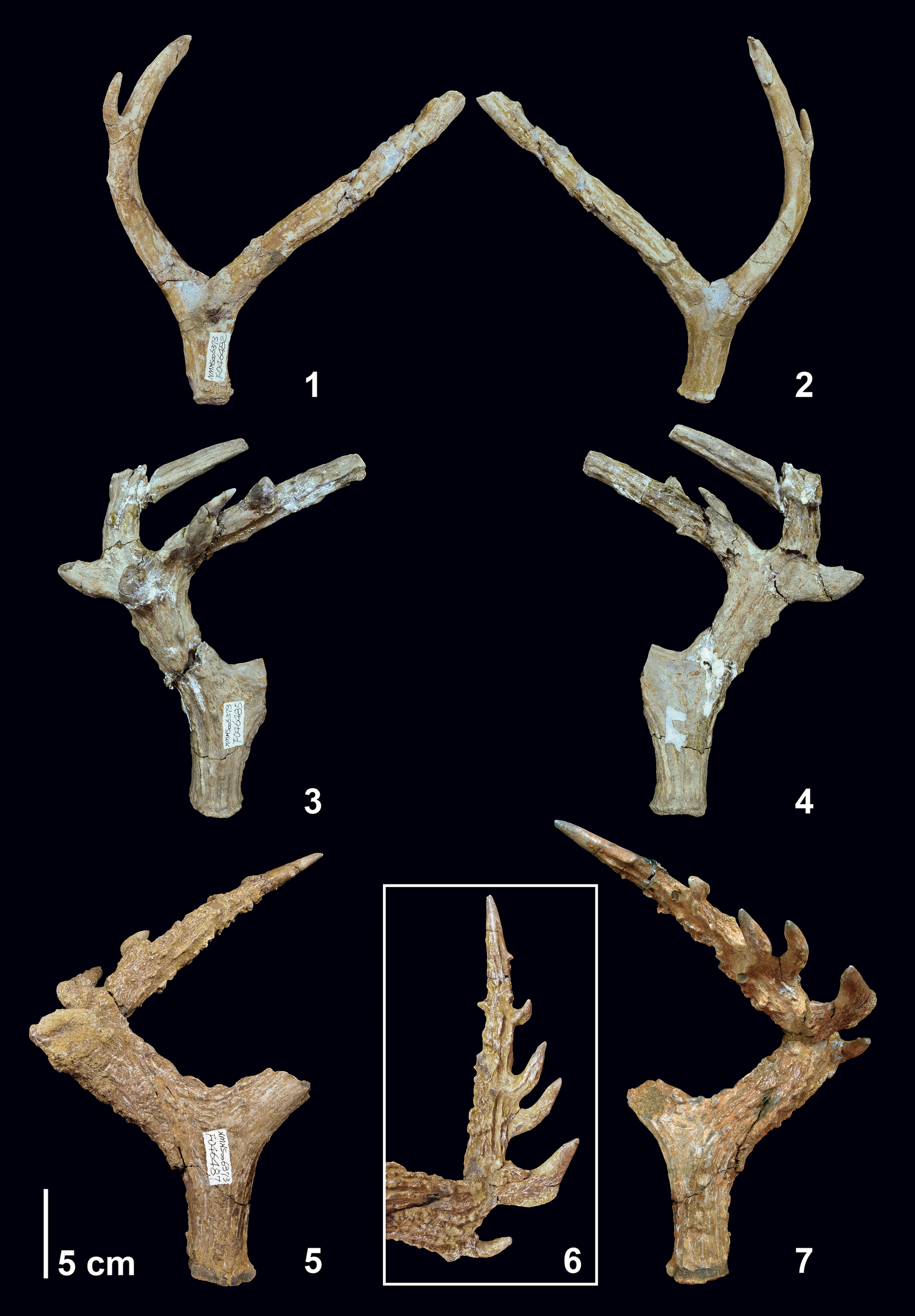
Figure 2. Long description
A multi-panel photo displays three distinct fossilized antler specimens against a black background. A 5 cm scale bar is located at the bottom left.
* Top Row (Specimen N M N S F 0 4 6 4 8 2): Panel 1 shows a medial view of a right antler with a thick base, a curved anterior beam, and a straight posterior beam extending upward. Panel 2 shows the lateral view of the same antler.
* Middle Row (Specimen N M N S F 0 4 6 4 8 3 and 4): Panel 3 shows a lateral view of a left antler with a rugged, textured base and multiple short, jagged tines branching from the main beam. Panel 4 shows the medial view of the same left antler.
* Bottom Row (Specimen N M N S F 0 4 6 4 8 7): Panel 5 shows a medial view of a right antler with a wide base and a sharply angled beam. Panel 6 is a boxed inset showing a ventral view of a lateral tine, revealing a series of small, pointed protrusions along one edge. Panel 7 shows the lateral view of the antler, highlighting the complex branching of the tines and the rough surface texture of the fossilized bone.
Elaphurus formosanus (Shikama, Reference Shikama1937): (1) NTM I04825, a right antler with burr and base; (2) NMNS F046618, a right antler with burr, base, and partial posterior beam; (3) NTUM-VP 250224, a right antler with burr and base; (4) NTUM-VP 250225, a left antler with burr and base; (5) ZFP Shu-135, a right antler with pedicle, burr, and base; (6) ZFP Shu-186, a left antler with burr and base; (7) ZFP Shu-190, a right antler with burr and base; (8) ZFP Shu-193, a right antler with burr and base; (9) ZFP Shu-197, a left antler with burr and base; (10) ZFP Shu-200, a right antler with burr and base; (11) NMNS F046612, a partial posterior beam of the right antler; (12) ZFP C0061, a partial posterior beam of the antler.
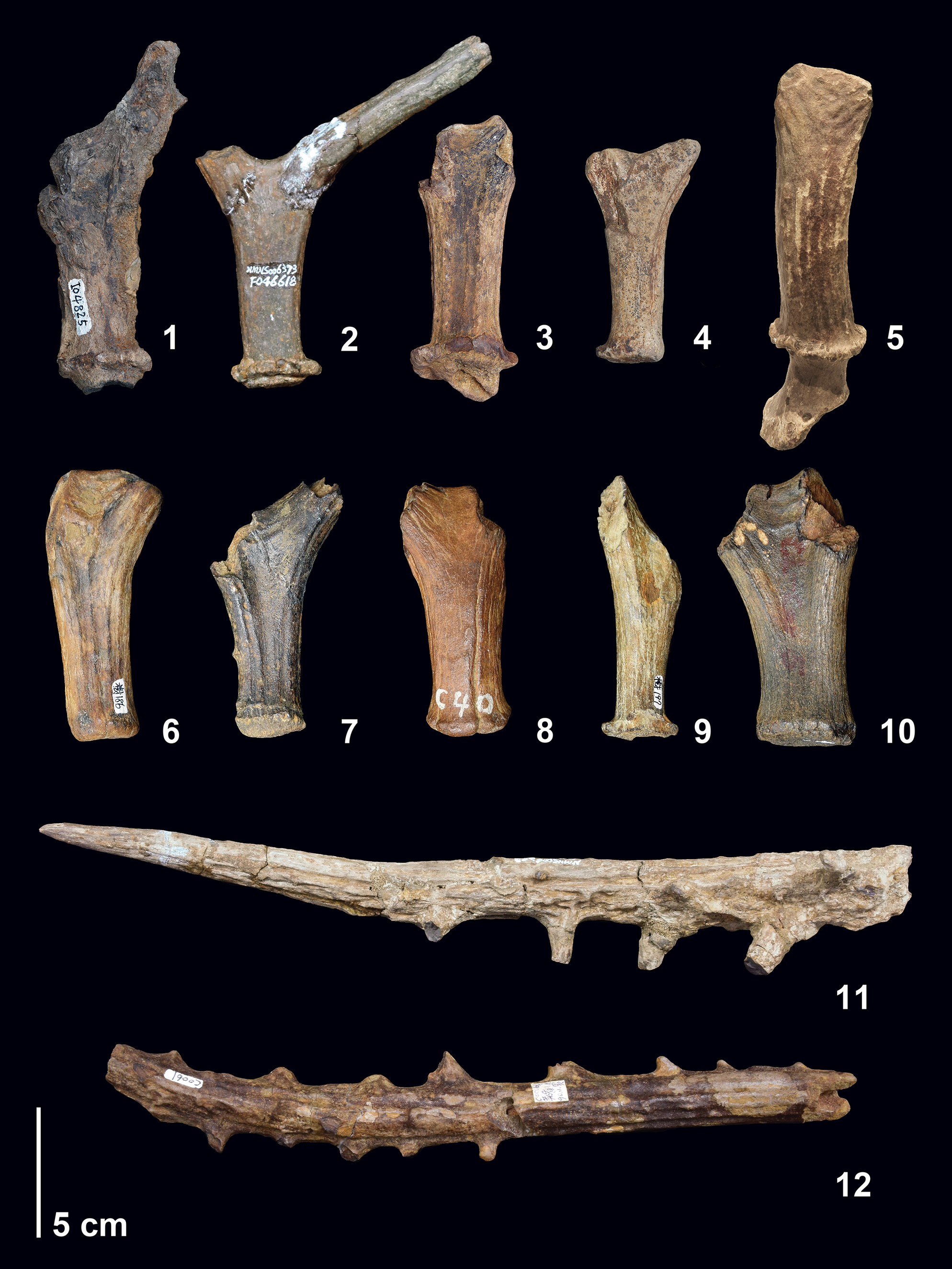
Figure 3. Long description
The image contains 12 numbered panels arranged in three rows against a black background. A 5 centimeter scale bar is located at the bottom left.
Row 1 (Top):
* 1: N T M I 0 4 8 2 5. A dark, textured right antler base with a prominent burr.
* 2: N M N S F 0 4 6 6 1 8. A right antler base with a long, slender posterior beam extending diagonally upward.
* 3: N T U M-V P 2 5 0 2 2 4. A right antler base with a thick, weathered burr.
* 4: N T U M-V P 2 5 0 2 2 5. A left antler base showing a flared top.
* 5: Z F P Shu-1 3 5. A right antler including the pedicle, a distinct circular burr, and a vertical base section.
Row 2 (Middle):
* 6: Z F P Shu-1 8 6. A left antler base with a light tan coloration.
* 7: Z F P Shu-1 9 0. A dark right antler base with vertical ridges.
* 8: Z F P Shu-1 9 3. A right antler base with ‘C 4 0’ written in white ink.
* 9: Z F P Shu-1 9 7. A slender left antler base with a flat bottom.
* 10: Z F P Shu-2 0 0. A wide right antler base with a broad, bifurcating top.
Row 3 (Bottom):
* 11: N M N S F 0 4 6 6 1 2. A long, horizontal partial posterior beam, tapering to a point on the left with several small protrusions along the bottom edge.
* 12: Z F P C 0 0 6 1. A horizontal partial posterior beam, darker in color than specimen 11, featuring multiple jagged points along its length.
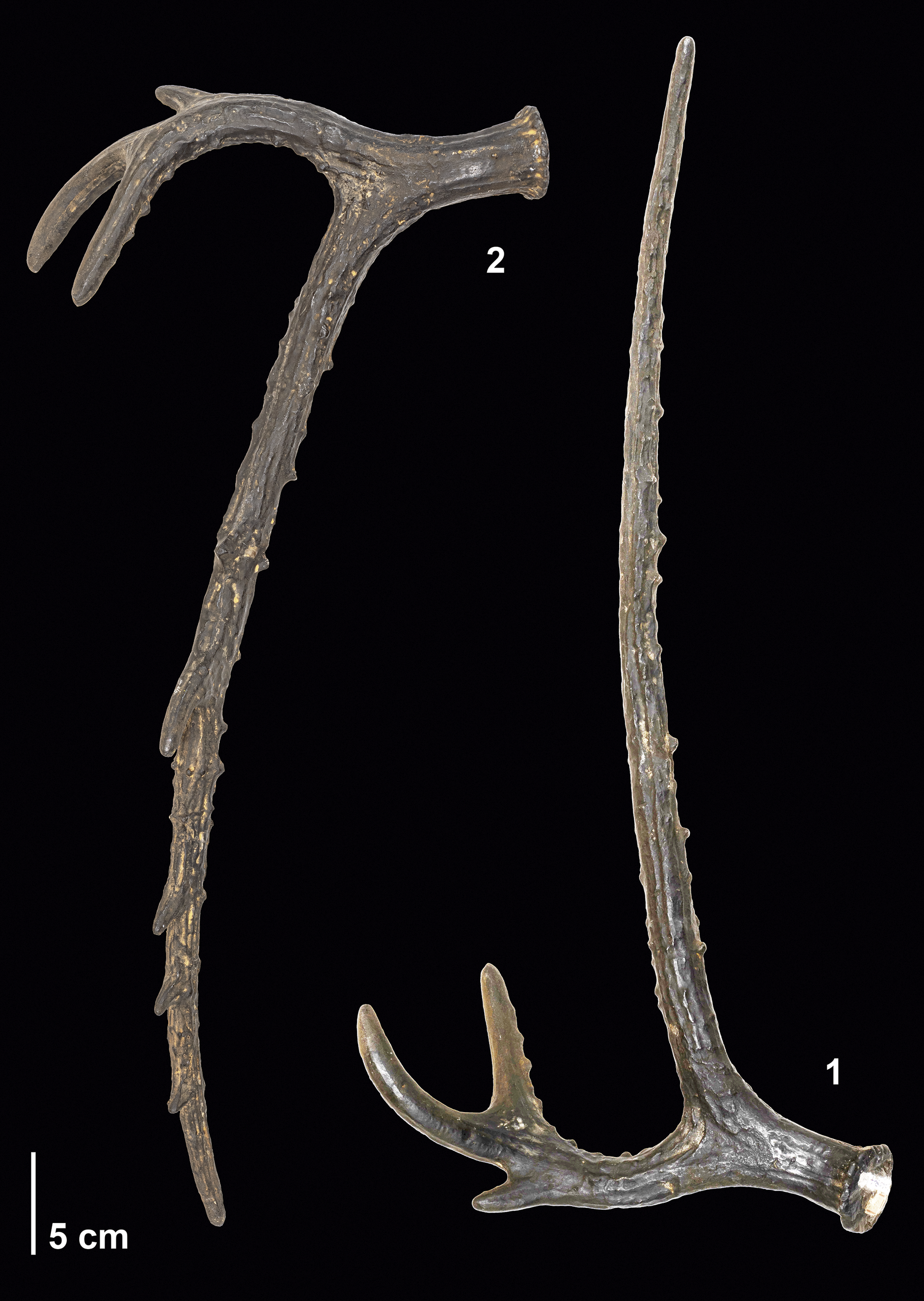
To clarify the morphology of the posterior beam, two isolated posterior beam fragments were also examined: NMNS F046612 (Fig. 3.11) and ZFP C0061 (Fig. 3.12). In addition, we included one replica specimen, NTM I04084 (Fig. 4.1, 4.2), which is a cast of ESK 6041 originally described by Otsuka and Shikama (Reference Otsuka and Shikama1978) as a morphological reference.
Elaphurus formosanus (Shikama, Reference Shikama1937), NTM I04084, the replica of specimen ESK 6041 by Otsuka and Shikama (Reference Otsuka and Shikama1978): (1) medial view; (2) lateral view.
Antler terminology
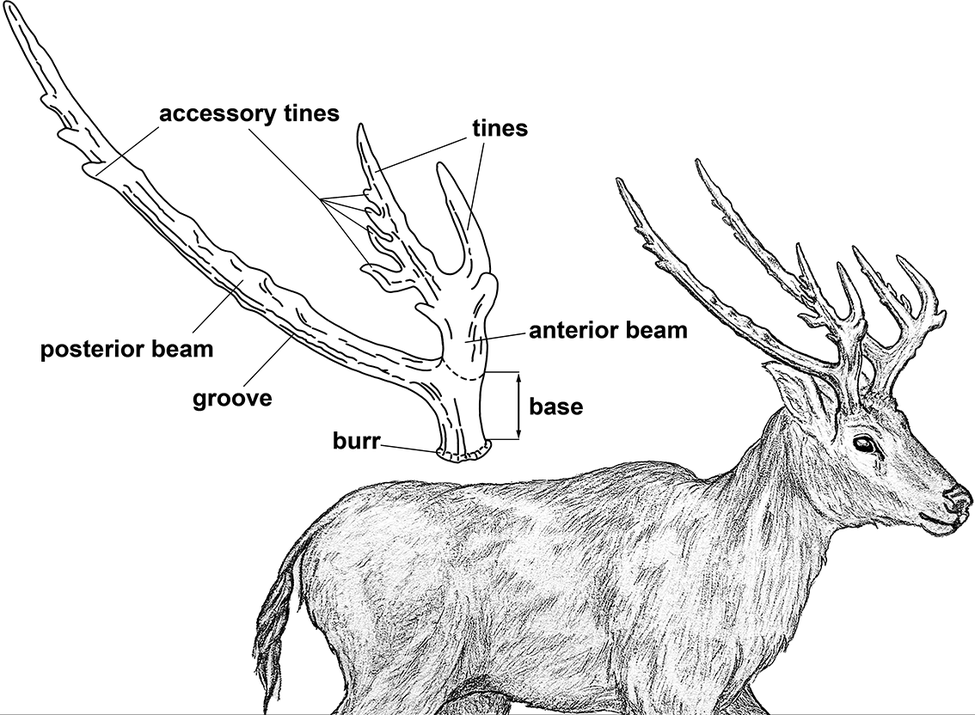
As mentioned by Pocock (Reference Pocock1912, p. 777), “There is no stag whose systematic position has troubled zoologists so much as Elaphurus.” The anatomy and taxonomy of Elaphurus antlers have been subjects of debate for more than a century (Heckeberg et al., Reference Heckeberg, Zachos and Kierdorf2022). To date, the anatomical terminology used for various components of Elaphurus antlers remains inconsistent across different studies and species. For instance, in fossil species, Teilhard de Chardin and Piveteau (Reference Teilhard de Chardin and Piveteau1930) referred to the anterior and posterior branches of E. bifurcatus as ‘fourch antérieure’ and ‘fourch postérieure,’ respectively. In contrast, Chia and Wang (Reference Chia and Wang1978) used the term ‘first fork’ and ‘main beam’ for these branches in E. chinnaniensis. The extant E. davidianus is particularly notable for its unique antler morphology, especially its more developed anterior branch relative to the posterior one, yet it remains uncertain whether these branches are homologous to the brow tine or main beam (Heckeberg et al., Reference Heckeberg, Zachos and Kierdorf2022). To ensure clarity and avoid confusion, this study adopts a unified terminology based primarily on Heckeberg et al. (Reference Heckeberg, Zachos and Kierdorf2022, p. 12) (Fig. 5): (1) Burr: defined as “the circular thickening on the most proximal end of the antler.” (2) Beam: the “main antler structure formed by the sequentially developing dominant split halves from successive bifurcation events.” In Elaphurus, the beam between the burr and the first bifurcation is referred to as the ‘base’ (equivalent to ‘b’ of Pocock, Reference Pocock1933 [Heckeberg et al., Reference Heckeberg, Zachos and Kierdorf2022]; ‘Stem 1’ of Dong et al., Reference Dong, Wei, Bai, Zhang, Liu, Chen and Wu2019). The anterior branch forked from the first bifurcation is the ‘anterior beam’ (‘a1’ of Pocock, Reference Pocock1933 [Heckeberg et al., Reference Heckeberg, Zachos and Kierdorf2022]; ‘Stem 2’ of Dong et al., Reference Dong, Wei, Bai, Zhang, Liu, Chen and Wu2019), whereas the posterior branch is ‘posterior beam’ (‘p1’ of Pocock, Reference Pocock1933 [Heckeberg et al., Reference Heckeberg, Zachos and Kierdorf2022]; ‘Stem 3’ of Dong et al., Reference Dong, Wei, Bai, Zhang, Liu, Chen and Wu2019). (3) Tine: refers to a “subordinate branch of an antler bifurcation with limited growth potential and early cessation of growth.” In Elaphurus, tines are found at the tips of both the anterior and posterior beams. For example, E. bifurcatus exhibits two bifurcations with four tines in total (Teilhard de Chardin and Piveteau, Reference Teilhard de Chardin and Piveteau1930; Otsuka, Reference Otsuka1968); in contrast, Tainan Elaphurus specimens and extant E. davidianus show only one bifurcation at the tip of the anterior beam. Although the terminology and homologies of the tines remain debated, for descriptive clarity, we refer to these bifurcations simply as ‘tines’: the ‘lateral tine’ (‘a2’ of Pocock, Reference Pocock1933 [Heckeberg et al., Reference Heckeberg, Zachos and Kierdorf2022]; ‘T1’ of Dong et al., Reference Dong, Wei, Bai, Zhang, Liu, Chen and Wu2019), and the ‘medial tine’ (‘p2’ of Pocock, Reference Pocock1933 [Heckeberg et al., Reference Heckeberg, Zachos and Kierdorf2022]; ‘T2’ of Dong et al., Reference Dong, Wei, Bai, Zhang, Liu, Chen and Wu2019); and in older individuals, ‘accessory tines’ (corresponding to ‘pre-trez tine’ and ‘pre-cacuminal tine’ of Samejima and Matsuoka, Reference Samejima and Matsuoka2020) can occur on the surfaces of beams or tines. (4) Groove: defined as a “Longitudinal blood vessel impression on the antler surface.” (5) Pearl: the “small button-like or granular protrusions that form the burr and are part of the perlaceous ornamentation in some deer antlers.” In both E. davidianus and Tainan Elaphurus specimens, such pearls are also observed on the surface of beams and tines in older individuals.
Antler terminology and reconstructed position of the antler of Elaphurus formosanus (Shikama, Reference Shikama1937) used in this study. Artistic reconstruction by Y.-S. Chung.
Measurements
To assess and compare the size variation of the Tainan species of Elaphurus with other Elaphurus spp., a total of 13 Elaphurus antler specimens from Tainan were selected for measurement and analysis. All specimens possess a burr and a complete antler base. In Cervidae, antler size is typically correlated with the diameter or circumference of the base, because both burr size and beam thickness tend to increase with body size and age (e.g., Lister, Reference Lister1990 for Cervus elaphoides Kahlke, Reference Kahlke1960; Otsuka, Reference Otsuka1988 for Cervus nippon Temminck, Reference Temminck1838). In this study, we measured the anteroposterior diameter of the burr and the proximal base. This approach follows the methodology employed by previous studies on Elaphurus, e.g., those of Dong et al. (Reference Dong, Wei, Bai, Zhang, Liu, Chen and Wu2019) for E. davidianus predavidianus, E. chinnaniensis, and E. bifurcatus; Chia and Wang (Reference Chia and Wang1978) for E. chinnaniensis; and Otsuka (Reference Otsuka1968) for E. b. shikamai. It is also consistent with the methods used by van der Geer (Reference van der Geer2018) for Candiacervus Kuss, Reference Kuss1975 and Gould (Reference Gould1974) for Megaloceros Brookes, Reference Brookes1828. However, because the burrs of the fossil antlers are often worn, potentially affecting the accuracy of measurements and comparisons, our primary focus was on the diameter of the base, which provides a more consistent indicator of size. Additionally, we measured the length of the base (defined as the distance on the anterior side from the junction with the burr to the lowest point of the first bifurcation where the anterior beam divides; Fig. 5) as a supplementary metric for evaluating antler size (see Table 1).
Measurements of antler specimens of Elaphurus formosanus (Shikama, Reference Shikama1937) and other Elaphurus spp. APD = anteroposterior diameter, L = length (straight-line measurement). All units in mm.
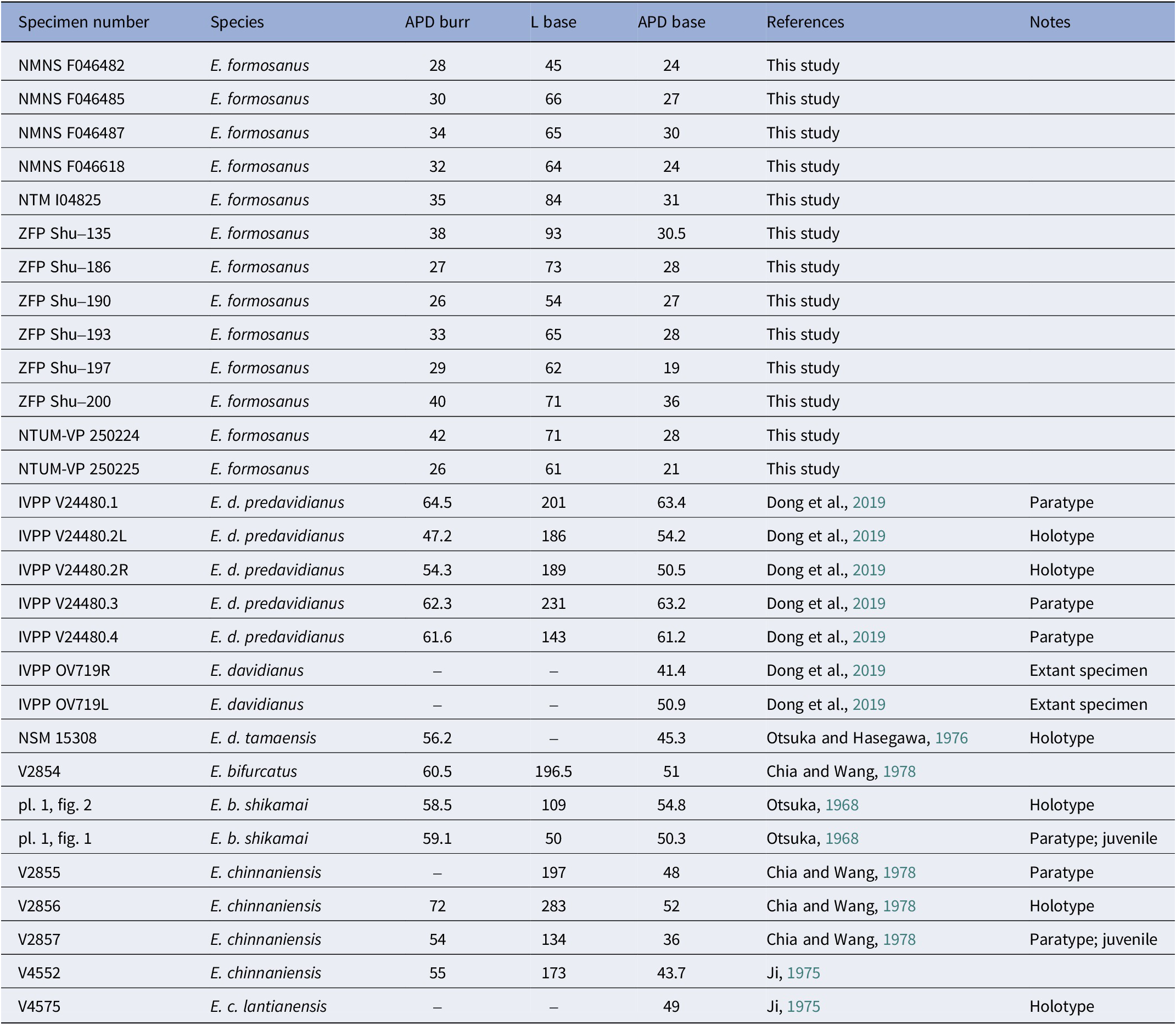
Table 1. Long description
A table titled Table 1 containing measurements in millimeters for antler specimens. The columns are Specimen number, Species, A P D burr, L base, A P D base, References, and Notes.
Key data points include:
* Elaphurus formosanus: 13 specimens (e.g., N M N S F 0 4 6 4 8 2, N T M I 0 4 8 2 5) with A P D burr ranging from 26 to 42, L base from 45 to 93, and A P D base from 19 to 36. All are from ‘This study’.
* Elaphurus davidianus predavidianus: 5 specimens (I V P P V 2 4 4 8 0 series) with significantly larger dimensions, including L base up to 231 and A P D burr up to 64.5.
* Elaphurus davidianus: 2 extant specimens (I V P P O V 7 1 9 R and L) with A P D base values of 41.4 and 50.9.
* Elaphurus davidianus tamaensis: Holotype N S M 1 5 3 0 8 with A P D burr of 56.2 and A P D base of 45.3.
* Elaphurus bifurcatus and E. b. shikamai: Specimens with A P D burr around 58 to 60 and L base up to 196.5.
* Elaphurus chinnaniensis: 4 specimens including holotype V 2 8 5 6 with the largest A P D burr in the table at 72 and L base at 283.
* Elaphurus chinnaniensis lantianensis: Holotype V 4 5 7 5 with an A P D base of 49.
Repositories and institutional abbreviations
ESK, Institute of Earth Sciences, Faculty of Science, Kagoshima University, Kagoshima, Japan; IGPS, The Tohoku University Museum, Sendai, Japan (previously curated at Institute of Geology and Paleontology, Tohoku University); IVPP, Institute of Vertebrate Paleontology and Paleonanthropology, Beijing, China; NMNS, National Museum of Natural Science, Taichung, Taiwan; NTM, National Taiwan Museum, Taipei, Taiwan (Taiwan Provincial Museum); NTUM-VP, Vertebrate Paleontology (Laboratory of Evolution and Diversity of Fossil Vertebrates), Museum of Zoology, National Taiwan University, Taipei, Taiwan; and ZFP, Tainan City Zuojhen Fossil Park, Tainan, Taiwan (previously known as Tainan Prefectural Fossil Museum).
Systematic paleontology
Artiodactyla Owen, Reference Owen1848
Cervidae Gray, Reference Gray1821
Elaphurus Milne-Edwards, Reference Milne-Edwards1866
Type species
Elaphurus davidianus Milne-Edwards, Reference Milne-Edwards1866.
Elaphurus formosanus (Shikama, Reference Shikama1937)
Reference Shikama1937 Cervus (Deperetia?) kokubuni Shikama, p. 83, pl. 14, figs. 16, 17.
Reference Shikama1937 Cervus (Deperetia?) syatinensis Shikama, p. 83, pl. 16, figs. 19, 20.
Reference Shikama1937 Capreolus (?) formosanus Shikama, p. 84, pl. 16, figs. 21, 22.
Holotype
IGPS 59952, an antler fragment preserving only base and burr, which was originally classified and named as Capreolus (?) formosanus by Shikama (Reference Shikama1937).
Revised diagnosis
Smallest species of Elaphurus (adult antler base anteroposterior diameter ~20 to ~40 mm, burr anteroposterior diameter ~25 to ~45 mm); anterior beam significantly shorter than posterior beam and bifurcated at distal tip; posterior beam straight and unbranched; well-developed accessory tines present on surfaces of anterior beam, tines, and posterior beam.
Description
NMNS F046482 (Fig. 2.1, 2.2) is a right antler, representing a relatively younger individual than specimens F046485 and F046487, as indicated by its smaller base and burr diameter (see Table 1), as well as its fewer accessory tines and pearls compared to the other specimens. The antler measures 208 mm in total height (straight-line measurement). Although the burr is partially weathered, its pearled trace can still be identified. The base is relatively short, with a smoothly even surface bearing only shallow grooves. The anterior beam originates ~45 mm above the burr, extending upward and leaning slightly forward; its anteroposterior diameter is ~17 mm. The anterior beam might have bifurcated originally, but the lateral tine is missing. The medial tine, continuing from the anterior beam, extends upward before bending backward. Its surface is smooth without pearls but bears an accessory tine directed upward on the anterior side. The posterior beam is preserved for ~185 mm in length, with an estimated diameter of ~19 mm, extending straight backward at an angle of ~100º relative to the anterior beam. The surface of the posterior beam is notably rugose with deep grooves.
NMNS F046485 (Fig. 2.3, 2.4) is a left adult antler with a nearly complete anterior beam and tines. The total height is ~204 mm (straight line measurement). The burr is preserved but shows weathering. The base is 66 mm in length, extending upward with grooves and pearls. The anterior beam was likely broken in situ, but the fracture can be reconstructed in cross section. The anterior beam measures 58 mm in length and has an oval cross section with an anteroposterior diameter of ~28 mm. It bears continuous small pearls and one accessary tine on the lateral surface. It extends upward and forward before bifurcating into two tines. The lateral tine, located 98 mm from the bifurcation, extends straight backward at ~90º relative to the anterior beam, nearly parallel to the posterior beam. It exhibits a high degree of rugosity with deep grooves and two accessory tines, both directed backward. The medial tine, measuring 107 mm from the bifurcation, is more curved than the lateral one and bends sharply backward. Its surface has pronounced grooves, and an accessory tine is present anterior to the bifurcation, projecting forward and slightly upward. Although most of the posterior beam is missing with only the proximal part remaining, the angle formed with the anterior beam can still be identified as ~110º.
NMNS F046487 (Fig. 2.5–2.7) is a right adult antler, larger and representing an older individual than F046482 and F046485. The burr is broken and the base surface is covered by penetrating grooves and multipolar pearls. The base cross section is nearly circular in outline, continuing to the posterior beam. The anterior beam is thicker than the base, with an anteroposterior diameter of ~32 mm and an oval cross section. It stretches upward and forward for 73 mm before bifurcating. The medial tine is absent, but an accessory tine is present anterior to the bifurcation. The lateral tine measures 170 mm from the bifurcation, has a diameter of ~22 mm, and grows straight backward at nearly 90º to the anterior beam, parallel to the posterior beam, similar to specimen F046485. It is ornamented with numerous pearls, grooves, and four well-developed accessory tines arranged from largest to smallest, all curving backward (see Fig. 2.6). The largest accessory tine, closest to the bifurcation, is ~55 mm in length. The distal tip of the lateral tine is smooth, lacking pearls and grooves. The posterior beam is missing except for the proximal portion, which has a diameter of ~28 mm and projects backward at ~100º.
NMNS F046612 (Fig. 3.11) is a partial posterior beam from the right antler, with a preserved straight-line length of 325 mm. The distal part is unbranched, extending backward and slightly upward, with grooves, pearls, and three aligned accessory tines on the same side. The surface is generally rugose. Based on comparison with antlers of extant Elaphurus davidianus, the side with continuous accessory tines is likely ventral. A similar morphology is also observed in ESK 6041 (Otsuka and Shikama, Reference Otsuka and Shikama1978; see NTM I04084, Fig. 4.1, 4.2) as well as ZFP C0061 (Fig. 3.12).
NTM I04084 (Fig. 4.1, 4.2) is a replica of specimen ESK 6041 described by Otsuka and Shikama (Reference Otsuka and Shikama1978). According to the original figure of ESK 6041 (Otsuka and Shikama, Reference Otsuka and Shikama1978, pl. 3, fig. 1a~c), the burr, proximal base, part of the anterior beam, two tines, and proximal posterior beam are missing. Early gypsum restoration suggests that these portions might not be reconstructed with complete accuracy. Nevertheless, the morphology of the posterior beam and first bifurcation can still be referenced. The preserved parts indicate an angle of ~100º between the anterior beam and the posterior beam. The antler measures ~600 mm in total length. The anterior beam extends upward and leans slightly forward before bifurcating. The posterior beam is unbranched, extending posteriorly with well-developed grooves, pearls, and continuous accessory tines, with a preserved length of ~500 mm. Comparison with NMNS F046485, F046487, and F046612 suggests that NTM I04084 was incorrectly assembled during restoration; specifically, the two tines extend straight backward, nearly perpendicular to the anterior beam, and bear accessory tines. The posterior beam tip points upward, whereas the continuous accessory tines on the posterior beam face downward.
Comparison
Elaphurus formosanus represents the smallest known species within the genus, the base and burr diameter of the mature antler is comparable in size to that of juvenile E. chinnaniensis (see Chia and Wang, Reference Chia and Wang1978) and young E. davidianus predavidianus (see Dong et al., Reference Dong, Wei, Bai, Zhang, Liu, Chen and Wu2019) (Fig. 6.1). Its anterior beam is shorter than the posterior beam; this length proportion is consistent with E. d. predavidianus but distinguishes the species from the extant E. davidianus, the latter of which possesses a relatively longer and more developed anterior beam. Elaphurus formosanus differs from all Early Pleistocene congeners (including E. d. predavidianus; E. d. tamaensis [Otsuka and Hasegawa, Reference Otsuka and Hasegawa1976]; E. bifurcatus; E. b. shikamai; E. chinnaniensis; E. c. lantianensis [Ji, Reference Ji1975]; and E. eleonorae Vislobokova, Reference Vislobokova1988 [see Vislobokova, Reference Vislobokova1990]) in having well-developed accessory tines along the surfaces of the anterior beam, tines, and posterior beam. This trait becomes progressively more elaborate with ontogeny and is otherwise observed only in extant E. davidianus (see Discussion for details). Elaphurus formosanus is further distinguished from E. chinnaniensis and E. c. lantianensis in possessing a bifurcated distal tip of the anterior beam. It is separated from E. bifurcatus, E. b. shikamai, E. chinnaniensis, and E. eleonorae by its unbranched and straight posterior beam, and contrasts with the morphological uncertainty regarding the posterior beams of E. d. predavidianus, E. d. tamaensis, and E. c. lantianensis.
Antler size analysis of Elaphurus formosanus (Shikama, Reference Shikama1937) and other Elaphurus spp.: (1) bivariate plots of burr and beam diameter of Elaphurus; (2) comparison of the antler base diameters among different Elaphurus species and subspecies; (3) bivariate plots of burr and beam diameter of E. formosanus.
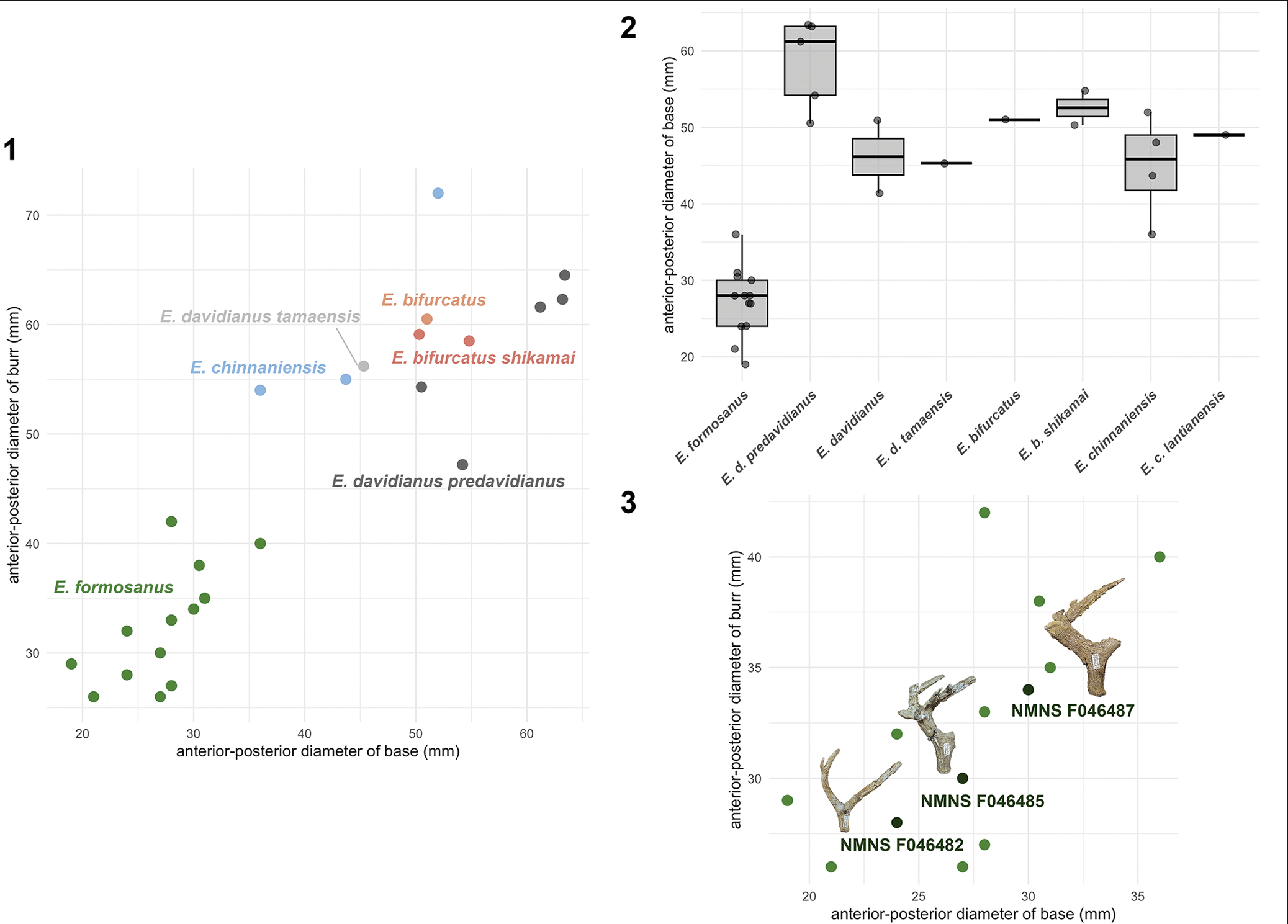
Figure 6. Long description
Panel 1 is a scatter plot with the x-axis representing anterior-posterior diameter of base in millimeters and the y-axis representing anterior-posterior diameter of burr in millimeters. Data points are color-coded by species. E dot formosanus points are clustered in the lower left between 20 and 35 millimeters on both axes. E dot chinnaniensis, E dot davidianus tamaensis, E dot bifurcatus, and E dot bifurcatus shikamai are clustered in the center between 35 and 55 millimeters. E dot davidianus predavidianus points are in the upper right between 50 and 65 millimeters.
Panel 2 is a box plot showing the anterior-posterior diameter of base in millimeters for eight species and subspecies. E dot formosanus has the lowest median around 28 millimeters. E dot d dot predavidianus has the highest median above 60 millimeters. Other species including E dot davidianus, E dot d dot tamaensis, E dot bifurcatus, E dot b dot shikamai, E dot chinnaniensis, and E dot c dot lantianensis range between 45 and 55 millimeters.
Panel 3 is a detailed scatter plot focusing on E dot formosanus with the same axes as Panel 1. It includes three inset photos of antler specimens labeled N M N S F 0 4 6 4 8 2, N M N S F 0 4 6 4 8 5, and N M N S F 0 4 6 4 8 7, showing a positive correlation between base and burr diameter as the antler size increases.
Remarks
The taxonomic history of the Elaphurus specimens from Tainan, along with the diagnosis of E. formosanus, has been marked by ambiguities for the following reasons: (1) All Tainan Elaphurus specimens, including the type material as described by Shikama (Reference Shikama1937), consist only of antler bases and burrs. Shikama (Reference Shikama1937, p. 83, 84) initially classified them as three new species: Cervus (Deperetia?) kokubuni, Cervus (Deperetia?) syatinensis, and Capreolus (?) formosanus based on characters such as “extraordinary bending of the antler outwards,” “small slender antler,” and “surface of beam with strong longitudinal furrows but no tubercles”; (2) Otsuka and Shikama (Reference Otsuka and Shikama1978) re-evaluated the type specimens of Shikama’s (Reference Shikama1937) new species and concluded that the purported diagnostic differences represented intraspecific variation within Elaphurus. They referred all three species to E. formosanus, replacing Capreolus (?) formosanus. However, their diagnosis of ‘E. formosanus’ was based on only a few characters on specimen ESK 6041, which preserved just a fragment of the anterior beam and a section of the posterior beam (Fig. 1). Consequently, the morphology of the anterior beam, bifurcation pattern, tine structure, and overall antler size remained uncertain; (3) Dong et al. (Reference Dong, Wei, Bai, Zhang, Liu, Chen and Wu2019) suggested synonymizing E. formosanus with E. d. predavidianus because the characters of ESK 6041 matched the diagnosis of the latter. However, our comparative analysis of antlers from various Elaphurus species reveals that the Tainan specimens possess a smaller body size and well-developed accessory tines, both of which are absent in all E. d. predavidianus specimens. This disparity indicates that these traits fall outside the range of intraspecific variation for E. d. predavidianus. Based on these considerations, we have examined new specimens, conducted a comprehensive re-description of Elaphurus material from Tainan, reassessed its taxonomic status, and addressed broader issues concerning its morphology and evolutionary implications.
Discussion
Comparative analyses of antler size measurements
Our quantitative analysis of antler size across various Elaphurus specimens (see Fig. 6.1, 6.2; Table 1; N = 29) reveals that the base and burr diameters of the Tainan specimens are consistently smaller than those found in other Elaphurus species. These results suggest that the body size of the Tainan species of Elaphurus is unique among Elaphurus species. Notably, the mature Tainan specimens in this study are only comparable in burr and base diameters to younger individuals of E. d. predavidianus (see Dong et al., Reference Dong, Wei, Bai, Zhang, Liu, Chen and Wu2019) and juvenile individuals of E. chinnaniensis (see Chia and Wang, Reference Chia and Wang1978), further underscoring the pronounced size reduction in the Tainan species of Elaphurus. Within the Tainan specimens, antlers representing multiple ontogenetic stages can also be distinguished (see Fig. 6.3; N = 13). For instance, specimen NMNS F046487 likely represents a mature individual, as indicated by its larger base and burr diameters, along with a greater abundance of accessory tines and pearls; in contrast, specimen NMNS F046482 represents a younger individual. These observations demonstrate that the small antler size in E. formosanus cannot be solely attributed to ontogenetic (age-related) factors or the range of intraspecific variation in individual growth.
Species identification of Elaphurus formosanus
Morphological comparison and antler size measurements reveal that the Tainan specimens possess a shorter anterior beam, well-developed tine structures, and a small body size, features that distinguish E. formosanus from other known Elaphurus species and further rule out synonymy with E. d. predavidianus (see Dong et al., Reference Dong, Wei, Bai, Zhang, Liu, Chen and Wu2019). In addition to smaller body size, the Tainan specimens are geologically younger than those of E. d. predavidianus (Tainan: 0.89–0.46 Ma; E. d. predavidianus: 2.2–1.7 Ma [Dong et al., Reference Dong, Wei, Bai, Zhang, Liu, Chen and Wu2019]), resulting in a notable temporal gap of at least 0.8 Myr. Furthermore, the two taxa differ in their geographic distribution. Taken together, these lines of evidence support the validity of the species ‘E. formosanus,’ as originally proposed by Otsuka and Shikama (Reference Otsuka and Shikama1978), and suggest that this taxon underwent dwarfism, representing the first dwarf cervid species in Taiwan. This could also explain why Shikama (Reference Shikama1937) initially misidentified the E. formosanus type specimen as a genus of small deer (Capreolus).
Given that the earliest fossil records and the highest morphological diversity of Elaphurus are centered on the Eurasian continent, and considering the morphological similarities between E. d. predavidianus and E. formosanus, particularly their shortened anterior beams, we hypothesize that E. formosanus originated from an early Eurasian lineage that includes both taxa, a segment of the populations of which dispersed to Taiwan and subsequently underwent speciation. Once the habitat became isolated, this species could have experienced evolutionary pressures that led to dwarfism in Taiwan during the Middle Pleistocene, although further evidence is required to fully elucidate its origin and evolutionary history. Several ecological mechanisms could account for the observed body size reduction. For example, modern moose, Alces alces (Linnaeus, Reference Linnaeus1758), tend to increase in body size with latitude, a trend consistent with Bergmann’s rule, which correlates larger body size with colder climates (Sand et al., Reference Sand, Cederlund and Danell1995). By inference, the lower and warmer latitude of Taiwan during the Pleistocene would suggest a smaller body size for E. formosanus under this rule. However, we propose that Foster’s rule (also known as the ‘island rule’) offers a more compelling explanation for E. formosanus, which predicts size reduction in large mammals in isolated ecosystems, driven by a trade-off between increased resource limitation and reduced predation pressure (Lomolino, Reference Lomolino2005; McCabe and Olsen, Reference McCabe and Olsen2015; Jennifer and Brian, Reference Jennifer and Brian2015). Numerous cases of dwarfism in cervids support this hypothesis. Examples include Candiacervus spp. from the Mediterranean islands (van der Geer, Reference van der Geer2018); Praemegaceros cazioti (Depéret, Reference Depéret1897) from Sardinia (Croitor et al., Reference Croitor, Bonifay and Bonifay2006); and Cervus astylodon (Matsumoto, Reference Matsumoto1926) and Muntiacus sp. indet. from Ryukiu islands near Taiwan (Otsuka and Takahashi., Reference Otsuka and Takahashi2000; Hayashi et al., Reference Hayashi, Kubo, Sánchez-Villagra, Taruno and Izawa2023). In Cervus astylodon, dwarfing was inferred from the proportions of limb bones, mandibles, and antlers, which all varied in size across different islands (Matsumoto and Otsuka, Reference Matsumoto and Otsuka2000). Similarly, extant insular populations of Cervus nippon show slower growth rates than their mainland counterparts, an adaptation linked to prolonged isolation and resulting in reduced body size (Hayashi et al., Reference Hayashi, Kubo, Sánchez-Villagra, Taruno and Izawa2023). In the context of the Tainan paleovertebrate fauna, evidence of possible dwarfism has been observed in the local steppe mammoth (Sun et al., Reference Sun, Cho, Liaw, Chang and Tsai2025). Furthermore, the study of Nesorhinus Antoine et al., Reference Antoine, Reyes, Amano, Bautista, Chang, Claude, De Vos and Ingicco2022, a rhinoceros that coexisted with E. formosanus in Tainan, suggests that the island rule can apply to large mammals on oceanic islands like Luzon and Taiwan following migration from mainland Asia (Antoine et al., Reference Antoine, Reyes, Amano, Bautista, Chang, Claude, De Vos and Ingicco2022). Nevertheless, it should be noted that dwarfism in E. formosanus is currently only evident in its antler morphology. Further fossil evidence from other skeletal elements, e.g., metatarsals or metacarpals, is warranted to better understand the extent of body size reduction and growth patterns (Matsumoto and Otsuka, Reference Matsumoto and Otsuka2000; van der Geer et al., Reference van der Geer, Dermitzakis and De Vos2006; Hayashi et al., Reference Hayashi, Kubo, Sánchez-Villagra, Taruno and Izawa2023; Miszkiewicz and van der Geer, Reference Miszkiewicz and van Der Geer2022; Snoodijk et al., Reference Snoodijk, Calderón, Lyras, van der Geer and Lomoschitz2025). Moreover, further study of the Tainan paleoenvironment is still necessary to elucidate the driving force behind its habitat isolation.
The morphological features of tine structures on antlers
Our results indicate that Elaphurus formosanus and E. davidianus predavidianus share similar anteroposterior beam proportions. However, E. formosanus exhibits well-developed accessory tines on both the anterior and posterior beams, with these structures becoming increasingly complex as the individual matures. This distinctive feature has not been reported in any other Pliocene to Early Pleistocene Elaphurus (including E. d. predavidianus, E. d. tamaensis, E. bifurcatus, E. b. shikamai, E. chinnaniensis, E. c. lantianensis, and E. eleonorae), but can still be observed in some adult individuals of the extant E. davidianus (Tsao, Reference Tsao1975; Samejima and Matsuoka, Reference Samejima and Matsuoka2020; Heckeberg et al., Reference Heckeberg, Zachos and Kierdorf2022). In contrast, certain species possess forked posterior beams, although the occurrence of posterior beam bifurcations in E. d. predavidianus, E. c. lantianensis, and E. eleonorae remains uncertain. Morphological analyses by Samejima and Matsuoka (Reference Samejima and Matsuoka2020) revealed that the antler structures of Panolia eldii (McClelland, Reference McClelland1842) more closely resemble those of E. davidianus, which agrees with mitochondrial DNA analyses identifying these two species as sister taxa (Pitra et al., Reference Pitra, Fickel, Meijaard and Groves2004; Ghazanfarullah et al., Reference Ghazanfarullah, Sharma, Tuboi, Angom, Gurumayum, Nigam and Hussain2021; Heckeberg et al., Reference Heckeberg, Zachos and Kierdorf2022). Beyond this relationship, it has even been suggested that Elaphurus might have originated through ancient hybridization between a female Panolia eldii and a male Cervus canadensis Erxleben, Reference Erxleben1777, or a closely related ancestor of these two species (Groves, Reference Groves2006). Notably, Samejima and Matsuoka (Reference Samejima and Matsuoka2020) also described accessory tine-like structures on the posterior beam of Panolia eldii as the ‘Pre-cacuminal tine,’ whereas on those on E. davidianus were described as ‘Pre-cacuminal tine’ and ‘Pre-trez tine.’
The development of accessory tines in Elaphurus formosanus can be reasonably explained through the morphology and function of antlers. Previous studies suggest that antlers primarily evolved under sexual selection pressures, particularly intraspecific competition among males. They serve both as weapons in fighting and as visual signals to establish dominance or to attract mates (Gould, Reference Gould1974; Clutton-Brock, Reference Clutton-Brock1982; Lincoln, Reference Lincoln1992). Tines play an important role during fights, providing both protection and a mechanical advantage by locking onto an opponent’s antlers during tussles, involving a series of pushing and twisting manouvres that can destabilize the opponent (Lincoln, Reference Lincoln1992). Beyond fighting, certain tines function as ornamental features for display, potentially allowing competitors to assess one another without physical combat. For instance, the crown at the antler tips of Cervus elaphus Linnaeus, Reference Linnaeus1758, which consists of multiple tines, serves as such an ornamental trait (Lister, Reference Lister and Wemmer1987). Observation of extant E. davidianus shows that males sometimes decorate their antlers with grass (Walton and Hosey, Reference Walton and Hosey1983; Wang et al., Reference Wang, Zhao, Xu, Li, Wu, Duan and Peng2017), a behavior thought to enhance sexual display and possibly drive tine evolution (Walton and Hosey, Reference Walton and Hosey1983).
Based on structural and functional considerations, we propose that the well-developed accessory tines in Elaphurus formosanus primarily functioned in sexual selection, either for display or fighting. This explains their more elaborate development compared to that of other Early Pleistocene Elaphurus species, as well as the observed increase in tine complexity with age. We further hypothesize that allometric scaling played a significant role in contributing to the pronounced development of tines: traits adapted for display or fighting (e.g., antlers, horns, or tusks) often increase or decrease disproportionately with body size (Gould, Reference Gould1974; Kodric-Brown et al., Reference Kodric-Brown, Sibly and Brown2006; van der Geer, Reference van der Geer2018). This principle has been invoked to explain the complex, multitined antlers of certain dwarf Candiacervus species classified as the ‘fighting type’ (van der Geer, Reference van der Geer2018). In E. formosanus, adaptation to an isolated habitat and reduced body size could have favored the development of relatively elaborate tines as a compensatory advantage in competition.
During the Pleistocene, Elaphurus underwent notable diversification, leading to increased species variation and potential hybridization across Asia (Heckeberg et al., Reference Heckeberg, Zachos and Kierdorf2022). The genus Elaphurus is hypothesized to have originated in East Asia during the Pliocene (Taru and Hasegawa, Reference Taru and Hasegawa2002), with E. eleonorae from the Early Pleistocene of Tajikistan representing the earliest known record and closely related to E. bifurcatus from northern China and Japan (Dong et al., Reference Dong, Wei, Bai, Zhang, Liu, Chen and Wu2019). Notably, although Elaphurus has included several species, i.e., E. bifurcatus, E. d. predavidianus, and E. chinnaniensis, during Early Pleistocene, only E. davidianus remains today, a species that was extirpated from the wild after the last reliable wild individual record in 1868 (Turvey et al., Reference Turvey, Barnes, Marr and Brace2017). This reflects a long-term decline in diversity and underscores the importance of conservation for this genus. Yet, the drivers of extinction remain unclear, and both the origin of the genus and the phylogenetic relationships among its species remain unresolved. Alternatively, in a broader framework, paleontological research in Taiwan has progressed in recent years, with growing evidence revealing a diverse assemblage of paleovertebrates that once inhabited Taiwan during the Pleistocene (Aves: Tsai and Mayr, Reference Tsai and Mayr2021; Wu et al., Reference Wu, Worthy, Chuang and Lin2023; Carnivora: Tsai and Tseng, Reference Tsai and Tseng2022; Perissodactyla: Tsai et al., Reference Tsai, Otsuka and Fang2024; Proboscidea: Biswas et al., Reference Biswas, Chang and Tsai2024, Reference Biswas, Banerjee, Baker, Chang and Tsai2025; Sun et al., Reference Sun, Cho, Liaw, Chang and Tsai2025; ancient Homo Linnaeus, Reference Linnaeus1758 (Denisovans): Tsutaya et al., Reference Tsutaya, Sawafuji, Taurozzi, Fagernäs and Patramanis2025; Crocodylians: Cho and Tsai, Reference Cho and Tsai2023; Squamata and Anura: Lin et al., Reference Lin, Lin, Chien, Lin, Nazir and Singh2025; Liaw et al., Reference Liaw, Cho, Sun, Biswas and Tsai2026; Testudines: Liaw and Tsai, Reference Liaw and Tsai2023; Liaw et al., Reference Liaw, Chuang and Tsai2025; Cetacea: Tsai and Chang, Reference Tsai and Chang2019). Recent studies have further highlighted the heightened extinction risk faced by island species, particularly those that have undergone significant dwarfism or gigantism (Rozzi et al., Reference Rozzi, Lomolino, van der Geer, Silvestro and Lyons2023). However, the causes of Pleistocene megafauna extinction in Taiwan remain unexplored. Further investigation into Elaphurus from the eastern margin of Eurasia promises not only to elucidate their evolutionary process but also to illuminate the collapse of Pleistocene ecosystems, providing a critical insights for contemporary conservation in the face of the ongoing Anthropocene extinction.
Acknowledgments
We thank C.-H. Tsai (National Taiwan University) for access to the specimens NTUM-VP 250224, 250225, and critical discussion; C.-H. Chang (National Museum of Natural Science) for access to specimens NMNS F046482, F046485, F046487, F046618, F046612, and critical discussion; C.-M. Kuo (Tainan City Zuojhen Fossil Park) for access to the specimens ZFP Shu-135, 186, 190, 193, 197, 200, and ZFP C0061; J.-N. Fang (National Taiwan Museum) for access to the specimens NTM I04084 and I04825; J. Calede, C. Scott, and three anonymous reviewers for constructive suggestions and comments. YYC received support from public donations to the Lab of Evolution and Diversity of Fossil Vertebrates, National Taiwan University (NTU FD107028, to C.-H. Tsai).
Author contributions and competing interests
YSC and YYC conceived and designed the study; YSC collected and analyzed the data, wrote the first draft of the manuscript and prepared the figures; both authors contributed to the revision and discussion of the manuscript and approved the final draft. The authors declare no competing interests.



