1. Introduction
Low-income neighborhoods of large and medium-sized cities in the developing world, commonly referred to as urban slums, experience disproportionately low levels of local public goods provision, such as trash collection (UNCHS (Habitat), 2001; Marx et al., Reference Marx, Stoker and Suri2013; Warr et al., Reference Warr, Menon and Rasphone2015). The inadequate level of provided services leads to uncollected waste on roads and other public places, which poses health risks and degradation of the urban environment (UN, 2000). This is an issue of global concern as urban slums accommodated 31.6 per cent of the world's urban population in 2001 (United Nations Human Settlements Programme, 2003).
Community participation in waste management is advocated by Rathi (Reference Rathi2007) as an option to alleviate the low levels of government provision. The viability of such an initiative, however, is often contingent upon the presence of effective informal taxation. Informal taxation, as defined by Olken and Singhal (Reference Olken and Singhal2011), is a system of local public goods finance coordinated by public officials but enforced socially rather than through the formal legal system. It involves monetary and/or labor payments with often complex arrangements determining how much each household should pay and what penalties apply for those who free ride. The elicited patterns from anecdotal evidence (for instance Ostrom (Reference Ostrom1990); Roseman (Reference Roseman1996); Njoh (Reference Njoh2003); Miguel and Gugerty (Reference Miguel and Gugerty2005); Rao (Reference Rao2005)), by Olken and Singhal (Reference Olken and Singhal2011) reveal that the concepts of mutual aid and self-help are deeply institutionalised within local communities. In particular, payments do not appear to be chosen by households individually but rather expected payments are generally coordinated by community leaders or a project committee.
Informal taxation in developing countries, typically being funded by substantial in-kind labor payments and spent on the provision of local public goods, is widespread but at the same time predominantly concentrated in rural areas (Olken and Singhal, Reference Olken and Singhal2011). This empirical regularity could in part be attributed to individual titling policies in former squatter settlements, which may induce the collapse of informal taxation in those urban neighborhoods (Field, Reference Field2004; Dosh, Reference Dosh2010) by generating the coordination problem of tax compliance. This problem a la Roland (Reference Roland2000) might arise due to the simultaneously reduced incentive of residents to contribute informal tax payments as they no longer face the common external threat of government eviction. A decrease in the levels of community-provided local public goods is, however, a concerning outcome as it may not be offset with a corresponding or any increase in government public services, due to the possible capture of local governments by local elites (Palaniswamy and Krishnan, Reference Palaniswamy and Krishnan2012).
This article, to the best of our knowledge, is the first to provide empirical evidence that the property rights institution of global titling sustains informal taxation. It is suggested in this article that global titling, which grants a neighborhood organisation the ownership rights over the neighborhood land before being subdivided into family-sized plots, could mitigate the coordination problem of informal tax compliance. Global titling provides a neighborhood organisation with extra tools that penalize free-riding behavior even among the individually-titled residents. These tools prevent the simultaneous decrease in the incentive to contribute informal tax payments, thereby more effectively curbing informal tax evasion.
The main finding of this article contributes to two strands of literature on property rights arrangements–those in urban squatter settlements as well as in rural areas with communally-owned land–by suggesting that both strong property rights and effective governance of the commons could be achieved if global titling policies are being pursued. These two strands recognise that the introduction of individual property rights leads to adverse outcomes related to the community provision of local public goods (Field, Reference Field2004) and the governing of the commons (Hammond, Reference Hammond2008). The main finding in this paper suggests that the concurrent introduction of global and individual titling policies could at least mitigate these adverse outcomes of individual titling policies without the necessity to sacrifice its beneficial outcomes–improvements in housing investment (Field, Reference Field2005; Galiani and Schargrodsky, Reference Galiani and Schargrodsky2010; Gandelman, Reference Gandelman2016), greater access to credit (Field and Torrero, Reference Field and Torrero2006) and an increase in labor supply (Field, Reference Field2007), higher economic growth at the local level (Green and Moser, Reference Green and Moser2013) and an increase in transfer rights (Do and Iyer, Reference Do and Iyer2008). From a broader perspective, the empirical findings of this article speak in favour of Ostrom's (Reference Ostrom1990) view that customary institutions should be strengthened instead of replaced by formal institutions in achieving both strong property rights and effective governance of the commons.
To study the main question of this article, we use cross-sectional household survey data collected by Lanjouw and Levy in 1998 in a stratified sample of low-income neighborhoods of Quito, Ecuador. Their data contains a rich set of household- and neighborhood-level characteristics, including individuals' labor contributions to two local public goods (trash collection in public areas and community patrolling) as well as an indicator noting whether a neighborhood is globally-titled or not. In-kind labor contributions are found by Olken and Singhal (Reference Olken and Singhal2011) to be the most widespread form of informal tax payments.
The global titling of a given neighborhood is endogenous in part due to the presence of eligibility requirements. To estimate the effect of global titling on in-kind labor contributions, exogenous variation in titling policies is required. This article relates current differences in global titling across neighborhoods to the nature of squatters' settlement.
The argument in this paper is based on the following premises. First, the nature of squatter settlement, crudely distinguished as organised vs. non-organised, has led to differences with respect to the organisation of coordinated action against eviction attempts. Second, forming a squatter settlement on agricultural land within the city limits qualifies a neighborhood organisation to register as a housing cooperative and thus to obtain the global title. Third, the acquisition of a global title by a neighborhood organisation has served as a tool that mitigates the coordination problem of tax compliance during the titling process. During this process, residents' incentive to voluntarily contribute their time to community projects is reduced as the credible eviction threat disappears. A global title provides a housing cooperative with extra tools to penalise free riding behavior even among the individually-titled residents.
Given these premises, we use a 2SLS empirical strategy based on geographic instruments that correlate with the presence of global titling in a given neighborhood. The first instrument, rugged terrain, proxies for a neighborhood's accessibility from its adjacent territories (other neighborhoods, parks, etc.). A less accessible neighborhood provides suitable conditions for a neighborhood organisation to summon up a larger number of neighborhood residents at fewer locations. A potential violent clash of the police with a larger number of residents increases the political cost of eviction. That is, rugged terrain, which creates less favourable conditions to dismantle a squatter settlement, is associated with a higher probability of observing a housing cooperative over time. The second instrument, latitude distance from Quito's historical centre, proxies for a neighborhood's likelihood of being formed on agricultural land. It is a legal requirement that a neighborhood be formed on agricultural land for a neighborhood organisation to be eligible to register as a housing cooperative and to obtain the global title.
It is found that global titling has a sizable positive average effect on overall in-kind labor contributions, which include time committed to trash collection in public areas and to community patrolling. The strong first stage correlation between the instruments, rugged terrain and latitude distance, and the presence of a housing cooperative in a given neighborhood suggest that the instruments are relevant. The Sargan test of overidentifying restrictions does not detect the presence of invalid instruments. The baseline results are robust to the inclusion of control variables associated with alternative mechanisms that could potentially undermine the claim that the institutional features of global titling are the driving force.
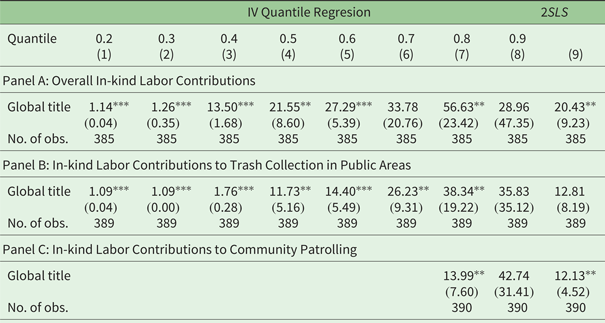
It is also found, based on IV quantile estimation evaluated at each decile, that global titling has a sizable and statistically significant effect on overall in-kind contributions across the entire distribution. This effect is also evident when the dependent variable measures the in-kind time contributions to each of the local public goods–trash collection and community patrolling. This result suggests that the baseline effect, interpreted as informal taxation, is drawn from a broad base.
This paper is organised as follows. Section 2 provides an institutional background of informal taxation in Quito, Ecuador. Section 3 describes the data, provides descriptive statistics and also presents the empirical strategy. Section 4 presents the 2SLS and IV quantile regression results and investigates the sensitivity of the baseline findings to alternative specifications. Section 5 provides a brief discussion of the main results and section 6 concludes.
2. Institutional setting
Anecdotal evidence by Burgwal (Reference Burgwal1995) and Dosh (Reference Dosh2010) suggests that informal taxation in Quito, Ecuador is conducted by neighborhood organisations registered as housing cooperatives that play a coordinating role in collecting in-kind labor contributions from the neighborhood residents. These neighborhood organisations operate predominantly in former squatter settlements with not fully-resolved property rights disputes. Housing cooperatives form upon the receipt of a global title and are dissolved upon the distribution of all individual titles. The Law and Regulation of Housing Cooperatives (LRHC), stipulates that a housing cooperative must fulfil the following three legal objectives in a sequential order: (i) to purchase land on behalf of its members by obtaining the global title to the property; (ii) to distribute individual titles to its members; and (iii) to be dissolved upon the distribution of all individual titles to members of the housing cooperative. The legal term for an organisation that is seeking to purchase land but has not completed a transaction that grants it a global title is a pre-housing cooperative (Burgwal, Reference Burgwal1995).
Housing cooperatives would typically be observed in former squatter settlements long after their legalisation. In these former squatter settlements, there is a significant delay in completing the process of distributing all individual titles which prevents the dissolution of a housing cooperative. Burgwal (Reference Burgwal1995) suggest that the delay in distributing all individual titles arises in part from the financial difficulties of some members in making payments on the purchased plots. These financial difficulties may occur more often in former squatter settlements, as a property transaction in those neighborhoods would often occur after, instead of prior to, the settlement of residents onto the transacted property.
The housing cooperatives in former squatter settlements of Quito are reported by both Burgwal (Reference Burgwal1995) and Dosh (Reference Dosh2010) to engage in the self-financed provision of a range of local public goods such as trash collection, community patrolling, and the construction of water supply and sewage networks. The provision of local public goods, however, is not explicitly stated as a responsibility of a housing cooperative in the LRHC.
The ability of a housing cooperative to finance the community provision of local public goods in part stems from the built-up fiscal capacity in terms of administrative infrastructure, monitoring and enforcement capabilities during the early stages when coordination action was necessary to ward off eviction attempts. The tools embedded in the global title also enable a housing cooperative to penalise free-riding behavior of community residents, including those who possess an individual title. Dosh (Reference Dosh2010) suggests that these tools may be effective in deterring free-riding behavior during the individual titling process when individuals face a reduced incentive to contribute to community projects as the threat of eviction disappears.
The origins of housing cooperatives' fiscal capacity are traced to the presence of a common external threat of eviction, which increases squatters' willingness to contribute their time to community projects. Anecdotal evidence of this is drawn from two sources: Dosh (Reference Dosh2010) compares and contrasts the causes for the rise and for the collapse of the neighborhood organisations in Ecuadorian and Peruvian squatter settlements, while Burgwal (Reference Burgwal1995) provides an account of the lifecycle of a neighborhood organisation registered as a housing cooperative in a squatter settlement in Quito, Ecuador.
The effectiveness of the coordinated nature of the squatters' time contributions in thwarting eviction attempts is noted by both Burgwal (Reference Burgwal1995) and Dosh (Reference Dosh2010) in several case studies. In the context of commonly-found naturally protected neighborhoods of Quito that are accessible from other parts of the city only at few locations, summoning up a large number of residents at those key locations may be effective at increasing the political cost of eviction. The increased political cost of eviction may arise due to the high likelihood of casualties in potential violent clashes between the police forces and the squatters.
Squatters' contributions may be voluntary in nature in the early stages of a squatter settlement formation. However, neighborhood organisations over time appear to acquire the capacity to demand informal in-kind labor tax payments from residents. Burgwal (Reference Burgwal1995) reports that record keeping of volunteer schedules was one of the early manifestations for the creation of administrative infrastructure that is used not only to more effectively coordinate residents' in-kind time contributions but also to monitor residents' compliance with the proposed schedule. In addition, Dosh (Reference Dosh2010) suggests that the extended period of a credible eviction threat, common for Quito squatter settlements, has facilitated the build-up of administrative infrastructure, monitoring and enforcement capabilities in neighborhood organisations.
The access to effective policy instruments by community organisations to sustain household contributions is particularly important during the titling process in former squatter settlements. The removal of the common external threat poses a challenge to the community provision of local public goods at two levels. First, at the individual level, it reduces squatters' willingness to contribute their time to community projects, an issue noted by Dosh (Reference Dosh2010). Secondly, at the community level, the reduced aggregate contributions and participation rates of squatters may result in the collapse of a neighborhood organisation in Dosh's (Reference Dosh2010) framework, termed ”organisational stages of development”. Dosh's (Reference Dosh2010) hypothesis is empirically supported by Field's (Reference Field2004) empirical finding of reduced likelihood of a neighborhood organisation being present in areas affected by a titling reform compared to those that are not. Her finding is drawn from data encompassing Peruvian squatter settlements. At the same time, Dosh (Reference Dosh2010) points to the widespread lack of improvement in public services in the former squatter settlements following the implementation of the titling reform.
The neighborhood organisations registered as housing cooperatives in Quito, Ecuador, have been more successful than their Peruvian counterparts in withstanding the challenges of reduced contributions and participation rates (Dosh, Reference Dosh2010). Burgwal (Reference Burgwal1995) credits this success to the tools embedded in a global title, which legally enable a housing cooperative to impose binding decisions on community residents, including penalties, on non-compliers with the collective decision-making process. Some of the most extreme penalties, listed in Articles 20 and 21 of the LRHC, entitle the Executive Council and the General Membership to expel members of the housing cooperative from the organisation and from the neighborhood if they are deemed ”disloyal” to the organisation (Burgwal, Reference Burgwal1995).
3. Materials and methods
3.1 Data and descriptive statistics
The main data source used in this article is cross-sectional household-level survey data from 20 urban neighborhoods in Quito, Ecuador collected by Lanjouw and Levy (Reference Lanjouw and Levy2002) in 1998. These neighborhoods are stratified based on two criteria: the neighborhood geographic location and the average income level of Quito. This stratification results in only low-income and middle-income neighborhoods being included in the sample. Also, the sampled neighborhoods are drawn from all administrative zones of Quito. In this dataset, 20 households are randomly sampled from each of the 20 sampled neighborhoods. In addition to this data source, data is also used from the Instituto Geográfico Militar (2002) regarding neighborhood-level data on the share of uncollected trash for the year 1995.
The key institutional variable is a binary indicator for the presence of a housing cooperative in each neighborhood. The outcome variables of interest include the self-reported in-kind labor contributions to trash collection in public areas and to community patrolling at the individual household member level, which for the purposes of the analysis are aggregated at the household level. In-kind labor contributions have the advantage of being less divertible into alternative uses, such as misappropriation and embezzlement, compared to in-kind good and monetary contributions (Olken, Reference Olken2006). In addition, the use of reported in-kind labor contributions by type of local public good is informative, even in the absence of spending data, on the proportions of the collected revenue allocated to the build-up of fiscal capacity, such as crime-control technology, and to the provision of other local public goods, such as trash collection in public areas.
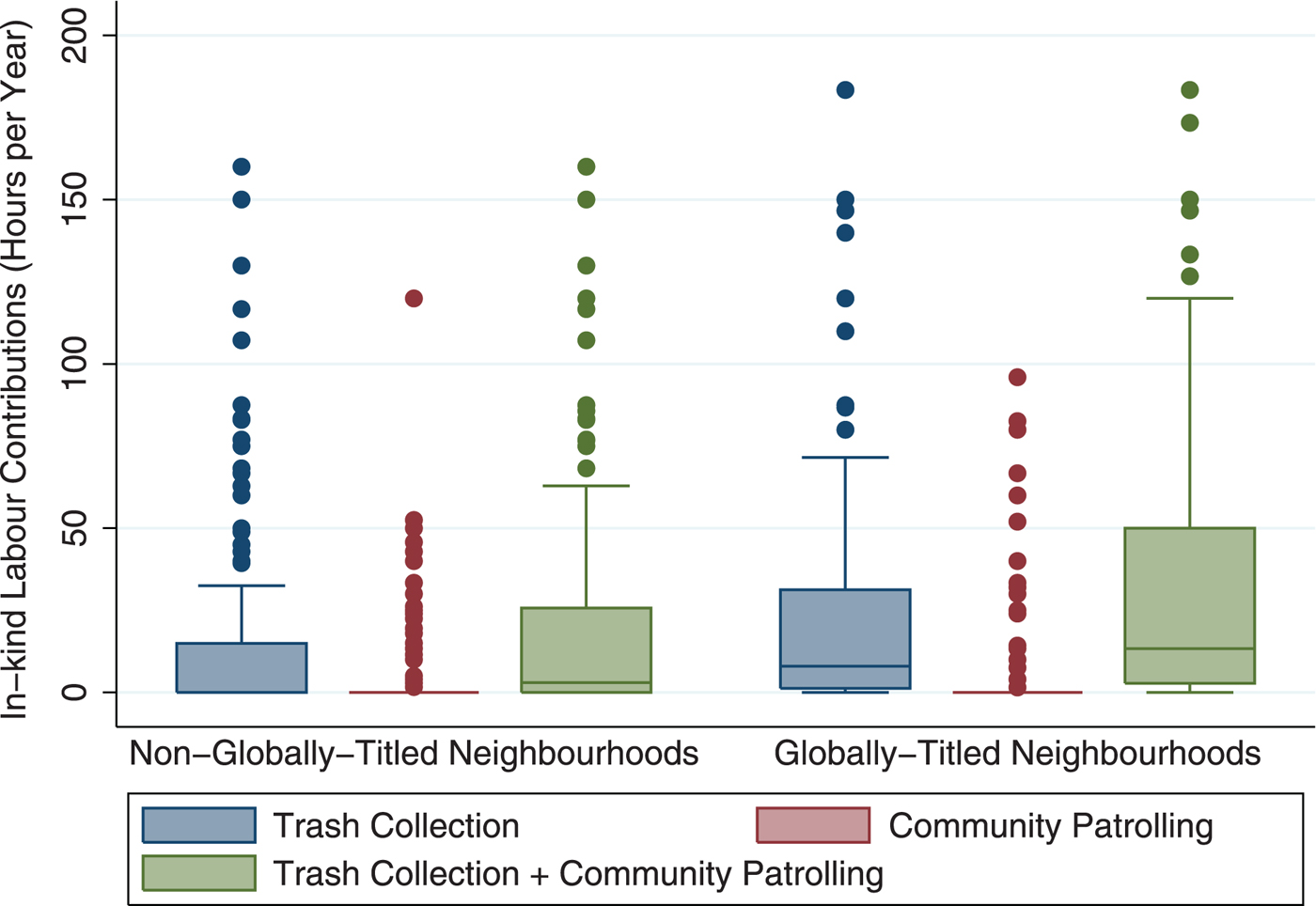
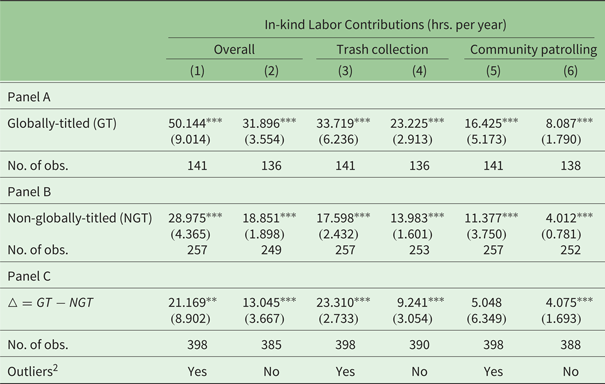
Columns 1, 2 and 3 respectively of table 1 report the in-kind overall labor contributions, the contributions to trash collection in public areas, and those to community patrolling. In each column, the descriptive statistics indicate that the average contributions are larger in the globally-titled neighborhoods than those in the non-globally-titled neighborhoods. Figure 1 presents the corresponding distributions of the in-kind overall contributions, the contributions to trash collection in public areas, and those to community patrolling respectively. These distributions indicate that in addition to higher average contributions, the global-titled neighborhoods also have higher medians, first and third quartiles.
Box plot of in-kind labor contributions by global titling.

Descriptive statistics: household labor contributions

Notes: Levels of significance: ***p<0.01, **p<0.05, *p<0.10. Standard errors are reported in parentheses. The exclusion of outliers for columns 2, 4 and 6 applies to all of Panels A, B and C.
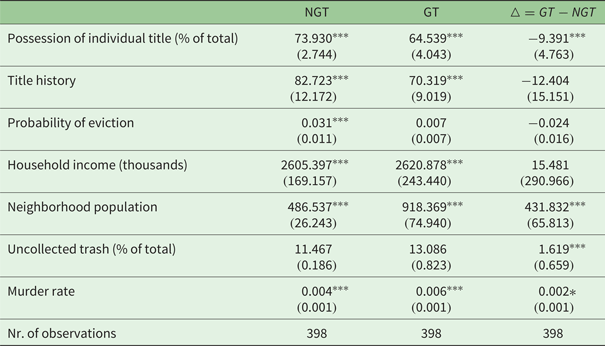
Table 2 reveals an important insight that maps the differences in the levels of the in-kind time household contributions between the two types of neighborhoods to the property security environment reflected in this cross-section of data. The first row indicates that both types of neighborhoods have large shares of residents who do not possess an individual title. Title history, a continuous variable that measures the fraction of time since settlement that a household is in possession of an individual title, reveals a similar pattern across the two type of neighborhoods. The third row indicates that the perceived probability of eviction is low in both types of neighborhoods even if it were to be compared to the shares of non-titled residents. The share of non-titled residents is higher in the globally-titled neighborhoods, while the perceived probability of eviction is also higher but statistically insignificant. These descriptive statistics correspond to the property security environment described by Dosh (Reference Dosh2010) in section 2, where the common threat of eviction is no longer present and there is a significant fraction of individually-titled residents. Dosh (Reference Dosh2010) suggests that these two factors contribute to a low incentive of residents to voluntarily contribute their time to community projects.
Descriptive statistics: socioeconomic characteristics

Notes: Levels of significance: ***p<0.01, **p<0.05, *p<0.10. Standard errors are reported in parentheses.
Table 2 also indicates that the two types of neighborhoods are comparable with respect to income levels as well as with the levels and the demand for public services. The level of public services is proxied for by the share of uncollected trash in each neighborhood, while the demand for public services by the murder rate. The globally-titled neighborhoods, however, are larger in population size.
In addition to using the Lanjouw-Levy dataset, geographic and historical data was collected from various maps and atlases for 324 Quito neighborhoods in 1999. These neighborhoods encompass the population of Quito neighborhoods appearing in the Quito map of Ediguias (Reference Ediguias1999), the year after the Lanjouw and Levy dataset was compiled. Each neighborhood is reported as having been formed as an illegally-formed neighborhood, provided that at least one of the following sources – Instituto Geográfico Militar (1992), Instituto Geográfico Militar (2002), or Carrion and Sanchez (Reference Carrion and Sanchez2003) – lists it as an illegal squatter settlement.
A variable, termed slope of terrain, is constructed that proxies for inaccessible boundaries from adjacent territories (other neighborhoods and parks). First the exact location and boundaries of each neighborhood depicted in Ediguias (Reference Ediguias1999) is mapped. Then, from topographic maps obtained from Google Maps (2014), information is extracted about the lowest and the highest altitudes of each neighborhood as well as the surface distance between the locations associated with the lowest and the highest altitude of the neighborhood, which are necessary to calculate the slope of terrain for each neighborhood.
Similarly, a variable is constructed that proxies for agricultural land, an eligibility requirement for the registration of a neighborhood organisation as a housing cooperative. This proxy variable measures the latitude distance from the historical centre by taking the difference between the geographical latitude of each neighborhood and that of Quito's historical centre. The coordinates of each neighborhood and that of Quito's historical centre are obtained from iTouchMap (2014).
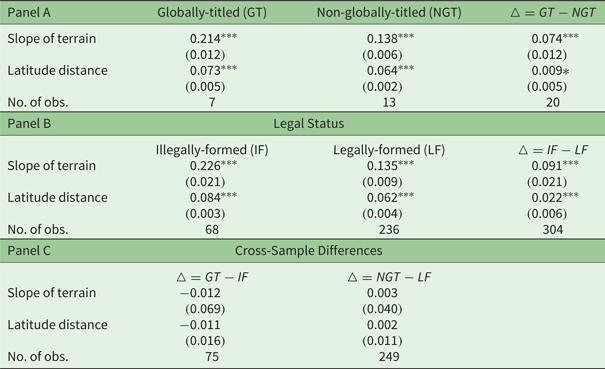
Panel A of table 3 reports that, relative to the non-globally-titled neighborhoods, the globally-titled neighborhoods from the Lanjouw-Levy dataset are located on terrain with less accessible surroundings and farther away from the midpoint of the historical centre of Quito on the North-South axis of the Guyllabamba valley. Panel B of table 3 provides the same comparison in these two geographic characteristics between the legally-formed and the illegally-formed neighborhoods for the population of Quito neighborhoods. The reported magnitudes reveal a strikingly similar pattern between the average characteristics of the population of illegally-formed neighborhoods and those of the globally titled neighborhoods sampled in the Lanjouw-Levy dataset. These patterns suggest that the geographic characteristics of the globally-titled neighborhoods sampled in the Lanjouw-Levy dataset are representative of the population of the squatter settlements in Quito in two respects: natural surrounding that facilitate the warding off of eviction attempts and an increased likelihood of meeting the eligibility requirements of a housing cooperative.
Descriptive statistics: geographic characteristics by neighborhood type

Notes: Levels of significance: ***p<0.01, **p<0.05, *p<0.10. Standard errors are reported in parentheses. Panel A includes the neighborhoods data from the Lanjouw-Levy dataset, while Panel B includes the population of Quito neighborhoods appearing in the Ediguias (Reference Ediguias1999) dataset.
3.2 Empirical strategy
The baseline model is given by:
 $$\ln (1 + y_{is}) = \beta _{0} + \beta_{1} d_{s} + {\bf x}_{\bf is}^{\bf \prime} {\bf \delta} + \varepsilon_{is},$$
where y is indicates the overall in-kind labor contributions to two local public goods, trash collection in public areas and community patrolling, of household i in neighborhood s. The endogenous regressor d s takes a value of 1 if the neighborhood is globally-titled, indicated by the presence of a housing cooperative, and 0 otherwise. The possession of a global title by a housing cooperative may provide it with tools to levy informal taxes on its membership. The baseline coefficient β1, therefore, measures the effect of global titling on the additional percentage of informal tax revenue that a housing cooperative is able to collect beyond the amount that would be raised from voluntary contributions. xis is a vector of household and neighborhood-level control variables. The error term must satisfy  ${\open E} [\varepsilon_{is} \vert d_{s},\, {\bf x}_{\bf is}] = 0$ to yield unbiased estimates.
Estimating this model with OLS is likely to lead to biased estimates due to the potential of reverse causality and selection bias. For instance, the present household contributions are likely to correlate with the lagged contributions that have been used for the buildup of fiscal capacity. The instrumental variable estimator can avoid the bias that ordinary least squares suffers from when the binary endogenous regressor, global title, in a regression is correlated with the regression's error term. The instrumental variable (IV) estimation requires both a valid instrument and an instrument that is not too weak (Murray, Reference Murray2006).
To capture the distribution effect of global titling on in-kind labor contributions, we estimate linear quantile regression models of the form:
 $$ Q_{\tau}({\rm ln} (1+y_{is}) \vert {\bf x}_{\bf is}, d_{1is} \gt d_{0is}) = \beta_{1} (\tau) d_{s} + {\bf x}_{\bf is}^{\bf \prime} {\bf \delta} (\tau),$$
where  $Q_{\tau }({\ln} (1 + y_{is})\vert x_{is},\,d_{1is} \gt d_{0is})$ denotes the τ -quantile of y is given xis and d is for compliers. β1 and δ (τ) are the quantile regression coefficients for compliers, in this context those residents living in a globally-titled neighborhood. The models of the form depicted in equation (2) are estimated via the instrumental quantile regression estimator of Chernozhukov and Hansen (Reference Chernozhukov and Hansen2006).
4. Results and robustness checks
4.1 Baseline results
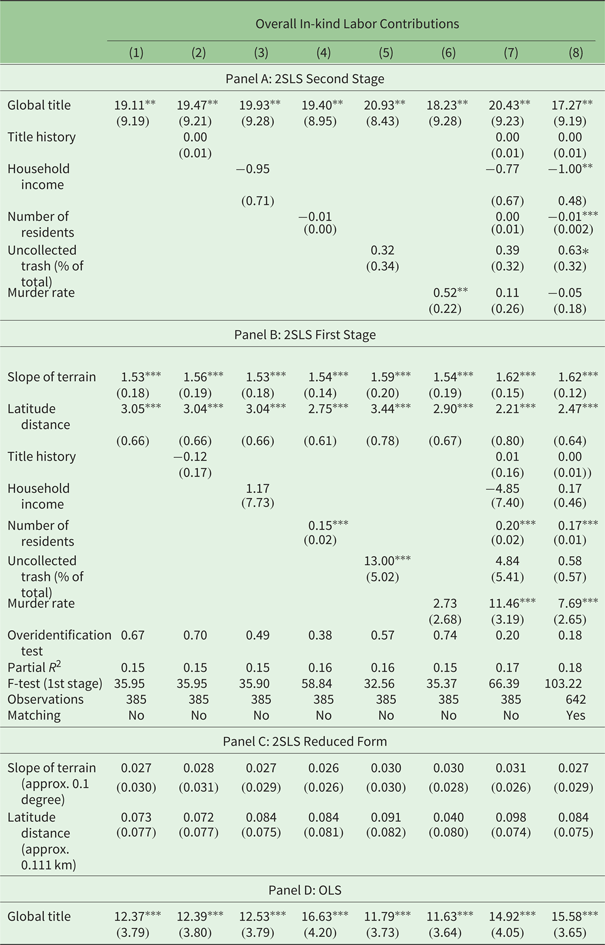
Panel A of table 4 presents the garden variety 2SLS estimates for β1, the coefficient of interest from the baseline regression (1). The reported estimate of global titling on the overall in-kind labor contributions indicate a sizable average effect that is also statistically significant. Panel B indicates a strong first-stage relationship between the instruments, rugged terrain and latitude distance, and the binary indicator of global titling.
Baseline results

Notes: Levels of significance: ***p<0.01, **p<0.05, *p<0.10. Standard heteroskedastic errors are reported in parentheses.
Panel A of table 5 presents the IV quantile estimates for the overall in-kind labor contributions, the coefficient of interest from regression equation (2). The estimated effect in panel A, reported in columns 1 to 8, reveals that the measured effect is both positive and statistically significant at each decile except the seventh and the top deciles. The magnitude of this effect is also increasing with each decile with the exception of the top decile.
Baseline results by quantiles and type of public good

Notes: Levels of significance: ***p<0.01, **p<0.05, *p<0.10. Standard heteroskedastic errors are reported in parentheses.
Panels B and C of table 5 present the corresponding estimates for the in-kind contributions to trash collection in public areas and to community patrolling respectively. The estimates reported in panel B closely follow those of panel A but are smaller than them in magnitude for all deciles except the top one. Panel C reports an effect only for the top two deciles due to the relatively low participation rate in community patrolling. The estimated effect is non-zero for those deciles, where the in-kind labor contributions are positive.
4.2 Robustness checks
The unbiasedness of the baseline results reported in table 4 is contingent on the instruments being both valid and not too weak. The validity of the instruments rests on the assumption that rugged terrain and latitude distance from the historical centre of Quito have no direct impact on the household contributions to local public goods and do not correlate with an omitted variable from the baseline regression. These geographic characteristics and, in particular, latitude distance from the historical centre of Quito, however, could be correlated with the cluster of socioeconomic factors as well as the demand for and supply of government service levels that influence households' in-kind time contributions. Several robustness checks are performed to mitigate these concerns. However, not failing a test is different from proof that the baseline empirical model is valid.
To alleviate concerns that this assumption is not violated, in table 4 we control for the demand for public goods, titling history, relevant socioeconomic characteristics of households and neighborhoods as they may influence the size of the household in-kind time contributions to local public goods (Bergstrom et al., Reference Bergstrom, Blume and Varian1986; Olken and Singhal, Reference Olken and Singhal2011; Barr et al., Reference Barr, Dekker and Fafchamps2015). While this exercise cannot completely rule out the concerns of an omitted variable bias, the baseline results are robust to the inclusion of additional controls proxying for several alternative explanations.
There could be a set of other plausible explanations, e.g., scavenger behavior (del Pilar Moreno-Sánchez and Maldonado, Reference del Pilar Moreno-Sánchez and Maldonado2006), that may not be testable with the inclusion of control variables due to the limitations of the available dataset. This issue is instead addressed with the partially testable identifying assumption, which requires that the instruments are uncorrelated with the error term. The inclusion of two instruments and one endogenous regressor allows us to partially test this assumption by running a diagnostic test based on the Sargan χ2 test. This test, as indicated in panel B of table 4, does not detect the correlation of an instrument with the error term or model misspecification. While failing this test would invalidate the baseline empirical model, not failing it does not corroborate the model's validity.
The reduced form is presented in panel C of table 4. In no specification is either of the two instruments correlated with the dependent variable – overall in-kind labor contributions. The absence of a statistically significant correlation between either of the instruments and the dependent variable provides no evidence that the instruments have a direct effect on the dependent variable. However, failing to reject a hypothesis is different from accepting it.
The 2SLS estimator is prone to bias in finite samples, the problem becoming more severe in the presence of weak instruments. The first-stage F test statistic and partial R 2 magnitudes, reported in panel B of table 4, do not suggest the presence of a weak instrument problem. In addition, the 2SLS estimate of the baseline coefficient is also reported to be similar in magnitude to the less-biased-than-2SLS LIML estimator.
Last but not least, the 2SLS results from a subsample that includes only the matched observations using a cross-sectional matching estimator technique are reported in column 8 of table 4. This technique aims to include only those observations in the sample from the treatment group (globally-titled neighborhoods) that have a corresponding match or matches in the control group (non-globally-titled neighborhoods) based on the observed characteristics used as controls in column 7 of table 4. The matching procedure yields a total of 136 observations in the treatment group (residents of globally-titled neighborhoods) and 506 in the control group (residents of non-globally-titled neighborhoods). The merit of this sample restriction is that only comparable observations across the treatment and the control groups are used for the baseline 2SLS estimates. There are, however, some drawbacks to this type of estimation – in particular the limited number of observable characteristics and the potential bias from time-invariant characteristics that cannot be eliminated in the presence of cross-sectional data.
The reported baseline coefficient in column 8 of table 4 is positive, sizable and statistically significant. Its magnitude is, however, smaller relative to that of the baseline coefficient reported in column 7. The 2SLS estimator in column 8 does not fail any of the tests reported in panel B or panel C.
The baseline effect of global titling on in-kind labor contributions is interpreted as informal taxation. This effect captures the ability of housing cooperatives, the neighborhood organizations in the globally-titled neighborhoods, to deter free-riding behavior even among the individually-titled residents in an environment with a low probability of eviction. Indirect support for this third premise of the main argument is provided by the IV quantile results, which are drawn from a larger base in the globally-titled neighborhoods.
5. Discussion
Organising collective action is a major obstacle to effectively addressing environmental problems ranging from the micro-level governance of biological and physical resource systems to the global-scale governance of issues such as climate change. The governance of the commons in urban residential areas is no exception as the piling of uncollected trash in public areas contributes to health risks and degradation of the urban environment (UN, 2000).
Designing institutions that restrict the access to or the usage of common property resources is commonly used to address the tragedy of the commons problem (Ostrom, Reference Ostrom1990). While well-applicable to biological and physical resource systems, restricting access to residential streets and parks is in general neither feasible (or at least very costly) nor socially desirable. In this environment, policy initiatives on waste management in public areas tend to focus on the scheduled collection of trash (Kinnaman, Reference Kinnaman2009). In the developed world, this is a role typically assumed by the municipal government, which has the coercive tools to fund those public services through taxation. In contrast, these public services are substandard or entirely missing in less developed countries (Kinnaman, Reference Kinnaman2009).
In less developed countries, the community provision of local public goods, funded by informal tax payments, is used to alleviate the inadequate levels of government provision to maintain a clean environment in residential areas. This article provides evidence that a global title is able to address the collective action problem of a reduced incentive to contributing to local public goods. By registering as a housing cooperative and acquiring a global title over the squatted land, a community organisation obtains additional legal tools to induce households to contribute their time to the provision of local public goods when they face a reduced incentive to do so in the absence of the common external threat of government eviction. In this respect, a community organisation is also able to collect informal tax payments from a broad tax base and avert the collective action problem outlined by Dosh (Reference Dosh2010) and Field (Reference Field2004) that stems from a titling reform in the Peruvian squatter settlements. At a broader level, the empirical findings of this article speak in favour of Ostrom's (Reference Ostrom1990) view that organic institutions should be strengthened instead of replaced by formal institutions during the titling process in order to improve the governance of the commons.
Does the collection of informal tax revenue improve the provision of community public services? The differential levying of informal tax payments across households by type of local public good is informative, even in the absence of spending data, on the proportions of the collected revenue allocated to the build-up of fiscal capacity, such as crime-control technology, and to the provision of other local public goods, such as trash collection in public areas. Such conjecture is consistent with the empirical finding that, compared to in-kind good and monetary contributions, in-kind labor contributions are less divertible into alternative uses, including misappropriation and embezzlement (Olken, Reference Olken2006).
6. Conclusion
The main finding of this article is that the global titling of a neighborhood sustains larger average in-kind labor household contributions estimated from a 2SLS empirical model. In addition, the estimates obtained from the IV quantile regression reveal that a positive effect is evident throughout the entire distribution. The estimated effect is interpreted as informal taxation as the paper finds empirical support in favour of all three premises on which the argument of this paper is built. Notably, the baseline effect is estimated in a low eviction environment for both the globally-titled and the non-globally-titled neighborhoods, where residents have a low incentive to contribute their time to community projects. This is also supported by the evidence suggesting that housing cooperatives in the globally-titled neighborhoods are able to enforce penalties even on households in possession of an individual title.
The findings of this article are specific to the urban neighborhoods of Quito, Ecuador. However, important lessons regarding titling policies could be drawn from them in strengthening the governance of the commons. For instance, future research could investigate the importance of empowering grassroots organisations with a global title in other aspects related to the governance of the commons. A candidate for such research is the conflict over the de facto authority to resolve property rights disputes between traditional leaders and formal authorities during the transition from informal to formal rules. Simelane (Reference Simelane2016) notes that this issue arises as formal institutions aim to replace, instead of strengthen, customary institutions for resolving disputes.
Supplementary material
The supplementary material for this article can be found at https://doi.org/10.1017/S1355770X18000293.
Acknowledgments
I am grateful to Alexander Karaivanov, Anke Kessler and Chris Muris for their support and advice throughout this project. I also benefited from invaluable comments from conference partcipants and anonymous referees.