Introduction
Emotion dysregulation is considered to be a core symptom in patients with borderline personality disorder (BPD; Linehan et al. Reference Linehan, Heard and Armstrong1993; McGlashan et al. Reference McGlashan, Grilo, Sanislow, Ralevski, Morey, Gunderson, Skodol, Shea, Zanarini, Bender, Stout, Yen and Pagano2005; Barnow, Reference Barnow2007; Barnow et al. Reference Barnow, Stopsack, Grabe, Meinke, Spitzer, Kronmüller and Sieswerda2009). According to Linehan et al. (Reference Linehan, Heard and Armstrong1993) and Crowell et al. (Reference Crowell, Beauchaine and Linehan2009), emotion dysregulation is characterized by highly sensitized responding to emotional stimuli as well as delayed habituation to such events. The empirical evidence for this model is, however, surprisingly scarce. Only a few studies explicitly examined emotion dysregulation in BPD patients and the majority of these studies exclusively focused on the patients' self-report of emotional experience (for a review, see Rosenthal et al. Reference Rosenthal, Gratz, Kosson, Cheavens, Lejuez and Lynch2008). One of the first published psychophysiological studies on BPD (Herpertz et al. Reference Herpertz, Kunert, Schwenger and Sass1999, Reference Herpertz, Werth, Lukas, Qunaibi, Schuerkens, Kunert, Freese, Flesch, Mueller-Isberner, Osterheider and Sass2001) measured emotional startle modulation in patients with BPD and healthy control subjects during viewing of standardized unpleasant, neutral and pleasant pictures from the International Affective Picture System (IAPS; Lang, Reference Lang, Sidowski, Johnson and Williams1980). Contrary to the expectations of the authors, neither self-report nor physiological data were elevated in patients with BPD compared with healthy control subjects during viewing of these standardized emotional stimuli. In fact, a similar pattern of emotion regulation of the startle response was found for BPD patients and controls. However, the pictures presented in the study of Herpertz et al. (Reference Herpertz, Kunert, Schwenger and Sass1999, Reference Herpertz, Werth, Lukas, Qunaibi, Schuerkens, Kunert, Freese, Flesch, Mueller-Isberner, Osterheider and Sass2001) might be less appropriate to induce the intense emotional responses in BPD patients than the use of short idiographic aversive and borderline-specific scripts. This conclusion is supported by a study conducted by Hazlett et al. (Reference Hazlett, Speiser, Goodman, Roy, Carrizal, Wynn, Williams, Romero, Minzenberg, Siever and New2007) who found a clear potentiation of the startle response to borderline-salient relative to neutral words in BPD patients but not in healthy controls. Another reason for these unexpected findings could be that dissociative symptoms have not been considered in these studies. Especially in BPD patients, dissociative symptoms are highly present and may influence psychophysiological reactions to emotional stimuli (APA, 1994; Stiglmayr et al. Reference Stiglmayr, Braakmann, Haaf, Stieglitz and Bohus2003, Korzekwa et al. Reference Korzekwa, Dell, Links, Thabane and Fougere2009a, Reference Korzekwa, Dell and Painb;Barnow et al. Reference Barnow, Arens, Sieswerda, Dinu-Biringer, Spitzer and Lang2010). Chronic sexual, physical as well as emotional neglect have been related to dissociation (Nijenhuis et al. Reference Nijenhuis, Vanderlinden and Spinhoven1998; Spitzer et al. Reference Spitzer, Barnow, Freyberger and Grabe2006) and BPD has often been associated with childhood abuse and neglect (Zanarini et al. Reference Zanarini, Frankenburg, Jager-Hyman, Reich and Fitzmaurice2008; Ball & Links, Reference Ball and Links2009; Igarashi et al. Reference Igarashi, Hasui, Uji, Shono, Nagata and Kitamura2010; Hong et al. Reference Hong, Ilardi and Lishner2011; for a review, see Barnow et al. Reference Barnow, Arens, Sieswerda, Dinu-Biringer, Spitzer and Lang2010). Dissociation experiences involve detachment from the overwhelming emotional content of trauma. If dissociation is a conditioned way for affective regulation, it becomes automatized and habitual in response even to minor stressors interfering with the processing of emotional information, particularly negative ones (Frewen & Lanius, Reference Frewen and Lanius2006; Oathes & Ray, Reference Oathes and Ray2008; Schore, Reference Schore2009). For example, according to the cortico-limbic disconnection model (Sierra & Berrios, Reference Sierra and Berrios1998), dissociation is a process that dampens affective reactivity to avoid emotional overstimulation (Sierra et al. Reference Sierra, Senior, Dalton, McDonough, Bond, Phillips, O'Dwyer and David2002). In brief, the model suggests that during dissociation the medial prefrontal cortex inhibits processing of external emotional stimuli in the amygdala, thus dampening emotional responses to these stimuli (Sierra & Berrios, Reference Sierra and Berrios1998; Sierra et al. Reference Sierra, Senior, Dalton, McDonough, Bond, Phillips, O'Dwyer and David2002; Lanius et al. Reference Lanius, Vermetten, Loewenstein, Brand, Schmahl, Bremner and Spiegel2010).
There is only one study, however, that has investigated the impact of dissociation on baseline startle response in individuals with BPD (Ebner-Priemer et al. Reference Ebner-Priemer, Badeck, Beckmann, Wagner, Feige, Weiss, Lieb and Bohus2005). In this habituation study, the authors found overall increased startle reactivity in BPD patients relative to controls, but these group differences were modulated by participants' dissociative experiences at the beginning of the experiment. Patients experiencing no dissociative symptoms showed overall larger startle response magnitude compared with patients with high dissociative experiences. Furthermore, experimental studies found reduced pain sensitivity in patients with BPD under stress conditions (Russ et al. Reference Russ, Shearin, Clarkin, Harrison and Hull1993; Bohus et al. Reference Bohus, Limberger, Ebner, Glocker, Schwarz, Wernz and Lieb2000; Schmahl et al. Reference Schmahl, Bohus, Esposito, Treede, Di Salle, Greffrath, Ludaescher, Jochims, Lieb, Scheffler, Hennig and Seifritz2006) and revealed a significant correlation between self-reported pain insensitivity and dissociative features. These results suggest that individual differences in dissociation among BPD individuals may help to explain the apparent discrepancies in the patterns of findings across psychophysiological studies. In another study, Kuo & Linehan (Reference Kuo and Linehan2009) found no differences in emotional reactivity in an imagery task for electrodermal activity controlling for dissociation. However, dissociation was used only as a covariate and no mediation analyses were conducted.
Therefore, although there is some evidence that dissociation influences emotional reactivity, none of the above-mentioned studies has investigated the impact of present-state dissociation on emotion regulation (e.g. modulation of startle response and electrodermal activity) during imagery of stressful experiences. The current study, therefore, investigated startle responses and electrodermal activity in response to idiographic aversive and standard unpleasant stimuli in female BPD patients considering present-state dissociation during laboratory testing (Blumenthal et al. Reference Blumenthal, Cuthbert, Filion, Hackley, Lipp and van Boxtel2005).
Emotional priming of the startle reflex operates on a very fundamental level outside of the subject's awareness and is mediated by the amygdala (Davis & Siegel, Reference Davis and Siegel2000). Thus, the emotional modulation of the startle reflex is a powerful approach to study emotion reactivity and dysregulation in the clinical context (Grillon, Reference Grillon2002; Mauler et al. Reference Mauler, Hamm, Weike and Tuschen-Caffier2006). The skin conductance level (SCL) reflects in part activity of the peripheral sympathetic nervous system. This measure is often used to study conditioned emotional responding and sympathetic correlates of exposure to negative scripts (e.g. Schmahl et al. Reference Schmahl, Elzinga, Ebner, Simms, Sanislow, Vermetten, McGlashan and Bremner2004).
Another important advantage of this study is that BPD patients and healthy controls were carefully matched by age, education level and smoking behaviour. Specifically, the controlling of nicotine intake is important because nicotine has been shown to influence startle amplitude (Grillon et al. Reference Grillon, Avenevoli, Daurignac and Merikangas2007). We also used the script-driven imagery paradigm that provides the possibility of creating individualized and standardized emotional stimuli, which generate more vivid images and more affect-relevant physiological responses than standardized pictures (Miller, Reference Miller, Levin, Kozak and Cook1987; Cook et al. Reference Cook, Melamed, Cuthbert, McNeil and Lang1988; McTeague et al. Reference McTeague, Lang, Laplante, Cuthbert, Strauss and Bradley2009).
The following hypotheses were tested:
(1) The imagining of BPD-salient experiences is well suited to detect differences between healthy controls and BPD patients (e.g. intensity of the startle response, affect modulation of startle, SCL).
(2) Dissociative experiences during the laboratory testing are negatively correlated with startle response magnitudes and also decrease autonomic arousal in the BPD group. We expect that the process of dissociation during testing mediates possible group differences in the startle response and SCL between BPD and healthy controls.
Method
Subjects
We investigated 33 female patients with BPD and a comparison group of 26 healthy controls. Investigated patients were in-patients at the Hospital of Psychiatry and Psychotherapy, University of Greifswald in Stralsund. Assessed by the Structured Clinical Interview for DSM-IV (SCID-II; Wittchen et al. Reference Wittchen, Zaudig and Fydrich1997), all patients met Diagnostic and Statistical Manual of Mental Disorders, Fourth Edition (DSM-IV) criteria for BPD, while no other cluster B personality disorder was diagnosed. Axis I co-morbidity was assessed by the Structured Clinical Interview for DSM-IV Axis I Disorders (SCID-I;Wittchen et al. Reference Wittchen, Zaudig and Fydrich1997). The occurrence of a post-traumatic stress disorder (PTSD) diagnosis was determined by a semi-structured interview, the Clinician-Administered PTSD Scale (Blake et al. Reference Blake, Weathers, Nagy, Kapoulek, Klauminzer, Charney, Keane and Buckley2000). A trained clinical psychologist (A.L.) administered all diagnostic instruments. Patients with a history of schizophrenia, psychotic disorder, bipolar affective disorder and current alcohol or drug abuse were excluded. Co-morbid axis I disorders included a history of affective disorder (n=25), alcohol or drug abuse (n=19), anxiety disorders (n=11), eating disorder (n=6) and PTSD (n=21). Half of BPD patients (n=16) also met criteria for other axis II disorders, including cluster A (n=2) and cluster C personality disorders (n=14). Patients were required to be free from any regular medication for a minimum of 2 weeks prior to the study and at least 24 h from p.r.n. (pro re nata) medication [p.r.n. medication was given to 17 patients as need called for it: analgetics (n=6), sedatives (n=5), neuroleptics (n=2), analgetics/sedatives and analgetics/neuroleptics (n=2), sedatives/neuroleptics (n=1)]. The healthy controls were recruited via announcements posted on bulletin boards and were matched for age, education and nicotine consumption. Exclusion criteria for healthy controls included meeting diagnostic criteria for axis I and axis II disorders assessed by SCID-I and SCID-II interview, a history of psychiatric/psychotherapeutic treatment and the use of psychotropic medication. All subjects were paid for their participation in the study. After receiving a detailed description of the study, a written informed consent was obtained from all participants. The study was approved by the ethical board of the University of Greifswald, Germany, according to the declaration of Helsinki.
Psychological and self-report measurements
The Borderline Personality Inventory (BPI; Leichsenring, Reference Leichsenring1999), a 53-item self-rating scale, was administered to validate the BPD diagnosis derived from the SCID-II and to obtain a measure for BPD-specific symptomatology. The psychometric characteristics of the BPI are good with high values for internal consistency (α=0.86–0.91), retest reliability (r=0.73–0.88) and convergent validity (r=0.73).
To assess trait dissociation the German version of the Dissociative Experiences Scale (DES; Bernstein & Putnam, Reference Bernstein and Putnam1986; Carlson, Reference Carlson, Putnam, Ross, Torem, Coons, Dill, Loewenstein and Braun1993; Freyberger et al. Reference Freyberger, Spitzer, Stieglitz, Kuhn, Magdeburg and Bernstein-Carlson1998; Spitzer et al. Reference Spitzer, Freyberger, Stieglitz, Carlson, Kuhn, Magdeburg and Kessler1998) was used. The DES is a 28-item, self-administered inventory to measure the frequency of dissociative experiences such as absorption, amnesia and identity disturbances. According to Zanarini et al. (Reference Zanarini, Frankenburg, Jager-Hyman, Reich and Fitzmaurice2008), three dissociative subgroups exist within the BPD population: low dissociaters with DES values between 0 to 10, moderate dissociaters (range 10–29) and severe dissociaters with quite elevated DES scores (⩾30).
Present-state dissociative experiences were assessed by the Dissociation–Tension Scale (DSS) – acute (Stiglmayr et al. Reference Stiglmayr, Braakmann, Haaf, Stieglitz and Bohus2003) and were administered before and after physiological measurements. This self-rating scale consists of 22 items concerning somatoform symptoms (e.g. perception of pain, vision and hearing) as well as psychological dissociation (e.g. derealization, depersonalization, amnesia). The DSS displays high values for internal consistency (α=0.94), split-half reliability (r=0.93) and convergent validity (r=0.77; Stiglmayr et al. Reference Stiglmayr, Braakmann, Haaf, Stieglitz and Bohus2003).
Anxiety symptoms were assessed by the State Trait Anxiety Inventory (STAI; Spielberger et al. Reference Spielberger, Gorsuch and Lushene1970) and depressive symptoms by the Beck Depression Inventory (BDI; Beck et al. Reference Beck, Ward, Mendelson, Mock and Erbaugh1961).
Procedure and emotional material
After clinical assessment, participants were asked about the most aversive situation in their lives and then asked to write it down on a script preparation form. Using an established method (Pitman & Orr, Reference Pitman and Orr1993), the interviewer prepared three idiographic aversive scripts based on their personal transcription. Additionally, we used nine standardized unpleasant themes (e.g. rejection, feelings of abandonment, fear, threat) and three neutral scripts which were tested beforehand in a pilot study to determine categories (e.g. neutral scripts had valence between 5.31 and 6.52; arousal was between 2.00 and 2.54; and unpleasant scripts were in the range between valence 2.38 and 4.08 and arousal between 4.62 and 7.58; see Supplementary material, available online).
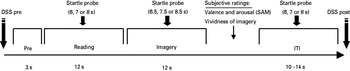
All scripts consisted of between three and six short sentences of comparable lengths with three scripts per category. Each trial began with a 3 s preparation period in which a fixation cross appeared on the screen followed by a script that was presented for 12 s. After 12 s a tone was played signalling the subject to imagine the previously read scene for 12 s. Another tone terminated the imagery period. Scripts from the different content categories were presented in random order. Acoustic startle probes (50 ms in duration, 95 dB bursts of white noise, rise-fall time <1 ms) generated by a Coulbourn noise generator were presented binaurally over headphones during the imagery (at 6.5, 7.5 or 8.5 s) period as well as during the inter-trial interval (at 6, 7 or 8 s). Additionally, six startle probe stimuli were delivered prior to the beginning of the experiment to reach a stable baseline of the startle response. After each imagery phase, subjects were asked to rate the valence and the intensity of their emotional experience during imagery using a computer-based version of the Self-Assessment Manikin (Lang, Reference Lang, Sidowski, Johnson and Williams1980). Self-report ratings ranged from feeling extremely pleasant (1) to feeling extremely unpleasant (9) and from being in a state of very low arousal (1) to being in a state of very high arousal (9). To determine the extent of dissociation, the DSS – acute was given before and after laboratory testing. After the ratings of each scene, an inter-trial interval (ITI) of 10–14 s length occurred before the next script presentation (startle probes were again presented either at 6, 7 or 8 s after the beginning of the ITI). Fig. 1 shows the procedure.
Segment from the script-driven imagery paradigm: schematic trial of the experimental session. After a 3 s presentation of a fixation cross, scripts were presented for 12 s. A startle eyeblink-eliciting probe was given after 6, 7 or 8 s. After that, the tone-cued imagery started, again for 12 s, where at 6.5, 7.5 or 8.5 s the startle probe was delivered. After imagery, subjects were asked for ratings of valence, arousal and vividness of imagery. The inter-trial interval (ITI) that followed lasted for 10 to 14 s. In 50% of ITIs, a startle probe was randomly delivered at 6, 7 or 8 s. Present-state dissociation was assessed at the beginning and at the end of laboratory testing. DSS, Dissociation–Tension Scale; SAM, Self-Assessment Manikin.

Physiological recordings, experimental control, and data reduction
The electromyographic activity (EMG) over the left orbicularis oculi muscle was recorded to measure the eyeblink component of startle response. Ag/AgCl miniature surface electrodes (Sensormedics, USA) filled with electrolyte (Marquette Hellige, UK) were attached beneath the lower eyelid using adhesive rings (Marquette Hellige, UK). The raw EMG signal was amplified and filtered through a 30–1000 Hz bandpass, using a Coulbourn S75-01 bioamplifier (Coulbourn Instruments, USA). Digital sampling with a rate of 1000 Hz started 100 ms before until 400 ms after the onset of the acoustic startle stimulus. The EMG signal was filtered off-line through a 60 Hz highpass filter, and thereafter rectified and integrated (time constant: 10 ms) using a digital filter. The reflex eyeblink data were reduced and scored off-line using a computer program that identified the peak amplitude (in μV; Globisch et al. Reference Globisch, Hamm, Schneider and Vaitl1993). Responses starting 20–100 ms after startle probe onset and reaching peak amplitude within 150 ms after probe onset were scored as valid startle eye blinks. No detectable eye blinks were scored as zero responses. Less than 1% of the trials had to be rejected due to excessive baseline shift or recording artifacts.
Skin conductance was recorded from the hypothenar eminence of the palmar surface of each participant's non-dominant hand as previously reported (Weike et al. Reference Weike, Schupp and Hamm2008). SCL was reduced into half-second bins. To reduce interindividual variability that was not related to the task, SCL was range corrected by dividing each individual half-second score by the participant's maximum SCL (Lykken & Venables, Reference Lykken and Venables1971). Autonomic reactions in skin conductance were determined by subtracting the average SCL from the 3 s period prior to script presentation from the average SCL during the 12 s imagery period.
Data analysis
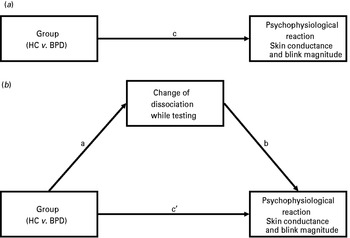
Statistical analyses were performed with SPSS version 18 (SPSS, Inc., USA). Data were tested for normal distribution using the Kolmogorov–Smirnov test. Following prior research, SCL, startle response magnitudes, valence and arousal ratings were analysed separately using general linear modelling with repeated measures with group (healthy control subjects v. BPD patients) as a between-subjects variable and script category (with neutral scripts as reference script) as a within-subjects variable. Greenhouse–Geisser adjustments were made where appropriate. The Kolmogorov–Smirnov test for normality indicated that the startle responses, SCL and Self-Assessment Manikin valence and arousal ratings showed a normal distribution (all p's>0.05). Additionally, we controlled analyses for co-morbidity (anxiety disorders, affective disorders and PTSD) within the BPD group. After testing for overall effects, comparisons of script categories were performed using contrast analysis with the neutral scripts as the reference category. For all tests significance was determined at a value of p<0.05. To test for the impact of dissociation, several mediation analyses were carried out using Sobel tests (Preacher & Hayes, Reference Preacher and Hayes2004) with change in dissociation as the mediator. The Sobel test determines the significance of the indirect effect of the mediator by testing the hypothesis of no difference between the total effect and the direct effect. Thus, in contrast to ‘traditional’ mediation analyses, there is no need for a significant main effect [e.g. correlation between predictor (healthy controls v. BPD) and outcome (e.g. startle response; see Fig. 2 a, b, path c)]. As the distribution of data is usually positively skewed in small sample sizes, we used bootstrap techniques (Shrout & Bolger, Reference Shrout and Bolger2002; Preacher & Hayes, Reference Preacher and Hayes2004).
The effect of dissociation on psychophysiological reactions without (a) and with (b) the proposed mediator. For group, healthy controls (HC)=0; borderline personality disorder in-patients (BPD)=1. Path c, Direct effect of group membership on psychophysiological reactions; path c', direct effect of group membership on psychophysiological reactions with the effect of dissociation removed; paths a and b, indirect effect of dissociation on psychophysiological reactions.

Results
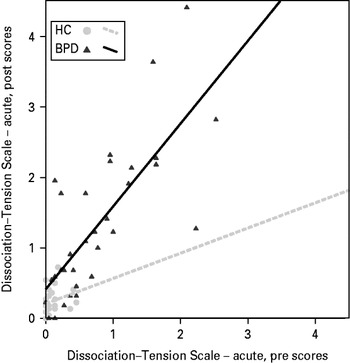
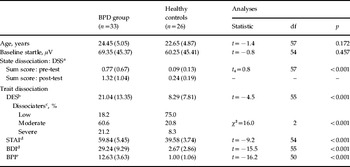
Age, education, mean values and standard deviations of BPI, BDI, STAI, DES and DSS (pre-post scores and change in dissociation), as well as baseline startle magnitudes (to the six probes presented prior to the imagery experiment) for both groups are depicted in Table 1. Individuals with BPD reported significantly elevated present-state dissociative symptom scores before (F 1,57=5.65, p<0.001) and after (F 1,57=5.80, p<0.001) the imagery experiment and showed a higher increase during the imagery assessment in DSS values than the healthy control group (F 1,57=8.09, p=0.006; see also Fig. 3). To determine whether these results were accounted for co-morbid PTSD, we compared BPD patients with and without PTSD, according to their level of dissociation. However, there were no significant differences for trait/state dissociation as well as change in dissociation between groups (all p's >0.10). This was also the case for the analyses of co-morbid anxiety or affective disorders. Furthermore, co-morbidity did not have an impact on the mediation analysis.
Degree of dissociation for healthy controls (HC) and borderline personality disorder in-patients (BPD). Pre-test state dissociation mean scores were: BPD, 0.77 (s.d.=0.67); HC, 0.09 (s.d.=0.13). Post-test state dissociation mean scores were: BPD, 1.32 (s.d.=1.04); HC, 0.24 (s.d.=0.19). Results of general linear modelling with repeated measures for Dissociation–Tension Scale (state dissociation): group, F 1,57=29.98 (p<0.001); time, F 1,57=24.88 (p<0.001); group×time, F 1,57=8.08 (p=0.006). Lines display the regression lines for each group (BPD: β=0.757, p<0.001; HC: β=0.248, p=0.222).

Demographic and psychometric characteristics of BPD patients and healthy controls

Data are given as mean (standard deviation) or as percentage.
BPD, Borderline personality disorder; df, degrees of freedom; DSS, Dissociation–Tension Scale – acute; DES, Dissociative Experiences Scale; STAI, State Trait Anxiety Inventory; BDI, Beck Depression Inventory; BPI, Borderline Personality Inventory.
a Results of general linear modelling with repeated measures for DSS (state dissociation): group, F 1,57=29.98 (p<0.001); time, F 1,57=24.88 (p<0.001); group×time, F 1,57=8.08 (p=0.006).
b BPD, n=33; healthy controls, n=24.
c DES: low, DES <10; moderate, DES <30; severe, DES ⩾30.
d BPD, n=33; healthy controls, n=24.
e BPD, n=28; healthy controls, n=24.
Table 1 also displays that individuals with BPD scored higher in trait dissociation (DES), depression (BDI) and trait anxiety (STAI) than healthy controls. For example, about 18% of the BPD patients were low dissociators with normal DES scores (range 0–10), 59% reported moderate DES scores (range 10–29) and 24% were in the severe dissociator group (values ⩾30). No group differences were obtained in education level and overall baseline startle response magnitudes.
Evaluative judgements: self-report
BPD patients rated all scenes as being more unpleasant (F 1,57=22.13, p<0.001) and more arousing (F 1,57=14.32, p<0.001) than the healthy control participants, whereas no differences in the vividness of imagery (F 1,57=0.05, p=0.945) were found (see further information in the supplementary data).
Psychophysiological reactivity
Group comparisons of startle response magnitudes and SCL
Blink magnitudes did not differ between patients and controls in the overall between-group comparison (F 1,54=0.31, p>0.10). However, we found significantly elevated SCL values in BPD patients compared with healthy controls (F 1,57=4.86, p=0.032). Furthermore, affective modulation of SCL varied significantly for the patients and controls with a significant script×group effect during the imagery of idiographic aversive scripts in relation to neutral scripts (F 1,57=4.60, p=0.036; see further information in the supplementary data).
Mediation analyses
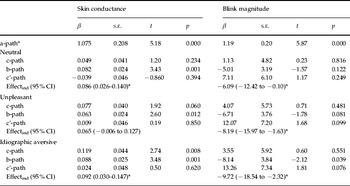
In order to determine the impact of dissociation on SCL and startle response, we computed several Sobel tests to analyse mediation processes as shown in Table 2. We proposed present-state dissociation as the mediating variable, BPD as the independent variable and psychophysiological measures (SCL and blink magnitude) as the dependent variables. In Fig. 2 a, the c path represents the total effect of BPD on psychophysiological measures. This was found to be significant for neutral and idiographic aversive scripts (and a trend for unpleasant scripts) for SCL, but not for startle response (see Table 2). Furthermore, as shown in Fig. 2 b, the significant β-coefficient for the a-path reveals, as expected, that borderline patients exhibit a higher degree of dissociation (p's<0.001; see also Fig. 3).
The mediating effect of dissociation on psychophysiological reactions regarding the relationship between borderline patients versus healthy controls and psychophysiological reactions

β, β Coefficient; s.e., standard error; Effectind, indirect effect; CI, confidence interval.
a Paths are explained in Fig. 2 a, b.
* p<0.05.
Regarding electrodermal activity (SCL), we found significant b-paths (dissociation/SCL, p<0.05) for all script categories. Moreover, the tests for indirect effects (effectind) revealed significant findings for neutral and idiographic aversive scripts. It is worth mentioning that for idiographic aversive scripts the analysis displayed a perfect mediation (e.g. c' is no longer significant).
Also, we found a negative association between present-state dissociation and the startle response magnitudes (b-paths) for all scripts, whereas this association reached significance only for idiographic aversive scripts and a trend for unpleasant scripts (p<0.10). In this context it is important to note, that after controlling for dissociation, we found a trend for a positive association between group and blink magnitude for unpleasant and idiographic aversive scripts (p<0.10), while the indirect effect reflected a significant negative relationship. This pattern indicates a so-called suppression effect.
Discussion
The current study explored self-reports, startle responses and SCL in BPD patients using script-driven imagery controlling for state and trait dissociation while also considering confounders such as education level and nicotine intake. As expected, startle eyeblink responses as well as SCL were significantly augmented as participants imagined unpleasant scripts compared with neutral scenes, supporting the validity of our method.
Our first result holds that patients with BPD rated all scripts as more unpleasant and arousing than healthy controls. This finding seems to be inconsistent with results of Herpertz et al. (Reference Herpertz, Werth, Lukas, Qunaibi, Schuerkens, Kunert, Freese, Flesch, Mueller-Isberner, Osterheider and Sass2001), who did not find significant differences in ratings of emotional pictures between BPD individuals and healthy control persons. Be that as it may, emotional pictures taken from the IAPS in the study of Herpertz et al. (Reference Herpertz, Kunert, Schwenger and Sass1999, Reference Herpertz, Werth, Lukas, Qunaibi, Schuerkens, Kunert, Freese, Flesch, Mueller-Isberner, Osterheider and Sass2001) might be less appropriate to tap the emotional contents that prompt the intense emotional responses in BPD patients than the use of short idiographic aversive and borderline-specific scripts. The fact that BPD patients rated all scripts, including neutral scenes, as more negative and arousing than the healthy control participants may indicate that the imagery of the unpleasant scripts produced an overall more negative mood state in BPD individuals which was difficult to regulate even during imagery of neutral scenes. This phenomenon is often observed in clinical practice and may be part of the emotion dysregulation in BPD patients (Koenigsberg et al. Reference Koenigsberg, Harvey, Mitropoulou, Schmeidler, New, Goodman, Silverman, Serby, Schopick and Siever2002, Reference Koenigsberg, Fan, Ochsner, Liu, Guise, Pizzarello, Dorantes, Tecuta, Guerreri, Goodman, New, Flory and Siever2010). Although patients reported overall stronger unpleasant feeling states than controls did, affective ratings were nevertheless modulated by the different emotional contents of the scenes.
The second finding was that, although we found significantly elevated SCL in the BPD group, the startle response magnitudes did not differ between BPD patients and healthy controls, confirming earlier reports of Herpertz et al. (Reference Herpertz, Kunert, Schwenger and Sass1999, Reference Herpertz, Werth, Lukas, Qunaibi, Schuerkens, Kunert, Freese, Flesch, Mueller-Isberner, Osterheider and Sass2001). However, in another study of our group, we revealed that individuals with BPD did not show a general emotional hyper-reactivity but are rather specifically vulnerable to emotional experiences of rejection and abandonment (Limberg et al. Reference Limberg, Barnow and Hamm2011). This supports findings of a recently published study of Hazlett et al. (Reference Hazlett, Speiser, Goodman, Roy, Carrizal, Wynn, Williams, Romero, Minzenberg, Siever and New2007). However, in both studies results were not controlled for dissociation. This is why it remains unclear whether or not dissociative experiences during testing had an impact on general psychophysiological response in BPD patients. Therefore, the current study extends earlier reports of our group by testing whether or not present-state dissociation has an impact on psychophysiological response pattern in BPD patients.
Here, we found that BPD patients had elevated scores in present-state dissociation at the beginning and end of testing. Furthermore, they displayed a stronger increase in dissociation during testing than healthy controls. In addition, we found evidence for an influence of present-state dissociation on SCL and startle responses in our study. For example, dissociation while testing led to elevated SCL scores during the imagery of emotional scripts, suggesting an overall stronger activation of the autonomic nervous system. Sobel testing revealed that present-state dissociation mediated the association between group assignment and SCL, while group differences were no longer significant when dissociation was considered as a mediator. Regarding the startle response, we found that present-state dissociation significantly reduced startle response magnitudes during imagery of idiographic aversive scripts as well as unpleasant scripts (unpleasant only as a trend, p<0.10). This suppression effect might explain why healthy controls and BPD patients did not differ in their overall startle response magnitudes. The mediating effect of dissociation concurs with the findings of Ebner-Priemer et al. (Reference Ebner-Priemer, Badeck, Beckmann, Wagner, Feige, Weiss, Lieb and Bohus2005), who investigated the impact of dissociation on baseline startle response in individuals with BPD. The authors reported overall increased startle reactivity in BPD patients relative to controls. Nevertheless, these group differences were modulated by participants' dissociative experiences at the beginning of the measurement.
To summarize, mediation analyses revealed that present-state dissociation mediates group differences in SCL and the startle response by increasing SCL and suppressing the startle response in the BPD group. Therefore, we would assume that dissociation decreases the input of sensory channels for processing the probe stimulus, while patients are still experiencing a high autonomic arousal (Flack et al. Reference Flack, Litz, Hsieh, Kaloupek and Keane2000; Weems et al. Reference Weems, Saltzman, Reiss and Carrion2003; Marshall, Reference Marshall2004). In line with these findings we would suggest that dissociation is an avoidance behaviour to deal with possible external threat by reducing external input but increasing autonomic arousal and tenseness. Analagous mechanisms showing a tonic immobility and a simultaneous increase of the pain threshold support this view (e.g. Bohus et al. Reference Bohus, Limberger, Ebner, Glocker, Schwarz, Wernz and Lieb2000; Schmahl et al. Reference Schmahl, Bohus, Esposito, Treede, Di Salle, Greffrath, Ludaescher, Jochims, Lieb, Scheffler, Hennig and Seifritz2006). For example, Bohus et al. (Reference Bohus, Limberger, Ebner, Glocker, Schwarz, Wernz and Lieb2000) found that lowered pain perception during stress was part of a more general stress-induced dissociative process. The authors also reported that during subjective distress, BPD patients showed increased physiological activation as assessed by heart rate and SCL. Moreover, Simeon et al. (Reference Simeon, Knutelska, Yehuda, Putnam, Schmeidler and Smith2007) found that dissociative symptoms in BPD were associated with a greater hypothalamic–pituitary–adrenal axis and noradrenergic reactivity to stress as well as with a lower ambient noradrenergic tone. Nevertheless, autobiographical memory seems to be unrelated to dissociation (Kremers et al. Reference Kremers, Spinhoven and Van der Does2004). We conclude that dissociation cannot be simply considered as a learned strategy to decrease emotional involvement but must instead be regarded as a dysfunctional emotion-regulation strategy that in the long run increases stress and autonomic output. This is supported by studies showing that dissociation leads to deficits in emotion regulation and emotion identification (Troisi et al. Reference Troisi, Belsanti, Bucci, Mosco, Sinti and Verucci2000; Kaplow et al. Reference Kaplow, Hall, Koenen, Dodge and Amaya-Jackson2008) and that dissociative processes prevent emotional learning (Steidl et al. Reference Steidl, Mohi-uddin and Anderson2006; Ebner-Priemer et al. Reference Ebner-Priemer, Mauchnik, Kleindienst, Schmahl, Peper, Rosenthal, Flor and Bohus2009). Moreover, our group revealed that high levels of dissociation in patients with affective or somatoform disorders predicted poor outcome during in-patient therapy (Spitzer et al. Reference Spitzer, Barnow, Freyberger and Grabe2007). Additionally, Kleindienst et al. (Reference Kleindienst, Limberger, Ebner-Priemer, Mauchnik, Dyer, Berger, Schmahl and Bohus2011) found that dissociation predicts poor treatment outcome in BPD patients undergoing in-patient dialectial behavior therapy. We suggest this may indicate that dissociative subjects react with dissociation as a response to negative emotions arising in psychotherapy and/or they suppress emotional responses leading to a less favourable outcome.
Conclusion
We assume that it may be helpful to differentiate between BPD patients with low dissociative experiences versus high dissociative experiences, because it is likely that the reduced emotional response to negative stimuli in high-dissociative patients with BPD reflects stronger dysfunctions in associated neurobiological systems (Korzekwa et al. 2009 a, b;Lanius et al. Reference Lanius, Vermetten, Loewenstein, Brand, Schmahl, Bremner and Spiegel2010). Therefore, the importance of assessing present-state dissociation in further investigations using, e.g. neuroimaging, is emphasized. Another important implication of our findings is the importance to assess dissociative symptoms and provide interventions to reduce dissociative responses to emotional stimuli.
Limitations
Limitations of this study should be noted. First, it is possible that our non-medicated BPD sample was less disturbed than BPD patients who receive regular medication. However, after analysing the amount of fulfilled BPD criteria, we did not find evidence for having an especially mildly disturbed sample (e.g. the SCID-II interview mean score was 6.7 and the BPI mean score was 12.8, which is comparable with other studies, e.g. Leichsenring, Reference Leichsenring1999). Furthermore, Zanarini et al. (Reference Zanarini, Frankenburg, Jager-Hyman, Reich and Fitzmaurice2008) reported that 32% of their out-patient BPD sample were low dissociators (e.g. had DES values between 0 and 10; see Method section), 42% reported moderate levels of dissociation and 26% had severe dissociative experiences. This is comparable with frequencies in our sample, while we had more patients who were in the moderate range (58.8% v. 42.0%). Another limitation is that we cannot exclude the possibility that discontinuation of medication close to testing (e.g. some patients were only 14 days without antidepressants) could have had an effect on the psychophysiological responding and dissociation levels. In addition, the DSS – acute was only given before and after laboratory testing. Thus, we were not able to measure change in dissociation after the different types of aversive and the neutral scripts. Strengths of this study are the use of personalized scripts that have been shown to evoke stronger emotional responses (Hazlett et al. Reference Hazlett, Speiser, Goodman, Roy, Carrizal, Wynn, Williams, Romero, Minzenberg, Siever and New2007; Limberg et al. Reference Limberg, Barnow and Hamm2011). Also, by excluding patients with current regular medication, we eliminated the confounding effects of pharmacological treatment. Finally, a further strength was that we matched both study groups for important confounding factors such as educational level and nicotine intake.
Note
Supplementary material accompanies this paper on the Journal's website (http://journals.cambridge.org/psm).
Acknowledgements
We thank all study participants for their motivation and participation in our study and the Department for Personality Disorders in the Hospital for Psychiatry and Psychotherapy (HANSE-Klinikum) in Stralsund, Germany (University of Greifswald) for their support. This work was in part supported by the German Research Foundation (DFG, BA-2172/2-1).
Declaration of Interest
None.