Introduction
Morphological traits in lichens are important in the understanding of functional adaptations, for example regarding lichen water relations. Also, traits with other well-documented functions, such as N-fixing cephalodia (Millbank & Kershaw Reference Millbank and Kershaw1969, Reference Millbank and Kershaw1970), may influence lichen hydration patterns, although this is poorly known. Cephalolichens are characterized by colonies of cyanobacteria (cephalodia) inhabiting an otherwise green algal-dominated thallus. Although cephalolichens share some traits with chloro- and cyanolichens, the cyano- and chlorolichen morphs of a cephalolichen are functionally fundamentally different. For example, whereas the chloromorph can be photosynthetically activated by humid air alone, the cyanomorph needs liquid water to initiate photosynthesis (Schlensog et al. Reference Schlensog, Schroeter and Green2000; Green et al. Reference Green, Schlensog, Sancho, Winkler, Broom and Schroeter2002). Furthermore, cyanolichens have substantially greater ratios of internal water holding capacity (WHCinternal) to specific thallus mass (STM) than chlorolichens, with cephalolichens at intermediate levels (Gauslaa & Coxson Reference Gauslaa and Coxson2011).
The species for our study belongs to the Lobariaceae, a family with many cephalo- and cyanolichens currently subjected to a number of taxonomic revisions. Moncada et al. (Reference Moncada, Lücking and Betancourt-Macuase2013) recently proposed to resurrect the old genus Ricasolia for some members of the genus Lobaria including Lobaria amplissima (Scop.) Forssell (= Ricasolia amplissima (Scop.) De Not.). This is primarily a western European species with a preference for temperate rainforest climates (Ellis Reference Ellis2016), but was recently reported (in the form of a new subspecies) from north-west America (Cornejo et al. Reference Cornejo, Derr and Dillman2017). Its primary photobiont belongs to the green-algal genus Dictyochloropsis (Dal Grande et al. Reference Dal Grande, Beck, Cornejo, Singh, Cheenacharoen, Nelsen and Scheidegger2014), presently referred to as Symbiochloris reticulata (Škaloud et al. Reference Škaloud, Friedl, Hallmann, Beck and Dal Grande2016), while its secondary cyanobacterial photobiont (Nostoc) occurs as invisible smaller internal cephalodia, sometimes with additional fruticose and spectacular external cephalodia (Jordan Reference Jordan1970). Compared to the cephalolichens L. pulmonaria and L. virens, L. amplissima is thicker with higher water storage and slower desiccation (Gauslaa et al. Reference Gauslaa, Solhaug and Longinotti2017; Longinotti et al. Reference Longinotti, Solhaug and Gauslaa2017). A thicker thallus also implies a need for more water to activate its photosystem II (PSII) (Phinney et al. Reference Phinney, Solhaug and Gauslaa2018). Furthermore, because lichen tissues with a cyanobacterium hold more water than those with green alga (Gauslaa & Coxson Reference Gauslaa and Coxson2011), the presence of many cephalodia should create a need for more water to fill the lichen's water storage. It is possible that two genetically slightly different varieties of L. amplissima may exist (Blom & Lindblom Reference Blom and Lindblom2010). The variety mainly occurring in oceanic climates usually has many external cephalodia, whereas the variety in drier parts of Scandinavia often lacks such cephalodia (Blom & Lindblom Reference Blom and Lindblom2010). However, there is no evidence as yet to suggest that genetic differences between the two varieties determine the frequency of external cephalodia in these two types, since a correlation does not prove causality. If an abundance of large external cephalodia has a major impact on the water storage pools, it probably affects lichen fitness along a moisture gradient, implying that it is not easy to know whether the presence of external cephalodia results from acclimation to wet climates or from genetic differences.
Here we test the hypothesis that thalli with external cephalodia have a higher WHC than those without. A higher WHC of cephalodiate thalli would be consistent with a higher competitive advantage of the variety with external cephalodia in a rainy climate, whereas a lower WHC in the thalli without external cephalodia would allow more frequent and more rapid PSII activation with just humid air and dewfall (Gauslaa Reference Gauslaa2014; Phinney et al. Reference Phinney, Solhaug and Gauslaa2018). The latter play an important role as hydration sources for lichens in more continental climates characterized by strong nocturnal cooling.
Material and Methods
We collected a number of separate L. amplissima thalli with varying amounts of external cephalodia from a large population of the western variety in the wet oceanic Kvinnherad, Hordaland, western Norway (59°58′41·41202″N, 6°3′39·49946″E, 350 m a.s.l.), in October 2013, from each of eight old pollarded trunks of Fraxinus excelsior. Pieces with and without external cephalodia were taken from each of the thalli collected. Debris, tree bark and bryophytes were removed. All pieces (120 with and 120 without external cephalodia), hereafter called thalli, had actively growing lobes with intact lobe ends and a minimum of cut edges. It was possible to select lobes of the two categories that were relatively similar with respect to the proportion of apical and central parts because the presence and number of external cephalodia varied across most thalli. In the laboratory, thalli were saturated in deionized water until their mass did not increase further. Their hydrated area (Awet) was determined from photographs using ImageJ 1.48 (Rasband Reference Rasband2014). We measured wet mass (WMblotting) immediately after blotting all external water on the surface with dry filter paper. Afterwards, we dried the thalli at room temperature and weighed them. At this weighing session, five additional control thalli of each species were also weighed air-dried then oven-dried (24 h at 70 °C) before measuring their oven-dry mass (DM). We used the mean reduction factor in mass from the air-dry to the oven-dry state for each category to convert air-dry mass to DM for all specimens and estimated specific thallus mass (STM) as STM = DM/Awet. The internal water holding capacity was calculated as WHCinternal = (WMblotting − DM)/Awet.
We computed means, standard errors and medians. For each category of thalli, linear regressions with 95% confidence intervals were calculated to evaluate species-specific differences in the STM-dependency of WHCinternal. Log-transformation was applied to improve data distributions for the regressions but a non-parametric test (Kruskal-Wallis one-way analysis of variance on ranks with all pairwise multiple comparison procedures, Dunn's Method) was used to assess differences between the two categories. These analyses were run in SigmaPlot (Systat Software, San Jose, CA).
Results
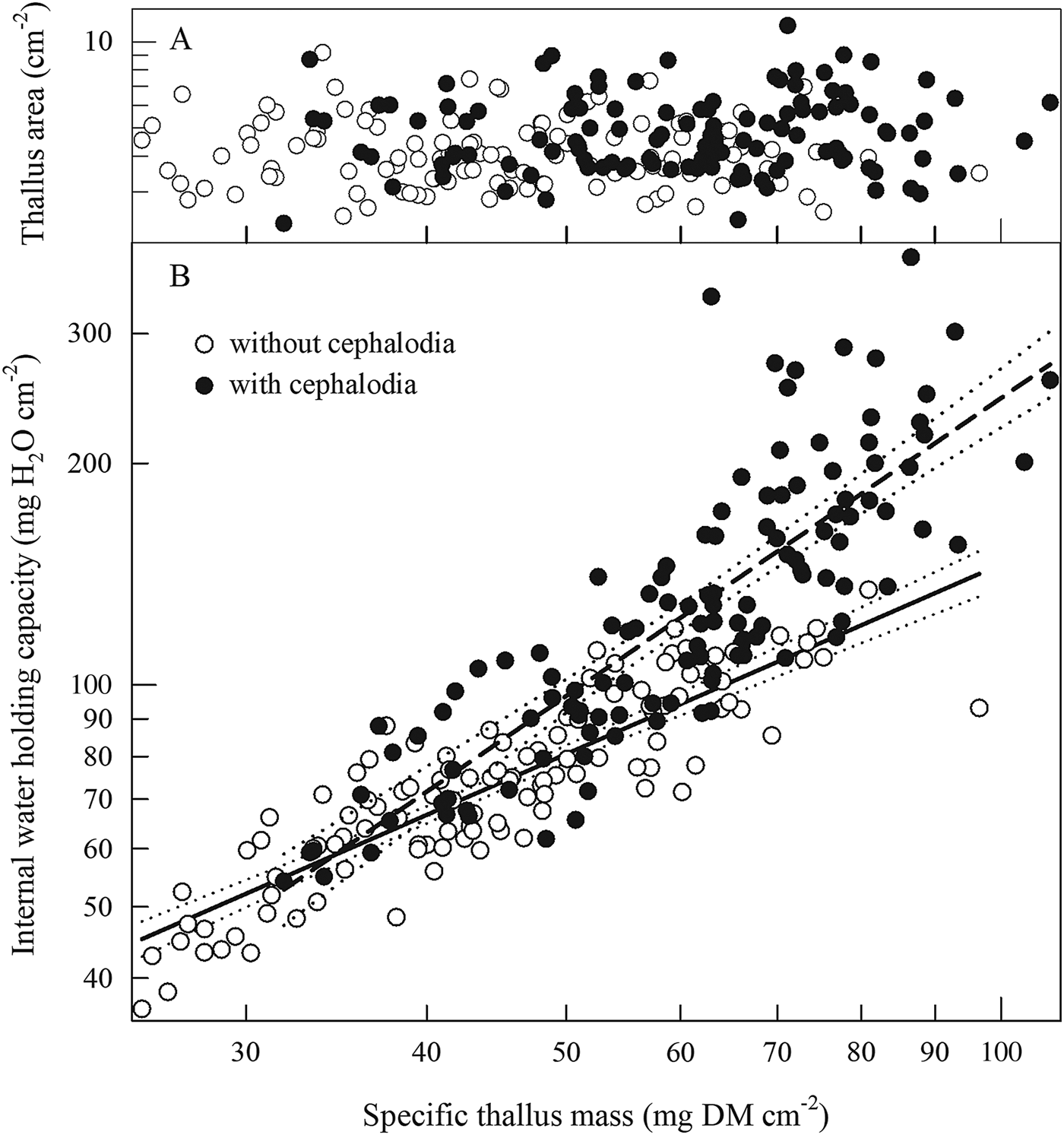
Sampled L. amplissima thalli with and without external cephalodia had broadly similar (Fig. 1A) yet slightly different surface areas (Table 1). The lack of significant regression between thallus area and STM in any of the two categories (Fig. 1A) shows that STM was not size-dependent for the limited range of sizes used in this study, facilitating comparisons between the two categories of thalli. The STM and WHCinternal were higher for the majority of thalli with external cephalodia than for those without (Table 1, Fig. 1B). WHCinternal was particularly great in thalli with higher STM. The mean STM was 1·3 times higher in thalli with external cephalodia than in those without; the mean WHCinternal was 1·8 times higher in cephalodiate thalli (Table 1). The WHCinternal/STM-ratio was 1·64 ± 0·014 (mean ± 1SE, n = 120) for the non-cephalodiate thalli versus 2·13 ± 0·014 for those with cephalodia. The slope for the respective regression lines in linear plots (not shown) was as high as 2·99 ± 0·24 for thalli with external cephalodia and just 1·31 ± 0·08 for thalli without. For individual thalli, there was more than a ten-fold total variation in WHCinternal from 35 (without external cephalodia) to 381 mg H2O cm−2 (with external cephalodia). Converted to mm of rain, this means that the non-cephalodiate thallus with the lowest STM could fill up its entire internal water storage with just 0·35 mm of rain or even dewfall. By contrast, at least 3·8 mm of rain would be needed to saturate the cephalodiate thallus with the highest WHCinternal, provided that all the rain hits the thallus.
A, thallus size of 240 prepared pieces of Lobaria amplissima thalli with (filled symbols) and without (open symbols) external cephalodia across specific thallus mass; B, dependency of internal water holding capacity (WHCinternal) on specific thallus mass for the L. amplissima thalli shown in Fig. 1A. The regression equations were log10 WHCinternal = 0·454 + 0·855 × log10 STM (r 2adj = 0·768; P < 0·001; solid line) for thalli without cephalodia and log10 WHCinternal = −0·297 + 1·343 × log10 STM (r 2adj = 0·697; P < 0·001; hatched line) for cephalodiate thalli. Dotted lines indicate 95% confidence intervals.

Thallus size, specific thallus mass (STM) and internal water holding capacity (WHCinternal) in Lobaria amplissima with and without external cephalodia. Median (25–75%) and mean values are provided (n = 120). Differences between the medians were analysed by the Kruskal-Wallis One-Way Analysis of Variance on Ranks.

Discussion
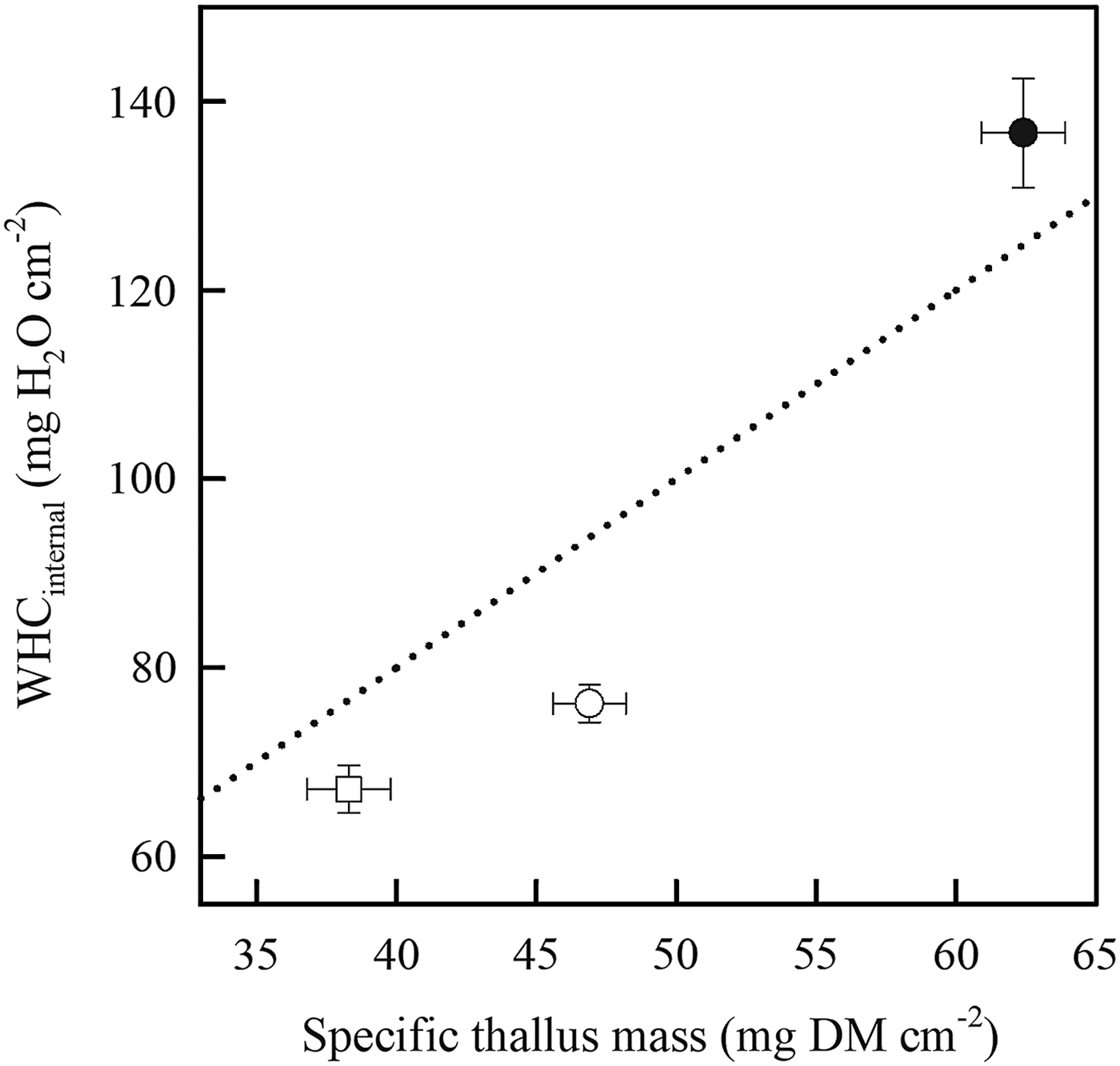
This study reports a functional significance of external cephalodia as hydration traits. Clear differences in water storage were found between thalli with and without external cephalodia, which might explain the respective western and eastern distributions of the two L. amplissima varieties described by Blom & Lindblom (Reference Blom and Lindblom2010). The WHCinternal, even in L. amplissima without external cephalodia (Fig. 1), is high compared to measured chloro- (Esseen et al. Reference Esseen, Olsson, Coxson and Gauslaa2015) and cephalolichens (Longinotti et al. Reference Longinotti, Solhaug and Gauslaa2017). It even lies above the 2:1 line (the slope of the regression line between STM and WHC) (Fig. 2) that characterizes cyanolichen members of the Lobariaceae (Gauslaa & Coxson Reference Gauslaa and Coxson2011), implying that every mg DM of an average L. amplissima with external cephalodia can store 2·2 mg water (Table 1). Lobaria amplissima holds small amounts of external water (Longinotti et al. Reference Longinotti, Solhaug and Gauslaa2017), therefore the WHCinternal accounts for most of its total water storage capacity. Our data do not allow an estimation of how much the cephalodia per se contribute to the WHCinternal. Such an estimation would require artificial removal of the cephalodia and recording of their water holding capacity. This could not be done because the thalli were used in a subsequent reintroduction experiment during which the external cephalodia in particular happened to be grazed by gastropods (Gauslaa et al. Reference Gauslaa, Johlander and Nordén2018). The high STM and WHCinternal in cephalodiate thalli could be explained in the following, not necessarily mutually exclusive, ways: 1) the STM, and WHCinternal in particular, is higher in the external cephalodia themselves because cyanolichens store more water than chlorolichens (Lange et al. Reference Lange, Green and Ziegler1988; Gauslaa & Coxson Reference Gauslaa and Coxson2011); 2) green algae-dominated lobes are thicker beneath cephalodia; 3) internal cephalodia might be more abundant in thalli with external cephalodia.
Specific thallus mass and internal water holding capacity (WHCinternal) in Lobaria amplissima from a wet oceanic site (>2000 mm rain; this study) with (filled circle) and without (open circle) external cephalodia, compared with another set of thalli (n = 109) with few or no external cephalodia sampled from drier sub-oceanic sites with an annual rainfall of 1000–1300 mm (open square; Longinotti et al. Reference Longinotti, Solhaug and Gauslaa2017). Means and standard errors are provided. The dotted line shows the 2:1 line (the slope of the regression line between STM and WHC) that characterizes cyanolichen members of the Lobariaceae (Gauslaa & Coxson Reference Gauslaa and Coxson2011).
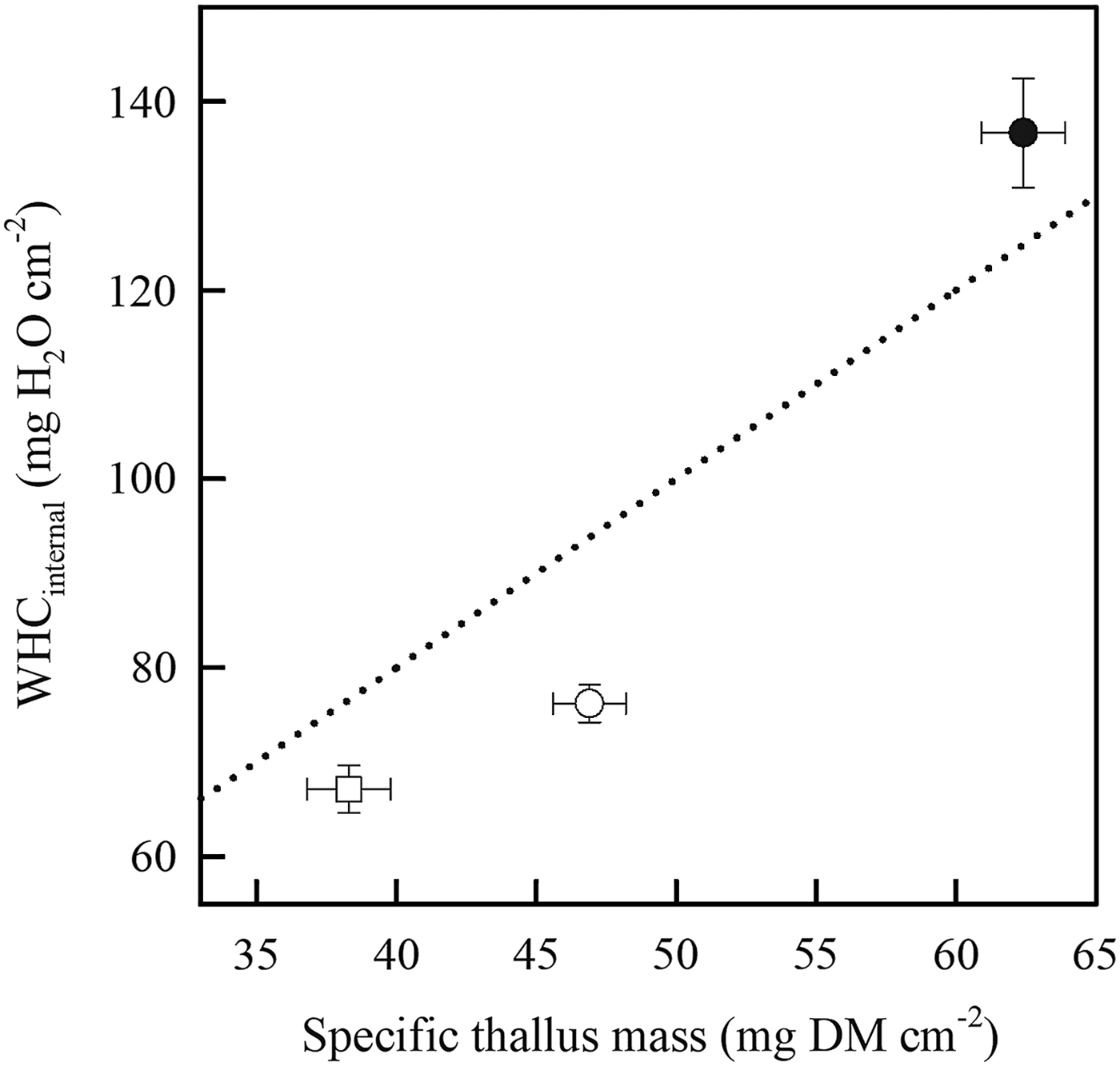
Regardless of the explanation, the much higher WHCinternal in thalli with external cephalodia than in those without has ecological implications. For comparison, Longinotti et al. (Reference Longinotti, Solhaug and Gauslaa2017) studying hydration traits in the eastern morph of L. amplissima with few or no external cephalodia (Blom & Lindblom Reference Blom and Lindblom2010) reported an average STM of 38 mg DM cm−2, which is lower than in our non-cephalodiate thalli belonging to the western morph in high rainfall areas (Fig. 2). Lobaria amplissima with an average STM of 40 mg DM cm−2 needed as much as 8·8 h to reach 95% of full PSII activation in air close to 100% relative humidity (Hovind Reference Hovind2018) but, during this vapour uptake period, these thalli reached a relative water content of just 18·9% of their full internal hydration storage capacity. Such a low water content will rapidly be depleted after sunrise. Under optimal but realistic humidity conditions for nocturnal vapour uptake in nature, the cephalodiate specimens with much higher STM and WHCinternal (Fig. 2) would have filled up much less of their relative water storage capacity. Therefore, they would presumably reach not only a lower level of PSII activation (Hovind Reference Hovind2018), but probably also lower levels of net photosynthesis (Lange et al. Reference Lange, Kilian and Ziegler1986). With respect to the wetting capability of dewfall, maximal dewfall rates seem to be <0·04 mm h–1 (Xiao et al. Reference Xiao, Meissner, Seeger, Rupp, Borg and Zhang2013) and a good, average nocturnal dewfall is just 0·2 mm (as reviewed by Gauslaa Reference Gauslaa2014), which would not be enough for L. amplissima. Therefore, L. amplissima with external cephalodia should have an advantage in a rainy climate with relatively frequent showers of >2 mm rainfall, consistent with their preference for rainforest climates (Ellis Reference Ellis2016). Only under such conditions can they fully benefit from their large WHCinternal, allowing long active periods after rain has ended.
In conclusion, cephalodia in cephalodiate lichens do not only have an important role in nitrogen fixation (Millbank & Kershaw Reference Millbank and Kershaw1969, Reference Millbank and Kershaw1970), but might also substantially influence functional hydration traits. An abundance of external cephalodia influences the duration of active hydration periods in rainy climates. Therefore, the trends observed in this study should imply a decreasing frequency of cephalodia from wet to drier climates, consistent with earlier reported data (Blom & Lindblom Reference Blom and Lindblom2010).