Introduction
Depression is a major contributor to healthcare costs associated with older populations, and is projected to be the leading cause of disease burden in older populations by the year 2020.Reference Goodwin1, Reference Katon, Lin, Russo and Unutzer2 The prevalence of depression in patients aged 65 and older may be as high as 40% in hospitalized and nursing home patients, and 8–15% in community settings.Reference Leon, Ashton, DMello and Dantz3 The prognosis of these depressive states is poor. A meta-analysis of outcomes at 24 months estimated that only 33% of subjects were well, 33% were depressed, and 21% had died.Reference Cole, Bellavance and Mansour4 Moreover, studies of depressed adults indicated that those with depressive symptoms, with or without depressive disorder, have poorer functioning that is comparable to or worse than that of people with chronic medical conditions such as heart and lung disease, arthritis, hypertension, and diabetes.Reference Gurland, Wilkder and Berkman5–Reference Wells and Burman7 In addition to poor functioning, depression increases the perception of poor health, the utilization of medical services, and healthcare costs.Reference Wells and Burman7–Reference Unutzer, Patrick and Simon9
Older age is commonly viewed as a risk factor for depression in the elderly, and this has been shown in many longitudinal and cross-sectional studies.Reference Harlow, Goldberg and Comstock10–Reference Sonnenberg, Beekman, Deeg and van Tilburg13 However, the converse conclusion was also reached by some studies.Reference Livingston, Watkin and Milne14, Reference Bruce, McAvay and Raue15 Moreover, a recent systematic review and meta-analysis showed that the odds ratio (OR) of being older as a function of increased depression was nonsignificant [OR = 1.2, 95% confidence intervals (95% CI) = 0.9–1.7].Reference Cole and Dendukuri16 However, this review included only two studies and could not conduct a definite conclusion. Therefore, the relationship between age and risk for depression among the old and the oldest old is still unclear in the literature.
Depression is a critically important issue for the elderly and those working with the elderly. As the population of the elderly and the very old increases, the number of depression cases affecting the elderly and very old individuals can be expected to rise.Reference Harpole, Williams and Olsen17 Therefore, for the prevention and treatment of depression in the elderly, it is important to investigate its risk factors. So we decided to conduct a meta-analysis in order to measure the magnitude and shape of the association between age and depression in the elderly and in the very elderly.
Methods
Search method
We have conducted a meta-analysis according to the earlier systematic review and the guidelines for reporting meta-analyses of observational studies.Reference Biessels, Staekenborg and Brunner18, Reference Stroup, Berlin and Morton19 This was one part of a best-evidence research project on depression in the elderly. In the research, we collected literature through searching MEDLINE (from the beginning of 1966), EMBASE (from the beginning of 1980), and the Cochrane Library (1990 to August 2007). The search terms (provided by the Cochrane Center) included “depression,” “elderly patients” (55 years and above), and “clinical trials.” Four researchers selected literature that involved clinical trials, depression (diagnostic criteria in a formal depression scale), and elderly patients (55 years and above). Any articles in the literature that were not clinical trials, were unrelated to depression, or did not include elderly patients were rejected. The literature selection was completed in three stages: (1) We reviewed the article titles to reject the inappropriate articles and keep those that would be potentially included; (2) we reviewed the abstracts of the articles that remained after the first stage, rejected the inappropriate articles and kept those that would be potentially included; and (3) we read the full text of the articles that remained after the second stage, rejected the inappropriate literature, and kept those articles that would be included. After this review, 6420 articles remained. These articles were classified into four subgroups according to the objective of the research program: (1) etiology- or epidemiology-related, (2) diagnostics-related, (3) therapeutics-related, and (4) prognosis-related. The search terms, search results, and classification of literature were reported previously.Reference Huang, Zhang and Dong20 As stated earlier, the selection and classification of the articles were performed by the four researchers, then each article was selected and classified by two researchers independently, and discrepancies were addressed by discussion. In this meta-analysis, we measured the magnitude and shape of the association age and depression in the elderly, so only etiology- or epidemiology-related articles might be potentially included. The inclusion and exclusion criteria are listed as follows.
Inclusion criteria
The following inclusion criteria were used for the articles used in the meta-analysis:
1. Cross-sectional and longitudinal studies where all participants were 55 years and over (the age at the end of the follow-up for longitudinal study)
2. Original research reported in English
3. Includes complete information on the prevalence or incidence of depression in different age groups
4. Use of an acceptable definition of depression
We accepted the diagnostic category of depression as applied by the authors of each study, which included the following: (1) the presence of depressive disorder, depressive symptoms, or “psychological distress,” as defined by scores above a cut point for abnormality on a standard mood scale; (2) severity of depressive disorder, depressive symptoms, or psychological distress, as defined by scores on a standard mood scale; and (3) the presence of major depression or minor depression (or dysthymia) according to Diagnostic and Statistical Manual of Mental Disorders (DSM)-IIIR, DSM-IV, or other standard psychiatric diagnostic criterion.
Exclusion criteria
Studies were excluded if they were limited to specific patient characteristics, such as convenience sampling; were based on retrospective recruitment; or if only an unstructured assessment of mood was used.
Data extraction and checking
For the longitudinal study, information about the country of study, group size at baseline and follow-up, age, proportion of men relative to women, depression criteria, exclusion criteria at baseline, length of follow-up, and number of incident cases of depression in each age group was abstracted from each report. For the cross-sectional study, information about the country of study, group size, age, proportion of men relative to women, depression criteria, exclusion criteria, and number of cases of depression in each age group was abstracted from each report. Every article included in the meta-analysis was read, and the data were extracted and cross-checked independently by two authors; discrepancies were addressed with discussion.
Statistical analysis
Data were entered into the RevMan 4.2 meta-analysis program (Cochrane Collaboration, Oxford, UK; see http://ims.cochrane.org/revman). The meta-analysis of the cross-sectional studies had the advantages of huge sample size and the ability to easily show the association between age and prevalence of depression, and the meta-analysis of the longitudinal studies had the advantage of easily conducting a causality conclusion. We conducted the meta-analysess of the cross-sectional studies and that of the longitudinal studies separately. In the meta-analysis of the cross-sectional studies, for prevalence rates of depression, odds risk (OR) and 95% confidence intervals (95% CIs) were calculated. Results were summarized using conventional Forest plots and ORs, which were stratified by features of the studies included. In the meta-analysis of longitudinal studies, for incidence rates of depression, relative risk (RRs) and 95% CIs were calculated. Results were summarized using conventional Forest plots and RRs, which were stratified by features of the studies included. Summary ORs and RRs were estimated using a random effects model.
Results
The search
Our search found 1027 potential etiology- or epidemiology-related articles. Of these, 896 articles were rejected as obviously unsuitable studies (unrelated to health status), which left 131 articles. Of these 131 articles, 92 were rejected for a variety of reasons, including lack of usable data or lack of a recognized instrument used for diagnosis. Thirty-nine studies remained and were included in the review.Reference Sonnenberg, Beekman, Deeg and van Tilburg13–Reference Bruce, McAvay and Raue15, Reference Al-Shammari and Al-Subaie21–Reference Turvey, Carney and Arndt56
Included studies
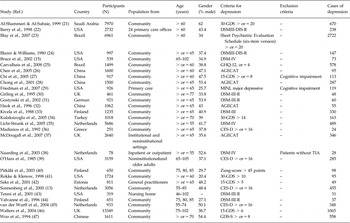
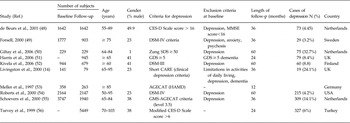
The characteristics of the 39 studies (including 10 longitudinalReference Livingston, Watkin and Milne14, Reference de Beurs, Beekman and Geerlings48–Reference Turvey, Carney and Arndt56 and 29 cross-sectionalReference Sonnenberg, Beekman, Deeg and van Tilburg13, Reference Bruce, McAvay and Raue15, Reference Al-Shammari and Al-Subaie21–Reference Woo, Ho and Lau47 studies available for meta-analysis) are summarized in Tables 1 and 2.
Characteristics of the 29 cross-sectional studies included in the meta-analysis

CES-D Scale: Center for Epidemiologic Studies Depression Scale; DSM: Diagnostic and Statistical Manual of Mental Disorders; GMS-AGECAT: Geriatric Mental State Schedule Automated Geriatric Examination for Computer Assisted Taxonomy; Short CARE: Shortened Comprehensive Assessment and Referral Evaluation; GDS-15: Geriatric Depression Scale; SADS: Schedule for Affective Disorders and Schizophrenia; CIDI: Composite International Diagnostic Interview; MINI: Mini International Neuropsychiatric Interview; MMSE: Mini-Mental State Examination.
Characteristics of the 10 prospective longitudinal studies included in the meta-analysis

CES-D Scale: Center for Epidemiologic Studies Depression Scale; DSM: Diagnostic and Statistical Manual of Mental Disorders; GMS-AGECAT: Geriatric Mental State Schedule Automated Geriatric Examination for Computer Assisted Taxonomy; Short CARE: Shortened Comprehensive Assessment and Referral Evaluation; GDS-15: Geriatric Depression Scale; SADS: Schedule for Affective Disorders and Schizophrenia; MMSE: Mini-Mental State Examination.
Data synthesis
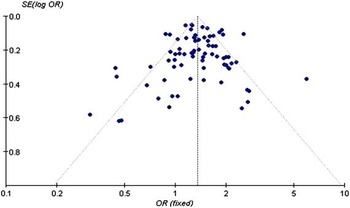
We assessed this bias using a funnel plot (shown in Figure 1). The funnel plot of ORs (under a fixed-effects model) was taken from the 39 studies in Tables 1 and 2. In the absence of publication bias, the points should be symmetrical around the vertical line at the pooled ORs. The reasonably symmetrical plot suggests the absence of a publication bias.
Funnel plot of the 39 studies included in the meta-analysis.

Comparison of risk of depression between individuals aged 55–64 years and those aged 65 years and over
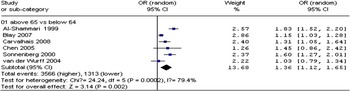
Six of the studies that were included compared the prevalence of depression between individuals aged 55–64 years and those aged 65 years and over.Reference Sonnenberg, Beekman, Deeg and van Tilburg13, Reference Al-Shammari and Al-Subaie21, Reference Blay, Andreoli, Fillenbaum and Gastal23, Reference Carvalhais, Lima-Costa and Peixoto25, Reference Chen, Li and Zhi26, Reference van der Wurff, Beekman and Dijkshoorn45 In the six studies, a total of 7004 individuals aged 55–65 years and 15017 aged 65 years and over were studied. There were 1313 and 3566 cases of depression in the groups aged 55–64 years and aged 65 years and over, respectively. After pooling these six studies, individuals aged 65 years had a higher prevalence of depression than those aged 55–64 years, OR: 1.36, 95% CI: 1.12–1.65 (Figure 2).
Comparison of risk of depression between individuals aged 65 years or over and those aged 55–64 years.

Comparison of risk of depression between individuals aged 55–69 years and those aged 70 years and over
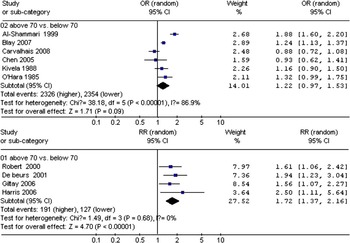
Six studies compared the prevalence of depression between individuals aged 55–69 years and aged 70 years and over.Reference Al-Shammari and Al-Subaie21, Reference Blay, Andreoli, Fillenbaum and Gastal23, Reference Carvalhais, Lima-Costa and Peixoto25, Reference Chen, Li and Zhi26, Reference Kivela, Pahkala and Laippala33, Reference O'Hara, Kohout and Wallace39 In the six studies, there were 10,650 individuals aged 55–69 years and 11,875 individuals aged 70 years and over. There were 2326 and 2354 cases of depression in the groups aged 55–69 years and aged 70 years and over, respectively. After pooling these six studies the higher prevalence of depression among those aged above 70 years was borderline statistically significant, OR: 1.22, 95% CI: 0.97–1.53. Four studies compared the incidence of depression between groups aged 55–69 years and those aged 70 years or over.Reference de Beurs, Beekman and Geerlings48, Reference Giltay, Zitman and Kromhout50, Reference Harris, Cook and Victor51, Reference Roberts, Shema, Kaplan and Strawbridge54 After pooling these studies, the higher incidence of depression among those aged above 70 years was statistically significant, RR: 1.72, 95% CI: 1.37–2.16; RR: 1.43. (Figure 3).
Comparison of risk of depression between individuals aged 70 years or over and those aged 55–69 years.

Comparison of risk of depression between individuals aged 55–74 years and those aged 75 years and over
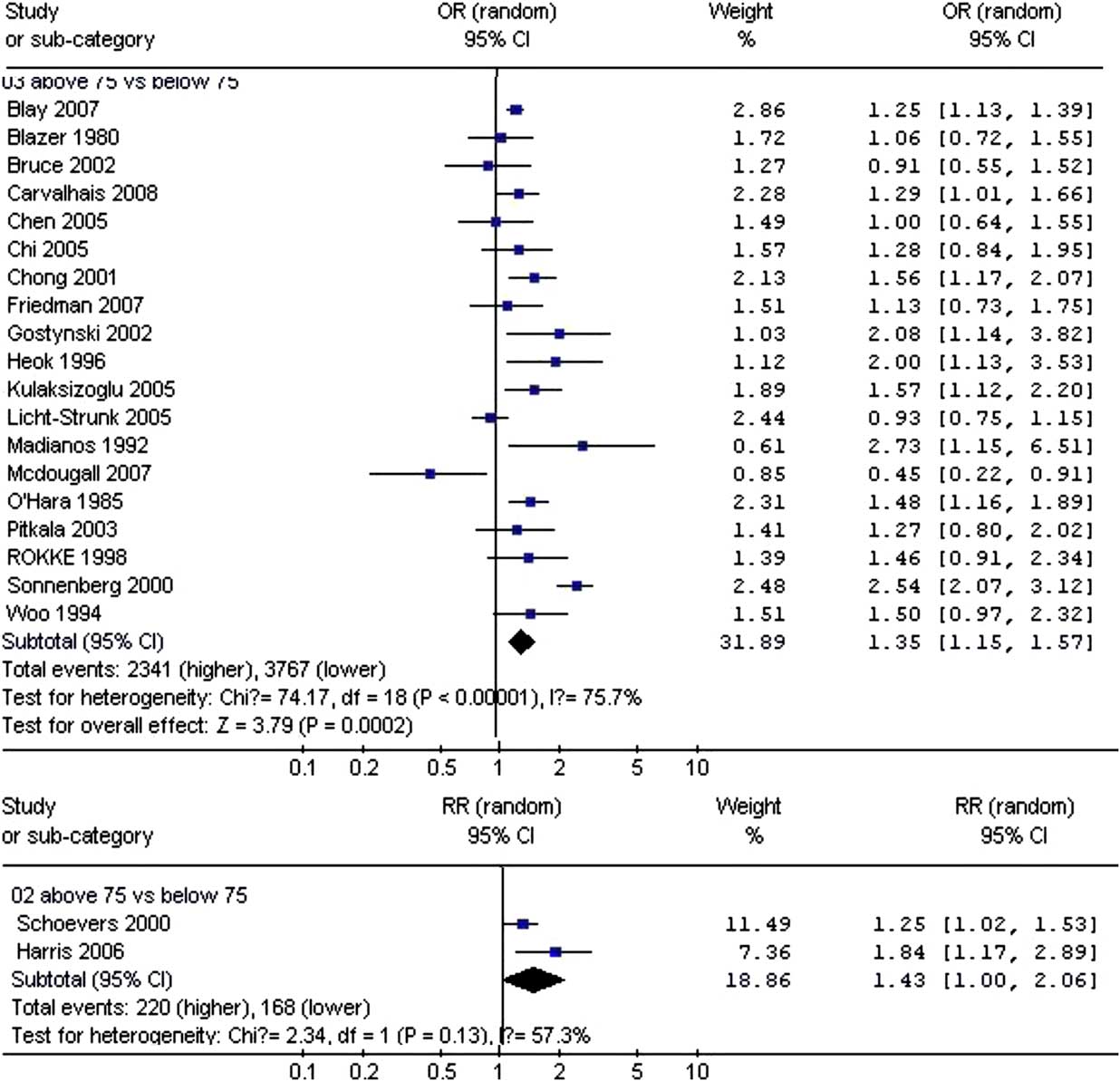
Nineteen studies compared the prevalence of depression between individuals aged 55–74 years and those aged 75 years or over.Reference Sonnenberg, Beekman, Deeg and van Tilburg13, Reference Bruce, McAvay and Raue15, Reference Blay, Andreoli, Fillenbaum and Gastal23–Reference Friedman, Conwell and Delavan29, Reference Gostynski, Ajdacic-Gross and Gutzwiller31, Reference Heok, Meng, Calvin and Li32, Reference Kulaksizoglu, Gurvit and Polat34–Reference McDougall, Matthews and Kvaal37, Reference O'Hara, Kohout and Wallace39–Reference Rokke and Klenow41, Reference Woo, Ho and Lau47 In the 19 studies, there were 20,534 subjects aged 55–74 years and 11,219 aged 75 years and over. There were 3767 and 2341 cases of depression in the groups aged 55–74 years and aged 75 years and over, respectively. After pooling these 19 studies, subjects aged 75 years had a higher prevalence of depression than those aged 55–74 years, OR: 1.35, 95% CI: 1.15–1.57. Two studies compared the incidence of depression between groups aged 55–74 years and aged 75 years or over. After pooling these studies, older age groups had a significantly higher incidence of depression than younger age groups, RR: 1.43, 95% CI: 1.00–2.06(Reference Harris, Cook and Victor51, Reference Schoevers, Beekman and Deeg55) (Figure 4).
Comparison of risk of depression between individuals aged 75 years or over and those aged 55–74 years.
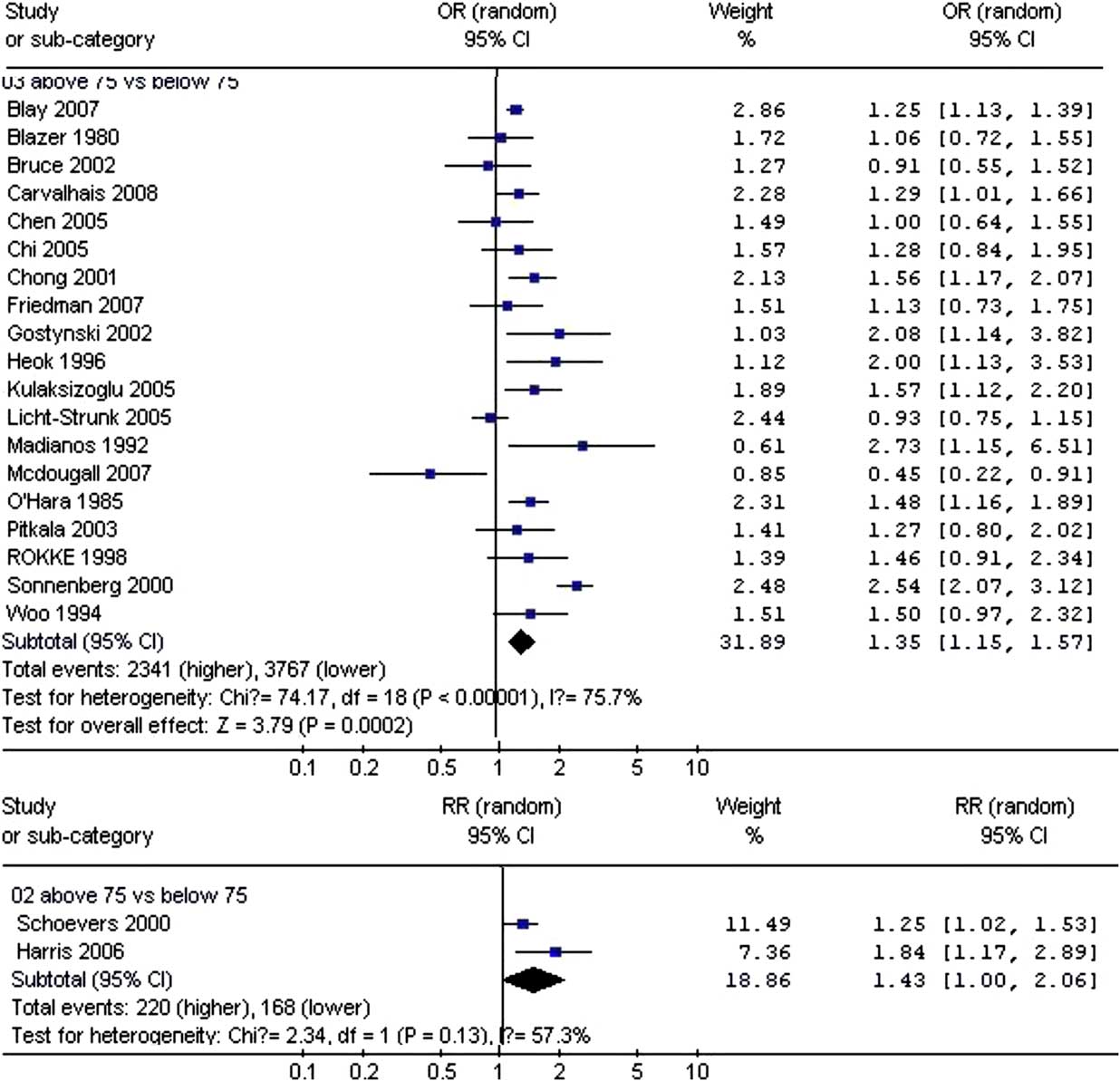
Comparison of risk of depression between individuals aged 55–79 years and those aged 80 years and over
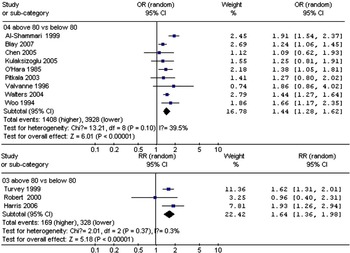
Nine studies compared the prevalence of depression between individuals aged 55–79 years and aged 80 years or over.Reference Al-Shammari and Al-Subaie21, Reference Blay, Andreoli, Fillenbaum and Gastal23, Reference Chen, Li and Zhi26, Reference Kulaksizoglu, Gurvit and Polat34, Reference O'Hara, Kohout and Wallace39, Reference Pitkälä, Kähönen-Väre and Valvanne40, Reference Valvanne, Juva, Erkinjuntti and Tilvis44, Reference Walters, Breeze and Wilkinson46, Reference Woo, Ho and Lau47 In the nine studies, there were 25,088 subjects aged 55–79 years and 10598 aged 80 years and over. There were 3928 and 1408 cases of depression in the groups aged 55–79 years and aged 80 years or over, respectively. After pooling these nine studies, subjects aged 80 years and over had a higher prevalence of depression than those aged 55–79 years, OR: 1.44, 95% CI: 1.28–1.62. Three studies compared the incidence of depression between groups aged 55–79 years and aged 80 years and over. After pooling these studies, older age groups had significantly higher incidence of depression than younger age groups, RR: 1.64, 95% CI: 1.36–1.98Reference Harris, Cook and Victor51, Reference Roberts, Shema, Kaplan and Strawbridge54, Reference Turvey, Carney and Arndt56 (Figure 5).
Comparison of risk of depression between individuals aged 80 years or over and those aged 55–79 years.

Comparison of risk of depression between individuals aged 55–84 years and those aged 85 years and over
Twelve of the studies included compared the prevalence of depression between individuals aged 55–84 years and those aged 85 years and over.Reference Bruce, McAvay and Raue15, Reference Chong, Tsang and Chen28–Reference Gostynski, Ajdacic-Gross and Gutzwiller31, Reference Kulaksizoglu, Gurvit and Polat34, Reference McDougall, Matthews and Kvaal37, Reference O'Hara, Kohout and Wallace39, Reference Saks, Kolk and Allev42, Reference Valvanne, Juva, Erkinjuntti and Tilvis44, Reference Walters, Breeze and Wilkinson46, Reference Woo, Ho and Lau47 In the 12 studies, there were 19,039 subjects aged 55–84 years and 4559 aged 85 years and over. There were 2072 and 658 cases of depression in the groups aged 55–84 years and 85 years and over, respectively. After pooling these 12 studies, subjects aged above 85 years had a higher prevalence of depression than those aged 55–84 years, OR: 1.52, 95% CI: 1.20–1.92. Two studies compared the incidence of depression between groups aged 55–84 years and aged 85 years and over. After pooling these studies, older age groups had a significantly higher incidence of depression than younger age groups, RR: 0.79, 95% CI: 0.23–2.77Reference Livingston, Watkin and Milne14, Reference Forsell49 (Figure 6).
Comparison of risk of depression between individuals aged 85 years or over and those aged 55–84 years.

Comparison of risk of depression between individuals aged 55–89 years and those ages 90 years and over, and between individuals aged aged 80–89 years and those aged 90 years and over
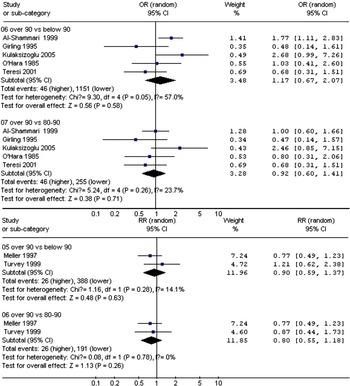
Five studies compared the prevalence of depression between individuals aged 55–89 years and those aged 90 years and over.Reference Al-Shammari and Al-Subaie21, Reference Girling, Barkley and Paykel30, Reference Kulaksizoglu, Gurvit and Polat34, Reference O'Hara, Kohout and Wallace39, Reference Teresi, Abrams and Holmes43 In the five studies, there were 12,439 subjects aged 55–89 years and 360 aged 90 years or over. There were 1151 and 46 cases of depression in the groups aged 55–89 years and aged 90 years or over, respectively. After pooling these studies, the difference in the prevalence of depression between the populations above and below 90 years old was not statistically significant, OR: 1.17, 95% CI: 0.67–2.07. These studies also provided the prevalence of depression in subjects aged 80–89 years old and 90 years and above. After pooling these studies, the difference in the prevalence of depression between the two age groups was not statistically significant, OR: 0.92, 95% CI: 0.60–1.41. Two studies compared the incidence of depression between groups aged 55–89 years and those aged 90 years or over, and between groups aged 80–89 years and aged 90 years or over. After pooling these studies, there were no statistically significant differences in the incidence of depression among these age groups, RR: 0.90, 95% CI: 0.59–1.37 and RR: 0.80, 95% CI: 0.55–1.18 for groups aged above 90 years old vs. below and above 90 years old vs. aged 80–89 years old, respectivelyReference Meller, Fichter and Schröppel53, Reference Turvey, Carney and Arndt56 (Figure 7).
Comparison of risk of depression between individuals aged 90 years or over and those aged 55–89 years, and between individuals aged 90 or over and those aged 80–89 years.

Discussion
We conducted the meta-analyses of the cross-sectional studies and the prospective longitudinal studies, respectively. The results are clear: Older age is a risk factor for depression in the general elderly population, but is not in the oldest population (over 90 years old). This is a robust finding concerning the relationship between age and risk for depression among the elderly and the oldest population.
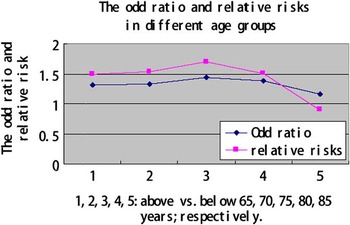
There were some interesting findings in the present the meta-analysis. First, the meta-analysis showed the magnitude and shape of the association age and depression in the elderly as an “S” shape (see Figure 8). In the elderly population aged below 85 years the risk of depression increased along with the increase of age, but in the population aged above 85 years, the relationship between age and risk of depression was not significant. Being older is a risk factor for late life depression, and this may be explained by more disability, worse social support, worse health status, more new medical illness, more unmarried status, and lower cognitive function in the older age population, as all of these are commonly viewed as risk factors for depression. It follows that older individuals should be screened for depression since their risk is higher. Subsequently, these individuals could be targeted for interventions to abate the potentially modifiable risk factors, such as disability, social support, health status, and cognitive function.
Odds risks and relative risks of depression and age.

Secondly, between the general elderly and the oldest populations, there was a discrepancy in the relationship between age and risk for depression. As was shown, the relationship between age and risk of depression was not significant in the oldest population, and the reason for this is unclear. We know that the prognosis of late-life depression is poor, and there is a high mortality rate in the depressed population. Mortality in the oldest population might tend to remove those with depression and leave those without depression. Therefore, it is reasonable to infer that mortality in the oldest population might weaken the association of age with risk for depression. This should be further confirmed.
However, the meta-analysis of prospective longitudinal studies also showed that the incidence of depression was related to age in the general elderly, but not in the oldest population, so for the relationship between age and risk for depression, mortality could not completely interprete the discrepancy between the elderly and the oldest population. However, in the oldest population, the level of risk of depression was higher than that in the general population. The prevalence and incidence rates were still very high and might be extreme in certain populations. But this was only a hypothesis, and needs to be confirmed. Meanwhile, for the oldest population, there were no special diagnostic tools for depression, and diagnostic tools for depression, generally used in clinical studies, might not be available for this age group. Therefore, in the oldest population, the relationship between age and risk of depression needs to be further investigated.
Although we attempted to adhere to the guidelines for reporting meta-analyses of observational studies, this review does have four limitations.Reference Stroup, Berlin and Morton19 First, we did not hand search journals and made no attempt to identify unpublished studies, raising the possibility that some studies have been missed. Second, despite our extensive literature search, we only included MEDLINE, EMBASE, and the Cochrane Library in our search; other databases such as CINAHL and PsycINFO were not included. Moreover, we screened the articles by reading abstracts, rather than the full texts, which was also a limitation. Third, the search was limited to articles published in English. Finally, there was heterogeneity in the results, perhaps related to different definitions of depression in different studies and small study groups in some studies. Therefore, a random-effects model, which is less precise than a fixed-effects model, was used in the review. Consequently, the results of the meta-analysis for these risk factors must be interpreted cautiously.
Conclusion
After an extensive literature search on the risk of depression in older adults, we conducted both cross-sectional and longitudinal meta-analyses of the articles we found that were related to our topic and met the criteria for inclusion. We found that though being elderly is a risk factor for depression in the general elderly population (55–89 years old), the risk was not statistically significant in the oldest population (90 years old and older). Further research is needed to determine the cause of this discrepancy.