Introduction
Over the past two decades many OECD countries, Israel included, have adopted welfare policies aimed at reducing dependency and increasing self-sufficiency. Related to these changes, employment and earnings rose substantially while welfare use declined in many countries (e.g. Acs and Loprest, Reference Acs and Loprest2007; Blank, Reference Blank, Auerbach, Card and Quigley2006; Cancian et al., Reference Cancian, Haveman, Meyer and Wolfe2003; Finn and Gloster, Reference Finn and Gloster2010; Shannon, Reference Shannon2009). However, many welfare recipients and leavers experience multiple spells of unemployment, have low earnings, circulate in and out of the welfare system or become disconnected from both work and welfare (e.g. Achdut and Stier, Reference Achdut and Stier2016; Acs and Loprest, Reference Acs and Loprest2007; Blank and Kovak, Reference Blank, Kovak, Heinrich and Scholz2009; Loprest and Nichols, Reference Loprest and Nichols2011).
The unstable nature of employment experienced by current and former welfare recipients draws attention to welfare-use intensity and its factors. Vulnerable groups, especially the poor, depend much more on market conditions than other workers. They are often less attractive to employers because they lack high-demand skills, or, as is the case with single mothers, bear heavy family burdens. Studies have demonstrated the reliance of welfare recipients and low skilled workers on the business cycle and their high vulnerability in times of economic recession (Hofferth et al., Reference Hofferth, Stanhope and Harris2005; Lerman, Reference Lerman2005; Moffitt, Reference Moffitt2008). Likewise, poor families depend more heavily on the availability of subsidised arrangements for young children since they cannot afford private arrangements. In the absence of these arrangements, mothers of young children have almost no choice about whether to work. Moreover, localities of residence differ in employment opportunities, generosity of wage offers and availability of affordable child-care. Hence, they affect how far single mothers can stably replace welfare with work income. Prior studies on this issue provide only limited and inconsistent information. Most were conducted before policy changes were made (e.g. Barrett, Reference Barrett2000; Fitzgerald, Reference Fitzgerald1995; Fitzgerald and Ribar, Reference Fitzgerald and Ribar2004; Hoynes, Reference Hoynes2000) while more recent research is based mainly on national US data of state-level labour market indicators which are too heterogeneous to capture local conditions (e.g. Grogger, Reference Grogger2004; Looney, Reference Looney2005; for review see Herbst and Stevens, Reference Herbst and Stevens2010) rather than local labour market conditions (see also Hoynes, Reference Hoynes2000).
Using national administrative data from Israel, the current study follows a cohort of single mothers who received Income Support Benefit in 2003 (46,000) and tracks their welfare dependency for 51 months. Our goal was to identify welfare-use trajectories based on cumulative usage, which reflects overall intensity of welfare use, and to identify chronic welfare dependence. We further examine the role of local area conditions measured by labour market characteristics and availability of subsidised child-care, beyond personal characteristics, in explaining these trajectories.
This study makes three contributions. First, by merging national administrative data with detailed geographic information, and taking a multilevel approach, it provides improved estimates of the effects of structural factors on welfare-use trajectories. Second, it expands on previous research by including a measure of local child-care availability among other local area conditions. Third, while no attempt is made to evaluate the effect of the policy change on welfare-use trajectories, the study provides a unique account of welfare usage in a policy context that differs from other countries (mainly the US, but not only), by not imposing a time-limit on benefit receipt; the absence of minimum working hours requirements, and its context, is uniform across the country. These unique features enable us to detect more accurately the effect of various local area factors on welfare use.
Theoretical and empirical background
According to the traditional economic model that derives from labour supply theory, women make decisions about whether to participate in paid work based on the costs and benefits of entering the labour market. For welfare recipients, the model assumes that individuals maximise utility by making choices about labour supply and welfare participation subject to a budget constraint that takes into account wage opportunities and welfare benefits. Welfare participation is chosen when being on welfare proves more beneficial than relying on work.
An extensive body of literature has documented the dynamic of welfare use in different Western countries, among them Canada (Barrett, Reference Barrett2000); US (Blank, Reference Blank1989; Fitzgerald, Reference Fitzgerald1995; Fitzgerald and Ribar, Reference Fitzgerald and Ribar2004; Harris, Reference Harris1993, Reference Harris1996; Hofferth et al., Reference Hofferth, Stanhope and Harris2005; Hoynes, Reference Hoynes2000; Salomon et al., Reference Salomon, Bassuk and Brooks1996); Sweden (Andrén and Gustafsson, Reference Andrén and Gustafsson2004; Bergmark and Bäckman, Reference Bergmark and Bäckman2004; Bäckman and Bergmark, Reference Bäckman and Bergmark2011); and Norway (Dahl and Lorentzen, Reference Dahl and Lorentzen2003). These studies indicated that most welfare spells were relatively short, but there was a high incidence of recidivism. Given these findings, it is important to examine welfare accumulation, and not only welfare dynamics, as the former captures more adequately the intensity of welfare use (see also discussion in Bergmark and Bäckman, Reference Bergmark and Bäckman2004). A six-year study on the duration of social assistance receipt in Canada found that 30 per cent of the single mothers received benefits for up to a year, while almost a third did so for four to six years (Cooke, Reference Cooke2009). Nam’s study (Reference Nam2005) on welfare exits and re-entries among welfare recipients in Michigan indicated that only 13 per cent received welfare continuously, but a large proportion of the sample (43 per cent) left and returned to welfare at least once after their initial exit. Based on the same sample, Seefeldt and Orzol (Reference Seefeldt and Orzol2005) examined welfare accumulation in a 60-month study and found that, on average, respondents accumulated 27.8 months on welfare; almost a quarter accumulated 40 months or more, with some 20 per cent of them receiving welfare continuously throughout the study period. Wood et al. (Reference Wood, Moore and Rangarajan2008) indicated that, among New Jersey welfare recipients, almost all sample members (97 per cent) exited TANF at some point during their five-year follow-up; however, 41 per cent returned to welfare.
Local labour market conditions affect these choices in two ways: lower unemployment rates increase the likelihood of obtaining work, and higher area wage rates increase the potential return to work of those on welfare (Hoynes, Reference Hoynes2000). That is, poor local economic conditions, in employment opportunities and generosity of wage offers, are expected to increase both the duration of welfare spells and recidivism rates, thereby increasing the welfare-use intensity. Other types of local factors may help women remain off welfare by supporting work, among them higher availability of subsidised child care. On the one hand, subsidised care services reduce the costs associated with employment and increase the family’s disposable income and, on the other hand, they allow mothers to increase their working hours. Moreover, subsidised child-care is a stable and affordable arrangement for young children, which presumably can help the mother to stay employed. Hence these facilities are expected to enhance sustainable welfare exit, and thereby to decrease welfare-use accumulation over time.
The literature on the effects of economic conditions on welfare utilisation can be sorted in many ways but, for our purposes, it is useful to focus on studies that used county-level (or province) measures of labour market opportunities rather than state-level measures (e.g. Grogger, Reference Grogger2004; Hofferth et al., Reference Hofferth, Stanhope and Harris2005; Looney, Reference Looney2005), as in this study.
Earlier studies in the US and Canada show the importance of local demand-side factors for welfare exit, the duration of welfare spells and recidivism rates (e.g. Barrett, Reference Barrett2000; Fitzgerald, Reference Fitzgerald1995; Fitzgerald and Ribar, Reference Fitzgerald and Ribar2004; Harris, Reference Harris1993; Hoynes, Reference Hoynes2000; Ribar, Reference Ribar2005). For example, Hoynes (Reference Hoynes2000) found that increase in county employment opportunities and increase in returns to work were expected to lead to higher exit rates and lower re-entry rates. Fitzgerald and Ribar (Reference Fitzgerald and Ribar2004) found that better economic opportunities in the respondent’s county of residence significantly reduced the chances of entering welfare and increased the likelihood of welfare exits. However, other studies found no effects of local labour market conditions on the length of welfare spells (Blank, Reference Blank1989) or on the probability of returning to welfare following an exit (Harris, Reference Harris1996).
In recent studies, and following policy changes, Cooke (Reference Cooke2009) found that among single mothers in Canada a higher regional unemployment rate was associated with longer durations of social assistance receipt, while a higher minimum wage tended to reduce the length of the first observed spell. Herbst and Stevens (Reference Herbst and Stevens2010) examined the four welfare-employment combinations (no work, no welfare; no work, welfare; work, welfare; work, no welfare) and found that lower county unemployment rates and higher rates of new hires and new hires’ earnings increased the likelihood that a woman would choose alternatives that include work. However, Mueser et al. (Reference Mueser, Stevens and Troske2007), who examined the effect of the county unemployment rate on recidivism among welfare recipients in Maryland and Missouri, found mixed results. In Missouri, cross-county differences in unemployment rates had a small statistically significant effect on the likelihood of returning to welfare, while in Maryland no effect was found. Additionally, the few ‘exit’ studies that included a measure of the local unemployment rate indicated no effect of this measure on welfare exit (Wood et al., Reference Wood, Moore and Rangarajan2008), on the likelihood of leaving long-term recipiency and recidivism (Bergmark and Bäckman, Reference Bergmark and Bäckman2004), or on welfare exit-route (Nam, Reference Nam2005), but a significant effect on the probability of sustaining long-term welfare-exit (Wood et al., Reference Wood, Moore and Rangarajan2008). None of these studies examined the role of local labour market opportunities and the availability of subsidised child-care in explaining welfare accumulation. Furthermore, these mixed findings highlight the need for further investigation and the importance of using national data combined with detailed geographical identification of localities to estimate welfare usage. The present study aims to accomplish this as it expands our limited and mixed knowledge of the association between local structural factors and welfare accumulation in a uniform policy context.
Regarding individual characteristics, the benefits from work are greater for women with more investments in human capital (Becker, Reference Becker1975; Mincer and Polachek, Reference Mincer and Polachek1974) as they have better chances of finding good employment and their expected income from work exceeds the expected income from welfare. Thus, women with low levels of human capital are at higher risk of long-term welfare dependency. Moreover, based on previous knowledge referring to the importance of ‘health capital’ for labour supply (see Currie and Madrian, Reference Currie, Madrian, Ashenfeletr and Card1999; Hill and Wolfe, Reference Hill and Wolfe1995) and to the high prevalence of health problems among welfare recipients (e.g. Kaplan et al., Reference Kaplan, Siefert, Ranjit, Raghuathan, Young, Tran, Danziger, Hudson, Lynch and Tolman2005; Loprest and Maag, Reference Loprest and Maag2009), one of the main determinants of welfare-use duration is health condition (e.g. Achdut, Reference Achdut2016; Heflin, Reference Heflin2003; Seefeldt and Orzol, Reference Seefeldt and Orzol2005).
The choices women make about how to provide for their families are also influenced by how various life circumstances affect these costs and benefits. Women with more children and very young children have the highest child-care costs and the highest benefits from public assistance, and are, therefore, the least likely to remain off welfare (e.g. Achdut, Reference Achdut2016; Harris, Reference Harris1993, Reference Harris1996; Hofferth et al., Reference Hofferth, Stanhope and Harris2005; Juon et al., Reference Juon, Green, Fothergill, Kasper, Thorpe and Ensminger2009; Nam, Reference Nam2005; Wood et al., Reference Wood, Moore and Rangarajan2008).
This static model can then be extended to incorporate the dynamics of changing life circumstances by assuming that costs and benefits associated with different decisions can vary over time (e.g. single mothers getting married; bearing more children; their children leaving home). Similarly, employment opportunities can change as a result of economic growth or downturns, so women may re-evaluate their options accordingly and choose different options at different points in time.
The Israeli context: welfare and child-care policy
The Income Support Programme (ISP) administered by the National Insurance Institute (NII) in Israel is a selective programme aimed at guaranteeing minimum income for families with limited means. The level of Income Support Benefit (ISB) for single mothers depends on the number of dependent children, and the amount of benefits paid to the family is determined by an income test. In addition, eligibility for ISB in Israel is contingent on a work test. Welfare recipients are required to report regularly to the local employment service and to accept any job offered to them. Work-test exemption is given to certain groups of recipients, among them mothers of young children and recipients defined as ‘unplaceable’ (temporarily or permanently) due to their own or their children’s health limitations.
In 2003 public assistance programmes were restructured in Israel in order to increase employment and decrease welfare dependence: ISB and the disregarded income level were reduced; the previous exemption from the work test for mothers of preschool-age children (younger than seven years) was limited to mothers of children younger than two years (The National Insurance Institute, 2002–2003). However, this new policy does not set specific working-hour requirements; sanctions are imposed only on those refusing to work at all, so in practice recipients can work very little and still receive supplemental ISBs, which are extremely low.
At the time of the study (2003–2007), public education was available in Israel to children aged four to eighteen. While private child-care was available for younger children, a few public and non-profit organisations provided supervised subsidised child-care arrangements for working mothers based on a work-income test and with priority to single mothers. This semi-public child-care system is not fully subsidised, and the availability is limited as demand is much greater than supply.
In sum, Israeli policy differs from that of many other countries in two respects: first, it is a uniform nationwide policy with no local welfare-to-work initiatives or local discretion in designing cash assistance and other work-related programmes as in other countries (e.g. Bentele and Nicoli, Reference Bentele and Nicoli2012; Bergmark and Bäckman, Reference Bergmark and Bäckman2004). This universal policy also helps to measure the effect of local characteristics more accurately, as there is no possible interaction between different policy components and local conditions. Secondly, and importantly, the Israeli legislation did not establish working-hour requirements: employment exemptions are given to mothers with very young children (younger than two years) and there is no time limit for benefit receipt. This policy makes combining work and welfare for long periods quite common. Furthermore, at the time of this study, no active measures were taken to increase the disposable income of those employed, such as tax credits or expanding child-care subsidies. Against this unique policy background, the current study examines the role of local structural factors in explaining long-term welfare-use accumulation.
Method
Research population and data sources
The research population was all single mothers who received ISB in 2003, just before the policy changes. Two sources of administrative data were obtained from the NII: the income support file and the salary file, both for 2000–2007. The former contained socio-demographic information on recipients, place of residence, obligatory work test, and history of welfare dependence. The last file provided information on annual earnings and monthly employment status. Two additional data sources were used: the first, obtained from the Central Bureau of Statistics, contained local labour market indicators for about 216 localities in Israel. Among these indicators were the rate of jobseekers out of the working-age population at a given locality (this indicator reflects the rate of jobseekers as reported by the local employment service and is used as an alternative indicator of the regional unemployment rate); rate of employees who earned up to the monthly minimum wage; and average wage for salaried women. The second obtained from the Ministry of Industry, Trade and Labor, contained localities’ information on the rate of children up to age 3.5 years in subsidised child-care facilities (out of all children aged three months to 3.5 years in the locality). This coverage rate was used as an indicator of the availability of subsidised child-care in the place of residence, as a higher rate of children placed in these facilities should indicate higher availability. The four sources were merged into one dataset containing individual-level variables and macro-level indicators of the local labour market and the coverage rate of subsidised child-care facilities at the place of residence. The income support file, containing 45,977 single mothers, was the basis for defining the research population. These single mothers residing in 186 localities comprised the research population. Excluded were the 1,983 (4.3 per cent) cases for whom there was no information on at least one of the local area indicators. The final dataset consisted of 43,944 mothers.
Measurement
Dependent variables: welfare-use accumulation
To estimate welfare accumulation, the sample was divided into four categories according to the cumulative number of months on welfare in the follow-up period, from May 2003 to July 2007 –51 months in all. The first group, short-termers, were mothers who received ISB for 1–18 months; the second group, mid-termers, received ISB for 19–36 months; the third group, long-termers, received ISB for 37–49 months; and the fourth group, chronically dependent mothers, received ISB for the entire follow-up period (50–51 months).Footnote 1 Our measure aimed to identify those who were chronically or long-term dependent, and differentiate them from those who were dependent for a relatively short time. These groups were qualitatively different, because the chronically dependent were those unable to achieve self-sufficiency at all during the 51-month follow-up. It is important to identify the factors associated with vulnerability and chronicity in a work-based welfare system.Footnote 2
Independent variables
On the individual level we measure each explanatory variable for the baseline year (2003), including information on past employment and welfare use in the three years preceding the study period (2000–2002). We also indicate changes occurring from the beginning (2003) to the end (2007) of the follow-up period in three events: whether the mother gave birth to an additional child; whether the number of eligible children declined; and whether the mother got married. On the locality level we use measures for the baseline year (2003) of child-care coverage rate, rate of job seekers, and rate of employees with earnings up to the monthly minimum wage along with measures of percentage change between 2003 and 2007 in the two local labour market indicators (see bottom of Table 1 for calculation of these variables). There is no available information on child-care coverage rate in 2007 so we couldn’t include a measure of change in this indicator from 2003 to 2007.
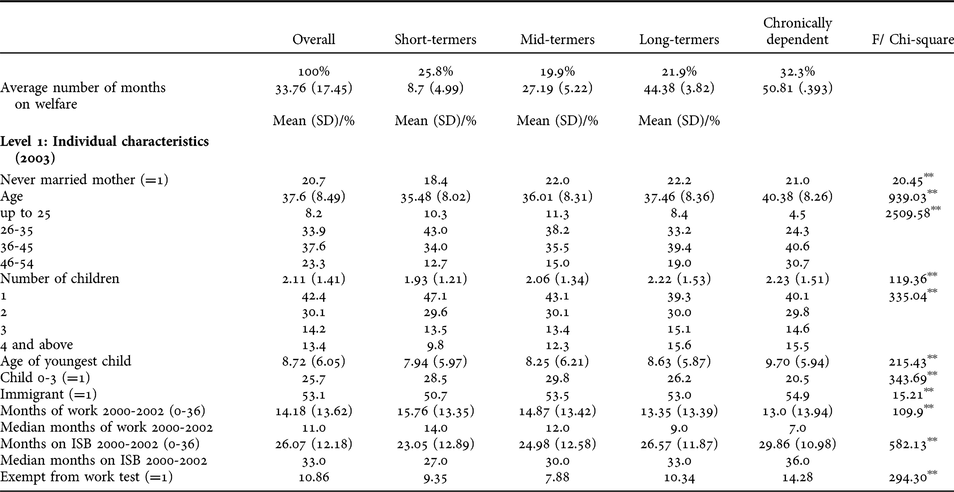
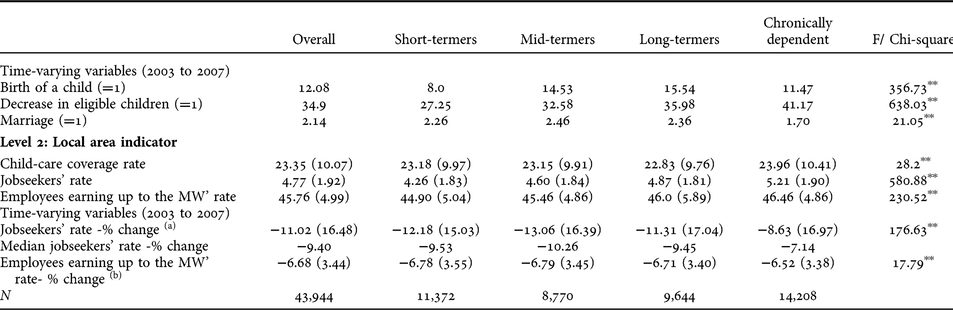
Baseline and time-varying characteristics, by welfare accumulation, 2003–2007

Note: *p < .05; **p < .01 (a) The calculation of this variable was as follows: (rate of jobseekers in 2007 – rate of job seekers in 2003) / (rate of job seekers in 2003) * 100. (b) (rate of minimum wage earners in 2007 – rate of minimum wage earners in 2003)/ (rate of minimum wage earners in 2003) * 100.
Because our approach considers welfare use trajectories through the entire period, and since there is no available yearly information on the structural factors used, we cannot account for year-to-year changes in each variable. Seefeldt and Orzol (Reference Seefeldt and Orzol2005) also take this approach and include only baseline measures of the independent variables (with no measure of change).
Table 1 summarizes the study variables, including characteristics of the mothers and their local area of residence according to the welfare-accumulation groups. In cases of variables with large standard deviations we also present the median values. The top panel of Table 1 shows the prevalence of each welfare-accumulation group, and each group’s average number of months on welfare. The short-termer group comprises a quarter of the study population with a low average of welfare accumulation (eight months); the mid-termer group comprises about a fifth of the mothers, with average use of more than two years; the long-termer group comprises about 22 per cent of the mothers, with a high average use approaching four years (44.38 months). The largest group is the chronically dependent, consisting of about a third of all mothers.
At the baseline date, 21 per cent of all single mothers were never married. Most were aged 26 to 45 years, with relatively few very young mothers. About 72 per cent of the single mothers had only one or two children and a quarter had a child aged 0-3. More than half were immigrants (mostly from the former Soviet Union), as compared with about 22 per cent in the general population of single mothers. Average months of work in the three years preceding the study was 14.18, indicating low employment. The duration of entitlement was quite high: ISBs were received on average for 26 months out of the full 36-month duration. Eleven per cent of the mothers were exempt from the work test due to their own or their child’s health problems. During the follow-up period, 12 per cent of the mothers gave birth; 35 per cent experienced a decrease in the number of eligible children and only 2.14 per cent got married (Table 1).
As for the locality of residence, the average coverage rate of subsidised child-care was 23.35 per cent, indicating the limited availability of this arrangement. With respect to local labour market conditions, average rate of job-seekers was 4.77 per cent and, on average, 45.7 per cent of the residents earned up to the minimum wage. On all measures, statistically significant differences existed among the study groups, although some of these differences were very small. Respondents in the short-term group were more likely to be younger and less likely to be never married than respondents in the other three groups. Older mothers and those with more and older children were more likely to be among the long-term and the chronically dependent groups. Immigrant mothers were less likely to be in the short-term group and most likely to be chronically dependent. Average and median months of employment in the three years preceding the reform varied across the study group, with the chronically dependent showing the lowest labour force attachment. Moreover, in the years 2000–2002, respondents in the short-term group received welfare for fewer months than did respondents in the other three groups, although significant differences were found among all the groups, with the chronically dependent having the most intense use. The median value indicates that half of the chronically dependent received welfare for the entire 36-month period preceding our follow-up. They also had the highest rate of work exemption, compared with the other three groups. Mid- and long-termers were more likely than short-termers to have experienced the birth of another child (14.5 per cent and 15.5 per cent vs. 8.0 per cent). By contrast, those in the chronically dependent group were most likely to have experienced a decrease in the number of eligible children (41 per cent). However, significant differences in the occurrence of this event were found among all four groups, as more intense welfare use is positively associated with the probability of experiencing a decrease in the number of eligible children. This is probably due to differences in the mothers’ ages.
As for locality of residence, subsidised child-care coverage rate did not vary substantially across the welfare-accumulation groups. Local labour market indicators as measured at the baseline slightly favored the short-term group. More important, the measure of change in the rate of job-seekers during the follow-up period (2003–2007) indicates a more pronounced improvement in the economic conditions of the short-term group than of the chronically dependent group (−12.18 percentage change in the rate of job-seekers compared to −8.36 per cent, respectively).
Data analysis
To examine the factors associated with welfare-use trajectories, we employed a multi-level analysis (HLM) with multinomial logistic regression. An advantage of using HLM is that we can simultaneously model the effects of local area characteristics on the odds of having a specific welfare trajectory while controlling for individual-level characteristics (Bryk and Raudenbush, Reference Bryk and Raudenbush1992). In this sense, we can account for variation in welfare trajectories within, as well as between, different localities. We excluded from the model the variable indicating a change in marital status because only two per cent of the mothers got married. We also excluded other local area indicators available in our dataset – salaried women’s average wage and average per capita income – due to high collinearity with those included (see Appendix Table A.1 in the online supplementary material for correlation matrix). To allow variation in individual-level variables across localities, only localities with at least 20 observations were included in the model.Footnote 3 Finally, note that we estimated a model that included an interaction effect between youngest child’s age and coverage rate of subsidised child-care, as we assumed that mothers of young children would be those most affected by the availability of these facilities. However, this interaction effect was insignificant, therefore we decided to present a model that referred to main effects only.
Findings
Multivariate results
Table 2 shows the results of a multinomial logistic regression model predicting welfare accumulation. Coefficients (standard error in parenthesis) of the independent variables for the short-term group are presented in the first columns; the second column shows these values for the mid-term group and the third column shows these values for the long-term group, all relative to the chronically dependent group, the reference category.
Multinomial regression: Prediction of welfare accumulation

Notes: Reference group is chronically dependent. *p < .05 **P < .01.
(a) reference group consisting of divorced, separated and widowed mothers.
The main interest of the current study is in the effect of local area factors on welfare-use trajectories. Contrary to our expectation, availability of subsidised child-care did not distinguish the short-term and mid-term groups from the chronically dependent. However, higher child-care coverage decreased the probability of having long-term welfare use instead of staying chronically on welfare. This association was not in the direction predicted.
In line with our expectation, higher unemployment in the locality decreased the likelihood of having short-term (b= −.229), mid-term (b= −.157) and long-term (b= −.091) trajectories. A higher unemployment rate was also associated with greater probability of mid-term or long-term welfare use rather than short-term use (comparison not shown). A relative rise in unemployment (or a more modest decline) during the period was also associated with a greater likelihood of exhibiting each of the first three trajectories rather than being chronically dependent. That is, better economic conditions in the locality from the start and their improvement over time were associated with lower welfare use. These findings are in line with the theoretical model assuming that mothers living in a weaker local labour market encounter greater difficulty achieving self-sufficiency and sustaining welfare exit; hence they are more likely to exhibit intense welfare use.
However, against our expectation the rate of minimum wage earners in the locality and its change over time did not distinguish between the welfare-accumulation groups. That is, greater wage generosity offered in the locality did not affect welfare-use intensity. We also tried a number of alternative specifications to capture the possible effects of local economic conditions on welfare accumulation. These included average wage for salaried women and average per capita income in the locality of residence. Both specifications yielded insignificant results. We will address these findings next in the discussion.Footnote 4
Turning to individual-level characteristics, never married mothers, older mothers, immigrants and those with longer previous duration on welfare were less likely to be in the short-, mid- or long-term trajectory than in the chronically dependent trajectory. These traits also increased the likelihood of being in the mid- and long-term trajectory as opposed to the short-term (comparison not shown). In contrast, richer work experience increased the likelihood of having a short- (b=.024), mid- (b=.016) or long-term (b=.005) trajectory rather than a chronically dependent trajectory (Table 2). Work experience also significantly increased the likelihood of being in the short-term group as against the mid- and long-term groups (comparison not shown).
As for family demands, having more children decreased the likelihood of having short-term (b= −.048) and mid-term (b= −.041) trajectories as compared to having a chronic dependence trajectory. Number of children also increased the odds of a long-term trajectory as opposed to mid- and short-term trajectories (comparison not shown). Additionally, mothers with older children were more likely to have a short- (.008), mid- (.020) or long-term (b=.021) trajectory than a chronic dependence trajectory (Table 2).
Mothers who suffered from their own or their child’s health problems were less likely to have either a mid-term (b=−.214) or a long-term (b=−.094) trajectory as against the probability of having the chronic dependence trajectory (Table 2). Contrary to expectations, the suffering of a mother or her child from a health condition did not distinguish the short-termers from the chronically dependent group. Possibly, mothers in the short-term group were exempt from the work test due to a temporary health condition that limited their ability to work, as opposed to a permanent health condition in the chronically dependent group, and as this condition passed they left welfare. However, the bivariate analysis revealed that the rate of work-test exemption due to health condition was higher in the chronically dependent group that in the short-term group (see Table 1).
Experiencing the birth of a child lessened the likelihood of having short-term (b=−.880) or mid-term (b=−.103) trajectories as against the probability of having the chronic dependence trajectory. This event was also associated with increased probability of exhibiting mid-term or long-term welfare use as against short-term use (not shown). As expected, having another baby was positively associated with longer duration on welfare, particularly given the automatic work-test exemption for mothers of children under age two. A decrease in the number of eligible children increased the likelihood of having a mid-term (b=.263) and a long-term (b=.129) trajectory as against being chronically dependent. A decrease in the number of eligible children is associated with a reduction in ISB amount, which increased the incentive to work. This was also associated with fewer family demands as children left home, or at least became more economically independent. Thus, this event decreased the probability of chronic welfare use. These findings, like children’s number and ages, highlight the importance of family constraints in determining welfare-use intensity.
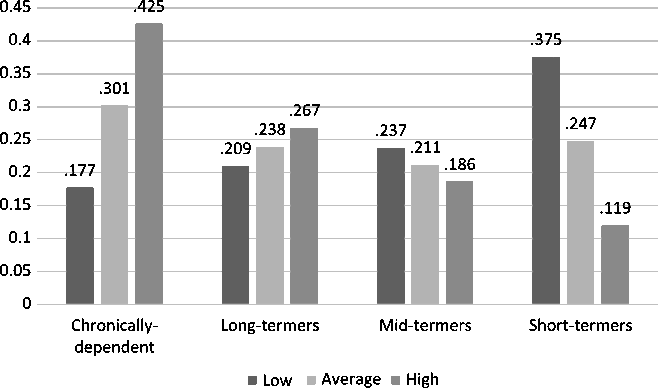
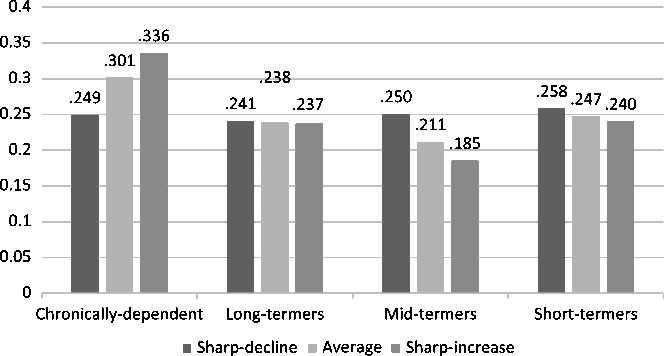
To demonstrate the effect of demand for work in the local labour market and changes in this demand over time – the two significant structural factors according to the multinomial model (Table 2) – Figures 1 and 2 present the predicted probabilities of the typical respondent, i.e. mother with average characteristics on all other independent variables (see Table 1), being in one of the four welfare-use trajectories. For our average mother the predicted probability of being in the chronically dependent group was .301; in the long-termers group it was .238; in the mid-termers group .211; and in the short-termers group .247. Figure 1 shows the probability differences due to changes in the average jobseekers’ rate in the local labour market. The figure presents three cases: localities with low (1.78 per cent), average (4.78 per cent) and high (8.78 per cent) unemployment. The chronically dependent bars show that, in a local labour market with a low jobseekers’ rate, the probability of being in this group decreases greatly – from .301 to .117, and, in localities with a high jobseekers’ rate, the probability of exhibiting chronic dependency increases from .301 to .425.
Predicted probabilities of welfare-use trajectories by job seekers’ rate in the local labour market

Predicted probabilities of welfare-use trajectories by percentage change in job seekers’ rate in the local labour market

Moving to the short-termer bars, the probability of this trajectory appearing is seen to increase from .247 to .375 in localities with a low jobseekers’ rate, and to decrease from .247 to .119 in localities with a high jobseekers’ rate. The magnitude of the local demand for work is more modest in the long- and mid-termer trajectories. For example, the probability of a long-term trajectory decreases from .238 to .209 in localities with low jobseekers’ rate and increases to .267 in localities with a high jobseekers’ rate. The opposite picture emerges from the mid-termer bars, as the probability of this trajectory appearing rises in low jobseekers’ localities (from .211 to .237) and declines in high jobseekers’ localities (from .211 to .186) (Figure 1).
With respect to changes over time in jobseekers’ rate, Figure 2 presents the estimated probability of localities experiencing a decline in unemployment (−40 per cent), experiencing the average trend (−11.0 per cent), and experiencing an increase (9.0 per cent). The figure shows that, in localities that experienced a decline in jobseekers’ rate, the probability of chronic dependency decreased from .301 to .249 and, in localities that experienced a rise in it, the probability increased from .301 to .336. The short-termer bars show that the probability of exhibiting this trajectory increased in localities that witnessed a positive trend from .247 to .258 and decreased modestly in localities with a negative trend from .247 to .240.
The magnitude of the effect of the over-time economic trend in the local labour market was very small with respect to the probability of exhibiting a long-term trajectory, but more pronounced with respect to the probability of exhibiting a mid-term trajectory. Here the probability of exhibiting a mid-term trajectory increased from .238 to .250 in localities with a positive trend and decreased to .185 in localities with a negative trend.
For changes in the average predicted probabilities of being in one of the four welfare-use trajectories due to changes in other explanatory variables, see Appendix Table A.2 in the online supplementary material.
Discussion
We documented long-term welfare accumulation by single mothers and examined the associated individual and local structural characteristics. Our results highlight the importance of local economic conditions, beyond individual characteristics, for the intensity of welfare use among female-headed families.
We found substantial diversity in welfare-use accumulation, a high proportion of mothers experienced prolonged cumulative and chronic use, and relatively few stayed on welfare for just a few months. This intense welfare use may be due to the characteristics of Israeli policies, in particular the absence of a time limit on benefit receipt; the absence of work requirement in the form of minimum working hours; and an exemption from a work test for a mother of children younger than two. These three policy components enabled mothers to combine work and welfare, a situation relevant mainly to mothers with barriers to employment in terms of their own traits and local labour market conditions. In fact, at the end of our follow-up, employment rate stood at around 50 per cent for the chronically dependent group, indicating the high prevalence of mothers who combined work and welfare for long periods. This overall picture suggests that, under a policy involving fewer mandatory measures and providing more social protection, the long-term welfare use by female-headed families tended to be more intense. This is not because welfare was more attractive than employment, but because the combination of personal and structural barriers to employment limited the prospect and the scope of employment of these mothers as indicated by our multivariate analysis.
The main purpose of our study was to examine the role of structural factors in determining single mothers’ welfare accumulation. In local labour markets characterised by higher unemployment, welfare recipients were found to encounter difficulty in replacing welfare income with work income on a stable basis. Moreover, any deterioration in work conditions also affected mothers’ ability to leave welfare stably. These findings suggest that long-term welfare usage is shaped not only by supply-side factors but also by the demand side, as related studies have suggested (e.g. Cooke, Reference Cooke2009; Herbst and Stevens, Reference Herbst and Stevens2010; Hoynes, Reference Hoynes2000; Wood et al., Reference Wood, Moore and Rangarajan2008) and in contrast to other studies (e.g. Bergmark and Bäckman, Reference Bergmark and Bäckman2004; Nam, Reference Nam2005).
At the same time, we found no evidence that wage offers in the locality reduced welfare accumulation. Possibly, most of these mothers were in any case employed in part-time minimum-wage jobs and, in localities with a higher demand for low-wage workers, it was perhaps easier for welfare recipients to find work. In fact, if wages are very high, the competition for these jobs may be considerable, especially for single mothers who have family constraints (see also Hofferth et al., Reference Hofferth, Stanhope and Harris2005; Ribar, Reference Ribar2005).
Finally, availability of subsidised child-care arrangements was insignificant in explaining welfare accumulation. There are several explanations for this. First, these facilities in Israel are only partial and, even when the higher level of support is set for a single mother, the cost is about 18 per cent of the monthly minimum wage for a full-time job. As public policies affect components of the costs and benefits of receiving welfare, a fully subsidised arrangement might change the picture. Secondly, as mentioned earlier, mothers of young children – under the age of two – are automatically exempted from the work-test and are eligible for ISB contingent solely on an income-test. Probably, many mothers choose to take care of their young children rather than being employed, given the costs of child-care, their expected wages and the benefits of maternal care.
As for individual characteristics we found that mothers in the chronically dependent group were the most disadvantaged in many characteristics. Like previous studies on welfare use (Achdut, Reference Achdut2016; Heflin, Reference Heflin2003; Nam, Reference Nam2005; Moore et al., Reference Moore, Wood and Rangarajan2012; Seefeldt and Orzol, Reference Seefeldt and Orzol2005; Wood et al., Reference Wood, Moore and Rangarajan2008) ours found that higher family demands, mother’s own or her child’s health problems, low level of labour force attachment and longer previous welfare usage were associated with more intense and chronic use.
There are several limitations to the current study. Information on formal education is not available in our dataset and, while education does not always affect welfare use, it is still a key factor in determining employment opportunities and earnings (see Achdut, Reference Achdut2016 for review of findings). However, the longitudinal information included in the models – previous employment and welfare use – most likely reflects heterogeneity in education. Secondly, because our approach considered cumulative usage covering a multiyear period, in our multivariate analyses we could not account for year-to-year changes in time-varying variables. We could only account for some changes that took place over those years as we incorporated time-varying variables in our models that indicate life events and changes in the economic conditions that were expected to affect the outcomes under discussion.
To conclude, when policies change, as they did under the welfare reforms, the costs and benefits of welfare dependence change. For the most part, welfare reform policies in Israel, as in other Western countries, were designed to increase the costs and reduce the benefits associated with welfare receipt relative to employment. However, conceptualising work and welfare as competing choices for many welfare recipients, particularly single mothers, tends to ignore the characteristics and life circumstances that put many of them into the welfare system to begin with. Mothers with multiple and chronic barriers to employment, at both the individual and local level, who have already been on welfare for long periods, face major difficulties in achieving self-sufficiency. This reality has only a little to do with the welfare policy that increased the incentive to work. As shown by the Israeli experience, even following a substantial reduction in benefits, which make part-time employment at the minimum wage far more attractive than welfare receipt, many mothers exhibit long and chronic welfare usage. These mothers, regardless of the generosity of public assistance, have only limited prospects in the labour market: some because they just can’t work and some because they can work only little for very low earnings. These groups of mothers cannot be supported under a work-based regime that leaves public assistance at an extremely low level; for them, a decent cash benefit system is required.
Furthermore, understanding the link between local economic conditions and welfare utilisation is important for policy design. Can good economic conditions alone reduce welfare reliance? Should the benefit level or other measures of assistance be relaxed in economic downturns? It is important to rethink the possibility of linking the support scheme to local labour market conditions. Our findings suggest that better economic conditions reduced welfare accumulation to some extent, but it is not clear whether economic expansion alone suffices to reduce long-term dependency, like many other factors involved in this phenomenon. Our findings also emphasise the need for policy makers to consider differential levels of public assistance in terms of cash benefits, disregarded earnings, child-care subsidies, and even differential entry points to a tax credit programme for women living in high unemployment areas with limited employment opportunities. These demand-side factors should be taken into account when a person’s employability is assessed.
Supplementary material
To view supplementary material for this article, please visit https://doi.org/10.1017/S0047279418000843